Archive for the The Universe and Stuff Category

The Biggest Things in the Universe

Posted in The Universe and Stuff with tags , , , , on November 12, 2011 by telescoper

I’ve never really thought of this blog as a vehicle for promoting my own research in cosmology, but it’s been a while since I posted anything very scientific so I thought I’d put up a brief advertisement for a paper that appeared on the arXiv this week by myself and Ian Harrison (who is a PhD student of mine). Here is the abstract, which I think is pretty informative about the contents of the paper; would that were always the case!

Motivated by recent suggestions that a number of observed galaxy clusters have masses which are too high for their given redshift to occur naturally in a standard model cosmology, we use Extreme Value Statistics to construct confidence regions in the mass-redshift plane for the most extreme objects expected in the universe. We show how such a diagram not only provides a way of potentially ruling out the concordance cosmology, but also allows us to differentiate between alternative models of enhanced structure formation. We compare our theoretical prediction with observations, placing currently observed high and low redshift clusters on a mass-redshift diagram and find – provided we consider the full sky to avoid a posteriori selection effects – that none are in significant tension with concordance cosmology.

The background to this paper is that,  according to standard cosmological theory, galaxies and other large-scale structures such as galaxy clusters form hierarchically. That is to say that they are built from the bottom-up from a population of smaller objects that progressively merge  into larger and larger structures as the Universe evolves. At any given time there is a broad distribution of masses, but the average mass increases as time goes on. Looking out into the distant Universe we should therefore see fewer high-mass objects at high redshift than at low redshift.

Recent observations – I refer you to our paper for references – have revealed evidence for the existence of some very massive galaxy clusters at redshifts around unity or larger, which corresponds to a look-back time of greater than 7 Gyr. Actually these are not at high redshift compared to galaxies, which have bee found at redshifts around 10, where the lookback time is more like 12 Gyr, but these are at least a thousand times less massive than large clusters so their existence in the early Universe is not surprising in the framework of the standard cosmological model. On the other hand, clusters of the masses we’re talking about – about 1,000,000,000,000,000 times the mass of the Sun – should form pretty late in cosmic history so have the potential to challenge the standard theory.
In the paper we approach the issue in a different manner to other analyses and apply Extreme Value Statistics to ask how massive we would expect the largest cluster in the observable universe should be as a function of redshift. If we see one larger than the limits imposed by this calculation then we really need to consider modifying the standard theory. This way of tackling the problem attempts to finesse a  number of biases  in the usual approach, which is to attempt to estimate the number-density n(M) of clusters as a function of mass M, because it does not require a correction for a posteori  selection effects; it is not obvious, for example, prevcisely what volume is being probed by the surveys yielding these cluster candidates.

Anyway, the results are summarised in our Figure 1, which shows some estimated cluster masses, together with their uncertainties, superimposed on the theoretical distribution of the mass of the most massive cluster at that redshift:

If you’re wondering why the curves turn down at very low redshift, it’s just because the volume available to be observed at low redshift is small: although objects are generally more massive at low redshift, the chance of getting a really big one is reduced by the fact that one is observing a much smaller part of space-time.

The results show:  (a) that, contrary to some claims, the current observations are actually entirely consistent with the standard concordance model; but also  (b)  that the existence of clusters at redshifts around 1.5 with masses much bigger than 10^{15} M_{\odot} would require the tabling of an amendment to the standard theory.

Of course this is is a very conservative approach and it yields what is essentially a null result, but I take the view that while theorists should be prepared to consider radical new theoretical ideas, we should also be conservative when it comes to the interpretation of data.


The Moon Doctor

Posted in Biographical, The Universe and Stuff with tags , , on November 4, 2011 by telescoper

I  worked all the way through my lunch break getting stuff ready for a short tripette that I have to make next week. My regular post-prandial blogpost  is consequently a bit later than usual, and also a bit shorter.

Anyway, the little orbital dynamics question I posted a couple of days ago, which seems to have attracted quite a number of responses, also reminded me of something that happened about 12 years ago,  just after I had moved to Nottingham to take up the position of Professor of Astrophysics at the University of Nottingham. I was sitting in my office, working – blogs hadn’t been invented then – when the phone rang and the voice at the other end said May I speak to Professor Coles please? When I replied that I was he, the caller went on to explain that he was a surgeon who worked at Queen’s Medical Centre, a hospital located right next to the University of Nottingham, with teaching staff working for the University.

It turned out that news of the setting up of the new Astronomy group there had made it into the University newsletter which my caller had seen. He asked if I had a few moments to answer a question about astrophysics which had been bothering him for some time and which he had just been discussing with some of his colleagues.  I said yes, and he asked: Does the Moon rotate?

I paused a bit, thinking how best to explain, and he went on to clarify his point, which was that if the Moon always has the same face towards the Earth does that mean it’s not rotating.

Understanding his question, I went on to explain that, yes, the Moon does rotate and that the reason it always shows the same face to the Earth (more-or-less, ignoring libration) is that the period of its rotation is the same as the Moon’s orbital period around the Earth. I also explained how to demonstrate this with two coffee mugs, moving one in a circle around the other and rotating the outer one so as to keep the handle pointing towards the central mug. Moreover, I explained the physics of this phenomenon, which is called tidal locking, and pointed out other examples in astrophysics.

After this spiel the caller said that was all very interesting but he had to go  now. Assuming I had bored him, as I fear I tend to do rather a lot, I apologized for going on about it for too long. He said no he wasn’t at all bored by the detail I had put in, he found it all absolutely fascinating. The reason for him needing to go was that he had to go back to tell the answer to the colleagues he had been discussing it with  just before phoning me.  They were all  in the operating theatre,  standing around a patient lying on the operating table, waiting  for him to return and complete the operation he had left in order to make the call…

Transfer Orbit

Posted in Cute Problems, The Universe and Stuff with tags , on November 2, 2011 by telescoper

From time to time I like to post nice physics problems on here. Here is a quickie that I used to use in my first-year Astrophysical Concepts course which has now been discontinued, so I don’t need to keep it to myself it any longer.

A simple way to travel from one planet in the solar system to another is to inject a spacecraft into an elliptical transfer orbit, like the one shown by the dashed curve, which is described by Kepler’s Laws in the same way that the planetary orbits (solid curves) are.

Kepler’s Third Law states that the  period of an elliptical orbit is given by P^2 \propto a^3 where a is the semi-major axis of the ellipse. Assuming that the orbits of Earth and Mars are both approximately circular and the radius of Mars’ orbit is 50% larger than Earth’s, and without looking up any further data, calculate the time taken to travel in this way from Earth to Mars.

Kielder Star Camp

Posted in The Universe and Stuff with tags , , , on October 27, 2011 by telescoper

I  came across a story in the Grauniad about the Kielder Forest Star Camp at which scores of amateur astronomers are gathering along with their tents this week to exploit the darkest skies in England.  The skies are pretty dark above  Cardiff right now, but that’s because of the thick cloud rather than lack of light pollution. I hope they have better weather in Kielder which, if you didn’t know, is in Northumberland. With an area of 250 square miles, Kielder Forest is  England’s largest forest (although it’s actually more of a plantation, being man-made under the auspices the Forestry Commission) and it surrounds Kielder Water, the largest man-made reservoir in the UK. Anyway, as the time-lapse video shows, it’s  a fine spot for astronomy when the clouds stay away; at the end you’ll see the excellent new Kielder Observatory too!

Good luck to all the participants (and, more importantly, clear skies…) .

A Big Idea

Posted in The Universe and Stuff with tags , , , on October 25, 2011 by telescoper

I thought I’d share this, part of the Big Ideas series produced by Cardiff University, because it features our own Haley Gomez:

In the video Haley explains how enormous quantities of dust have been found by astronomers in the School of Physics & Astronomy. We just can’t get the cleaning staff, you see. In fact more recently there have also been discoveries of damp, mould, crumbling ceilings and broken windows.

I don’t want to steal Haley’s thunder in any way, but I should mention that an even more startling discovery has recently been made elsewhere in the School of Physics & Astronomy at Cardiff University. In my office, in fact.  Not  dust, but anti-dust!

Death of a Cosmological Parameter

Posted in The Universe and Stuff with tags , , , on October 21, 2011 by telescoper

I’m sad to have to use the medium of this blog to report the tragic death of the Hubble parameter. It had been declining for some time and, despite appearing to pick up recently, the end was somewhat inevitable. Condolences to the other parameters, especially Ω (who was in a close relationship with H), on this sad loss.

The original photograph (and joke) may be found here.


Baby Planet Pictures…

Posted in Astrohype, The Universe and Stuff with tags , , on October 20, 2011 by telescoper

My eye was caught this morning by this dramatic picture on the front page of the Guardian website, linked to a story about the discovery of a very young planet:

I wonder how many people looking at it thought that it was an actual picture of a planet actually forming? In fact the above graphic is just an “artist’s conception” of the view near the planet, which is called LkCa 15b. The real picture is considerably less dramatic:

What you see is (left) a disk of dust and gas surrounding a star cleverly made visible by masking out the light from the star, which is much brighter than the disk.  On the right you can see a blow up of the inner region of the system, which appears to show a Jupiter-like planet associated with an irregular blob of material, out of which it probably condensed and from which it may still be accreting.

The size of the picture on the right is worth noting. The angle indicated is 76 milli-arcseconds. This is the angle subtended by  the  width of a  human hair at distance of about 130 metres…

The Physics of the Pole Vault

Posted in Education, The Universe and Stuff with tags , , , , , on October 17, 2011 by telescoper

At the RAS Club Dinner last Friday I chatted for a while with my former DPhil supervisor, John Barrow. I’m not sure how, but the topic came up about how helpful it is to use sports to teach physics. By coincidence he chose the same example as I have used in the past during first-year tutorials,  the pole vault.

Years ago I went to watch an athletics meeting at Gateshead Stadium and sat right next to the pole vault area. I can tell you that the height the vaulters reach is truly spectacular, especially when you’re close to the action. The current world record for the pole vault is 6.14m, in fact, set by the legendary Sergey Bubka in 1994, so the record hasn’t been broken for 17 years. Here’s a clip of him a few years earlier clearing a mere 6.10 metres (pretty comfortably, by the look of it)…

One might infer, from the fact that the record has not been broken for such a long time, that pole vaulters are working pretty much at the limit of what the human body can achieve. And a bit of physics will convince you of the same.

Basically, the pole is a device that converts the horizontal kinetic energy of the vaulter \frac{1}{2} m v^2,  as he/she runs in, to the gravitational potential energy m g h acquired at the apex of his/her  vertical motion, i.e. at the top of the vault.

Now assume that the approach is at the speed of a sprinter, i.e. about 10 ms^{-1}, and work out the height h = v^2/2g that the vaulter can gain if the kinetic energy is converted with 100% efficiency. Since g = 9.8 ms^{-2} the answer turns out to be about 5 metres.
This suggests that  6.15 metres should not just be at, but beyond, the limit of a human vaulter,  unless the pole were super-elastic. However, there are two things that help. The first is that the centre of mass of the combined vaulter-plus-pole does not start at ground level; it is at a height of a bit less than 1m for an an average-sized person.  Nor does the centre of mass of the vaulter-pole combination reach 6.15 metres. The pole does not go over the bar, but it’s pretty light so that probably doesn’t make much difference. However, it’s not  obvious that the centre of mass of the vaulter actually passes over the bar.  That certainly doesn’t happen in the high jump – owing to the flexibility of the jumper’s back the arc is such that the centre of mass remains under the bar while the different parts of the jumper’s body go over it.

Moreover, it’s not just the kinetic energy of the vaulter that’s involved. A human can in fact jump vertically from a standing position, using elastic energy stored in muscles. One can’t jump very high like that, but it seems likely to me that this accounts for a few tens of centimetres.

Anyway, it is clear that pole vaulters are remarkably efficient athletes. And not a little brave either – as someone who is scared of heights I can tell you that I’d be absolutely terrifed being shot up to 6.15 metres on the end of  a bendy stick, even with something soft to land on!

Another day, another tutorial…

Posted in Education, The Universe and Stuff with tags , , , , on October 13, 2011 by telescoper

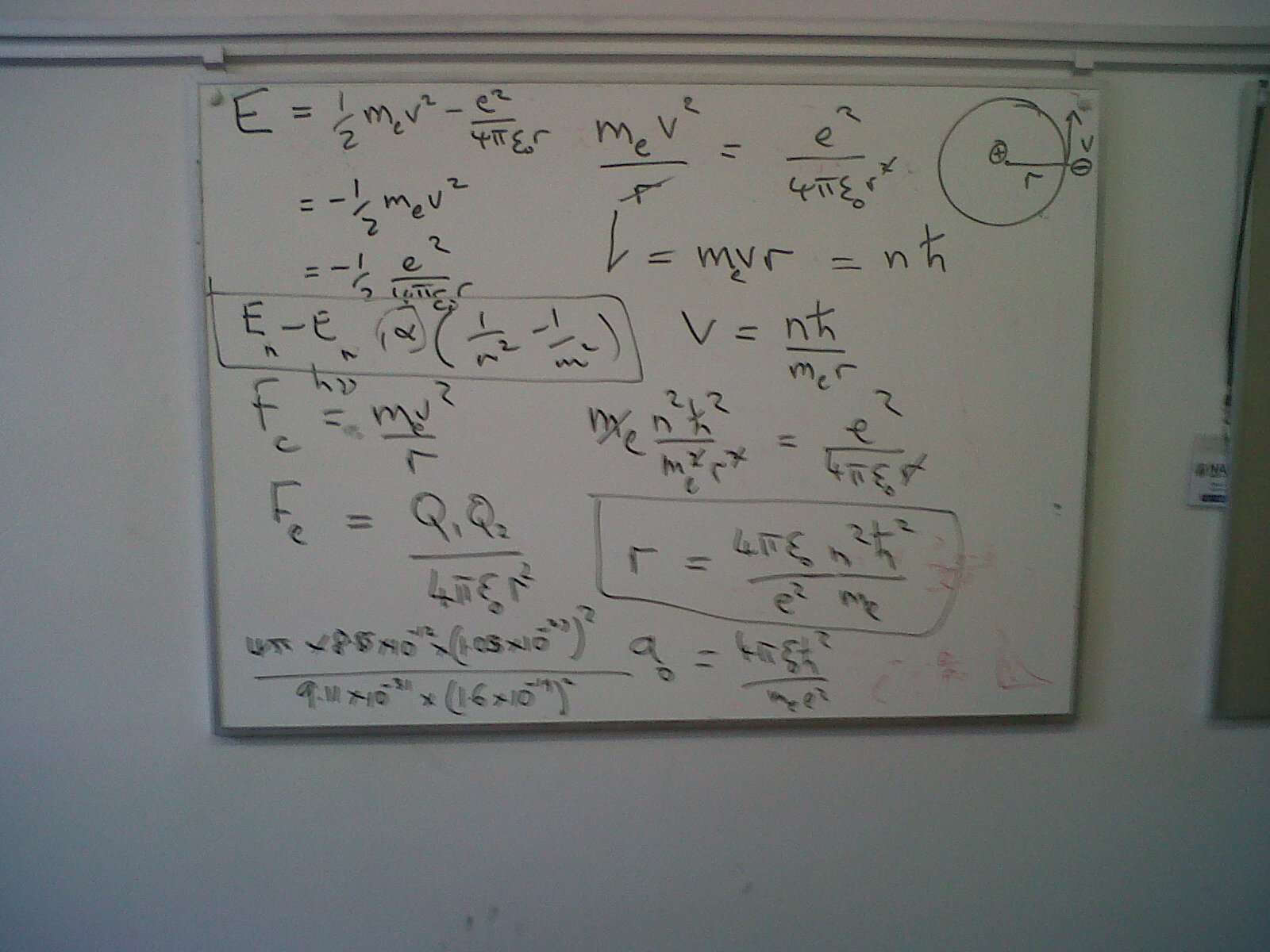
Oh what fun it is to derive the Bohr radius. At least the camera on my Blackberry works!

Wave your hands and think of Astronomy….

Posted in The Universe and Stuff with tags on October 12, 2011 by telescoper

Here’s a short video presentation in which it is demonstrated that astronomers like to move their hands while talking. It’s frightfully amusing, but I can’t help thinking it would have been even better if the musical accompaniment had been, well, musical. Anyway, keep watching until 2:17 or thereabouts and you’ll see that I have a small part.