Archive for the The Universe and Stuff Category

Astronomy Lost and Found

Posted in Science Politics, The Universe and Stuff with tags , , , , , on May 31, 2012 by telescoper

Just finished my last postgraduate lecture, so that’s the teaching out of the way for this academic year. Time, methinks, for a short post to pass on two little bits of astronomy news for reaction and perhaps comment?

The first item concerns the balloon-borne polarimeter experiment known to its friends as EBEX. A truly bizarre story emerged this week concerning the disappearance of this telescope and associated equipment while it was in transit via lorry from the University of Minnesota to the launch site in Palestine, Texas. The truck failed to arrive at its destination, and seemed to vanish for about three days.

Obviously scientists working on EBEX were getting very nervous about its whereabouts , but finally it showed up. Apparently undamaged. The truck had apparently been stolen when the driver at stayed at a motel for the night; it was eventually found, three days later, abandoned not far from the motel.

Curiously, though, the driver hadn’t reported the theft of the truck to the local police. I wonder why? Something tells me there might be more to this story than meets the eye…

The other item of news I thought I’d pass on is an official announcement from the Science and Technology Facilities Council  of the forthcoming closure of both the James Clerk Maxwell Telescope (JCMT) and the UK Infra-red Telescope (UKIRT), both based at Hawaii;  UKIRT will close in September 2013, and JCMT the following year.

There’s been much reaction to this announcement on Twitter. Andy Lawrence has posted about it, for example.  Most colleagues of mine who have commented on the STFC decision have expressed dismay at the decision to lose UKIRT and JCMT and surprise at the decision to extend the operations of the Isaac Newton Group of Telescopes (ING) at the Observatorio del Roque de los Muchachos on La Palma in the Canary Islands, primarily the William Herschel Telescope (WHT) until at least 2015. I’m not sure of the extent to which these decisions were made on scientific grounds.

The decision to close UKIRT/JCMT isn’t exactly a surprise as they have been living on borrowed time since the STFC prioritisation exercise in 2009. It remains to be seen how the astronomical community reacts to the decision. I gather a statement is expected from the Royal Astronomical Society later today.

Comments and reaction are invited via the comments box, but please don’t shoot the messenger!

UPDATE: The statement from the RAS can be found here.

SKA Site Duel ends in Dual Site for SKA

Posted in Science Politics, The Universe and Stuff with tags , , , , , on May 26, 2012 by telescoper

I wasn’t going to post about this but then I realised nobody seemed to have used the obvious headline so thought I might as well knock out a quickie.

Yesterday, after much to-ing and fro-ing an announcement was finally made  concerning the site of the Square Kilometre Array.  The two contenders for the honour of hosting this superb project were South Africa and Australasia (both Australia and New Zealand get a bit, actually).

So who won?

Well, formally the decision was to split the project between both. At first sight this looks like a political compromise, but wiser heads than me disagree and say that this an excellent outcome on science grounds. I’d be interested to hear  opinions on that, in fact.

In any case, a quick skim through the STFC announcement makes it clear that South Africa actually gets the lion’s share of the actual dishes, which will be operated alongside the  Meerkat facility, and will do what I think is the more exciting science.  Having been to Cape Town just recently I know how much the SKA project means for astronomy in South Africa so I’m delighted for them that the outcome is so positive.

It does, however, remain to be seen what the implications of this decision are for the overall cost and scientific value-for-money, but for the time being the thing I’m most pleased about is that a decision has been reached.  I think the SKA project is by far the most exciting ground-based astronomy project around, and it will be very exciting to watch it grow.

Measuring the Universe

Posted in The Universe and Stuff with tags , on May 24, 2012 by telescoper

Here’s a cute little video produced by the excellent folk of the Royal Observatory Greenwich about the forthcoming Transit of Venus, and how such events can be used to establish the distance scale of the Solar System..

Dark Matter: Dearth Evaded

Posted in Astrohype, The Universe and Stuff with tags , , , , , , on May 23, 2012 by telescoper

While I’m catching up on developments over the last week or so I thought I’d post an update on a story I blogged about a few weeks ago. This concerns the the topic of dark matter in the Solar Neighbourhood and in particular a paper on the arXiv by Moni Bidin et al. with the following abstract:

We measured the surface mass density of the Galactic disk at the solar position, up to 4 kpc from the plane, by means of the kinematics of ~400 thick disk stars. The results match the expectations for the visible mass only, and no dark matter is detected in the volume under analysis. The current models of dark matter halo are excluded with a significance higher than 5sigma, unless a highly prolate halo is assumed, very atypical in cold dark matter simulations. The resulting lack of dark matter at the solar position challenges the current models.

In my earlier post I remarked that this  study   makes a number of questionable assumptions about the shape of the Milky Way halo – they take it to be smooth and spherical – and the distribution of velocities within it is taken to have a very simple form.

Well, only last week a rebuttal paper by Bovy & Tremaine appeared on the arXiv. Here is its abstract:

An analysis of the kinematics of 412 stars at 1-4 kpc from the Galactic mid-plane by Moni Bidin et al. (2012) has claimed to derive a local density of dark matter that is an order of magnitude below standard expectations. We show that this result is incorrect and that it arises from the invalid assumption that the mean azimuthal velocity of the stellar tracers is independent of Galactocentric radius at all heights; the correct assumption—that is, the one supported by data—is that the circular speed is independent of radius in the mid-plane. We demonstrate that the assumption of constant mean azimuthal velocity is physically implausible by showing that it requires the circular velocity to drop more steeply than allowed by any plausible mass model, with or without dark matter, at large heights above the mid-plane. Using the correct approximation that the circular velocity curve is flat in the mid-plane, we find that the data imply a local dark-matter density of 0.008 +/- 0.002 Msun/pc^3= 0.3 +/- 0.1 Gev/cm^3, fully consistent with standard estimates of this quantity. This is the most robust direct measurement of the local dark-matter density to date.

So it seems reports of the dearth were greatly exaggerated..

Having read the paper I think this is a pretty solid refutation, and if you don’t want to take my word for it I’ll also add that Scott Tremaine is one of the undisputed world experts in the field of Galactic Dynamics. It will be interesting to see how Moni Bidin et al. respond.

This little episode raises the question that, if there was a problem with the assumed velocity distribution in the original paper (as many of us suspected), why wasn’t this spotted by the referee?

Of course to a scientist there’s nothing unusual about scientific results being subjected to independent scrutiny and analysis. That’s how science advances. There is a danger in all this, however, with regard to the public perception of science. The original claim – which will probably turn out to be wrong – was accompanied by a fanfare of publicity. The later analysis arrives at a much less spectacular conclusion,  so will probably attract much less attention. In the long run, though, it probably isn’t important if this is regarded as a disappointingly boring outcome. I hope what really matters for scientific progress is people doing things properly. Even if it  don’t make the headlines, good science will win out in the end. Maybe.

Rigid Body Sings

Posted in Poetry, The Universe and Stuff with tags , , , , on May 14, 2012 by telescoper

Gin a body meet a body
Flyin’ thro the air,
Gin a body hit a body,
Will it fly? And where?

Ilka impact has its measure
Ne’er a’ ane hae I
Yet a’ the lads they measure me,
Or, at least, they try.

Gin a body meet a body
Altogether free,
How they travel afterwards
We do not always see.

Ilka problem has its method
By analytics high;
For me, I ken na ane o’ them,
But what the waur am I?

by James Clerk Maxwell (1831-1879)

P.S. This poet is of course much better known as a physicist, but this is a nice little parody of Robert Burns’ Comin’ through the Rye in authentic Scots.

Bayes’ Theorem and the Search for Supersymmetry

Posted in The Universe and Stuff with tags , , , , on May 13, 2012 by telescoper

Interesting comments about Bayes’ theorem and the prospects for detecting supersymmetry at the Large Hadron Collider. This piece explains how a non-detection isn’t always “absence of evidence” but can indeed by “evidence of absence”. It’s also worth reading the comments if you’re wondering whether what people say about Lubos Motl is actually true…

Phi G's avatarviXra log

Here’s a puzzle. There are three cups upside down on a table. You friend tells you that a pea is hidden under one of them. Based on past experience you estimate that there is a 90% probability that this is true. You turn over two cups and don’t find the pea. What is the probability now that there is a pea underneath? You may want to think about this before reading on.

Naively you might think that two-thirds of the parameter space has been eliminated, so the probability has gone from 90% to 30%, but this is quite wrong. You can use Bayes Theorem to get the correct answer but let me give you a more intuitive frequentist answer. The situation can be models by imagining that there are thirty initial possibilities with equal probability. Nine of them have a pea under the first cup, nine more under the second and nine more under the third…

View original post 880 more words

Merseyside Astronomy Day

Posted in Books, Talks and Reviews, The Universe and Stuff with tags , , , , on May 11, 2012 by telescoper

I’m just about to head by train off up to Merseyside (which, for those of you unfamiliar with the facts of British geography, is in the Midlands). The reason for this trip is that I’m due to give a talk tomorrow morning (Saturday 12th May) at Merseyside Astronomy Day, the 7th such event. It promises to be a MAD occasion.

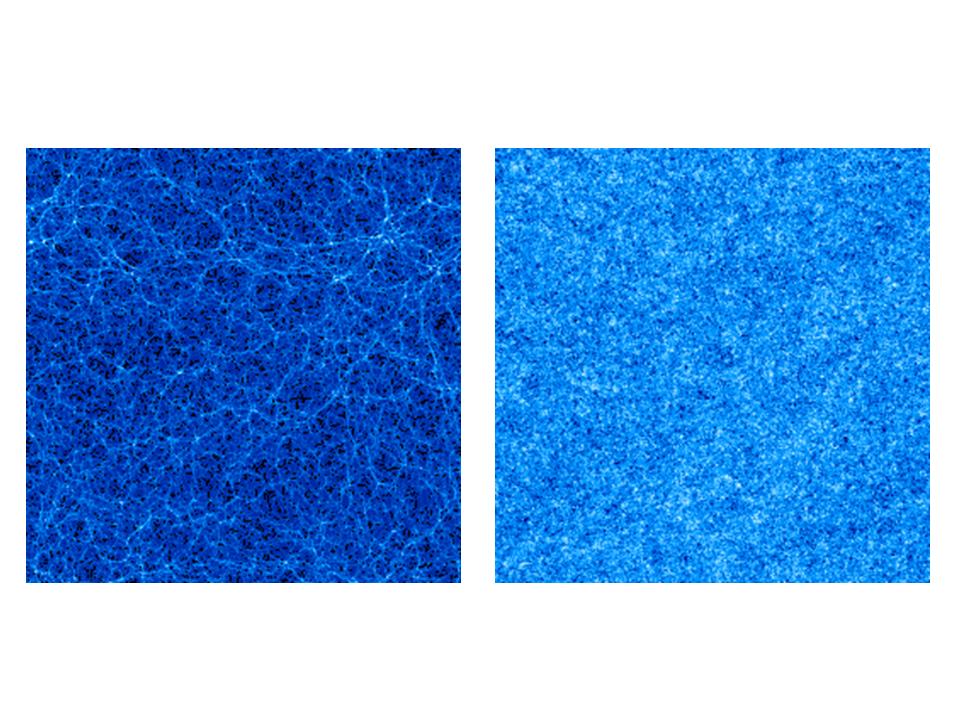
My lecture, entitled The Cosmic Web, is an updated version of a talk I’ve given a number of times now; it will focus on the large scale structure of the Universe and the ideas that physicists are weaving together to explain how it came to be the way it is. Over the last few decades astronomers have revealed that our cosmos is not only vast in scale – at least 14 billion light years in radius – but also exceedingly complex, with galaxies and clusters of galaxies linked together in immense chains and sheets, surrounding giant voids of empty space. Cosmologists have developed theoretical explanations for its origin that involve such exotic concepts as ‘dark matter’ and ‘cosmic inflation’, producing a cosmic web of ideas that is in some ways as rich and fascinating as the Universe itself.

Anyway, I’m travelling to Liverpool this afternoon so I can meet the organizers for dinner this evening and stay overnight because there won’t be time to get there by train from Cardiff tomorrow morning. It’s not all that far from Cardiff to Liverpool as the crow flies, but unfortunately I’m not going by crow by train. I am nevertheless looking forward to seeing the venue, Spaceport, which I’ve never seen before.

If perchance any readers of this blog are planning to attend MAD VII please feel free to say hello. No doubt you will also tell me off for referring to Liverpool as the Midlands…

Dielectric Breakdown

Posted in The Universe and Stuff with tags , , on May 9, 2012 by telescoper

This is the season when our  second-year students are picking the projects they want to do in their third year, as are those third-year students intending to carry on for Year 4 of the MPhys programme. I’ve been chatting to quite a few students about this particular project so thought I’d do a quick post here.


One of the third-year projects I’ve got in the current catalogue for next year concerns a computer model of dielectric breakdown based on the idea of diffusion-limited aggregation. This is  a neat model that allows the students to simulate pretty patterns like the one shown on the left.

The mathematics of it was first presented in Niemeyer, L., Pietronero, L., Wiesmann, H., “Fractal dimension of dielectric breakdown,” Physical Review Letters 52 (1984), 1033-1036.

Dielectric breakdown happens when a sufficiently large voltage is applied across a material that doesn’t normally conduct electricity, the classic example being a lightning strike. Here’s another example, which I find particularly electrifying…

Classical physics can be fun, you know!

The case for JUICE

Posted in Science Politics, The Universe and Stuff with tags , , , on May 8, 2012 by telescoper

Here’s a nice blog peace giving the case for JUICE (The Jupiter Icy Moon Explorer recently selected by the European Space Agency for its next L-class mission).

Duncan Forgan's avatarWell-Bred Insolence

There’s been a lot of chatter in astronomy circles about the negative consequences of ESA’s latest L-class (i.e. large) space mission selection.  JUICE (The JUpiter Icy moon Explorer) was selected over two rival missions – the New Gravitational wave Observatory (NGO), and the Advanced Telescope for High ENergy Astrophysics (ATHENA).  In the current age of global austerity, one group’s win is several groups’ losses, and understandably the X-Ray and gravitational wave communities are upset at the choice.  Indeed, reading the comments section on astro blogs might make planetary scientists go a little pale. Not least the fact that ATHENA supporters have already delivered a 1450 signature petition demanding a rethink.  The fact that the decision making process has been somewhat cloudy doesn’t help matters.

It does indeed suck that this is a zero-sum game (in fact, probably…

View original post 802 more words

Experiment Marathon, Reykjavik 2008

Posted in Art, Books, Talks and Reviews, The Universe and Stuff with tags , , , on May 8, 2012 by telescoper

A while ago I blogged about an event I attended, called  Experimental Marathon, which was held in Reykjavik Art Museum in May 2008. I was reminded about this for various reasons recently and managed to dig up a couple of pictures of my presentation, which appeared in the glossy book of the event that was produced later on.

As you can probably infer, I gave a talk which was basically about the cosmic microwave background. My “experiment” was a television set that wasn’t tuned properly producing a screenful of static. I pointed out that some (actually not that much) of the buzz was coming from the beginning of the universe. Pretty unoriginal and gimmicky, I know, but it seemed to go down quite well with the audience and I had some nice questions and comments at the end of my 20 minutes.

During the three days of the event I also got to meet quite a few artists, scientists and other luminaries whose names are on the list here.:

You can find one of the numerous reviews of this event here, which also includes quite a few pictures of various experiments including one that some might consider to be NSFW …