Archive for the The Universe and Stuff Category

Feynman on a Flower

Posted in Art, The Universe and Stuff with tags , on July 9, 2011 by telescoper

I have a friend who’s an artist and has sometimes taken a view which I don’t agree with very well. He’ll hold up a flower and say “look how beautiful it is,” and I’ll agree. Then he says “I as an artist can see how beautiful this is but you as a scientist take this all apart and it becomes a dull thing,” and I think that he’s kind of nutty. First of all, the beauty that he sees is available to other people and to me too, I believe. Although I may not be quite as refined aesthetically as he is … I can appreciate the beauty of a flower. At the same time, I see much more about the flower than he sees. I could imagine the cells in there, the complicated actions inside, which also have a beauty. I mean it’s not just beauty at this dimension, at one centimeter; there’s also beauty at smaller dimensions, the inner structure, also the processes. The fact that the colors in the flower evolved in order to attract insects to pollinate it is interesting; it means that insects can see the color. It adds a question: does this aesthetic sense also exist in the lower forms? Why is it aesthetic? All kinds of interesting questions which the science knowledge only adds to the excitement, the mystery and the awe of a flower. It only adds. I don’t understand how it subtracts.

Richard Feynman (1918-1988)

And this time, as a bonus, here’s a clip of him saying the words..


Feynman on Computers

Posted in The Universe and Stuff with tags , on July 8, 2011 by telescoper

This is a special one for all those people who prefer fiddling about with computers to actually doing science with them!

Well, Mr. Frankel, who started this program, began to suffer from the computer disease that anybody who works with computers now knows about. It’s a very serious disease and it interferes completely with the work. The trouble with computers is you *play* with them. They are so wonderful. You have these switches – if it’s an even number you do this, if it’s an odd number you do that – and pretty soon you can do more and more elaborate things if you are clever enough, on one machine.

After a while the whole system broke down. Frankel wasn’t paying any attention; he wasn’t supervising anybody. The system was going very, very slowly – while he was sitting in a room figuring out how to make one tabulator automatically print arc-tangent X, and then it would start and it would print columns and then bitsi, bitsi, bitsi, and calculate the arc-tangent automatically by integrating as it went along and make a whole table in one operation.

Absolutely useless. We *had* tables of arc-tangents. But if you’ve ever worked with computers, you understand the disease – the *delight* in being able to see how much you can do. But he got the disease for the first time, the poor fellow who invented the thing.

Richard Feynman (1918-1988)

JWST: Too Big to Fail?

Posted in Finance, Science Politics, The Universe and Stuff with tags , , , , , on July 7, 2011 by telescoper

News emerged last night that the US Government may be about to cancel the  James Webb Space Telescope, which is intended to be the successor to the Hubble Space Telescope. I’m slow out of the blocks on this one, as I had an early night last night, but there’s already extensive reaction to the JWST crisis around the blogosphere: see, for example, Andy Lawrence, Sarah Kendrew, and Amanda Bauer; I’m sure there are many more articles elsewhere.

The US House Appropriations Committee has released its Science Appropriations Bill for the Fiscal Year 2012, which will be voted on tomorrow. Among other announcements (of big cuts to NASA’s budget) listed in the accompanying press release we find

The bill also terminates funding for the James Webb Space Telescope, which is billions of dollars over budget and plagued by poor management.

It is undoubtedly the case that JWST is way over budget and very late. Initial estimates put the cost of the at $1.6 billion and that it would be launched this year (2011). Now it can’t launch until at least 2018,  and probably won’t fly until as late as 2020, with an estimated final price tag of $6.8 billion. I couldn’t possibly comment on whether that is due to poor management or just that it’s an incredibly challenging project.

There’s a very informative piece on the Nature News Blog that explains that this is an early stage of the passage of the bill and that there’s a long way to go before JWST is definitely axed, but it is a worrying time for all those involved in it. There are serious implications for the European Space Agency, which is also involved in JWST, to STFC, which supports UK activity in related projects, and indeed for many groups of astronomers around the world who are currently engaged in building and testing instruments.

One of the arguments against cancelling JWST now is that all the money that has been spent on it so far would have been wasted, in other words that it’s “too big to fail”, which is an argument that obviously can’t be sustained indefinitely. It may be now it’s so far over budget that it’s become a political liability to NASA, i.e. it’s too big to succeed. It’s too early to say that JWST is doomed – this draft budget is partly a political shot across the bows of the President by the Republicans in the House – but it does that the politicians are prepared to think what has previously been unthinkable.

UPDATE: A statement has been issued by the American Astronomical Association.


Feynman on Poetry

Posted in Poetry, The Universe and Stuff with tags , on July 6, 2011 by telescoper

Poets say science takes away from the beauty of the stars – mere globs of gas atoms. I too can see the stars on a desert night, and feel them. But do I see less or more? The vastness of the heavens stretches my imagination – stuck on this carousel my little eye can catch one – million – year – old light. A vast pattern – of which I am a part… What is the pattern, or the meaning, or the why? It does not do harm to the mystery to know a little about it. For far more marvelous is the truth than any artists of the past imagined it. Why do the poets of the present not speak of it? What men are poets who can speak of Jupiter if he were a man, but if he is an immense spinning sphere of methane and ammonia must be silent?

Richard Feynman (1918-1988)

Feynman on Wine

Posted in Poetry, The Universe and Stuff with tags , on July 5, 2011 by telescoper

A poet once said, ‘The whole universe is in a glass of wine.’ We will probably never know in what sense he meant it, for poets do not write to be understood. But it is true that if we look at a glass of wine closely enough we see the entire universe. There are the things of physics: the twisting liquid which evaporates depending on the wind and weather, the reflection in the glass; and our imagination adds atoms. The glass is a distillation of the earth’s rocks, and in its composition we see the secrets of the universe’s age, and the evolution of stars. What strange array of chemicals are in the wine? How did they come to be? There are the ferments, the enzymes, the substrates, and the products. There in wine is found the great generalization; all life is fermentation. Nobody can discover the chemistry of wine without discovering, as did Louis Pasteur, the cause of much disease. How vivid is the claret, pressing its existence into the consciousness that watches it! If our small minds, for some convenience, divide this glass of wine, this universe, into parts — physics, biology, geology, astronomy, psychology, and so on — remember that nature does not know it! So let us put it all back together, not forgetting ultimately what it is for. Let it give us one more final pleasure; drink it and forget it all!

Richard Feynman (1918-1988)


False Convergence and the Bandwagon Effect

Posted in The Universe and Stuff with tags , , , , , , on July 3, 2011 by telescoper

In idle moments, such as can be found during sunny sunday summer afternoons in the garden, it’s  interesting to reminisce about things you worked on in the past. Sometimes such trips down memory lane turn up some quite interesting lessons for the present, especially when you look back at old papers which were published when the prevailing paradigms were different. In this spirit I was lazily looking through some old manuscripts on an ancient laptop I bought in 1993. I thought it was bust, but it turns out to be perfectly functional; they clearly made things to last in those days! I found a paper by Plionis et al. which I co-wrote in 1992; the abstract is here

We have reanalyzed the QDOT survey in order to investigate the convergence properties of the estimated dipole and the consequent reliability of the derived value of \Omega^{0.6}/b. We find that there is no compelling evidence that the QDOT dipole has converged within the limits of reliable determination and completeness. The value of  \Omega_0 derived by Rowan-Robinson et al. (1990) should therefore be considered only as an upper limit. We find strong evidence that the shell between 140 and 160/h Mpc does contribute significantly to the total dipole anisotropy, and therefore to the motion of the Local Group with respect to the cosmic microwave background. This shell contains the Shapley concentration, but we argue that this concentration itself cannot explain all the gravitational acceleration produced by it; there must exist a coherent anisotropy which includes this structure, but extends greatly beyond it. With the QDOT data alone, we cannot determine precisely the magnitude of any such anisotropy.

(I’ve added a link to the Rowan-Robinson et al. paper for reference). This was  a time long before the establishment of the current standard model of cosmology (“ΛCDM”) and in those days the favoured theoretical paradigm was a flat universe, but one without a cosmological constant but with a critical density of matter, corresponding to a value of the density parameter \Omega_0 =1.

In the late eighties and early nineties, a large number of observational papers emerged claiming to provide evidence for the (then) standard model, the Rowan-Robinson et al. paper being just one. The idea behind this analysis is very neat. When we observe the cosmic microwave background we find it has a significant variation in temperature across the sky on a scale of 180°, i.e. it has a strong dipole component

There is also some contamination from Galactic emission in the middle, but you can see the dipole in the above map from COBE. The interpretation of this is that the Earth is not at rest. The  temperature variation causes by our motion with respect to a frame in which the cosmic microwave background (CMB) would be isotropic (i.e. be the same temperature everywhere on the sky) is just \Delta T/T \sim v/c. However, the Earth moves around the Sun. The Sun orbits the center of the Milky Way Galaxy. The Milky Way Galaxy orbits in the Local Group of Galaxies. The Local Group falls toward the Virgo Cluster of Galaxies. We know these velocities pretty well, but they don’t account for the size of the observed dipole anisotropy. The extra bit must be due the gravitational pull of larger scale structures.

If one can map the distribution of galaxies over the whole sky, as was first done with the QDOT galaxy redshift survey, then one can compare the dipole expected from the distribution of galaxies with that measured using the CMB. We can only count the galaxies – we don’t know how much mass is associated with each one but if we find that the CMB and the galaxy dipole line up in direction we can estimate the total amount of mass needed to give the right magnitude. I refer you to the papers for details.

Rowan-Robinson et al. argued that the QDOT galaxy dipole reaches convergence with the CMB dipole (i.e. they line up with one another) within a relatively small volume – small by cosmological standards, I mean, i.e. 100 Mpc or so- which means that  there has to be quite a lot of mass in that small volume to generate the relatively large velocity indicated by the CMB dipole. Hence the result is taken to indicate a high density universe.

In our paper we questioned whether convergence had actually been reached within the QDOT sample. This is crucial because if there is significant structure beyond the scale encompassed by the survey a lower overall density of matter may be indicated. We looked at a deeper survey (of galaxy clusters) and found evidence of a large-scale structure (up to 200 Mpc) that was lined up with the smaller scale anisotropy found by the earlier paper. Our best estimate was \Omega_0\sim 0.3, with a  large uncertainty. Now, 20 years later, we have a  different standard cosmology which does indeed have \Omega_0 \simeq 0.3. We were right.

Now I’m not saying that there was anything actually wrong with the Rowan-Robinson et al. paper – the uncertainties in their analysis are clearly stated, in the body of the paper as well as in the abstract. However, that result was widely touted as evidence for a high-density universe which was an incorrect interpretation. Many other papers published at the time involved similar misinterpretations. It’s good to have a standard model, but it can lead to a publication bandwagon – papers that agree with the paradigm get published easily, while those that challenge it (and are consequently much more interesting) struggle to make it past referees. The accumulated weight of evidence in cosmology is much stronger now than it was in 1990, of course, so the standard model is a more robust entity than the corresponding version of twenty years ago. Nevertheless, there’s still a danger that by treating ΛCDM as if it were the absolute truth, we might be closing our eyes to precisely those clues that will lead us to an even better understanding.  The perils of false convergence  are real even now.

As a grumpy postscript, let me just add that Plionis et al. has attracted a meagre 18 citations whereas Rowan-Robinson et al. has 178. Being right doesn’t always get you cited.

Yesterday, when I was young…

Posted in Biographical, The Universe and Stuff with tags , on July 1, 2011 by telescoper

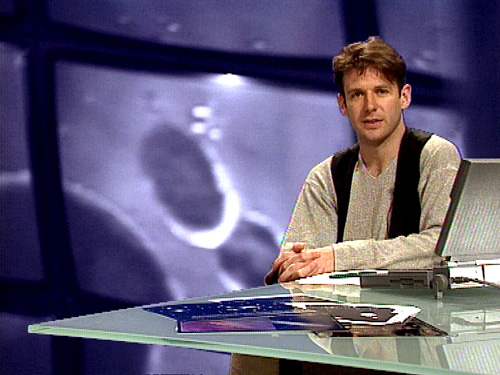
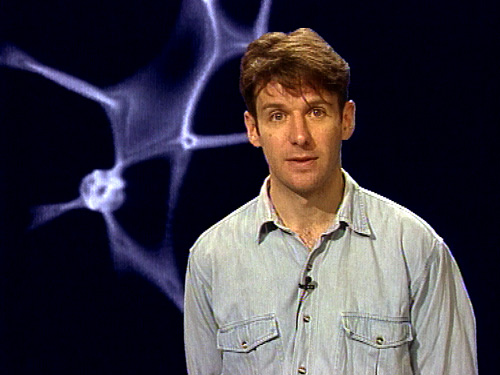
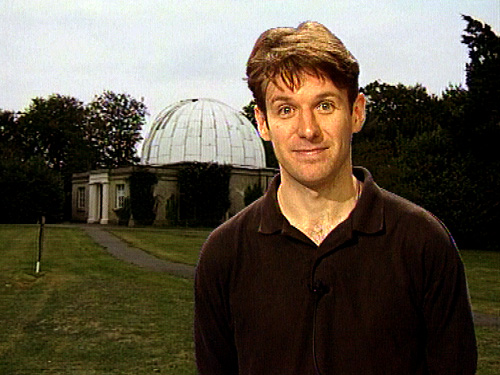
Looking for some old papers on my ancient laptop this afternoon I came across these pictures. I think they are stills taken from a series of video lectures I did a while ago (around 1996) called Topics of Modern Cosmology with a company called EUROPACE 2000. The course vanished without trace – although I still have the unedited footage in a box in my office – leaving only these  relics of a bygone era:

Thought for the Day

Posted in The Universe and Stuff with tags , , , on July 1, 2011 by telescoper

For naturalism, fed on recent cosmological speculations, mankind is in a position similar to that of a set of people living on a frozen lake, surrounded by cliffs over which there is no escape, yet knowing that little by little the ice is melting, and the inevitable day drawing near when the last film of it will disappear, and to be drowned ignominiously will be the human creature’s portion. The merrier the skating, the warmer and more sparkling the sun by day, and the ruddier the bonfires at night, the more poignant the sadness with which one must take in the meaning of the total situation.

From The Varieties of Religious Experience by William James, first published in 1902…

Bright and Early

Posted in The Universe and Stuff with tags , , , , , , on June 29, 2011 by telescoper

Some interesting astronomy news emerged this evening relating to a paper published in 30th June issue of the journal Nature. The press release from the European Southern Observatory (ESO) is quite detailed, so I’ll refer you there for the minutiae, but in a nutshell:

A team of European astronomers has used ESO’s Very Large Telescope and a host of other telescopes to discover and study the most distant quasar found to date. This brilliant beacon, powered by a black hole with a mass two billion times that of the Sun, is by far the brightest object yet discovered in the early Universe.

and the interesting numbers are given here (with links from the press release):

The quasar that has just been found, named ULAS J1120+0641 [2], is seen as it was only 770 million years after the Big Bang (redshift 7.1, [3]). It took 12.9 billion years for its light to reach us.

Although more distant objects have been confirmed (such as a gamma-ray burst at redshift 8.2, eso0917, and a galaxy at redshift 8.6, eso1041), the newly discovered quasar is hundreds of times brighter than these. Amongst objects bright enough to be studied in detail, this is the most distant by a large margin.

When I was a lad, or at least a postdoc, the most distant objects known were quasars, although in those days the record holders had redshifts just over half that of the newly discovered one. Nowadays technology has improved so much that astronomers can detect “normal” galaxies at even higher redshifts but quasars remain interesting because of their extraordinary luminosity. The standard model for how a quasar can generate so much power involves a central black hole onto which matter falls, liberating vast amounts of gravitational energy.

You can understand how efficient this is by imagining a mass m falling onto a black hole of Mass M from a large distance to the horizon of the black hole, which is at the Schwarzschild radius R=2GM/c^2. Since the gravitational potential energy at a radius R is -GMm/R the energy involved in bringing a mass m from infinity to the horizon is a staggering \frac{1}{2} mc^2, i.e. half the rest mass energy of the infalling material. This is an overestimate  for various reasons but it gives you an idea of how much energy is available if you can get gravity to do the work; doing the calculation properly still gives an answer much higher than the amount of energy that can be released by, e.g., nuclear reactions.

The point is, though, that black holes aren’t built in a day, so if you see one so far away that its light has taken most of the age of the Universe to reach us then it tells us that its  black hole must have grown very quickly. This one seems to be a particularly massive one, which means it must have grown very quickly indeed. Through observations like this  we learn something potentially very interesting about the relationship between galaxies and their central black holes, and how they both form and evolve.

On the lighter side, ESO have also produced the following animation which I suppose is quite illustrative, but what are the sound effects all about?

Cosmic Clumpiness Conundra

Posted in The Universe and Stuff with tags , , , , , , , , , , , , , , on June 22, 2011 by telescoper

Well there’s a coincidence. I was just thinking of doing a post about cosmological homogeneity, spurred on by a discussion at the workshop I attended in Copenhagen a couple of weeks ago, when suddenly I’m presented with a topical hook to hang it on.

New Scientist has just carried a report about a paper by Shaun Thomas and colleagues from University College London the abstract of which reads

We observe a large excess of power in the statistical clustering of luminous red galaxies in the photometric SDSS galaxy sample called MegaZ DR7. This is seen over the lowest multipoles in the angular power spectra Cℓ in four equally spaced redshift bins between 0.4 \leq z \leq 0.65. However, it is most prominent in the highest redshift band at z\sim 4\sigma and it emerges at an effective scale k \sim 0.01 h{\rm Mpc}^{-1}. Given that MegaZ DR7 is the largest cosmic volume galaxy survey to date (3.3({\rm Gpc} h^{-1})^3) this implies an anomaly on the largest physical scales probed by galaxies. Alternatively, this signature could be a consequence of it appearing at the most systematically susceptible redshift. There are several explanations for this excess power that range from systematics to new physics. We test the survey, data, and excess power, as well as possible origins.

To paraphrase, it means that the distribution of galaxies in the survey they study is clumpier than expected on very large scales. In fact the level of fluctuation is about a factor two higher than expected on the basis of the standard cosmological model. This shows that either there’s something wrong with the standard cosmological model or there’s something wrong with the survey. Being a skeptic at heart, I’d bet on the latter if I had to put my money somewhere, because this survey involves photometric determinations of redshifts rather than the more accurate and reliable spectroscopic variety. I won’t be getting too excited about this result unless and until it is confirmed with a full spectroscopic survey. But that’s not to say it isn’t an interesting result.

For one thing it keeps alive a debate about whether, and at what scale, the Universe is homogeneous. The standard cosmological model is based on the Cosmological Principle, which asserts that the Universe is, in a broad-brush sense, homogeneous (is the same in every place) and isotropic (looks the same in all directions). But the question that has troubled cosmologists for many years is what is meant by large scales? How broad does the broad brush have to be?

At our meeting a few weeks ago, Subir Sarkar from Oxford pointed out that the evidence for cosmological homogeneity isn’t as compelling as most people assume. I blogged some time ago about an alternative idea, that the Universe might have structure on all scales, as would be the case if it were described in terms of a fractal set characterized by a fractal dimension D. In a fractal set, the mean number of neighbours of a given galaxy within a spherical volume of radius R is proportional to R^D. If galaxies are distributed uniformly (homogeneously) then D = 3, as the number of neighbours simply depends on the volume of the sphere, i.e. as R^3, and the average number-density of galaxies. A value of D < 3 indicates that the galaxies do not fill space in a homogeneous fashion: D = 1, for example, would indicate that galaxies were distributed in roughly linear structures (filaments); the mass of material distributed along a filament enclosed within a sphere grows linear with the radius of the sphere, i.e. as R^1, not as its volume; galaxies distributed in sheets would have D=2, and so on.

The discussion of a fractal universe is one I’m overdue to return to. In my previous post  I left the story as it stood about 15 years ago, and there have been numerous developments since then. I will do a “Part 2” to that post before long, but I’m waiting for some results I’ve heard about informally, but which aren’t yet published, before filling in the more recent developments.

We know that D \simeq 1.2 on small scales (in cosmological terms, still several Megaparsecs), but the evidence for a turnover to D=3 is not so strong. The point is, however, at what scale would we say that homogeneity is reached. Not when D=3 exactly, because there will always be statistical fluctuations; see below. What scale, then?  Where D=2.9? D=2.99?

What I’m trying to say is that much of the discussion of this issue involves the phrase “scale of homogeneity” when that is a poorly defined concept. There is no such thing as “the scale of homogeneity”, just a whole host of quantities that vary with scale in a way that may or may not approach the value expected in a homogeneous universe.

It’s even more complicated than that, actually. When we cosmologists adopt the Cosmological Principle we apply it not to the distribution of galaxies in space, but to space itself. We assume that space is homogeneous so that its geometry can be described by the Friedmann-Lemaitre-Robertson-Walker metric.

According to Einstein’s  theory of general relativity, clumps in the matter distribution would cause distortions in the metric which are roughly related to fluctuations in the Newtonian gravitational potential \delta\Phi by \delta\Phi/c^2 \sim \left(\lambda/ct \right)^{2} \left(\delta \rho/\rho\right), give or take a factor of a few, so that a large fluctuation in the density of matter wouldn’t necessarily cause a large fluctuation of the metric unless it were on a scale \lambda reasonably large relative to the cosmological horizon \sim ct. Galaxies correspond to a large \delta \rho/\rho \sim 10^6 but don’t violate the Cosmological Principle because they are too small to perturb the background metric significantly. Even the big clumps found by the UCL team only correspond to a small variation in the metric. The issue with these, therefore, is not so much that they threaten the applicability of the Cosmological Principle, but that they seem to suggest structure might have grown in a different way to that usually supposed.

The problem is that we can’t measure the gravitational potential on these scales directly so our tests are indirect. Counting galaxies is relatively crude because we don’t even know how well galaxies trace the underlying mass distribution.

An alternative way of doing this is to use not the positions of galaxies, but their velocities (usually called peculiar motions). These deviations from a pure Hubble flow are caused by lumps of matter pulling on the galaxies; the more lumpy the Universe is, the larger the velocities are and the larger the lumps are the more coherent the flow becomes. On small scales galaxies whizz around at speeds of hundreds of kilometres per second relative to each other, but averaged over larger and larger volumes the bulk flow should get smaller and smaller, eventually coming to zero in a frame in which the Universe is exactly homogeneous and isotropic.

Roughly speaking the bulk flow v should relate to the metric fluctuation as approximately \delta \Phi/c^2 \sim \left(\lambda/ct \right) \left(v/c\right).

It has been claimed that some observations suggest the existence of a dark flow which, if true, would challenge the reliability of the standard cosmological framework, but these results are controversial and are yet to be independently confirmed.

But suppose you could measure the net flow of matter in spheres of increasing size. At what scale would you claim homogeneity is reached? Not when the flow is exactly zero, as there will always be fluctuations, but exactly how small?

The same goes for all the other possible criteria we have for judging cosmological homogeneity. We are free to choose the point where we say the level of inhomogeneity is sufficiently small to be satisfactory.

In fact, the standard cosmology (or at least the simplest version of it) has the peculiar property that it doesn’t ever reach homogeneity anyway! If the spectrum of primordial perturbations is scale-free, as is usually supposed, then the metric fluctuations don’t vary with scale at all. In fact, they’re fixed at a level of \delta \Phi/c^2 \sim 10^{-5}.

The fluctuations are small, so the FLRW metric is pretty accurate, but don’t get smaller with increasing scale, so there is no point when it’s exactly true. So lets have no more of “the scale of homogeneity” as if that were a meaningful phrase. Let’s keep the discussion to the behaviour of suitably defined measurable quantities and how they vary with scale. You know, like real scientists do.