Archive for the The Universe and Stuff Category

The Necessity of Atheism

Posted in History, Literature, The Universe and Stuff with tags , , , , , , , , on February 15, 2011 by telescoper

In the course of doing a crossword at the weekend, I learnt that the poet Percy Bysse Shelley was sent down from (i.e. kicked out of) Oxford University 200 years ago this month for writing a pamphlet entitled The Necessity of Atheism. He was at University College, in fact. A bit of googling around led me to the full text, which is well worth reading whatever your religious beliefs as it is a fascinating document. I’ll just quote a few excerpts here.

The main body of the tract begins There is No God, but this is followed by

This negation must be understood solely to affect a creative Deity. The hypothesis of a pervading Spirit co-eternal with the universe remains unshaken.

That’s pretty close to my own view, for what that’s worth.

More interestingly, Shelley goes on later in the work to talk about science and how it impacts upon belief. A couple of sections struck me particularly strongly, given my own scientific interests.

In one he tackles arguments for the existence of God based on Reason:

It is urged that man knows that whatever is must either have had a beginning, or have existed from all eternity, he also knows that whatever is not eternal must have had a cause. When this reasoning is applied to the universe, it is necessary to prove that it was created: until that is clearly demonstrated we may reasonably suppose that it has endured from all eternity. We must prove design before we can infer a designer. The only idea which we can form of causation is derivable from the constant conjunction of objects, and the consequent inference of one from the other. In a base where two propositions are diametrically opposite, the mind believes that which is least incomprehensible; — it is easier to suppose that the universe has existed from all eternity than to conceive a being beyond its limits capable of creating it: if the mind sinks beneath the weight of one, is it an alleviation to increase the intolerability of the burthen?

The other argument, which is founded on a Man’s knowledge of his own existence, stands thus. A man knows not only that he now is, but that once he was not; consequently there must have been a cause. But our idea of causation is alone derivable from the constant conjunction of objects and the consequent Inference of one from the other; and, reasoning experimentally, we can only infer from effects caused adequate to those effects. But there certainly is a generative power which is effected by certain instruments: we cannot prove that it is inherent in these instruments” nor is the contrary hypothesis capable of demonstration: we admit that the generative power is incomprehensible; but to suppose that the same effect is produced by an eternal, omniscient, omnipotent being leaves the cause in the same obscurity, but renders it more incomprehensible.

He thus reveals himself as an empiricist, a position he later amplifies with a curiously worded double-negative:

I confess that I am one of those who am unable to refuse my assent to the conclusion of those philosophers who assert that nothing exists but as it is perceived.

This is a philosophy I can’t agree with, but his use of words clearly suggests the young Shelley has been reading David Hume‘s analysis of causation.

Later he turns to the mystery of life and the sense of wonder it inspires.

Life and the world, or whatever we call that which we are and feel, is an astonishing thing. The mist of familiarity obscures from us the wonder of our being. We are struck with admiration at some of its transient modifications, but it is itself the great miracle. What are changes of empires, the wreck of dynasties, with the opinions which support them; what is the birth and the extinction of religious and of political systems, to life? What are the revolutions of the globe which we inhabit, and the operations of the elements of which it is composed, compared with life? What is the universe of stars, and suns, of which this inhabited earth is one, and their motions, and their destiny, compared with life? Life, the great miracle, we admire not because it is so miraculous. It is well that we are thus shielded by the familiarity of what is at once so certain and so unfathomable, from an astonishment which would otherwise absorb and overawe the functions of that which is its object.

Finally, I picked the following paragraph for its mention of astronomy:

If any artist, I do not say had executed, but had merely conceived in his mind the system of the sun, and the stars, and planets, they not existing, and had painted to us in words, or upon canvas, the spectacle now afforded by the nightly cope of heaven, and illustrated it by the wisdom of astronomy, great would be our admiration. Or had he imagined the scenery of this earth, the mountains, the seas, and the rivers; the grass, and the flowers, and the variety of the forms and masses of the leaves of the woods, and the colors which attend the setting and the rising sun, and the hues of the atmosphere, turbid or serene, these things not before existing, truly we should have been astonished, and it would not have been a vain boast to have said of such a man, Non merita nome di creatore, se non Iddio ed il Poeta. But how these things are looked on with little wonder, and to be conscious of them with intense delight is esteemed to be the distinguishing mark of a refined and extraordinary person. The multitude of men care not for them.

I think the multitude care just as little 200 years on.

P.S. The quotation is from the 16th Century Italian poet Torquato Tasso; in translation it reads “None deserve the name of Creator except God and the Poet”.

Share/Bookmark

We have all the Time in the World

Posted in Music, The Universe and Stuff with tags , , on February 14, 2011 by telescoper

I came across this on Youtube a while ago, but I’ve been saving it up because I thought it might make a nice St Valentine’s Day gift for all lovers of astronomy (and/or someone special). Enjoy!


Share/Bookmark

The Bull’s-Eye Effect

Posted in The Universe and Stuff with tags , , , , on February 10, 2011 by telescoper

What a day.

For a start we had another manic UCAS admissions event. Applications to study physics here have rocketed, by more than 50% compared to last year, so it’s all hands on deck on days like this. Next weekend we have our first Saturday event of the year, and that promises to be even more popular. Still, it’s good to be busy. Without the students, we’d all be on Her Majesty’s Dole. At least some of our advertising is hitting the target.

After that it was back to the business of handing out 1st Semester examination results to my tutees – the Exam Board met yesterday but I skived off because I wasn’t involved in any exams last semester. Then a couple of undergraduate project meetings and a few matters related to postgraduate admissions that needed sorting out.

Finally, being a member of our esteemed Course Committee, I spent a little bit of time trying to assemble some new syllabuses. All our Physics (and Astrophysics) courses are changing next year, so this is a good chance to update the content and generally freshen up some of the material we teach.

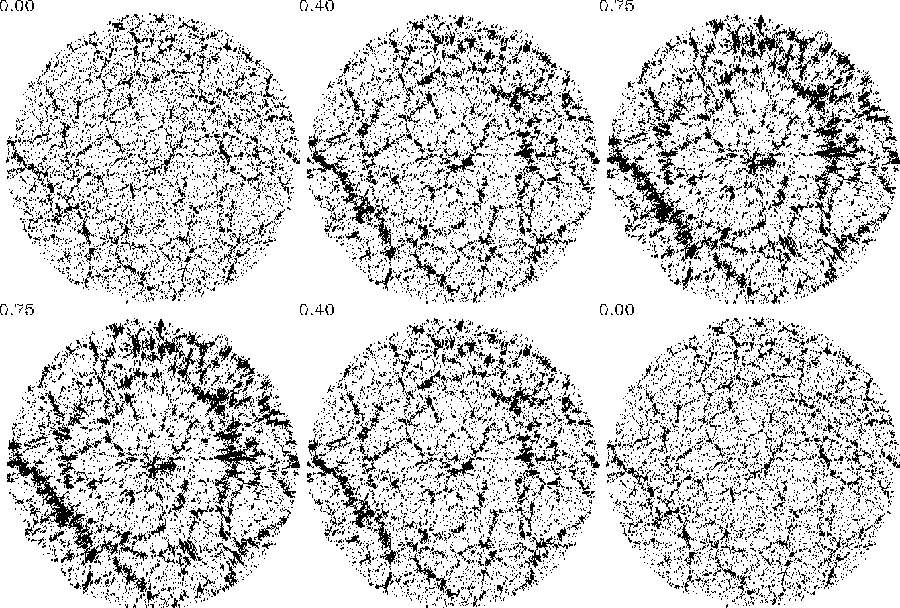
In the course of thinking about this, I dug about among some of my old course notes from here there and everywhere, some of which I’ve kept on an old laptop. I chanced upon this cute little graphic, which I don’t think I’ve ever used in a lecture, but I thought I’d put it up here because it’s pretty. Sort of.

What it shows is a simulation of the large-scale structure of the Universe as might be mapped out using a galaxy redshift survey. The observer is in the centre of the picture (which a two-dimensional section through the Universe); the position of each galaxy is plotted by assuming that the apparent recession velocity (which is what a redshift survey measures) is related to the distance from the observer by Hubble’s Law:

V\simeq cz =H_0 R

where V  is the recession velocity, z  is the redshift, H_0 is Hubble’s constant  and R is the radial distance of the galaxy. However, this only applies exactly in a completely homogeneous Universe. In reality the various inhomogeneities (galaxies, clusters and superclusters) introduce distortions into the Hubble Law by generating peculiar velocities

V=H_0 R+ V_p

These distort the pattern seen in redshift space compared to real space. In real space the pattern is statistically isotropic, but in redshift space things look different along the line of sight from the observer compared to the directions at right angles as described quite nicely by this slide from a nice web page on redshift-space distortions.

There are two effects. One is that galaxies in tightly bound clusters have high-speed disordered motions. This means that each cluster is smeared out along the line of sight in redshift space, producing artefacts sometimes called “Fingers of God” – elongated structures that always point ominously at the observer. The other effect caused by large-scale coherent motions as matter flows into structures that are just forming, which squashes large-scale features in the redshift direction more-or-less opposite to the first.

These distortions don’t simply screw up our attempts to map the Universe. In fact they help us figure out how much matter might pulling the galaxies about. The number in the upper left of the first (animated) figure is the density parameter, \Omega. The higher this number is, the more matter there is to generate peculiar motions so the more pronounced the alteration; in a low density universe, real and redshift space look rather similar.
Notice that in the high-density universe the wall-like structures look thicker (owing to the large peculiar velocities within them) but that they are also larger than in the low-density universe. In a paper a while ago, together with Adrian Melott and others, we investigated  the dynamical origin of this phenomenon, which we called the Bull’s-Eye Effect because it forms prominent rings around the central point. It turns out to be Quite Interesting, because the merging of structures in redshift-space to create larger ones is entirely analogous the growth of structure by hierarchical merging in real space, and can be described by the same techniques. In effect, looking in redshift space gives you a sneak preview of how the stucture will subsequently evolve in real space…


Share/Bookmark

Our Place in the Universe

Posted in Television, The Universe and Stuff with tags , , , on February 9, 2011 by telescoper

I suspect I’m not the only person working in astronomy who found inspiration in Carl Sagan‘s epic TV series Cosmos, which was broadcast on British television when I was at Secondary School. Although the graphics are a bit dated now, and the language perhaps a bit florid for modern tastes, it has lost nothing of its splendour or profundity which is largely due to the charisma (and beautiful writing) of the presenter. It’s also in stark contrast to the simple-minded stuff served up by modern so-called science programmes. Here’s a little taster, which brought back happy memories to me, and I hope will do the same for fellow astronomers-of-a-certain-age.

We live on an insignificant planet of a humdrum star lost in a galaxy tucked away in some forgotten corner of a Universe in which there are far more galaxies than people. We make our World significant by the courage of our questions, and by the depth of our answers.


Share/Bookmark

The Black Stars

Posted in Poetry, The Universe and Stuff with tags , , on February 1, 2011 by telescoper

Let no one sing again of love or war.

The order from which the cosmos took its name has been dissolved;
The heavenly legions are a tangle of monsters,
The universe – blind, violent, strange – assails us.
The sky is strewn with horrible dead suns,
Dense sediments of mangled atoms.
Only desperate heaviness emanates from them,
Not energy, not messages, not particles, not light.
Light itself falls back down, broken by its own weight,
And all of us human seed, we live and die for nothing,
The skies perpetually revolve in vain.

by Primo Levi (1919-1987), translated by Ruth Feldman and Brian Swann.


Share/Bookmark

Scale

Posted in The Universe and Stuff with tags , , , , , on January 31, 2011 by telescoper

A number of people drew my attention to this today. It’s definitely worth passing on to those of you who haven’t seen it already. Have a look at this  blog post too!


Share/Bookmark

Certain Scientists aren’t Good Scientists

Posted in Science Politics, The Universe and Stuff with tags , , , , , on January 30, 2011 by telescoper

Just time for a quickie today because tomorrow is the first day of teaching (in what we optimistically call the “Spring Semester”) and I’ve decided to head into the department this afternoon to prepare some handouts and concoct some appropriately fiendish examples for my first problem set.

I thought I’d take the opportunity to add a little postscript to some comments I made in a post earlier this week on the subject of misguided criticisms of science. Where I (sometimes) tend to agree with some such attacks is when they are aimed at scientists who have exaggerated levels of confidence in the certainty of their results. The point is that scientific results are always conditional, which is to say that they are of the form “IF we assume this theoretical framework and have accounted for all sources of error THEN we can say this”.

To give an example from my own field of cosmology we could say “IF we assume the general theory of relativity applies and the Universe is homogeneous and isotropic on large scales and we have dealt with all the instrumental uncertainties involved etc etc THEN 74% of the energy density in the Universe is in a form we don’t understand (i.e. dark energy).” We don’t know for sure that dark energy exists, although it’s a pretty solid inference, because it’s by no means certain that our assumptions – and there are a lot of them – are all correct.

Similar statements are made in the literature across the entire spectrum of science. We don’t deal with absolute truths, but always work within a given theoretical framework which we should always be aware might be wrong. Uncertainty also derives from measurement error and statistical noise. A scientist’s job is to deal with all these ifs buts and don’t-knows in as hard-nosed a way as possible.

The big problem is that, for a variety of reasons, many people out there don’t understand that this is the way science works. They think of science in terms of a collection of yes or no answers to well-posed questions, not the difficult and gradual process of gathering understanding from partial clues and (occasionally inspired) guesswork.

Why is this? There are several reasons. One is that our system of science education does not place sufficient emphasis on science-as-method as opposed to science-as-facts. Another is that the media don’t have time for scientists to explain the uncertainties. With only a two-minute slot on the news to explain cosmology to a viewer waiting for the football results all you can do is deliver a soundbite.
This is what I wrote in my book From Cosmos to Chaos:

Very few journalists or television producers know enough about science to report sensibly on the latest discoveries or controversies. As a result, important matters that the public needs to know about do not appear at all in the media, or if they do it is in such a garbled fashion that they do more harm than good. I have listened many times to radio interviews with scientists on the Today programme on BBC Radio 4. I even did such an interview once. It is a deeply frustrating experience. The scientist usually starts by explaining what the discovery is about in the way a scientist should, with careful statements of what is assumed, how the data is interpreted, and what other possible interpretations might be. The interviewer then loses patience and asks for a yes or no answer. The scientist tries to continue, but is badgered. Either the interview ends as a row, or the scientist ends up stating a grossly oversimplified version of the story.

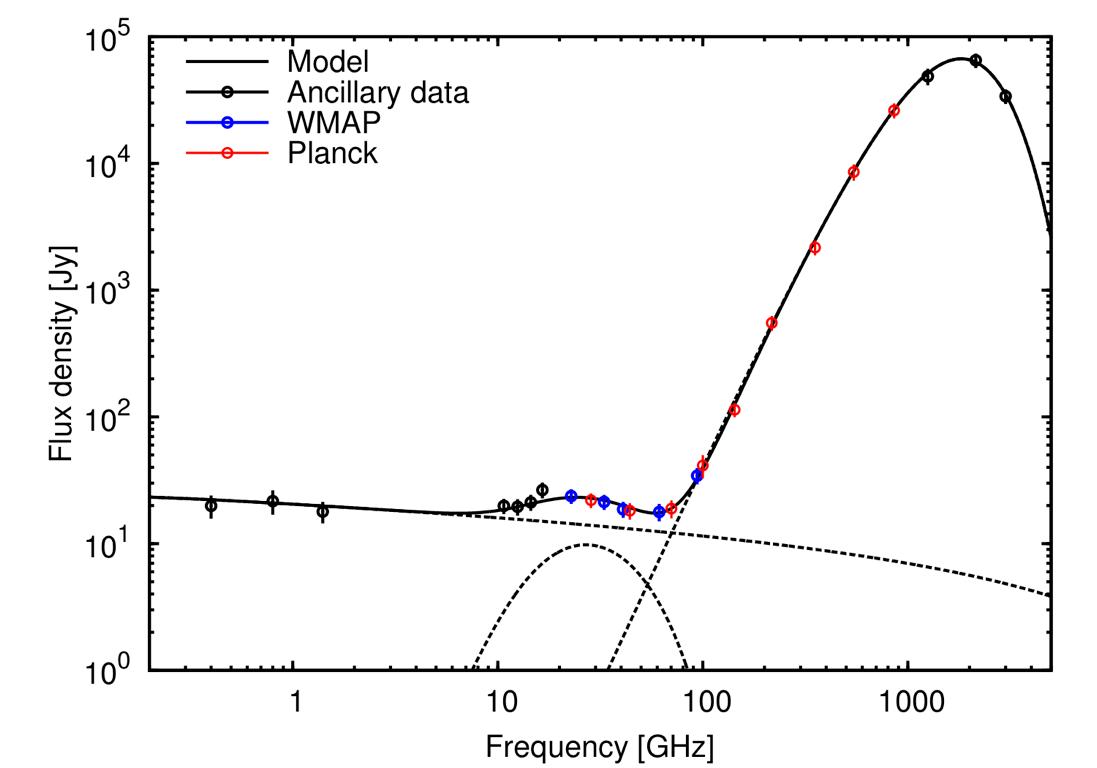
Here’s another, more recent, example. A couple of weeks ago, a clutch of early release papers from the Planck satellite came out; I blogged about them here. Among these results were some interesting new insights concerning the nature of the Anomalous Microwave Emission (AME) from the Milky Way; the subject of an excellent presentation by Clive Dickinson at the conference where the results were announced.

The title of a story in National Geographic is typical of the coverage this result received:

Fastest Spinning Dust Found; Solves Cosmic “Fog” Puzzle

Now look at the actual result. The little bump in the middle is the contribution from the anomalous emission, and the curve underneath it shows the corresponding “spinning dust” model:

There’s certainly evidence that supports this interpretation, but it’s clearly nowhere near the level of “proof”. In fact, in Clive’s talk he stated the result as follows:

Plausible physical models appear to fit the data

OK, so that would never do for a headline in a popular magazine, but I hope I’ve made my point. There’s a big difference between what this particular scientist said and what was presented through the media.

I hope you’re not thinking that I’m criticising this bit of work. Having read the papers I think it’s excellent science.

But it’s not just the fault of the educationalists and the media. Certain scientists play this dangerous game themselves. Some enjoy their 15 minutes – or, more likely, two minutes – of fame so much that they will happily give the journalists what they want regardless of the consequences. Worse still, even in the refereed scientific literature you can find examples of scientists clearly overstating the confidence that should be placed in their results. We’re all human, of course, but my point is that a proper statement of the caveats is at least as much a part of good science as theoretical calculation, clever instrument design or accurate observation and experiment.

We can complain all we like about non-scientists making ill-informed criticisms of science, but we need to do a much better job at being honest about what little we really know and resist the temptation to be too certain.


Share/Bookmark

“Astrology is rubbish”, but… (via Whewell’s Ghost)

Posted in The Universe and Stuff with tags , on January 26, 2011 by telescoper

Here’s a very nicely reasoned and invective-free blog post, on the subject of the decision by the Astrological Association of Great Britain to petition the BBC in complaint about its “unfair representation of astrology”.

"Astrology is rubbish", but... Over the past week or two I've seen a steady trickle of tweets from astronomers, science writers and journalists having a good laugh about astrology. Fair enough, perhaps, except that this all began with a story on NBC News (and video here), reporting on the comments of one Parke Kunkle, an astronomy instructor linked with the Minnesota Planetarium Society and Minnesota Community and Technical College (where, it appears from Rate My Professor, he … Read More

via Whewell's Ghost


Share/Bookmark

Hard Decisions, Easy Targets

Posted in Science Politics, The Universe and Stuff with tags , , , , , , on January 25, 2011 by telescoper

Just back from a day trip to London – at the Institute of Physics to be precise – to wrap up the proceedings of this years protracted STFC Astronomy Grants Panel (AGP) business. The grant letters have already gone out, so no real decisions were made relating to the current round, but we did get the chance to look at a fairly detailed breakdown of the winners and losers. Perhaps more significantly we also discussed issues relating to the implementation of the brand new system which will be in place for 2011/12.

I’m not exactly sure at the moment how much of what we discussed is in the public domain, so I won’t write anything about the meeting here. Tomorrow there is a meeting of the RAS Astronomy Forum at which department representatives will also be briefed about these issues. I will, however, in due course, on as much information as I can through this blog in case there is anyone out there who doesn’t hear it via the Forum.

Not being able to blog about AGP business, I thought I’d comment briefly on a couple of recent things that sprang to mind on the train journey into London. Last night there was a programme in the BBC series Horizon called Science under Attack, presented by Nobel laureate Sir Paul Nurse. I didn’t watch all of it, but I was fortunate (?) enough to catch a segment featuring a chap called James Delingpole, whom I’d never heard of before, but who apparently writes for the Daily Torygraph.

My immediate reaction to his appearance on the small screen was to take an instant dislike to him. This is apparently not an uncommon response, judging by the review of the programme in today’s Guardian. I wouldn’t have bothered blogging about this at all had I wanted to indulge in an ad hominem attack on this person, but he backed up his “unfortunate manner” by saying some amazing things, such as

It’s not my job to sit down and read peer-reviewed papers, because I don’t have the time; I don’t have the expertise

Yet he feels qualified to spout off on the subject nevertheless. The subject, by the way, was climate change. I’m sure not even the most hardened climate skeptic would want Mr Delingpole on their side judging by his performance last night or, apparently, his track-record.

Anyway, this episode reminded me of another egregious example of uninformed drivel that appeared in last week’s Times Higher. This was a piece purporting to be about the limits of mathematical reasoning by another person who is quite new to me, Chris Ormell, who appears to have some academic credentials, if only in the field of philosophy.

Ormell’s piece includes a rant about cosmology which is on a par with Delingpole’s scribblings about climate change, in that he has absolutely no idea what he is talking about. Jon Butterworth and Sean Carroll have already had a go at pointing out the basic misunderstandings, so I won’t repeat the hatchet job here. If I had blogged about this at the weekend – which I might have done had my rodent visitor not intervened – I would have been considerably less polite than either of them. Ormell clearly hasn’t even read a wikipedia article on cosmology, never mind studied it to a level sufficiently deep to justify him commenting on it in a serious magazine.

I’m still amazed that such a pisspoor article could have made it through the Times Higher’s editorial procedures but more worrying still is the ract that Ormell is himself the editor of a journal, called Prospero, which is “a journal of new thinking of philosophy for education”. The last thing education needs is a journal edited by someone so sloppy that he can’t even be bothered to acquire a basic understanding of his subject matter.

What’s in common between these stories is, however, in my opinion, much more important than the inadequate scientific understanding of the personalities involved. Rubbishing the obviously idiotic, which is quite easy to do, may blind us to the fact that, behind all the errors, however badly expressed it may be, people like this may just have a point. Too often the scientific consensus is portrayed as fact when there are clearly big gaps missing in our understanding. Of course falsehoods should be corrected, but what science really needs to go forward is for bona fide scientists to be prepared to look at the technical arguments openly and responsibly and be candid about the unknowns and uncertainties. Big-name scientists should themselves be questioning the established paradigms and be actively exploring alternative hypotheses. That’s their job. Closing ranks and stamping on outsiders is what makes the public suspicious, not reasoned argument.

In both climatology and cosmology there are consensus views. Based on what knowledge I have, which is less in the former case than in the latter, both these views are reasonable inferences but not absolute truths. In neither case am I a denier, but in both cases I am a skeptic. Call me old-fashioned, but I think that’s what a scientist should be.


Share/Bookmark

NAM 2011

Posted in The Universe and Stuff with tags , , , , on January 20, 2011 by telescoper

Just a quick post to plug this year’s forthcoming Royal Astronomical Society National Astronomy Meeting, incorporating the MIST and UKSP meetings, which will be taking place at the splendid Venue Cymru conference centre, Llandudno, North Wales, from Sunday 17 April to Thursday 21 April.

Registration is now open, and you can now also submit abstracts of either oral or poster presentations to be considered for inclusion in the various sessions described in the science programme.

I’ve been asked to organise a small part of this meeting, namely a session on Recent Developments in Astro-statistics, so if you’d like to give a talk in that session please register and upload an abstract to the website. You can’t do the latter until you have done the former. Astro-statistics will be interpreted widely, so I hope to have a varied programme including as many applications of statistics to astronomy and astrophysics as I can get!

NAM is a particularly good opportunity for younger researchers – PhD students and postdocs – to present their work to a big audience so I particularly encourage such persons to submit abstracts. Would more senior readers please pass this message on to anyone they think might want to give a talk?

If you have any questions please feel free to use the comments box (or contact me privately).


Share/Bookmark