Archive for the The Universe and Stuff Category

Euclid Update

Posted in Euclid, The Universe and Stuff with tags , , , , on October 7, 2023 by telescoper

Having settled in to my new apartment on the Gran Via I’ve got time for a another quick update on the European Space Agency’s Euclid mission. For full details about what follows you can see here. Everything I mention here is already in the public domain, so I am not disclosing any secrets!

The last update I posted contained some frustrating and potentially worrisome news: the Performance Verification (PV) phase of the mission had to be put on hold in order to troubleshoot an intermittent problem with the Fine Guidance Sensor (FGS), which is supposed to help to maintain correct pointing of the telescope. This wasn’t working correctly as demonstrated vividly by the following image:

Obviously the survey couldn’t proceed without accurate control of the pointing of the telescope so it was urgently necessary to find out what was going wrong and fix it. It turns out that the software was getting confused by the flashes caused by cosmic ray protons hitting the detectors, think they were the gude stars it was supposed to be steering by. After identifying the problem, new software was written and uploaded to the spacecraft.

I wasn’t sure how this had gone until I saw via an internal communication that the PV phase had restarted. That announcement would not have been made had the upgrade not worked and sure enough it has now been made public that all is well. Congratulations to the instrumentation and software teams for this success. They’ve been working phenomenally hard on this.

There was an additional problem with stray light in the telescope that I have also mentioned before. That was only an issue for specific orientations of the telescope and has been dealt with by simply redesigning the survey a little to minimize the occurrence of the effect.

So the gremlins have been dispelled, and we go on into the PV phase after a delay of about a month. The survey is due to last 6 year so this hiccup is not a big deal really. We can in fact anticipate some early science results from this phase in a month or so, although they will not be part of the full survey which will start after the PV phase is complete, after a few months.

The Return of a Small Universe?

Posted in The Universe and Stuff with tags , , , , on October 5, 2023 by telescoper

Today I attended a cosmology discussion group where the paper being considered was by Jean-Luc Lehners and Jerome Quintin and was entitled A small Universe. Here is the abstract:

Many cosmological models assume or imply that the total size of the universe is very large, perhaps even infinite. Here we argue instead that the universe might be comparatively small, in fact not much larger than the currently observed size. A concrete implementation of this idea is provided by the no-boundary proposal, in combination with a plateau-shaped inflationary potential. In this model, opposing effects of the weighting of the wave function and of the criterion of allowability of the geometries conspire to favour small universes. We point out that a small size of the universe also fits well with swampland conjectures, and we comment on the relation with the dark dimension scenario.

arXiv:2309.03272

This paper is based on rather speculative arguments. I don’t have anything against those, but the discussion of this particular case reminded me that the idea that the Universe might be much smaller than we think is one that has come and gone many times during my lifetime. The point is that Einstein’s equations of general relativity are local in that they relate the geometric properties of space-time at specific coordinate position to the energy and momentum at the same position. When we make cosmological models based on these equations we usually assume a great deal of symmetry, i.e. that defined in a certain way the spatial sections which form surfaces of simultaneity have the same curvature everywhere, regardless of spatial position. The standard cosmology takes this curvature to be zero, in fact, so the spatial sections are Euclidean (flat), though the curvature could be positive or negative.

Usually when we assume the universe is flat we also assume that it is infinite, but it is possible in principle that a flat universe could be finite, for example in the case of a cube with opposite faces identified so that it has a sort of toroidal symmetry that has no physical edge. The size of the notional cube defines a topological scale which is independent of Einstein’s equations. That’ just a simple example: the topology does not have to be based on a cube; it could be, for example, a rhombic dodecahedron…

Likewise when we talk about a universe with negative spatial curvature we also assume it to be infinite, but that doesn’t have to be the case either: there are spaces with negative spatial curvature which are finite. A manifestation of this idea that I remember from way back in 1999 was a paper by Neil Cornish and David Spergel entitled A small universe after all?

Observing a small universe from the inside produces many interesting effects like a sort of cosmic hall of mirrors. For instance, if you can see far enough you will see the back of your own head. More realistically, the observed large-scale structure of the universe would repeat, and there would be correlated features in the cosmic microwave background. The idea is therefore amenable to observational test; the absence of any of the predicted correlations places constrains the topological scale to be comparable to the size of the observable universe or larger. Of course if it’s infinitely large then the small universe is not small at all…

(For a bit of gratuitous self-promotion, I refer you to a paper I wrote with Graca Rocha and Patrick Dineen back in 2004 using the WMAP observations of the CMB to constrain compact topologies. Given the wealth of new data we have acquired since then I’m sure the constraints are even stronger now.)

Anyway, my point is that speculative ideas are all very well but they don’t mean much if you can’t test them. This one at least has the virtue of making testable predictions.

Exploring the Cosmos at Maynooth

Posted in Maynooth, The Universe and Stuff with tags , , on October 4, 2023 by telescoper

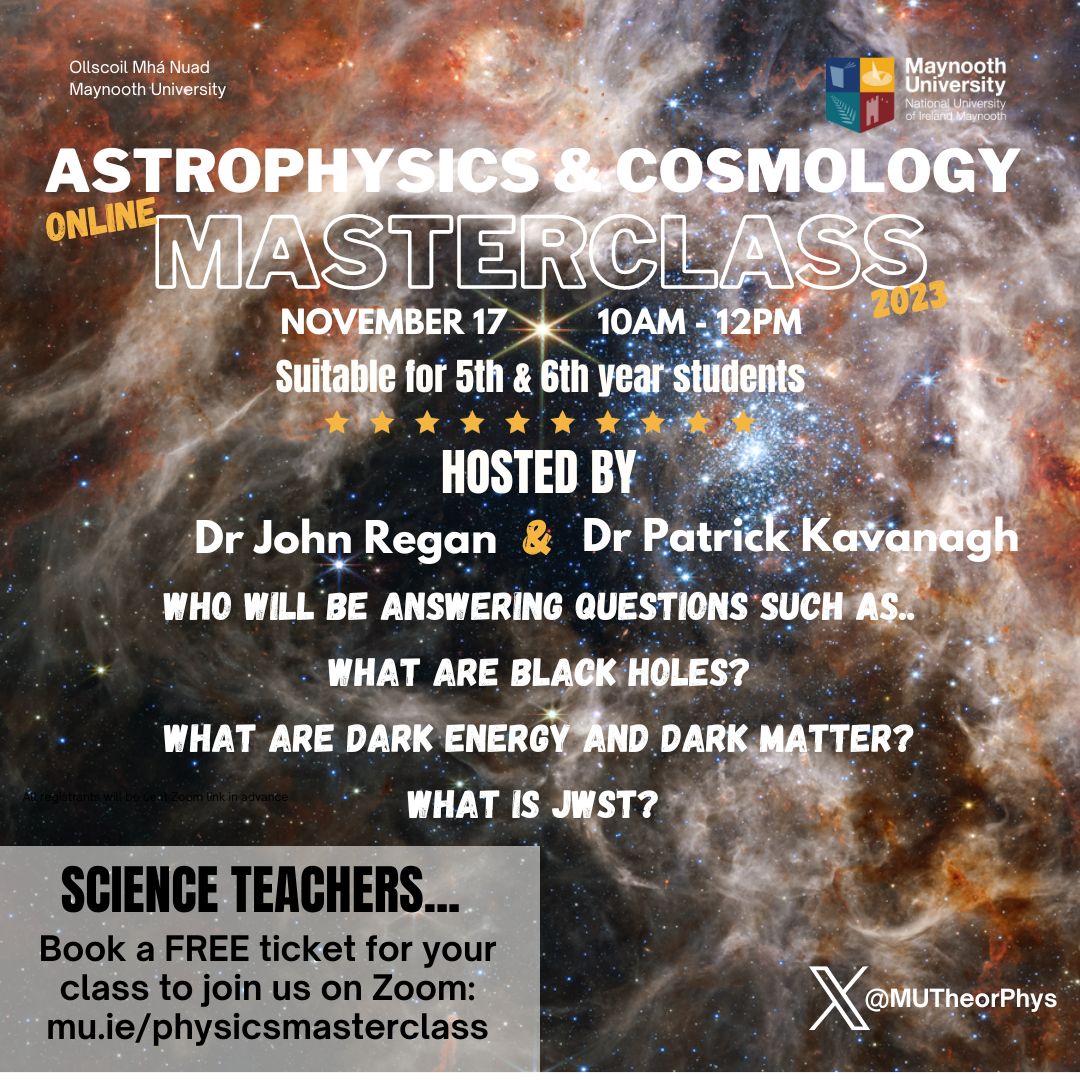
Being away on sabbatical I almost forgot to post a reminder of the event I blogged about a few weeks ago at Maynooth University entitled Exploring the Cosmos. I’m told this has attracted a huge amount of interest, but the room for the event is very large and there may well be some space left.

Best wishes to everyone taking part and I hope it goes well!

On the 5th of October, at 6.30pm, in the TSI Building Maynooth University will host an all-ages event to explore the vastness of space. Using stunning visualisations Maynooth University Astrophysicists will examine star and planet formation, peer back in time with our physicists trying to image the very edges of our visible universe, and take a journey into the unknown as we trace the origin and evolution of black holes.

Programme:

18.30 Welcome

18.35: John Regan: “Black Holes in Our Universe”

Black Holes are among the most exotic objects in our Universe. In this talk John will discuss the basics of black hole formation, how we can detect them today and the future of black hole hunting using gravitational wave observatories that Maynooth University is a part of. John will also discuss some of the strange effects you might encounter near a black hole – like time slowing down!

18.55: Aoibhinn Gallagher: “The Dark Universe”

There is so much in our universe which is unknown to us, most of it in fact. What is dark matter, what is dark energy? We will go on a journey during this talk through the history of our universe and the history of cosmology (the study of the universe) itself to try and arrive at answers to these questions. Also I will talk about the real life science happening at Maynooth university on these very topics.

19.15: Tea & Coffee Break

19.45: Neil Trappe: “Seeing the Invisible Universe – Terahertz Astronomy”

When you look outside at the clear night sky you will see many thousands of stars overheard. The Moon, stars, planets, comets and galaxies can all be observed if you know where to look just using your eyes, binoculars or a telescope.

Astronomers spend many hours looking at the night sky with large automated telescopes from many exotic places around the world to add to our knowledge of the Universe and understand difficult questions like how did the Sun and our Solar System form, how are stars born and how do they die, is there life elsewhere in the Universe, and indeed how did the Universe come into existence at all?

In Maynooth University a team of researchers develop telescopes to see the Universe with different kinds of light, specifically far infrared or “terahertz” light. Why do we do this – we see the Universe differently and can learn lots more information ‘seeing’ with terahertz radiation that is invisible to our eyes.

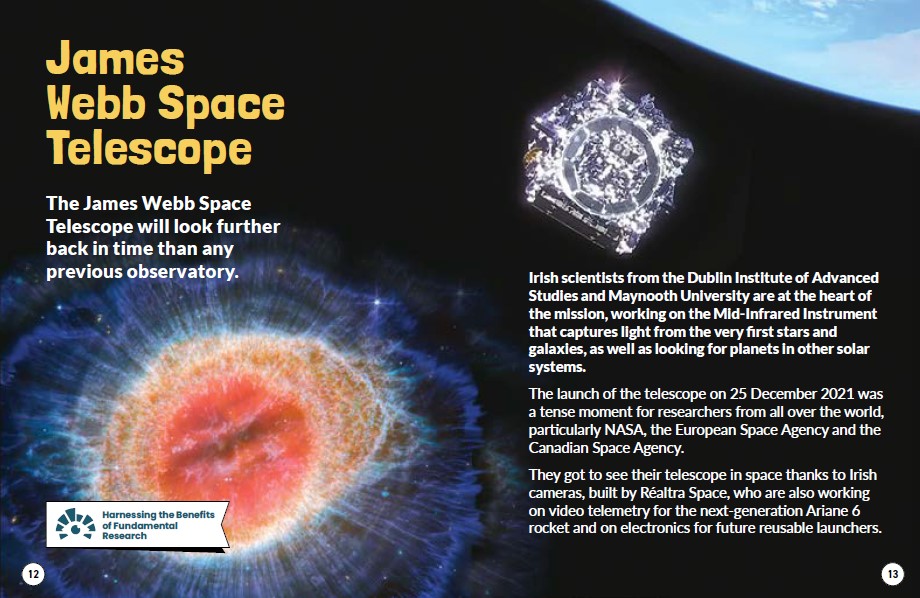
20.05: Patrick Kavanagh: “The First Year of the James Webb Space Telescope”

The James Webb Space Telescope has made unexpected and groundbreaking discoveries almost routine in its first year. It has produced captivating images of our own Solar System, measured the content of atmospheres around other stars, viewed the stellar birth and death in amazing detail, revealed the skeletal structure of galaxies, and peered deep in to the cosmic past in search of the first stars and galaxies. In this talk Dr. Kavanagh will give an overview of Webb and present some of the highlights of the first year of this revolutionary telescope.

20.30: Finish

It should be a fun evening. If you’re around please come along. This event is free to attend but you need to register, which you can do here. Please feel free to share this with friends and colleagues.

New Views of the Orion Nebula

Posted in The Universe and Stuff with tags , , on October 3, 2023 by telescoper

The Orion Nebula, a stellar nursery about 400 pc away from Earth, is a much-studied object that has yielded considerable insights into the processes of star formation. If you thought that there wasn’t much more to be learned about this object, though, you’d be very wrong. A set of JWST images has been released by the European Space Agency and they are amazing. You can see them all here, but here’s a taster in the form of a detail from one of the pictures. The following image is entitled “Explosion fingers from the BN-KL region in Orion” but to me it looks like demons rising up from the Underworld, like in the last act of Don Giovanni…

Here’s the blurb:

This cutout from the new NASA/ESA/CSA James Webb Space Telescope short-wavelength infrared image of the Orion Nebula shows bright ‘fingers’ of gas racing away from an explosion that occurred roughly 500 to 1000 years ago in the heart of a dense molecular cloud behind the nebula, perhaps as two young massive stars collided. The dense cloud is called Orion Molecular Cloud 1 and lies to the northwest of the visible Trapezium stars in Orion.

The fingers are predominantly red, indicating emission from molecular hydrogen gas that has been shocked by the immense energy pouring out from the explosion site. Near the tips of some of the fingers, the emission turns green due to hot iron gas and even white in some cases where the gas is at its hottest. Further down, the fingers seem mostly turbulent, but in some places, the flow appears laminar.

The Orion Nebula lies roughly 1300 light-years from Earth in the so-called ‘sword’ of the constellation of Orion the Hunter, and the image shows a region that is 4 by 2.75 light-years in size.

Image description: The image shows a series of red fingers of shocked molecular gas expanding from the bottom of the image towards the top and top right. Each of the fingers comprises a series of bright arcs of emission like bow waves, expanding behind tips, the latter often appearing green. There are many stars spread across the image with the characteristic eight spikes due to diffraction in the optics of Webb, and there is a foreground haze of wisp blue clouds due to the Orion Nebula, which lies in front of the fingers.

Nobel Prize for Physics Speculation

Posted in Science Politics, The Universe and Stuff with tags , on October 2, 2023 by telescoper

Just  to mention that tomorrow morning (Tuesday, October 3rd 2023) will see the announcement of this year’s Nobel Prize for Physics. I must remember to make sure my mobile phone is fully charged so I can be easily reached.

Of course this is just one of the announcements. This morning, for example, there is the announcement of the Prize for Physiology or Medicine, and on Wednesday is the Prize for Chemistry: both of these sometimes go to physicists too. You can find links to all the announcements here.

I do, of course, already have a Nobel Prize Medal of my own already, dating from 2006, when I was lucky enough to attend the prize-giving ceremony and banquet.

I was, however, a guest of the Nobel Foundation rather than a prizewinner, so my medal is made of chocolate rather than gold. I think after 17 years the chocolate is now inedible, but it serves as a souvenir of a very nice weekend in Stockholm!

Regular readers of this blog, Sid and Doris Bonkers, may recall that I called it correctly last year when Alain Aspect, John F. Clauser and Anton Zeilinger won. I had however predicted them every year for many years until they won, and they won’t win it again, so I can’t follow my usual strategy. I’ll suggest that there’s an outside chance for Michael Berry and Yakir Aharonov for their work on the geometric phase, although if they were going to win they probably would have done so by now. Feel free to make your predictions through the comments box below.

To find out you’ll have to wait for the announcement, around about 10.45 (UK/Irish time) tomorrow morning. I’ll update this post when the wavefunction has collapsed.

UPDATE: The 2023 Nobel Prize for Physics goes to:

Pierre Agostini
The Ohio State University, Columbus, USA

Ferenc Krausz
Max Planck Institute of Quantum Optics, Garching and Ludwig-Maximilians-Universität München, Germany

Anne L’Huillier
Lund University, Sweden

“for experimental methods that generate attosecond pulses of light for the study of electron dynamics in matter”

Congratulations to them! The full press release containing the citation can be found here.

Anyway, for the record, I’ll reiterate my opinion that while the Nobel Prize is flawed in many ways, particularly because it no longer really reflects how physics research is done, it does at least have the effect of getting people talking about physics. Surely that at least is a good thing?

P.S. My own claim for the 2023 Physics Nobel Prize is based on the discovery of the Coles Law.

The Decline of the Milky Way’s Rotation

Posted in The Universe and Stuff with tags , , , , on September 28, 2023 by telescoper

I just noticed an interesting item on the ESA website about results described in a paper by Jiao et al. (on the arXiv here) relating to the rotation of the Milky Way as determined by Gaia’s Data Release 3.

The key result in the paper is summarized in this diagram:

A galaxy rotation curve like this is a diagnostic of the radial distribution of mass. If all the mass were concentrated at the centre, the galaxy would behave like the Solar System (in which most of the mass is contained within the Sun). In such a Keplerian profile the rotation speed falls off with distance, just as the outer planets move more slowly in their orbits than the inner ones. According to modern cosmology, however, there is dark matter not concentrated in the centre, in which case the rotation curve does not decline with distance and may even rise. According to theory, at large distances, the rotation curve of a spiral galaxy should be roughly flat.

The new results seem to contract this notion. The Figure shows a rotation curve that declines for distances about 15 kpc from the Galactic Centre; for reference the Sun orbits at a radius of about 10 kpc.

One of the problems in constructing a rotation curve of our own Galaxy is that we are inside it so it isn’t possible to make measurements across the entire system like we can with other galaxies. Using the Gaia measurements and a plausible model, however, the authors find much less dark matter than anticipated.

With a bit of extrapolation using a model, this measurement leeds to a reduction in the estimated total mass of the Milky Way. The value usually bandied about is around 1012 Solar Masses, while the new measurements imply a much lower mass of about 2 × 10¹¹ Solar Masses.

A factor of five reduction is quite a dramatic change and I’m sure this result will be challenged by those of an orthodox persuasion while also providing encouragement to dark matter sceptics. We’ll just have to wait and see how this pans out.

New Publication at the Open Journal of Astrophysics

Posted in OJAp Papers, Open Access, The Universe and Stuff with tags , , , on September 28, 2023 by telescoper

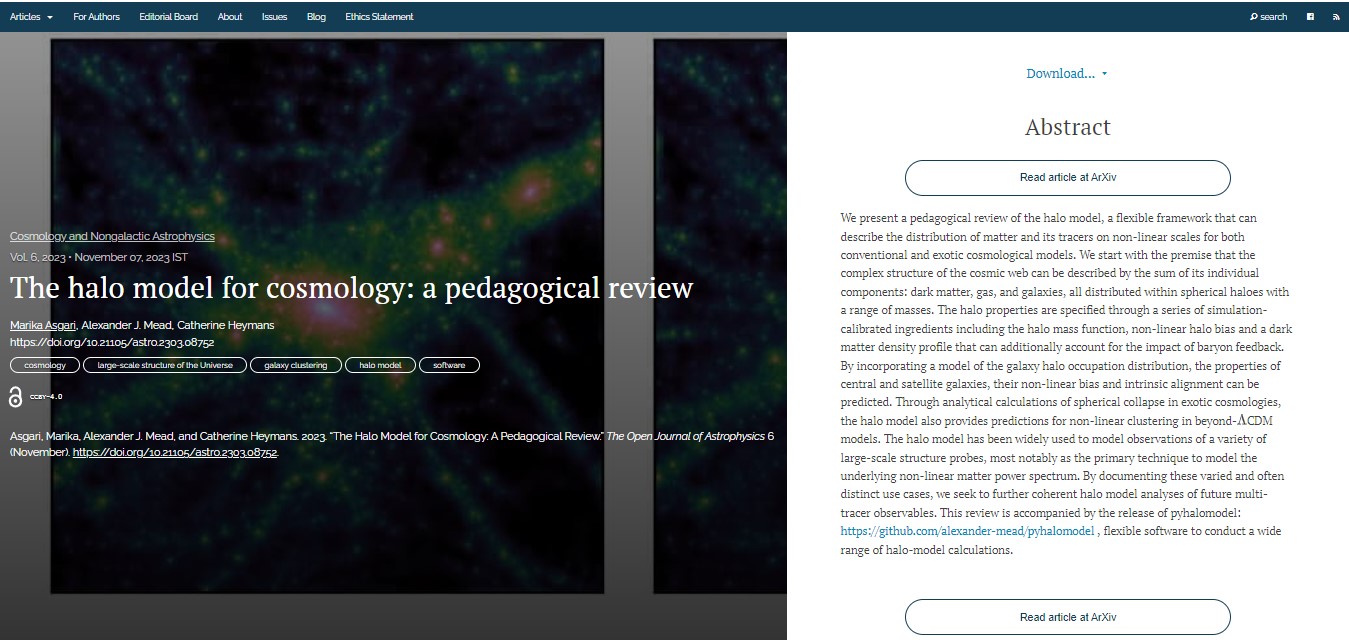
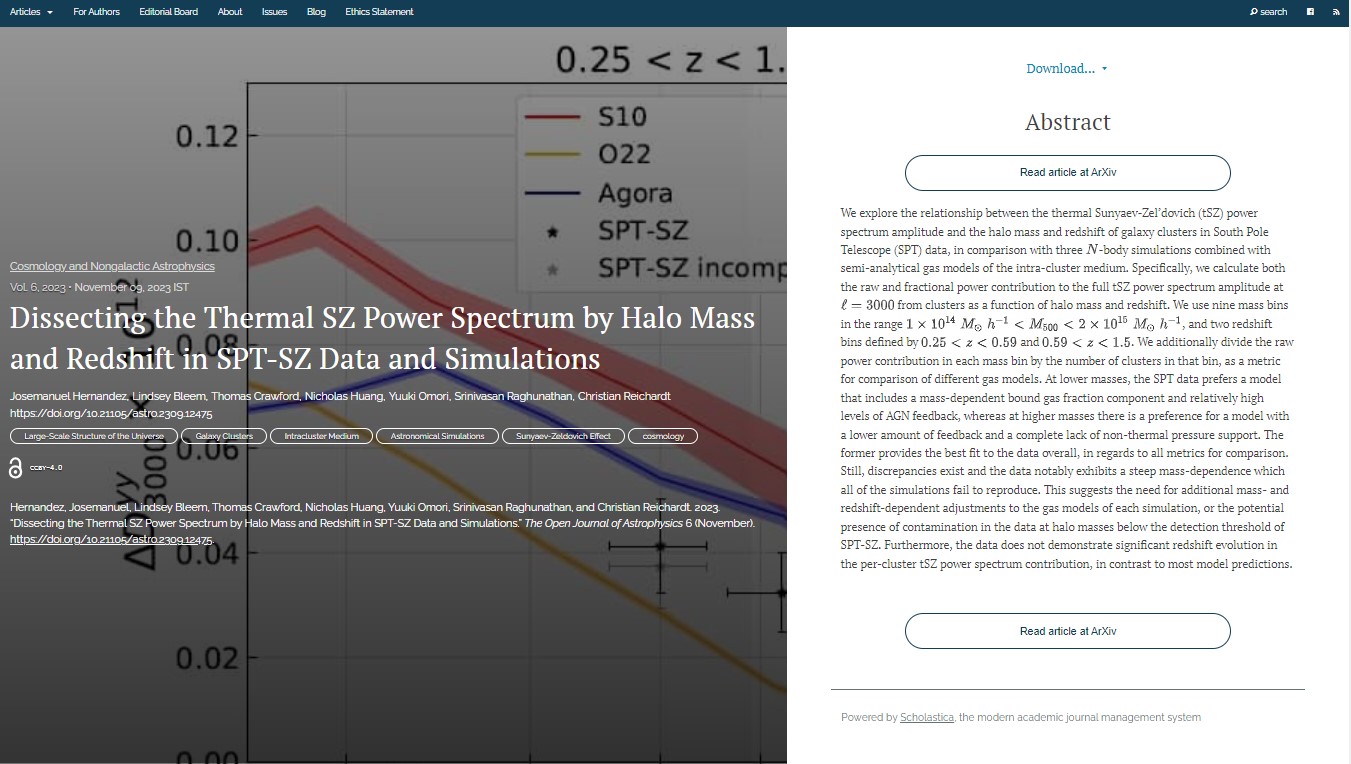
Time to announce yet another new paper at the Open Journal of Astrophysics. This one was published yesterday (27th September 2023).

The latest paper is the 37th  so far in Volume 6 (2023) and the 102nd in all. The authors are Joe McCaffrey (Maynooth, Ireland), Samantha Hardin (Georgia Tech, USA), John Wise (Georgia Tech) and John Regan (Maynooth). As this one involved two authors from my own Department, I recused myself from the editorial process, although it is work I am very interested in.

The primary classification for this paper is Astrophysics of Galaxies and its title is “No Tension: JWST Galaxies at z>10 Consistent with Cosmological Simulations”.  I’ve blogged about this paper before, a few months ago, when it appeared on the arXiv. The editorial process on this one has been very thorough and  it has been a few rounds with the reviewers before being accepted for publication. The authors may have found this a bit irksome, but I think the process improved them paper considerably, which is what it is meant to do.

As many of you will be aware, there’s been a considerable to-do not to mention a hoo-hah about the detections by JWST of some galaxies at high redshift. Some of these have been shown not to be galaxies at high redshift after all, but some around z=10 seem to be genuine. This paper is a response to claims that these somehow rule out the standard cosmological framework.

The key figure in the current paper is this:

The solid curves show the number of galaxies of a given mass one would expect to see as a function of redshift in fields comparable to those observed with estimated values from observations (star-shaped symbols). As you can see the observed points are consistent with the predictions. There’s no tension, so you can all relax.

Anyway, here is a screen grab of the overlay of the published version which includes the  abstract:


You can click on the image of the overlay to make it larger should you wish to do so. You can find the officially accepted version of the paper on the arXiv here.

An Irish Astronomical Connection…

Posted in Barcelona, History, The Universe and Stuff on September 27, 2023 by telescoper

After posting yesterday about the sizeable differences between Maynooth and Barcelona in terms of Physics, I stumbled across an Irish connection in the foyer of the Physics Department.

I’ve posted before about the famous optical instrument manufacturer, the Grubb Telescope Company, founded in Dublin by Thomas Grubb and later renamed Grubb Parsons after its relocation to Newcastle upon Tyne. I’ve posted about other connections too. The presence of this telescope in Barcelona is further evidence – as if it were needed – that, in its time, the Grubb Telescope Company really was the world leader in optical instrumentation.

Autumnal Equinox 2023

Posted in The Universe and Stuff with tags on September 23, 2023 by telescoper

It’s almost that time of year again. The Autumnal Equinox (in the Northern hemisphere) took takes place this morning (Saturday 23nd September 2023)  at 7.50am Irish Summer Time (06.50 UT).

Although  the term `equinox’  refers to a situation in which day and night are of equal length, which implies that it’s a day rather than a specific time, the astronomical equinox is more accurately defined by a specific event, i.e. when the plane defined by Earth’s equator passes through the centre of the Sun’s disk (or, if you prefer, when the centre of the Sun passes through the plane defined by Earth’s equator). Day and night are not necessarily exactly equal on the equinox, but they’re the closest they get. From now on days in the Northern hemisphere will be shorter than nights and they’ll get shorter still until the Winter Solstice on 22nd December 2023 at 03.27 Irish Time. I don’t think I’ll be up for that event.

Many people take the autumnal equinox to be the end of summer. There is a saying around these parts, however, that `Summer is Summer to Michaelmas Day’ (September 29th), which is not until next week. I must say, though, though it doesn’t feel particularly summery this morning. Temperatures fell dramatically overnight and were at one point barely above freezing…

Exploring the Cosmos at Maynooth

Posted in Maynooth, The Universe and Stuff with tags , , on September 21, 2023 by telescoper

Regular readers of this blog – both of them – may remember that last year there was an event at Maynooth University entitled Exploring the Cosmos which was very well attended, with over 400 people showing up. That event was held during Space Week 2022 and it was such a success that it’s being repeated during this year’s Space Week.

I gave a talk at last year’s event but won’t be there this year as I’ll be away on sabbatical. Some of the other speakers are different too. The fact that the line-up has changes is good because it means that people who came last year will get a different set of presentations.

On the 5th of October, at 6.30pm, in the TSI Building Maynooth University will host an all-ages event to explore the vastness of space. Using stunning visualisations Maynooth University Astrophysicists will examine star and planet formation, peer back in time with our physicists trying to image the very edges of our visible universe, and take a journey into the unknown as we trace the origin and evolution of black holes.

Programme:

18.30 Welcome

18.35: John Regan: “Black Holes in Our Universe”

Black Holes are among the most exotic objects in our Universe. In this talk John will discuss the basics of black hole formation, how we can detect them today and the future of black hole hunting using gravitational wave observatories that Maynooth University is a part of. John will also discuss some of the strange effects you might encounter near a black hole – like time slowing down!

18.55: Aoibhinn Gallagher: “The Dark Universe”

There is so much in our universe which is unknown to us, most of it in fact. What is dark matter, what is dark energy? We will go on a journey during this talk through the history of our universe and the history of cosmology (the study of the universe) itself to try and arrive at answers to these questions. Also I will talk about the real life science happening at Maynooth university on these very topics.

19.15: Tea & Coffee Break

19.45: Neil Trappe: “Seeing the Invisible Universe – Terahertz Astronomy”

When you look outside at the clear night sky you will see many thousands of stars overheard. The Moon, stars, planets, comets and galaxies can all be observed if you know where to look just using your eyes, binoculars or a telescope.

Astronomers spend many hours looking at the night sky with large automated telescopes from many exotic places around the world to add to our knowledge of the Universe and understand difficult questions like how did the Sun and our Solar System form, how are stars born and how do they die, is there life elsewhere in the Universe, and indeed how did the Universe come into existence at all?

In Maynooth University a team of researchers develop telescopes to see the Universe with different kinds of light, specifically far infrared or “terahertz” light. Why do we do this – we see the Universe differently and can learn lots more information ‘seeing’ with terahertz radiation that is invisible to our eyes.

20.05: Patrick Kavanagh: “The First Year of the James Webb Space Telescope”

The James Webb Space Telescope has made unexpected and groundbreaking discoveries almost routine in its first year. It has produced captivating images of our own Solar System, measured the content of atmospheres around other stars, viewed the stellar birth and death in amazing detail, revealed the skeletal structure of galaxies, and peered deep in to the cosmic past in search of the first stars and galaxies. In this talk Dr. Kavanagh will give an overview of Webb and present some of the highlights of the first year of this revolutionary telescope.

20.30: Finish

It should be a fun evening. If you’re around please come along. This event is free to attend but you need to register, which you can do here. Please feel free to share this with friends and colleagues.