Archive for the The Universe and Stuff Category

The Centre for Astrophysics and Space Science at Maynooth (CASM)

Posted in Maynooth, The Universe and Stuff with tags , , on September 5, 2023 by telescoper

As part of effort to bring about closer interactions between members of the Departments of Theoretical Physics and Experimental Physics at MaynoothUniversity, we have formed a Centre for Astrophysics and Space Science which now has its own web pages.

The members of CASM have been meeting regularly together for coffee on Tuesdays for over a year, during which time more people have joined the Centre.

Today being a nice day we decided to make a team photograph showing staff, postgrads, and postdocs split roughly evenly between the two Departments. There’s also an undergraduate who has been working with us through the summer and helped to set up the web pages.

The People of CASM

Not everyone was able to be there this morning, but it’s lovely to see the group as big as this. I think it will be even bigger when I get back from my sabbatical next year…

Three New Publications at the Open Journal of Astrophysics

Posted in OJAp Papers, Open Access, The Universe and Stuff with tags , , , , , , , on August 30, 2023 by telescoper

Not unexpectedly because of holidays, August has been rather a quiet month at the Open Journal of Astrophysics, but with people returning to work this week business has picked up again and it’s time to announce the last batch (all published this week).

In fact, this week we have published three papers, which I now present to you here. These take the count in Volume 6 (2023) up to 34 and the total published by OJAp up to 99. Who will be the author(s) of the 100th? We will just have to wait and see! I’ll do a special post for whichever paper wins that honour.

In chronological order, the three papers published this week, with their overlays, are as follows. You can click on the images of the overlays to make them larger should you wish to do so.

First one up is “Bright common envelope evolution requires jets” by Noam Soker of Technion, Haifa in Israel. This is a discussion of the role of jets that a main sequence secondary star launches as it enters a common envelope evolution (CEE) with a primary giant star. The paper was published on 28th August, is just the fifth item in the folder marked Solar and Stellar Astrophysics and can be found here.

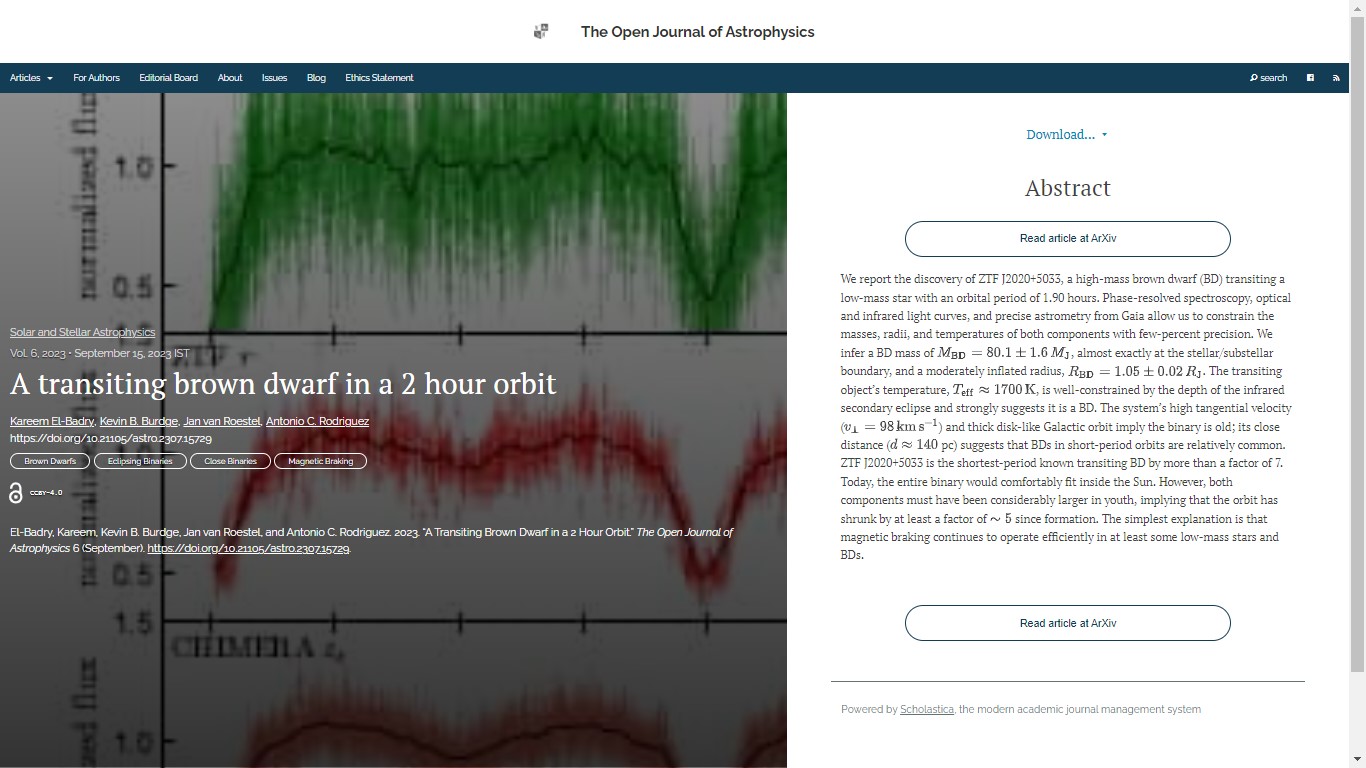
Here is a screen grab of the overlay, which includes the abstract:


You can find the officially accepted version of the paper on the arXiv here.

The second paper to announce is “Almanac: MCMC-based signal extraction of power spectra and maps on the sphere” by Elena Sellentin (Leiden), Arthur Loureiro (Stockholm); Lorne Whiteway (UCL); Javier Lafaurie (Leiden); Sreekumar Balan (UCL); Malak Olamaie (York); and Andrew Jaffe & Alan Heavens (Imperial).  This presents a new software tool called Almanac , which uses Hamiltonian Monte Carlo sampling to infer the underlying all-sky noiseless maps of cosmic structures, together with their auto- and cross-power spectra.

This one is  in the folder marked Cosmology and Nongalactic Astrophysics. The paper was also published on 28th August 2023 and you can see the overlay here:


The accepted version of this paper can be found on the arXiv here.

The last paper of this batch paper is in the Instrumentation and Methods for Astrophysics folder. It is entitled “Neural Network Based Point Spread Function Deconvolution For Astronomical Applications” and the authors are: Hong Wang, Sreevarsha Sreejith, Yuewin, Nesar Ramachandra*, Anze Slosar & Shinjae Yoo, all of the Brookhaven National Laboratory (NY) except * who is at the Argonne National Laboratory (IL), all based in the USA. This paper discusses a neural-network based deconvolution algorithm based on Deep Wiener Deconvolution Network (DWDN) and its performance in an astronomical context.

Here is the overlay:


You can find the full text for this one on the arXiv here.

Celestial Echoes: The Night Sky in Irish Folklore

Posted in History, Irish Language, The Universe and Stuff with tags , , , , on August 29, 2023 by telescoper
The Milky Way over a shipwreck in Co Wexford, photographed by Adrian Hendroff, winner of this year’s Reach for the Skies photography competition.

I mentioned last week that I attended a public lecture by journalist Seán Mac an tSíthigh called Celestial Echoes: the Night Sky in Irish folklore. The talk was largely about some of the names given to celestial objects and the stories attached to those names. Much of the material was drawn from an extensive National Folklore Collection held at University College, Dublin. Unfortunately, however, the index to this collection is not very good at names for stars and constellations. In some cases it isn’t obvious what those names that are recorded actually refer to and in some cases the words themselves are obscure. The lecturer stressed that many of these words would have been known by the parents or grandparents of people in the audience, but have since been lost. There’s an article here that makes a similar point in a wider context. One prominent source of folklore, for example, is the traditional style of mackerel fishing, done at night so that the phosphorescence produced by the fish could be seen, which basically no longer exists so the folk names of stars and constellations used by the fishermen for navigation have been forgotten. Some other names have obviously been influenced by the Greco-Roman constellation names, etc.

I didn’t take many notes during this very enjoyable talk, but I did jot down a few words and phrases that I thought I’d pass on here. Given that my knowledge of modern Irish is very limited and many of the words used are dialect or archaic words that you won’t find in dictionaries, I’ll restrict myself to just a few of the things that caught my ear. Many of these are very similar in Scots Gaelic. Apologies in advance for misspellings, mistranslations or other forms of incompetence!

Before we start let me just mention that the Irish word for “star” is réalta (plural réaltai), which can also mean “a light”. There is also a diminutive, réiltín. Astronomy is réalteolaíocht and astrophysics is réaltfhisic. I’ve always liked the way astrophysics looks like “real physics”!

  • The Milky Way is usually Bealach na Bó Finne (the Way of the White/Fair Cow). The legend that goes with this name is of a cow that produces an endless supply of milk. The Milky Way can also have the more literal name Claí Mór na Réaltaí (the Great Wall of Stars); in Irish mór means “big or great” and must be cognate with the Welsh mawr. Another folk name is An Láir Bhán (the White Mare).
  • Orion is An Bodach which can mean a man, specifically an old man, or a ghost.
  • Betelgeuse is An Spor Dearg (the Red Spur); Rigel is An Spor Liath (the Grey Spur).
  • The Orion Nebula is An Sparán (the purse, pouch); cf. Scots sporran.
  • In modern Irish, the Pleaides is An Tréidín (the Little Flock or Herd) but there are a variety of other terms including Buaile an Bhodaigh (the ghost’s milking place) and Na Cearrbhaigh (the Gamblers, because they look like people playing cards..).
  • The constellation of Leo is An Corrán (the Hook, Sickle).
  • Polaris is An Réalta Thuaidh (the North Star) but also Réalta Eolais (guiding star)
  • Sirius is An Réalta Mhadra (the Dog Star).
  • Ursa Minor is An Dragbhoth (the Fiery House).
  • Ursa Major is An Mathghamhain Mór (the Great Bear); a more modern alternative word for “bear” is mathúin. The Plough is An Camchéachta
  • The Aurora Borealis can be Soilse na Speire Thuaidh (lights of the Northern sky) or na Gealáin Thuaidh or na Saighneáin.
  • A Comet is réalta (an) eireabaill, (star with a tail) réalta mhongach (long-haired or maned star) or réalta (na) scuaibe (star with a brush). There is an (extremely exaggerated) account of a comet in the famous book (and mainstay of the Irish language leaving certificate) by Peig Sayers; given the timing it may have been Halley’s Comet near its 1910 perihelion.

That’s enough for now. I have a few more, but they’ll have to wait…

An Evening of Weird Matter at MU!

Posted in Maynooth, Talks and Reviews, The Universe and Stuff with tags , on August 28, 2023 by telescoper

With just over a week to go, I thought I’d post a reminder that Maynooth University is hosting a theoretical physics meeting early next month, from September 6th to 8th; for details see here. It has been decided that there will be a couple of public evening lectures as a double-header on the first night of the conference. One of the speakers is me. Technically I’ll be on sabbatical from September 1st but I’ve delayed my travels to allow me to ive this talk. Anyway, the advert is here:

You can join us for this “evening of science celebrating the weird and wonderful ways that matter can manifest in our universe” by getting a ticket at Eventbrite below.

Tickets are free but you do need to register in advance!

Euclid Update

Posted in Euclid, The Universe and Stuff with tags , , , , on August 27, 2023 by telescoper

Time for a quick update on the European Space Agency’s Euclid mission. For full details about what follows you can see here. Everything I mention here is already in the public domain, so I am not disclosing any secrets!

The last update I posted mentioned that Euclid had moved into what is called the Performance Verification phase of its mission. That has now been put on hold in order to troubleshoot an intermittent problem with the Fine Guidance Sensor (FGS) which helps to maintain correct pointing of the telescope. This issue can probably be fixed by software updates, but these will have to be tested, hence the pause. This is rather irksome, but the instrument teams are confident they can find a solution soon.

Anyway, while we’re waiting, here is a video from Launch Pad Astronomy explaining about the mission. It was actually released about six days ago but I didn’t have time to post it until now. About 15 minutes long, it’s a big longer than previous official Euclid videos I’ve posted, but I think it’s very informative:

Oh, I almost forgot to mention that I’ll be talking a little bit about Euclid among other things at this event on 6th September.

Two Views of the Ring Nebula

Posted in Cardiff, Maynooth, The Universe and Stuff with tags , , , , , , , , , on August 22, 2023 by telescoper

It’s very nice to have an opportunity, courtesy of JWST, to congratulate astronomers from my current institution (Maynooth, Ireland) and my previous one (Cardiff, UK) – as well as many others – or their involvement in stunning new observations of the Ring Nebula (aka M57 and NGC 6720), a planetary nebula. There is a full story on the Maynooth University website here detailing the involvement of Dr Patrick Kavanagh in the processing of the images and another on the Cardiff University website here about Dr Roger Wesson, who led the programme. Not surprisingly there has been a lot of news coverage about these wonderful images obtained with the NIRCam and MIRI instruments on JWST here in Ireland and in Wales and elsewhere.

A particular excuse for reproducing the pictures here is to try out the fancy “image comparison” tool on WordPress, which allows the reader – that’s you – to slide one picture over the other. Have a go!

This groovy visual shows two images side by side of the Ring Nebula. The image on the left shows the NIRCam view and the image on the right shows the MIRI image. The left image shows the planetary nebula as a distorted doughnut with a rainbow of colours with a blue/green inner cavity and clear filamentary structure in the inner region. The right image shows the nebula with a red/orange central cavity with a ring structure that transitions from colours of yellow to purple/blue. Picture credits ESA/Webb, NASA, CSA, M. Barlow, N. Cox, R. Wesson

The full paper describing these observations can be found on the arXiv here.

Weird Matter at MU!

Posted in Maynooth, Talks and Reviews, The Universe and Stuff with tags , on August 19, 2023 by telescoper

I mentioned a while ago that Maynooth University is hosting a theoretical physics meeting early next month, from September 6th to 8th; for details see here. It has been decided that there will be a couple of public evening lectures as a double-header on the first night of the conference. One of the speakers is me. Technically I’ll be on sabbatical from September 1st but I’ve delayed my travels to allow me to ive this talk. Anyway, the advert is here:

You can join us for this “evening of science celebrating the weird and wonderful ways that matter can manifest in our universe” by getting a ticket at Eventbrite below.

Tickets are free but you do need to register in advance!

R.I.P. Mark Birkinshaw (1954-2023)

Posted in Biographical, R.I.P., The Universe and Stuff with tags , , , , on August 17, 2023 by telescoper

I just heard this morning of the passing of Mark Birkinshaw (left) who was, since 1992, William P. Coldrick Professor of Cosmology and Astrophysics at the University of Bristol. Before that he held positions in Cambridge and Harvard.

I’m told that he died in hospital of a “short but serious illness”.

Among other important contributions to cosmology and astrophysics, in 1984, along with Steve Gull of Cambridge and Harry Hardebeck of the Owens Valley Observatory, was the first to measure experimentally the Sunyaev-Zel’dovich effect in a galaxy cluster; the reference is here.

It was in Cambridge as an undergraduate that I first met Mark Birkinshaw. He taught the long vacation course on Physical Applications of Complex Variables that I took in the summer of 1984. It was a tough course but he was an excellent teacher. All these years later I still have my handwritten notes for that course as well as the handouts. I still use them too.

After that I saw him regularly at conferences and seminars and on various committees for PPARC and then STFC. He was extremely diligent in such “community service” roles and was an invaluable contributor owing to his wide range of knowledge beyond his own speciality.

Having been a mainstay of astrophysics research at Bristol University for over thirty years, Mark will be greatly missed. I send condolences to his friends and colleagues at Bristol and elsewhere in the world, and especially to Diana. You can send thoughts, tributes and condolences and/or make a charitable donation in Mark’s memory here, where there are also details of the funeral arrangements.

Anomalous Media Coverage

Posted in The Universe and Stuff with tags , , , on August 14, 2023 by telescoper

Via a characteristically garbled piece in the Grauniad, bizarrely entitled Scientists may be on brink of discovering fifth force of nature, I found out that there has been an announcement of a new measurement of the anomalous magnetic dipole moment – known to its friends as (g-2) – of the muon. This new measurement is consistent with one made a couple of years ago, but with a smaller range of uncertainty. It’s an impressive result from an experimental point of view.

There is a news item explaining the new result here, which says

Precision test of particle’s magnetism confirms earlier shocking findings — but theory might not need a rethink after all.

That’s pretty much the opposite of what the Guardian piece says.

There’s also a video produced by the Fermilab Muon g-2 team that explains what has changed from 2021 to now:

My own view is that these recent experimental measurements of g-2, which seem to be a bit higher than theorists expected, can be straightforwardly reconciled with the predictions of the standard model of particle physics by simply adopting a slightly lower value of 2 in the theoretical calculations.

P.S. The classical value is of course  g-2 ≈ 7.81 m s-2.

Not the First Room-Temperature Superconductor?

Posted in The Universe and Stuff with tags , , , , , on August 13, 2023 by telescoper

A few weeks ago I reported on a paper on arXiv entitled The First Room-Temperature Ambient-Pressure Superconductor. It presented a material now known as LK-99. The quest for high temperature superconductivity has been very active for many years so this claim generated a lot of interest and LK-99 now has a very active Wikipedia page. Not entirely surprisingly, the claim of superconductivity has been met with some resistance. Geddit?

To summarise, a number of groups seem to have managed to synthesize LK-99, but none have managed to recreate the claimed superconductivity.

This paper on arXiv by scientists at the CSIR National Physical Laboratory in India states:

The report of synthesis of modified Lead apatite (LK-99) with evidence of superconductivity at more than boiling water temperature has steered the whole scientific community. There have been several failures to reproduce superconductivity in LK-99 including partial successes. Here, we have continued our efforts to synthesize phase pure LK-99 with improved precursors. The process has been followed as suggested by Sukbae Lee et. al., [1,2]. The phase purity of each precursor is evidenced by Powder X-ray diffraction (PXRD) and well fitted by Rietveld refinement. The PXRD confirms the synthesis of phase pure polycrystalline LK-99 with apatite structure. The freshly synthesized sample does not show any signature of superconductivity levitation on a magnet (diamagnetism). The magnetization measurements on SQUID also show that LK-99 is diamagnetic at 280 K, there is no sign of superconductivity in LK-99 at room temperature. Moreover, we have also performed first principle calculations to investigate the electronic band structure of the LK-99 near Fermi level. Our study verifies that the Cu doped lead apatite (LK-99) has bands crossing at Fermi level, indicating generation of strong correlation in the system.

arXiv:2308.03544

There is also this paper submitted to arXiv on the same day (7th August) by scientists from the University of Manchester:

Recently, two arXiv preprints (arXiv:2307.12008arXiv:2307.12037) reported signatures of superconductivity above room temperature and at ambient pressure, striking worldwide experimental research efforts to replicate the results3-7, as well as theoretical attempts to explain the purported superconductivity8-12. The material of interest has chemical formula Pb10−xCux(PO4)6O, where x≈1, and was named by the authors as LK-99. It belongs to lead apatite family, and was synthesized from two precursors, lanarkite (PbSO4⋅PbO) and copper phosphide (Cu3P). Here we performed a systematic study on LK-99, starting from solid-state synthesis, followed by characterisation and transport measurements. We did not observe any signatures of superconductivity in our samples of LK-99.

arXiv:2308.03823

While other studies suggest that LK-99 may have some interesting magnetic properties, it’s not looking good for this as a room-temperature superconductor, or indeed any kind of superconductor at all. I would like to see a few more results published before deciding firmly that the matter is closed, but I don’t think I’ll be buying shares in LK-99.

P.S. Nobody should get too overwrought if the claim is refuted: it’s an example of a thing called the scientific method.