
(The Euclid spacecraft will be launched via SpaceX on a Falcon 9 rocket from Cape Canaveral in July 2023, but no further details are publicly available right now.)
(The Euclid spacecraft will be launched via SpaceX on a Falcon 9 rocket from Cape Canaveral in July 2023, but no further details are publicly available right now.)
It’s time once more to announce a new paper at the Open Journal of Astrophysics. The latest paper is the 13th paper so far in Volume 6 (2023) and the 78th in all. This one is another for the folder marked Cosmology and NonGalactic Astrophysics and its title is “The catalog-to-cosmology framework for weak lensing and galaxy clustering for LSST”.
The lead author is Judit Prat of the University of Chicago (Illinois, USA) and there are 21 co-authors from elsewhere in the USA and in the UK. The paper is written on behalf of the LSST Dark Energy Science Collaboration (LSST DESC), which is the international science collaboration that will make high accuracy measurements of fundamental cosmological parameters using data from the Rubin Observatory Legacy Survey of Space and Time (LSST). The OJAp has published a number of papers involving LSST DESC, and I’m very happy that such an important consortium has chosen to publish with us.
Here is a screen grab of the overlay which includes the abstract:
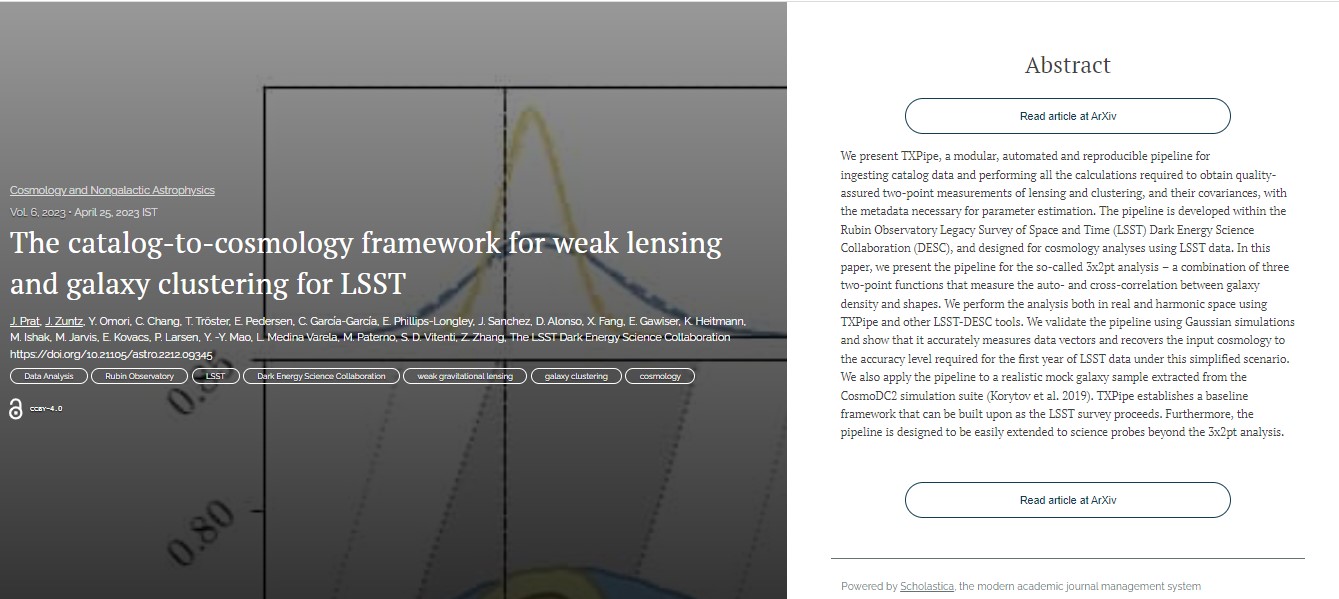
You can click on the image of the overlay to make it larger should you wish to do so. You can find the officially accepted version of the paper on the arXiv here.
Pictures made by observational astronomers, like the one I featured a couple of days ago, often feature on various sites as “Astronomy Pic of the Week” or such. I’ve often thought that this disadvantages astrophysicists of the more theoretical sort and wondered why don’t we do same with graphical illustrations of other kinds. On that basis, I offer this (found here) as my inaugural Astrophysics Plot of the Week:

Its explanatory power is matched by its simplicity and elegance.
Back after a short hiatus due to the Easter holidays, it’s time to announce yet another new paper at the Open Journal of Astrophysics. This one was accepted for publication a few weeks ago but the final version only appeared on the arXiv yesterday. Since OJAp is an arXiv-overlay journal, we have to wait for authors to upload the accepted version before we can publish the overlay.
Anyway, the latest paper is the 12th paper so far in Volume 6 (2023) and the 77th in all. This one is in the currently under-populated folder marked Solar and Stellar Astrophysics and its title is “Predicting Stellar Mass Accretion: An Optimized Echo State Network Approach in Time Series Modeling”.
The authors are: Gianfranco Bino, Shantanu Basu & Ramit Dey (all at the University of Western Ontario, Canada), Sayantan Auddy (Jet Propulsion Laboratory, Pasadena, USA), Lyle Muller (University of Western Ontario, Canada) and Eduardo I. Vorobyov (University of Vienna, Austria & Southern Federal University, Russia).
Here is a screen grab of the overlay which includes the abstract:
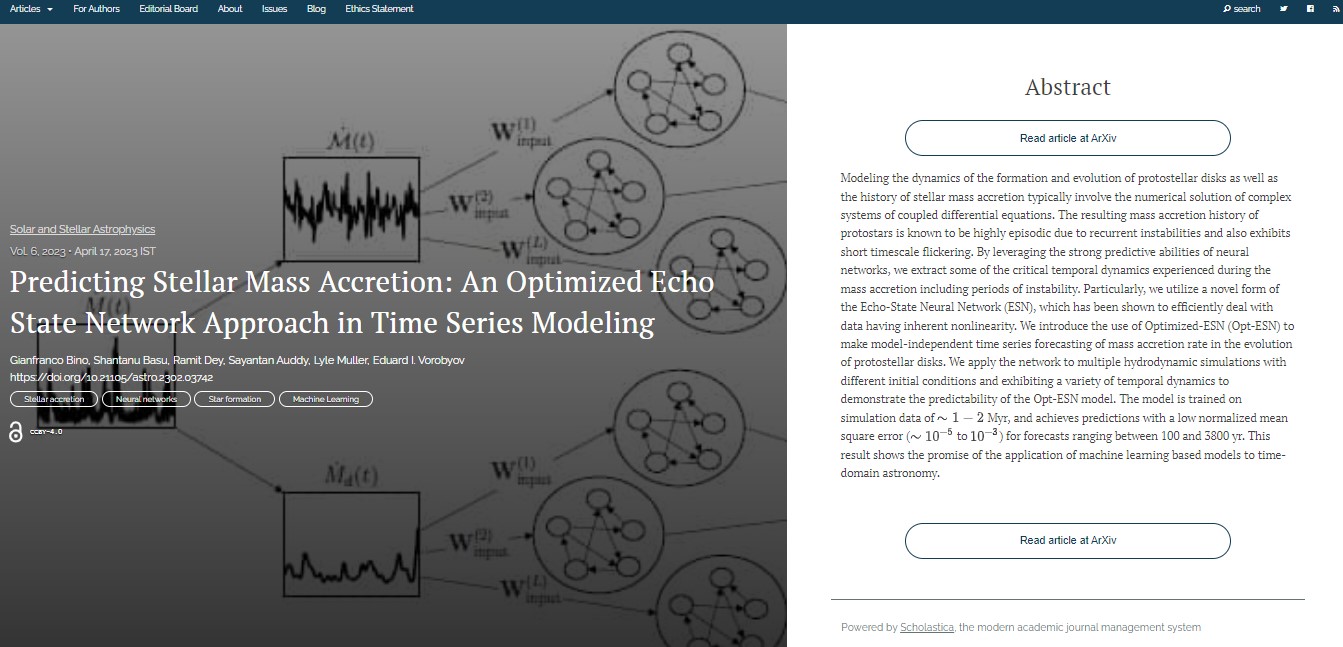
You can click on the image of the overlay to make it larger should you wish to do so. You can find the officially accepted version of the paper on the arXiv here.
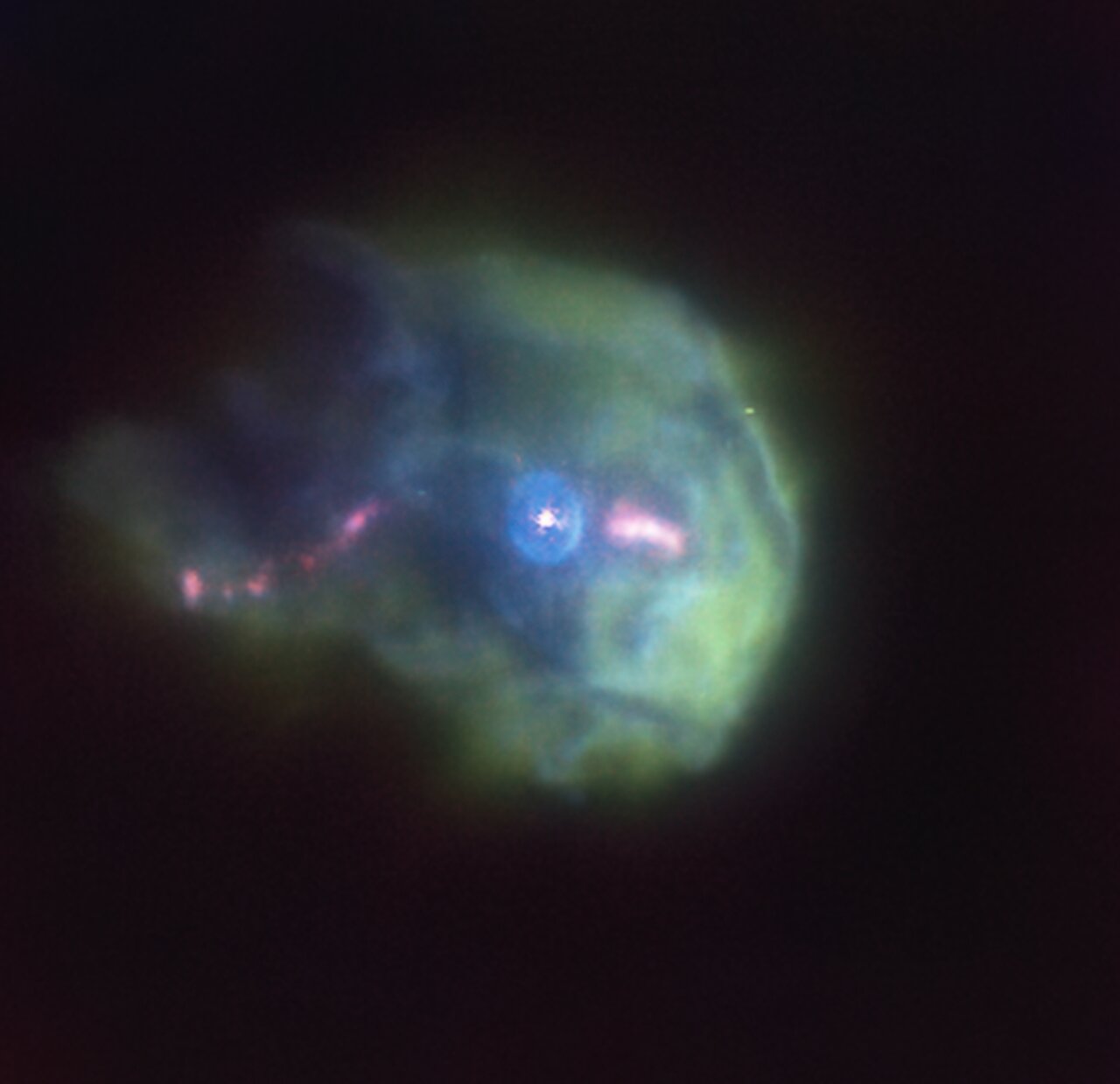
I think for the first time, Maynooth astronomers have been featured in the European Space Agency’s Picture of the Week. Here is the blurb from ESO:
–o–
This Picture of the Week shows the young stellar object 244-440 in the Orion Nebula observed with ESO’s Very Large Telescope (VLT) –– the sharpest image ever taken of this object. That wiggly magenta structure is a jet of matter launched close to the star, but why does it have that shape?
Very young stars are often surrounded by discs of material falling towards the star. Some of this material can be expelled into powerful jets perpendicularly to the disc. The S-shaped jet of 244-440 suggests that what lurks at the center of this object isn’t one but two stars orbiting each other. This orbital motion periodically changes the orientation of the jet, similar to a water sprinkler. Another possibility is that the strong radiation from the other stars in the Orion cloud could be altering the shape of the jet.
These observations, presented in a new paper led by Andrew Kirwan at Maynooth University in Ireland, were taken with the Multi Unit Spectroscopic Explorer (MUSE) instrument at ESO’s VLT in Chile. Red, green and blue colours show the distribution of iron, nitrogen and oxygen respectively. But this is just a small fraction of all the data gathered by MUSE, which actually takes thousands of images at different colours or wavelengths simultaneously. This allows astronomers to study not only the distribution of many different chemical elements but also how they move.
Moreover, MUSE is installed at the VLT’s Unit Telescope 4, which is equipped with an advanced adaptive optics facility that corrects atmospheric turbulence, delivering images sharper than Hubble’s. These new observations will therefore allow astronomers to study with unprecedented detail how stars are born in massive clouds like Orion.
–o–
There’s also a little video showing how the picture was made using MUSE:
Congratulations to Andrew Hirwan and supervisor Emma Whelan from the Department of Experimental Physics for this coup!
I stumbled by accident yesterday on a bit of news relating to UK Astronomy Grant funding via the Science and Technology Facilities Council (STFC). I am of course completely out of that system, and have been for years, but I am nevertheless quite nosy so was interested to find out about the changes. Thanks to Alan Heavens and Paul Crowther for enlightening me.
Way back in 2010 I wrote in somewhat critical terms about the new-style Consolidated Grants that STFC was planning to introduce. This system replaced a dual approach of so-called “Standard Grants” – which were typically rather small, usually funding one postdoctoral researcher and bits and bobs – and “Rolling Grants” – which were usually larger, covering all the activities of a department or institution – with a single system of “Consolidated Grants”. The Standard Grants were “responsive”, in that investigators could put in an application whenever they wanted, whereas Rolling Grants were on a fixed timetable. After the change, the responsive mode went out the window and Departments were forced to apply collectively, once every three years.
Much of the reason for the change was the administrative cost of the system. There were huge numbers of standard grant applications. Back in the mists of time there were two application deadlines per year so it was a heavy burden on the panels and the Swindon office, especially since so little funding was available in the first place. Standard grants were also the first to get squeezed when there was a funding shortfall, whereas Rolling grants generally carried on rolling.
Well, the news is that the current Astronomy grant round, with applications in 2022 and grants starting in 2023, will see the last of these Consolidated Grants. From this year on, there will be a new system of – wait for it – “Small” and “Large” grants, thought these are officially called Type 1 and Type 2. The Small Awards scheme is described here and it looks very much like the old Standard Grant system. Details of the Large grants scheme are not yet available, but I believe they will start next year. You can find more details here (PDF).
So now it seems something very like the old system is returning, and there are no doubt the same worries that Large grants will eat up most of the money, leaving very little for the Small grants. Déjà vu.
Anyway, the way I came across this piece of news was via the announcement of a clutch of PDRA positions in cosmology and extragalactic astrophysics at the University of Sussex (where I worked from 2013-16). It seems the Astronomy Centre must have done pretty well in the (final) STFC Consolidated Grant round, which is very good to hear! It seems there might be a bit more money generally in the grant line this year too, which is also good news.
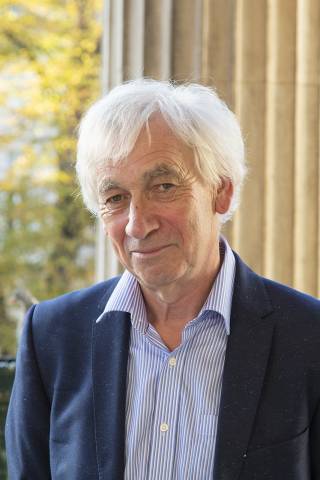
I’m delighted to be able to convey the news that the 2023 Gruber Prize for Cosmology has been awarded to Richard Ellis. Heartiest congratulations to him! The official announcement reads:
Over the past five decades Richard Ellis’s innovations have reimagined cosmology in fundamental ways. His observations have pushed the cosmic horizon—how far across the universe we can see—to a period close to the development of the first galaxies. Meanwhile the instruments he conceived, then shepherded through development and execution, have transformed myriad astronomical methodologies.
The full citation is here:
The Gruber Foundation is pleased to present the 2023 Cosmology Prize to Richard Ellis for his numerous contributions in the fields of galaxy evolution, the onset of cosmic dawn and reionization in the high redshift universe, and the detection of the earliest galaxies via the Hubble Ultra Deep Field study.
Richard Ellis has also driven several frontier instrumental developments in optical astronomy, especially the use of multi-object spectroscopy to study many galaxies in the same field of view. These included the “autofib” instrument, the “2dF” facility on the Anglo-Australian Telescope, which led to the discovery of baryon acoustic oscillations, the “LDSS” on the Herschel Telescope, which studied the redshifts of faint galaxies, and the “PFS” currently under commissioning on the Subaru Telescope to study dark matter and dark energy.
There’s a lot more information and biographical material in the full press release here.
If I can add just a couple of personal comments. Way back in 1985, when I was about to start my PhD DPhil, I attended an SERC summer school for new research students held in Durham. The lectures on Observational Cosmology at that school were delivered by Richard Ellis. I still have the notes, in fact. In many ways, this was my first encounter with modern cosmology. Quite few things have changed since then of course, but it was a formative experience. One thing I particularly remember is his discussion of the Hubble constant controversy:

You will see that there were two main estimates, one low and one high, both about three sigma away from the currently-favoured value of around 70. Plus ça change, plus c’est la même chose…
The second comment is that Richard was the external member on the panel that awarded me my first Chair position way back in 1998. Gosh. Was that really 25 years ago? Still, it goes to show that even an eminent scientist such as Richard can sometimes make an error of judgement!
I wish to draw your attention to a clutch of new papers out on the arXiv today (here, here and here) which describe latest results from the Atacama Cosmology Telescope (ACT for short). There was a webinar about this yesterday, which I failed to attend because I forgot about it.
The first of the papers listed above summarizes the key science results, which include a mass map obtained from gravitational lensing of the cosmic microwave background and its implications for cosmology.
As cosmic background photons propagate freely through space, i.e. without scattering, from the time of recombination to the observer, they are deflected by the gravitational effect of the large-scale distribution of matter in the Universe. This lensing effect leaves imprints in the temperature and polarization anisotropies, which can be used to reconstruct a map of the lensing potential, the gradient of which determines the lensing deflections. Structures in the CMB temperature pattern look bigger on the sky if we view them through an overdense clump of dark matter. By looking how the typical size of hot and cold spots in the CMB temperature map vary across the sky, it is possible to reconstruct the lensing deflections and hence the distribution of dark matter integrated along the line of sight. Since the structure through which the radiation passes is changing with time, this sort of map can provide constraints on models for the evolution of structure.
To cut a long story short, here is the map obtained using Data Release 6 of the ACT data over about 25% of the sky:

There’s a lot of information in the three papers but the key conclusion can be found in the last sentence of the abstract of the first paper:
Our results provide independent confirmation that the universe is spatially flat, conforms with general relativity, and is described remarkably well by the ΛCDM model, while paving a promising path for neutrino physics with gravitational lensing from upcoming ground-based CMB surveys.
Nothing revolutionary, then, but interesting nevertheless. There is an article on the BBC website about these results.
Some years ago – actually about 30! – I wrote a book with George Ellis about the density of matter in the Universe. Many of the details in that book are of course out of date now but the main conclusions still stand. We started the book with a general discussion of cosmological models which I think also remains relevant today so I thought I’d do a quick recap here.
Anyone who takes even a passing interest in cosmology will know that it’s a field that’s not short of controversy, sometimes reinforced by a considerable level of dogmatism in opposing camps. In understanding why this is the case, it is perhaps helpful to note that much of the problem stems from philosophical disagreements about which are the appropriate criteria for choosing a “good” (or at least acceptable) theory of cosmology. Different approaches to cosmology develop theories aimed at satisfying different criteria, and preferences for the different approaches to a large extent reflect these different initial goals. It would help to clarify this situation if one could make explicit the issues relating to choices of this kind, and separate them from the more `physical’ issues that concern the interpretation of data.
The following philosophical diversion was intended to initiate a debate within the cosmological community. Some cosmologists in effect claim that there is no philosophical content in their work and that philosophy is an irrelevant and unnecessary distraction from their work as scientists. I would contend that they are, whether they like it or not, making philosophical (and, in many cases, metaphysical) assumptions, and it is better to have these out in the open than hidden.
To provide a starting point for, consider the following criteria, which might be applied in the wider context for scientific theories in general, encapsulating the essentials of this issue:
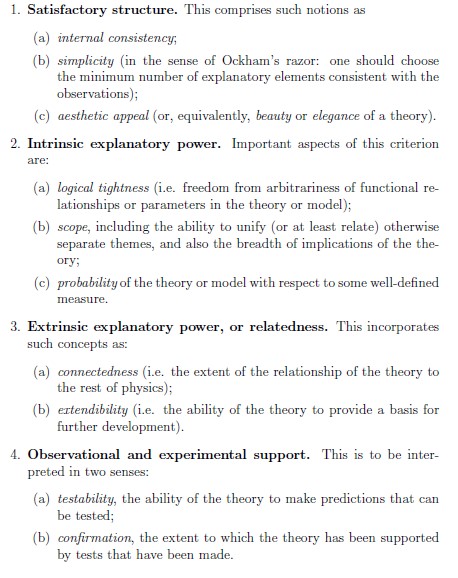
One can imagine a kind of rating system which judges cosmological models against each of these criteria. The point is that cosmologists from different backgrounds implicitly assign a different weighting to each of them, and therefore end up trying to achieve different goals to others. There is a possibility of both positive and negative ratings in each of these areas.
Note that such categories as “importance”, “intrinsic interest” and “plausibility” are not included. Insofar as they have any meaning apart from personal prejudice, they should be reflected in the categories above, and could perhaps be defined as aggregate estimates following on from the proposed categories.
Category 1(c) (“beauty”) is difficult to define objectively but nevertheless is quite widely used, and seems independent of the others; it is the one that is most problematic . Compare, for example, the apparently “beautiful” circular orbit model of the Solar System with the apparently ugly elliptic orbits found by Kepler. Only after Newton introduced his theory of gravitation did it become clear that beauty in this situation resided in the inverse-square law itself, rather than in the outcomes of that law. Some might therefore wish to omit this category.
One might think that category 1(a) (“logical consistency'”) would be mandatory, but this is not so, basically because we do not yet have a consistent Theory of Everything.
Again one might think that negative scores in 4(b) (`confirmation’) would disqualify a theory but, again, that is not necessarily so, because measurement processes, may involve systematic errors and observational results are all to some extent uncertain due to statistical limitations. Confirmation can therefore be queried. A theory might also be testable [4(a)] in principle, but perhaps not in practice at a given time because the technology may not exist to perform the necessary experiment or observation.
The idea is that even when there is disagreement about the relative merits of different models or theories, there is a possibility of
agreement on the degree to which the different approaches could and do meet these various criteria. Thus one can explore the degree to which each of these criteria is met by a particular cosmological model or approach to cosmology. We suggest that one can distinguish five broadly different approaches to cosmology, roughly corresponding to major developments at different historical epochs:
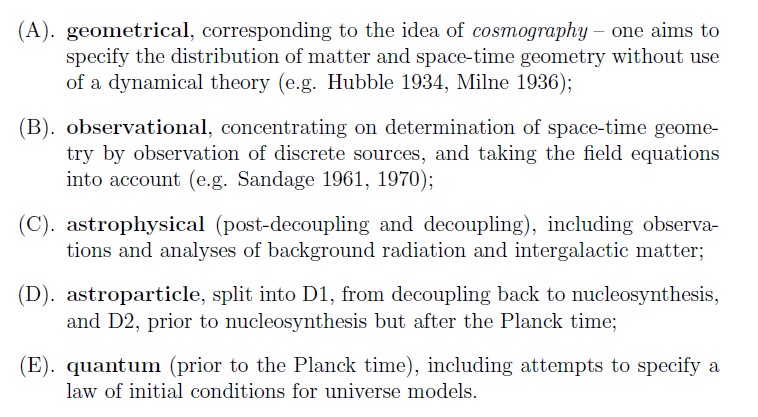
These approaches are not completely independent of each other, but any particular model will tend to focus more on one or other aspect and may even completely leave out others. Comparing them with the criteria above, one ends up with a star rating system something like that shown in the Table, in which George and I applied a fairly arbitrary scale to the assignment of the ratings!
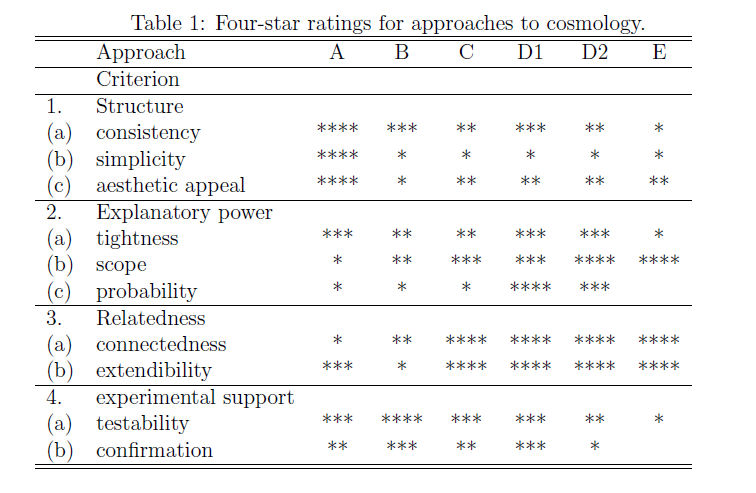
To a large extent you can take your pick as to the weights you assign to each of these criteria, but my underlying views is that without a solid basis of experimental support [4(b)], or at least the possibility of confirmation [4(a)], a proposed theory is not a ‘good’ one from a scientific point of view. If one can say what one likes and cannot be proved wrong, one is free from the normal constraints of scientific discipline. This contrasts with a major thrust in modern cosmological thinking which emphasizes criteria [2] and [3] at the expense of [4].
As a member of academic staff who teaches in a publicly funded University, and in the spirit of the Open Access movement, I think that as far as possible I should put the content of my lectures in the public domain. I’ve decided today to do this with my final-year module on Advanced Electromagnetism. Here you go.
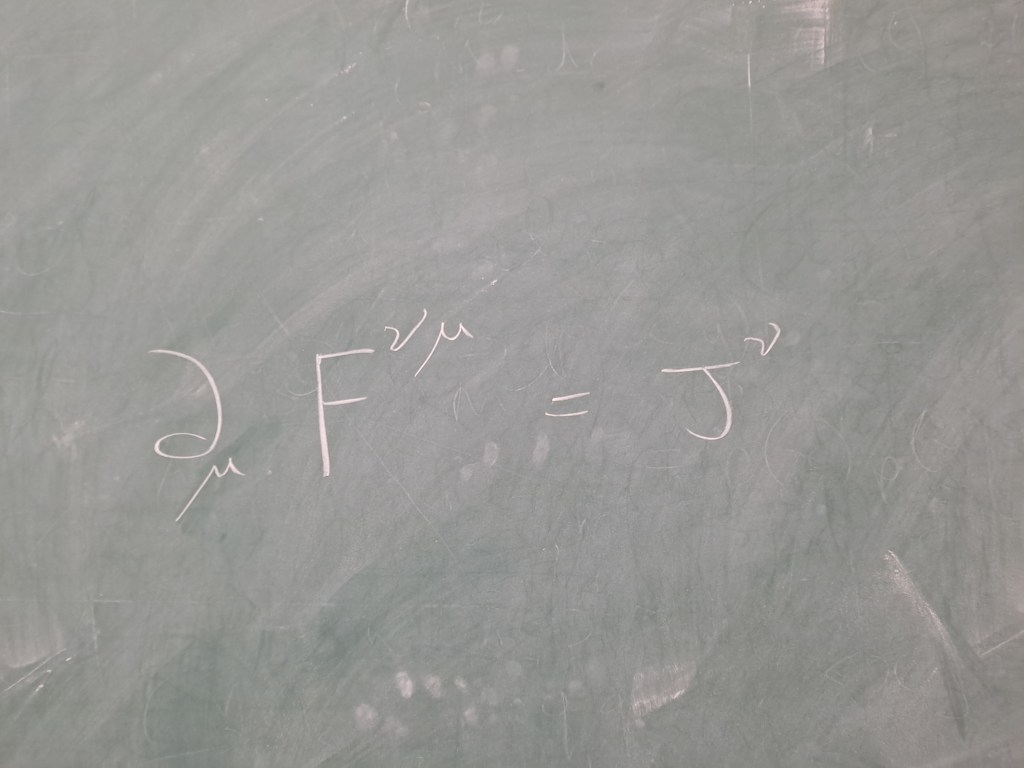
Any questions?
If you think that isn’t much for the 17 lectures I’ve given so far, just look at what I started with:

I reckon I’ve made quite a lot of progress!

 In the Dark