Archive for the The Universe and Stuff Category

Page Charges and Monthly Notices

Posted in Open Access, The Universe and Stuff with tags , , , , on January 31, 2023 by telescoper

Some time ago (in 2020) I reported here that the publishers of Monthly Notices of the Royal Astronomical Society (known as MNRAS for short) had decided to abandon the print edition and only have online articles. This is not surprising as demand for hard copies was falling drastically.

At the time I heard from a reliable source that MNRAS was also planning to introduce page charges – fees paid by authors to publish papers in the journal – and posted a comment to that effect here. This comment led to wild accusations of “serious academic misconduct” by me from a certain individual who shall remain nameless.

Well, the “rumour” I reported in 2020 is now confirmed to be the truth (as I knew it was). At a recent meeting of the national societies affiliated to the European Astronomical Society, Royal Astronomical Society President Mike Edmunds confirmed that, in the near future, all authors publishing in Monthly Notices of the Royal Astronomical Society will have to pay page charges. The timescale is “within a few years”.

This is part of a move to making all articles Open Access, largely forced by Plan S through which funding agencies require research outputs to be made freely available upon publication. Page charges are Article Processing Charges by another name.

Other notable journals, such as the Astrophysical Journal (ApJ) and Astronomy & Astrophysics (A&A), have levied page charges for as long as I can remember, though in the latter case it is complicated because there is a waiver for researchers in “member” countries. ApJ and other journals also have a waiver scheme for those who cannot afford to pay. For those who have to pay, the fee is usually about $100 per page. For a long time MNRAS was the exception and indeed the only feasible choice for people who don’t have access to funding to cover page charges, including many in the developing world. More recently, however, MNRAS introduced a charge for longer papers: £50 per page over 20 pages, so a paper of 21 pages costs £50 and one of 30 pages costs £500, etc. This will now be extended to all papers. I don’t have a figure for what MNRAS will charge in future or what waivers will be offered, but it seems likely to be similar to existing journals.

The introduction of page charges is an attempt to maintain the profitability of MNRAS after the loss of income from subscriptions, as readers will no longer be required to pay to read papers. It is therefore a transfer of cost from reader to author. I chose the ‘profitability’ because the prime purpose of MNRAS is no longer the dissemination of scientific results but the generation of income to fund other activities of the Royal Astronomical Society. Despite the move to the much cheaper digital-only publishing mode, the annual cost of an institutional subscription to this journal is currently over $10,000. Most of that is goes as profit to Oxford University Press (the actual publisher) and to the Royal Astronomical Society. Page charges are nothing to do with the actual cost of publication, but are intended to protect the publisher’s profit margins.

Much of what the RAS does with the revenue generated by journals is laudable, of course, but I don’t think it is fair to fleece researchers in order to fund its activities. I think authors can see this, and the attempt to transfer costs onto researchers will backfire. In particular, it’s a move that plays into the hands of The Open Journal of Astrophysics, which publishes papers (online only) in all the areas of Astrophysics covered by MNRAS, and more, but is entirely free both for authors and readers. If you don’t want to pay page charges, or make your library pay a subscription, then you could give it a try.

For myself, I abandoned the traditional journal system many years ago, as it is so clearly a racket.

The question for the Royal Astronomical Society, and other learned societies that fund their activities in a similar way, is whether they can find a sustainable funding model that takes proper account of the digital publishing revolution. If their revenue from publishing does fall, can they replace it? And, if not, in what form can they survive?

New Publication at the Open Journal of Astrophysics

Posted in OJAp Papers, Open Access, The Universe and Stuff with tags , , , , , , on January 27, 2023 by telescoper

Time to announce another new paper at the Open Journal of Astrophysics. This one was published yesterday, 26th January 2023. The latest paper is the third paper in Volume 6 (2023) as well as the 68th in all. It’s yet another in the Cosmology and NonGalactic Astrophysics folder.

The latest publication is entitled “Palatini formulation for gauge theory: implications for slow-roll inflation” and the authors are Syksy Räsänen of the University of Helsinki in Finland and Yosef Verbin (The Open University of Israel, Ra’anana, Israel). The first author has  published a previous paper on the Palatini formulation in the Open Journal of Astrophysics.

Here is a screen grab of the overlay which includes the  abstract:


You can click on the image to make it larger should you wish to do so. You can find the officially accepted version of the paper on the arXiv here.

P.S. You may be wondering about the image shown in the overlay. This paper doesn’t contain any figures or images so I tried out the collection of stock photographs that comes free with the Scholastica platform by typing in “gauge”. The result was a quite amusing collection of pictures of various kinds of dials and other gauges. I quite liked the one above so used it just for show!

ChatGPT and Physics Education

Posted in Education, The Universe and Stuff with tags , , , on January 24, 2023 by telescoper

Following on the theme of ChatGPT, I see that Phil Moriarty has done a blog post about its use in Physics Education which many of my readers will find well worth reading in full. His findings are well in accord with mine, although I haven’t had as much time to play with it as he has. In particular, it is easily defeated by figures and pictures so if you want to make your assessment ChatGPT-proof all you need to do is unlike lots of graphics. More generally, ChatGPT is trained to produce waffle so avoid questions that require students to produce waffle. This shouldn’t pose too many problems, except for disciplines in which waffle is all there is.

Phil Moriarty also done a video in the Sixty Symbols series, on that YouTube thing that young people look at, which you can view here:

I start teaching Computational Physics next week and will be seeing how ChatGPT does at the Python coding exercises I was planning to set!

ChatGPT in the Swampland

Posted in Maynooth, Open Access, The Universe and Stuff with tags , , , , , on January 22, 2023 by telescoper

My inestimable PhD student Kay Lehnert has been having a look at the capabilities of the Artificial Intelligence platform ChatGPT at writing about string theoretical ideas, specifically the swampland conjectures. It’s remarkable what this does well but also notable what it doesn’t do well at all. What he found was so interesting he wrote it up as a little paper, which you can find on the arXiv here. The abstract is:

In this case study, we explore the capabilities and limitations of ChatGPT, a natural language processing model developed by OpenAI, in the field of string theoretical swampland conjectures. We find that it is effective at paraphrasing and explaining concepts in a variety of styles, but not at genuinely connecting concepts. It will provide false information with full confidence and make up statements when necessary. However, its ingenious use of language can be fruitful for identifying analogies and describing visual representations of abstract concepts.

It took arXiv a while to decide what to do with this paper as it doesn’t fit in any of the usual categories. The arXiv sections that usually cover string theory are General Relativity and Quantum Cosmology (gr-qc) and/or high-energy physics theory (hep-th), which was where it was originally submitted, but this isn’t really a string theory paper per se. After being held by the moderators for a while it eventually it appeared in Popular Physics (physics.pop-ph), cross-listed in Artificial Intelligence (cs.AI) & Computation and Language (cs.CL); the latter two are computer science categories, obviously.

Figure 2 of the paper, which you should read if you want to know what it represents!

The reclassification of this paper was perfectly reasonable. In fact with this, as with any other arXiv paper, the thing that matters most is that it it is freely available to anyone who wants to read it and is discoverable, i.e. can easily be found via search engines. In the era of Open Access, things will generate interest if they are interesting (and accessible).

We posted the following on the Maynooth University Theoretical Physics Department Twitter account, something we do whenever a new paper by someone in the Department comes out:

Judging by the number of views (101K) by this morning, this one certainly seems to be attracting interest! Hopefully this blog post will generate even more..

Finally, there might be people reading this blog who can suggest a journal that might consider publishing an article on this sort of subject? Whatever you think about ChatGPT I think it’s generating a lot of discussion right now, so the topic is… er… topical.

Please use the box below for any suggestions.

PhD Opportunity in Theoretical Astrophysics at Maynooth!

Posted in Maynooth, The Universe and Stuff with tags , , , on January 18, 2023 by telescoper

Posting this again because the deadline (31st January) is coming up fast….

The Department of Theoretical Physics at Maynooth University invites applications for a PhD in Theoretical Astrophysics starting in September 2023. The successful applicant will work in the group led by Dr. John Regan on a project examining the formation processes of massive black holes in the early Universe. Massive black holes populate the centres of all massive galaxies and are now also observed in both the centres and in off-centre locations in less massive dwarf galaxies.

For more details and instructions on how to apply, see here.

New Publication at the Open Journal of Astrophysics

Posted in OJAp Papers, Open Access, The Universe and Stuff with tags , , , on January 12, 2023 by telescoper

Time to announce another new paper at the Open Journal of Astrophysics. This one was published officially on 9th January 2023. The latest paper is the second paper in Volume 6 (2023) as well as the 67th in all. This one is in the Astrophysics of Galaxies folder.

The latest publication is entitled “Wide Binaries as a Modified Gravity test: prospects for detecting triple-system contamination” and the authors – Dhruv Manchanda, Will Sutherland Charalambos Pittordis – are all based at Queen Mary, University of London.

Here is a screen grab of the overlay which includes the  abstract:


You can click on the image to make it larger should you wish to do so. You can find the officially accepted version of the paper on the arXiv here.

R.I.P. Richard Bower

Posted in Biographical, R.I.P., The Universe and Stuff with tags , , , , on January 10, 2023 by telescoper

I was shocked and saddened this weekend to hear of the death from cancer of Professor Richard Bower of Durham University. Richard was a leading light in the Institute for Computational Cosmology (ICC) at Durham, though his research interests spanned observational and theoretical studies of galaxy and cluster formation as well as numerical studies. 

I heard the sad news via social media and there have many tributes to and personal reminiscences of Richard have been circulated from friends, colleagues and former students, including this lovely one by Josh Borrow. I’m sure there will be official obituaries in due course that do justice to Richards personality and achievements in teaching and research; I’ll add links when I see them.

If I can add a personal note, I only worked on one project with Richard, about thirty years ago while I was still at Queen Mary & Westfield College in London. Doing the project was tremendous fun – so much so that the paper we ended up writing bears little relation to what we thought it would be like when we started. We were both young then – I think Richard was about a year younger than me – and both had a tendency to fly off at tangents, but fortunately we were working with two responsible adults (Carlos Frenk and Simon White) who kept us in order. I think the paper we wrote is a nice one, but the real point is that the whole experience was so enjoyable that it was not only formative experience for me from an intellectual point of view but also left me with very fond memories. Whenever we met subsequently, which happened fairly frequently and conferences and on panels and the like, we always talked about what a great time that was. It’s hard to accept we’ll never have that conversation again.

I send heartfelt condolences to Richard’s family, friends and colleagues, both past and present, and in Durham and elsewhere. was an irrepressible and irreplaceable character who will be greatly missed by the entire cosmological community.

Rest in peace, Richard Bower.

New Publication at the Open Journal of Astrophysics

Posted in OJAp Papers, Open Access, The Universe and Stuff with tags , , , , on January 7, 2023 by telescoper

Continuing the process of catching up with business at the Open Journal of Astrophysics, here is the first paper of 2023. This one was accepted before Christmas but the final version only appeared on arXiv after the holiday and was published officially on 4th January 2023.

The latest paper is the first paper in Volume 6 (2023) as well as the 66th in all. It’s yet another in the Cosmology and Non-Galactic Astrophysics folder.

The latest publication is entitled “It takes two to know one: Computing accurate one-point PDF covariances from effective two-point PDF models“. This is a British-French-German collaboration led by Cora Uhlemann of Newcastle University with co-authors  Oliver Friedrich, Aoife Boyle, Alex Gough, Alexandre Barthelemy, Francis Bernardeau, and Sandrine Codis.

This is such an interesting paper that we discussed it at our cosmology journal club at Maynooth University a while ago when it first appeared on arXiv and reading it again since then has suggested a nice project to me!

Anyway, here is a screen grab of the overlay which includes the  abstract:


You can click on the image to make it larger should you wish to do so. You can find the officially accepted version of the paper on the arXiv here.

Fifty Years of Gravitation

Posted in The Universe and Stuff with tags , , on January 5, 2023 by telescoper

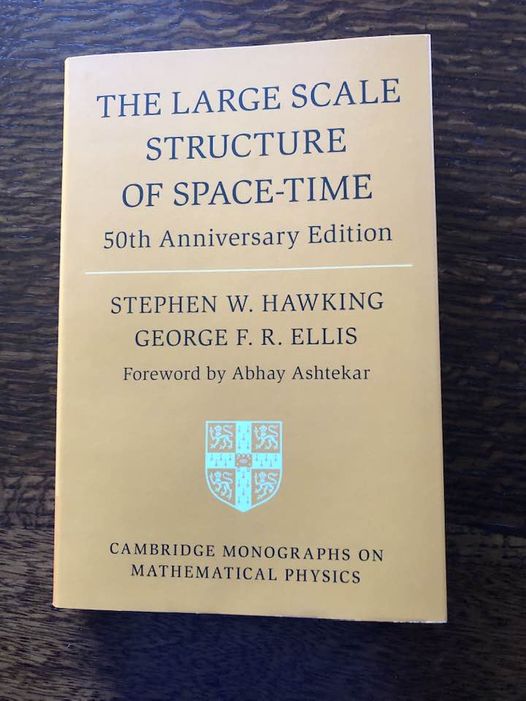
I was surprised to discover, a couple of days ago, that the classic textbook Gravitation by Misner, Thorne and Wheeler is 50 years old this year. MTW as it is usually known was first published in 1973, and has has now been reprinted 24 times. I bought my copy (shown above) about 30 years ago. I’ve often joked that this tome is so hefty that it not only allows one to read about Gravitation but also to experience its practical effects!

This anniversary reminds me that there was a competition running at ITP2022 last year that involved holding out a copy of the book  in one hand at arm’s length for as long as possible following the instructions below:

The winner of the competition was John Brennan of Maynooth University, with a time of 3 minutes and 29 seconds. If you can lay your hands on a copy of MTW you can try to do better!

New Publication at the Open Journal of Astrophysics

Posted in OJAp Papers, Open Access, The Universe and Stuff with tags , , on January 5, 2023 by telescoper

I’ve been catching up on publishing matters over the past day or so, including dealing with a bit of a backlog generated by the Christmas break. The Open Journal is run entirely by volunteers and we all need some time off at some point.

To start with I’m delighted to be able to announce the last paper of 2022 at the Open Journal of Astrophysics.  The latest paper is the 17th paper in Volume 5 (2022) as well as the 65th in all. It’s yet another in the Cosmology and Non-Galactic Astrophysics folder.

The latest publication is entitled “The Cosmic Graph: Optimal Information Extraction from Large-Scale Structure using Catalogues“. It is written by a distinguished collection of cosmologists from around the world (and Alan Heavens).

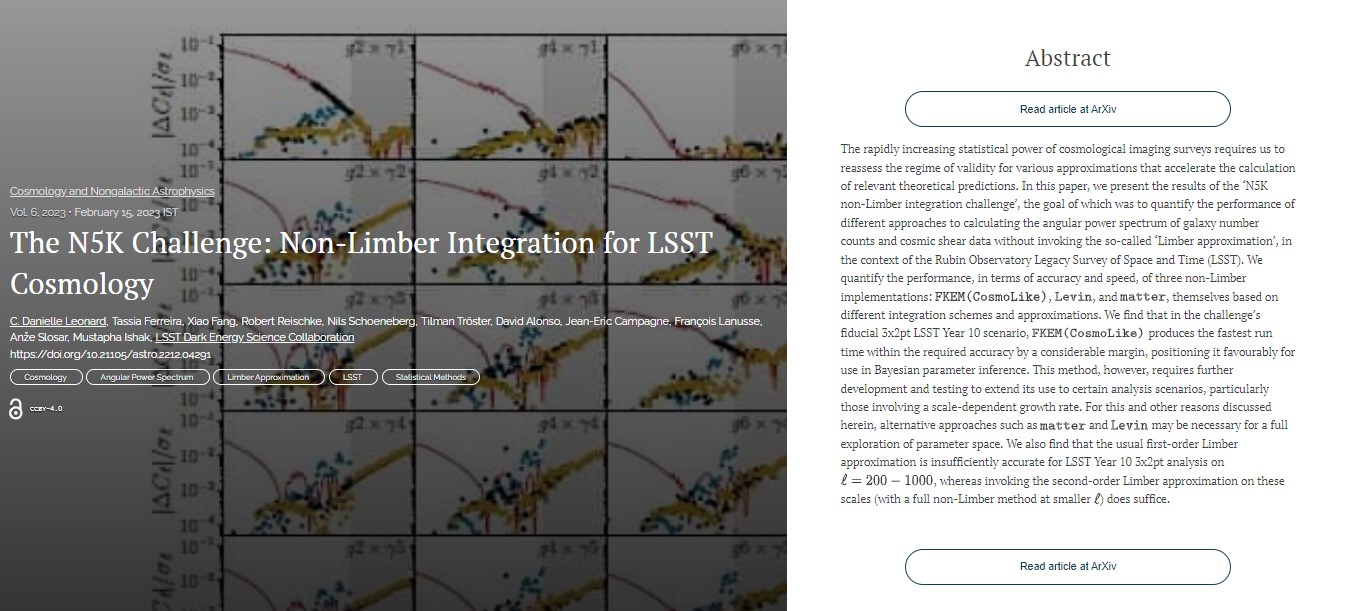
Anyway, here is a screen grab of the overlay which includes the  abstract:


You can click on the image to make it larger should you wish to do so. You can find the officially accepted version of the paper on the arXiv here.

Here is a bigger version of the image from the paper used on the overlay:


Code and a tutorial for the analysis and relevant software can be found here .