Archive for the The Universe and Stuff Category

Webb Deployment

Posted in Biographical, The Universe and Stuff with tags on January 8, 2022 by telescoper

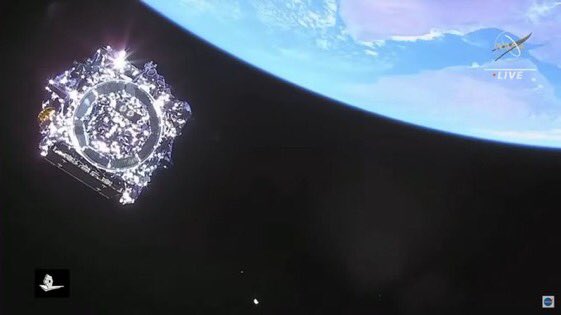
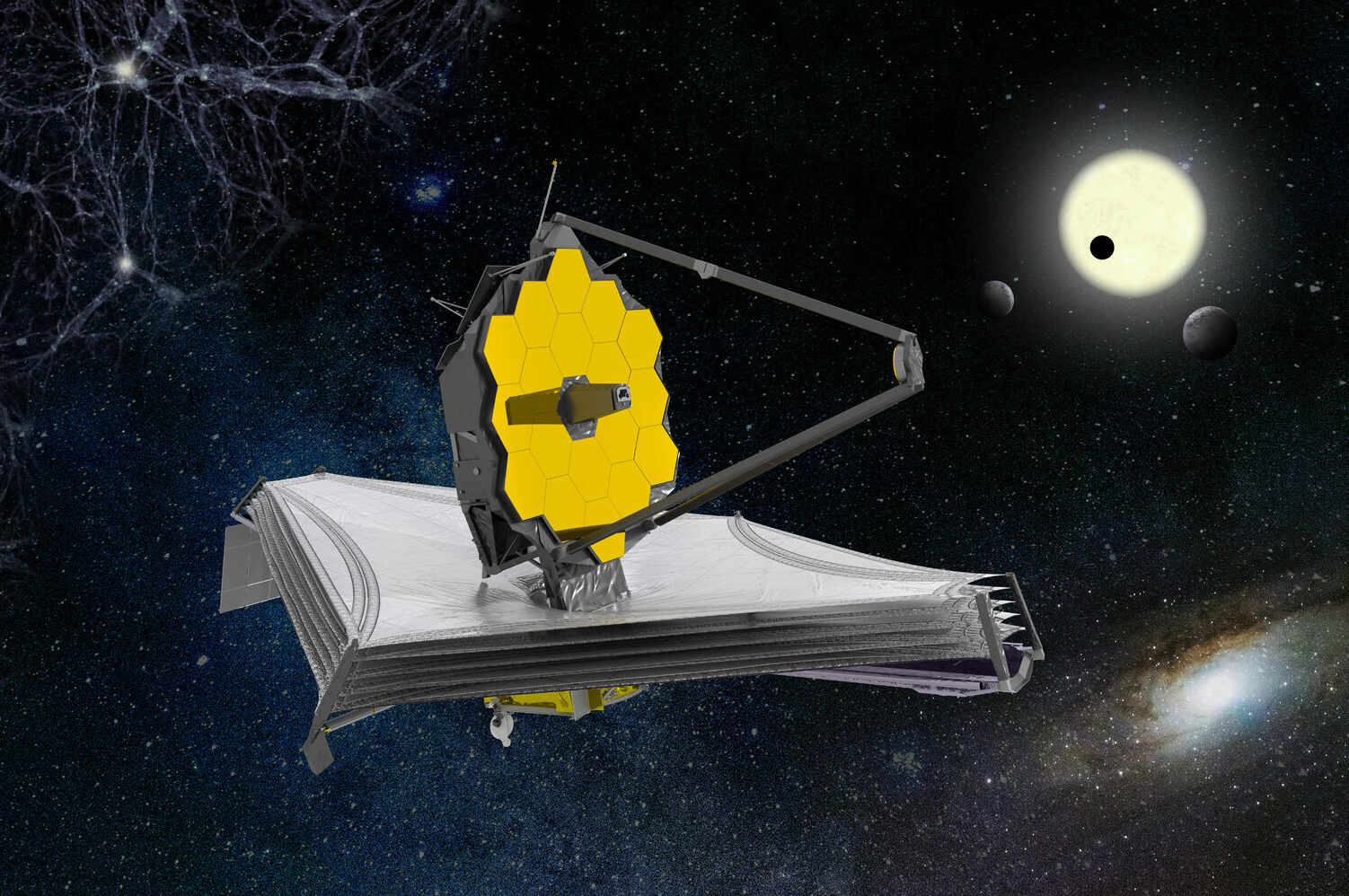
I’ve been busy all afternoon supervising an online examination and I’m now about to cook my dinner, which means I haven’t got time to post anything much but I will pass on the very welcome news that the James Webb Space Telescope has now completed the lengthy sequence of operations that were required to deploy a large sunshield, the primary and secondary mirrors and other bits and bobs needed to turn it into a proper observatory rather than just a basket of deployables. The whole thing should now look something like this:

Artists impression of Webb (with, by the look of it, a bit of the Cosmic Web)

There were over 300 potential single-point failures in this sequence so these last couple of weeks have been as stressful as the launch. Now commissioning work can begin.

This all gives me the excuse to have a celebratory drink just like I did on Christmas Day. Cheers!

A Piece of Euclid

Posted in Biographical, Euclid, Maynooth, The Universe and Stuff with tags , , on January 6, 2022 by telescoper

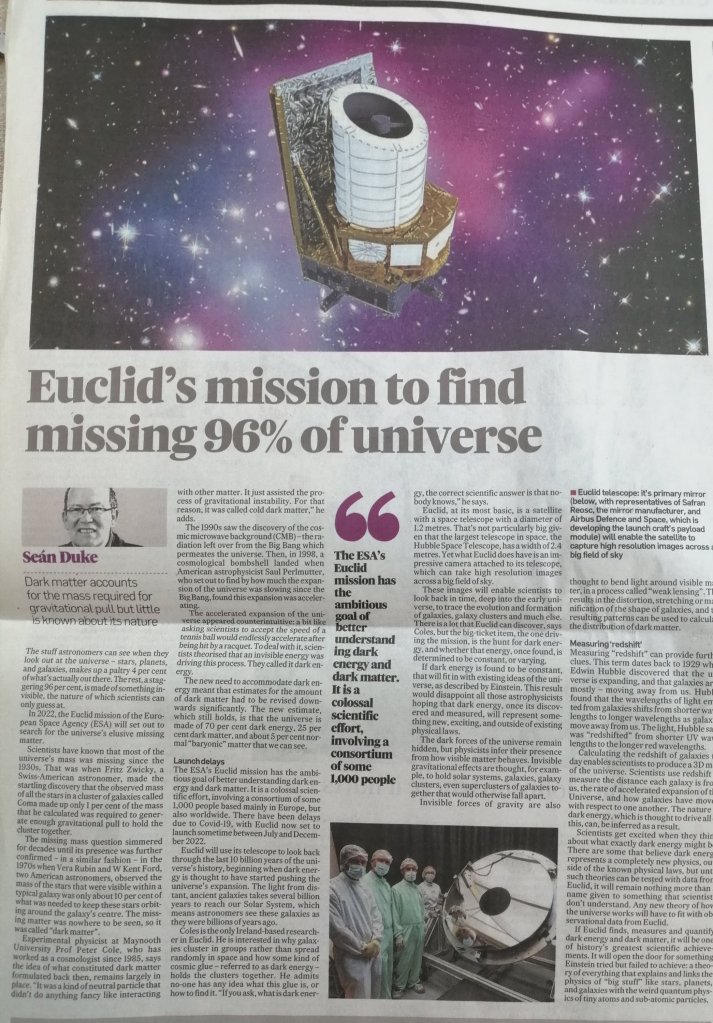
Fame at last! A colleague from the Department of Theoretical Physics at Maynooth University told me the above piece appeared in today’s Irish Times so I rushed out and bought the paper. My rapture was rapidly modified however when I discovered that my name was given incorrectly (as Cole instead of Coles), but that was to some extent offset by the amusement it would give my colleagues to see me described as an “Experiment Physicist”. These two slips are now corrected in the online version of the article which you can find here.

I was quite surprised by the sudden appearance of the article today because I spoke to the writer, Seán Duke, about Euclid well over a year ago (May 2020). That’s the reason that some things are a bit out of date. For example, the launch of Euclid will now not take place until the first quarter of 2023. Also the piece states that the largest telescope in space is the Hubble Space Telescope (HST) which is no longer the case (as of Christmas Day 2021…).

I’ll leave it as an exercise for the student to spot any other errors. Please feel free to point them out through the Comments Box. If you’re not banned, that is…

A Time For Perihelion

Posted in The Universe and Stuff on January 4, 2022 by telescoper

Earth’s elliptical orbit viewed at an angle (which makes it look more eccentric than it is – in reality is very nearly circular).

According to my new RAS Diary,  today (Tuesday 4th January 2022) at approximately 06:55 GMT the Earth reaches at the point on its orbit which which it is at its closest to the Sun, i.e. at its perihelion. At this time the distance from the Sun’s centre to Earth’s centre will be  147,105,052 km. This year, aphelion (the furthest distance from the Sun) is at 08:11 GMT on July 4th 2022 at which point the centre of the Earth will be 152,098,455  km from the centre of the Sun. You can find a list of times and dates of perihelion and aphelion for future years here.

At perihelion the speed of the Earth in its orbit around the Sun is greater than at aphelion (about 30.287 km/s versus 29.291 km/s). This difference, caused by the Earth’s orbital eccentricity, contributes to the difference between mean time and solar time I blogged about when discussing the Winter Solstice a couple of weeks ago.

It surprises me how many people think that the existence of the seasons has something to do with the variation of the Earth’s distance from the Sun as it moves in its orbit. The fact that perihelion occurs in the depth of winter should convince anyone living in the Northern hemisphere that this just can’t be the case, as should the fact that it’s summer in the Southern hemisphere while it is winter in the North.

The real reason for the existence of seasons is the tilt of the Earth’s axis of rotation. I used to do a little demonstration with a torch (flashlight to American readers) to illustrate this when I taught first-year astrophysics. If you shine a torch horizontally at a piece of card it will illuminate a patch of the card. Keep the torch at the same distance but tilt the card and you will see the illuminated patch increase in size. The torch is radiating the same amount of energy but in the second case that energy is spread over a larger area than in the first. This means that the energy per unit area incident on the card is decreases when the card is tilted. It is that which is responsible for winter being colder than summer. In the summer the sun is higher in the sky (on average) than in winter. From this argument you can infer that the winter solstice not the perihelion, is the relevant astronomical indicator of winter.

That is not to say that the shape of the Earth’s orbit has no effect on temperatures. It may, for example, contribute to the summer in the Southern hemisphere being hotter than in the North, although it is not the only effect. The Earth’s surface possesses a significant North-South asymmetry: there is a much larger fraction of ocean in the Southern hemisphere, for example, which could be responsible for moderating any differences in temperature due to insolation. The climate is a non-linear system that involves circulating air and ocean currents that respond in complicated ways and on different timescales not just to insolation but to many other parameters, including atmospheric composition (especially the amount of water vapour).

The dates when Earth reaches the extreme points on its orbit (apsides) are not fixed because of the variations in its orbital eccentricity so, in the short-term, the dates can vary up to 2 days from one year to another. The perihelion distance varies slightly from year to year too; it’s slightly greater this year than last year, for example.

There is however a long-term trend for perihelion to occur later in the year. For example, in 1246, the December Solstice (Winter Solstice for the Northern Hemisphere) was on the same day as the Earth’s perihelion. Since then, the perihelion and aphelion dates have drifted by an average of one day every 58 years and this trend will continue. This means that by the year 6430 the timing of the perihelion and the March Equinox will coincide, although I will probably have retired by then…

A Citation Landmark

Posted in Open Access, The Universe and Stuff with tags , , on December 31, 2021 by telescoper

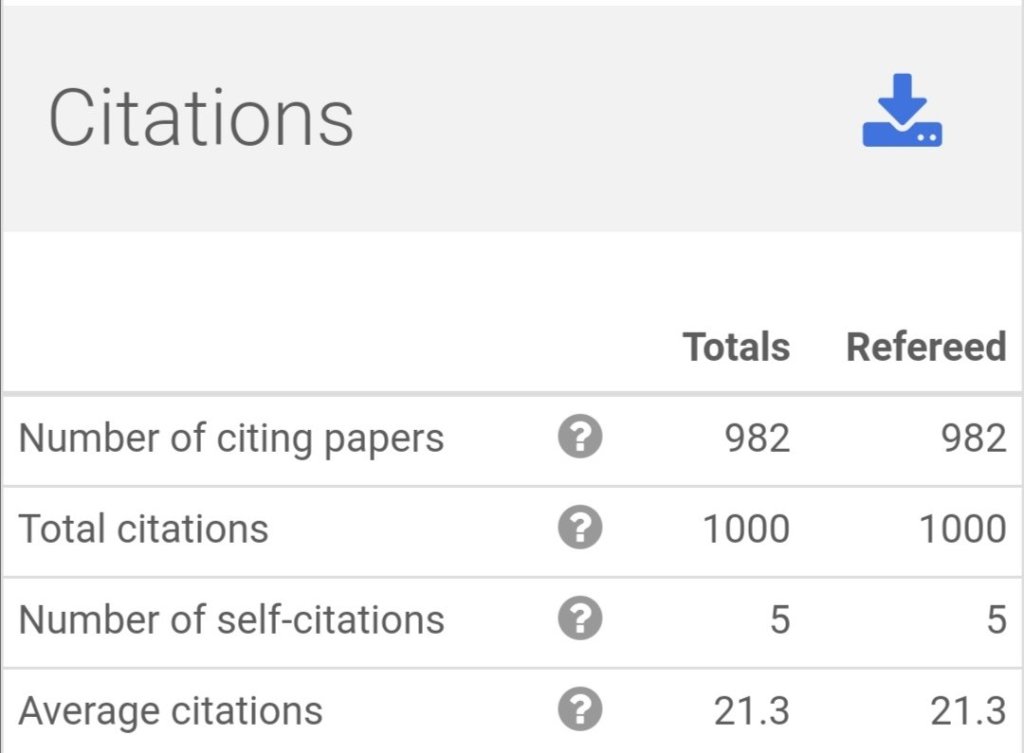
Just over a week ago I posted an item about the citations garnered by papers in the Open Journal of Astrophysics in the course of which I speculated on whether we would reach the 1000 mark before the end of 2021. Well, I checked on the NASA/ASD system today and it seems we have just made it:

There is still one paper we have published but not yet listed on ADS so the real number might be a little higher. It’s also possible that the figure will dip below a thousand again, at least for a short time. That is because ADS sometimes counts the citations to a published paper and to its preprint separately thus causing some duplication; when the issue is finally resolved the number of citations can go down.

Anyway, that’s a nice note to end the year on. Tomorrow we start with Volume 5 (2022)!

R.I.P. Willy Kley (1958-2021)

Posted in Biographical, The Universe and Stuff with tags , , , on December 29, 2021 by telescoper

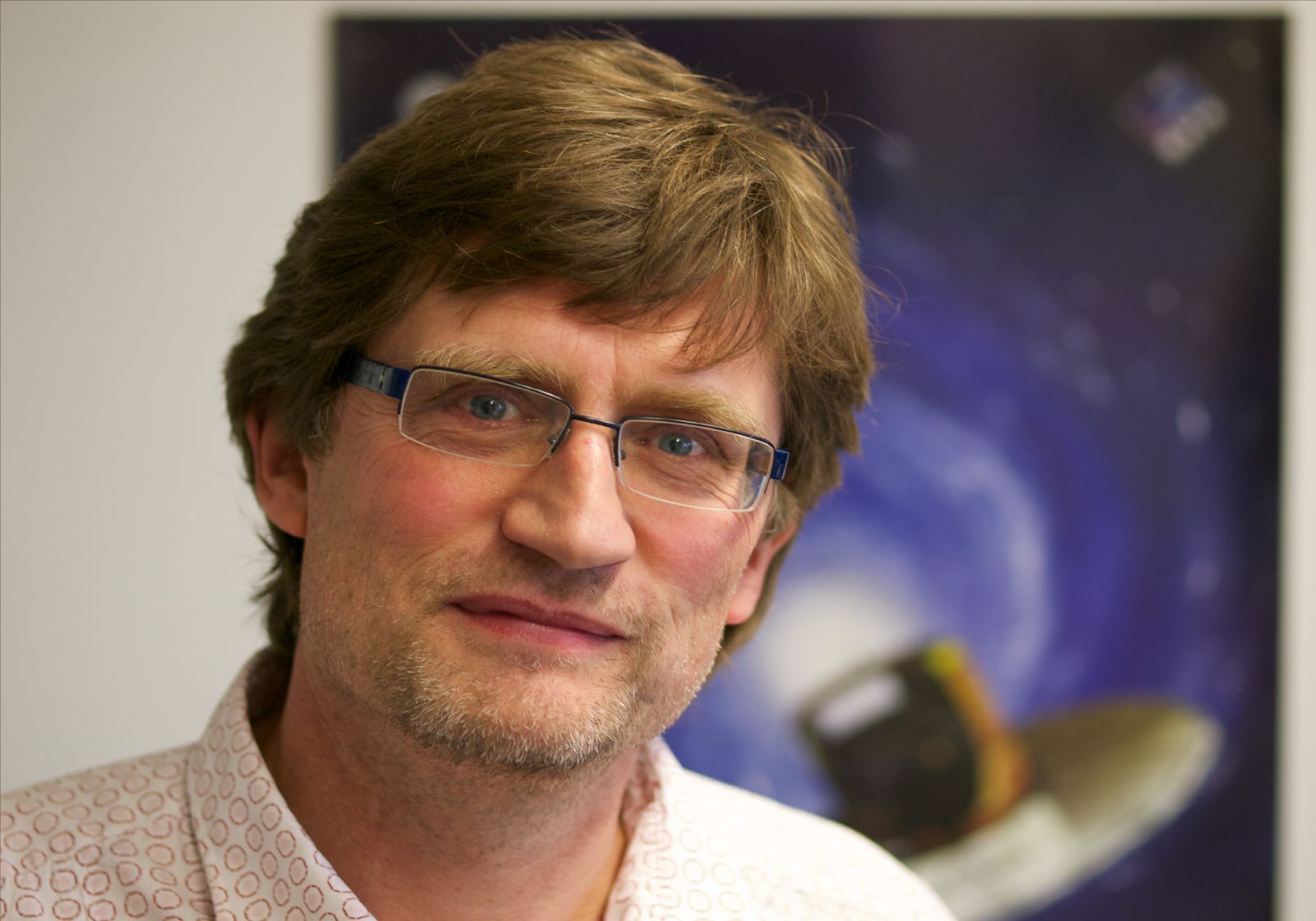
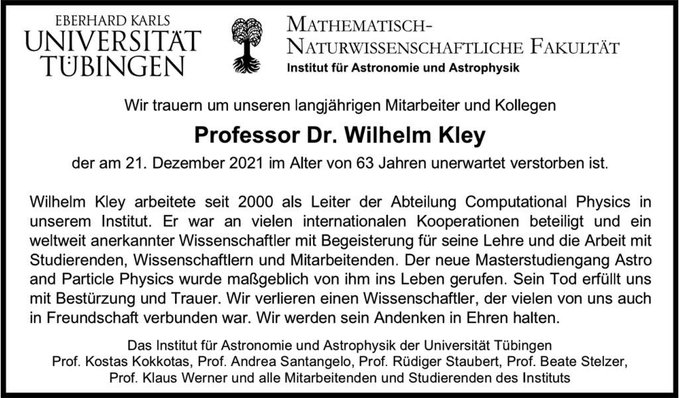
Once again it is my sad task to pass on news of the death of a colleague from the field of astrophysics. Prof. Dr. Wilhelm (“Willy”) Kley of the Institut für Astronomie & Astrophysik at the Universität Tübingen
in Germany passed away suddenly on 21st December 2021, at the age of 63.

Here is the official announcement (in German) from his institution:

Willy Kley was a computational astrophysicist who worked on accretion processes, especially in the context of the formation of planets and planetary systems. I knew him a little personally, as he was for a time in the Astronomy Unit at Queen Mary & Westfield College (as it was then called) at the same time I was there. He worked with the group led by John Papaloizou, alongside Richard Nelson and others, and I was working on cosmology, so we didn’t work together, but I did get to know him a bit and had a number of interesting discussions. He was a very nice man as well as a first-rate scientist. Looking at his (extensive) publication list it seems that he continued to collaborate with former QMW colleagues after his return to Germany in 2000.

His death was unexpected – I believe he suffered a heart attack – and I’m sure the news will come as a shock to many of his friends and collaborators. To them, and to his family, I send heartfelt condolences.

The Future of Extragalactic Observations from the Past

Posted in Biographical, The Universe and Stuff with tags , , , , , , , , , on December 27, 2021 by telescoper

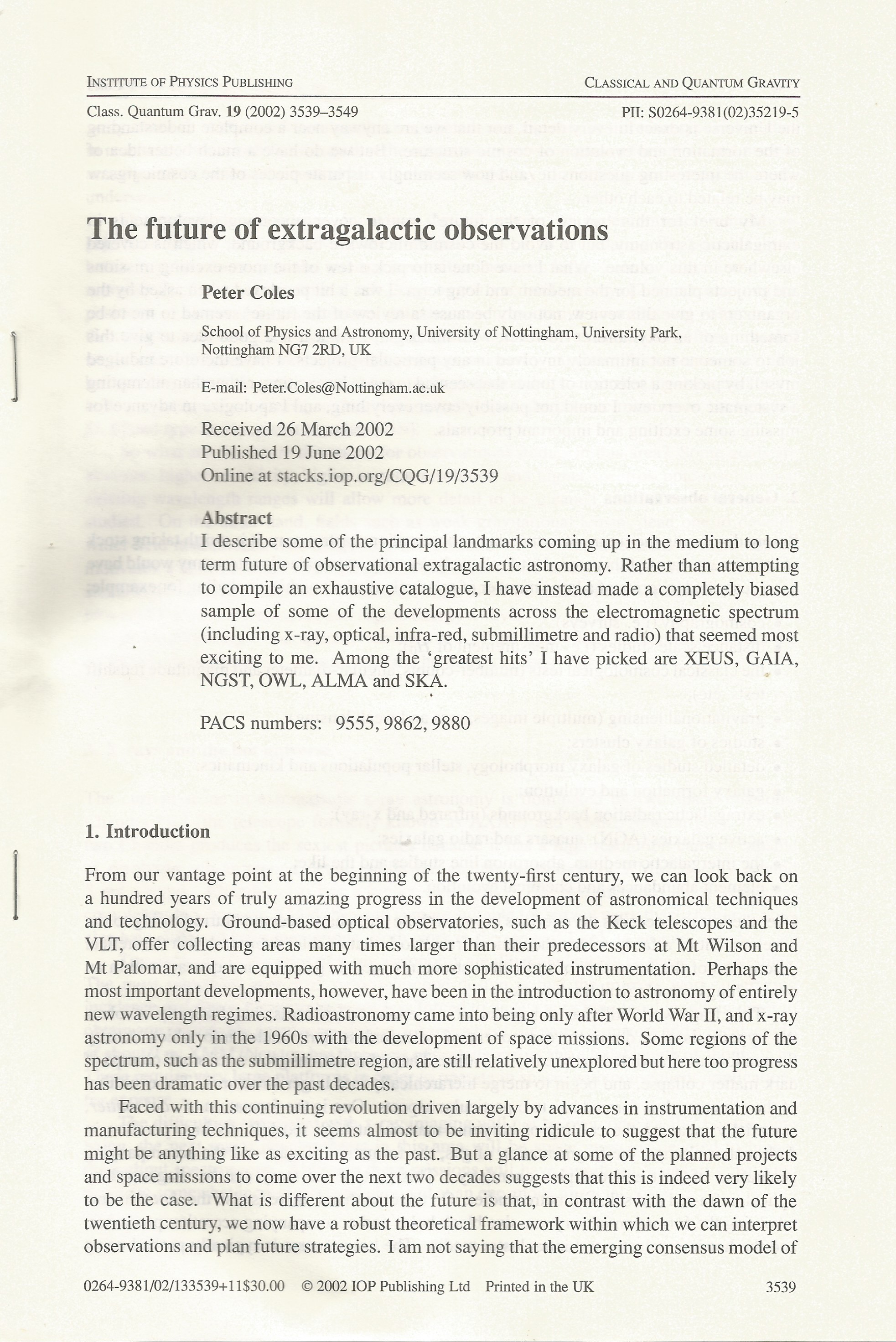
The launch of the James Webb Space Telescope on Christmas Day triggered a memory that twenty years ago, in July 2001, I was an invited speaker at a Conference in Cape Town entitled The Early Universe and Cosmological Observations: a Critical Review. That meeting was preceded by the 16th International Conference on General Relativity and Gravitation in Durban which I also attended, but did not speak at. For the Cape Town meeting I was asked to give a talk about some of the things coming up in the future to do with observational extragalactic astronomy, though I was told to avoid the cosmic microwave background and galaxy redshift surveys as other speakers were covering those areas. At the time I was serving on the Astronomy Advisory Panel for the (now defunct) Particle Physics and Astronomy Research Council so I was keeping up with developments fairly well then.

Anyway, I wrote up my talk and it was published in 2002 in a special issue of Classical and Quantum Gravity, along with the other talks (which were more theoretical, as opposed to hypothetical). I never bothered to put in on the arXiv so if you want a copy you’ll have to get it from the publisher.

I’m not claiming it is a particularly insightful article – and I did refrain from giving specific timescales – but, looking back at it, it is interesting which projects I mentioned in the abstract actually did get completed in the following twenty years.

The European X-ray mission XEUS was never completed. It was proposed for a while to merge it with a rival US mission Constellation-X in the International X-ray Observatory (IXO), but that was cancelled in 2011/12 owing to budget constraints at NASA. An ESA X-ray mission, called ATHENA (Advanced Telescope for High ENergy Astrophysics, based to some extent on the XEUS concept, is pencilled in for launch in 2034.

At the time of writing the article, JWST was called the Next Generation Space Telescope (NGST) and was envisaged to be an 8m class telescope, though I did suggest in the article would probably be “de-scoped” to involve a smaller mirror “perhaps 6m or thereabouts”. As we now know, it was finally launched on December 25 2021 and has a mirror of diameter 6.5m.

GAIA was developed and launched in 2013 and will operate until next year; it has been a tremendous success.

The Overwhelming Large (OWL) Telescope was planned to be a huge ground-based telescope, with a 100m diameter mirror and a target timescale of around 2015, to be built by the European Southern Observatory in Chile. I remember in informal discussions we used to call it the FLT. It was eventually decided that was not technically feasible and it was downgraded to a merely Extremely Large Telescope, which has a 39m mirror, underwhelming in comparison. Construction is in progress and it should see first light in 2027.

As well as the ELT there are now also the Thirty Metre Telescope and the Giant Magellan Telescope, which will come into operation on a similar timescale.

The Atacama Large Millimetre Array (ALMA) consisting of 66 telescopes working as an interferometer was completed and has been fully operational since 2013. That too has been a great success.

The Square Kilometre Array (SKA) also had its share of cost overruns and technical delays and although initial construction plans have been developed it is not expected to be operational until 2027.

Probably the most notable omission from my list is the Large Synoptic Survey Telescope (LSST) now called the Vera Rubin Observatory. That wasn’t really within my horizon in 2001, although its planning phase had started then. It really got under way around 2008 and is now nearing completion. I certainly would have mentioned it had I known more about it at the time!

P.S. In case you’re wondering, the Euclid Mission due to be launched in early 2023 was very far from the drawing board in 2001 so I don’t apologize for not mentioning it!
On Nominal

Posted in The Universe and Stuff with tags , on December 26, 2021 by telescoper

Yesterday’s launch of the James Webb Space Telescope reminded me of something I blogged about many years ago. At regular intervals during the launch we heard staff at Mission Control in Kourou saying that everything was “nominal”. As always when wondering about the meaning of words, I searched in the One True Chambers Dictionary, where I found:

nominal, adj relating to or of the nature of a name or noun; of names; by name; only in name; so-called, but not in reality; inconsiderable, small, minor, in comparison with the real value, hardly more than a matter of form…

So was the so-called launch of JWST only in name, but not in reality? Was it faked? Is the telescope real?

That reminds me that years and years ago I had an idea for a crime novel with a plot that revolves around the murder of a prominent cosmologist just as some important scientific discovery is about to be announced. Suspicion gathers that the whole thing is an enormous hoax and the discovery bogus. But the experiment is shrouded in secrecy, and was so expensive that it can’t easily be repeated, so  who can tell, and how?

I wouldn’t put it past some conspiracy theorist to argue that the data from JWST (assuming there is some) is manufactured.

It’s very difficult to know for sure whether any scientific discoveries are genuine or not, even if the data and analysis procedures are made public. There’s always the possibility that everything might have been fabricated or simulated, but in most cases the experiment can be repeated at a later date and the fraud eventually exposed, such as in the Schön Scandal.  In Big Science, this may not be practicable. However, Big Science requires big teams of people and the chances are someone would blow the whistle, or try to…

Anyway, I know that there are people out there who take everything I write on this blog absurdly literally so I’ll spell it out that I am in no way suggesting that the James Webb Space Telescope is a fraud. Or predicting that there’ll be a murder just before the first observations are released. Any similarity purely coincidental and all that. And I’ve never had time to write the book anyway – perhaps a publisher might read this and offer me an advance as an incentive?

Moreover, going back to the Chambers Dictionary, I note the final definition given there and omitted above i

…according to plan (space flight)

So that’s that. Nothing sinister. I’m not sure how “nominal” acquired that meaning, mind you, but that’s another story…

Merry JWSTmas!

Posted in The Universe and Stuff with tags , , , , on December 25, 2021 by telescoper

Well it’s 10.20am on Christmas Day and I’ve got up specially early in order to be ready for the launch at 12.20pm today (Irish Time) of the James Webb Space Telescope from Kourou in French Guiana. The JWST project has been almost thirty years in the making and it is great that it is finally going to be heading into space. The launch however is just the start – JWST has a very complicated journey in front of it – as demonstrated by the following little video.

In particular, JWST should separate from the Ariane 5 launcher at about 27 minutes after takeoff so look out for that.

I have no direct personal involvement with JWST but I am still feeling a bit nervous. I can’t imagine how it must feel to have spent decades working on it. I know a great many astronomers around the world who are waiting anxiously and hoping all goes well. Fingers crossed!

If you want to watch the launch live you can do so on Youtube here:

You can find alternative viewing options here.

The launch window opens at 12.20 UTC and lasts for 31 minutes but I understand they’re going to launch as early as possible within that so it looks like we’re in for a launch before lunch rather than the other way round.

I’ll update with any news as the day goes on.

UPDATE: 12.28pm Launched right on time, everything nominal as JWST leaves Earth’s atmosphere propelled by Stage One of the Ariane 5.

UPDATE: 12.31pm Stage One jettisoned, Stage 2 ignition. All still nominal.

UPDATE: 12.48pm JWST has separated from the launch vehicle and is on its way. The solar panel is deployed and is working. The spectacular onboard video showing the separation of JWST from the Ariane 5 launch vehicle and the deployment of the solar panels was supplied by Irish company Réaltra.

P.S. I still think JWST should have had a different name.

The Winter Solstice 2021

Posted in The Universe and Stuff with tags , , , on December 21, 2021 by telescoper

So it comes around again. The winter solstice in the Northern hemisphere happens today, Tuesday 21st December, at 15.59 Irish Time. Among other things, this means that tomorrow is the shortest day of the year in the Northern hemisphere. Days will get steadily longer from then until the Summer Solstice next June.  The  the shortest day – defined by the interval between sunrise and sunset – is today. Tomorrow will be two whole seconds longer. Make the most of it!

This does not, however,  mean that sunrise will happen earlier tomorrow than it did this morning.  Actually, sunrise will carry on getting later until the new year, the length of the day nevertheless increasing because sunset occurs even later. Sunrise yesterday morning (20th December) was at 08.37 Dublin Time while today it was 08.38; the latest sunrise will be on 29th December (08.40). Sunset last night was at 16.07 and tonight it will be at 16.08. The earliest sunset this year was actually on 13th December (16:06).

These complications arise because there is a difference between mean solar time (measured by clocks) and apparent solar time (defined by the position of the Sun in the sky), so that a solar day does not always last exactly 24 hours. A description of apparent and mean time was given by Nevil Maskelyne in the Nautical Almanac for 1767:

Apparent Time is that deduced immediately from the Sun, whether from the Observation of his passing the Meridian, or from his observed Rising or Setting. This Time is different from that shewn by Clocks and Watches well regulated at Land, which is called equated or mean Time.

The discrepancy between mean time and apparent time arises because of the Earth’s axial tilt and the fact that it travels around the Sun in an elliptical orbit in which its orbital speed varies with time of year (being faster at perihelion than at aphelion).

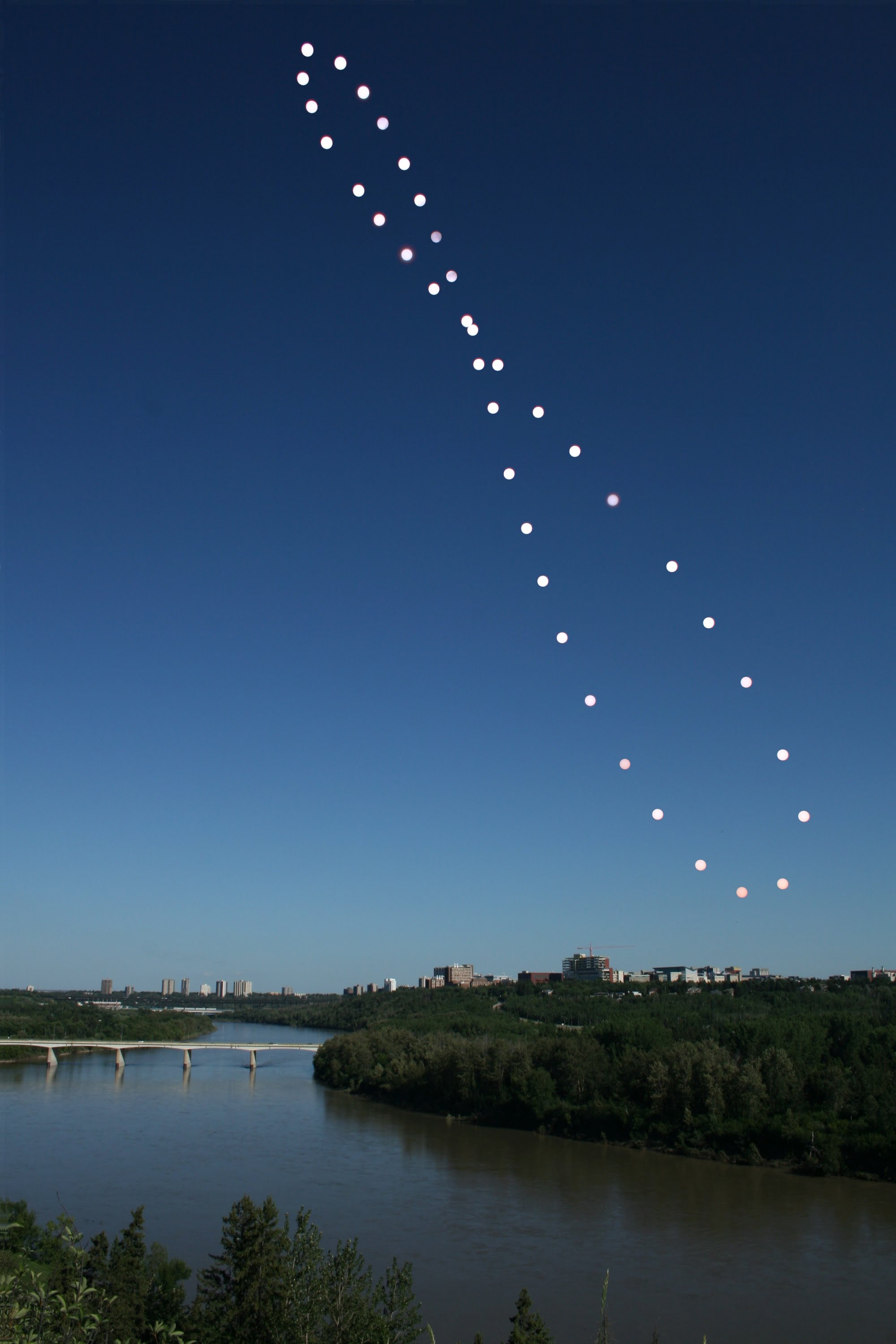
In fact if you plot the position of the Sun in the sky at a fixed time each day from a fixed location on the Earth you get a thing called an analemma, which is a sort of figure-of-eight shape whose shape depends on the observer’s latitude. Here’s a photographic version taken in Edmonton, with photographs of the Sun’s position taken from the same position at the same time on different days over the course of a year:

maxresdefault

The winter solstice is the lowermost point on this curve and the summer solstice is at the top. These two turning points define the time of the solstices much more precisely that the “shortest day” or  “longest night”.

Anyway, the north–south component of the analemma is the Sun’s declination, and the east–west component arises from the  equation of time which quantifies the difference between mean solar time and apparent solar time. This curve can be used to calculate the earliest and/or latest sunrise and/or sunset.

Using a more rapid calculational tool (Google), I found a table of the local mean times of sunrise and sunset for Dublin around the 2020  winter solstice. This shows that today is indeed the shortest day (with a time between sunrise and sunset of 7 hours 29 minutes and 57 seconds).

P.S. As usual, crowds gathered at the spectacular neolithic monument at Newgrange in County Meath to observe the sunrise at the Solstice. As usual it was cloudy.

New Publication at the Open Journal of Astrophysics

Posted in OJAp Papers, Open Access, The Universe and Stuff with tags , , , , , , on December 17, 2021 by telescoper

It’s nice to be able to announce another publication in the Open Journal of Astrophysics before the Christmas break. This one was published yesterday, actually, but I didn’t get time to post about it until just now. It is the 17th paper in Volume 4 (2021) and the 48th in all.

The latest publication is entitled Mapping Spatially Varying Additive Biases in Cosmic Shear Data and is written by Tom Kitching and Anurag Deshpande of the Mullard Space Science Laboratory (UCL) and Peter Taylor of the Jet Propulsion Laboratory (Caltech).

Here is a screen grab of the overlay which includes the abstract:

You can click on the image to make it larger should you wish to do so. You can find the arXiv version of the paper here. This is another one for the Cosmology and Nongalactic Astrophysics folder, which is the most popular category so far on the Open Journal of Astrophysics site.

P. S. Let me apologise for any inconvenience caused by a recent temporary outage on our Scholastica platform overnight between 16th & 17th December (US time). Normal service has now been restored.