Archive for the The Universe and Stuff Category

Early Dark Energy and Cosmic Tension

Posted in The Universe and Stuff with tags , , , , , on March 19, 2020 by telescoper

To avoid talking any more about you-know-what I thought I would continue the ongoing Hubble constant theme. Rhere is an interesting new paper on the arXiv (by Hill et al.) about the extent to which a modified form of dark energy might relieve the current apparent tension.

The abstract is:


You can click on this to make it bigger; you can also download the PDF here.

I think the conclusion is clear and it may or may not be related to a previous post of mine here about the implications of Etherington’s theorem.

Here’s my ongoing poll on the Hubble constant poll. Feel free to while away a few seconds of your time working from home casting a vote!


New Publication at the Open Journal of Astrophysics!

Posted in OJAp Papers, Open Access, The Universe and Stuff with tags , , , , , , , on March 13, 2020 by telescoper

Well Maynooth University may have shut down but the The Open Journal of Astrophysics certainly has not.

In fact we have just published another paper! This one is called Halo Spins from Primordial Inner Motions and the first author is Mark Neyrinck (based in Bilbao). The other authors are Miguel Aragon-Calvo (based in Mexico), Bridget Falck and Alex Szalay (based in the USA) and Jie Wang (China).

Here is a grab of the overlay:

You can find the arXiv version of the paper here.

As an added bonus there are some groovy videos to go with this paper:

You might have to read the paper, however, to understand exactly what they mean (although they are very pretty anyway).

An Astronomical Anniversary

Posted in Biographical, History, The Universe and Stuff with tags , , on March 10, 2020 by telescoper

I was reminded via Twitter that today is the 200th anniversary of the first formal meeting of the Astronomical Society of London which took place on 10th March 1820. This society turned into the Royal Astronomical Society when it was given a Royal Charter in 1831. Here is the first page of the the Minutes of that first meeting:

Those of you who have been paying attention will recall that the decision to form the Society was taken at a dinner in January 1820 and the bicentenary of this event was celebrated in January by the RAS Dining Club (of which I am a member).

Club Dinners usually take place after the Open Meetings of the Royal Astronomical Society on the second Friday of the month. Sadly, however, there won’t be a Club Dinner this Friday as it has been cancelled owing to the Coronavirus emergency. I’ll have to make do with beans on toast again then.

Incidentally, I thought I’d share this list of the first 200(ish) members of the Royal Astronomical Society (PDF) kindly sent to me by former Cardiff colleague Mike Edmunds. There are some illustrious names among the early members, including Laplace and Bessel, as well as some oddities, such as His Excellency Alexis Greig (Vice Admiral of the Imperial Russian Navy) and Edward Riddle, Esq. (First Mathematical Master, the Royal Naval Asylum).


Maynooth’s Creation

Posted in Maynooth, Music, The Universe and Stuff with tags , , , , on March 8, 2020 by telescoper

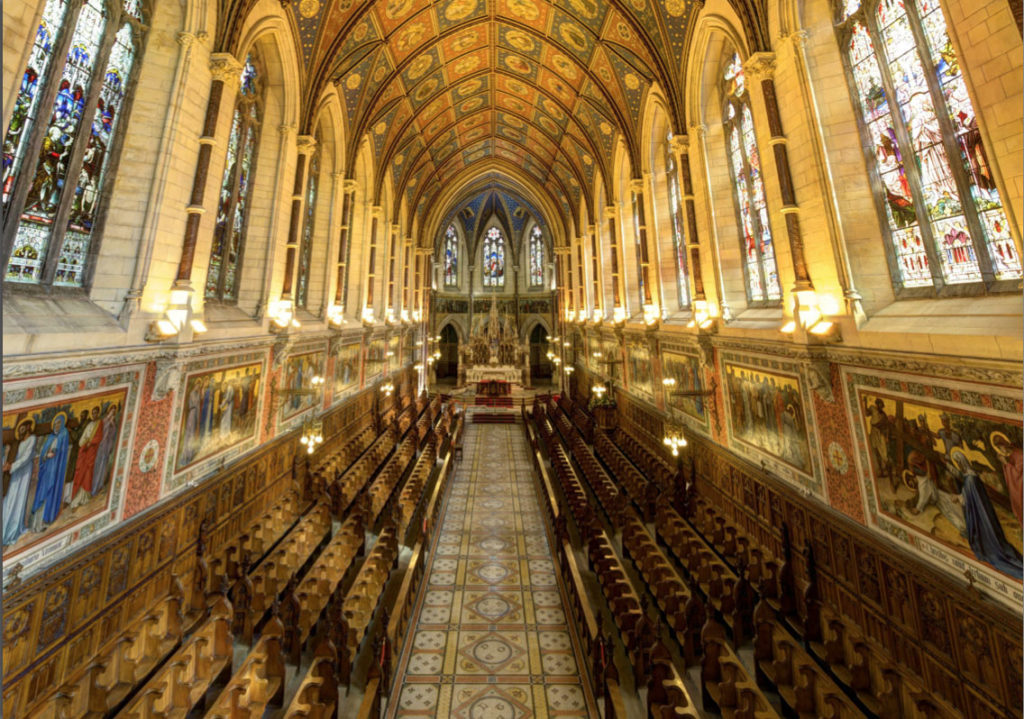
As it was foretold, this afternoon to the College Chapel at Maynooth, which looks like this inside:
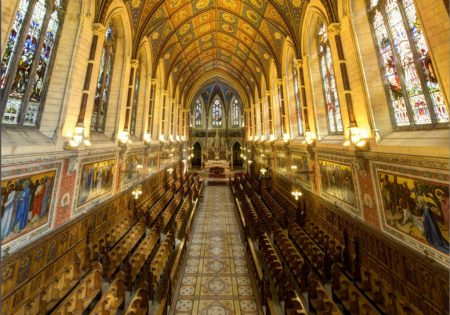
This was in fact the first time I’ve set foot inside the Chapel. The occasion was the annual Spring Concert by Maynooth University Choral Society, accompanied by the Irish Choral Sinfonia, in a performance of Haydn’s great oratorio The Creation.
It’s worth mentioning that Haydn started preparing to write his Creation in 1796, which is just a year after St Patrick’s College in Maynooth was established (as the National Seminary of Ireland). This work was therefore was a good choice for the year in which the College celebrates the 225th year of its own creation.

Although the College Chapel is quite large it provided a very intimate setting for this great masterpiece (in that the audience was very close to the musicians and singers) and provided a very distinctive acoustic. Curiously, this was the first time I had heard this work performed in English.

The solo vocalists – Claudia Boyle (soprano), Andrew Gavin (tenor) and Simon Morgan (bass) – were all excellent, as were the choir and orchestra. All in all it was a hugely enjoyable experience, even if the wooden seats were a bit unforgiving!

After the performance there was a Buffet Supper in Pugin Hall, which I had assumed would just be sandwiches but which turned out to be a very nice meal with wine at which I got chatting to some very friendly people. Admission to the event was by invitation only, but the guest list was not restricted to folk from Maynooth University.

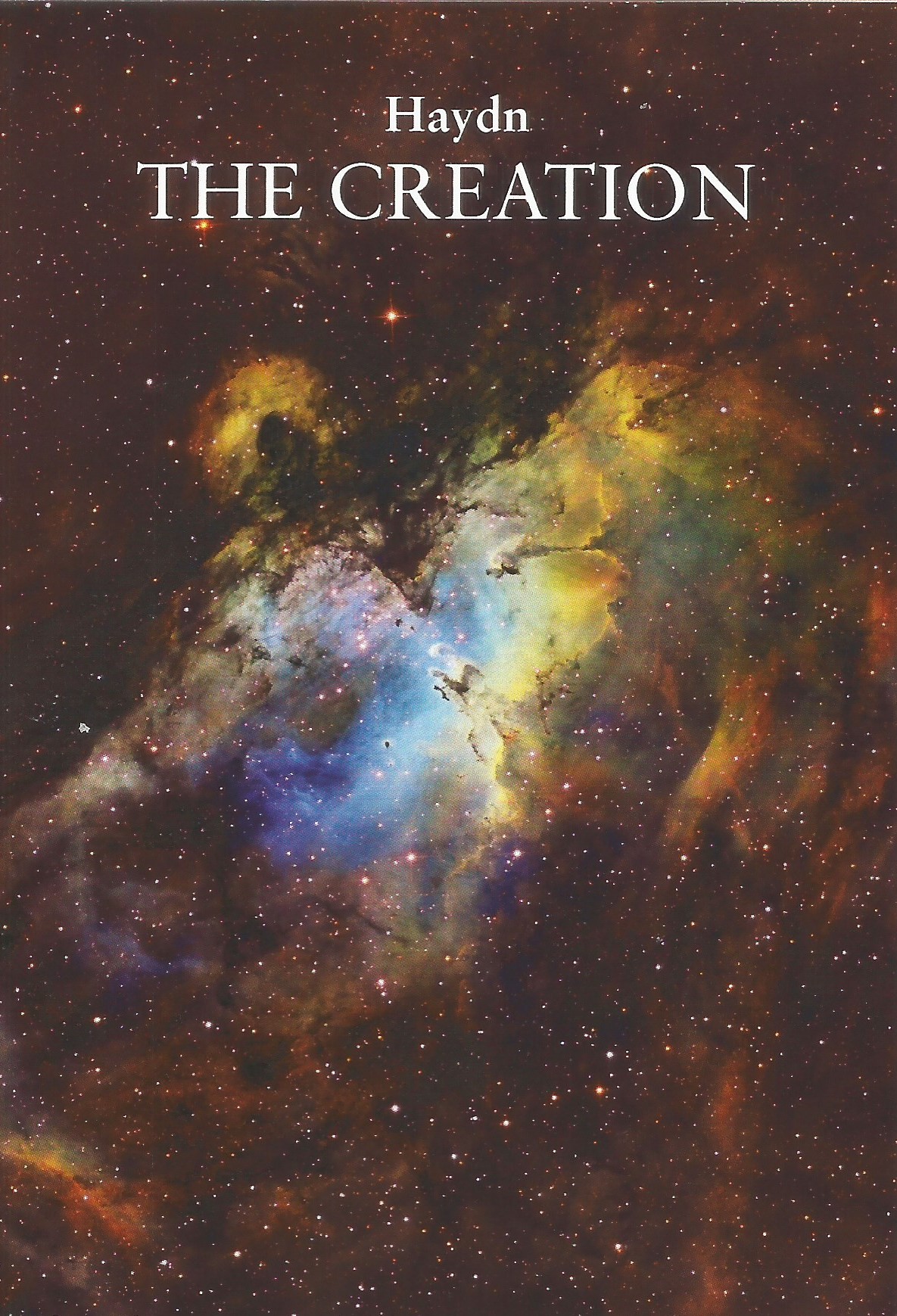
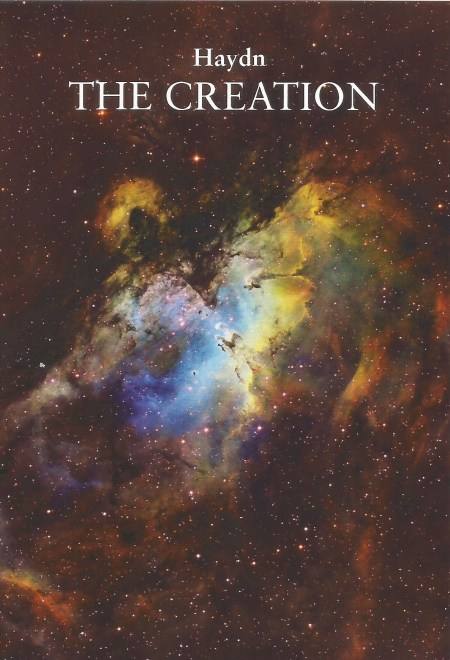
As the token astrophysicist present a few people asked me what was shown in the picture on the cover of the programme. Not being a proper astronomer I didn’t know but I am reliably informed that it is the Eagle Nebula (M16), though it is reversed left to right which I claim as an excuse for not recognising it…
From the Inventor of the H-index

Posted in Biographical, The Universe and Stuff with tags , , , , on March 5, 2020 by telescoper

My third-year students are busily engaged with a Computational Physics class test so I thought I’d occupy myself for a few minutes by sharing an interesting little paper that appeared on the arXiv a few weeks ago. The paper is by Jorge Hirsch, the inventor of the (in)famous H-index.

Here is the abstract:

A magnetic field H is expelled from the interior of a metal becoming superconducting. Everybody thinks the phenomenon is perfectly well understood, particularly scientists with the highest H-index think that. I don’t. I will explain why I believe that without Holes, conceptualized by Heisenberg in 1931 fifty years after Hall had first detected them in some metals, neither magnetic field expulsion nor anything else about superconductivity can be understood. I have been a Heretic in the field of superconductivity for over 30 years, and believe that Hans’ little story about the emperor perfectly captures the essence of the situation. Here is (a highly condensed version of) the wHole story.

You will see that, despite the liberal sprinkling of letters H, the paper isn’t ostensibly about the H-index, but it does contain some interesting comments thereon, including:

I proposed the H-index hoping it would be an objective measure of scientific achievement. By and large, I think this is believed to be the case. But I have now come to believe that it can also fail spectacularly and have severe unintended negative consequences. I can understand how the sorcerer’s apprentice must have felt.

I think the opinion of a scientist about the value of the H-index roughly speaking divides according to whether a said scientist has a big one or a small one. Those lucky enough to have a high H-index probably think it is fine, while those who have a low value can probably find a reason why it is flawed. My own H-index (42 according to Google Scholar) is mediocre, which I reckon is a fair reflection of my status.

R.I.P. Freeman Dyson (1923-2020)

Posted in The Universe and Stuff with tags , on February 29, 2020 by telescoper

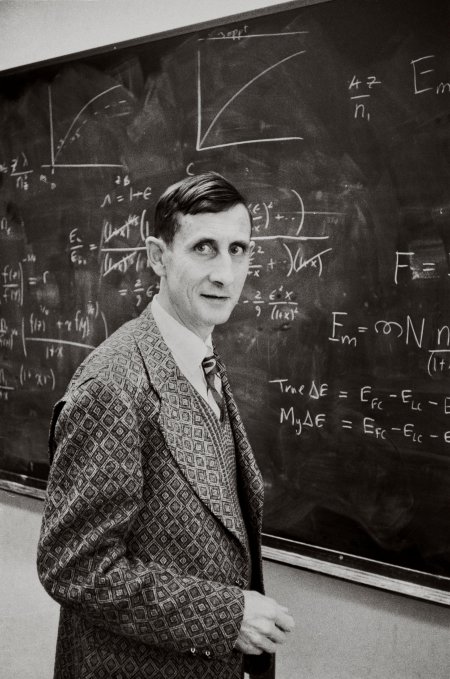
I was just about to leave work last night when I heard via social media the sad news of the death at the age of 96 of the theoretical physicist Freeman Dyson.

Overnight the regular media have been running tributes to him, and various friends and colleagues have been posting their own personal recollections of a remarkable scientist who also seems to have been a kind and generous human being.

I never had the opportunity to meet, or even correspond with, Freeman Dyson myself but I do recall from Nottingham times being told that both Dyson and Julian Schwinger visited and gave lectures for the bicentennial celebrations of the birth of George Green. People there remembered him with fondness.

Please feel free to share any personal reminiscences through the Comments Box below.

Freeman Dyson was an original and creative thinker who was by no means always right but I’ve always felt that scientists should be judged by their best work rather that their worst, and Dyson was a wonderful generator of ideas and made important and influential contributions across a wide range of fields from Quantum Electrodynamics and Solid State Physics to Astronomy and Cosmology.

Rest in peace, Freeman Dyson (1923-2020).

Clifford’s `Space-Theory of Matter’

Posted in Beards, History, mathematics, The Universe and Stuff with tags , , , on February 26, 2020 by telescoper

Well, here’s another thing I didn’t know until I was informed by Twitter.

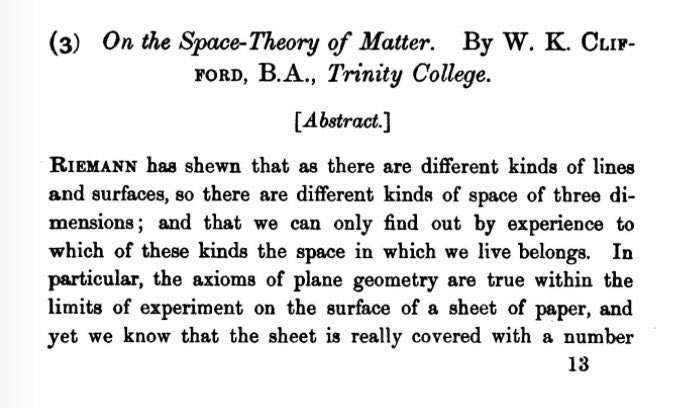
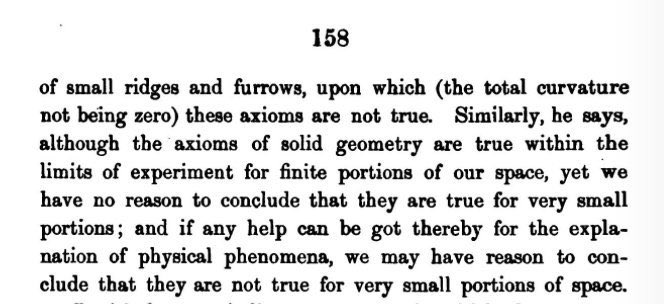
Way back in 1876 –  forty years before Einstein presented his Theory of General Relativity – the mathematician W.K. Clifford (who is most famous nowadays for the Clifford Algebra) presented a short paper in the Proceedings of the Cambridge Philosophical Society in which he speculated that space might be described by Riemannian rather than Euclidean Geometry.

Here are a couple of excerpts:

and

The paper does not contain any actual equations, and his concentration on small scales rather than large was misguided, but it is quite remarkable that he was thinking about such matters such a long time ago!

Unfortunately Clifford died very young, in 1879, at the age of 33, tuberculosis. Had he lived longer he might have been able to develop these ideas a bit further.

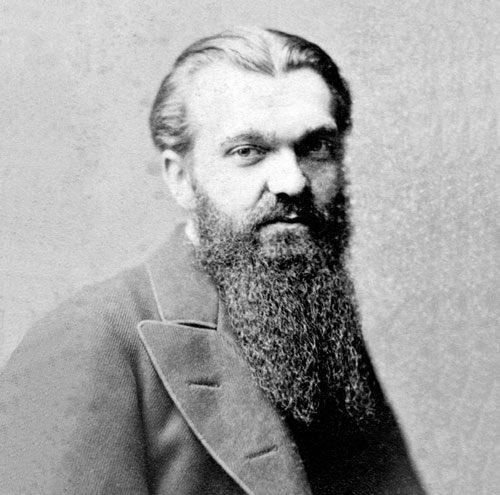
As a postscript I should mention that Clifford had an impressive beard.

A Problem of Snooker

Posted in Cute Problems, The Universe and Stuff with tags , , , on February 25, 2020 by telescoper

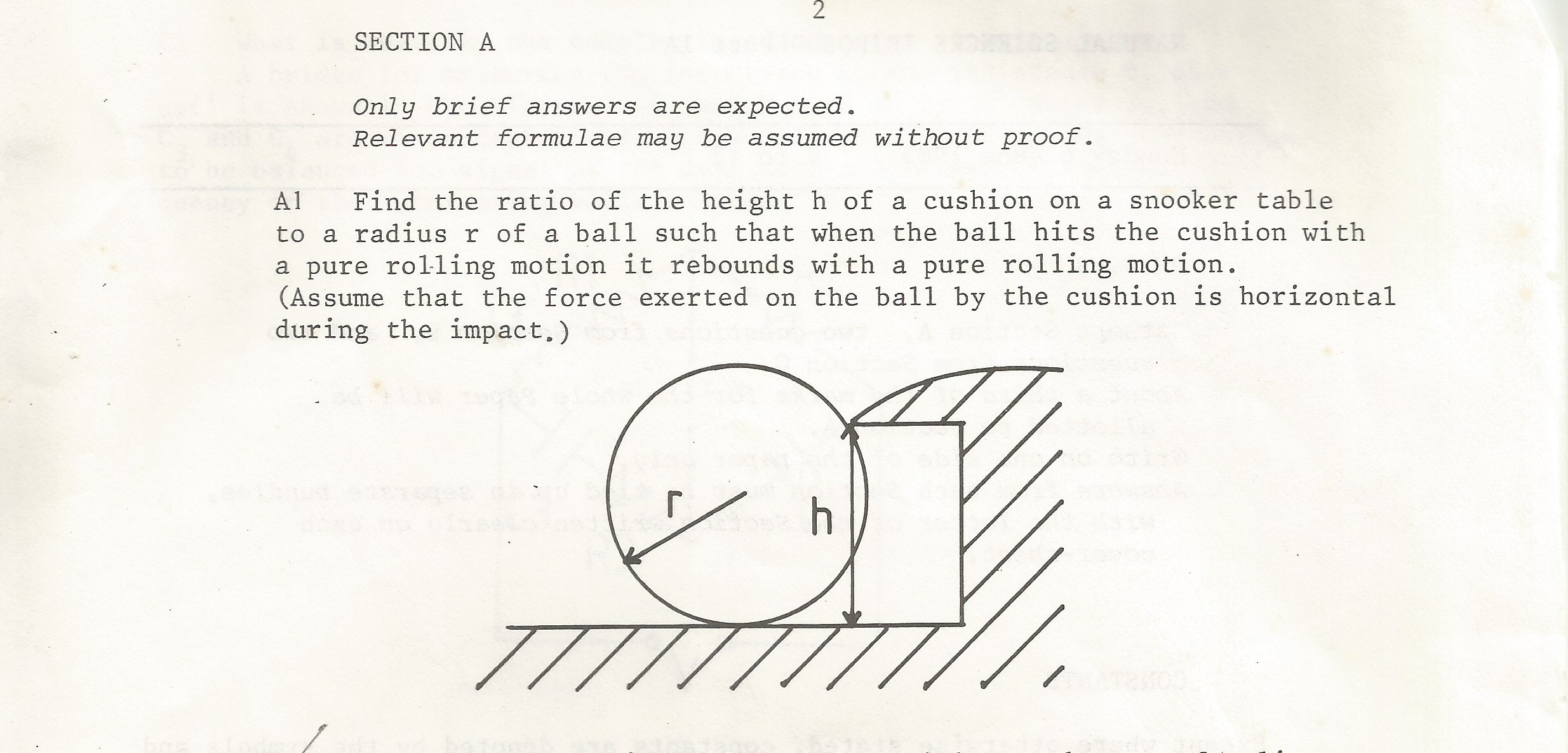
I came across the following question in a first-year physics examination from Cambridge (Part 1A Natural Sciences) and, since I have posted anything in the Cute Problems folder for a while I thought I would share it here:

Answers through the comments box please! And please show your working!

P.S. The preamble does not say whether you can also assume irrelevant formulae without proof…


A Statistical Solution to the Chaotic, Non-Hierarchical Three-Body Problem

Posted in The Universe and Stuff with tags , , , on February 24, 2020 by telescoper

I’m a bit late passing this on but I think some of my readers might find this interesting, as I did when I came across it a week or so ago. There’s a paper on the arXiv by Nicholas Stone and Nathan Leigh with the title A Statistical Solution to the Chaotic, Non-Hierarchical Three-Body Problem and the following abstract:

The three-body problem is arguably the oldest open question in astrophysics, and has resisted a general analytic solution for centuries. Various implementations of perturbation theory provide solutions in portions of parameter space, but only where hierarchies of masses or separations exist. Numerical integrations show that bound, non-hierarchical triples of Newtonian point particles will almost always disintegrate into a single escaping star and a stable, bound binary, but the chaotic nature of the three-body problem prevents the derivation of tractable analytic formulae deterministically mapping initial conditions to final outcomes. However, chaos also motivates the assumption of ergodicity, suggesting that the distribution of outcomes is uniform across the accessible phase volume. Here, we use the ergodic hypothesis to derive a complete statistical solution to the non-hierarchical three-body problem, one which provides closed-form distributions of outcomes (e.g. binary orbital elements) given the conserved integrals of motion. We compare our outcome distributions to large ensembles of numerical three-body integrations, and find good agreement, so long as we restrict ourselves to “resonant” encounters (the ~50% of scatterings that undergo chaotic evolution). In analyzing our scattering experiments, we identify “scrambles” (periods in time where no pairwise binaries exist) as the key dynamical state that ergodicizes a non-hierarchical triple. The generally super-thermal distributions of survivor binary eccentricity that we predict have notable applications to many astrophysical scenarios. For example, non-hierarchical triples produced dynamically in globular clusters are a primary formation channel for black hole mergers, but the rates and properties of the resulting gravitational waves depend on the distribution of post-disintegration eccentricities.

The full paper can be downloaded here. The abstract is very clear but you might want to read the wikipedia entry for the three-body problem for general background. Here’s a fun figure from the paper:

Let me just add a note of explanation of the word `hierarchical’ as applied here: it means when the mass of one body is very different from the other two, or that two of the bodies have a much smaller separation from each other than they do from the third.

This paper does not present an analytic solution of the unrestricted three-body problem (which is known to be intractable) but does provide some very useful statistical insights into the long-term evolution of three-body systems, for example confirming the generally held opinion that most such systems evolve into a state in which one body is ejected and the other two form a tight binary.

Evidence for a Spatially Flat Universe?

Posted in The Universe and Stuff with tags , , , , , , on February 19, 2020 by telescoper

Yesterday I saw a paper by George Efstathiou and Steve Gratton on the arXiv with the title The Evidence for a Spatially Flat Universe. The abstract reads:

We revisit the observational constraints on spatial curvature following recent claims that the Planck data favour a closed Universe. We use a new and statistically powerful Planck likelihood to show that the Planck temperature and polarization spectra are consistent with a spatially flat Universe, though because of a geometrical degeneracy cosmic microwave background spectra on their own do not lead to tight constraints on the curvature density parameter ΩK. When combined with other astrophysical data, particularly geometrical measurements of baryon acoustic oscillations, the Universe is constrained to be spatially flat to extremely high precision, with ΩK = 0.0004 ±0.0018 in agreement with the 2018 results of the Planck team. In the context of inflationary cosmology, the observations offer strong support for models of inflation with a large number of e-foldings and disfavour models of incomplete inflation.

You can download a PDF of the paper here. Here is the crucial figure:

This paper is in part a response to a paper I blogged about here and some other related work with the same general thrust. I thought I’d mention the paper here, however, because it contains some interesting comments about the appropriate choice of priors in the problem of inference in reference to cosmological parameters. I feel quite strongly that insufficient thought is given generally about how this should be done, often with nonsensical consequences. It’s quite frustrating to see researchers embracing the conceptual framework of Bayesian inference but then choosing an inappropriate prior. The prior is not an optional extra – it’s one of the key ingredients. This isn’t a problem limited to the inflationary scenarios discussed in the above paper, by the way, it arises in a much wider set of cosmological models. The real cosmological flatness problem is that too many cosmologists use  flat priors everywhere!