Archive for the The Universe and Stuff Category

New Publication at the Open Journal of Astrophysics!

Posted in OJAp Papers, Open Access, The Universe and Stuff with tags , , , , , , on November 24, 2019 by telescoper

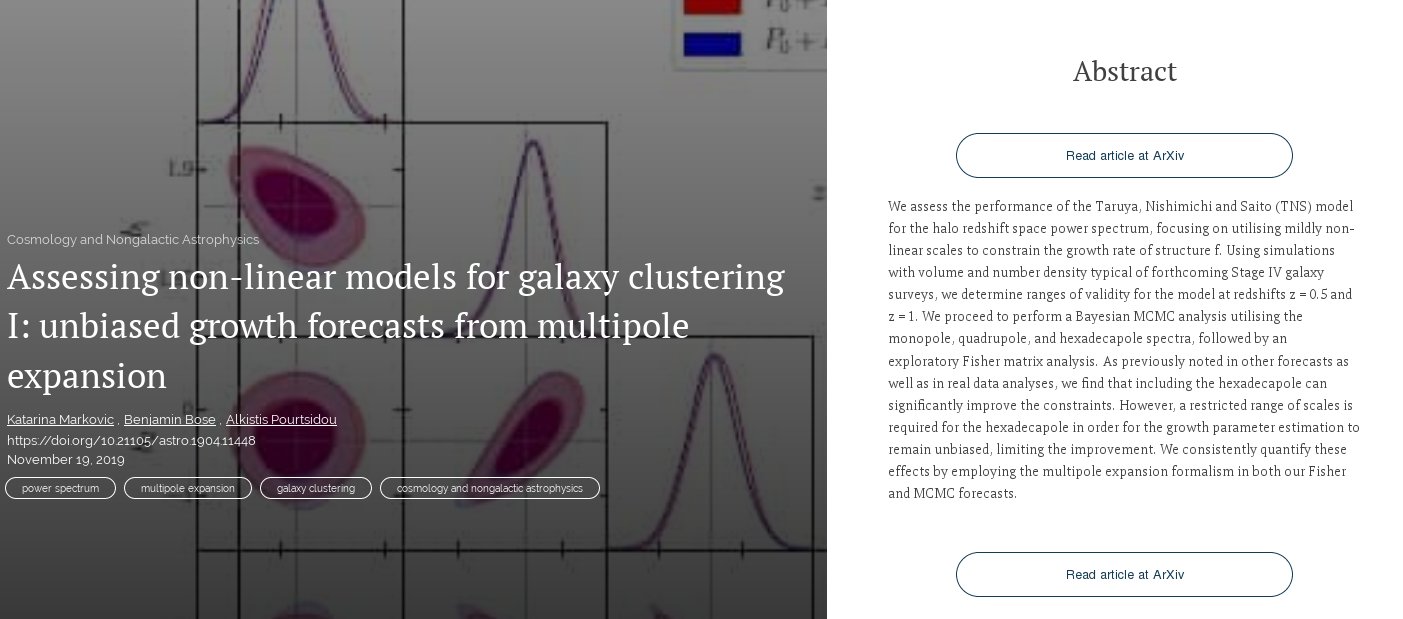
Yesterday we published another new paper at The Open Journal of Astrophysics. Here is a grab of the overlay:

The authors are Katarina MarKovic (now of JPL in California), Benjamin Bose (of the University of Geneva) and Alkistis Pourtsidou (Queen Mary, University of London).

You can find the accepted version on the arXiv here. This version was accepted after modifications requested by the referee and editor. Because this is an overlay journal the authors have to submit the accepted version to the arXiv (which we then check against the copy submitted to us) before publishing; version 2 on the arXiv is the accepted version.

I’d like to apologize to the authors for a delay in publishing this paper. It was ready to go a couple of weeks ago, but we had some trouble with an extension to the platform provided by Scholastica which was intended to register Digital Object Identifiers automatically and thus speed up the process. Unfortunately we found some bugs in, and other problems with, the new software and in the end have given up and reverted to the old manual registration process. Hopefully Scholastica will be able to offer a working system for DOI registration before too long.

Anyway, you will see that this is one for the `Cosmology and Nongalactic Astrophysics’ folder. We would be happy to get more submissions from other areas, especially Stellar and Planetary astrophysics. Hint! Hint!

P.S. Just a reminder that we now have an Open Journal of Astrophysics Facebook page where you can follow updates from the Journal should you so wish..

With the Cosmic Web in Mind..

Posted in Astronomy Lookalikes, The Universe and Stuff with tags , , , , , on November 23, 2019 by telescoper

Some time ago I posted one of my Astronomy Look-alikes about the remarkable similarity between the structure of the human brain and that revealed by computer simulations of the large-scale structure of the Universe:

I wonder whether this means that the Cosmic Web is really just all in the mind?

Anyway I just came across an article by Franco Vazza and Alberto Fenetti that takes the comparison between brain cells (among other things) and the Cosmic Web a bit further, including a look at the corresponding power spectra:

The main point to take from this picture is that many naturally occurring patterns have approximately power-law power spectra, at least over a limited range of scales. However, as I have pointed out before on this blog, the power spectrum on its own does not really quantify pattern in any meaningful way. Here for example are two patterns with exactly the same power spectrum:

The point is that the power spectrum does not contain any information about the phase correlations of the Fourier modes, which are important in quantifying localised features. For further discussion of this issue, see here.

The Theoretical Physics Equipment Store

Posted in Education, The Universe and Stuff with tags , on November 22, 2019 by telescoper

This door, deep in the bowels of the Department of Theoretical Physics at Maynooth University, leads to a cupboard in which we keep all the equipment used in our Theoretical Physics lectures:

The door is not numbered as a security precaution because of the high value of the items contained in the cupboard. This is foolproof measure because it is the only door in the Department without a number on it, and is therefore impossible to identify. It is here that you will find, among other things, some items I used in my first-year Mechanics lectures:

  • a supply of light inelastic string;
  • frictionless pulleys (various sizes);
  • rigid rods of various lengths;
  • a large array of point masses;
  • smooth inclined planes at various angles;
  • a collection of perfectly elastic spheres;
  • bottles containing a variety of incompressible fluids of negligible viscosity;
  • jars of ideal gas.

I’m mindful, however, that we may lack some items that are in regular use in Theoretical Physics departments elsewhere, perhaps for more advanced topics,  so if anyone has ideas for things to be added to this store please suggest them through the comments box so I can ensure that we have them in stock for next semester.


R. I. P. John Brown (1947-2019)

Posted in The Universe and Stuff with tags on November 18, 2019 by telescoper

It’s a very sad way to start the week but I have to convey the news that the Astronomer Royal for Scotland, John Brown, passed away suddenly on Saturday 16th November.

John (pictured above just after he received the Gold Medal of the Royal Astronomical Society in 2012) was an expert on the physics of solar and stellar plasmas. He was also an enthusiastic and dedicated teacher and advocate for science, giving memorably ebullient public talks to a diverse range of audiences in which he often included conjuring tricks (of which he was a skilled exponent). He was awarded an OBE in 2016 for services to science and outreach.

Above all else he was a very kindly and affable character who was universally liked, was great fun to be around, and who will be greatly missed within the astronomical community and beyond.

I send my heartfelt condolences to his family, friends and colleagues at the University of Glasgow on the loss of a much loved and irreplaceable character.

Rest in peace, John Campbell Brown (1947-2019).

The Case for Irish Membership of CERN

Posted in Politics, The Universe and Stuff with tags , , , , on November 16, 2019 by telescoper

In the news here in Ireland this week is a new report from a Committee of the Houses of the Oireachtas making the case for Ireland to join CERN. You can download the report here (PDF) and you’ll find this rather striking graphic therein:

You will see that there are only three European countries that don’t have any form of membership or other agreement with CERN: Latvia, Bosnia-Herzegovina and Ireland. The fact that almost everyone else is in is not in itself necessarily a good argument for Ireland to join, but it does make one wonder why so many other countries have found it to join or have an agreement with CERN while Ireland has not.

As the document explains, if the Irish government  were to decide to take Ireland into CERN then  it would first have to become an Associate Member, which would cost around €1.2 million per year. That’s small potatoes really, and  the financial returns to Irish industry and universities are likely to far exceed that, so the report strongly recommends this step be taken. This Associate member stage would last up to 5 years, and then to acquire full membership a joining fee of around €15.6 million would have to be paid, which is obviously a much greater commitment but in my view still worthwhile.

While I strongly support the idea of Ireland joining CERN I do have a couple of concerns.

One is that I’m very sad that the actual science done at CERN is downplayed in the Oireachtas report. Most of it is about return to industry, training opportunities, etc. These are important, of course, but it must not be forgotten that big science projects like those carried out at CERN are above all else science projects. The quest for knowledge does have collateral benefits, but it a worthy activity in its own right and we shouldn’t lose sight of that.

My other (related) concern is that joining CERN is one thing, but in order to reap the scientific reward the government has to invest in the resources needed to exploit the access to facilities membership would provide. Without a related increase in research grant funding for basic science the opportunity to raise the level of scientific activity in Ireland would be lost.

Ireland recently joined the European Southern Observatory (ESO), a decision which gave Irish astronomers access to some amazing telescopes. However, there is no sign at all of Irish funding agencies responding to this opportunity by increasing funding for academic time, postdocs and graduate students needed to do the actual science.

Although astronomy is clearly much more interesting than particle physics (😉) in one respect the case of ESO is very like the case of CERN – the facilities do not themselves do the science. We need people to do that.

That was the Science Week that was..

Posted in Books, Talks and Reviews, The Universe and Stuff with tags , , , on November 15, 2019 by telescoper


So, as advertised, this morning I gave a talk mainly to school students as part of Science Week Ireland on the subject of the cosmic web. This was a similar talk to the one I gave at DIAS a couple of weeks ago.


There was a slight confusion about rooms but we did eventually get everyone into the right lecture theatre and weren’t too late getting started. The audience was about 140, so the room was very full and most of them didn’t fall asleep. I had a nice chat afterwards with a group of them and they seemed to have enjoyed it. Anyway, in case anyone is interested here are my slides. Most of them are recycled from previous versions of this talk.

Following this morning’s exertions we had lovely seminar after lunch by Wyn Evans of Cambridge about the stellar dynamics of the Milky Way and the wonders of Gaia and soon will be going to dinner.

Upcoming conference in Ireland on the history of physics

Posted in History, The Universe and Stuff on November 13, 2019 by telescoper

Much as I dislike the word “upcoming”, it is my pleasure to reblog this announcement about a conference to be held at Trinity College next summer (June 17th to 19th). In particular the deadline for abstracts is only a month away (December 15th) so if you would like to contribute a talk you have until then to submit an abstract!

cormac's avatarAntimatter

Just a quick post to highlight the fact that December 15th marks the deadline for submission of abstracts for the 4th International Conference on the History of Physics. The conference marks the fourth in a biennial series of meetings supported by the UK Institute of Physics and the European Physical Society that aim to bring together historians of science and physicists with an interest in the history of their subject and will take place at Trinity College Dublin on June 17th-19th. The website for the conference is here and previous iterations of the conference can be found here.

fiop-poster05112019

I have attended all three of the previous meetings of this conference series and they were most interesting. As the conference takes place in Ireland this time around, I have been heavily involved in the preparations, from chairing the scientific programming committee to attending regular meetings of the organizing committee…

View original post 79 more words

Newton’s Laws in Translation

Posted in History, Maynooth, The Universe and Stuff with tags , , on November 13, 2019 by telescoper

I’m about to do some lectures about Newton’s Laws of Motion to my first-year Mathematical Physics class so I thought I’d put up a quick post about how these laws have been expressed through the years. The original versions in the Principia (frontispiece above, first published in 1687) are of course in Latin. I did five years of Latin at school, but found most of the Principia impenetrable when I tried to read it in the original


The laws of motion are however fairly clear, perhaps because they are familiar in English:

Lex I: Corpus omne perseverare in statu suo quiescendi vel movendi uniformiter in directum, nisi quatenus illud a viribus impressis cogitur statum suum mutare.

Lex II: Mutationem motus proportionalem esse vi motrici impressæ, & fieri secundum lineam rectam qua vis illa imprimitur.

Lex III: Actioni contrariam semper & æqualem esse reactionem: sive corporum duorum actiones in se mutuo semper esse æqualeset in partes contrarias dirigi.

As I am teaching in a room in the old college here in Maynooth (which was founded in 1795), I looked for a contemporary English translation. This is from 1792:

Law I: Every body perseveres in a state of being at rest or of moving uniformly straight forward except insofar as it is compelled to change its state by forces impressed.

Law II: The alteration of motion is ever proportional to the motive force impressed; and is made in the direction of the right line in which that force is impressed.

Law III: To every action there is always opposed an equal reaction: or the mutual action of two bodies upon each other are always equal, and directed to contrary parts.

And finally here’s the modern version I was taught at School:

First Law: Every body continues in a state of rest or uniform motion in a straight line unless it is acted upon by an external (unbalanced) force.

Second Law: The rate of change of momentum of a body is proportional to the impressed force, and is in the direction in which this force acts.

Third Law: To every action there is always an equal and opposite reaction,

an alternative form of the Third Law being:

Third Law: If Body A exerts a force on Body B then Body B exerts a force on Body A which is equal in magnitude and opposite in direction.

Going back to the 1792 English translation, the exposition of the second law continues:

If a force generates a motion, a double force will generate double the motion, a triple force triple the motion, whether that force be impressed altogether and at once, or gradually and successively. And this motion (being always directed the same way with the generating force), if the body moved before, is added to or subtracted from the former motion, according as they directly conspire with or are directly contrary to each other; or obliquely joined, when they are oblique, so as to produce a new motion compounded from the determination of both.

If only Newton had known vector notation!


More Cosmic Tension?

Posted in The Universe and Stuff with tags , , , , , , , , , on November 12, 2019 by telescoper

Quite a lot of fuss was being made in cosmological circles while I was away last week concerning a paper that had just been published in Nature Astronomy by Eleonora Di Valentino, Alessandro Melchiorri and Joe Silk that claims evidence from the Planck Cosmic Microwave background and other data that the Universe might be closed (or at least have positive spatial curvature) in contrast to the standard cosmological model in which the spatial geometry is Euclidean. Nature Astronomy is behind a paywall but the paper is available for free on the arXiv here. The abstract reads:

The recent Planck Legacy 2018 release has confirmed the presence of an enhanced lensing amplitude in CMB power spectra compared to that predicted in the standard ΛCDM model. A closed universe can provide a physical explanation for this effect, with the Planck CMB spectra now preferring a positive curvature at more than 99% C.L. Here we further investigate the evidence for a closed universe from Planck, showing that positive curvature naturally explains the anomalous lensing amplitude and demonstrating that it also removes a well-known tension within the Planck data set concerning the values of cosmological parameters derived at different angular scales. We show that since the Planck power spectra prefer a closed universe, discordances higher than generally estimated arise for most of the local cosmological observables, including BAO. The assumption of a flat universe could, therefore, mask a cosmological crisis where disparate observed properties of the Universe appear to be mutually inconsistent. Future measurements are needed to clarify whether the observed discordances are due to undetected systematics, or to new physics, or simply are a statistical fluctuation.

I think the important point to take from this study is that estimates of cosmological parameters obtained from Planck are relatively indirect, in that they involve the simultaneous determination of several parameters some of which are almost degenerate. For example, the `anomalous’ lensing amplitude discussed in this paper is degenerate with the curvature so that changing one could mimic the effect on observables of changing the other; see Figure 2 in the paper.

It’s worth mentioning another (and, in my opinion, better argued) paper on a similar topic by Will Handley of Cambridge which is on the arXiv here. The abstract of this one reads:

The curvature parameter tension between Planck 2018, cosmic microwave background lensing, and baryon acoustic oscillation data is measured using the suspiciousness statistic to be 2.5 to 3σ. Conclusions regarding the spatial curvature of the universe which stem from the combination of these data should therefore be viewed with suspicion. Without CMB lensing or BAO, Planck 2018 has a moderate preference for closed universes, with Bayesian betting odds of over 50:1 against a flat universe, and over 2000:1 against an open universe.

Figure 1 makes a rather neat point that the combination of Planck and Baryon Acoustic Oscillations does not separately give consistent values for the Hubble constant and the curvature and neither does the combination of Planck and direct Hubble constant estimates:

I don’t know what the resolution of these tensions is, but I think it is a bit dangerous to dismiss them simply as statistical flukes. They might be that, of course, but they also might not be. By shrugging one’s shoulders and ignoring such indications one might miss something very fundamental. On the other hand, in my opinion, there is nothing here that definitely points the finger at spatial curvature either: it is possible that there is something else missing from the standard model that, if included, would resolve these tensions. But what is the missing link?

Answers on a postcard, or through the comments box.

The University Strikes are Back!

Posted in Education, The Universe and Stuff with tags , , , , on November 6, 2019 by telescoper

I noticed that a recent ballot of members of the University and College Union (UCU) has delivered a mandate for industrial action across 60 UK universities. Eight days of strikes will start later this month: they will last from November 25th until December 4th. The cause of the dispute is twofold: (1) the long-running saga of the Universities pension scheme (about which there were strikes in 2018); and (2) over pay, equality, workloads and the ever-increasing casualisation of lecturing and other work.

Among the institutions to have voted for strike action are my previous employers Cardiff, Sussex and Nottingham.
It seems to have taken a long time to count the votes in the case of Sussex UCU, but the result was a large majority in favour of action. It remains to be seen what the impact of these strikes will be, but they could affect a very large number of students. Nobody likes going on strike but the UK higher education system is a very poor state right now, and many of my former colleagues feel that they have no alternative.

Anyway, the real purpose of this short post is simply to express solidarity with those taking industrial action. It it set to be a big struggle, but I wish everyone taking part all the best on the picket lines!