Archive for the The Universe and Stuff Category

A Prominence from Principe

Posted in History, The Universe and Stuff with tags , , , , on April 13, 2019 by telescoper

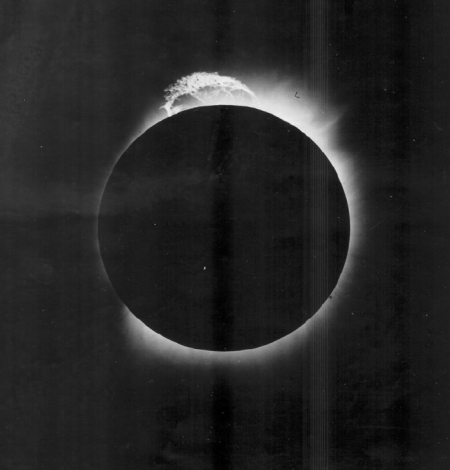
While I seem to be on a little run of posts about the 1919 Eclipse I thought I’d share the above photograph, taken at Principe, that shows that the bending of light from stars was not the only observation made at this eclipse. At the top of the figure you can see a wonderful example of a solar prominence..

The Mystery Object Revealed

Posted in History, The Universe and Stuff with tags , , , , , on April 12, 2019 by telescoper

As I revealed this afternoon in my talk at the Royal Astronomical Society, yesterday’s mystery object..

..is in fact the 4-inch object (geddit?) glass that was manufactured by Howard Grubb in Dublin and taken to Sobral in Brazil in 1919 to be used in a famous experiment to measure the bending of light by the Sun during a total eclipse.

Here is a picture of the observing setup in Sobral:

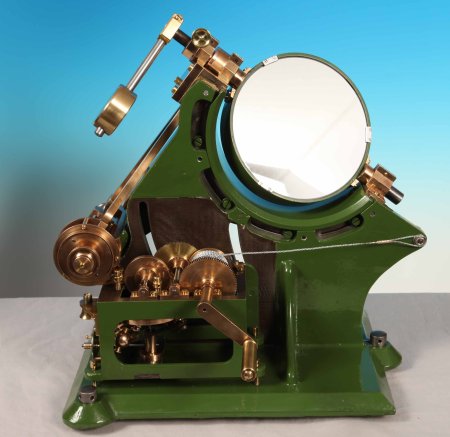
The 4-inch lens is mounted in the square tube on the right. The eclipse was observed using a coelostat (a steerable mirror) that reflected light into the telescopes. Here is a photograph of the coelostat:

The object glass and coelostat are usually on display at Dunsink Observatory but these are currently en route to Brazil for the commemorations of the centenary of the historic expedition.

Photo Credits to Tom Ray of DIAS…

Mystery Object

Posted in History, The Universe and Stuff on April 11, 2019 by telescoper

I’ve had a very busy day today and am now about to dash off again so I’ll just post this picture to see if anyone can guess what the mystery object is..

Answers through the Comments Box please!

Results from the Event Horizon Telescope

Posted in Astrohype, The Universe and Stuff with tags , , on April 10, 2019 by telescoper

Following yesterday’s little teaser, let me point out that there is a press conference taking place today (at 2pm Irish Summer Time, that’s 3pm Brussels) to announce a new result from the Event Horizon Telescope. The announcement will be streamed live here.

Sadly, I’m teaching at the time of the press conference so I won’t be able to watch, but that doesn’t mean that you shouldn’t!

I’ll post pictures and comments when I get back. Watch this space. Or you could watch this video..

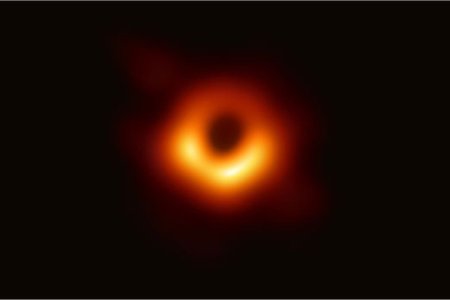
UPDATE: Well, there we are. Here is the image of the `shadow’ of the event horizon around the black hole in M87:

The image is about 42 micro arcseconds across. I guess to people brought up on science fiction movies with fancy special effects the image is probably a little underwhelming, but it really is an excellent achievement to get that resolution. Above all, it’s a great example of scientific cooperation – 8 different telescopes all round the world. The sizeable European involvement received a substantial injection of funding from the European Union too!

Other parameters are here:

The accompanying EU press release is here. Further information can be found here. The six publications relating to this result can be found here:

The Shadow of an Event Horizon

Posted in The Universe and Stuff with tags , , , , , on April 9, 2019 by telescoper

There is a paper on the arXiv written about 5 years ago called Towards the event horizon – the supermassive black hole in the Galactic Center by Falcke and Markoff, the abstract of which reads:

The center of our Galaxy hosts the best constrained supermassive black hole in the universe, Sagittarius A* (Sgr A*). Its mass and distance have been accurately determined from stellar orbits and proper motion studies, respectively, and its high-frequency radio, and highly variable near-infrared and X-ray emission originate from within a few Schwarzschild radii of the event horizon. The theory of general relativity (GR) predicts the appearance of a black hole shadow, which is a lensed image of the event horizon. This shadow can be resolved by very long baseline radio interferometry and test basic predictions of GR and alternatives thereof. In this paper we review our current understanding of the physical properties of Sgr A*, with a particular emphasis on the radio properties, the black hole shadow, and models for the emission and appearance of the source. We argue that the Galactic Center holds enormous potential for experimental tests of black hole accretion and theories of gravitation in their strong limits.

Please note that the black hole in the centre of the giant elliptical galaxy M87 is about 1000 times further away from us than the black hole in the centre of the Milky Way but is also about 1000 times more massive, so its Schwarzschild radius is 1000 times larger. The observational challenge of imaging the event horizon is therefore similar in the two cases.

You may find this useful if, by sheer coincidence, there is some big announcement tomorrow..

Gravitational Wave Flash!

Posted in The Universe and Stuff with tags , , , , on April 9, 2019 by telescoper

The third observing run for Advanced LIGO – O3 – started on April 1 2019, after 19 months upgrading the detectors. Last night, April 8, saw the first new detection of a candidate gravitational wave source, apparently another black hole binary, dubbed S190408an.

It is anticipated that sources like this will be discovered at a rate of roughly one per week for the (planned) year-long run. Given the likely rate of events the policy of LIGO is now to make data publicly available directly without writing papers first. You can find the data entry for this event here, including this map of its position.

Whether the LIGO Scientific Collaboration will release sufficient data for others to perform a full analysis of the signal remains to be seen, but if the predicted detection rate matches reality, the field is going to move very rapidly from studies of individual events to statistical analysis of large populations. Such is the way of science!

Approaching the Centenary of the 1919 Eclipse Expeditions

Posted in Books, Talks and Reviews, History, The Universe and Stuff on April 4, 2019 by telescoper

Just a brief post to alert my readers – both of them – to the fact that there’s a very big centenary celebration coming up, on May 29th. This is 100 years to the day since a total eclipse of the Sun provided the opportunity to test Albert Einstein’s (then) new theory of general relativity. This was the event that turned Einstein into a cultural icon. I’ll be posting about a number of things to commemorate this important happening – include some new things that I’ve been working on to do with this, and an event here in Maynooth – but for the mean time let me just mention a couple of imminent items.

One is that I am giving a 30-minute talk on the 1919 Eclipse Expeditions at the Ordinary Meeting of the Royal Astronomical Society in Burlington House in London on 12th April 2019 (that’s a week tomorrow). That’s the closest date to the centenary that could be managed, as the May meeting of the RAS is the Annual General Meeting at which there is no scientific programme and there are no meetings after that until October 2019.

The second thing is that I’ve written a review of three books based on the 1919 expeditions for Nature, which I’m told will be the lead piece in their Spring Books supplement, published on April 18th 2019.

Anyway, all this provides me with a good excuse to repost an old item here. I’ve written quite a lot about this in past years, including a little book and a slightly more technical paper. I decided, though, to post this little piece which is based on an article I wrote some years ago for Firstscience.

–0–

The Eclipse that Changed the Universe

A total eclipse of the Sun is a moment of magic: a scant few minutes when our perceptions of the whole Universe are turned on their heads. The Sun’s blinding disc is replaced by ghostly pale tentacles surrounding a black heart – an eerie experience witnessed by hundreds of millions of people throughout Europe and the Near East last August.

But one particular eclipse of the Sun, eighty years ago, challenged not only people’s emotional world. It was set to turn the science of the Universe on its head. For over two centuries, scientists had believed Sir Isaac Newton’s view of the Universe. Now his ideas had been challenged by a young German-Swiss scientist, called Albert Einstein. The showdown – Newton vs Einstein – would be the total eclipse of 29 May 1919.

Newton’s position was set out in his monumental Philosophiae Naturalis Principia Mathematica, published in 1687. The Principia – as it’s familiarly known – laid down a set of mathematical laws that described all forms of motion in the Universe. These rules applied as much to the motion of planets around the Sun as to more mundane objects like apples falling from trees.

At the heart of Newton’s concept of the Universe were his ideas about space and time. Space was inflexible, laid out in a way that had been described by the ancient Greek mathematician Euclid in his laws of geometry. To Newton, space was the immovable and unyielding stage on which bodies acted out their motions. Time was also absolute, ticking away inexorably at the same rate for everyone in the Universe.

Sir Isaac Newton, painted by Sir Godfrey Kneller. Picture Credit: National Portrait Gallery,

For over 200 years, scientists saw the Cosmos through Newton’s eyes. It was a vast clockwork machine, evolving by predetermined rules through regular space, against the beat of an absolute clock. This edifice totally dominated scientific thought, until it was challenged by Albert Einstein.

In 1905, Einstein dispensed with Newton’s absolute nature of space and time. Although born in Germany, during this period of his life he was working as a patent clerk in Berne, Switzerland. He encapsulated his new ideas on motion, space and time in his special theory of relativity. But it took another ten years for Einstein to work out the full consequences of his ideas, including gravity. The general theory of relativity, first aired in 1915, was as complete a description of motion as Newton had prescribed in his Principia. But Einstein’s description of gravity required space to be curved. Whereas for Newton space was an inflexible backdrop, for Einstein it had to bend and flex near massive bodies. This warping of space, in turn, would be responsible for guiding objects such as planets along their orbits.

Albert Einstein (left), pictured with Arthur Stanley Eddington (right). Picture Credit: Royal Greenwich Observatory.

By the time he developed his general theory, Einstein was back in Germany, working in Berlin. But a copy of his general theory of relativity was soon smuggled through war-torn Europe to Cambridge. There it was read by Arthur Stanley Eddington, Britain’s leading astrophysicist. Eddington realised that Einstein’s theory could be tested. If space really was distorted by gravity, then light passing through it would not travel in a straight line, but would follow a curved path. The stronger the force of gravity, the more the light would be bent. The bending would be largest for light passing very close to a very massive body, such as the Sun.

Unfortunately, the most massive objects known to astronomers at the time were also very bright. This was before black holes were seriously considered, and stars provided the strongest gravitational fields known. The Sun was particularly useful, being a star right on our doorstep. But it is impossible to see how the light from faint background stars might be bent by the Sun’s gravity, because the Sun’s light is so bright it completely swamps the light from objects beyond it.

A scientific sketch of the path of totality for the 1919 eclipse. Picture Credit: Royal Greenwich Observatory.

Eddington realised the solution. Observe during a total eclipse, when the Sun’s light is blotted out for a few minutes, and you can see distant stars that appear close to the Sun in the sky. If Einstein was right, the Sun’s gravity would shift these stars to slightly different positions, compared to where they are seen in the night sky at other times of the year when the Sun far away from them. The closer the star appears to the Sun during totality, the bigger the shift would be.

Eddington began to put pressure on the British scientific establishment to organise an experiment. The Astronomer Royal of the time, Sir Frank Watson Dyson, realised that the 1919 eclipse was ideal. Not only was totality unusually long (around six minutes, compared with the two minutes we experienced in 1999) but during totality the Sun would be right in front of the Hyades, a cluster of bright stars.

But at this point the story took a twist. Eddington was a Quaker and, as such, a pacifist. In 1917, after disastrous losses during the Somme offensive, the British government introduced conscription to the armed forces. Eddington refused the draft and was threatened with imprisonment. In the end, Dyson’s intervention was crucial persuading the government to spare Eddington. His conscription was postponed under the condition that, if the war had finished by 1919, Eddington himself would lead an expedition to measure the bending of light by the Sun. The rest, as they say, is history.

The path of totality of the 1919 eclipse passed from northern Brazil, across the Atlantic Ocean to West Africa. In case of bad weather (amongst other reasons) two expeditions were organised: one to Sobral, in Brazil, and the other to the island of Principe, in the Gulf of Guinea close to the West African coast. Eddington himself went to Principe; the expedition to Sobral was led by Andrew Crommelin from the Royal Observatory at Greenwich.

British scientists in the field at their observing site in Sobral in 1919. Picture Credit: Royal Greenwich Observatory

The expeditions did not go entirely according to plan. When the day of the eclipse (29 May) dawned on Principe, Eddington was greeted with a thunderstorm and torrential rain. By mid-afternoon the skies had partly cleared and he took some pictures through cloud.

Meanwhile, at Sobral, Crommelin had much better weather – but he had made serious errors in setting up his equipment. He focused his main telescope the night before the eclipse, but did not allow for the distortions that would take place as the temperature climbed during the day. Luckily, he had taken a backup telescope along, and this in the end provided the best results of all.

After the eclipse, Eddington himself carefully measured the positions of the stars that appeared near the Sun’s eclipsed image, on the photographic plates exposed at both Sobral and Principe. He then compared them with reference positions taken previously when the Hyades were visible in the night sky. The measurements had to be incredibly accurate, not only because the expected deflections were small. The images of the stars were also quite blurred, because of problems with the telescopes and because they were seen through the light of the Sun’s glowing atmosphere, the solar corona.

Before long the results were ready. Britain’s premier scientific body, the Royal Society, called a special meeting in London on 6 November. Dyson, as Astronomer Royal took the floor, and announced that the measurements did not support Newton’s long-accepted theory of gravity. Instead, they agreed with the predictions of Einstein’s new theory.

The final proof: the small red line shows how far the position of the star has been shifted by the Sun’s gravity. Each star experiences a tiny deflection, but averaged over many exposures the results definitely support Einstein’s theory. Picture Credit: Royal Greenwich Observatory.

The press reaction was extraordinary. Einstein was immediately propelled onto the front pages of the world’s media and, almost overnight, became a household name. There was more to this than purely the scientific content of his theory. After years of war, the public embraced a moment that moved mankind from the horrors of destruction to the sublimity of the human mind laying bare the secrets of the Cosmos. The two pacifists in the limelight – the British Eddington and the German-born Einstein – were particularly pleased at the reconciliation between their nations brought about by the results.

But the popular perception of the eclipse results differed quite significantly from the way they were viewed in the scientific establishment. Physicists of the day were justifiably cautious. Eddington had needed to make significant corrections to some of the measurements, for various technical reasons, and in the end decided to leave some of the Sobral data out of the calculation entirely. Many scientists were suspicious that he had cooked the books. Although the suspicion lingered for years in some quarters, in the end the results were confirmed at eclipse after eclipse with higher and higher precision.

In this cosmic ‘gravitational lens,’ a huge cluster of galaxies distorts the light from more distant galaxies into a pattern of giant arcs. Picture Credit: NASA

Nowadays astronomers are so confident of Einstein’s theory that they rely on the bending of light by gravity to make telescopes almost as big as the Universe. When the conditions are right, gravity can shift an object’s position by far more than a microscopic amount. The ideal situation is when we look far out into space, and centre our view not on an individual star like the Sun, but on a cluster of hundreds of galaxies – with a total mass of perhaps 100 million million suns. The space-curvature of this immense ‘gravitational lens’ can gather the light from more remote objects, and focus them into brilliant curved arcs in the sky. From the size of the arcs, astronomers can ‘weigh’ the cluster of galaxies.

Einstein didn’t live long enough to see through a gravitational lens, but if he had he would definitely have approved….

Time-Varying Constants

Posted in The Universe and Stuff with tags , , , on April 1, 2019 by telescoper

Two serious questions crossed my mind during Friday’s very interesting talk about the redefinition of SI units. One is that the changeover to the new system takes place on 20th May, which is right in the middle of the examination period at Maynooth University. We will therefore have to supply two differents set of physical constants, one to go with examination papers taken before 20th May and the other for those taken afterwards. This will even affect those of us who like to use natural units in which, for example, Planck’s Constant is set equal to unity: after the redefinition of Planck’s constant on 20th May 2019, we will have to set its value in natural units to be equal to 0.99999999987.

The other question is that the new system of SI units presupposes that the constants of physics are actually constant and can therefore provide a stable framework. Many theories have been suggested in which the fundamental constants change with time. In the present context I feel obliged also to point out as an example the classic paper of Scherrer (2009) (PDF available here) the abstract of which reads:

We examine the time variation of a previously-uninvestigated fundamental dimensionless constant. Constraints are placed on this time variation using historical measurements. A model is presented for the time variation, and it is shown to lead to an accelerated expansion for the universe. Directions for future research are discussed.

This casts grave doubt on the motivation for the new system of SI units, at least until 12 noon.

A Change of Units

Posted in The Universe and Stuff with tags , , , , on March 29, 2019 by telescoper

To round off a very strange week I’ve just been to an interesting talk by Dr Bajram Zeqiri of the National Physical Laboratory in Teddington (UK) about imminent changes to the International System of Units (usually known as SI units). In a nutshell, what is to happen is that the current seven base units are to be redefined in terms of fundamental constants. In effect this means that the these constants will fix the standard units rather than the other way round. For more details, see here. The change is due to come into effect on 20th May 2019.

Our speaker Dr Zeqiri is nearing the end of a short tour of Ireland speaking about these changes. Before giving the third talk on this subject talk today, 29th March 2019, thought to be the date on which the United Kingdom would leave the European Union, he wondered whether he might be able to claim political asylum in Ireland. Fortunately, today is not Brexit Day and following today’s events in Westminster it is by no means certain when that might be or indeed whether Brexit will even happen at all…

Machine Learning in the Physical Sciences

Posted in The Universe and Stuff with tags , , , , , on March 29, 2019 by telescoper

If, like me, you feel a bit left behind by goings-on in the field of Machine Learning and how it impacts on physics then there’s now a very comprehensive review by Carleo et al on the arXiv.

Here is a picture from the paper, which I have included so that this post has a picture in it:

The abstract reads:

Machine learning encompasses a broad range of algorithms and modeling tools used for a vast array of data processing tasks, which has entered most scientific disciplines in recent years. We review in a selective way the recent research on the interface between machine learning and physical sciences.This includes conceptual developments in machine learning (ML) motivated by physical insights, applications of machine learning techniques to several domains in physics, and cross-fertilization between the two fields. After giving basic notion of machine learning methods and principles, we describe examples of how statistical physics is used to understand methods in ML. We then move to describe applications of ML methods in particle physics and cosmology, quantum many body physics, quantum computing, and chemical and material physics. We also highlight research and development into novel computing architectures aimed at accelerating ML. In each of the sections we describe recent successes as well as domain-specific methodology and challenges.

The next step after Machine Learning will of course be Machine Teaching…