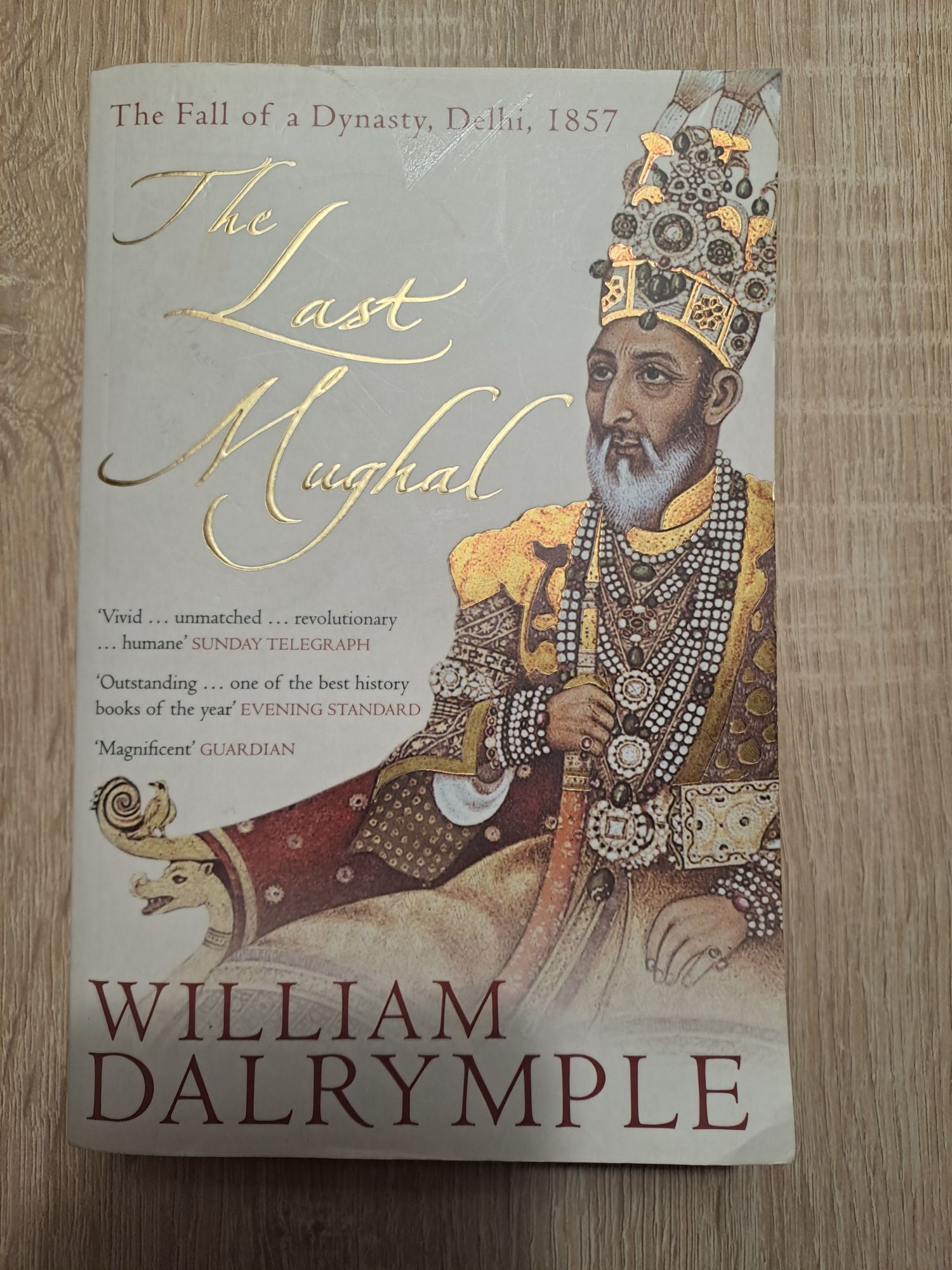
The latest item on my sabbatical reading list is The Last Mughal by William Dalrymple. This is about Bahadur Shah Zafur, the last King of the Mughal Dynasty that ruled Hindustan from its capital Delhi for 350 years, but it’s really about the last years of his life, focusing on the Indian Rebellion (Uprising) of 1857, when Mughal rule was already in a state of decline, to his death in exile in Rangoon five years afterwards. His narrative makes much use of the Mutiny Papers, an enormous collection of correspondence from the time of the rebellion collected in India’s National Archive, and there is extensive use of quoted material. There is also an extensive glossary and some excellent illustrations.
I remember learning about the “Indian Mutiny” (as it was called then) when I was doing my O-level History (in 1979) but that was more-or-less entirely from a British perspective. The immediate trigger for the rebellion of the sepoys in the British Army, we were told with some amusement by our teacher, was that a rumour had spread that the grease used to lubricate cartridges for the newly-issued Enfield rifles contained a mixture of beef fat and lard, offensive to both Hindus and Muslims. The implication was that this was a silly and trivial matter. There was, of course, a lot more to it than that…
Dalrymple explains how the British, Hindus and Muslims in Delhi co-existed reasonably peacefully until the middle of the 19th Century; there were many mixed marriages and it was by no means unknown for British representatives of the East India Company to wear Indian dress. This began to change with the arrival of a new British colonial class who disrespected any religion other than their own form of Christianity; the same attitudes were held by this class towards Irish Catholics. Resentment had been building up among both Hindus and Muslims, who felt their beliefs were under threat. The Enfield rifles were just the spark that lit the fire.
Let me quote from the book:
But while Zafar was certainly never cut out to be a heroic or revolutionary leader, he remains, like his ancestor the Emperor Akbar, an attractive symbol of Islamic civilisation at its most tolerant and pluralistic. he himself was a notable poet and calligrapher; his court contained some of the talented and artistic and literary figures in modern South Asian history; and the Delhi he presided over was undergoing one of its great periods of learning, communal amity and prosperity. He is certainly a strikingly liberal and sensitive figure when compared to the Victorian Evangelicals whose insensitivity, arrogance and blindness did so much to bring the Uprising of 1857 down upon their own heads, and those of the people and court of Delhi, engulfing all of northern India in a religious war of terrible violence
The Last Mughal, pp. 483-4
The Indian Rebellion (which took place between May and September 1857) was on a huge scale and involved terrible atrocities: women and children were not spared, many of the executed in sadistic fashion. The rebels (“mutineers” to the British) flocked to Delhi drawn to the idea that the Mughal King would lead them to victory. Unfortunately Zafar was already an old man of 82 and he was in no fit state, either mentally or physically, to be a military leader. By then he had very little power as King anyway; he certainly had only modest financial resources. He was really more of a mascot than anything else.
The lack of military leadership at Delhi was a serious problem for the rebels. In the British army a sepoy was unable to rise to a rank that involved commanding more than about 100 men. There was no-one at Delhi capable of organizing and coordinating the huge rebel army, with the result that they were unable to dislodge a much smaller British force that had assembled on a ridge outside the city. Eventually a much larger British column arrived and Delhi’s fate was sealed. Not without themselves suffering heavy casualties, the British eventually stormed the Kashmiri Gate, entered the city, looted what they could find and massacred the remnants of the rebel army in revenge for the atrocities committed by the sepoys. The famous Red Fort was largely destroyed. A plan to flatten Delhi completely was seriously considered, but eventually rejected. What remained however was a City of the Dead – that’s the title of Chapter 11.
Zafar was eventually captured but in contrast to most of the rest of his family and members of his court, was not summarily executed but exiled to Rangoon where he died in obscurity just five years later.
This book is vividly written with a extraordinary eye for detail as well as a sense of the grand sweep of the history. It must be difficult to combine the large and small scale like that. Although it’s well written it’s not always easy to read. The graphic descriptions of indiscriminate slaughter by both sides made me very uncomfortable, as did the obvious racism of many British officials and army officers revealed by the Mutiny Papers. But these are part of history, and we have to be made aware of them.
Zafar was of course Muslim, but a significant majority – almost two-thirds – of the sepoys who took part in the rebellion were Hindus. It’s interesting that both factions seem to have been content to rally around the Mughal banner. At his “trial” the British authorities in the form of prosecutor Major Harriott tried to argue that Zafar was the leader of a global Muslim conspiracy.
Here’s another quote:
The Uprising in fact showed every sign of being initiated by upper-caste Hindu sepoys reacting against specifically grievances perceived as a threat to their faith and dharma.; it then spread rapidly through the country, attracting a fractured and diffuse collection of other groups alienated by aggressively insensitive and brutal British policies. Among these were the Mughal court and the many Muslim individuals who made their way to Delhi and fought as civilian jihadis united against the kafir enemy. Yet Harriott’s bigoted and Islamophobic argument oversimplified this complex picture down to an easily comprehensible, if quite fictional, global Muslim conspiracy with an appealingly visible and captive hate figure at its centre, towards whom righteous vengeance could now be directed.
The Last Mughal, pp. 439-40
I won’t dwell on the obvious and important lesson about how bigotry and intolerance feed extremism, as the one lesson one can learn from studying history is that nobody ever learns the most obvious and important lesson.








 In the Dark