It’s time once more for another Saturday update of activity at the Open Journal of Astrophysics. Since the last update we have published a further three papers, bringing the number in Volume 9 (2026) to 163 and the total so far published by OJAp up to 611.
I continue to include the posts made on our Mastodon account (on Fediscience); these announcements also show the DOI for each paper.
The first paper to report this week was published on Tuesday 28th July in the folder Cosmology and Nongalactic Astrophysics. “The Origins of the Bulk Flow” by Richard Watkins & Trajan Clark (Willamett U., USA) and Hume A Feldman (U. Kansas, USA) analyzes the origin of large-scale bulk flow using the CosmicFlows-4 catalog, finding that it is largely influenced by structures beyond 200 h-1 Mpc, challenging previous assumptions.
The overlay for this paper is here
You can find the officially accepted version on arXiv here and the announcement on Fediverse here:
New Publication at the Open Journal of Astrophysics: "The Origins of the Bulk Flow" by Richard Watkins & Trajan Clark (Willamett U., USA) and Hume A Feldman (U. Kansas, USA).
The second paper for this week, also published on Tuesday 28th July in the folder Cosmology and Nongalactic Astrophysics is: “Enhancing weak lensing redshift distribution characterization by optimizing the Dark Energy Survey Self-Organizing Map Photo-z method” by A. Campos (Carnegie Mellon U., USA) and the DES collaboration (113 authors). This study improves the Self-Organizing Map methodology for estimating redshift distribution in galaxies, notably reducing overlap between redshift bins, in preparation for the Dark Energy Survey Year 6 data.Abstractfor Enhancing weak lensing redshift distribution characterization by optimizing the Dark Energy Survey Self-Organizing Map Photo-z method.
The overlay looks like this:
The official version of the paper can be found on arXiv here and the Fediverse announcement here:
New Publication at the Open Journal of Astrophysics: "Enhancing weak lensing redshift distribution characterization by optimizing the Dark Energy Survey Self-Organizing Map Photo-z method" by A. Campos (Carnegie Mellon U., USA) and the DES collaboration (113 authors)
New Publication at the Open Journal of Astrophysics: "The Ray Tracing Sampler: Bayesian Sampling of Neural Networks for Everyone" by Peter Behroozi (U. Arizona, USA)
So here we are again, on a Saturday morning, with another update of activity at the Open Journal of Astrophysics. Since the last update we have published a further five papers, bringing the number in Volume 9 (2026) to 87 and the total so far published by OJAp up to 535.
I will continue to include the posts made on our Mastodon account (on Fediscience) to encourage you to visit it. Mastodon is a really excellent service, and a more than adequate replacement for X/Twitter (which nobody should be using); these announcements also show the DOI for each paper.
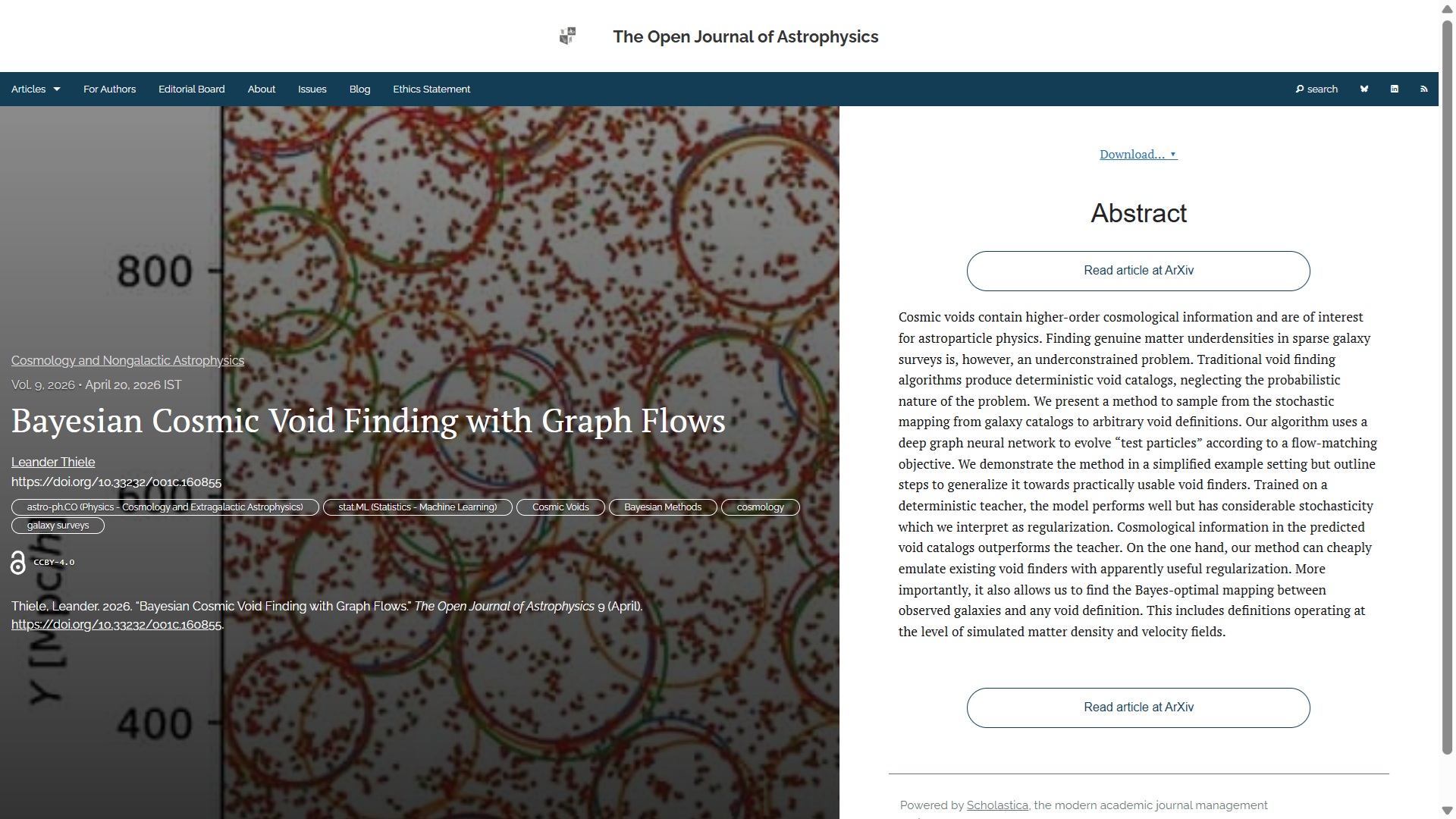
The first paper to report this week is “Bayesian Cosmic Void Finding with Graph Flows” by Leander Thiele (U. Tokyo, Japan). This was published on Monday 20th April in the folder Cosmology and Nongalactic Astrophysics. The paper presents a method using a deep graph neural network to identify cosmic voids in sparse galaxy surveys, improving upon traditional deterministic algorithms by considering the problem’s probabilistic nature. The overlay is here:
You can find the officially accepted version on arXiv here and the announcement on Fediverse here:
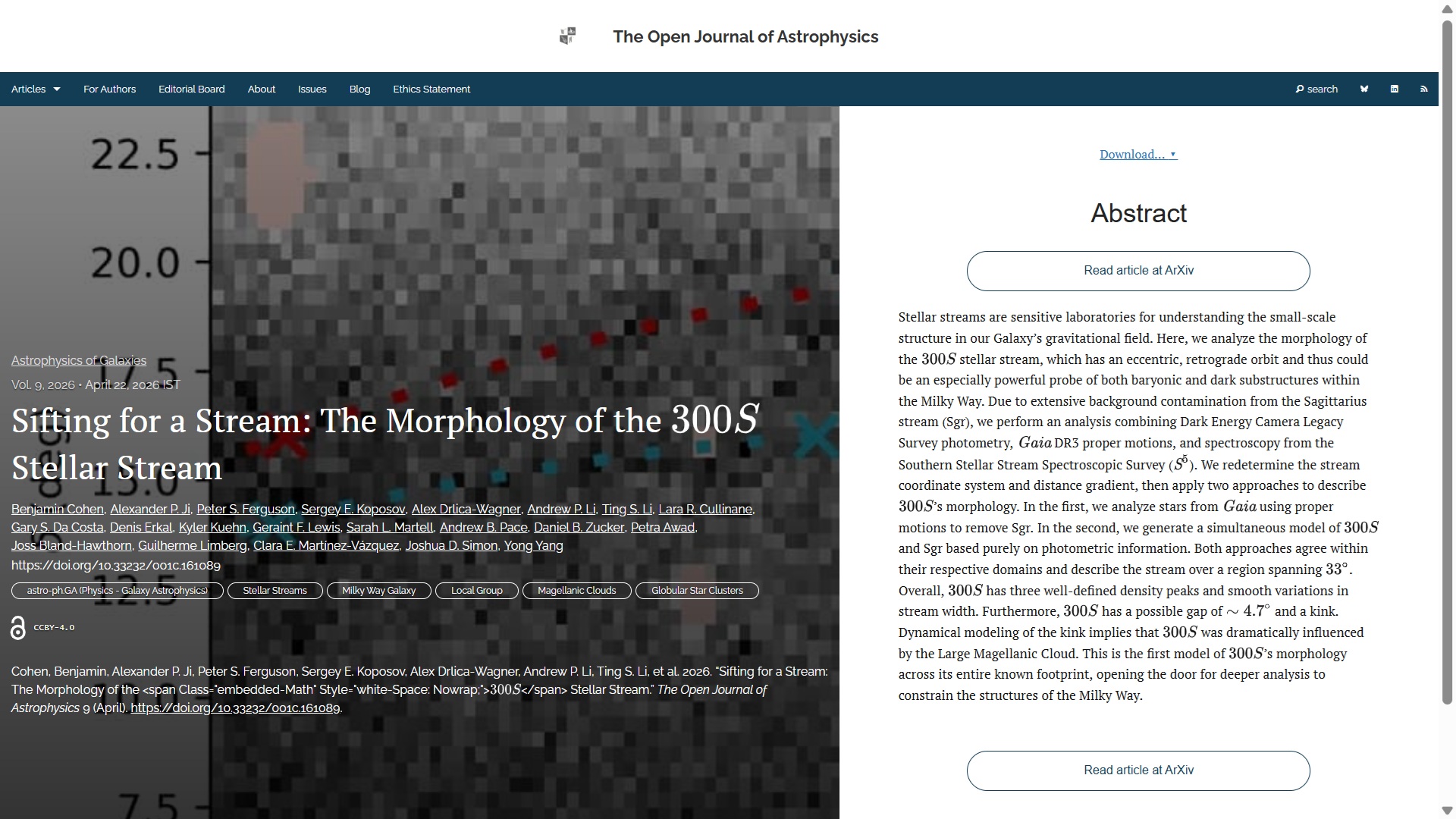
The second paper for this week, published on Wednesday 22nd April in the folder Astrophysics of Galaxies, is “Sifting for a Stream: The Morphology of the 300S Stellar Stream” by Benjamin Cohen (U. Chicago, USA) and 20 others distributed around the world. This study analyzes the morphology of the $300S$ stellar stream, revealing three density peaks, a possible gap, and a kink, suggesting significant influence from the Large Magellanic Cloud on its structure.
The overlay for this one is here:
The official version of the paper can be found on arXiv here and the Fediverse announcement here:
New Publication at the Open Journal of Astrophysics: "Sifting for a Stream: The Morphology of the 300S Stellar Stream" by Benjamin Cohen (U. Chicago, USA) and 20 others distributed around the world.
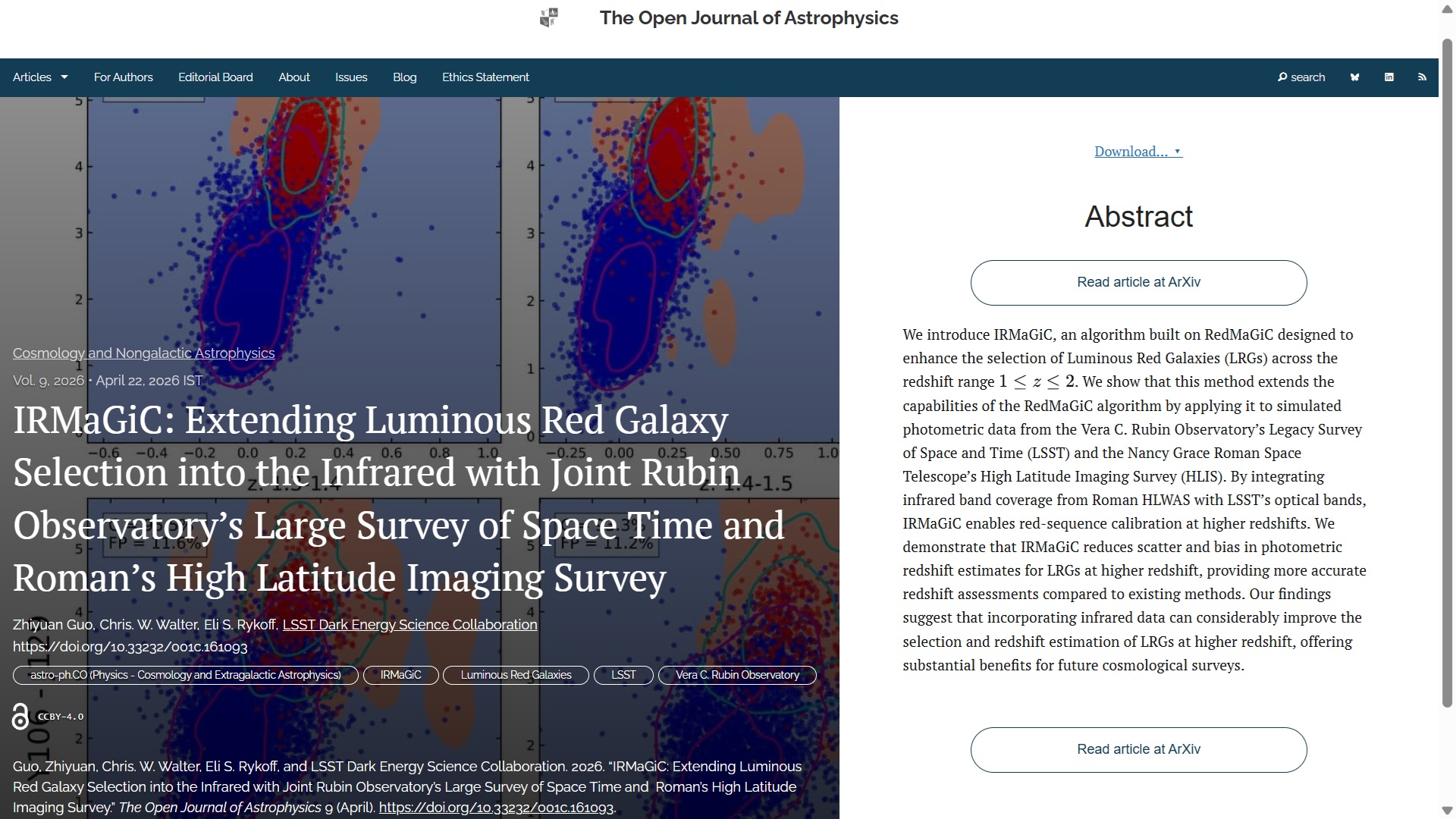
New Publication at the Open Journal of Astrophysics: "IRMaGiC: Extending Luminous Red Galaxy Selection into the Infrared with Joint Rubin Observatory’s Large Survey of Space Time and Roman’s High Latitude Imaging Survey" by Zhiyuan Guo & Chris. W. Walter (Duke U., USA) and Eli S. Rykoff (Stanford U., USA) on behalf of the LSST Dark Energy Science Collaboration
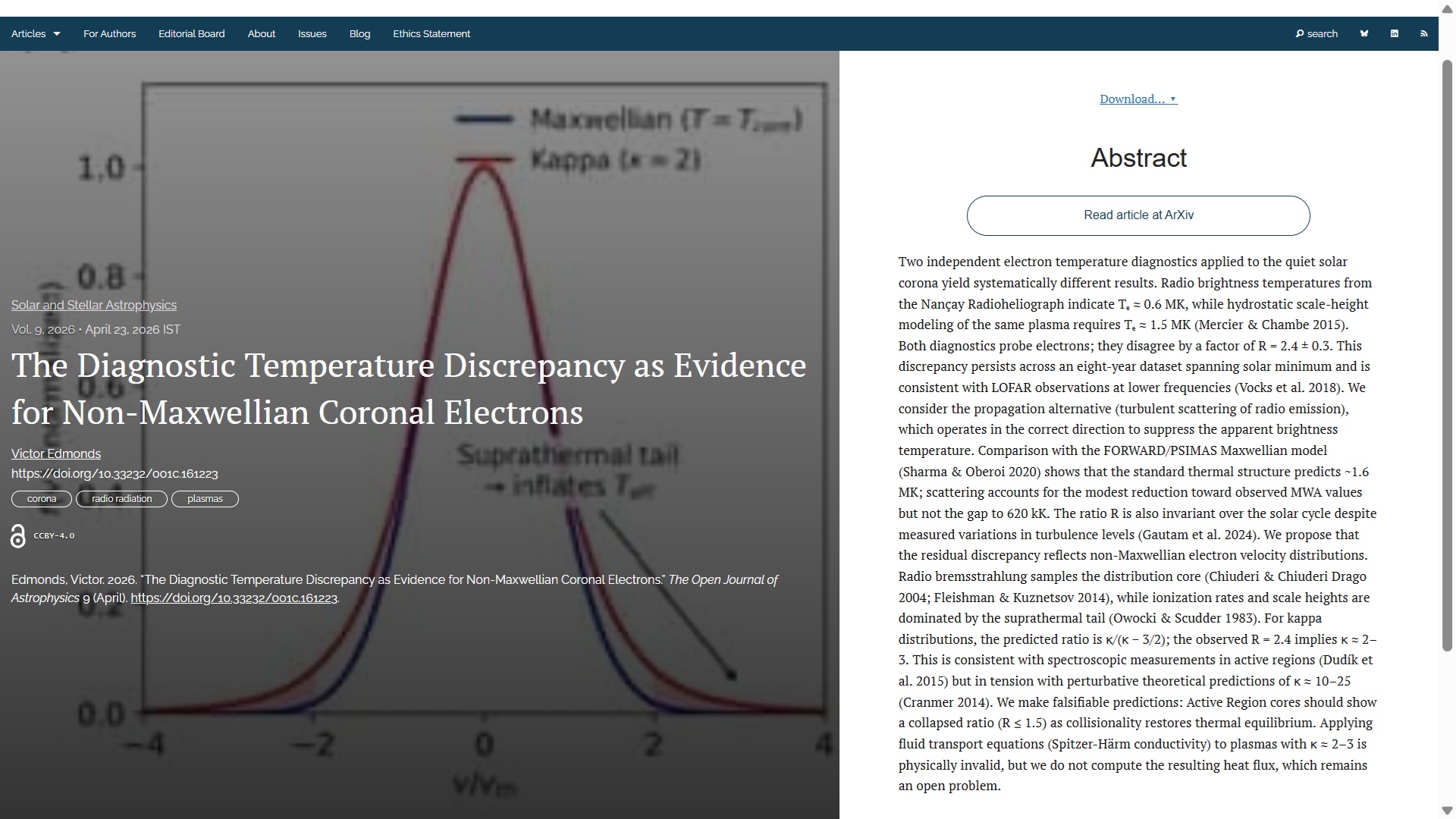
New Publication at the Open Journal of Astrophysics: "The Diagnostic Temperature Discrepancy as Evidence for Non-Maxwellian Coronal Electrons" by Victor Edmonds (Final Stop Consulting, USA)
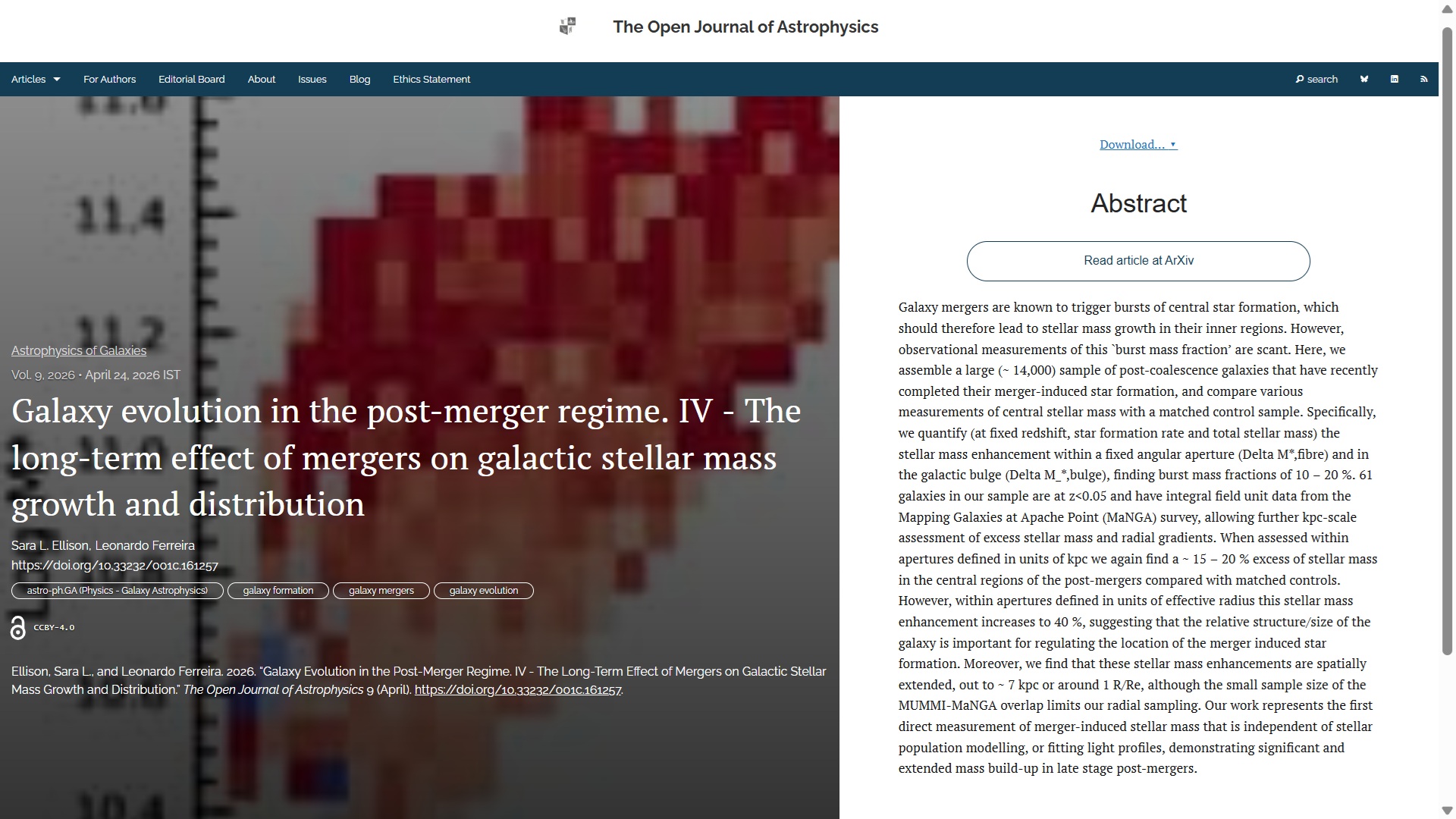
The fifth and final paper for this week was published on Friday 24th April in the folder Astrophysics of Galaxies. The title is “Galaxy evolution in the post-merger regime. IV – The long-term effect of mergers on galactic stellar mass growth and distribution” by Sara L. Ellison (U. Victoria, Canada) and Leonardo Ferreira (Universidade Federal do Rio Grande, Brazil). This study uses a large sample of post-merger galaxies to demonstrate that galaxy mergers trigger significant and extended stellar mass growth in their central regions, independent of stellar population modelling.
The overlay is here:
You can find the authorized version of this paper on arXiv here and the Fediverse announcement is here:
New Publication at the Open Journal of Astrophysics: "Galaxy evolution in the post-merger regime. IV – The long-term effect of mergers on galactic stellar mass growth and distribution" by Sara L. Ellison (U. Victoria, Canada) and Leonardo Ferreira (Universidade Federal do Rio Grande, Brazil)
New Publication at the Open Journal of Astrophysics: "Galaxy evolution in the post-merger regime. IV – The long-term effect of mergers on galactic stellar mass growth and distribution" by Sara L. Ellison (U. Victoria, Canada) and Leonardo Ferreira (Universidade Federal do Rio Grande, Brazil)
Once again it’s time for the usual Saturday morning update of activity at the Open Journal of Astrophysics. Since the last update we have published a further eight papers, bringing the number in Volume 9 (2026) to 67 and the total so far published by OJAp up to 515.
I will continue to include the posts made on our Mastodon account (on Fediscience) to encourage you to visit it. Mastodon is a really excellent service, and a more than adequate replacement for X/Twitter (which nobody should be using); these announcements also show the DOI for each paper.
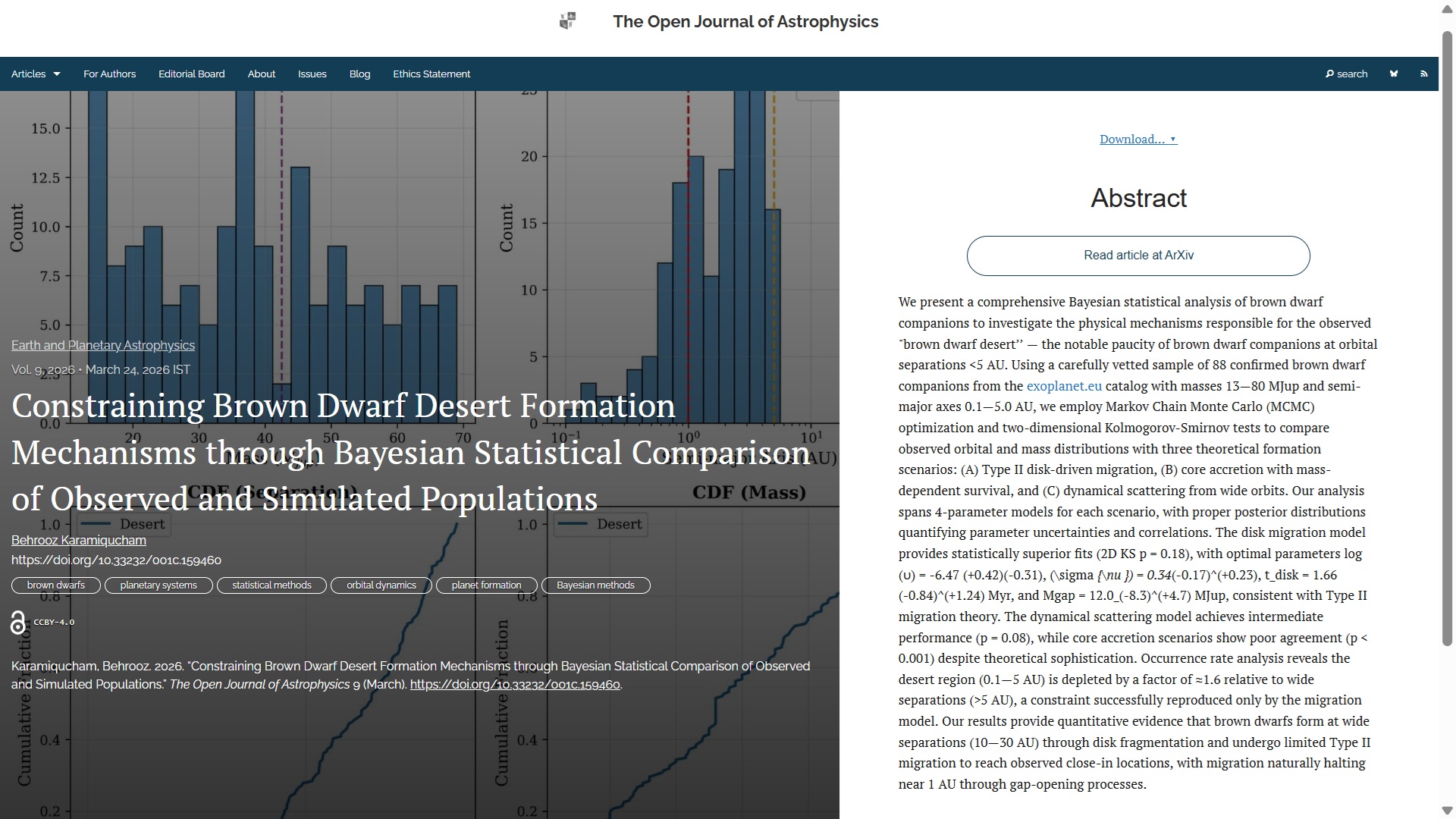
New Publication at the Open Journal of Astrophysics: "Constraining Brown Dwarf Desert Formation Mechanisms through Bayesian Statistical Comparison of Observed and Simulated Populations" by Behrooz Karamiqucham (College of Charleston, USA)
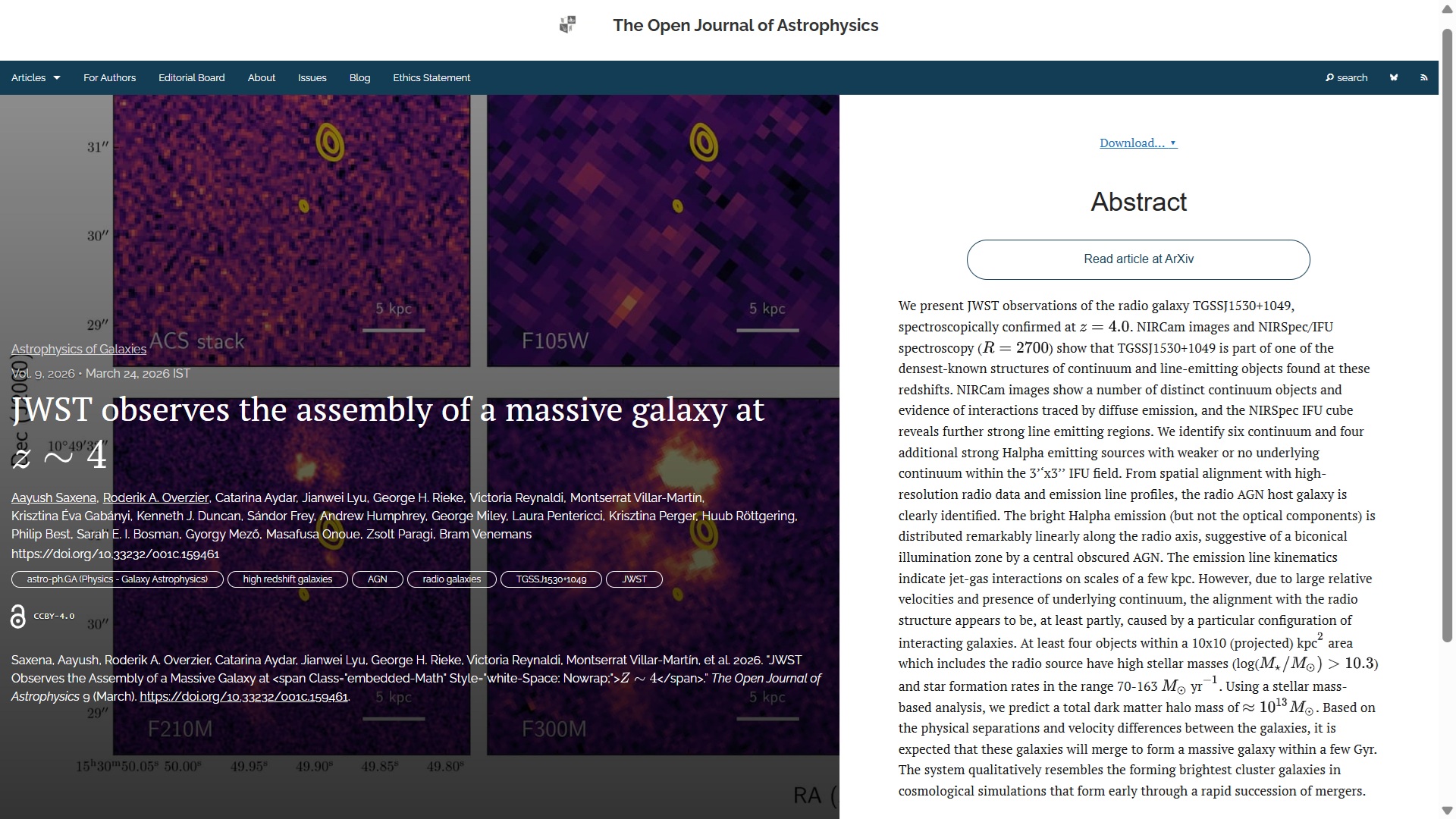
The second paper for this week, also published on Tuesday March 24th, but in the folder Astrophysics of Galaxies, is “JWST observes the assembly of a massive galaxy at z ~ 4” by Aayush Saxena (University of Oxford, UK) and 20 others (based in the UK, Europe, USA, Brazil, Japan and China). The paper presents observations of radio galaxy TGSSJ1530+1049, revealing it as part of a dense structure of emitting objects likely to merge to form a massive galaxy within a few Gyr.
The overlay for this one is here:
The official version of the paper can be found on arXiv here and the Fediverse announcement here:
New Publication at the Open Journal of Astrophysics: "JWST observes the assembly of a massive galaxy at z ~ 4" by Aayush Saxena (University of Oxford, UK) and 20 others (based in the UK, Europe, USA, Brazil, Japan and China)
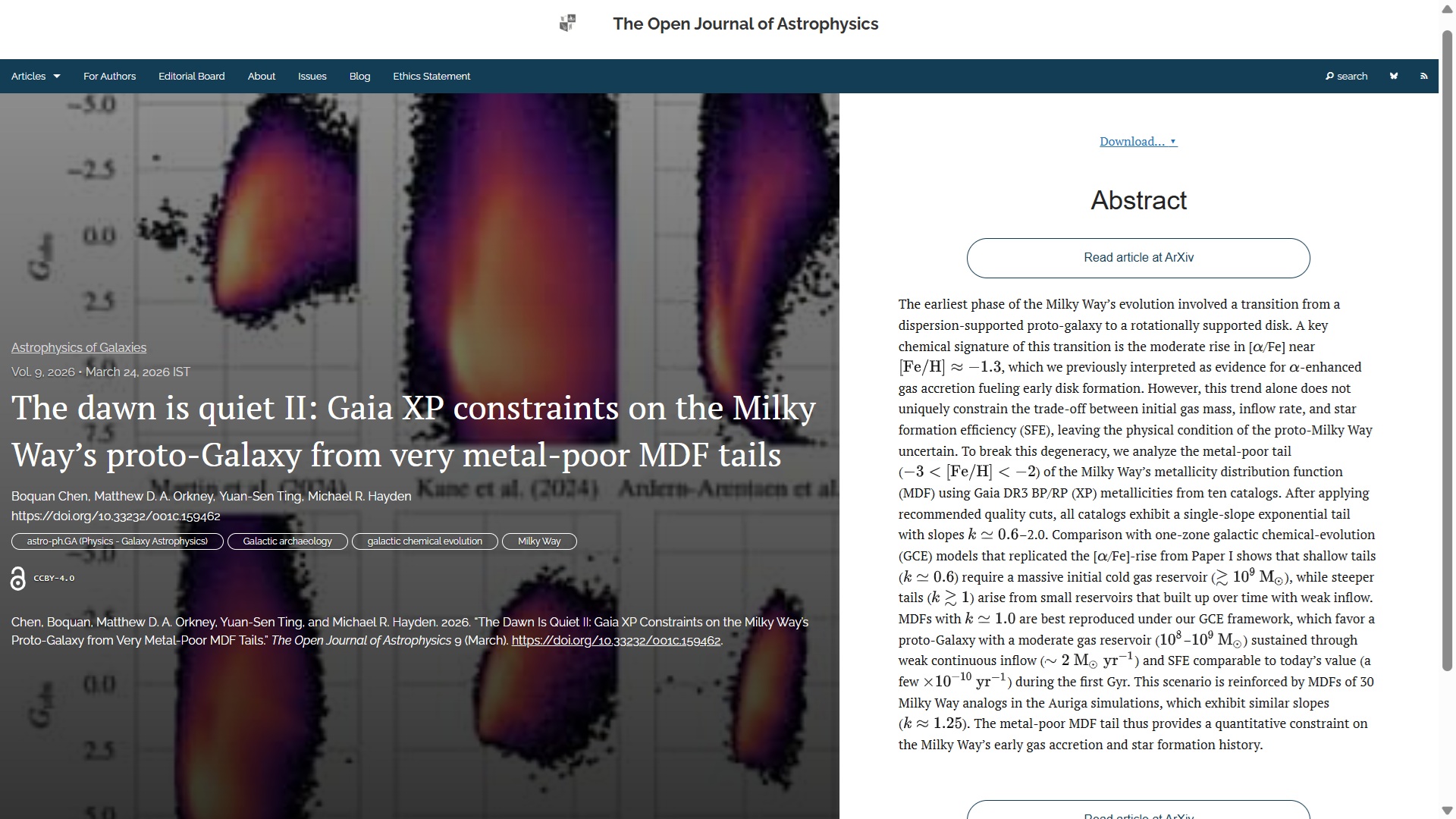
Next one up, the third paper of the week, also published on Tuesday March 24th in the folder Astrophysics of Galaxies, is “The dawn is quiet II: Gaia XP constraints on the Milky Way’s proto-Galaxy from very metal-poor MDF tails” by Boquan Chen (Ohio State U., USA), Matthew D. A. Orkney (Universitat de Barcelona, Spain), Yuan-Sen Ting (Ohio State U.) & Michael R. Hayden (U. Oklahoma, USA). The paper aegues that the Milky Way’s metallicity distribution suggests that its early evolution involved a moderate gas reservoir, sustained by weak continuous inflow, and star formation efficiency similar to the present value.
The overlay for this one is here:
The final, accepted version can be found on arXiv here and the Mastodon announcement is here:
New Publication at the Open Journal of Astrophysics: "The dawn is quiet II: Gaia XP constraints on the Milky Way’s proto-Galaxy from very metal-poor MDF tails" by Boquan Chen (Ohio State U., USA), Matthew D. A. Orkney (Universitat de Barcelona, Spain), Yuan-Sen Ting (Ohio State U.) & Michael R. Hayden (U. Oklahoma, USA)
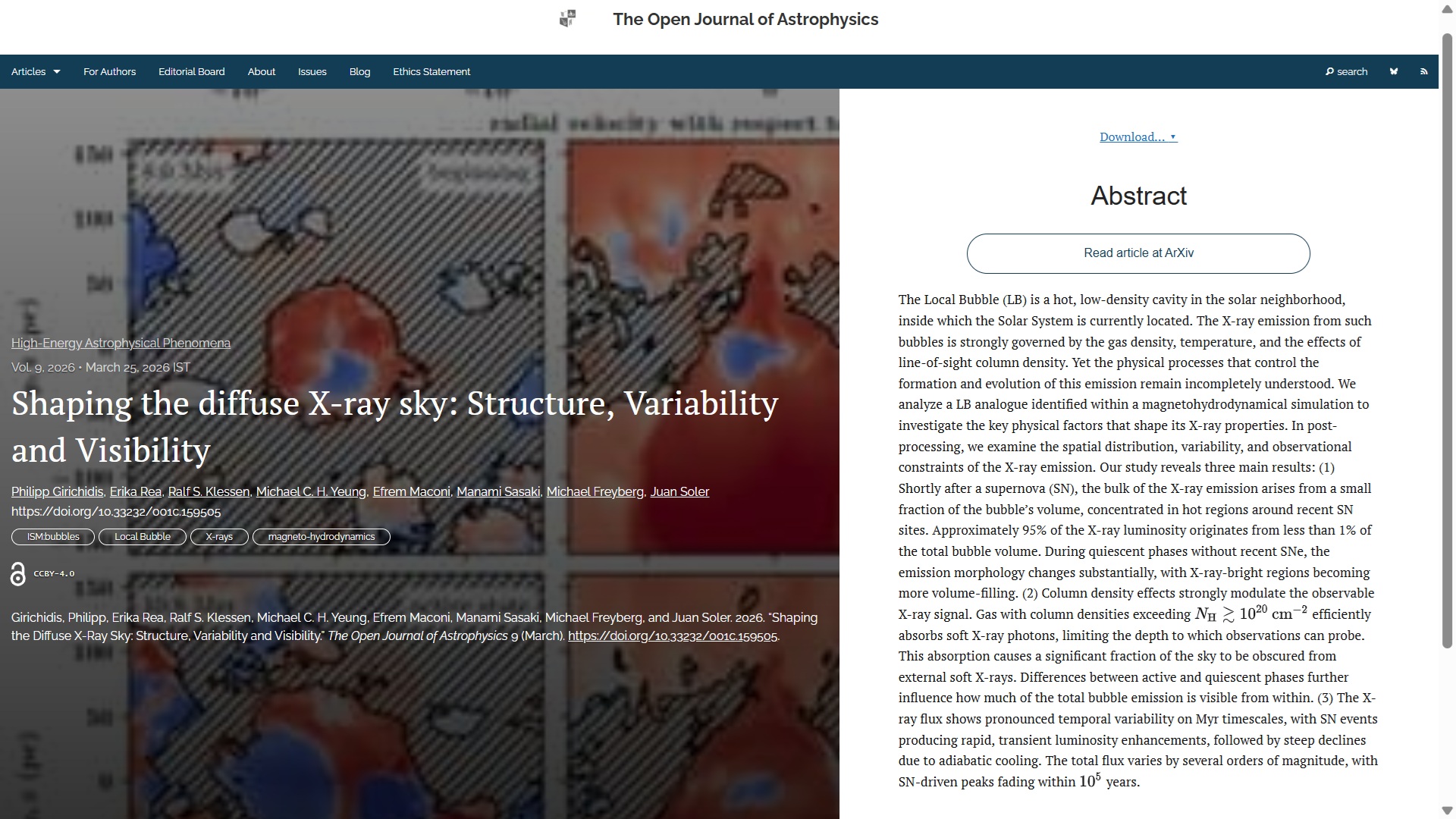
The fourth paper this week, published on Wednesday 25th March 2026 in the folder High-Energy Astrophysical Phenomena is “Shaping the diffuse X-ray sky: Structure, Variability and Visibility” by Philipp Girichidis (Heidelberg U., Germany) and 7 others based in Germany, USA, Austria and Italy. The paper argues that the X-ray properties of the Local Bubble (LB), a low-density cavity in the solar neighborhood reveal that supernova events significantly influence X-ray emissions, which show pronounced temporal variability
The overlay is here:
The finally accepted version of this paper can be found here and the Mastodon announcement is here:
New Publication at the Open Journal of Astrophysics: "Shaping the diffuse X-ray sky: Structure, Variability and Visibility" by Philipp Girichidis (Heidelberg U., Germany) and 7 others based in Germany, USA, Austria and Italy
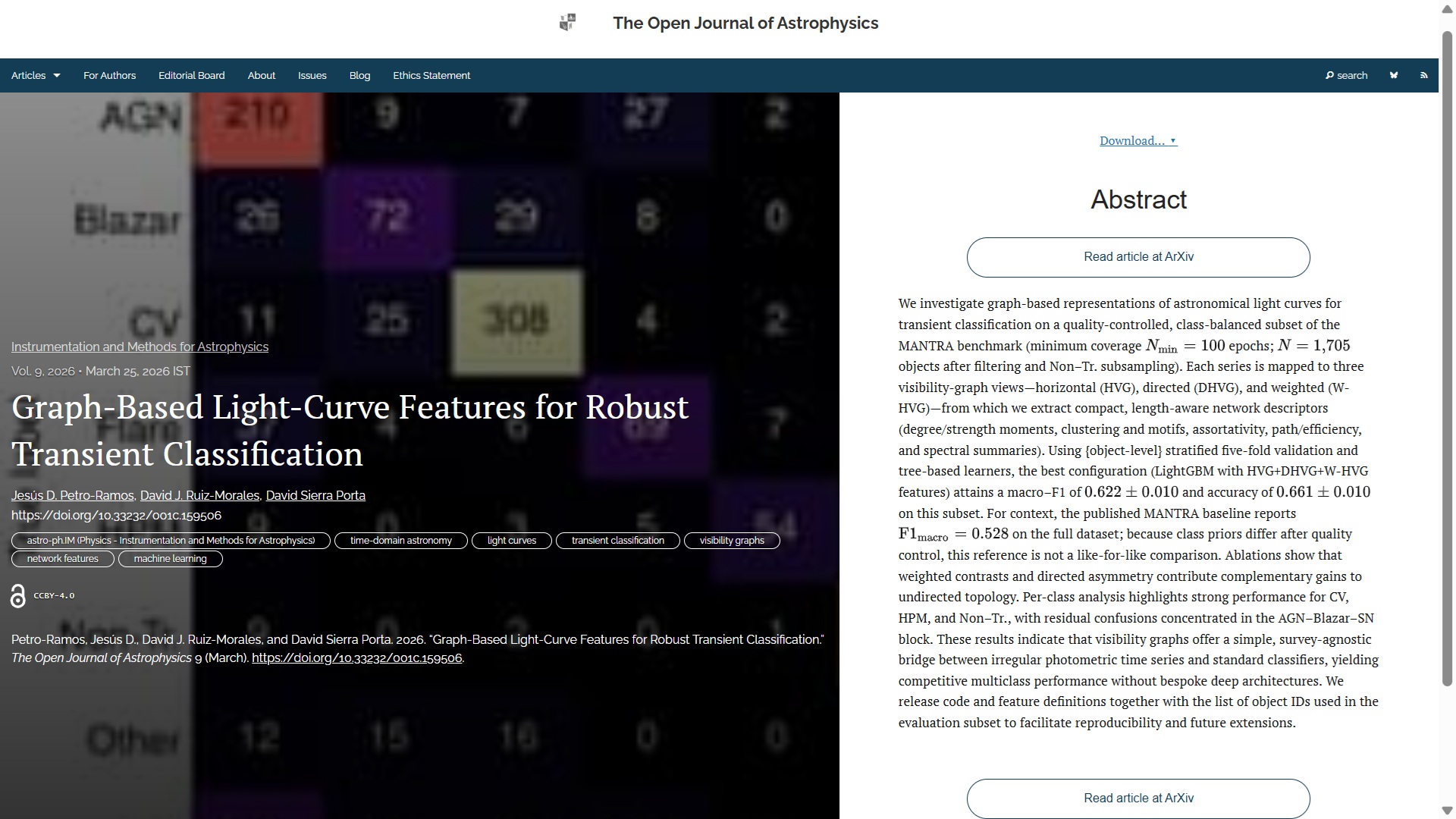
The fifth paper this week, also published on Wednesday 25th March 2026, is “Graph-Based Light-Curve Features for Robust Transient Classification” by Jesús D. Petro-Ramos David J. Ruiz-Morales, David Sierra Porta (Universidad Tecnológica de Bolívar, Colombia). This paper, which is in the folder Instrumentation and Methods for Astrophysics, uses graph-based representations of astronomical light curves for transient classification, achieving competitive multiclass performance, highlighting the potential of visibility graphs as a survey-agnostic tool for classifying time series.
This is the overlay:
The officially accepted version can be found on arXiv here and the Mastodon announcement follows:
New Publication at the Open Journal of Astrophysics: "Graph-Based Light-Curve Features for Robust Transient Classification" by Jesús D. Petro-Ramos David J. Ruiz-Morales, David Sierra Porta (Universidad Tecnológica de Bolívar, Colombia)
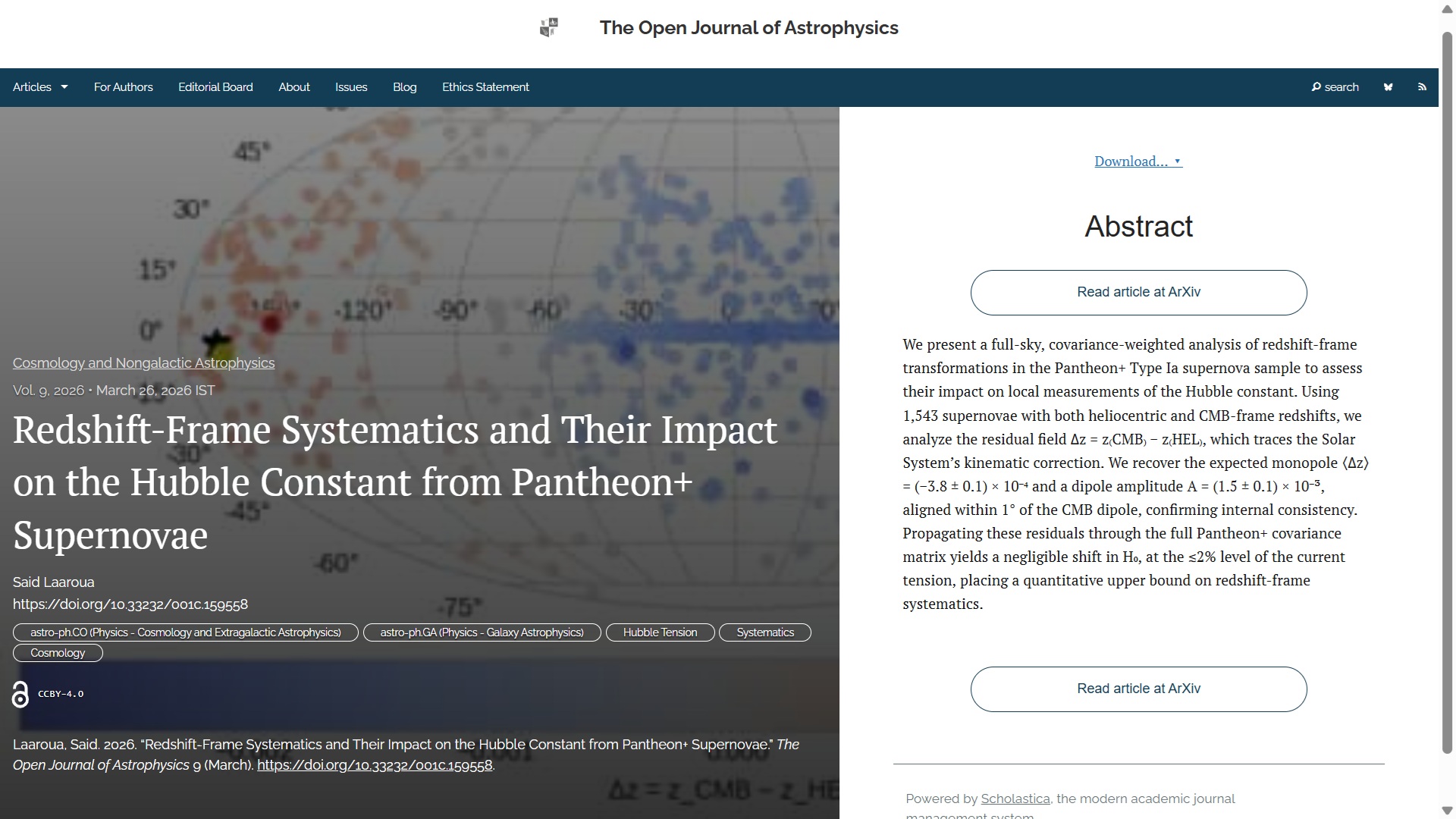
New Publication at the Open Journal of Astrophysics: "Redshift-Frame Systematics and Their Impact on the Hubble Constant from Pantheon+ Supernovae" by Said Laaroua (Santa Rosa Junior College, USA)
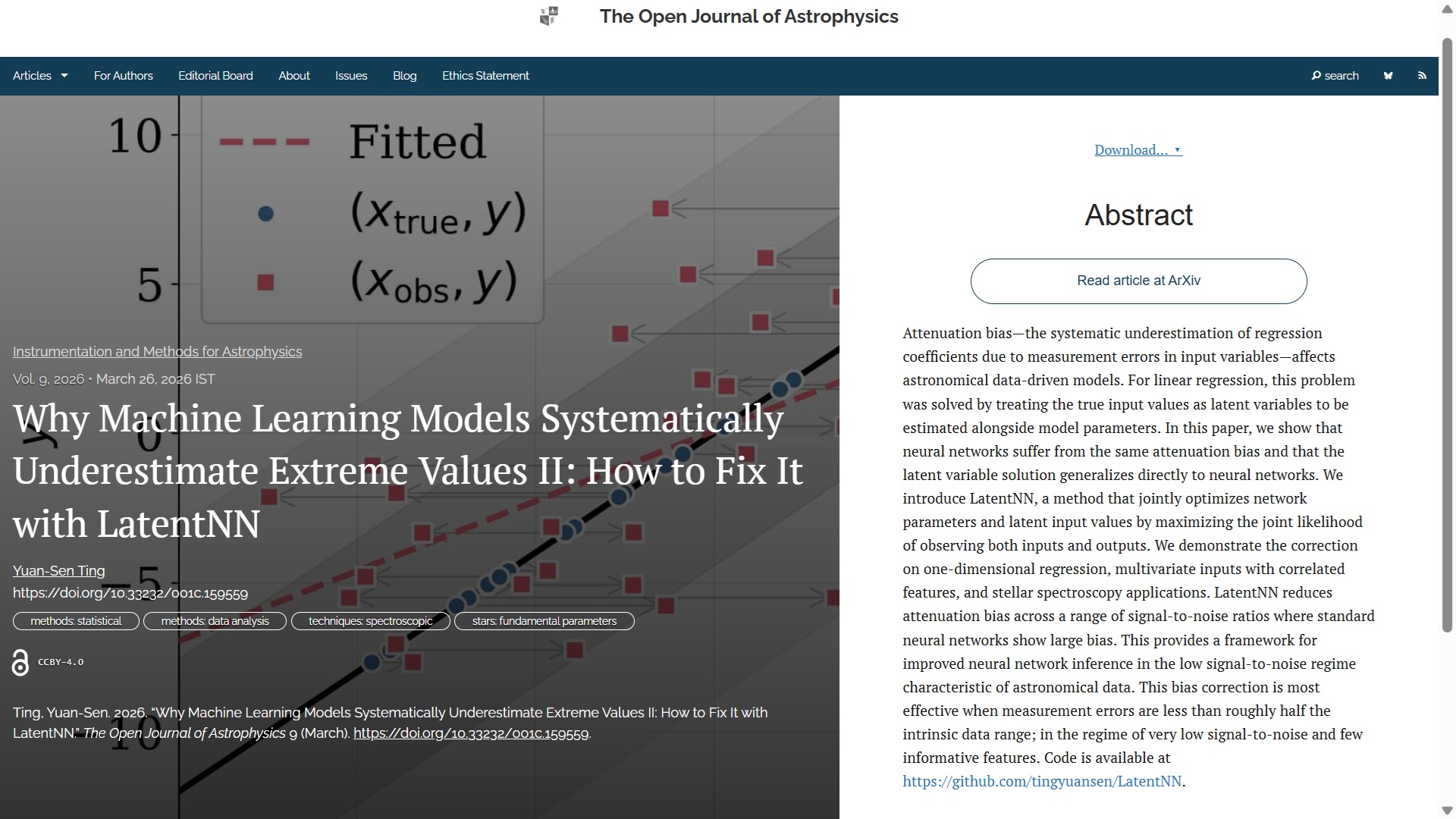
New Publication at the Open Journal of Astrophysics: "Why Machine Learning Models Systematically Underestimate Extreme Values II: How to Fix It with LatentNN" by Yuan-Sen Ting (Ohio State University, USA)
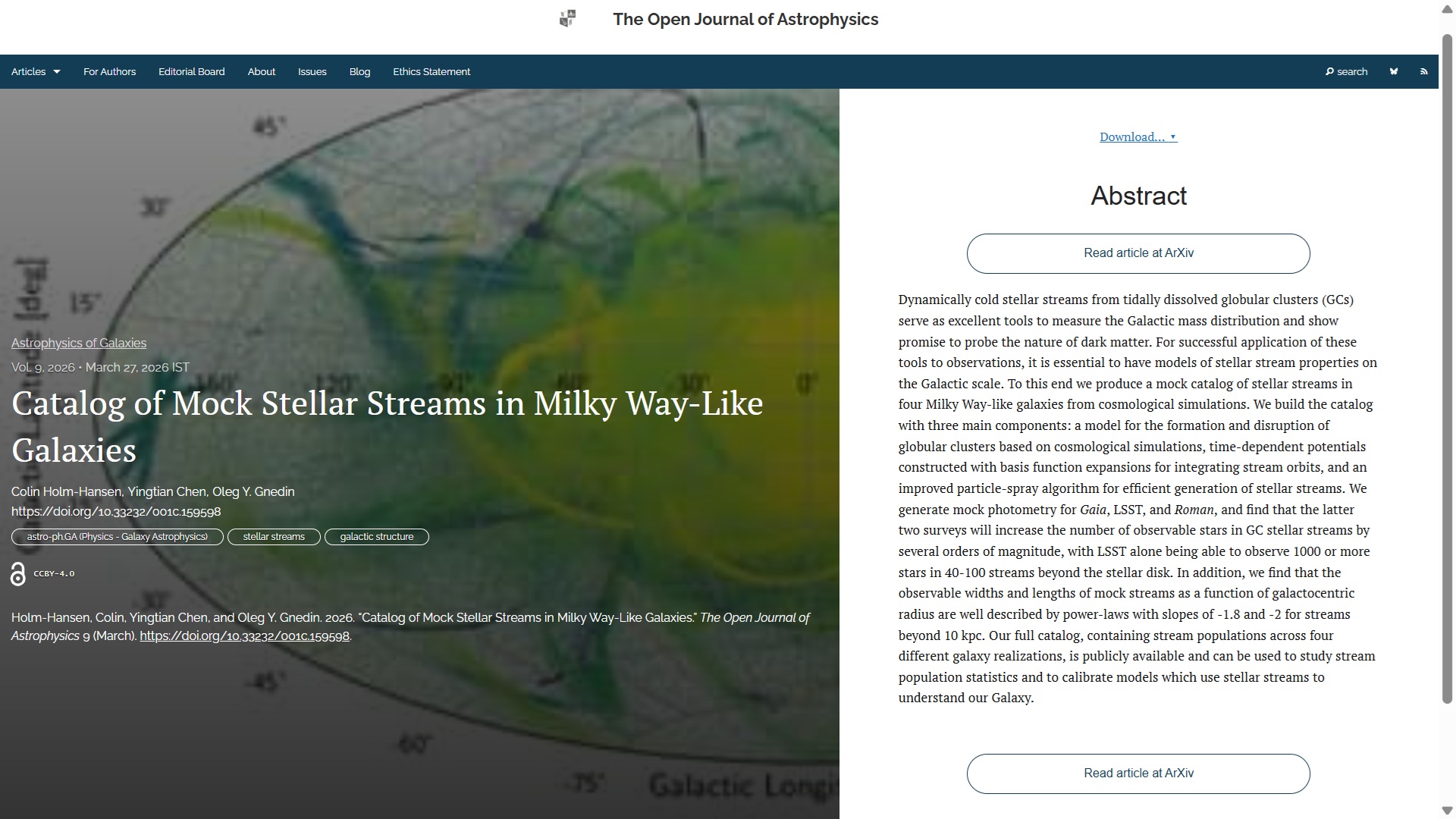
New Publication at the Open Journal of Astrophysics: "Catalog of Mock Stellar Streams in Milky Way-Like Galaxies" by Colin Holm-Hansen, Yingtian Chen and Oleg Y. Gnedin (University of Michigan, USA)
You will have observed that this week’s papers cover five of the six main categories on astro-ph. We haven’t yet managed to cover all six in a week – we only missed Solar and Stellar Astrophysics this time!
It’s Saturday once more, so it’s time for another update of activity at the Open Journal of Astrophysics. Since the last update we have published a further four papers, bringing the number in Volume 9 (2026) to 51 and the total so far published by OJAp up to 499. I hoped we would reach 500 this week, but that milestone will have to wait. We have however passed the 50 mark for this year, so we have now published more papers so far in 2026 than we published in all of 2023.
I will continue to include the posts made on our Mastodon account (on Fediscience) to encourage you to visit it. Mastodon is a really excellent service, and a more than adequate replacement for X/Twitter (which nobody should be using); these announcements also show the DOI for each paper.
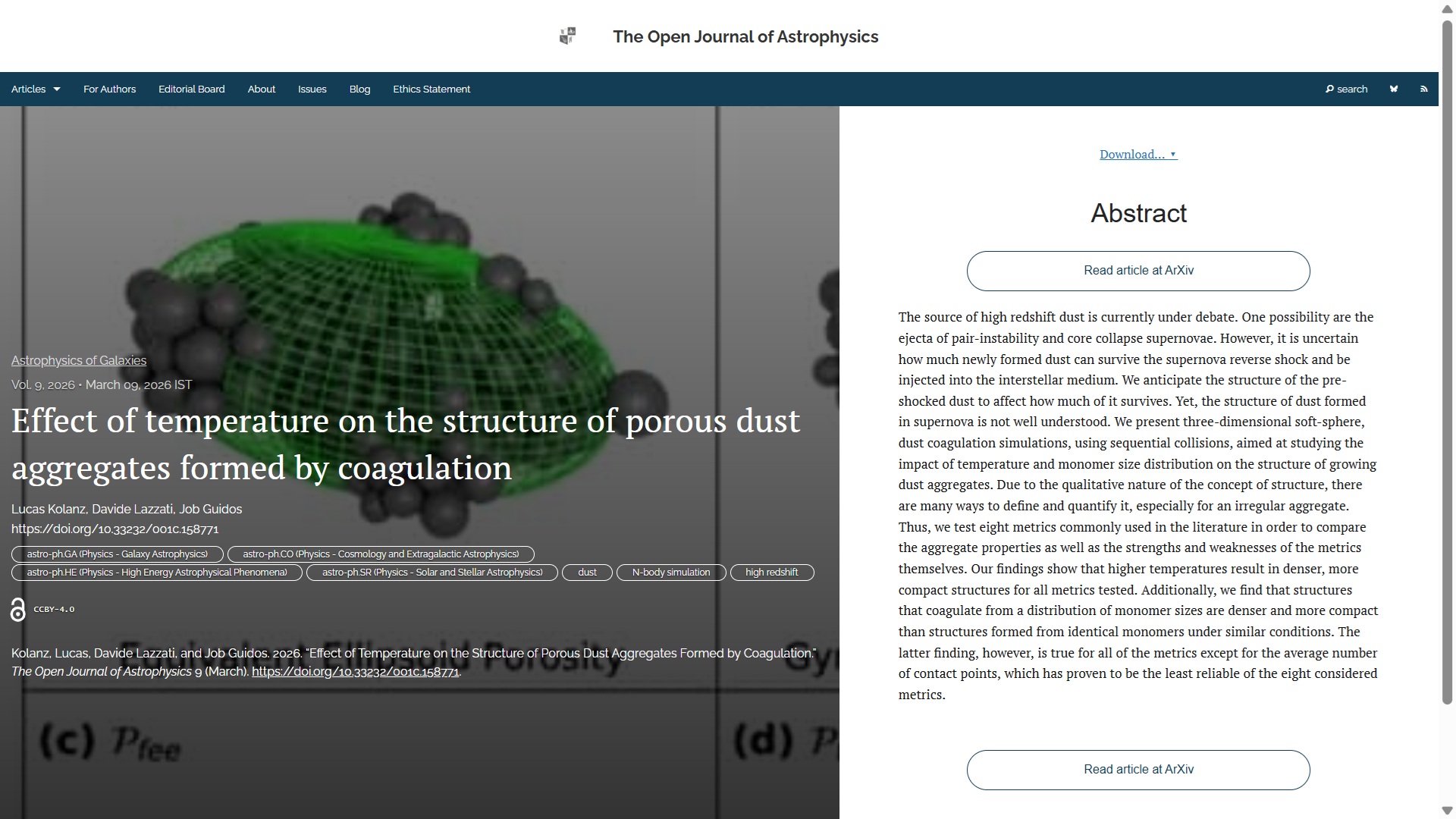
New Publication at the Open Journal of Astrophysics: "Effect of temperature on the structure of porous dust aggregates formed by coagulation" by Lucas Kolanz, Davide Lazzati and Job Guidos (Oregon State University, USA)
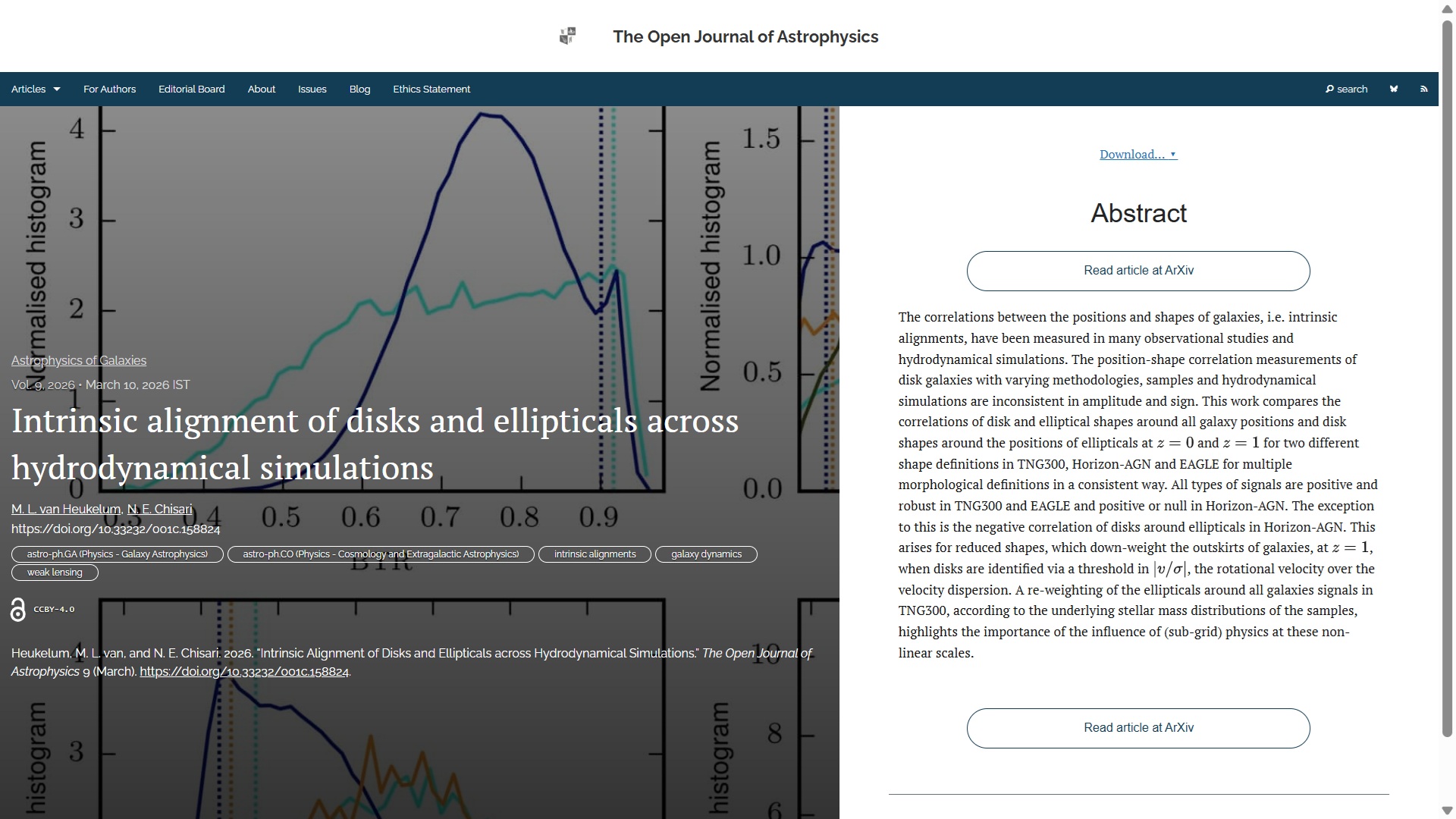
The second paper for this week is “Intrinsic alignment of disks and ellipticals across hydrodynamical simulations” by M. L. van Heukelum and N. E. Chisari (Utrecht University, The Netherlands). This is one of two papers published on Tuesday 10th March. This one is in the folder Astrophysics of Galaxies: it examines the inconsistent correlations between galaxy positions and shapes, comparing disk and elliptical shapes in different simulations. The results highlight the importance of sub-grid physics at non-linear scales.
The overlay for this one is here:
The official version of the paper can be found on arXiv here and the Fediverse announcement here:
New Publication at the Open Journal of Astrophysics: "Intrinsic alignment of disks and ellipticals across hydrodynamical simulations" by M. L. van Heukelum and N. E. Chisari (Utrecht University, The Netherlands)
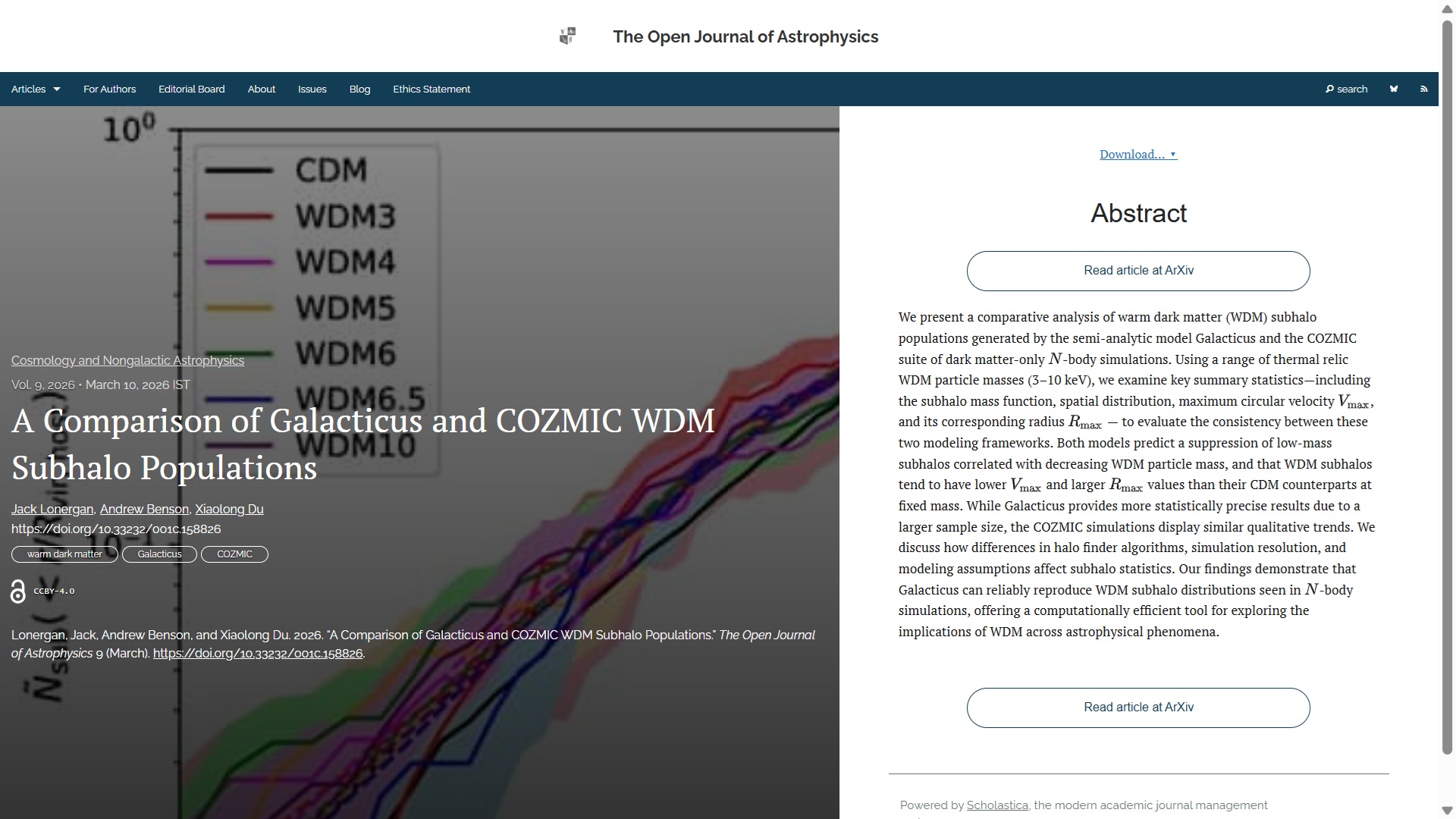
Next one up is “A Comparison of Galacticus and COZMIC WDM Subhalo Populations” by Jack Lonergan (U. Southern California), Andrew Benson (Carnegie Observatories) and Xiaolong Du (UCLA), all based in the USA. This paper was published on 10th March 2026 in the folder Cosmology and Nongalactic Astrophysics. The study compares warm dark matter subhalo populations using the Galacticus model and COZMIC simulations, finding both can reliably reproduce these distributions, with Galacticus offering computational efficiency.Abstractfor A Comparison of Galacticus and COZMIC WDM Subhalo Populations.
The overlay for this one is here:
The final, accepted version can be found on arXiv here and the Mastodon announcement is here:
New Publication at the Open Journal of Astrophysics: "A Comparison of Galacticus and COZMIC WDM Subhalo Populations" by Jack Lonergan (U. Southern California), Andrew Benson (Carnegie Observatories) and Xiaolong Du (UCLA), all based in the USA.
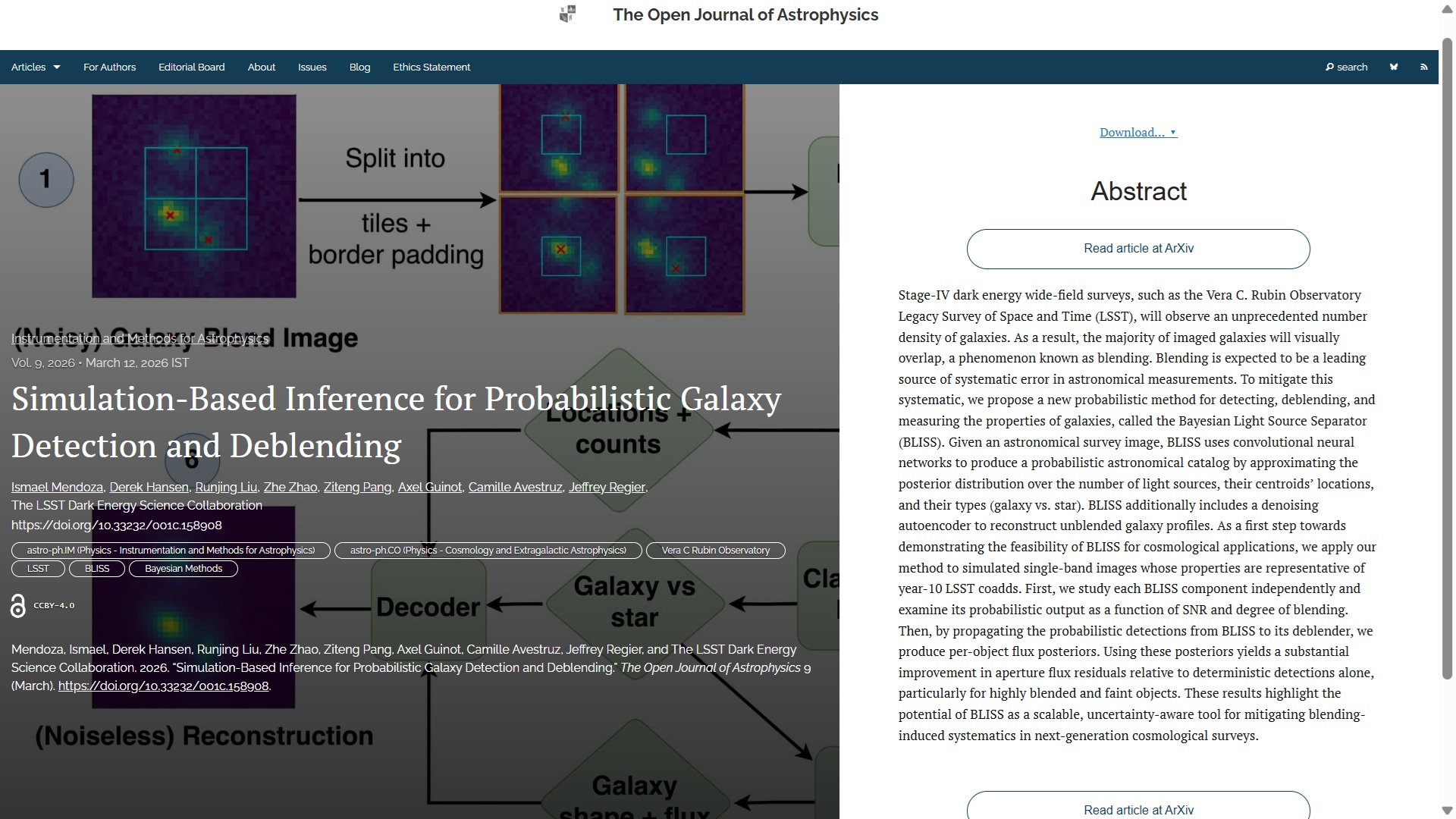
And finally for this week we have “Simulation-Based Inference for Probabilistic Galaxy Detection and Deblending” by Ismael Mendoza (U. Maryland, USA) and 7 others (all based in the USA) on behalf of the LSST Dark Energy Science Collaboration. This was published on Thursday March 12th in the folder Instrumentation and Methods for Astrophysics. The article introduces the Bayesian Light Source Separator (BLISS), for detecting and measuring galaxy properties in wide-field cosmological surveys. BLISS demonstrates improved performance, particularly for faint and blended objects.
The overlay is here:
The finally accepted version of this paper can be found here and the Mastodon announcement is here:
New Publication at the Open Journal of Astrophysics: "Simulation-Based Inference for Probabilistic Galaxy Detection and Deblending" by Ismael Mendoza (U. Maryland, USA) and 7 others (all based in the USA) on behalf of the LSST Dark Energy Science Collaboration
P.S. Thank you once again to the many people who have responded to the latest call for editors. I’ve been sending out invitations and getting people onboard as quickly as I can, but I still have a number to get to, so please bear with me!
It’s Saturday once more so time for another update of activity at the Open Journal of Astrophysics. Since the last update we have published seven papers, bringing the number in Volume 9 (2026) to 11 and the total so far published by OJAp up to 459. This week has been quite busy; for only the second time in recorded history we published at least one paper each working day.
I will continue to include the announcements made on our Mastodon account (on Fediscience) to encourage you to visit it. Mastodon is a really excellent service, and a more than adequate replacement for X/Twitter which nobody should be using.
The first three papers this week were all published on Monday January 12th in the folder Astrophysics of Galaxies.
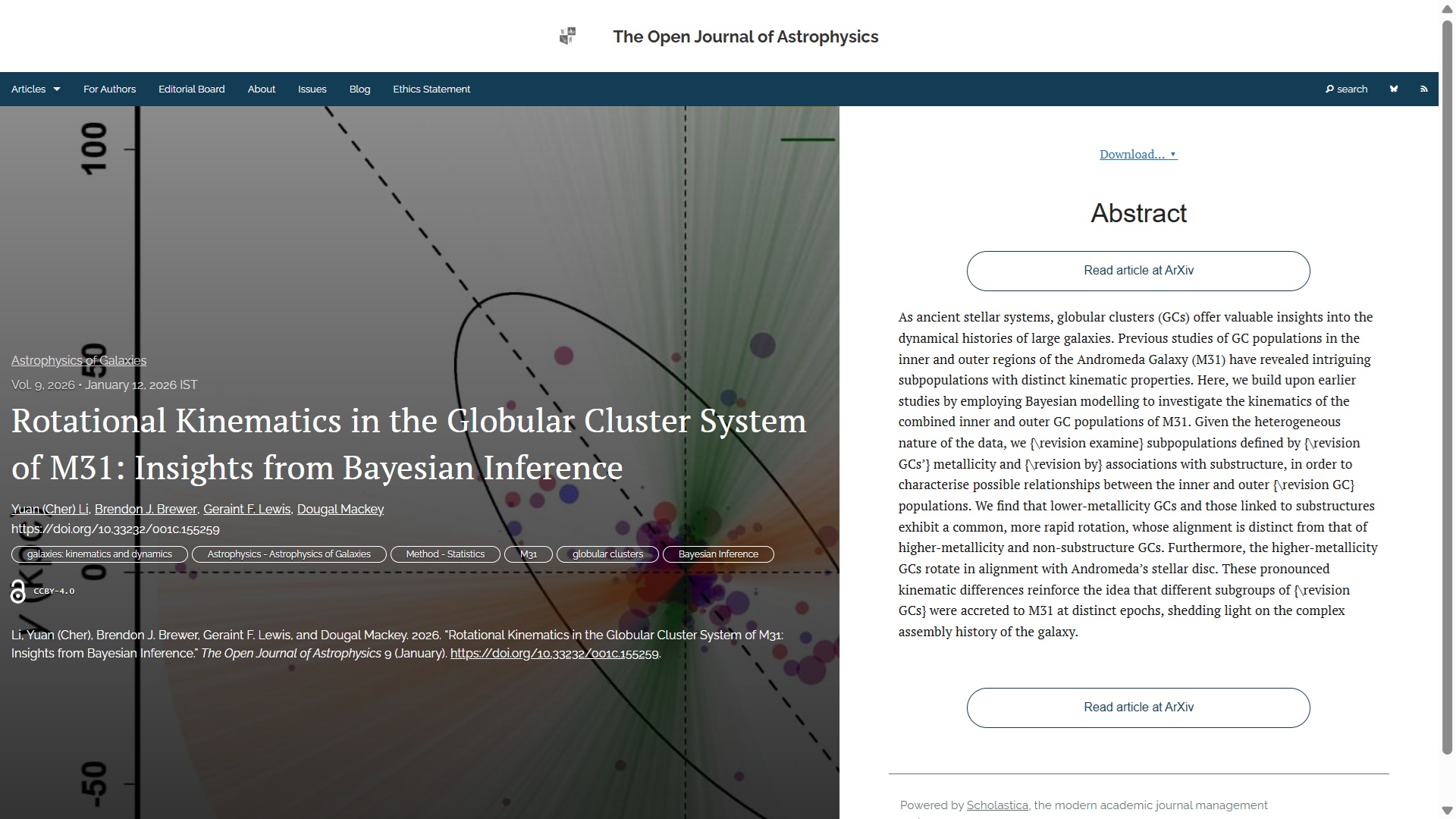
The first paper to report this week is “Rotational Kinematics in the Globular Cluster System of M31: Insights from Bayesian Inference” by Yuan (Cher) Li & Brendon J. Brewer (U. Auckland, New Zealand), Geraint F. Lewis (U. Sydney, Australia) and Dougal Mackey (independent researcher, Australia). This study uses Bayesian modelling to explore the kinematics of globular clusters in the Andromeda Galaxy, revealing distinct rotation patterns that suggest different subgroups were added at separate times.
The overlay is here:
You can find the officially accepted version on arXiv here and the announcement on Fediverse here:
New Publication at the Open Journal of Astrophysics: "Rotational Kinematics in the Globular Cluster System of M31: Insights from Bayesian Inference" by Yuan (Cher) Li & Brendon J. Brewer (U. Auckland, New Zealand), Geraint F. Lewis (U. Sydney, Australia) and Dougal Mackey
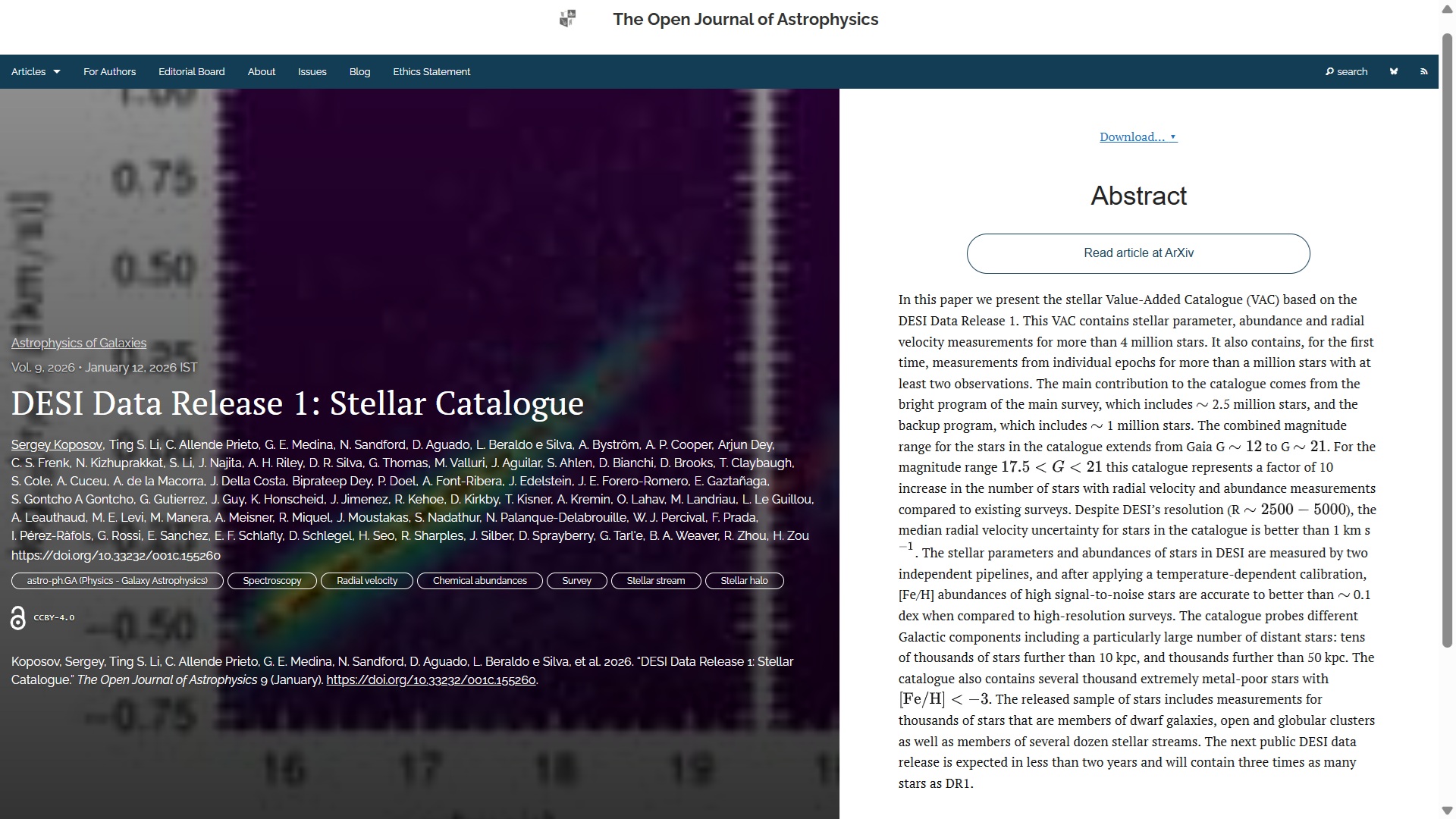
The second paper is “DESI Data Release 1: Stellar Catalogue” by Sergey Koposov (U. Edinburgh, UK) and an international cast of 67 other authors. This paper introduces and describes the stellar Value-Added Catalogue (VAC) based on DESI Data Release 1, providing measurements for over 4 million stars, including radial velocity, abundance, and stellar parameters.
The overlay for this one is here:
The official version of the paper can be found on arXiv here and the Fediverse announcement here:
New Publication at the Open Journal of Astrophysics: "DESI Data Release 1: Stellar Catalogue" by Sergey Koposov (U. Edinburgh, UK) and an international cast of 67 other authors.
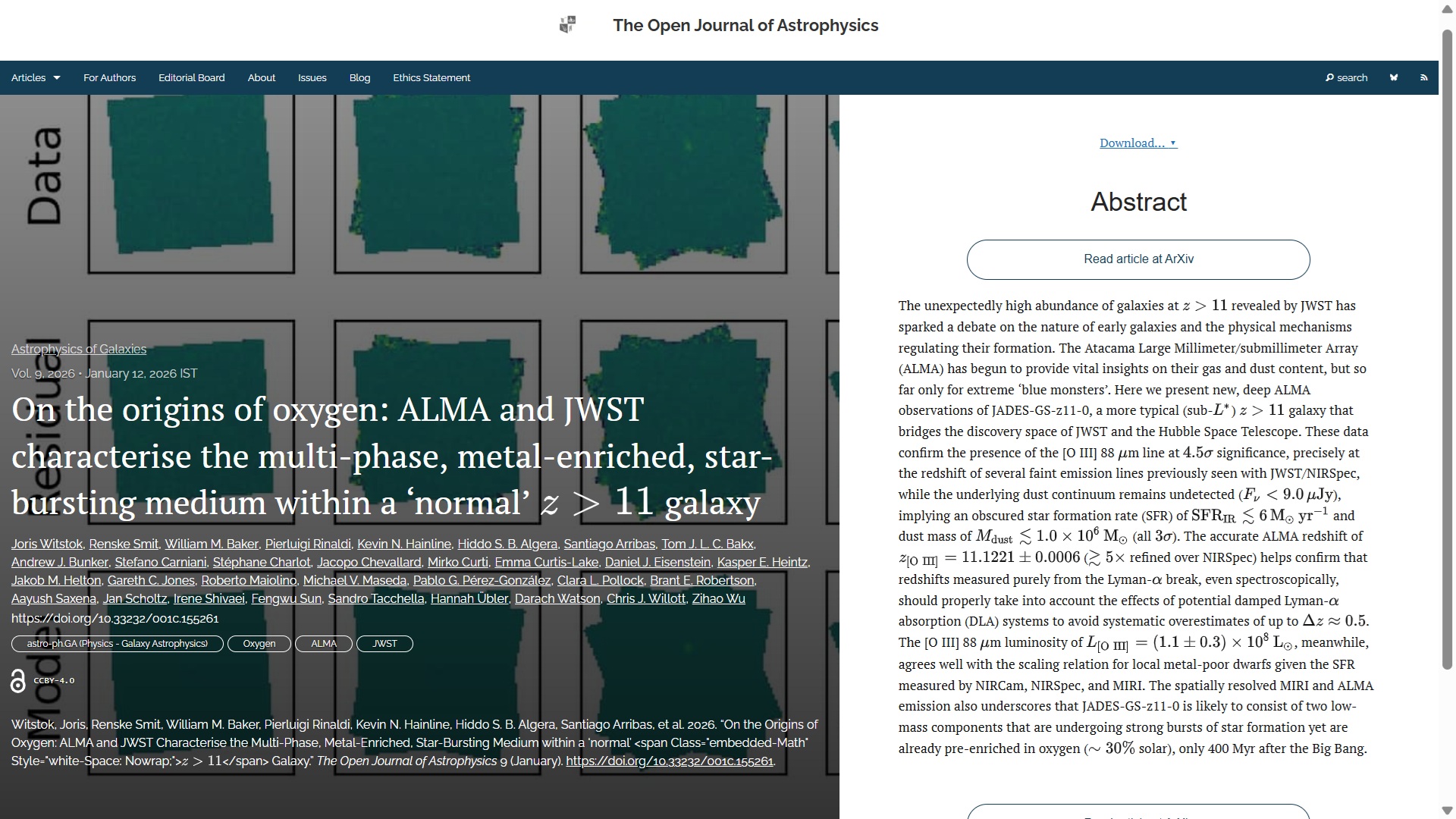
New Publication at the Open Journal of Astrophysics: "On the origins of oxygen: ALMA and JWST characterise the multi-phase, metal-enriched, star-bursting medium within a ‘normal’ z>11 galaxy" by Joris Witstok (Cosmic Dawn Centre, Copenhagen, Denmark) and 37 others dotted around the world
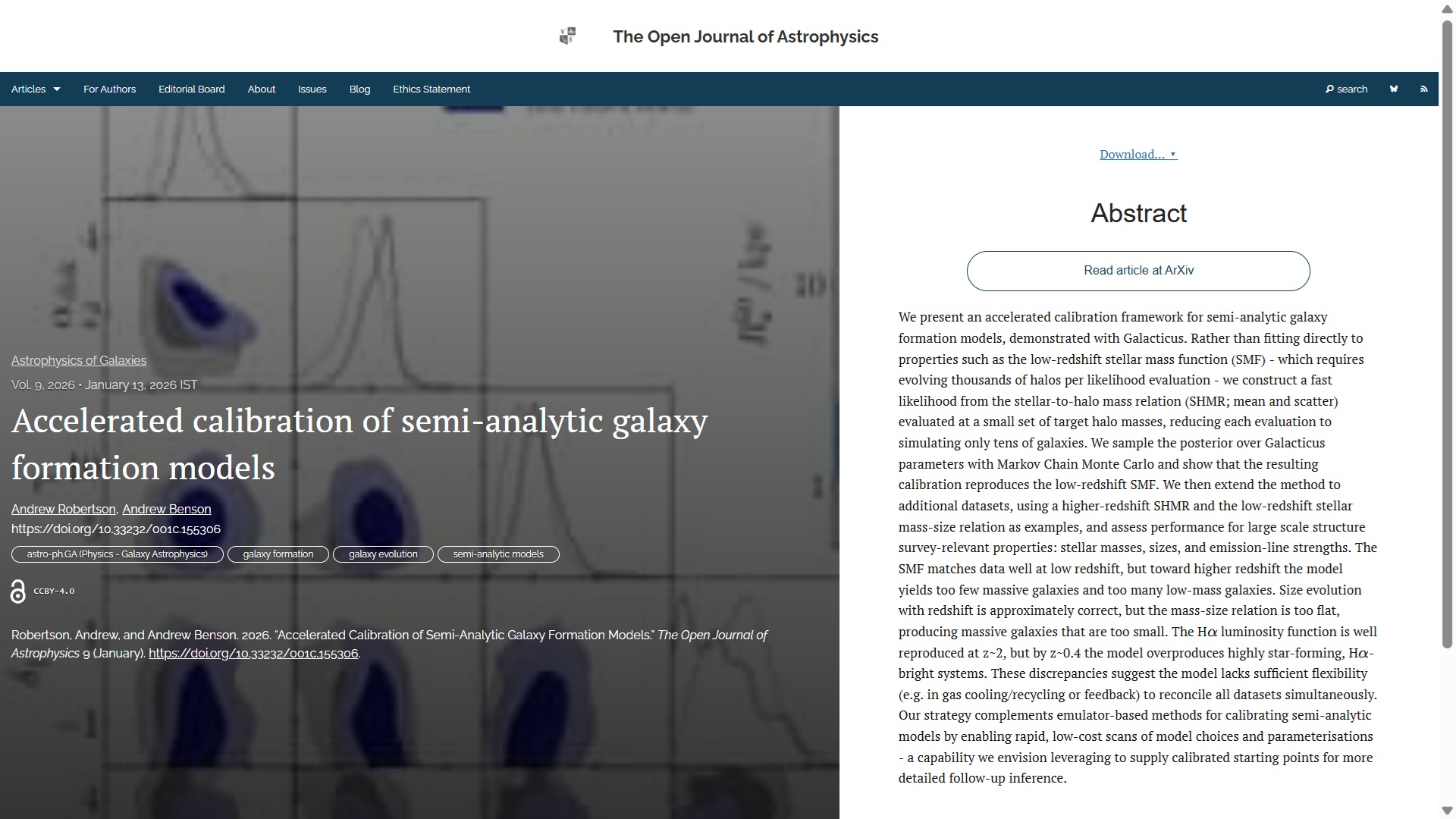
The fourth paper this week is also in the folder Astrophysics of Galaxies. but was published on Tuesday 13th January. It is entitled “Accelerated calibration of semi-analytic galaxy formation models” by Andrew Robertson and Andrew Benson (Carnegie Observatories, USA). This paper presents a faster calibration framework for galaxy formation models, using fewer simulations for each evaluation. However, the model shows discrepancies suggesting the model needs to be made more flexible.
The overlay is here:
You can find the officially accepted version on arXiv here and the Mastodon announcement here:
New Publication at the Open Journal of Astrophysics: "Accelerated calibration of semi-analytic galaxy formation models" by Andrew Robertson and Andrew Benson (Carnegie Observatories, USA)
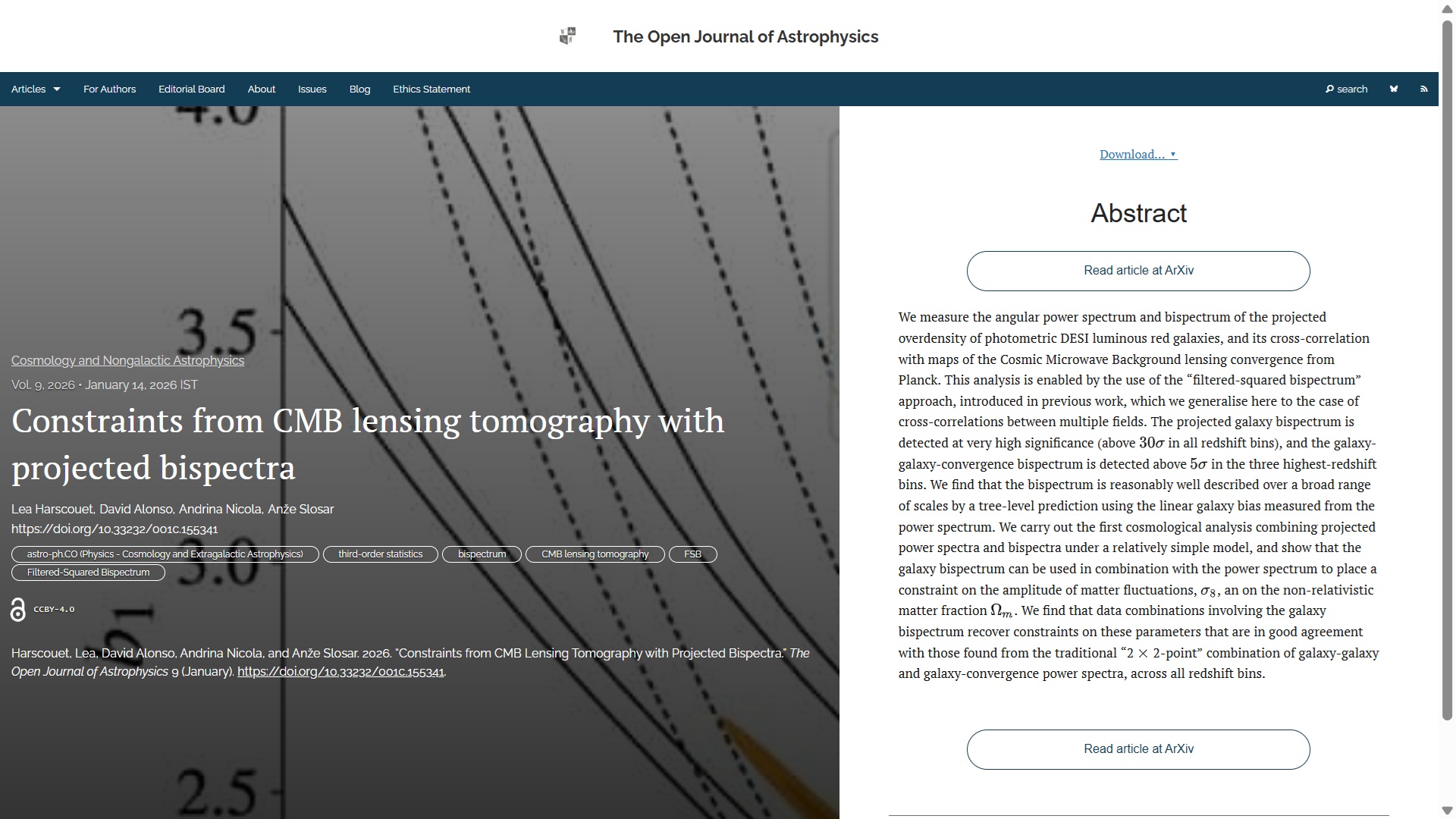
Next one up, published on Wednesday 14th January in the folder Cosmology and Nongalactic Astrophysics, is “Constraints from CMB lensing tomography with projected bispectra” by Lea Harscouet & David Alonso (U. Oxford), UK), Andrina Nicola (U. Manchester, UK) and Anže Slosar (Brookhaven National Laboratory, USA). This study presents angular power spectra and bispectra of DESI luminous red galaxies, finding that the galaxy bispectrum can constrain the amplitude of matter fluctuations and the non-relativistic matter fraction. The overlay is here:
You can find the officially accepted paper on arXiv here and the Mastodon announcement here:
New Publication at the Open Journal of Astrophysics: "Constraints from CMB lensing tomography with projected bispectra" by Lea Harscouet & David Alonso (U. Oxford, UK), Andrina Nicola (U. Manchester, UK) and Anže Slosar (Brookhaven National Laboratory, USA)
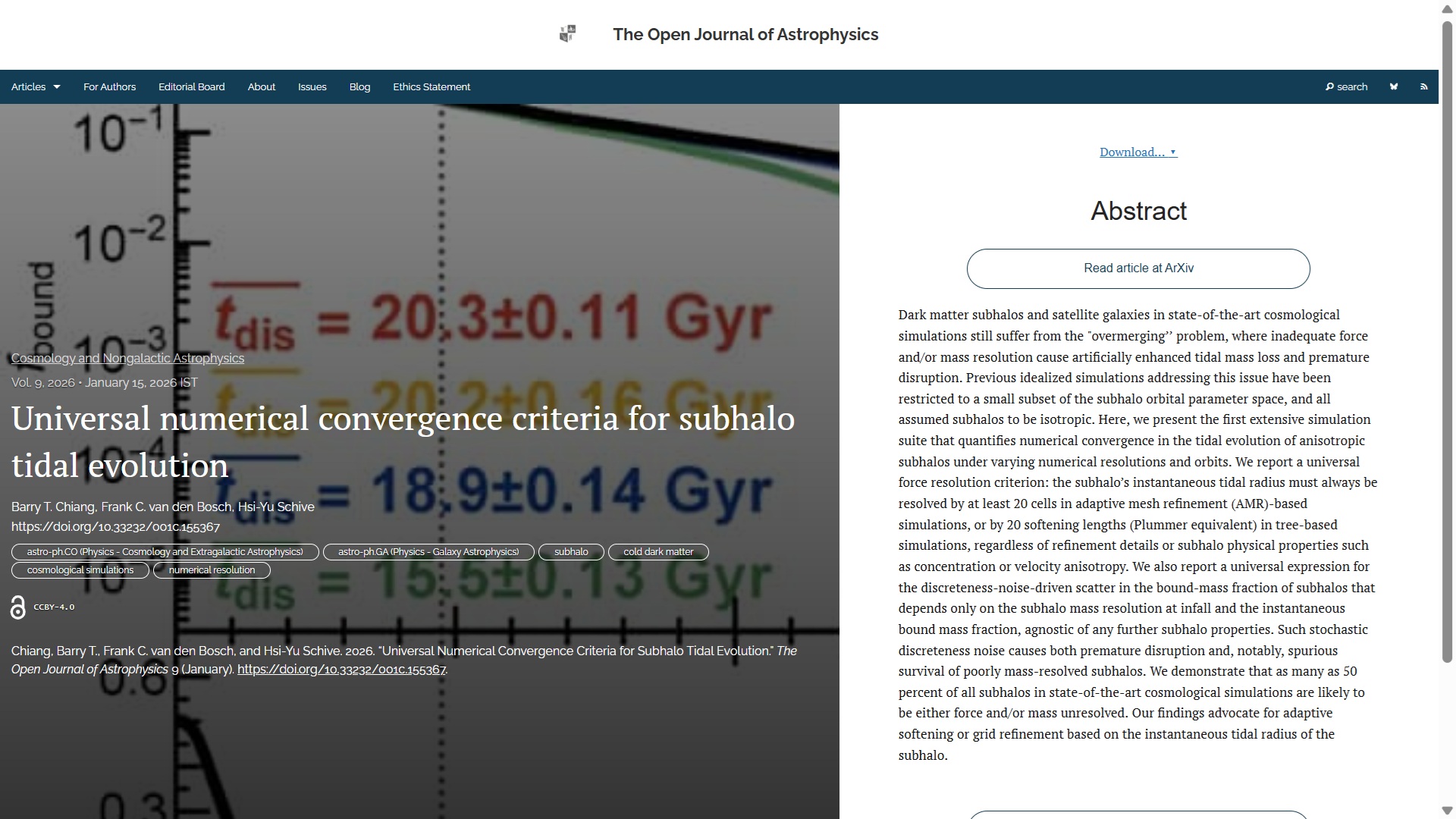
The sixth paper this week is “Universal numerical convergence criteria for subhalo tidal evolution” by Barry T. Chiang & Frank C. van den Bosch (Yale U., USA) and Hsi-Yu Schive (National Taiwan University, Taiwan). This was published on Thursday 15th January in the folder Cosmology and Nongalactic Astrophysics; it presents an analysis of a simulation suite that addresses the ‘overmerging’ problem in cosmological simulations of dark matter subhalos, showing that up to 50% of halos in state-of-the art simulations are unresolved. The overlay is here:
The final accepted version of this paper can be found on arXiv here. The Mastodon announcement follows:
New Publication at the Open Journal of Astrophysics: "Universal numerical convergence criteria for subhalo tidal evolution" by Barry T. Chiang & Frank C. van den Bosch (Yale U., USA) and Hsi-Yu Schive (National Taiwan University, Taiwan)
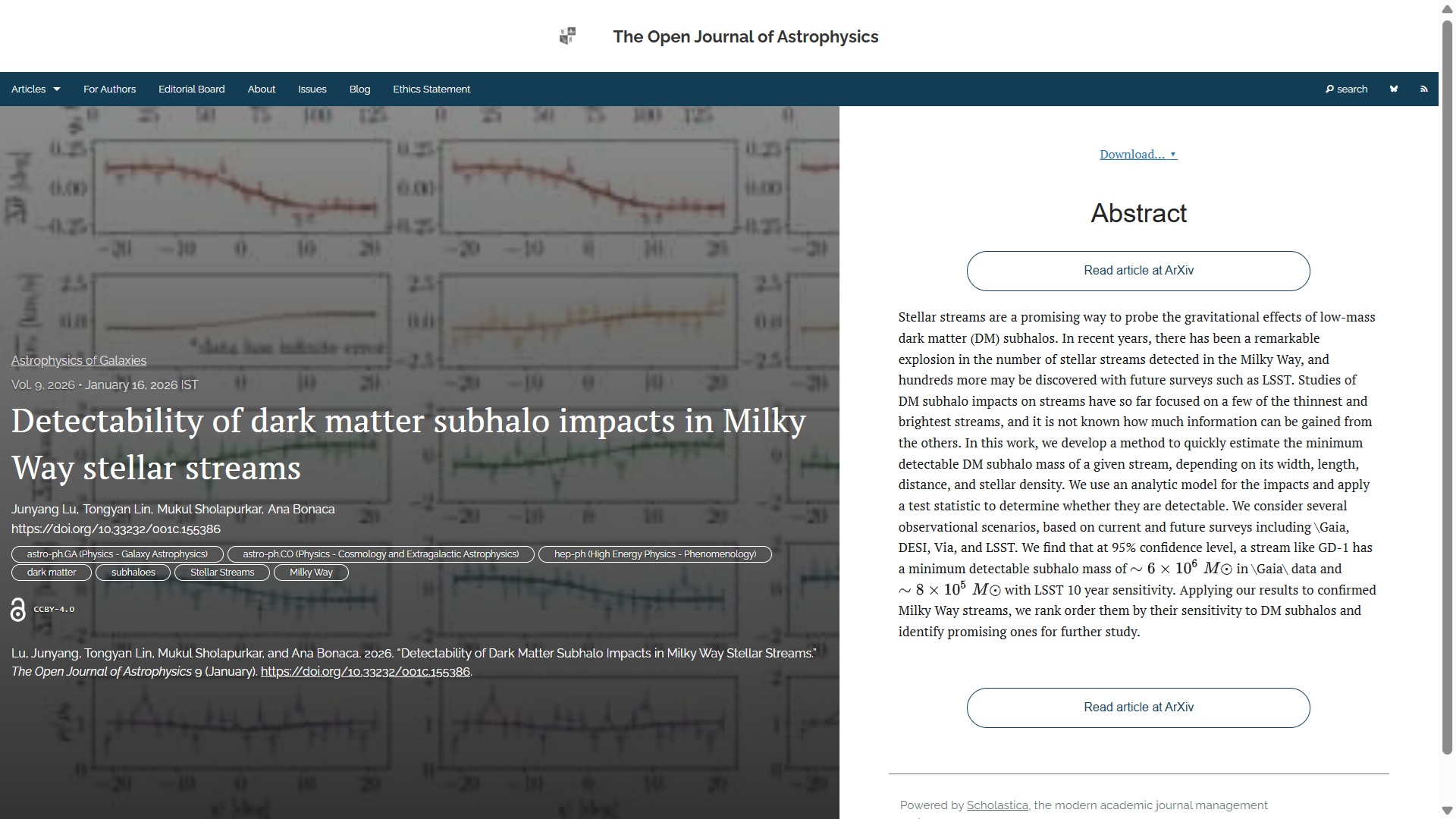
Finally for this week we have “Detectability of dark matter subhalo impacts in Milky Way stellar streams” by Junyang Lu , Tongyan Lin & Mukul Sholapurkar (UCSD, USA) and Ana Bonaca (Carnegie Observatories, USA). This was published on Friday 16th January (i.e. yesterday) in the folder Astrophysics of Galaxies. The study develops a method to estimate the minimum detectable dark matter subhalo mass in stellar streams, ranking them by sensitivity and identifying promising lines for further research.
The overlay is here:
The officially accepted version can be found on arXiv here and the Fediverse announcement here:
New Publication at the Open Journal of Astrophysics: "Detectability of dark matter subhalo impacts in Milky Way stellar streams" by Junyang Lu , Tongyan Lin & Mukul Sholapurkar (UCSD, USA) and Ana Bonaca (Carnegie Observatories, USA)
Once again it’s time for the usual Saturday morning update of the week’s new papers at the Open Journal of Astrophysics. Since the last update we have published a further six papers, which brings the number in Volume 8 (2025) up to 190, and the total so far published by OJAp up to 425. I blogged about the significance of the latter figure here.
New Publication at the Open Journal of Astrophysics: "The galaxy-IGM connection in THESAN: observability and information content of the galaxy-Lyman-alpha cross-correlation at z>6" by Enrico Garaldi (U. Tokyo, Japan), Verena Bellscheidt (Tech. U. Munich, Germany), Aaron Smith (U. Texas Austin, USA) and Rahul Kannan (York U. Canada)
New Publication at the Open Journal of Astrophysics: "A Less Terrifying Universe? Mundanity as an Explanation for the Fermi Paradox" by Robin H.D. Corbet (U. Maryland, USA)
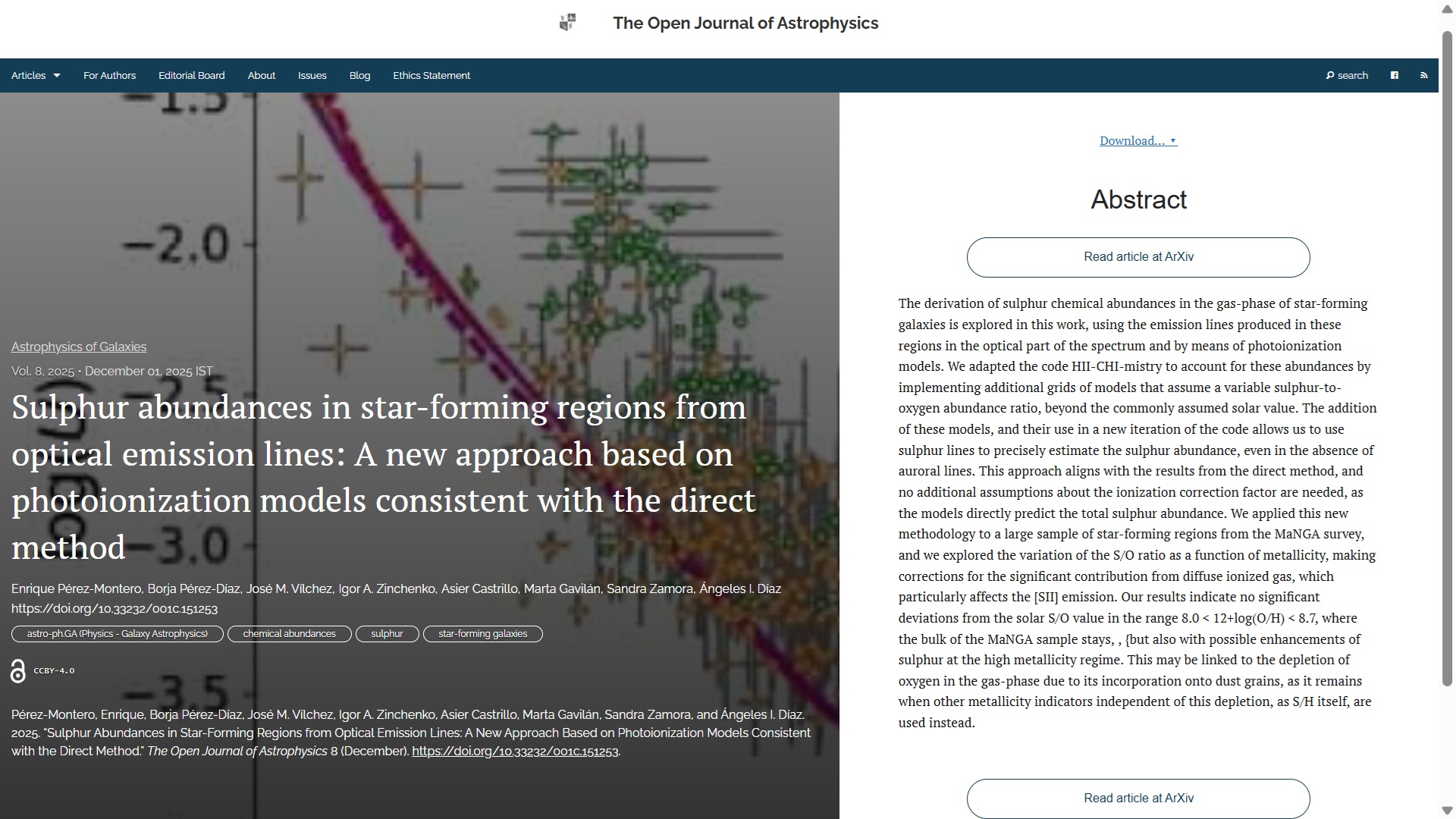
New Publication at the Open Journal of Astrophysics: "Sulphur abundances in star-forming regions from optical emission lines: A new approach based on photoionization models consistent with the direct method" by Enrique Pérez-Montero, Borja Pérez-Díaz, & José M. Vílchez ( (Instituto de Astrofísica de Andalucía, Spain), Igor A. Zinchenko (LMU, Germany), Asier Castrillo, Marta Gavilán, Sandra Zamora & Ángeles I. Díaz (Universidad Autonoma de Madrid , Spain)
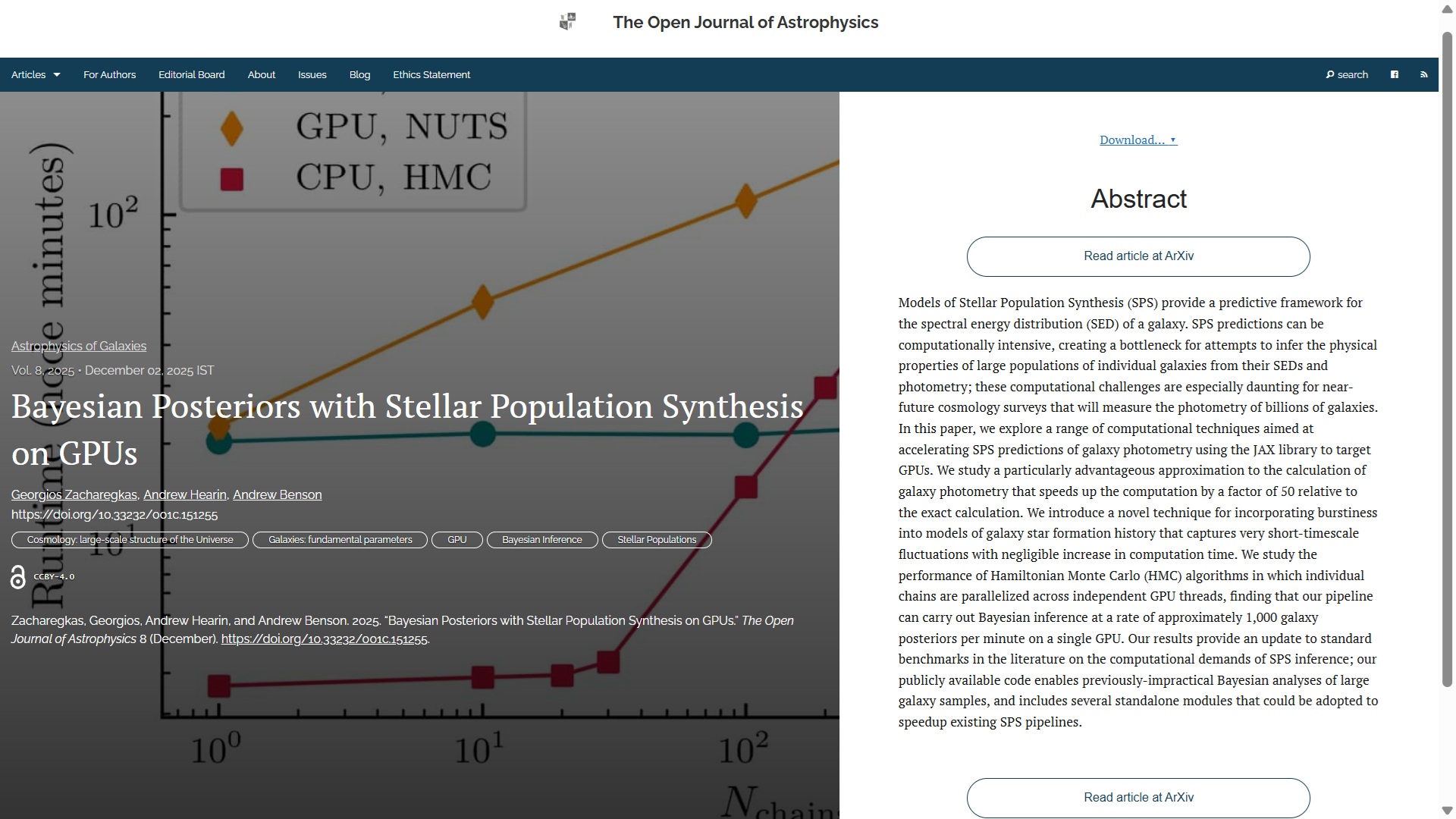
The fourth article of the week is “Bayesian Posteriors with Stellar Population Synthesis on GPUs” by Georgios Zacharegkas & Andrew Hearin (Argonne National Laboratory, USA) and Andrew Benson (Carnegie Observatories, USA). This is an exploration of a range of computational techniques aimed at accelerating Stellar Population Synthesis predictions of galaxy photometry using the JAX library to target GPUs (Graphics Processing Units, in case you didn’t know). This paper was published on Tuesday December 2nd 2025 in the folder Astrophysics of Galaxies.
The overlay is here:
You can find the official published version on arXiv here. The Fediverse announcement follows:
New Publication at the Open Journal of Astrophysics: "Bayesian Posteriors with Stellar Population Synthesis on GPUs" by Georgios Zacharegkas & Andrew Hearin (Argonne National Laboratory, USA) and Andrew Benson (Carnegie Observatories, USA)
Next one up is “IAEmu: Learning Galaxy Intrinsic Alignment Correlations” by Sneh Pandya Yuanyuan Yang, Nicholas Van Alfen, Jonathan Blazek and Robin Walters (Northeastern University, Boston, USA). This presents a neural-network-based emulator that predicts the galaxy position-position, position-orientation, and orientation-orientation, correlation functions and their uncertainties using mock catalogs based on the halo occupation distribution (HOD) framework. It was published on December 2nd 2025 in the folder Cosmology and Nongalactic Astrophysics. The overlay is here:
The official accepted version can be found on arXiv here. The Mastodon announcement is here:
New Publication at the Open Journal of Astrophysics: "IAEmu: Learning Galaxy Intrinsic Alignment Correlations" by Sneh Pandya Yuanyuan Yang, Nicholas Van Alfen, Jonathan Blazek and Robin Walters (Northeastern University, Boston, USA)
The last paper for this weel is “Unraveling the Nature of the Nuclear Transient AT2020adpi” by Paarmita Pandey (Ohio State University, USA) and a team of 15 others based in the USA, UK and Australia. This was published on Thursday December 4th 2025 in the folder High-Energy Astrophysical Phenomena. It is an investigation into a particular transient event AT2020adpi and a discussion of whether it is an extreme example of AGN variability or a Tidal Disruption Event (TDE). The overlay is here:
You can find the officially-accepted version on arXiv here, and the Mastodon announcement is here:
New Publication at the Open Journal of Astrophysics: "Unraveling the Nature of the Nuclear Transient AT2020adpi" by Paarmita Pandey (Ohio State University, USA) and 15 others based in the USA, UK and Australia
It’s my last morning in Phoenix and since I was too busy at the weekend to post the usual update from the Open Journal of Astrophysics I will do so now, before I go to the Airport for my flight home.
Looking at the workflow I see that there is a considerable backlog of papers that have been accepted but are waiting for the authors to put the final version on arXiv. As a result there is only one paper to report for last week, being the 17th paper in Volume 7 (2024) and the 132nd altogether; it was published on March 6 2024. I expect more soon!
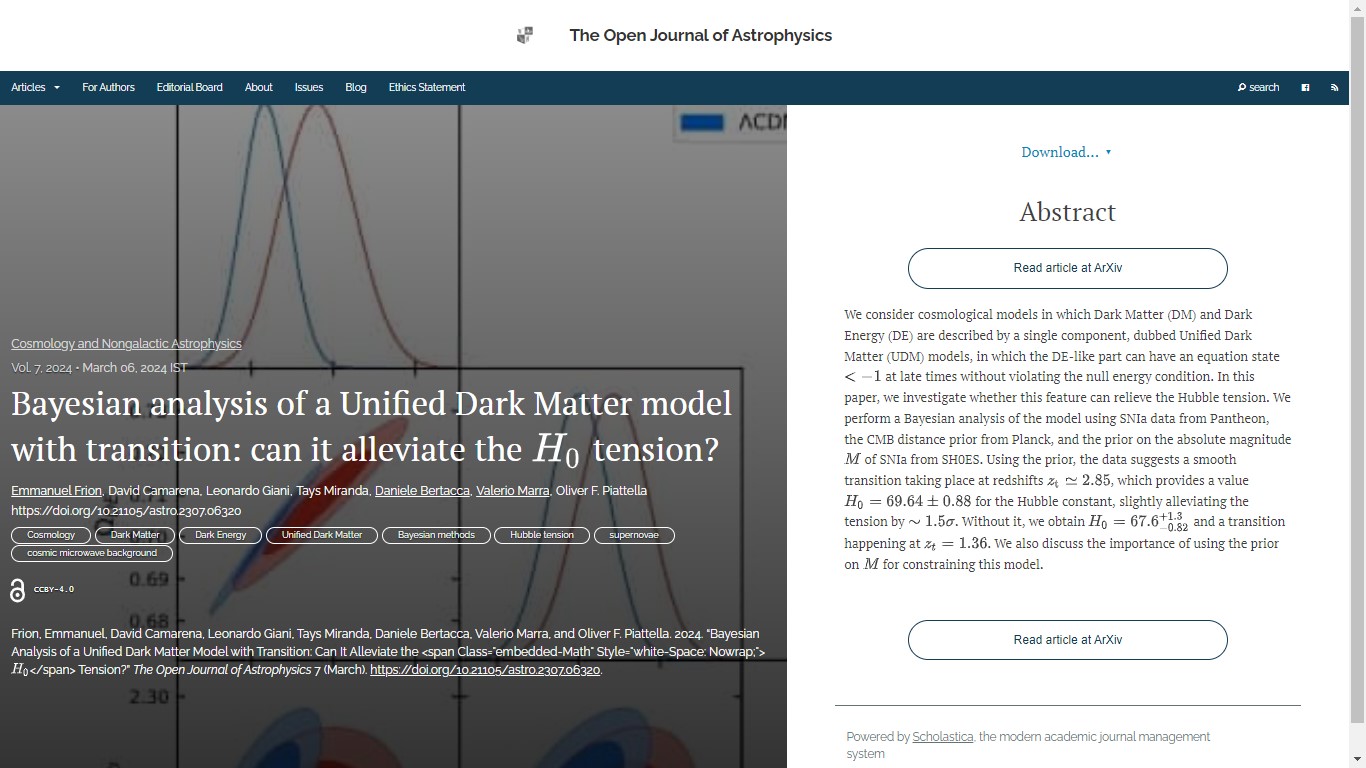
The authors are seven in number: Emmanuel Frion (University of Helsinki, Finland, and Western University, Canada); David Camarena (University of New Mexico, USA); Leonardo Giani (University of Queensland, Australia); Tays Miranda (University of Helsinki and University of Jyväskylä, both in Finland); Daniele Bertacca (Università degli Studi di Padova, Italy); Valerio Marra (Universidade Federal do Espírito Santo, Brazil and Osservatorio Astronomico di Trieste, Italy);
and Oliver F. Piattella (Università degli Studi dell’Insubria, Como, Italy).
Here is the overlay of the paper containing the abstract:
You can click on the image of the overlay to make it larger should you wish to do so. You can also find the officially accepted version of the paper on the arXiv here.
It’s Friday afternoon but before I collapse, exhausted, into the arms of the weekend I’ll take the opportunity to announce yet another new paper at the Open Journal of Astrophysics.
The latest paper is the 45th so far in Volume 6 (2023) – just five to go for a half-century – and it’s the 110th altogether. This one was actually published on Tuesday November 14th.
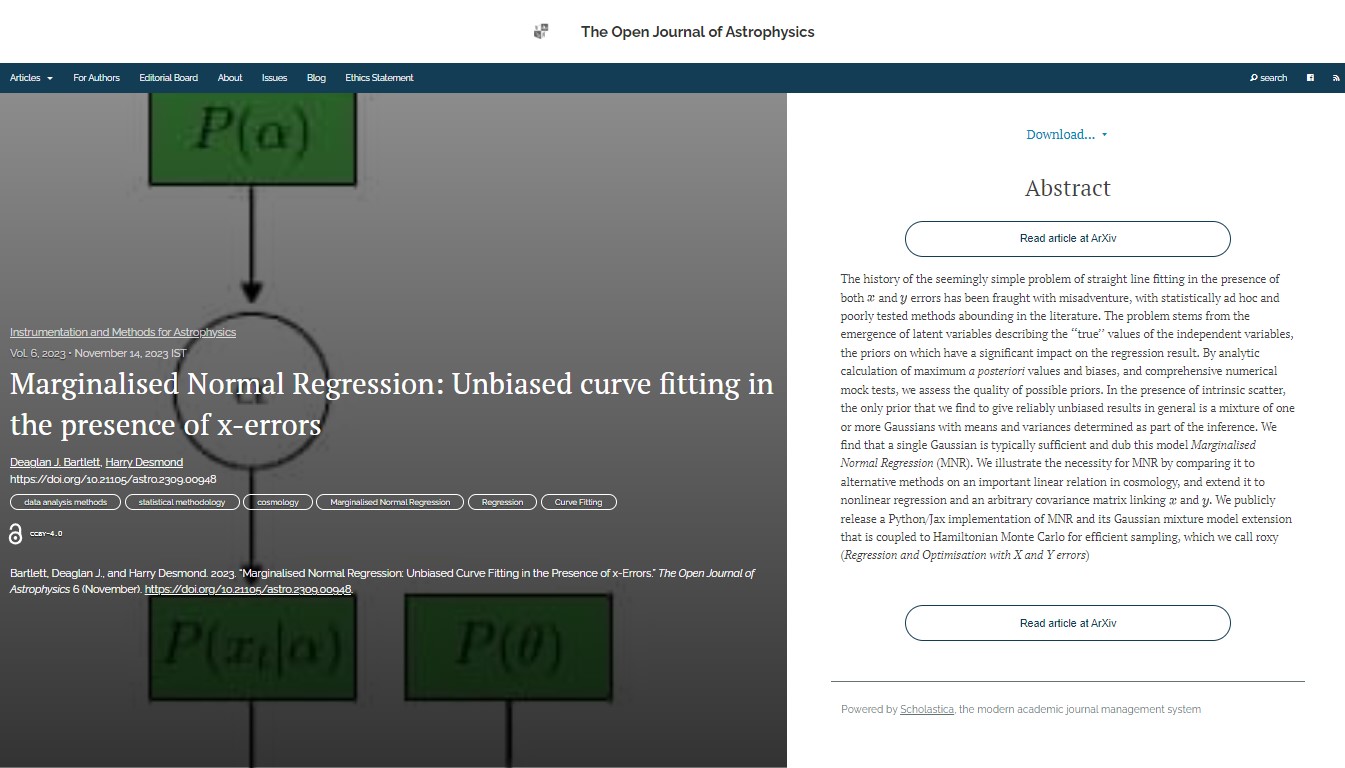
The title is “Marginalised Normal Regression: Unbiased curve fitting in the presence of x-errors” and it’s by Deaglan J. Bartlett (Institut d’Astrophysique de Paris, France) and Harry Desmond (Portsmouth, UK). It sounds like a statistical methods paper, and indeed it is, but remember that there’s a very long historical connection between astronomy and the development of statistical methods for data analysis, and this paper tackles a very longstanding issue: how best to fit curves in the presence of noisy data. This paper presents a new method for doing this, together with applications to cosmological and astrophysical data, and accompanying software. It is in the folder marked Instrumentation and Methods for Astrophysics.
Here is the overlay of the paper containing the abstract:
You can click on the image of the overlay to make it larger should you wish to do so. You can find the officially accepted version of the paper on the arXiv here.
Well, Maynooth University may well be still (partially) closed as a result of the Covid-19 pandemic but the The Open Journal of Astrophysics is definitely fully open.
In fact we have just published another paper! This one is in the Astrophysics of Galaxies section and is entitled A Bayesian Approach to the Vertical Structure of the Disk of the Milky Way. The authors are Phillip S Dobbie and Stephen J Warren of Imperial College, London.
I’d like to take this opportunity to thank the Editorial team and various referees for their efforts in keeping the Open Journal of Astrophysics going in these difficult times.
The views presented here are personal and not necessarily those of my employer (or anyone else for that matter).
Feel free to comment on any of the posts on this blog but comments may be moderated; anonymous comments and any considered by me to be vexatious and/or abusive and/or defamatory will not be accepted. I do not necessarily endorse, support, sanction, encourage, verify or agree with the opinions or statements of any information or other content in the comments on this site and do not in any way guarantee their accuracy or reliability.