The Harvard Astronomer’s Songbook

Posted in Uncategorized with tags , on November 16, 2023 by telescoper

I’ve just finished a major task I’ve been struggling over for ages but before I head home early to celebrate, inspired this wonderfully snarky article on arXiv, I thought I’d indulge in a list of my Top Ten entries from the Harvard Astronomer’s Songbook. Feel free to add your own contributions through the Comments Box!

  1. Careless Loeb
  2. What’s Loeb got to do with it?
  3. All you need is Loeb
  4. How deep is your Loeb?
  5. Crazy little thing called Loeb
  6. Endless Loeb
  7. Loeb is in the Air
  8. The Power of Loeb
  9. Tainted Loeb
  10. I’m in the Mood for Loeb

and a bonus track, Bye Bye Loeb

Ireland, CERN and Science

Posted in Science Politics, The Universe and Stuff with tags , , , , , on November 15, 2023 by telescoper

And lo! it came to pass that Minister for Further and Higher Education, Research, Innovation and Science Simon Harris TD has today secured Government approval to submit Ireland’s formal application to join the European Organization for Nuclear Research (CERN) as an Associate Member.

I have posted about this before, for example here. Currently Ireland is in the anomalous position of not having any form of association agreement with CERN; the list of Full and Associate Member states can be found here.

There is an important point about CERN membership, however, which I hope is not sidelined. The case for joining CERN made at political levels is largely about the return in terms of the potential in contracts to technology companies based in Ireland from instrumentation and other infrastructure investments. This was also the case for Ireland’s membership of the European Southern Observatory, which Ireland joined about five years ago. The same thing is true for involvement in the European Space Agency, which Ireland joined in 1975. These benefits are of course real and valuable and it is entirely right that arguments should involve them.

Looking at CERN membership from a scientific point of view, however, the return to Ireland will be negligible unless there is a funding to support scientific exploitation of the facility. That would include funding for academic staff time, and for postgraduate and postdoctoral researchers to build up an active community as well as, e.g., computing facilities. This need not be expensive even relative to the modest cost of associate membership (approximately  €1.9M). I would estimate a figure of around half that would be needed to support CERN-based science.

The problem is that research funding for fundamental science (such as particle physics) in Ireland is so limited as to be virtually non-existent by a matter of policy at Science Foundation Ireland, which basically only funds applied research. Even if it were decided to target funding for CERN exploitation, unless there is extra funding that would just lead to the jam being spread even more thinly elsewhere.

As I have mentioned before, Ireland’s membership of ESO provides a cautionary tale. The Irish astronomical community was very happy about the decision to join ESO, but that decision was not accompanied by significant funding to exploit the telescopes. Few astronomers have therefore been able to benefit from ESO membership. While there are other benefits of course, the return to science has been extremely limited. The phrase “to spoil a ship for a ha’porth of tar” springs to mind.

Although Ireland joined ESA almost fifty years ago, the same issue applies there. ESA member countries pay into a mandatory science programme which includes, for example, Euclid. However, did not put any resources on the table to allow full participation in the Euclid Consortium. There is Irish involvement in other ESA projects (such as JWST) but this is somewhat piecemeal. There is no funding programme in Ireland dedicated to the scientific exploitation of ESA projects.

Under current arrangements the best bet in Ireland for funding for ESA, ESO or CERN exploitation is via the European Research Council but to get a grant from that one has to compete with much better developed communities in those areas.

A significant shake-up of research funding in Ireland is in view, with Science Foundation Ireland and the Irish Research Council set to merge into a single entity called Research Ireland. If I had any say in the new structure I would set up a pot of money specifically for the purposes I’ve described above. Funding applications would have to be competitive, of course, and I would argue for a panel with significant international representation to make the decisions. But for this to work the overall level of public sector research funding will have to increase dramatically from its current level, well below the OECD average. Ireland is currently running a huge Government surplus which is projected to continue growing until at least 2026. Only a small fraction of that surplus would be needed to build viable research communities not only in fundamental science but also across a much wider range of disciplines. Failure to invest now would be a wasted opportunity.

Lemons and Leaves

Posted in Barcelona, Maynooth with tags , on November 14, 2023 by telescoper
Kennst du das Land, wo die Zitronen blühn?

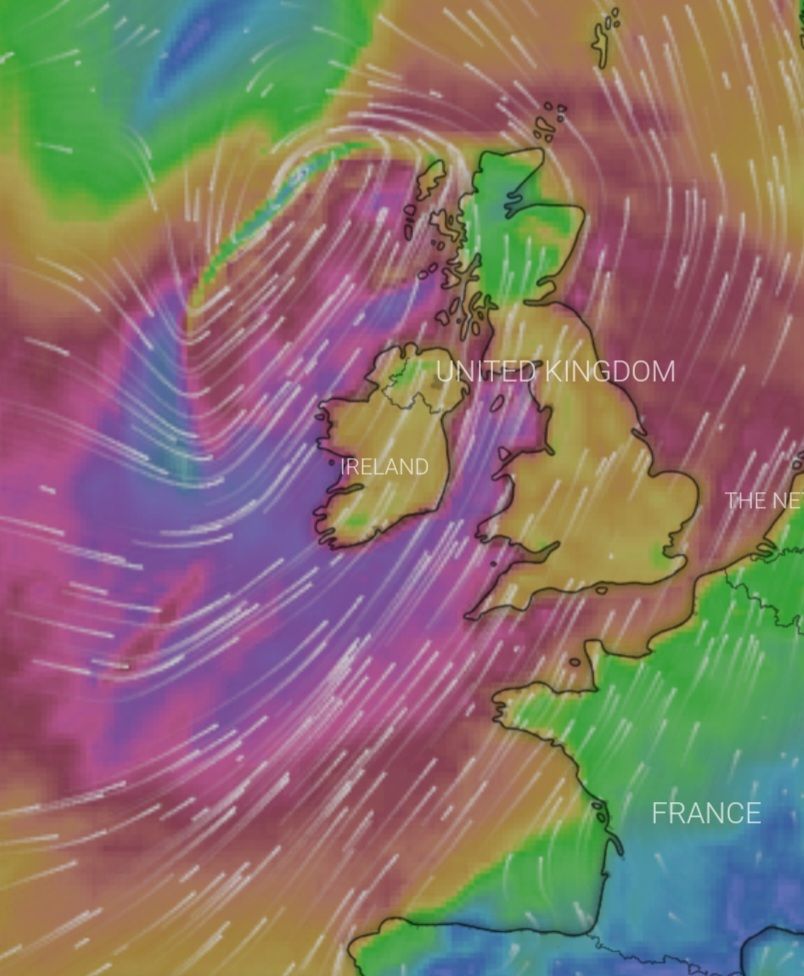
Yesterday, Storm Debi passed over Ireland. There was a red weather alert in Maynooth but, as far as I know, no damage apart from a few broken branches and fallen leaves. It was far worse elsewhere in Ireland. Meanwhile, here in Barcelona, it’s sunny and 25° C..

The Atwood Machine

Posted in Barcelona, Cute Problems, Education, Maynooth with tags , , , on November 14, 2023 by telescoper

In the foyer of the Physics Department at the University of Barcelona you will find, as well as a fine refracting telescope, an example of the Atwood Machine. For some years before my current sabbatical I have been teaching Newtonian Mechanics to first-year students in Maynooth and used this as a simple worked example. I have to admit I’ve never seen an actual Atwood machine before, and what I’ve done in lectures is the simplified form on the right rather than the actual machine on the left.

The illustration on the right depicts the essential elements, but you can can see that the actual machine has a ruler which, together with a timing device, can be used to determine the acceleration of the suspended mass and how that varies with the other mass. You can work this out quite easily in the simplest case of a frictionless pulley by letting the tension in the string (which is light and inextensible) be T (say) and then eliminating it from the equations of motion for the two masses. I leave the rest as an exercise for the reader. A more interesting problem, for the advanced student, is when you have to take into account the rotational motion of the pulley wheel…

In fernem Land – Leo Slezak

Posted in Literature, Opera with tags , , , on November 13, 2023 by telescoper

The book I’m currently reading in the evenings contains a scene in which members of a family listen to a gramophone record of Leo Slezak singing In fernem Land from the opera Lohengrin by Richard Wagner. Being the anorak I am I searched around the many recordings made by Slezak and I reckon it must be this one. The sound quality isn’t great, but then it was recorded way back in 1907 and it always amazes me that you can hear anything at all from over a century ago. It’s an interesting performance because it’s taken at quite a slow tempo and Slezak’s voice sounds to my ears more like a lyric tenor than the Heldentenor one normally associates with Wagnerian roles. Anyway, it’s well worth a listen as there’s much to appreciate and it’s very different from modern renditions.

Now that you’ve heard the record, I wonder if you can guess the book I’m reading? Answers through the comments box please!

Astrophysics & Cosmology Masterclass at Maynooth

Posted in Maynooth, The Universe and Stuff with tags , , , on November 13, 2023 by telescoper

Both my regular readers may remember that for the last couple of years at this time of year there has been an Astrophysics & Cosmology Masterclass at Maynooth; see here and here for the previous incarnations. Not being in Maynooth I almost forgot about this year’s Masterclass, which has a different line-up with Dr Paddy Kavanagh adding some observational content alongside Dr John Regan.

This event is online only from 10am to 12pm on Friday 17th November 2023 and you can find out more details and register here.

Demonstration!

Posted in Barcelona, Politics with tags , on November 12, 2023 by telescoper
A demonstration went past my apartment in Barcelona today

The march was a right-wing protest against a proposed amnesty for Catalan separatists. Judging by the time it took to pass my apartment, I’d say there were a few thousand people on it and it passed off peacefully as far as I could tell.

P.S. it’s warmer again today, about 21°C.

Three New Publications at the Open Journal of Astrophysics

Posted in OJAp Papers, The Universe and Stuff with tags , , , , , , , , , on November 12, 2023 by telescoper

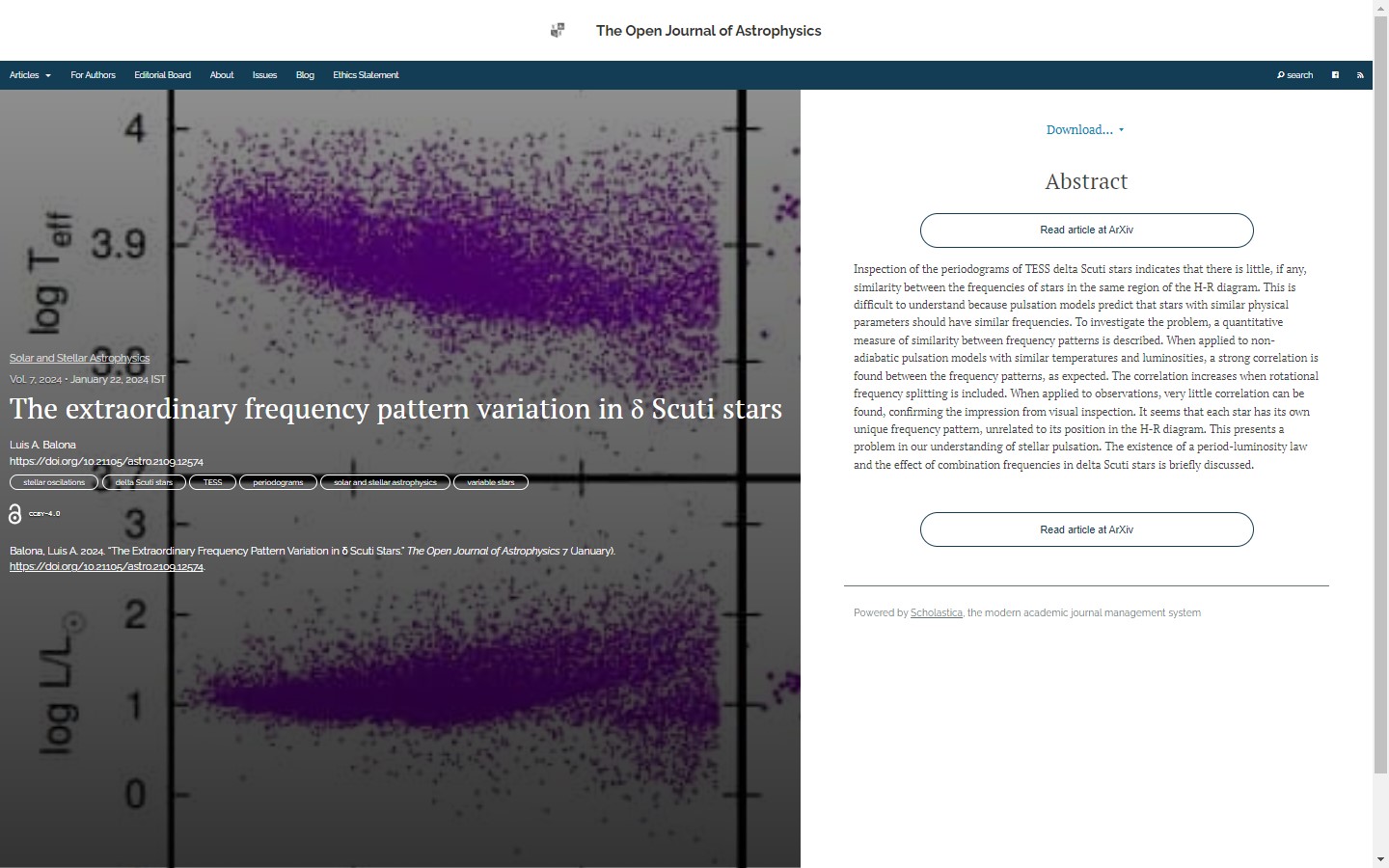
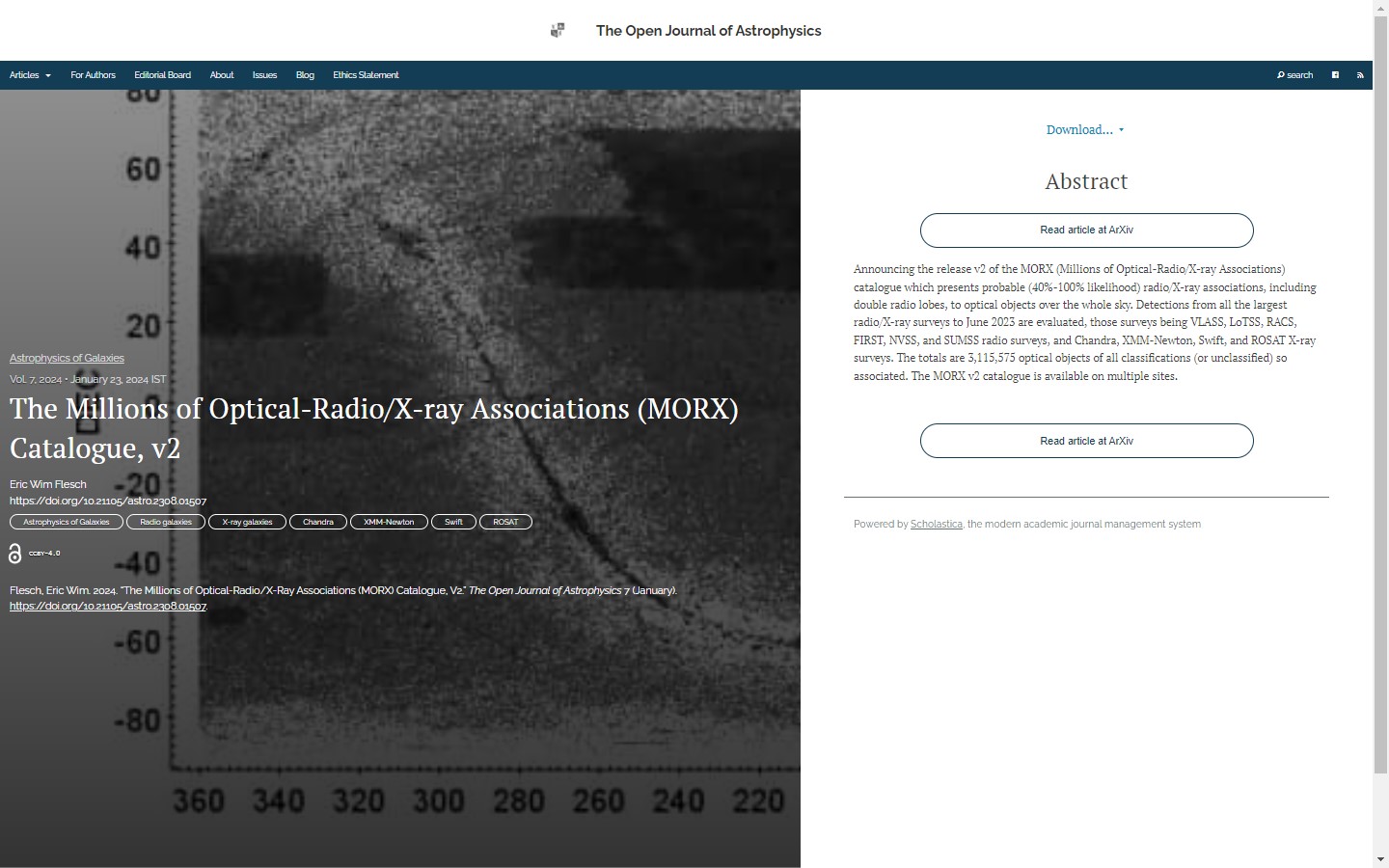
It’s been a busy week generally, and specifically at the  Open Journal of Astrophysics. In fact, this week we have published three papers, which I didn’t have time to post here at the time we published them but now present to you. These take the count in Volume 6 (2023) up to 44 and the total published by OJAp up to 109. With many more in the pipeline we’re still on for 50 by the end of the year.

In chronological order, the three papers published this week, with their overlays, are as follows. You can click on the images of the overlays to make them larger should you wish to do so. All three of these papers are in the folder Cosmology and Nongalactic Astrophysics.

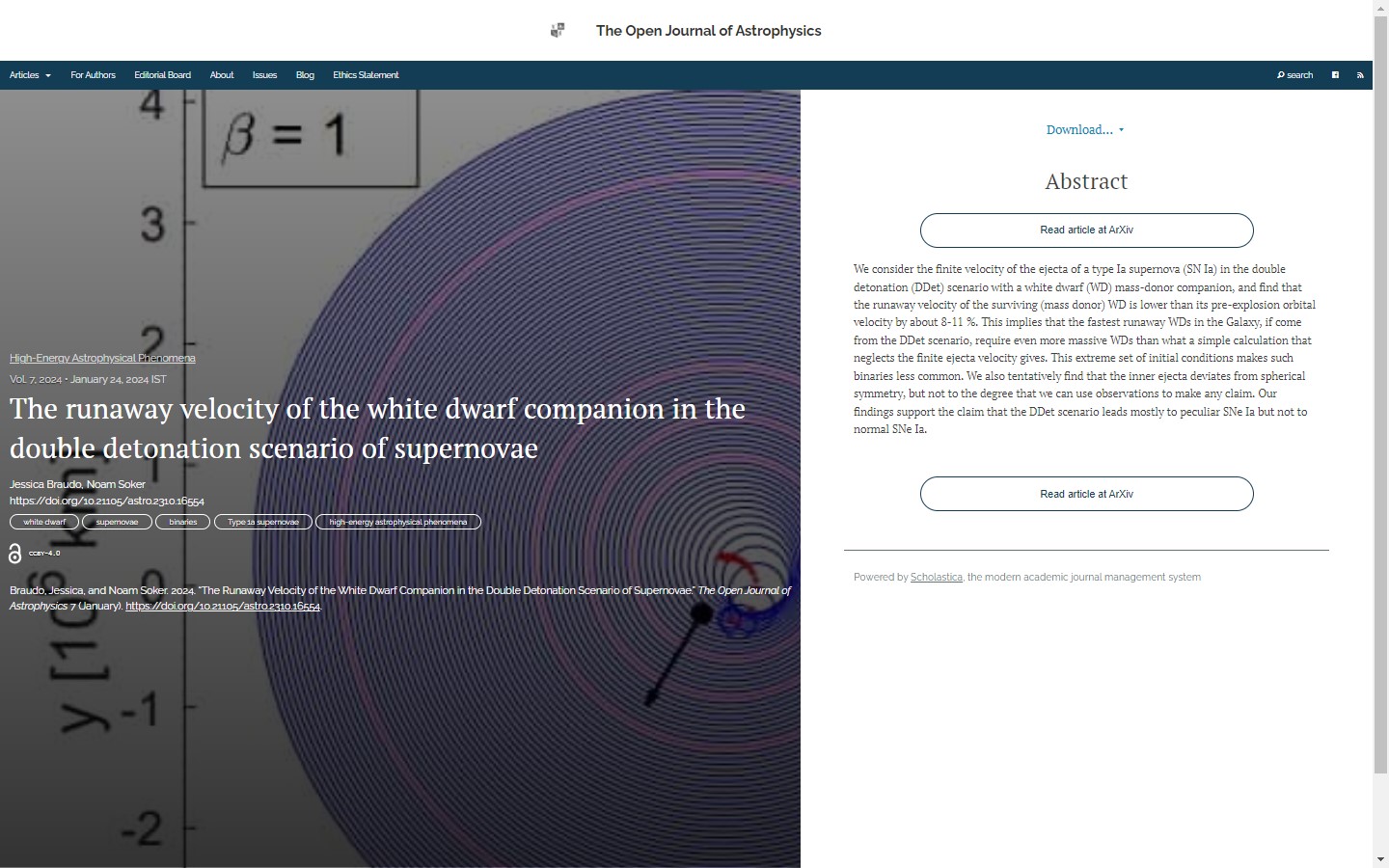
First one up is “On the degeneracies between baryons, massive neutrinos and f(R) gravity in Stage IV cosmic shear analyses” by Alessio Spurio Mancini (Mullard Space Sciences Laboratory, University College London, UK) and Benjamin Bose (Royal Observatory Edinburgh, UK). This presents a fast nonlinear matter power spectrum emulator for f(R) gravity with massive neutrinos, coupled with a baryon feedback emulator forecasts for a cosmic shear experiment with typical Stage IV specifications. This paper was published on 6th November 2023.

Here is a screen grab of the overlay, which includes the abstract:

You can find the officially accepted version of the paper on the arXiv here.

The second paper to announce is “” by Marika Asgari (Hull, UK), Alexander Mead (Bochum, Germany) and Catherine Heymans (Edinburgh, UK).  This presents a thorough discussion of the popular halo model for cosmological structure with applications, accompanied by the release of a software suite called pyhalomodel (which you can download here). The paper was also published on 7th November 2023 and you can see the overlay here:


The accepted version of this paper can be found on the arXiv here.

The last paper of this batch is  entitled “Dissecting the Thermal SZ Power Spectrum by Halo Mass and Redshift in SPT-SZ Data and Simulations” and the authors are: by Josemanuel Hernandez (Chicago), Lindsey Bleem (Chicago) , Thomas Crawford (Chicago), Nicholas Huang (Berkeley), Yuuki Omori (Chicago), Srinivasan Raghunathan (NCSA, Urbana) & Christian Reichardt (Melbourne). This paper, a study of the mass and redshift dependence of the thermal Sunyaev-Zeldovich effect in South Pole Telescope data and a comparison thereof with theoretical calculations, was published on 9th November 2023.

Here is the overlay:


You can find the full text for this one on the arXiv here.

The Geometry of Barcelona

Posted in Architecture, Barcelona, Biographical with tags , , , on November 11, 2023 by telescoper

Having a lazy Saturday morning before going out to do some shopping I thought I’d do a silly post about a few random things that struck me about Barcelona. As I have mentioned before, I am resident in area of the city known as Eixample. Most of this zone was built in the 19th and early 20th centuries and its layout was very carefully planned, as you can see from this aerial picture:

I initially thought that the name Eixample related to the exemplary nature of the area, but in fact it means something like “extension”; the “ample” has a similar sense to the English “ample”.

To orient yourself, the Sagrada Familia is towards the bottom left. In the middle of the top you can see Plaza de Cataluña. Near that there is a junction of two wide tree-lined roads; the one running from SW to NE (relative to the picture) is the Gran Via de les Corts Catalanes (which is actually 8 miles long altogether); the one perpendicular to the Gran Via is Passeig de Gràcia. My apartment is a few blocks SW of this junction. You can see to the top left how the pattern of streets changes, as you approach the older part of town, the harbour and the sea.

Anyway, the street plan of Eixample is generally rectangular but if you look carefully you will note that the footprint of the blocks is not quite rectangular; the corners are shaved off to make them octagonal. This is a very nice feature because it means that visibility around the corners is very good and there is a lot of pavement space near the entrances. Many of these buildings now have a bar or restaurant on the ground floor and there is plenty of room for seated areas. Above all, combined with the wide boulevard-type roads, this gives this densely-populated area a much less claustrophobic feel than other cities with rectilinear street layouts, such as New York. Note also that each block encloses a communal space which contains private gardens, play areas, etc, though some appear to have been built over especially.

The road passing diagonally through the picture is called, um, Avenida Diagonal. It plays a rather similar role to Broadway in Manhattan.

As well as A. Diagonal, Barcelona has A. Parallel. In Spanish this is called Avenida del Paralelo; in Catalan it is Avinguda del Paral·lel. The signs on the Metro are all in Catalan so the one on the Metro station on this road says Paral·lel. I was puzzled for some time by the dot between the two letters “l” but it’s quite straightforward. In Catalan (and Spanish) the diagraph “ll” (which used to be listed a separate letter of the alphabet) is pronounced like the English letter “y”, e.g. in paella and amontillado. The dot in Paral·lel is there to indicate that it’s not the letter “ll” in the middle but two letters “l” next to each other and is pronounced para-lel rather than para-yel. The Spanish word “Paralelo” avoids this problem by simply dropping an “l”.

Now it’s nearly time to get ready to go out. The temperature here has fallen noticeably over the last few weeks. It was around 15° last week with a stiff westerly breeze. That was enough to persuade some of the locals to put on their winter coats, scarves and woolly hats although to me it still felt warm when in the sun. Today is about 19° C. The cooler weather makes it far less sweaty and much more pleasant to walk about. It’s also noticeable that there are fewer tourists around, which has two advantages: (a) one’s mean free path between people is longer and (b) it’s much easier to get into places of interest. I hope to ramp up my visits to museums and art galleries between now and Christmas.

University Management Salaries

Posted in Barcelona, Maynooth on November 10, 2023 by telescoper

I have long believed that the hierarchical management structure of modern universities, especially in the UK and Ireland, is wrong and damaging. One aspect of this is the unjustifiably high salaries paid to the people at the very top. I can see no good reason for any university President, Vice-Chancellor, Rector, or whatever else their name is, to receive a salary above the standard scale for professors.
The problem with the high salaries these people get nowadays is not only the expense (which is considerable) but the fact that it sends out the message that they are much more important than they actually are and that the people who actually carry out the core work of a third-level institution – the academics and related staff – are mere subordinates. Moving into management should really be regarded as a sideways move, not an advance.

Incidentally, I would also argue that nobody should be employed in a senior management role in a university who neither teaches nor does research. How can someone who is not active in these areas know the reality of the situation facing staff who are?

Anyway, these thoughts came back into my mind after an informal chat with some people here in the ICC. It turns out that the salary of the Rector of the University of Barcelona, Joan Guàrdia Olmos, is in the public domain. It is made up from various components but the grand total is €124,619.58 (2022 figure). That would be well below the bottom level of the Professor A scale in Maynooth. Contrast that with the President of Maynooth University, Eeva Leinonen, who is paid a salary of €208,509, which is considerably higher than the top of the Professor A scale at Maynooth. Professor Leinonen also receives €13,500 benefit in kind for rent-free accommodation.

You can contrast these salaries with the respective institutions, both of which are public universities. The University of Barcelona has around 63,000 students and about 5000 staff; it is widely regarded as the top University in Spain (pop. 47 million). Maynooth University has about 15,000 students and about 900 staff; it is not regarded by anybody as the top University in Ireland (pop. 5 million).
I think you get the point.