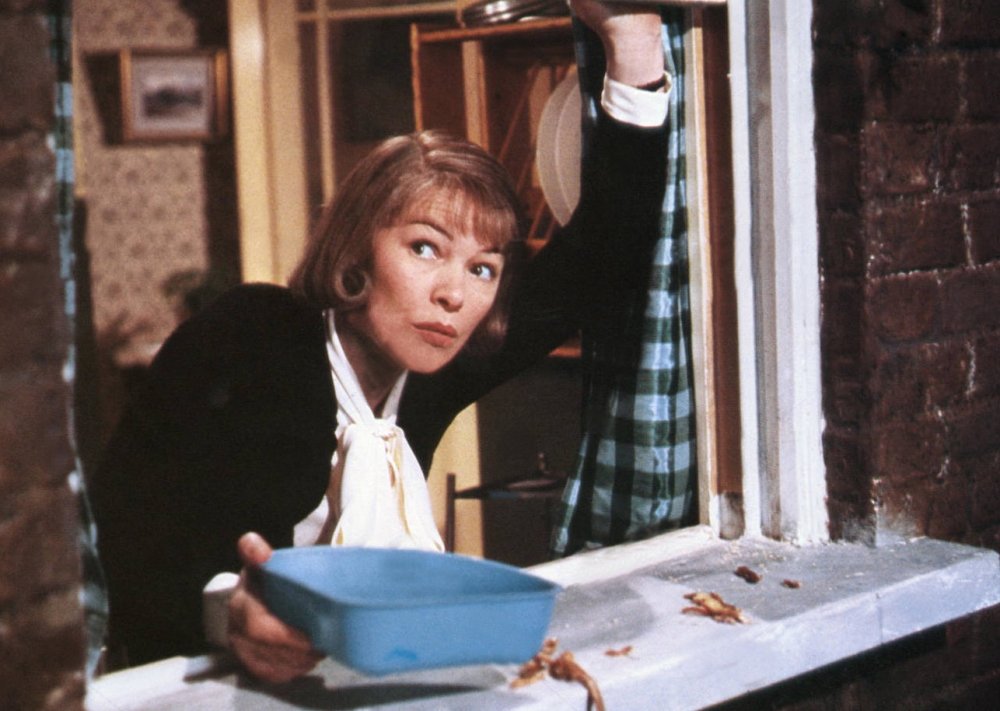
I’ve been writing far too many R.I.P. posts recently, but I had to say something to mark the passing of Glenda Jackson who has died at the age of 87. Glenda Jackson had an illustrious acting career during which she won many awards (including two Oscars) and then turned her hand to politics; she was a Labour Member of Parliament from 1992 to 2015.
Glenda Jackson in Stevie (1978)
The role in which I remember Glenda Jackson best was in the film Stevie (1978) in which she played the poet Stevie Smith, whose poetry I have admired greatly for its dark yet whimsical tone since I was introduced to it while at school. The originality of her voice is the reason I’ve posted some of her poems on this blog from time to time.
Stevie Smith, who died in 1971, made a number of radio broadcasts and, without really trying to impersonate her, I think Glenda Jackson captured perfectly her quirky mixture of wit and melancholia. It was a marvelous performance in what I think is a neglected film masterpiece.
Just a short post passing on the information that we have a fixed-term job available in the Department of Theoretical Physics at Maynooth University. You can find further details here.
The position is for 10 months, starting in September 2023, and is to provide teaching cover for Professor Peter Coles (Who He? Ed.) who will be on sabbatical leave next academic year.
I know it is a relatively short appointment, but it seems to me that it would provide a good opportunity for an early-career academic, perhaps someone straight out of a PhD, to gain some teaching experience.
The deadline for applications is 23.30 on Sunday July 9th and you should apply through the jobs portal here.
Please feel free to pass this on to anyone who may be interested!
P.S. I’m not involved in the recruitment process, just passing this on for information.
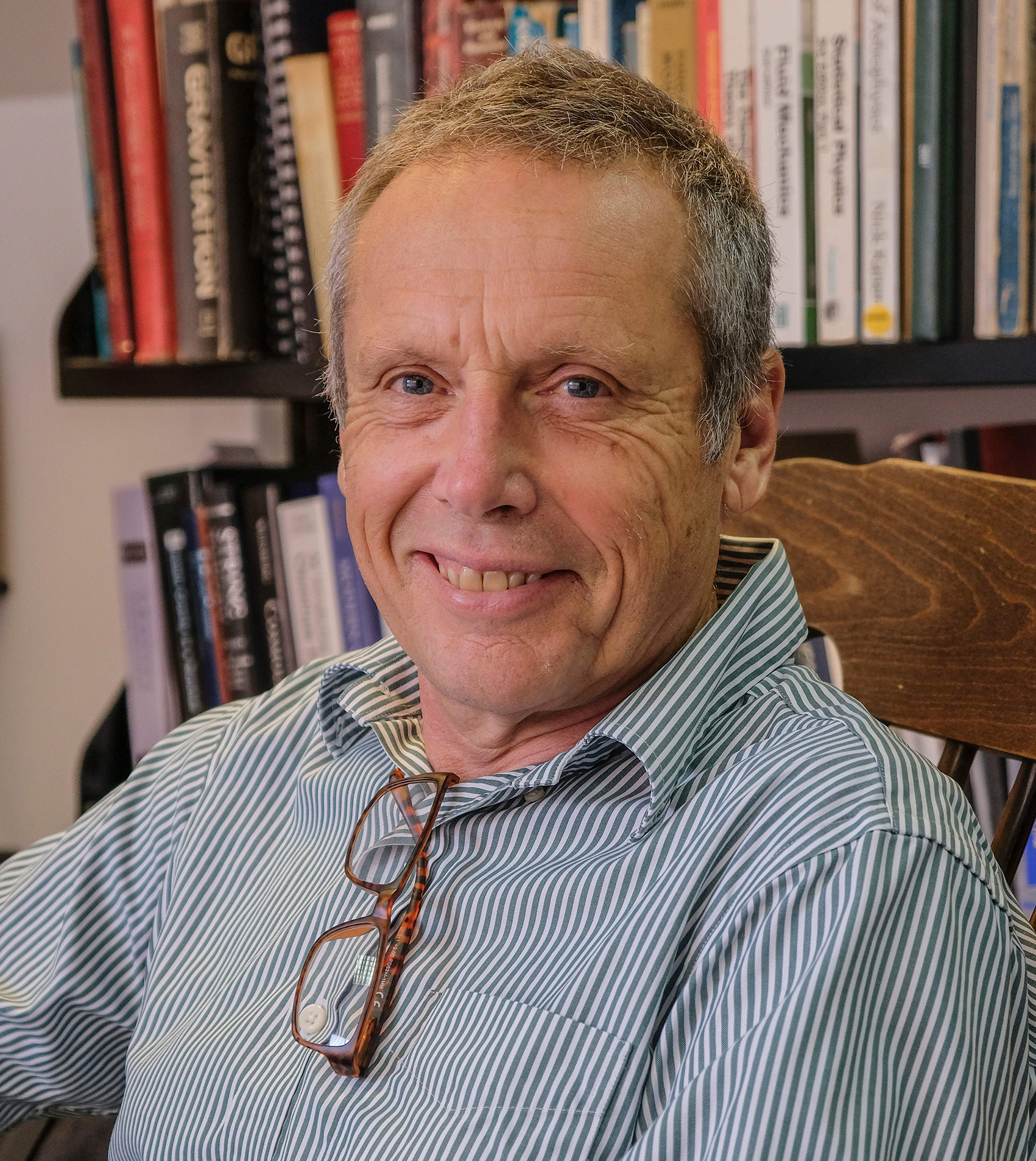
It was with a sense of shock that I heard this afternoon of the death of the age of 68 of cosmologist Nick Kaiser. It seems like only yesterday that we were celebrating the award of the Gruber Prize to Nick, but that was back in 2019. In a field filled with very clever people, Nick was one of the cleverest and also one of the nicest.
I have never worked directly with Nick Kaiser but he had an enormous influence on me, especially early on in my career. When I was doing my PhD, Nick was based in Cambridge and if I remember correctly he was the first person ever to ask me a question during a conference talk when I gave one there in 1987. Nick was never shy about making such interventions, sometimes somewhat mischievously. At first he terrified me because I didn’t know him except by scientific reputation, and didn’t realize what a nice guy he was. His question was actually very helpful, as it allowed me explain something that I’d skipped because I was under time pressure. His response to my explanation was very complimentary and supportive, which encouraged me a lot, and we chatted for quite a while after the session (in a pub). He was very friendly and approachable, and very far from the intimidating character I’d expected. Anyway, his 1984 paper on cluster correlations was the direct motivation for my very first publication (in 1986).
I mentioned yesterday that many of the papers published by the Open Journal of Astrophysics over the last few years have been in the field of weak gravitational lensing. It is safe to say that is a field that was basically created by Nick; see the paper by Kaiser & Squires (1993) that kicked it all off. You could also say the same about the use of redshift-space distortions, concerning which he wrote a seminal paper in 1987. These are two techniques that will be applied in the analysis of data from the Euclid spacecraft, to be launched next month.
These are just a few of things that Nick did. He did many others, always original and always interesting. In recognition of his achievements he was made a Fellow of the Royal Society in 2008, won the Gold Medal of the Royal Astronomical Society in 2017, the Daniel Chalonge and Hector de Vega Medals in 2018, and the Gruber Prize for Astronomy in 2019.
It’s hard to characterize someone of such intellectual breadth, but it always seemed to me that his approach was driven by a very deep physical insight. He was often able to identify what were the fundamental aspects of apparently complicated phenomena and build simple models that captured most of the physics. Using this approach he could penetrate the thickets in which others might get lost. He was perfectly capable of undertaking more complicated calculations to elaborate the details, but he always started by focussing on the basics.
I met Nick many times here and there, usually at conferences. He was always enthusiastic and energetic and entertaining, and was great company to talk to over a drink or several. You always had a good laugh talking to Nick, but you always learnt something too. His son studied in Cardiff some years ago, while I was working there, and Nick sometimes came to visit on the pretext of giving a seminar. I remember once he almost missed his own talk because we were sitting in a pub chatting.
Nick spent recent years in Paris; I remember his presence when I did an online colloquium for the Daniel Chalonge – Hector de Vega School in 2021. He certainly seemed in fine health and good spirits then. Indeed, he gave a talk in the same series that year which you can download here.
Nick’s untimely death is particularly shocking because he was ultra-fit. I think he got hooked on ultra-endurance events while living in Hawaii, as the first Ironman events were held there. Mere marathons were not enough for him. I think I last saw him in person in 2016 during a meeting in Italy. While most of us laboured on the “easy” hiking trails, Nick found them uninteresting and went running off looking for greater challenges.
It still hasn’t really sunk in that Nick has gone. I know I’m not the only one who feels that way. I think the sense of loss will pervade the cosmological community for a considerable time. I send deepest condolences to his family, friends, colleagues and co-workers. He’ll be hugely missed by a huge number of people.
I was just thinking this morning that it’s been a while since I posted anything in my Bad Statistics folder when suddenly I come across this gem from a paper in Nature Astronomy entitled Could quantum gravity slow down neutrinos?
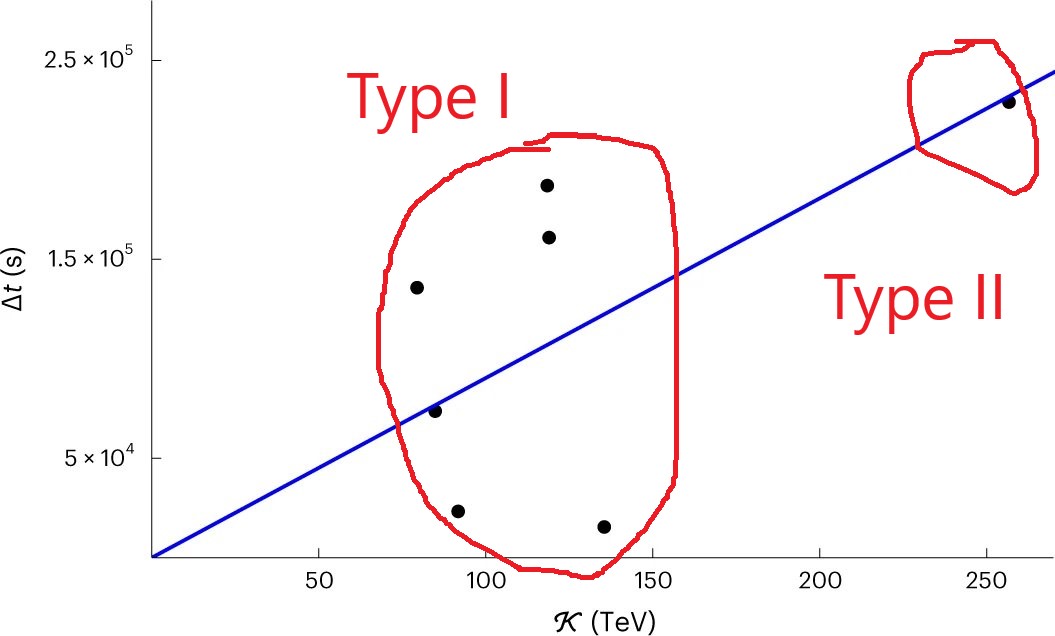
The paper itself is behind a paywall (though a preprint version is on the arXiv here). The results in the paper were deemed so important that Nature Astronomy tweeted about them, including this remarkable graph:
Understandably there has been quite a lot of reaction from scientists on Twitter to this plot, questioning how the blue line is obtained from the dots (as only one point to the right appears to be responsible for the trend), remarking on the complete absence of any error bars on either axis for any of the points, and above all wondering how this managed to get past a referee, never mind one for a “prestigious” journal such as Nature Astronomy. It wouldn’t have passed muster as an undergraduate exercise.
Of course this is how a proper astronomer would do it:
Joking aside, if you look at the paper (or the preprint if you can’t afford it) you will see another graph, which shows two other points at higher energy (red triangles):
The extra two points don’t have any error-bars either, and according to the preprint these appear to be unconfirmed candidate GRB events.
The abstract of the paper is:
In addition to its implications for astrophysics, the hunt for neutrinos originating from gamma-ray bursts could also be significant in quantum-gravity research, as they are excellent probes of the microscopic fabric of spacetime. Some previous studies based on neutrinos observed by the IceCube observatory found intriguing preliminary evidence that some of them might be gamma-ray burst neutrinos whose travel times are affected by quantum properties of spacetime that would slow down some of the neutrinos while speeding up others. The IceCube collaboration recently significantly revised the estimates of the direction of observation of their neutrinos, and we here investigate how the corrected directional information affects the results of the previous quantum-spacetime-inspired analyses. We find that there is now little evidence for neutrinos being sped up by quantum spacetime properties, whereas the evidence for neutrinos being slowed down by quantum spacetime is even stronger than previously determined. Our most conservative estimates find a false-alarm probability of less than 1% for these ‘slow neutrinos’, providing motivation for future studies on larger data samples.
I agree with the last sentence where it says larger data samples are needed in future, but also I’d suggest higher standards of data analysis are also called for. Not to mention refereeing. After all, it’s the quality of the reviewing that you pay for, isn’t it?
P.S. For those of you wondering, this paper would not have been published by the Open Journal of Astrophysics even if passed review, as it is not on the astro-ph section of arXiv (it’s on gr-qc).
Following the recent spell of very warm weather in Maynooth, and perhaps encouraged by heavy overnight rain, the Japanese Honeysuckle (Lonicera Japonica) in my garden has now started to bloom. Each flower only lasts a few days – starting white, turning yellow, then gold, then dying – but new ones keep coming, so for a while you can see all the different stages of evolution. In among the white and yellow tones there are many buds that are yet to open. The colours of the flowers are not the best part of a honeysuckle, though: that’s the richly perfumed aroma they give off, especially in the evening. As Tennyson put it “the woodbine* spices are wafted abroad…”. The weather isn’t always warm enough to sit out in the garden when mine flowers, but it is now and it’s very lovely.
*woodbine is another name for honeysuckle, in case you didn’t know…
I was shocked this morning to stumble across the news (which made it onto the media in Ireland) of the horrific events in Nottingham in the early hours of this morning that left three people dead. Only later was it revealed that two of those dead were students at the University of Nottingham. This must be a very difficult time for the whole community in Nottingham and particularly the University. My thoughts are with everyone affected by these events, especially those who were injured or otherwise traumatized, and I send sincere condolences to the bereaved.
RTÉ put up this graphic showing the locations involved:
I lived in Nottingham and worked at the University of Nottingham for about eight years (from 1999 until 2007) . The locations shown are much closer to the City Centre than either the University campus or where I lived (in Beeston), both of which are off the map downwards and to the left. Despite this, and the fact that I haven’t been there for some time, I remember the area well enough to be shaken by the thought of things like this happening in such a familiar place. It must be much more difficult for those more directly affected.
I think the two students were found dead at Ilkeston Road in the early hours of this morning, but the rest of the picture of what happened remains very confused. It does no good to speculate on social media – as many are sadly doing – about the details or the motivation for the violence and mayhem. We’ll find out the truth in due course.
It’s time to announce yet another new paper at the Open Journal of Astrophysics. This one was published on Friday 9th June.
The latest paper is the 19th paper so far in Volume 6 (2023) and the 84th in all, so with more than half of 2023 remaining and many papers still in the pipeline we’re on track to reach a total of 100 papers by the end of 2023!
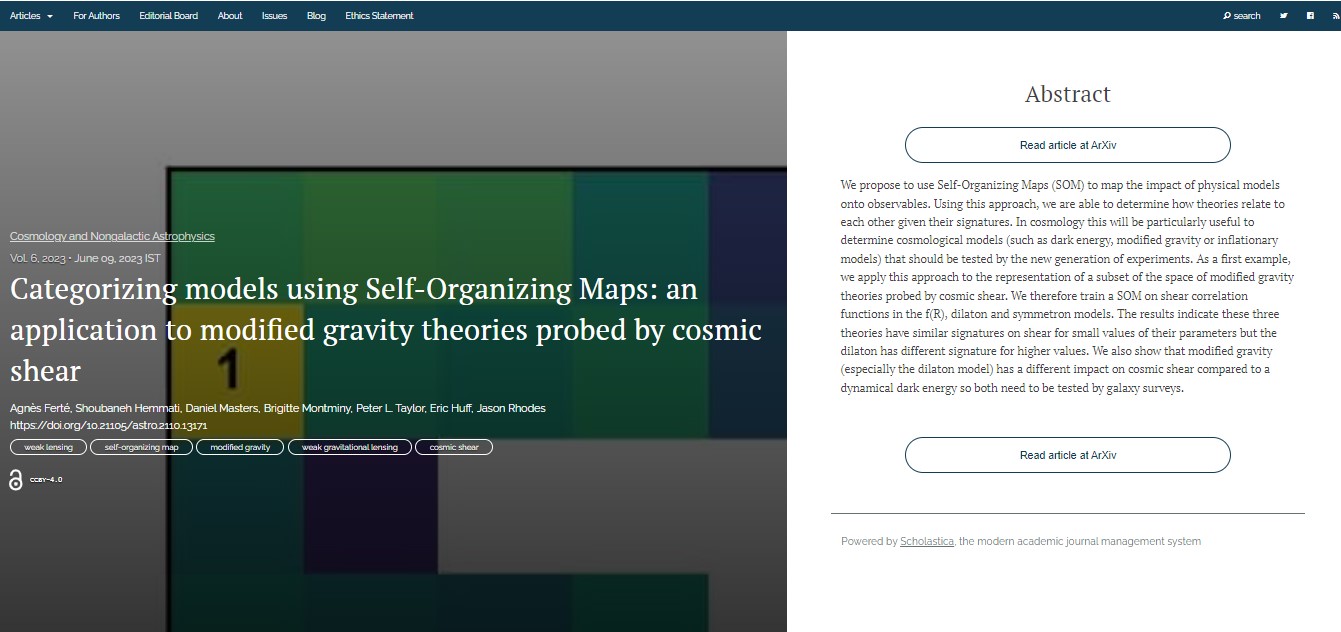
The primary classification for this paper is Cosmology and Nongalactic Astrophysics and its title is “Categorizing models using Self-Organizing Maps: an application to modified gravity theories probed by cosmic shear”. For the uninitiated, a Self-Organizing Map is a machine-learning technique that makes large-dimensional data sets easier to analyze. This paper is yet another one about weak gravitational lensing (cosmic shear), which is obviously what the cool kids do these days.
The authors are: Agnès Ferté (JPL); Shoubaneh Hemmati (IPAC); Daniel Masters (IPAC); Brigitte Montminy (JPL); Peter L. Taylor (JPL); Eric Huff (JPL); and Jason Rhodes (JPL).
(JPL=Jet Propulsion Laboratory, IPAC= Infrared Processing & Analysis Center, both associated with California Institute of Technology, Pasadena, USA)
Here is a screen grab of the overlay which includes the abstract:
You can click on the image of the overlay to make it larger should you wish to do so. You can find the officially accepted version of the paper on the arXiv here.
P.S. The first author tweeted about this paper:
Excited about our new paper published in the Open Journal of Astrophysics! We propose to use unsupervised learning to map a large theory space into 2D, a useful tool to select models to test with future data. Looking forward to taking this approach to the next steps! https://t.co/2zQtXQbMkn
When I blogged last week about English Paper 2 of the 2023 Leaving Certificate, I mentioned that one of the poets that came up was Paula Meehan. I wasn’t at all familiar with her work before then I looked around for some examples, and found some lovely poems. I’m not surprised the students were glad she came up this year. She has a very distinctive and powerful sense of imagery and a wry sense of humour, as exemplified by this witty but poignant poem, which takes an unusual perspective of the Easter Rising 2016. Inspired by the epigram which is quoted from the Irish Architectural Archive, it is a meditation on what is commemorated and what is not.
–0–
6 of our waterfowl were killed or shot, 7 of the garden seats broken and about 300 shrubs destroyed.
Park Superintendent in his report on the damage to St. Stephen’s Green, during the Easter Rising 1916
Time slides slowly down the sash window
puddling in light on oaken boards. The Green
is a great lung, exhaling like breath on the pane
the seasons’ turn, sunset and moonset, the ebb and flow
of stars. And once made mirror to smoke and fire,
a Republic’s destiny in a Countess’ stride,
the bloodprice both summons and antidote to pride.
When we’ve licked the wounds of history, wounds of war,
we’ll salute the stretcher bearer, the nurse in white,
the ones who pick up the pieces, who endure,
who live at the edge, and die there and are known
by this archival footnote read by fading light;
fragile as a breathmark on the windowpane or the gesture
of commemorating heroes in bronze and stone.
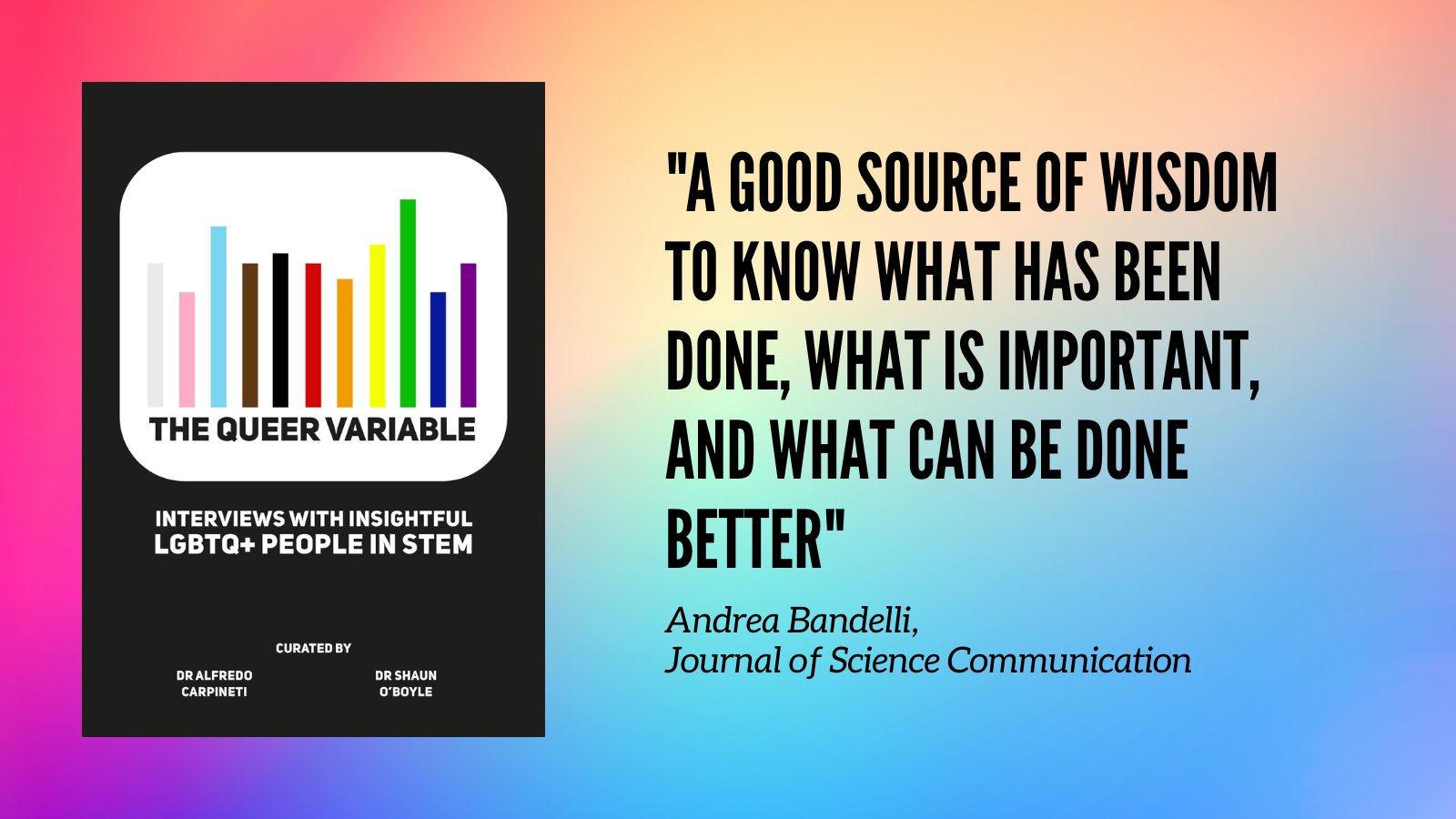
As it’s Pride Month I’d take this opportunity to re-advertise The Queer Variable which is a collection of 40 interviews with people who are studying or working in Science, Technology, Engineering, and Maths (STEM) and who are part of the LGBTQ+ community. You can find out more about the book and download it for free as a PDF or an e-book (whatever that is) here.
“The Queer Variable” is an edited collection of interviews with 40 LGBTQ+ people who experienced the full range of issues — positive and negative — that queer people in STEM regularly face. Through their own voices they describe how unnecessarily difficult certain academic environments can be, and how many chances to do good science go to waste when institutions and their leaders implicitly and explicitly discourage LGBTQ+ people from advancing their careers in STEM. The book contains a wealth of good advice for university leaders, lab directors, teachers and many others in leadership positions on how to make their organisations inclusive, diverse and respectful of everyone.
Andrea Bandelli (2022). Together in diversity: insights and wisdom from LGBTQ+ people working in STEM JCOM 21(06), R03.
I am one of the people interviewed for the book. My interview is actually the first in the book, which suggests I might have been the first person interviewed. Most of the interviews took place between 2020 and 2021, but I seem to remember doing mine (over a rather choppy Zoom connection) back in late 2019 when I was a mere lad of 56 years old and before the Covid-19 pandemic. That all seems a very long time ago now!
Anyway, many thanks to Alfredo Carpineti and Shaun O’Boyle for compiling this collection and making it available. I hope people will find it useful.
Incidentally, one of the sponsors of this project is Science Foundation Ireland whose Director General, Prof. Philip Nolan (former President of Maynooth University) is quoted thusly:
SFI is delighted to support this important publication, which highlights the diverse spectrum of talent and experience among our LGBTQ+ research colleagues. STEM research must benefit all of our society and therefore STEM careers must also be welcoming and accessible to all members of our society. I thank all of the contributors for sharing their powerful personal stories and for providing insights into the challenges they have faced on their career journeys. By raising their voices, they are helping break down barriers for future generations.
One thing that I forgot to mention in my post about examinations a few days ago is that students at Irish schools all sit exactly the same examination papers at the same time. This is very different from the UK where there are several different Exam Boards that have different syllabuses and set different papers. One consequence of the Irish system is immediately an exam is over, there is a national discussion of the students’ and teachers’ reaction to it. The examination papers are posted online after the examination too – you can find them here – so that everyone can join in the discussion.
I have to admit that when I was a student I was never one for talking about examinations after I had taken them. While most of my peers stood around outside the Exam Hall conducting a post mortem on the paper, I usually just went home. I always figured that there was nothing I could do about the results then so it was best to put it behind me and focus on the next thing. That’s what I’ve recommended to students throughout my career too: don’t look back, look forward.
Anyway, the first Leaving Certificate examination this year (on Wednesday) was English Paper 1, followed by Paper 2 on Thursday. Both seem to have been received relatively favourably by students; see some discussion here and here. Paper 1 is really an English Language Examination, with exercises on comprehension and composition while Paper 2 focuses on literature. Every year summer I look at the set books and poems for the English Leaving Certificate Paper 2 and they’re usually an interesting mix. This year the novels included Mary Shelley’s Frankenstein, Raymond Chandler’s The Big Sleep, Oscar Wilde’s The Picture of Dorian Gray, and Margaret Atwood’s The Handmaid’s Tale. The list of poets for the Higher examination was Elizabeth Bishop, Emily Dickinson, John Donne, Patrick Kavanagh, Derek Mahon, Paula Meehan, Adrienne Rich, and W.B. Yeats. Not all the texts come up in the examination. In the case of the poets, for example, Mahon, Kavanagh, Meehan, Donne and Rich appeared on Paper 2 but there was no Dickinson, Donne or Bishop.
While I have a personal interest in English literature, the English examinations are not relevant to me in a professional capacity. On the other hand, the Leaving Certificate papers in Mathematics are of direct relevance to me as a Professor in the Department of Theoretical Physics because they indicate the level of mathematical preparation of students likely to come in next academic year.
General reaction to Higher Mathematics Paper 1 seems to have been much more mixed than for the English papers, with many students taking to social media to express shock that it was so difficult: the hashtag #MathsPaper1 is still trending on Irish Twitter; you can also find some reaction here.
I have looked at the paper but can’t really comment on the level of difficulty because I haven’s studied previous years examinations in detail but I will say that (a) there’s quite a lot to do in the 150 minutes allowed and (b) there’s nowhere near as much calculus as in my A-level Mathematics over 40 years ago (though remember that Irish students do more subjects in the LC than UK students who do A-levels). Note also that because of the pandemic, this would have been the first state examination taken in Mathematics by many students.
The Leaving Certificate Higher Mathematics examination is split into two sections of equal weight. Section A (‘Concepts and Skills’) requires students to answer 5 questions from 6 (each split into parts); Section B (‘Contexts and Applications’) gives a choice of 3 out of 4 longer questions. That’s less choice than I expected; students have to answer 8 out of 10 questions. The Ordinary Level Examination has the same structure, but the questions are much more straightforward.
Mathematics Paper 2 is on Monday, so I’ll update this post then.
Update: Mathematics Paper 2 seems to have gone down much better than Paper 1. You can find it, along with some reaction, here.
The views presented here are personal and not necessarily those of my employer (or anyone else for that matter).
Feel free to comment on any of the posts on this blog but comments may be moderated; anonymous comments and any considered by me to be vexatious and/or abusive and/or defamatory will not be accepted. I do not necessarily endorse, support, sanction, encourage, verify or agree with the opinions or statements of any information or other content in the comments on this site and do not in any way guarantee their accuracy or reliability.





 In the Dark