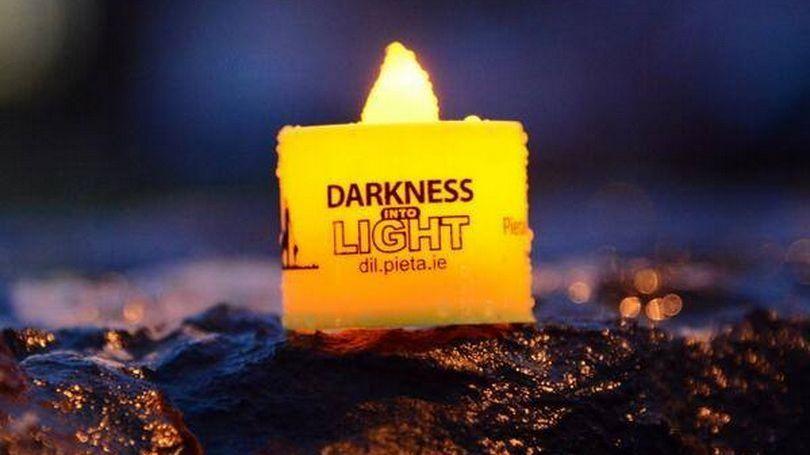
My birthday is coming up and for my birthday this year I’m asking for donations to Pieta, which is a charity working to prevent suicide and self-harm. I’ve chosen this cause because their mission means a lot to me. I hope you’ll consider contributing; every little bit will help.
You can donate here by my Facebook Fundraiser. Facebook takes care of the donation processing with no fees. If you decide to give, you can choose who can see that you donated, or donate privately. The Fundraiser will stay open for a couple of weeks or so.
If you prefer you can also donate directly to Pieta here and you can do that at any time.
A week or so ago I mentioned that the European Council had adopted a text that calls for the EU Commission and Member States to support policies towards a scholarly publishing model that is not-for-profit, open access and multi-format, with no costs for authors or readers.
The journal Nature has responded to the news with a piece entitled EU council’s ‘no pay’ publishing model draws mixed response and the lede:
Some academics have welcomed the proposed open access plans. But publishing industry representatives warn they are unrealistic and lack detail.
It’s not really accurate to describe the response as mixed as it is completely separated: the vested interests in the academic publishing industry are against it and everyone else is for it! It’s hardly surprising to see Nature (owned by academic publishing company Springer Nature). I found this in the text of the Nature piece:
The conclusions are concerning because they support a move that would abolish an industry
Caroline Sutton, the chief executive of the STM (a membership organization of academic publishers)
Indeed, though I would argue that what the proposals would abolish is not so much an industry as a racket. I’ve been blogging here about the Academic Journal Racket since 2009. It’s nice at last to see some real movement towards its abolition. Further on, I find:
The STM is also concerned that the move would eliminate independent European publishing companies and usher in a state-defined system that could stymie academic freedom. It warns that the amount of public funds used to build repositories of academic research papers by member states or institutions is hard to quantify.
How would free open access publishing stymie academic freedom? If anything does that it’s the extortionate publishing fees levied by publishers. And it’s a very bad argument to say that the costs of repositories is hard to quantify when everyone can see your enormous profit margins!
I was thinking about the financial strife currently afflicting many UK universities. If the UK university sector has to choose over the next few years between sacking hundreds of academic staff and ditching its voluntary subsidy to the publishing industry, I know what I would pick. In this respect I’m definitely an abolitionist.
It’s 1st June 2023, which means that it’s the first day of Pride Month 2023. I’m looking forward to the Pride Festival with a March and Parade in Dublin later this month, of which I’m planning to attend at least part, even if I am obviously far too old for that sort of thing. Another thing that happens this month is that I turn 60!
Incidentally, this will be the 40th anniversary of the first official Dublin Pride.
With its origins as a commemoration of the Stonewall Riots of 1969, Pride remains both a celebration and protest. It’s more necessary than ever now because of the sustained abuse being aimed at trans people from all quarters, including those in political power and those sad losers who have nothing better to do that spend all day tweeting their bigotry on social media. Bigots will always be bigots, but the lowest of the low are those that masquerade as some sort of progressive while spouting their hate and prejudice. As well as a celebration and a protest, Pride is an opportunity for us all to show solidarity against those who seek to divide us.
Though many LGBTQIA+ people in many countries – even those that claim to be more liberal – still face discrimination, hostility and violence, Pride Month always reminds me of how far we’ve come in the past 50 years. Recently my own celebration of Pride is very subdued as it tends to makes me feel old and irrelevant as well as worried that we might be headed back to the bigotry and intolerance of the past; the rights we have won could so easily be taken away. But as I get older, I find I have become more and more protective towards younger LGBT+ people. I don’t want them to have to put up with the crap that I did when I was their age.
I would like to wish all LGBTQIA+ people around the world, but especially staff and students at Maynooth University, a very enjoyable and inspiring Pride 2023!
I couldn’t resist sharing this book review. I recommend you read all of it, but if you can’t be bothered, here is a taster:
“So I can now state with confidence: beating out a crowded field, this is the worst book about quantum computing, for some definition of the word “about,” that I’ve ever encountered.”
Ouch!
Read the rest here:
When I was a teenager, I enjoyed reading Hyperspace, an early popularization of string theory by the theoretical physicist Michio Kaku. I’m sure I’d have plenty of criticisms if I reread it today, but at the time, I liked it a lot. In the decades since, Kaku has widened his ambit to, well, pretty much […]
I bookmarked this paper on arXiv a week or so ago with the intention of sharing it here, but evidently forgot about it. Anyway, as its name suggests, it’s a review by Brent Tully from a historical perspective of measurements of the Hubble Constant. I’m not sure whether it is intended for publication in a book – as it opens with the heading “Chapter 1” – but it’s well worth reading whatever its purpose. Here is the abstract:
For 100 years since galaxies were found to be flying apart from each other, astronomers have been trying to determine how fast. The expansion, characterized by the Hubble constant, H0, is confused locally by peculiar velocities caused by gravitational interactions, so observers must obtain accurate distances at significant redshifts. Very nearby in our Galaxy, accurate distances can be determined through stellar parallaxes. There is no good method for obtaining galaxy distances that is applicable from the near domain of stellar parallaxes to the far domain free from velocity anomalies. The recourse is the distance ladder involving multiple methods with overlapping domains. Good progress is being made on this project, with satisfactory procedures and linkages identified and tested across the necessary distance range. Best values of H0 from the distance ladder lie in the range 73 – 75 km/s/Mpc. On the other hand, from detailed information available from the power spectrum of fluctuations in the cosmic microwave background, coupled with constraints favoring the existence of dark energy from distant supernova measurements, there is the precise prediction that H0 = 67.4 to 1%. If it is conclusively determined that the Hubble constant is well above 70 km/s/Mpc as indicated by distance ladder results then the current preferred LambdaCDM cosmological model based on the Standard Model of particle physics may be incomplete. There is reason for optimism that the value of the Hubble constant from distance ladder observations will be rigorously defined with 1% accuracy in the near future.
Brent Tully, arXiv:2305.11950
Here is the concluding paragraph:
As the 20th century came to an end, ladder measurements of the Hubble constant were at odds with the favored cosmological model of the time of cold dark matter with Λ =0. The new favorite became the ΛCDM model with dark energy giving rise to acceleration of space in a topologically flat universe. Yet ladder measurements, continuously improving, create doubts that this currently favorite model is complete. Yes, there is a Hubble tension.
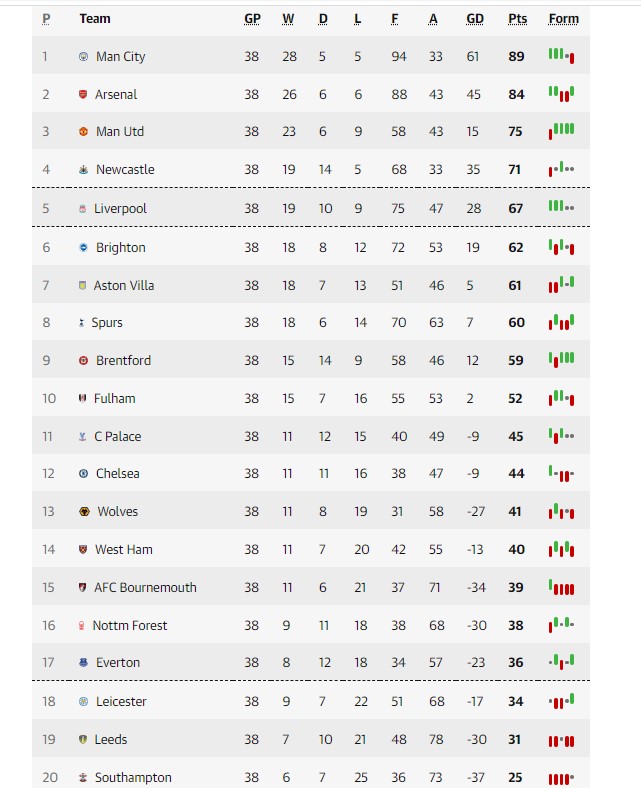
Now all the final results are in and validated the Board can now proceed to the classification of Honours for the 2022/23 Premier League.
As Chair, I will remind you of the regulations as we go through. Fortunately, this time matters are relatively straightforward.
Four candidates (Manchester City, Arsenal, Manchester United and Newcastle United) have a final score greater than or equal to 70 will therefore be awarded First Class Honours. All four can look forward to further study next year; Manchester City win this year’s Prize for getting the top mark.
The next four candidates all have scores in the range 60-69 so they are all in the Upper Second Class, i.e. II.1, category – though in the case of Tottenham Hotspur, only just. Liverpool will be disappointed to have missed out on a First, but Aston Villa and Brighton & Hove Actually will probably be satisfied.
Only two candidates are in the Lower Second Class (II.2) this year (Brentford and Fulham) while Crystal Palace, Chelsea, Wolverhanpton Wanderers and West Ham United all get clear Thirds, having marks in the range 40-49.
AFC Bournemouth, Nottingham Forest and Everton have all technically failed, but with marks in the range 35-39 they are “soft fails” and are allowed to pass by compensation. There being no extenuating circumstances, however, they do not qualify for Honours and must be content with being classified as “Ordinary”.
That leaves the three candidates at the bottom of the table – Leicester City, Leeds United and Southampton – who are all “hard fails” so will have to terminate the course and consider their options while taking some time out.
This is a bank holiday weekend in the United Kingdom, but not here in Ireland. Over here the old Whit Monday bank holiday is marked on the first Monday in June (i.e. a week tomorrow) rather than the last Monday in May as it is in the UK. Whit Sunday is another name for Pentecost, a moveable feast, which occurs on the 7th Sunday after Easter Sunday and therefore moves around in the calendar. Last year, Whit Sunday was actually June 5th; this year it is May 28th (today); and next year it will be on 19th May. So sometimes Ireland has a holiday on Whit Monday, sometimes the UK does, and sometimes neither.
Anyway, tomorrow may not be a holiday here on the Emerald Isle but I’ve finished marking my examinations so one major source of stress has been removed and I can get on with other things next week. Best wishes to colleagues still ploughing through their scripts.
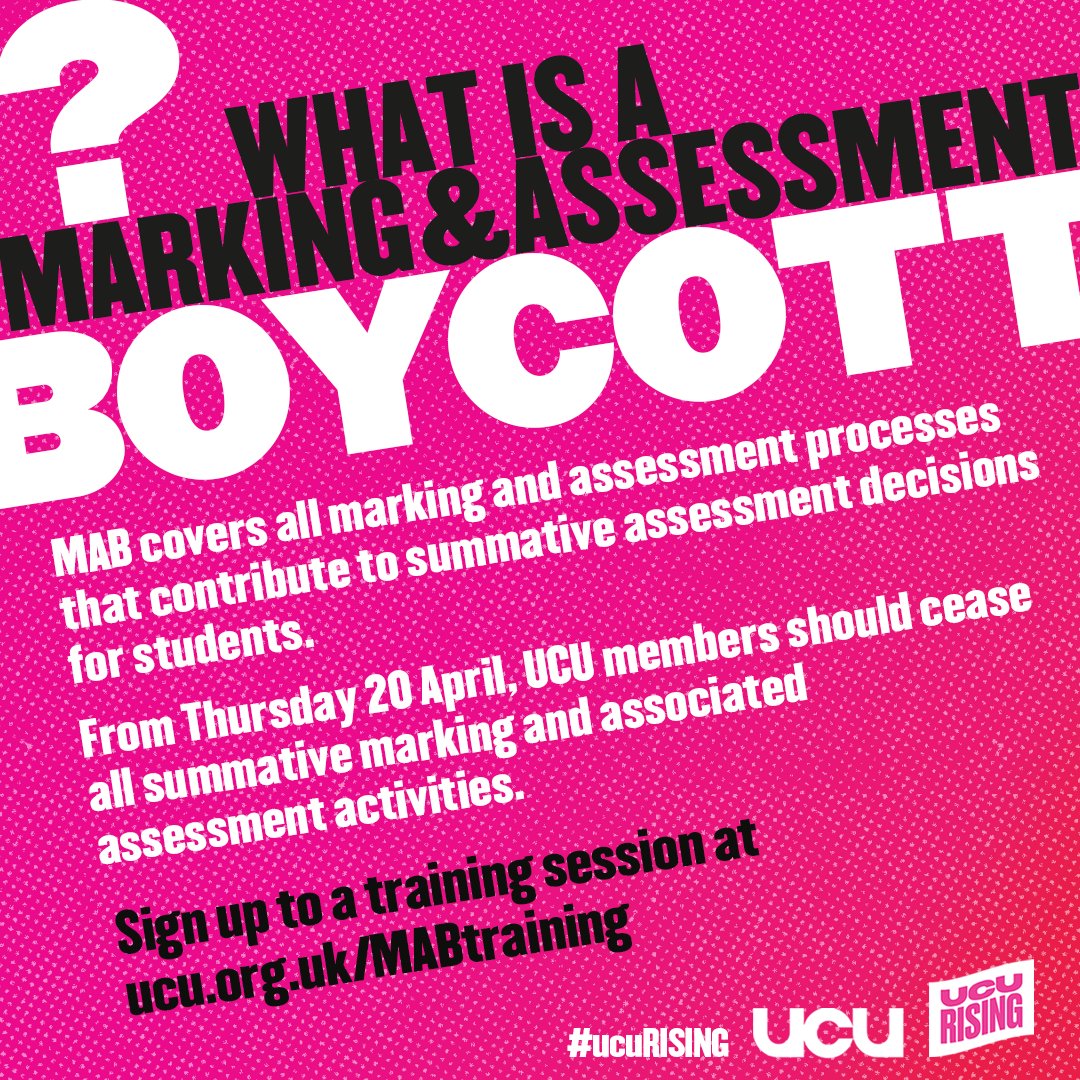
All of this reminded me that universities on the other side of the Irish Sea are currently gripped by a marking and assessment boycott called by the University and College Union (UCU) as part of ongoing industrial action over pay and conditions. This has already been going on for over a month.
I haven’t kept up very well with what’s been going on in UK universities but it looks like a deal has been struck over pensions which will result in benefits being restored to members of the USS scheme. Drastic and unjustifiable cuts imposed on the pension scheme were just one part of the UCU industrial dispute, however, and action continues with respect to the others. Accordingly, UCU has asked its members in higher education institutions which are part of the pay and working conditions dispute to cease undertaking all summative marking and associated assessment activities/duties. The boycott also covers assessment-related work such as exam invigilation and the processing of marks.
The managers of some universities have reacted to this boycott with 100% salary cuts to staff participating in it. The gloves seem to be off and it doesn’t seem likely that a resolution will be reached any time soon. I support the industrial action, by the way, as I hope do colleagues in Ireland who are employed as External Examiners in UK universities and who should to carry out their duties which would be tantamount to crossing a picket line.
It remains to be seen what will happen to students who hope to graduate from UK universities this summer, especially those who need a specific grade to take their next step. These students have had a difficult time with both the pandemic and the industrial action, but something must be done to arrest the downward spiral of pay and working conditions for university teachers, otherwise there will no long be a higher education system worthy of the name.
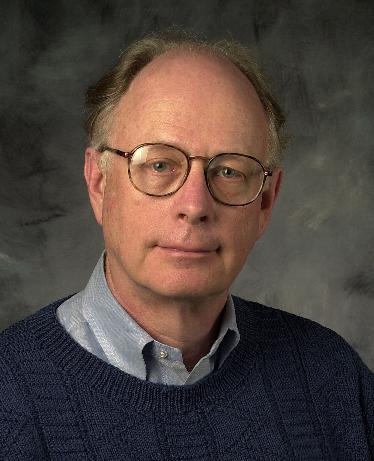
It’s another one of the occasions on which I have to use this blog to pass on some sad news. Renowned physicist James B. Hartle has passed away.
Jim Hartle’s scientific work was concerned with the application of Einstein’s theory of general relativity to astrophysics, especially gravitational waves, relativistic stars, black holes, and cosmology, specifically the theory of the wave function of the universe. For much of his career he was interested in the earliest moments of the big bang where the subjects of quantum mechanics, gravity theory and cosmology overlap, leading among other things to the Hartle-Hawking conjecture.
Jim Hartle was one of the speakers at the very first scientific conference I attended in Cargèse, Corsica way back in 1986. I remember his lectures very well after all these years, not least because he was so witty. I remember his response when someone asked him about the existence of large dimensionless numbers in cosmology: “…it’s a property that numbers have that some of them are larger than others.”
Condolences to his family, friends and colleagues. Rest in peace, Jim Hartle (1939-2023).
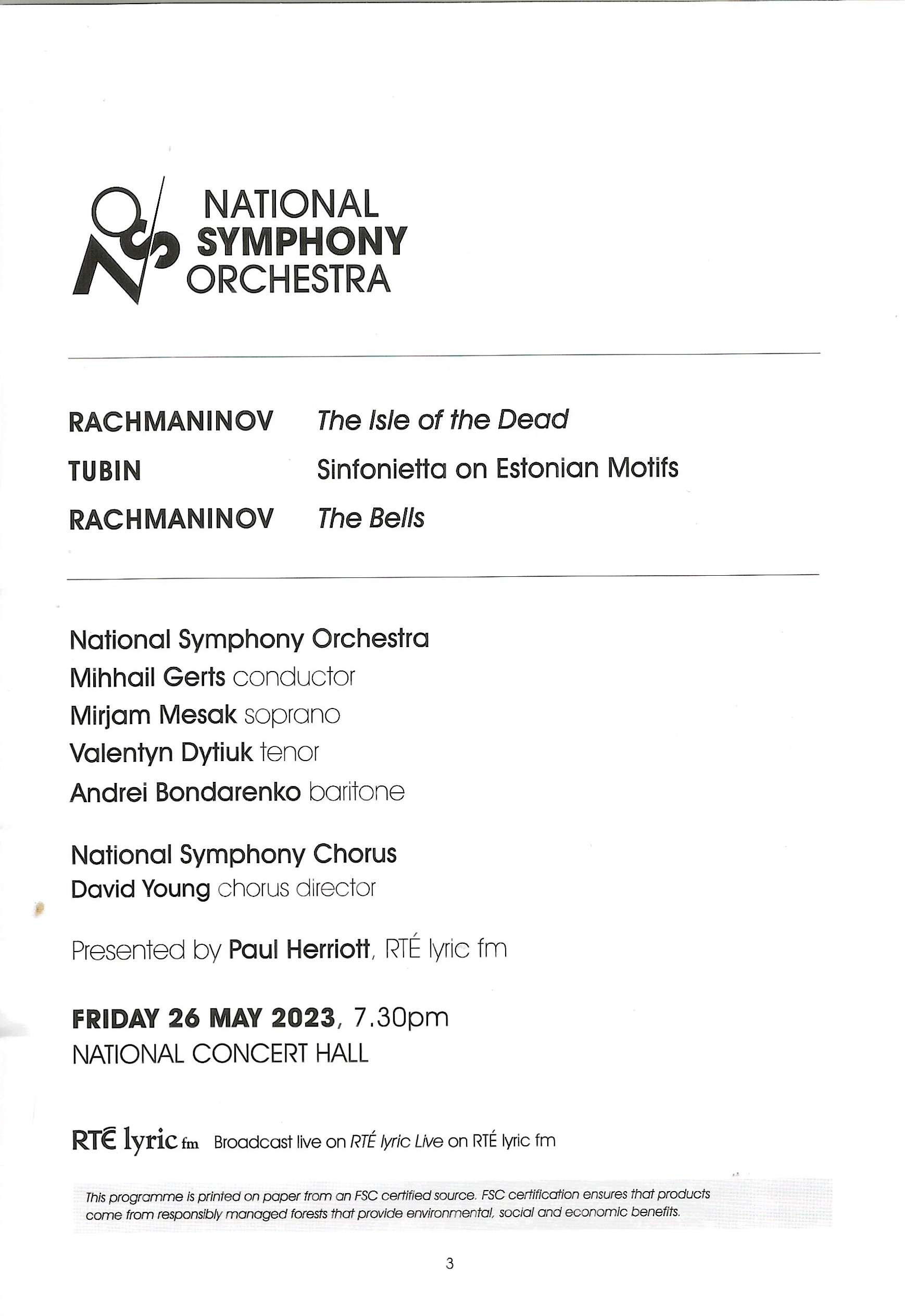
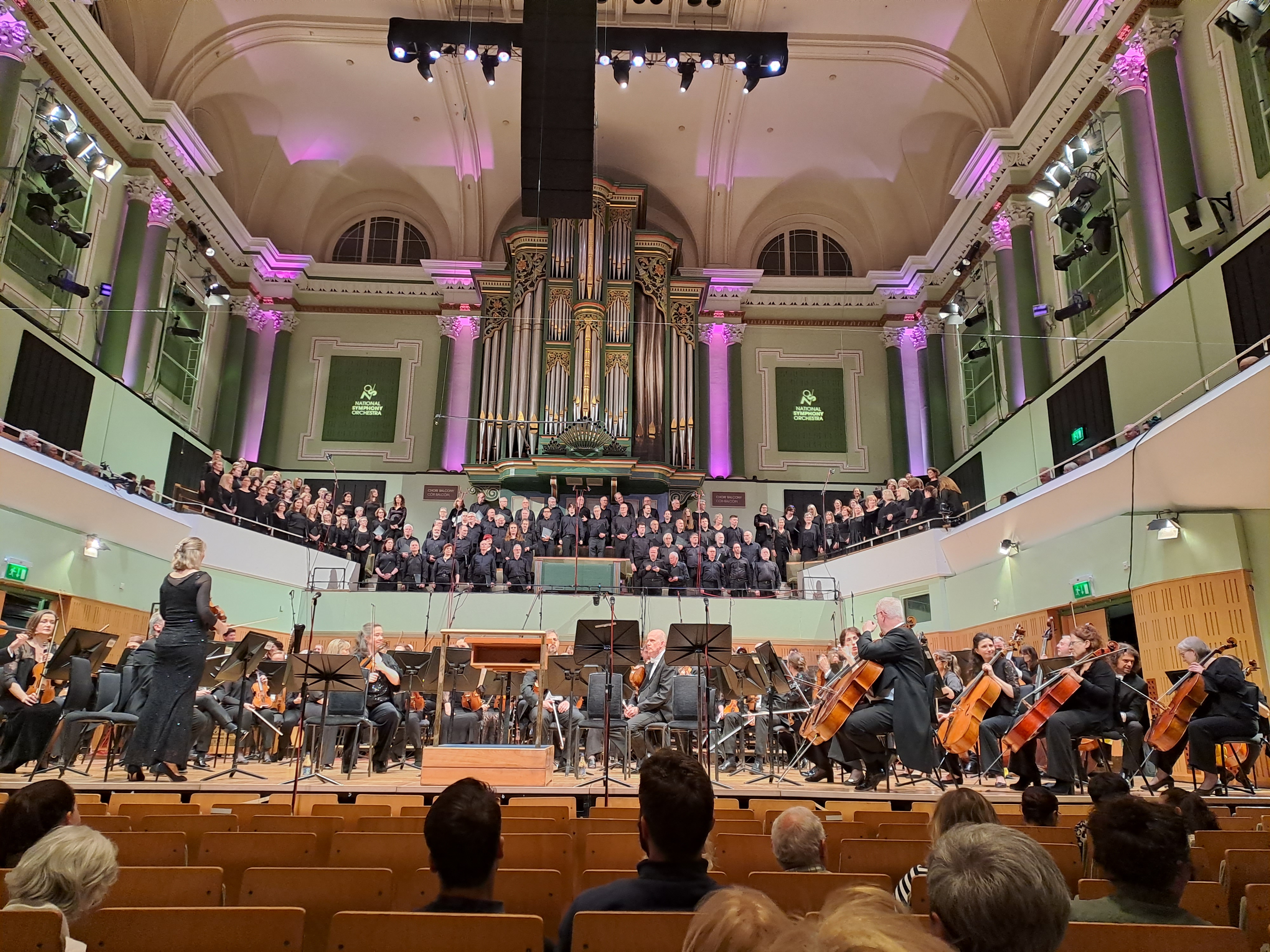
Yesterday, after a nice walk through the sunny streets of Dublin, at the National Concert Hall for the final concert of the season by the National Symphony Orchestra, under the direction of Mihhail Gerts, who were joined, for the second half, by the National Symphony Chorus directed by David Young and three star vocalists. The progamme consisted of two pieces by Sergei Rachmaninov (who was born 150 years ago this year) and one by Eduard Tubin (an Estonian composer who was new to me before last night).
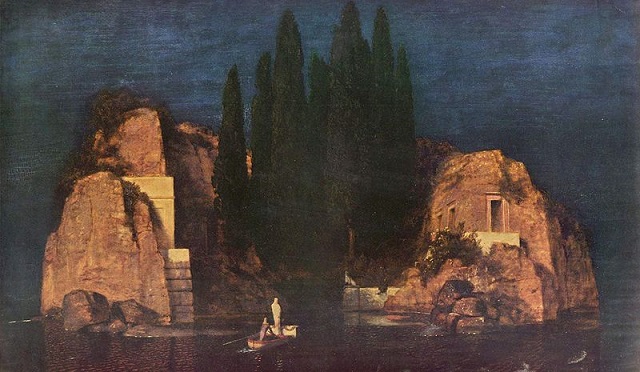
The Isle of the Dead, by Arnold Böcklin
The first item one the menu was The Isle of the Dead, Op. 29 by Sergei Rachmaninov, inspired by a painting of the same name by Arnold Böcklin and written around 1908. The rhythms of the opening passage evoke the motion of a boat moving across the sea to the island, from which point the piece develops among a cloud of increasingly dense harmonic layers into a dark atmosphere full of foreboding. It’s a darkly dramatic work that I’ve enjoyed every time I heard it and last night was no exception.
There then followed the Sinfonietta on Estonian Motifs by Eduard Tubin introduced by conductor Mihhail Gerts, who is himself from Estonia. It’s a work in three movements inspired by the folk songs the composer heard as a child growing up in Estonia. I knew that much before the performance started but didn’t realize it would turn out to be such a weighty composition. The two outer movements are rhythmically complex in a way that’s reminiscent of Stravinksy (especially Petrushka) and the overall mood is far from the pastoral tranquility I’d expected: the music is rather edgy, in fact. I suppose that’s not surprising given that it was written in 1940. I enjoyed this but it is strange how much it reminded me of other composers: as well as Stravinsky, there are clear nods in the direction of Sibelius and at times it also reminded me of Arnold Bax. You might say it is a little bit derivative. I couldn’t possibly comment.
After the interval
After the wine break we had The Bells, a choral symphony for soprano, tenor, bass-baritone, chorus and large symphony orchestra by Sergei Rachmaninov (Op. 35). The words are based on a Russian translation of the poem The Bells by Edgar Allan Poe which was very popular in Russia in the early 20th century and which clearly resonated with Rachmaninov:
The sound of church bells dominated all the cities of Russia I used to know, they accompanied every Russian from childhood to the grave and no composer could escape their influence. Most of my life was lived amid vibrations of of the bells of Moscow.
Sergei Rachmaninov
The Bells is in four movements, echoing the four stanzas of the poem, and representing the journey “from childhood to the grave”, the last movement being a Lento subtitled The Mournful Iron Bells. The three soloists sing in one part each; the third movement involves orchestra and chorus only. Ukrainian tenor Valentyn Dytiuk sang in the first movement, Estonian soprano Mirjam Mesak the second and Ukrainian baritone Andrei Bondarenko the fourth. All three soloists were superb but particularly enjoyed the sinewy muscularity of Bondarenko’s baritone which gave a sense of rawness to his performance.
It was a fitting finale to the season. Congratulations to the National Symphony Orchestra for a great performance, and to the National Symphony Orchestra who were outstanding too.
Walking back to Pearse Station to get the train for Maynooth I found myself wondering when my next visit to the National Concert Hall will be. I’ll be away on sabbatical most of next year. Still, there’ll be plenty of music where I’m going…
So here I am, on a fine early summer evening, waiting for the train into Dublin for the last performance of the season by the National Symphony Orchestra at the National Concert Hall. I’m looking forward to it very much, as the second half is a piece I’ve never heard before. I’ll write more about it tomorrow.
There’s an end of term feeling in other ways, too. The examination period ended earlier this week, and most students have now vanished for the summer. Quite a few staff members will be marking scripts at home too. Campus has been very quiet for the last few days. The train I’m now on, the 17.10 from Maynooth to Connolly, usually very busy on a Friday, is almost empty today.
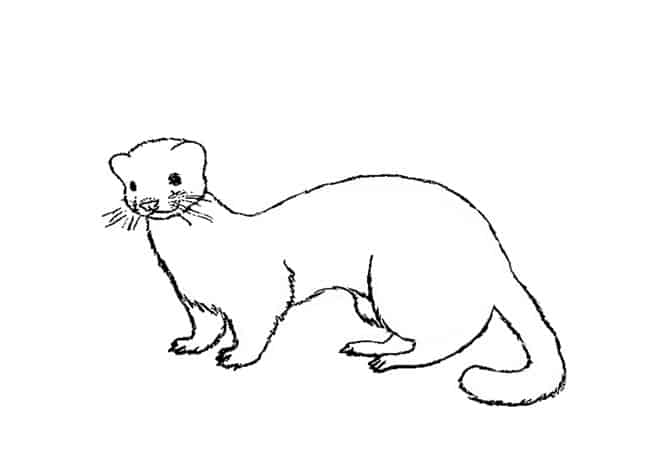
The one exception to the general lack of activity on campus happened on Wednesday when a mysterious ferret appeared on Campus. It even tried to get into the Science Building, but failed (I suppose) because it didn’t have a swipe card. It seems this critter was a family pet that had got out and went on an adventure. It was spotted at various locations around the town before being collected by its owner and returned safely home.
Artist’s impression of the ferret.
Despite that flurry of excitement, I managed to finish marking my examinations and other assessments, but the grades still need to be checked. They then have to be approved by the Departmental Exam Board in early June. They then get a final dose of scrutiny at the University Examination Board. Students will have to wait almost another month to get their results. It’s quite a slow process, but it’s right to be careful.
The views presented here are personal and not necessarily those of my employer (or anyone else for that matter).
Feel free to comment on any of the posts on this blog but comments may be moderated; anonymous comments and any considered by me to be vexatious and/or abusive and/or defamatory will not be accepted. I do not necessarily endorse, support, sanction, encourage, verify or agree with the opinions or statements of any information or other content in the comments on this site and do not in any way guarantee their accuracy or reliability.




 In the Dark