Covid-19 in Ireland – The Last Post

Posted in Biographical, Covid-19 with tags , , , on March 1, 2023 by telescoper

On February 29th 2020, Ireland identified its first case of the novel coronavirus, SARS CoV2, the virus that causes COVID-19. The World Health Organization declared the outbreak a pandemic on March 11th. On March 12th 2020 Schools and Colleges in Ireland were closed.

Since then, I have posted regular updates of the number of cases of COVID-19, initially daily and more recently weekly as the frequency of official announcements on the data hub decreased. The plotting the latest figures actually became a sort of ritual for me over this time and I even found mildly therapeutic.

Now, however, three full years have passed- can it really be three full years? – have since the (official) arrival of the pandemic in Ireland and, with the situation looking stable, I think it’s time to stop posting these updates. I made the decision to stop at the end of February 2023 unless something drastic happened to change my mind. Ironically, I just heard this morning that one of my colleagues has a new case of Covid-19 but that hasn’t changed my mind.  I hope this makes it clear that I don’t think the pandemic is over: there are many people still suffering from new infections and the effects of “Long Covid”. I just don’t see the need to continue my updates here.

I will leave the data online here in case anyone is interested in the numbers, but I won’t be posting any further updates.

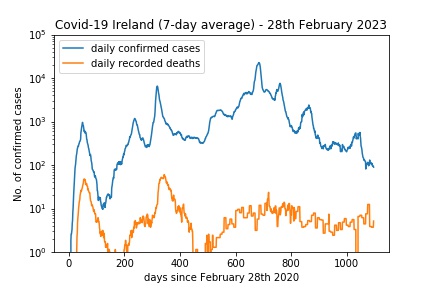
So here are the final graphs from me.  The present 7-day moving average of new cases is just 89.6 per week, down from 103.0 last week and 36 deaths were recorded in the same period.
 

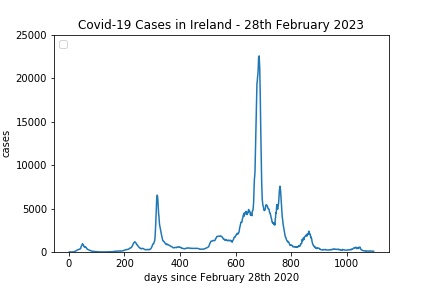
On a linear scale the cases look like this
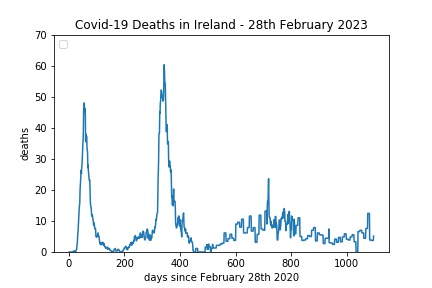
The numbers for deaths on a linear scale look like this

A Poem for St David’s Day

Posted in Poetry with tags , , , on March 1, 2023 by telescoper

Dydd Gŵyl Dewi Hapus!

Today is St David’s Day, and it seems apt to celebrate it with a poem by Dylan Thomas. I’ve loved this particular one since I first heard it when I was a student many years ago. I say “heard it” rather than “read it” because it was through buying a tape of the man himself reading his poems that got me hooked. I have posted this on St David’s Day before but that was many years ago and I hope you will forgive the repetition.

Fern Hill reflects about the passage of time, the loss of childhood happiness and the inevitability of death but its mood is defiant rather than gloomy. It’s full of vibrant imagery, but it’s also written with a wonderful feeling for the natural rhythms and cadences language. You can listen to Dylan Thomas reading this exactly as if it were music.


 Fern Hill

Now as I was young and easy under the apple boughs
About the lilting house and happy as the grass was green,
The night above the dingle starry,
Time let me hail and climb
Golden in the heydays of his eyes,
And honoured among wagons I was prince of the apple towns
And once below a time I lordly had the trees and leaves
Trail with daisies and barley
Down the rivers of the windfall light.

And as I was green and carefree, famous among the barns
About the happy yard and singing as the farm was home,
In the sun that is young once only,
Time let me play and be
Golden in the mercy of his means,
And green and golden I was huntsman and herdsman, the calves
Sang to my horn, the foxes on the hills barked clear and cold,
And the sabbath rang slowly
In the pebbles of the holy streams.

All the sun long it was running, it was lovely, the hay
Fields high as the house, the tunes from the chimneys, it was air
And playing, lovely and watery
And fire green as grass.
And nightly under the simple stars
As I rode to sleep the owls were bearing the farm away,
All the moon long I heard, blessed among stables, the nightjars
Flying with the ricks, and the horses
Flashing into the dark.

And then to awake, and the farm, like a wanderer white
With the dew, come back, the cock on his shoulder: it was all
Shining, it was Adam and maiden,
The sky gathered again
And the sun grew round that very day.
So it must have been after the birth of the simple light
In the first, spinning place, the spellbound horses walking warm
Out of the whinnying green stable
On to the fields of praise.

And honoured among foxes and pheasants by the gay house
Under the new made clouds and happy as the heart was long,
In the sun born over and over,
I ran my heedless ways,
My wishes raced through the house high hay
And nothing I cared, at my sky blue trades, that time allows
In all his tuneful turning so few and such morning songs
Before the children green and golden
Follow him out of grace.

Nothing I cared, in the lamb white days, that time would take me
Up to the swallow thronged loft by the shadow of my hand,
In the moon that is always rising,
Nor that riding to sleep
I should hear him fly with the high fields
And wake to the farm forever fled from the childless land.
Oh as I was young and easy in the mercy of his means,
Time held me green and dying
Though I sang in my chains like the sea.

Most Exciting Aurora Pictures Ever!

Posted in The Universe and Stuff with tags , on February 28, 2023 by telescoper

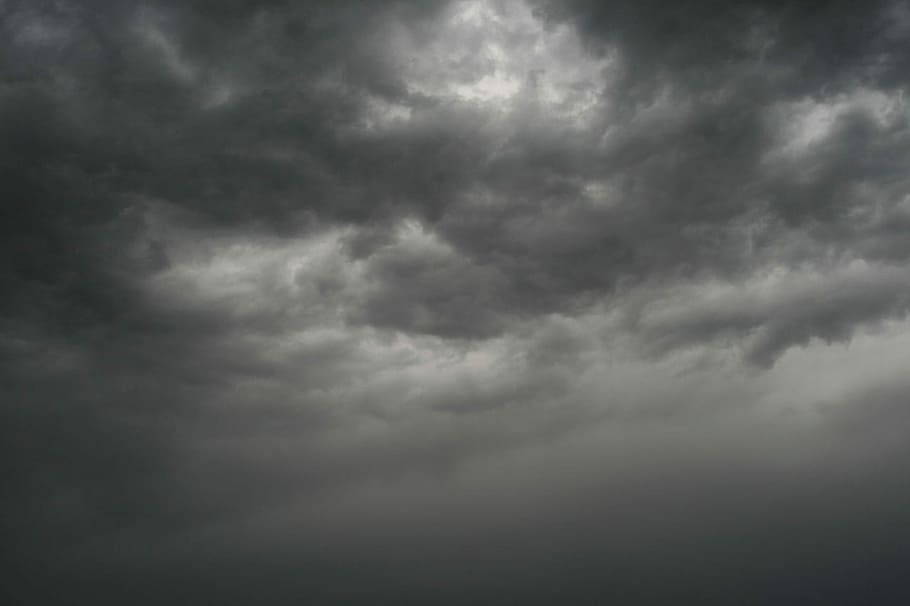
Last night offered spectacular views of the Aurora Borealis (Northern Lights) all over Ireland. I took these amazing pictures, which are among the best I’ve seen, in Maynooth, County Kildare. I know that to the untrained eye they look like ordinary clouds, but an expert such as myself can clearly see dynamic patterns of brilliant green grey that appear as curtains, rays, spirals, and flickers covering the entire sky. It was a stunning, once-in-a-lifetime experience to witness this dramatic cosmic spectacle!

State Supports for PhD Researchers

Posted in Education, Maynooth with tags , , , on February 27, 2023 by telescoper

By sheer coincidence, the very same day that I posted a piece in which complained that the issue of PhD stipends for Irish postgraduates had apparently been “kicked into the long grass”, the consultation has at last opened.

You can contribute your submission or submit your contribution, whichever seems appropriate, here.

The Great British Tomato Mystery

Posted in Maynooth, Politics with tags , , , , on February 26, 2023 by telescoper

Q: What’s red and not there?

A: No tomatoes.

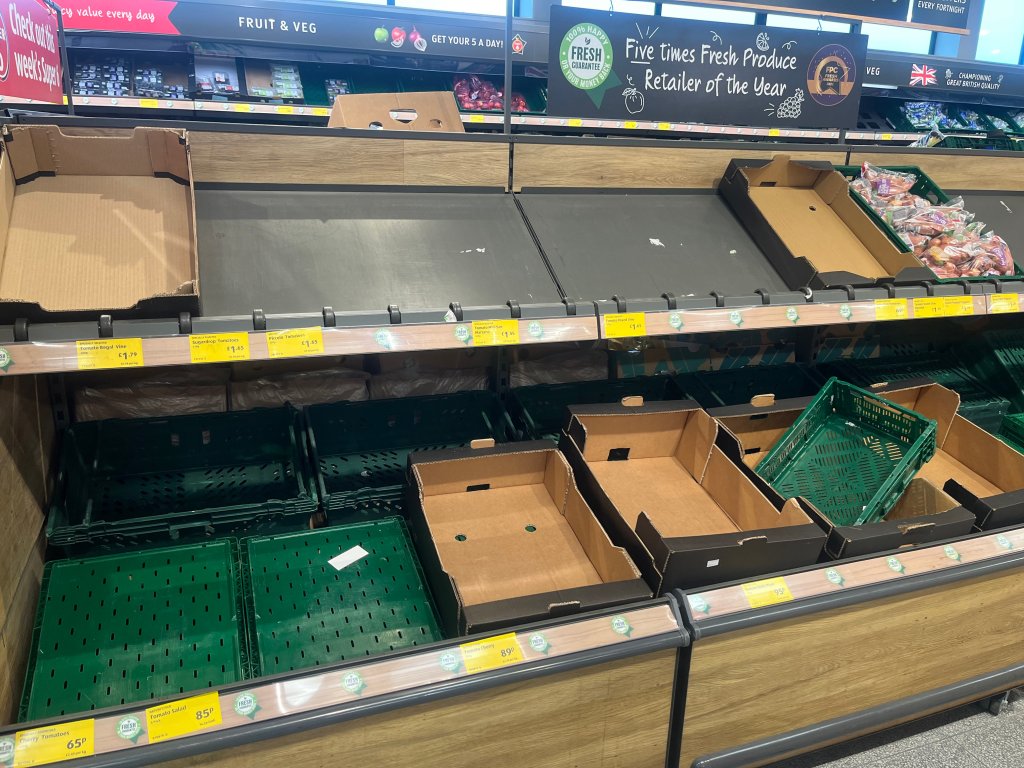
This week my social media timelines have been filled with pictures like this of British supermarket shelves bereft of salad vegetables, especially tomatoes. The UK Government has stated, through its mouthpiece the BBC, that this is due to unseasonably bad weather in Spain and Morocco, although I very much doubt this is the whole story.

There have been reports of similar shortages in Ireland but all I can do is report on my own experience. Because I live on my own in a small town with plenty of shops nearby I don’t do a big weekly trip to the supermarket but prefer to buy fresh things as and when I need them, usually on the way home from work. I therefore generally pop into Dunnes and/or Supervalu every day. On no occasion this week have I noticed any shortage of tomatoes or other salad ingredients in Maynooth, despite always going in the evening when you might expect the shelves to be depleted. I found plenty of nice tomatoes from both Spain and Morocco, though the ones I actually bought – of the cherry vine variety – are from Italy. People living elsewhere in Ireland may of course have experienced shortages, but I certainly haven’t.

Can Black Holes really create Dark Energy?

Posted in Astrohype, The Universe and Stuff with tags , , , , on February 25, 2023 by telescoper
Gratuitous Black Hole Graphic

A couple of papers were published recently that attracted quite a lot of media interest so I thought I’d mention the work here.

The researchers detail the theory in two papers, published in The Astrophysical Journal and The Astrophysical Journal Letterswith both laying out different aspects of the cosmological connection and providing the first “astrophysical explanation of dark energy”. The lead author of both papers is Duncan Farrah of the University of Hawaii. Both are available on the arXiv, where all papers worth reading in astrophysics can be found.

The first paper, available on the arXiv here, entitled Preferential Growth Channel for Supermassive Black Holes in Elliptical Galaxies at z<2, and makes the argument that observations imply that supermassive black holes grow preferentially in elliptical galaxies:

The assembly of stellar and supermassive black hole (SMBH) mass in elliptical galaxies since z∼1 can help to diagnose the origins of locally-observed correlations between SMBH mass and stellar mass. We therefore construct three samples of elliptical galaxies, one at z∼0 and two at 0.7≲z≲2.5, and quantify their relative positions in the MBH−M∗ plane. Using a Bayesian analysis framework, we find evidence for translational offsets in both stellar mass and SMBH mass between the local sample and both higher redshift samples. The offsets in stellar mass are small, and consistent with measurement bias, but the offsets in SMBH mass are much larger, reaching a factor of seven between z∼1 and z∼0. The magnitude of the SMBH offset may also depend on redshift, reaching a factor of ∼20 at z∼2. The result is robust against variation in the high and low redshift samples and changes in the analysis approach. The magnitude and redshift evolution of the offset are challenging to explain in terms of selection and measurement biases. We conclude that either there is a physical mechanism that preferentially grows SMBHs in elliptical galaxies at z≲2, or that selection and measurement biases are both underestimated, and depend on redshift.

arXiv: 2212.06854

Note the important caveats at the end. I gather from people who work on this topic that it’s a rather controversial claim.

The second paper, entitled Observational evidence for cosmological coupling of black holes and its implications for an astrophysical source of dark energy and available on the arXiv here, discusses a mechanism by which it is claimed that the formation of black holes actually creates dark energy:

Observations have found black holes spanning ten orders of magnitude in mass across most of cosmic history. The Kerr black hole solution is however provisional as its behavior at infinity is incompatible with an expanding universe. Black hole models with realistic behavior at infinity predict that the gravitating mass of a black hole can increase with the expansion of the universe independently of accretion or mergers, in a manner that depends on the black hole’s interior solution. We test this prediction by considering the growth of supermassive black holes in elliptical galaxies over 0<z≲2.5. We find evidence for cosmologically coupled mass growth among these black holes, with zero cosmological coupling excluded at 99.98% confidence. The redshift dependence of the mass growth implies that, at z≲7, black holes contribute an effectively constant cosmological energy density to Friedmann’s equations. The continuity equation then requires that black holes contribute cosmologically as vacuum energy. We further show that black hole production from the cosmic star formation history gives the value of ΩΛ measured by Planck while being consistent with constraints from massive compact halo objects. We thus propose that stellar remnant black holes are the astrophysical origin of dark energy, explaining the onset of accelerating expansion at z∼0.7.

arXiv:2302.07878


The first I saw of these papers was in a shockingly poor write-up in the Guardian which is so garbled that I dismissed the story out of hand. I recently saw it taken up in Physics World though so maybe there is something in it. Having scanned it quickly it doesn’t look trivially wrong as I had feared it would be.

I haven’t had much time to read papers over the last few weeks but I’ve decided to present the second paper – the more theoretical one – next time I do our cosmology journal club at Maynooth, which means I’ll have to read it! I’ll add my summary after I’ve done the Journal club on Monday afternoon.

In the meantime I was wondering what the general reaction in the cosmological community is to these papers, especially the second one. If anyone has strong views please feel free to put them in the comments box!

UPDATE: There is a counter-argument on the arXiv today.

Raising PhD Stipends

Posted in Education, Maynooth, Politics with tags , , on February 24, 2023 by telescoper

Although the Irish Government has kicked its planned review of postgraduate support into the long grass, the Board of Trinity College Dublin recently approved a proposal to increase stipends to for all its PhD students to €25,000. I applaud this decision, but would argue that it doesn’t go far enough.

A while ago Government of Ireland announced a new scheme intended to recruit “high-level researchers” to PhD programmes in Ireland. This scheme, which is a public-private partnership of around  €100 million, will fund around 400 PhD studentships with an annual stipend around €28K, which is substantially higher than the current rate for, e.g., ICR-funded students which is €18.5K. The justification for the higher €28K stipends is that they would be “in line with financial supports offered under similar global scholarships”. I take this as a statement that the Irish Government has acknowledged that the proper rate of pay for a PhD student is at this level, which seems to me to be about right. It seems to me to be logical that all PhD stipends should be increased to this level.

High levels of inflation are combining with spiraling rental costs to make it very difficult for a student to live on the current level of stipend (especially in the Greater Dublin area). This forces postgraduate students to undertake large amounts of tutoring or other work in order to get by financially. This situation is a direct result of the chronic underfunding of higher education in Ireland which means that there aren’t enough academic staff to cover the teaching required. Universities will argue that they don’t have any choice but to exploit PhD students to make up the shortfall, but that doesn’t make the situation is acceptable.

It is of course good for a research student to get some teaching experience during their PhD but this should be on a voluntary basis. A PhD student who chooses to teach will probably do a better job than one who is forced to do it in order to pay the rent. My basic point, though, is that a full-time research student should be funded to do research full time, and it is grossly unfair to pay them too little for this to be possible.

There needs to be a serious “levelling up” of PhD stipends across the entire third-level sector in Ireland. I hope in particular that my own institution, Maynooth University, will take the lead and increase its PhD studentships to the fair level of €28K per annum. This would be a good way to spend at least some of the surplus of €13.2M it ran up during the first year of the pandemic alone.

UPDATE: The Government has now opened a consultation on PhD supports to which you can contribute here.

Early Morning Lectures

Posted in Biographical, Education, Maynooth on February 23, 2023 by telescoper

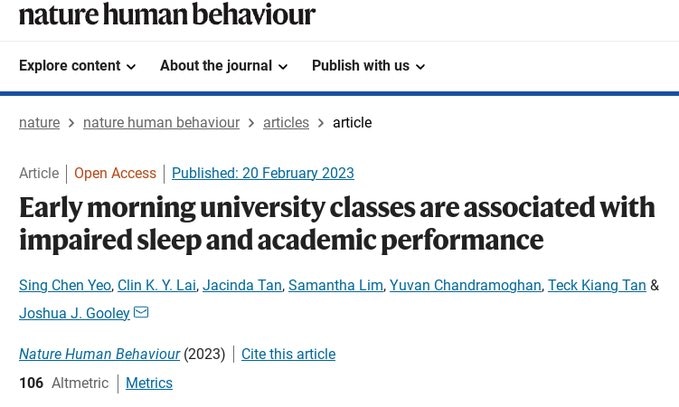
I saw this doing the rounds on Twitter the other day. I even made a little joke about it which went viral (by my standards) with over a million views and almost 2000 retweets:

There’s no accounting for taste.

Am I a meme now?

Anyway, I’m in the office quite early this morning ahead of my 9am Computational Physics lecture so thought I’d do a quick post. I realize that 9am is not early compared to practice in some institutions abroad where lectures can start at 7.30am or even earlier. Everything I say here is based on my own experience and is not claimed to be universal.

As a lecturer I don’t mind 9am lectures at all. I find itt’s nice to get something significant done before 10am as opposed to just trying to deal with emails. On the other hand, I live only about 20 minutes’ walk away from campus so I don’t have to get up especially early. As a matter of fact I get up at 7am on weekdays, so no real adjustment is necessary for a 9am start. If I had a two-hour commute it would no doubt be a different matter.

At conferences and so on, I don’t find myself sleeping in the morning sessions. I find the slots immediately after lunch the worst for staying awake. That’s the time we have our theoretical physics seminars at Maynooth, actually.

My own experiences of being an undergraduate student (at Cambridge) was that I had regular 9am lectures 6 days a week (Saturdays included) and didn’t mind those either. But Cambridge is relatively compact and, living in College, it didn’t take me long to get to the lecture theatres in town. I usually felt quite sharp at 9am, actually, probably less so later in the morning.

Of course the reality is different for many students, some of whom have lengthy journeys into campus on not-entirely reliable public transport, so find a 9am start a challenge (to say the least). It’s certainly not unknown for students to doze off, but I don’t mind that as long as they don’t snore too loudly. I try to break up these lectures with things for the students to do, and that sometimes wakes them up again. In terms of attendance it’s the early evening slots that are worse in my experience than early morning.

Anyway, here in Maynooth we teaching staff have no real say over timetabling so now I should head off to Hall C to set up.

UPDATE: I had a pretty full class but one student did doze (without snoring) for about 3 minutes.

The Gaming of Citation and Authorship

Posted in Open Access with tags , , on February 22, 2023 by telescoper

About ten days ago I wrote a piece about authorship of scientific papers in which I pointed out that in astrophysics in cosmology it is often the case that many “authors” (i.e. people listed in the author list) of papers (largely those emanating from large consortia) often haven’t even read the paper they are claiming to have written.

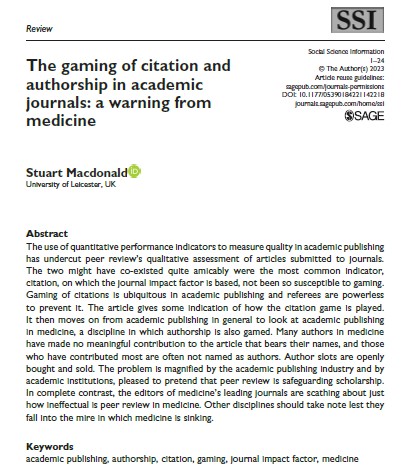
I now draw your attention to a paper by Stuart Macdonald, with the abstract:

You can find the full paper here, but unfortunately it requires a subscription. Open Access hasn’t reached sociology yet.

The paper focuses on practices in medicine, but it would be very wrong to assume that the issues are confined to that discipline; others have already fallen into the mire. I draw your attention in particular to the sentence:

Many authors in medicine have made no meaningful contribution to the article that bears their names, and those who have contributed most are often not named as authors. 

The first bit certainly also applies to astronomy, for example.

The paper does not just discuss authorship, but also citations. I won’t discuss the Journal Impact Factor further, as any sane person knows that it is daft. Citations are not just used to determine the JIF, however – citations at article level make more sense, but are also not immune from gaming, and although they undoubtedly contain some information, they do not tell the whole story. Nor will I discuss the alleged ineffectiveness of peer review in medicine (about which I know nothing). I will however end with one further quote from the abstract:

The problem is magnified by the academic publishing industry and by academic institutions….

So many problems are…

The underlying cause of all this is that the people in charge of academic institutions nowadays have no concept of the intrinsic value of research and scholarship. The only things that are meaningful in their world are metrics. Everything we do now is reduced to key performance indicators, such as publication and citation counts. This mindset is a corrupting influence encourages perverse behaviour among researchers as well as managers.

Euclid in a Nutshell

Posted in Euclid, Literature, The Universe and Stuff with tags , , , , on February 21, 2023 by telescoper

O God, I could be bounded in a nut shell and count
myself a king of infinite space…

Hamlet, Act 2, Scene II.

It Hamlet rather than Euclid who said those words, but they came into my mind when I saw the latest nice video about the Euclid Mission from the European Space Agency, entitled Euclid in a Nutshell. It’s a quick one-minute summary of of what the mission is for and what it will do:

The text with the video reads:

ESA’s Euclid mission is designed to explore the composition and evolution of the dark Universe. The space telescope will create a great map of the large-scale structure of the Universe across space and time by observing billions of galaxies out to 10 billion light-years, across more than a third of the sky. Euclid will explore how the Universe has expanded and how structure has formed over cosmic history, revealing more about the role of gravity and the nature of dark energy and dark matter.

Euclid is a fully European mission, built and operated by ESA, with contributions from NASA. The Euclid Consortium – consisting of more than 2000 scientists from 300 institutes in 13 European countries, the US, Canada and Japan – provided the scientific instruments and scientific data analysis. ESA selected Thales Alenia Space as prime contractor for the construction of the satellite and its Service Module, with Airbus Defence and Space chosen to develop the Payload Module, including the telescope. NASA provided the near-infrared detectors of the NISP instrument.