Royal Mail Failure

Posted in Politics with tags on January 18, 2023 by telescoper

Quite a few people I know in the UK are unaware that the Royal Mail is currently unable to deliver any mail to locations outside the UK. The above message, from the Royal Mail website, has been there for a week now and has not changed in that time apart from the date at the top. There is no information about what has happened, no estimate when services will resume, and no idea what will happen to mail stuck in the system. This failure to communicate with users just adds insult to injury. It also calls into question the claim that this failure is “temporary”

I am mildly inconvenienced by the Royal Mail’s collapse, as I am waiting for some items of legal correspondence, but it must be catastrophic for small businesses who use its services to export products abroad. I’m sure any that survive this disaster will be taking their custom elsewhere as soon as they can.

Ooh. An update! Hopefully, they’ll start to clear the backlog soon.

Marking Schemes

Posted in Biographical, Education, Maynooth with tags , , , on January 17, 2023 by telescoper

It’s 3.40pm so I’ve reached the tea interval on the first day of marking the scripts from my first-year module on Mechanics and Special Relativity. Blogging will be a bit thin until I’ve completed this task, which will take even longer than usual as we have more students on this module than in previous years, up by more than 50% on last year. At the current rate I estimate it will take me until Friday to finish.

It turned very cold here at the weekend and I realized I had run out of food for the birds so I had to dash out to the shops on Sunday and replenish my stock. When I refilled the feeders it only took a few minutes for the robin to arrive, closely followed by starlings, a magpie, some sparrows, a woodpigeon, and then some more starlings. While I was waiting for my pot of tea to brew I filled the dispensers again.

I woke up this morning to find a very hard frost in Maynooth. The temperature hasn’t risen above zero all day so the frost is still there now. I am at home while I do the marking, which gives me an excuse not to venture out into the cold (except to feed the birds). It’s nice to be in the warm, but marking at home ensures that I am not interrupted by anyone but myself and especially not a student who might wander into my office on campus with all the scripts lying around.

Some scripts (side view)

For the last two years we’ve held this examination as an online timed assessment, but now uses old-fashioned written answer books which are much easier on the eye. I still find however that I can only managed about 30 scripts in one sitting before my attention starts to wander. I’ve therefore divided them into five packets, taking a break when I’ve finished each one. Thirty is about the number of overs you get in a session of Test Match Cricket, though I don’t stick very strictly to the same timings; I don’t always have lunch at 1pm, for example.

I’ve often discussed the process of marking examinations with my colleagues and they all have different techniques. What I do is mark one question at a time rather than one script at a time. What I mean by that is that I go through every script marking all the attempts at Question 1, then I start again and do Question 2, etc. I find that this is much quicker and more efficient than marking all the questions in each script then moving onto the next script. The reason for this is that I can upload into my mind the model answer for Question 1 so that it stays there while I mark dozens of attempts at it so I don’t have to keep referring to the marking scheme. Other advantages are that it’s easier to be consistent in giving partial credit when you’re doing the same question over and over again, and that also you spot what the common mistakes are more easily.

Whichever way you do it, grading this number of examinations is a long job, a marathon not a sprint. We also owe it to the students to be as fair as possible, all of which means taking it at a steady pace.

Now, it’s 4pm and time for the resumption…

Composition in Blue – Fernand Léger

Posted in Art with tags , on January 16, 2023 by telescoper

Fernand Léger, Composition in Blue, 1920-27, oil on canvas, 130.5 × 97.2 (Art Institute of Chicago)

ScienceCast and arXiv

Posted in Open Access with tags , , on January 15, 2023 by telescoper

Browsing the arXiv blog, as one does from time to time, I saw an item about ScienceCast and arXiv which I think is worth highlighting here. I wasn’t aware of ScienceCast before seeing the arXiv blog entry so perhaps some readers of this blog hadn’t either.

According to its own website,

ScienceCast provides a website where researchers can create explainer videos in a collaborative space and receive feedback on their work from other researchers through blog posts and chat functions. The platform also provides the ability for users to post datasets supporting the researcher’s work so that the work can be verified by reference to its data.

Although I haven’t used it, the first of these features seems very nice, allowing users to develop video explainers for science projects with feedback from collaborators. This will be of interest to people wanting to make their work a little more accessible and those, especially at the early career stage, who would like advice on video presentations. The second feature may be of less interest to astrophysicists, who already have platforms for sharing data and whose data sets are often very large, but it might work for smaller examples.

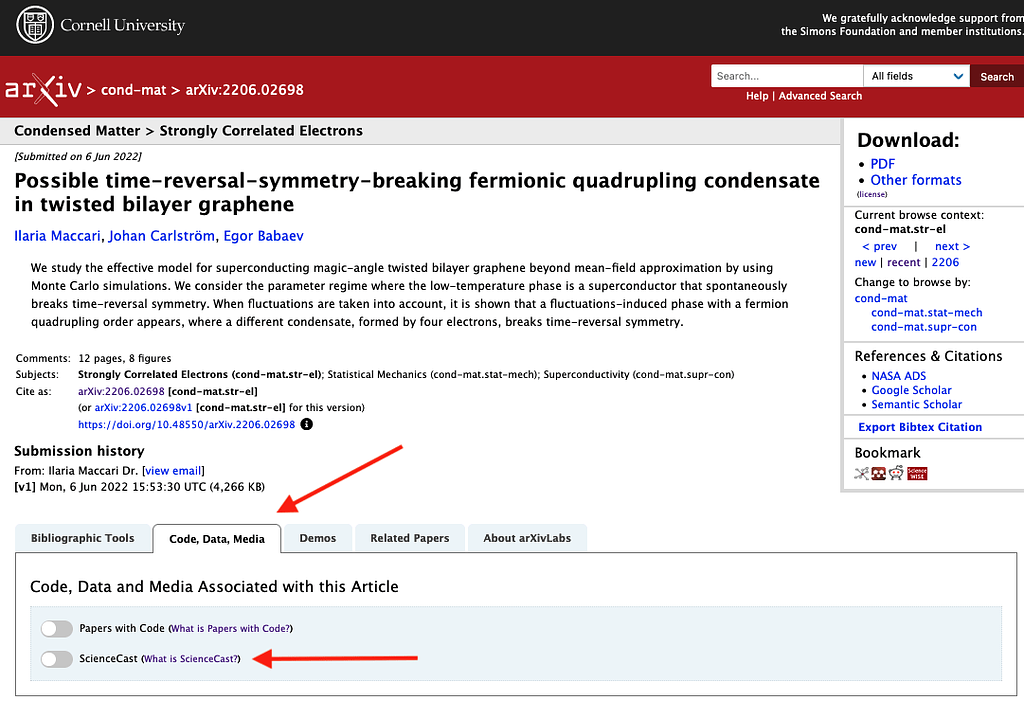
Anyway, the new feature from arXivLabs that the arXiv blog post is about allows users to include ScienceCast material directly on the arXiv. Here’s how it looks:

Activating the ScienceCast feature using the slider allows one to see any content there directly on arXiv. Which is nice. I’ll be interested to see what the uptake is like. I may even play around with it myself, although that will have to wait until I’ve finished marking examinations…

Mahler, Weber, Schubert and Strauss at the NCH

Posted in Biographical, Music with tags , , , , , , , , , , , , on January 14, 2023 by telescoper

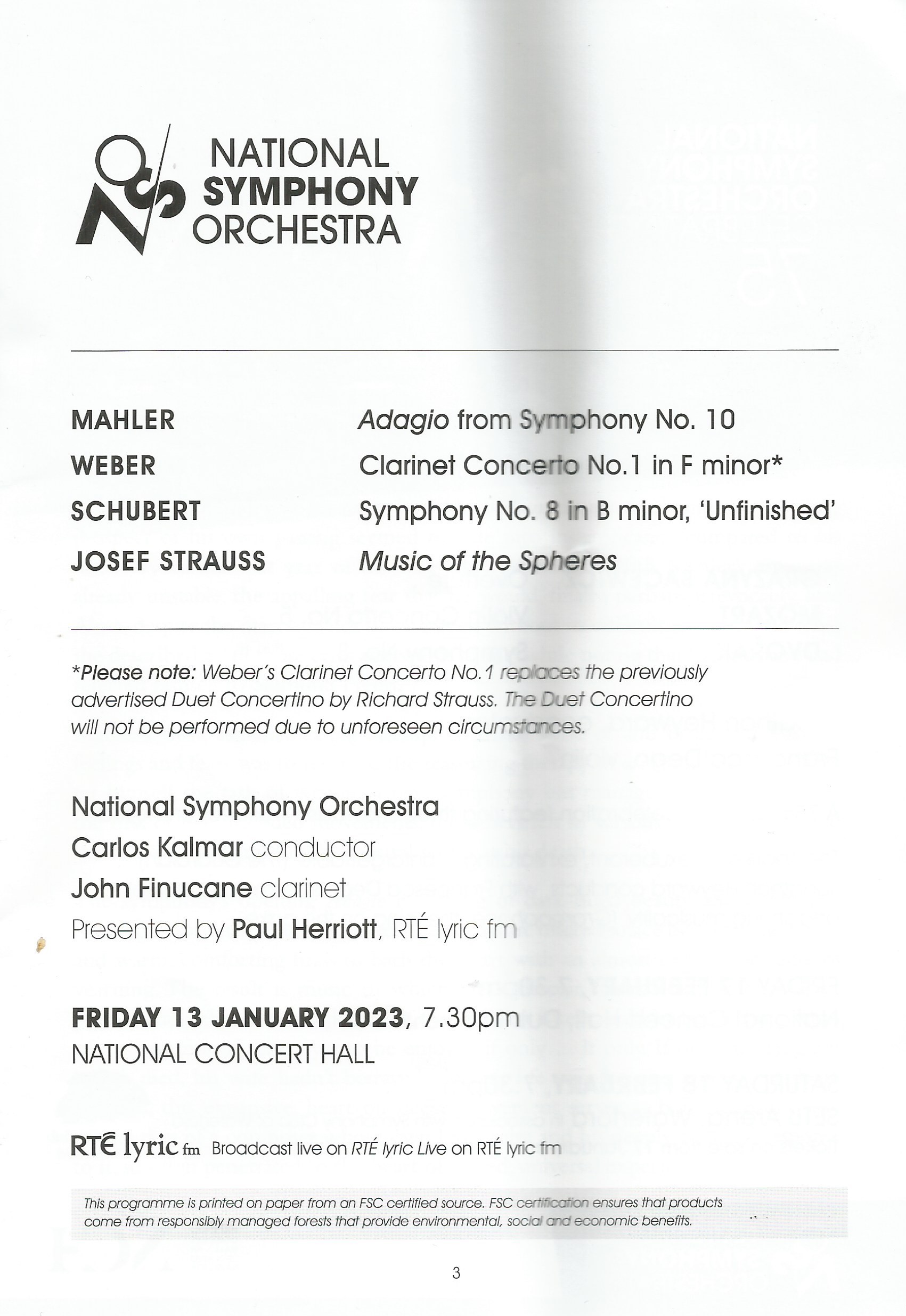
And so it came to pass that last night I took the train into Dublin for my first concert of the year 2023 at the National Concert Hall in Dublin which happened to be by the National Symphony Orchestra under the direction of guest conductor Carlos Kalmar.

It was an unusual programme in terms of its construction. Often the menu for such concerts begin with a short appetizer but this one started with the first movement of  Gustav Mahler‘s 10th Symphony. The composer died a hundred years ago in 1910 having not actually finished the rest of the symphony, but I gather that he left sufficiently detailed sketches and notes that complete versions have been constructed, but nevertheless the first movement is frequently performed on its own. It’s quintessentially Mahler in many ways, but it’s a strange opening for a symphony because it’s a very long Adagio movement (lasting about 30 minutes). It’s a complex and weighty movement for a full orchestra, rather cryptic in nature but overall with a rather dark tone, far from the usual lollipop to start a concert!

Originally this programme was supposed to feature the Duet Concertino by Richard Strauss but it was announced last week that this would be replaced by the Clarinet Concerto No. 1 in F Minor by Carl Maria von Weber with the NSO’s principal clarinettist John Finucane. Unusually for a concerto performance, John Finucane was reading a score, which perhaps suggests he stood in at short notice but in any case the performance was very fine. The third movement, a spirited Rondo kicked off by a very jaunty theme, is probably the most familiar piece, but I particularly enjoyed the interplay between clarinet and horns in the slow (2nd movement). John Finucane had brought his fan club with him, and the audience responded warmly.

After the wine break we had Symphony No. 8 in B Minor by Franz Schubert, the famous “Unfinished Symphony”. Somewhat surprisingly, I am pretty sure that I had never heard this piece performed live until this concert.

Schubert apparently wrote the first two wonderful movements of this piece in the space of only eight days in 1822 but then seems to have abandoned it. The composition wasn’t interrupted by his death – he didn’t pass away until 1828 – so it’s a mystery why he didn’t finish it. It wasn’t even discovered until the 1860s. Unlike Mahler 10, we don’t have any idea what the rest of this symphony would have been but the two existing movements are exceptional, not least for the stream of lovely melodies. This work clearly belongs to the same world as the Weber piece (which was composed in 1811) but having one after the other emphasizes the transition from Classical to Romantic, and having Mahler on the same programme contrasts early and late Romantic in a very illuminating way.

The last piece was Music of the Spheres, a waltz by Josef Strauss, the younger brother of the more famous Johan Strauss II. It’s a jolly enough but rather insubstantial piece that seemed rather incongruous to me in this programme, especially at the end as it is the sort of piece one could imagine as an appetizer. It seems to have been decided that something was needed in place of the missing movement(s) of the Schubert Symphony, so perhaps it was meant to play the role of a dessert?

In any case it was an upbeat way to end the concert which was very enjoyable. I then made my way out into the rain to get the train back to Maynooth. For a Friday night, Dublin was very quiet indeed, perhaps because of the inclement weather and/or the post-Christmas lull. The NCH wasn’t full but there was a decent attendance and the performance was warmly appreciated.

P.S. Note that the National Symphony Orchestra is no longer the RTÉ National Symphony Orchestra owing to some restructuring. Note also that it is planned to close down the NCH for at least two years for extensive refurbishment. I’m not sure what will happen to the NSO during this period.


The RAS Awards

Posted in Uncategorized on January 13, 2023 by telescoper

I’m sitting in the bar of the National Concert Hall in Dublin ahead of tonight’s concert but I have enough time to congratulate all the winners of this year’s Royal Astronomical Awards. The full list of awardees, announced this afternoon, can be found here.

In particular, I’d like to congratulate John Peacock on his Gold Medal!

John is an occasional commenter on this blog, and may even read it sometimes too!

Essays, Mills and ChatGPT

Posted in Education with tags , , , on January 13, 2023 by telescoper

I saw an article the other day about how “contract cheating” was endangering the integrity of Ireland’s universities. This refers to the problem of students outsourcing their assignments to professional essay mills. Given the enthusiasm that university managers have for outsourcing in other contexts I’d be surprised if they see this as a problem. Indeed, their response might well be to outsource the grading of assignments in a similar fashion. It does however raise questions about academic integrity for thus of us who care about such matters.

I have to admit that I’ve never really understood the obsession in some parts of academia with “the student Essay” as a form of assessment. I agree that writing skills are extremely important but they’re not the only skills it is important for students to acquire during the course of a degree. Of course I’m biased because I work in Theoretical Physics, an area in which student essays play a negligible role in assessment. Our students do have to write project reports, etc, but writing about something you yourself have done seems to me to be different from writing about what other people have done. While forms of assessment in science subjects have evolved considerably over the last 50 years, other domains still seem to concentrate almost exclusively on “The Essay”.

Whatever you think about the intrinsic value of The Essay (or lack thereof) it is clear that if it is not done in isolation (and under supervision) it is extremely vulnerable to cheating. The article I referred to above concentrates on the corrupting influence of “Essay Mills” who will produce – for a fee – an essay on a given topic.

I believe however that this is not the biggest threat to academic integrity. There is a lot of discussion going on these days about ChatGPT, an AI system that can produce text on demand using sources on the internet. This is not great at dealing with technically complex specialist topics but can produce plausible if somewhat superficial offerings in many circumstances where something less demanding is required. Indeed, the more banal the task the better ChatGPT does. For example, here is an AI version of a university Strategic Plan which captures the vacuous nature of such documents with uncanny accuracy:

According to a pilot programme of which I am aware, the present configuration of ChatGPT scores an average of about 70% on (short) student essay tasks. It won’t be long before it gets much better than that. I predict that something like it will soon put essay mills out of business as it will be far cheaper and its use far more widespread. This is the real threat to the viability of “The Essay” in a modern university. The response will need to be quick!

Update: piece from the Irish Times.

P.S. It’s worth mentioning that AI systems can also write simple computer code to a reasonable level of proficiency, so this vulnerability also affects programming tasks.

New Publication at the Open Journal of Astrophysics

Posted in OJAp Papers, Open Access, The Universe and Stuff with tags , , , on January 12, 2023 by telescoper

Time to announce another new paper at the Open Journal of Astrophysics. This one was published officially on 9th January 2023. The latest paper is the second paper in Volume 6 (2023) as well as the 67th in all. This one is in the Astrophysics of Galaxies folder.

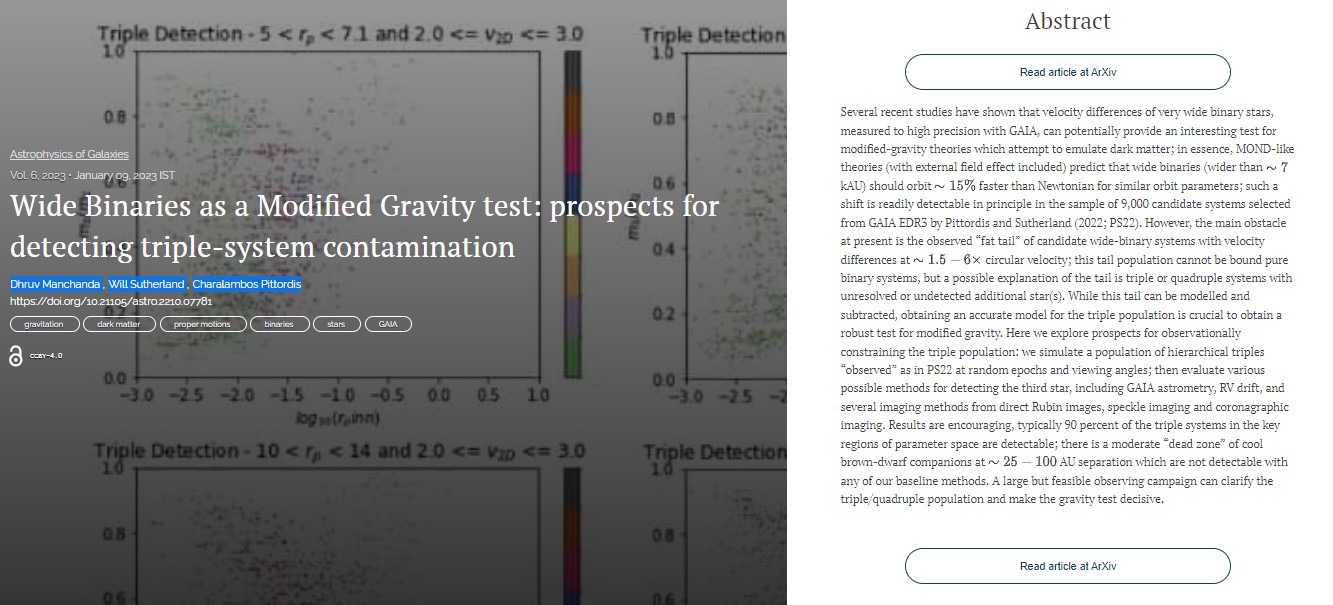
The latest publication is entitled “Wide Binaries as a Modified Gravity test: prospects for detecting triple-system contamination” and the authors – Dhruv Manchanda, Will Sutherland Charalambos Pittordis – are all based at Queen Mary, University of London.

Here is a screen grab of the overlay which includes the  abstract:


You can click on the image to make it larger should you wish to do so. You can find the officially accepted version of the paper on the arXiv here.

R.I.P. David Duckham (1946-2023)

Posted in R.I.P., Rugby with tags , , , on January 11, 2023 by telescoper

I seem to be devoting a lot of this blog to R.I.P. posts these days but sadly I have to do it again because former England rugby union international David Duckham has passed away at the age of 76. With great poise and balance as well as a blistering turn of pace, Duckham was an oustanding player on the wing and his international career would have been even more memorable had he had better players around; the England team of the early 70s was rather weak, actually finishing bottom of the Five Nations in four of the seven years he played.

David Duckham was one of only three England players who made it into the Barbarians side that played New Zealand in Cardiff on 27th January 1973, a match many regard as the greatest game of rugby ever played. Can that really have been 50 years ago?

The Barbarians’ side on that day was packed with Welsh legends and the Welsh supporters after the game changed Duckham’s name from “David” to “Dai” because he was “good enough to be Welsh”. I regarded that great Welsh rugby team of the 70s in exactly the same light as the great Brazilian football team of the same period.

I remember commentator Cliff Morgan during that game describing Duckham as “a man who can really motor” and indeed he could. Here’s a short clip* of him in action:

http://www.youtube.com/clip/UgkxFupDdxcSqxaLxHJfSJ244OKl2hDV9y7k

I’m not sure why New Zealand scrum-half Sid Going decided to kick after controlling the scrum so well with all the Barbarians pack committed and knowing that the ball would probably end up in the hands of JPR Williams, a man who could very quickly turn defence into attack. On this occasion, however, Duckham was already coming in off his wing, so JPR just slipped him the ball and off he went in thrilling fashion. That amazing dummy even fooled the cameraman who nearly let Duckham go out of shot as he scythed through the All Blacks until stopped by Sid Going. Brilliant stuff.

R.I.P. David Duckham (1946-2023)

*Not sure why it won’t embed properly but you’ll just have to click on the link!

R.I.P. Richard Bower

Posted in Biographical, R.I.P., The Universe and Stuff with tags , , , , on January 10, 2023 by telescoper

I was shocked and saddened this weekend to hear of the death from cancer of Professor Richard Bower of Durham University. Richard was a leading light in the Institute for Computational Cosmology (ICC) at Durham, though his research interests spanned observational and theoretical studies of galaxy and cluster formation as well as numerical studies. 

I heard the sad news via social media and there have many tributes to and personal reminiscences of Richard have been circulated from friends, colleagues and former students, including this lovely one by Josh Borrow. I’m sure there will be official obituaries in due course that do justice to Richards personality and achievements in teaching and research; I’ll add links when I see them.

If I can add a personal note, I only worked on one project with Richard, about thirty years ago while I was still at Queen Mary & Westfield College in London. Doing the project was tremendous fun – so much so that the paper we ended up writing bears little relation to what we thought it would be like when we started. We were both young then – I think Richard was about a year younger than me – and both had a tendency to fly off at tangents, but fortunately we were working with two responsible adults (Carlos Frenk and Simon White) who kept us in order. I think the paper we wrote is a nice one, but the real point is that the whole experience was so enjoyable that it was not only formative experience for me from an intellectual point of view but also left me with very fond memories. Whenever we met subsequently, which happened fairly frequently and conferences and on panels and the like, we always talked about what a great time that was. It’s hard to accept we’ll never have that conversation again.

I send heartfelt condolences to Richard’s family, friends and colleagues, both past and present, and in Durham and elsewhere. was an irrepressible and irreplaceable character who will be greatly missed by the entire cosmological community.

Rest in peace, Richard Bower.