The Little Things

Posted in Biographical, Politics with tags , , , , on February 25, 2022 by telescoper

Yesterday morning I heard the news about Russia’s invasion of Ukraine via the radio as soon as it woke me up at 7am. It took me a while to summon up the energy to get out of bed and get ready for my 9am lecture. The routine things of life seem so trivial and futile compared to wars and other disasters over which one has no influence. But it does not help Ukraine (nor anyone else, including yourself) to be overwhelmed by despair. So I got up and did my lecture, as I did this morning with a 9am tutorial.

Somehow, it feels like a duty to persevere. I think that’s partly because the tyrants of this world want people to feel powerless. By persisting with the little things you are, in a very small way, defying those who want you to be terrified. The image of Vladimir Putin as some sort mastermind, a Karla-like bogeyman with strategic superpowers, has hypnotized too many. He’s just a sad old relic of the Cold War.

I try to resist looking at the news too often, my desire to stay informed tempered by a wish to remain sane. I’d like to believe that the Ukrainians can hold out, but they’re massively outnumbered and outgunned so the odds are heavily against them. But they’re fighting on their home soil for a just cause against an invader. That should count for something. The longer they can hold out wear down the Russian army the more chance there is that the tide will turn against Putin at home.

I doubt that sanctions from the West will have any impact on Putin’s murderous intentions, at least not in the short term. In any case they look weak to me. Russian teams are still playing in UEFA tournaments, and Russia will still be in Eurovision. Why is this tolerated?

I spent an hour yesterday on a zoom call related to the European Space Agency’s Euclid mission, which is due to be launched on a Russian Soyuz spacecraft in 2023. The latest batch of sanctions may lead to a delay in Euclid or even its cancellation. That would be a major problem for many scientists around the world. It’s a big thing for us, but it gets smaller when you compare it with what’s happening in the world. I bet a majority of us working in cosmology would prefer to see Euclid scrapped altogether than see further death and destruction unfold. I know I would.

It wouldn’t work that way, of course, but the question we have to ask ourselves is who are we happy to do business with? How could you sleep at night after giving money to or taking money from the Kremlin or its proxies? Maybe Putin will succeed only in giving the West a renewed sense of moral certainty.

For years the West has been corrupted by dirty money from Russia’s gangster oligarchs. Now Ukraine is paying the price. We’ve been far too slow to understand the true nature of who and what we’ve been dealing with. Now it’s time to get serious. “Business as usual” no longer applies, at least not with Russia…

A Dark Day #IStandWithUkraine

Posted in Politics with tags , on February 24, 2022 by telescoper

Just a reminder that Johnson’s UK Government has a huge majority in the House of Commons and could easily pass emergency laws to impose sanctions on Putin and his oligarch pals after Russia’s invasion of Ukraine, if it wanted to. It won’t, because the Conservative Party is awash with dirty Russian money and is fatally compromised.

February Storms

Posted in Talks and Reviews, The Universe and Stuff with tags , on February 23, 2022 by telescoper

We’ve had three major storms over the past week (Dudley, Eunice and Franklin). Today I was reminded that precisely five years ago today I was trying to make it from Cardiff to Lincoln to give a lecture, so I thought I’d reblog the post I wrote at the time. It took me nearly all day and I was an hour late, but, you know, the show must go on and so it did.

There’s obviously a thing about February and storms!

telescoper's avatarIn the Dark

What a day!

This morning I set out from Cardiff to travel here to Lincoln for mypublic lecture. I took the9.45 train via Birmingham which, after a change of trains in Nottingham, should have got me into Lincoln at 14.23, with plenty of time to have a look around and chat to people before the scheduled start of my talk at 18.00 hours.

That was the plan, but it omitted an important factor:Storm Doris.Fallen trees, broken down trains and general disorganisation meant that it took ninehours to get to Lincoln, even including getting a taxi from Nottingham because I missed my connection.

The strangest thing was that I never actually saw any particularly bad weather. In fact there was quite a lot of sunshine en route. All the chaos was caused elsewhere, apparently.

Anyway I finally turned up almost an hour late for my talk…

View original post 89 more words

The art of building a smooth cosmic distance ladder in a perturbed universe

Posted in The Universe and Stuff with tags , , on February 22, 2022 by telescoper

Catching up on some literature on the inestimable arXiv I came across this paper by Obinna Umeh which I haven’t gone through in detail but which looks very interesting:

How does a smooth cosmic distance ladder emerge from observations made from a single location in a lumpy Universe? Distances to the Type Ia supernova (SN1A) in the Hubble flow are anchored on local distance measurements to sources that are very nearby. We described how this configuration could be built in a perturbed universe where lumpiness is described as small perturbations on top of a flat Friedmann-Lemaıtre Robertson-Walker (FLRW) spacetime. We show that there is a non-negligible modification (about 11%) to the background FLRW area distance due to the presence of inhomogeneities in the immediate neighbourhood of an observer. We find that the modification is sourced by the electric part of the Weyl tensor indicating a tidal deformation of the local spacetime of the observer. We show in detail how it could impact the calibration of the SN1A absolute magnitude in the Hubble flow. We show that it resolves the SN1A absolute magnitude and Hubble tensions simultaneously without the need for early or late dark energy.

The area distance here is what I usually call the angular-diameter distance; when one thinks of supernova measurements one usually thinks of the luminosity distance but these are related through the reciprocity relation discussed here which applies to each source regardless of whether the metric is of FLRW form or not. For a general discussion of cosmological distances see here.

A Time for Peace Piece

Posted in Jazz on February 22, 2022 by telescoper

With all that’s going on in the world right now it seems appropriate to repost this beautiful track by the great jazz pianist Bill Evans. I remember reading somewhere that Bill Evans recorded this right at the end of a session, in 1958. It was unrehearsed, entirely improvised and done in one take. It’s based on a simple two-chord progression that subsequently appeared in Flamenco Sketches, one of the tracks on the classic Miles Davis album Kind of Blue. To my ears, Peace Piece is more redolent of the composition style of Erik Satie than any other jazz musician I can think of. Although it starts out very simply it becomes more complex and fragmented as it develops, and makes effective use of dissonance in creating tension to contrast with the rather meditative atmosphere established at the beginning. Anyway, this is one of my all-time favourite tracks by one of my all-time favourite jazz musicians so I hope you don’t mind me sharing it on here.

Job Opportunity in Computer Science, Statistics or Applied Mathematics at Maynooth

Posted in mathematics, Maynooth with tags on February 21, 2022 by telescoper
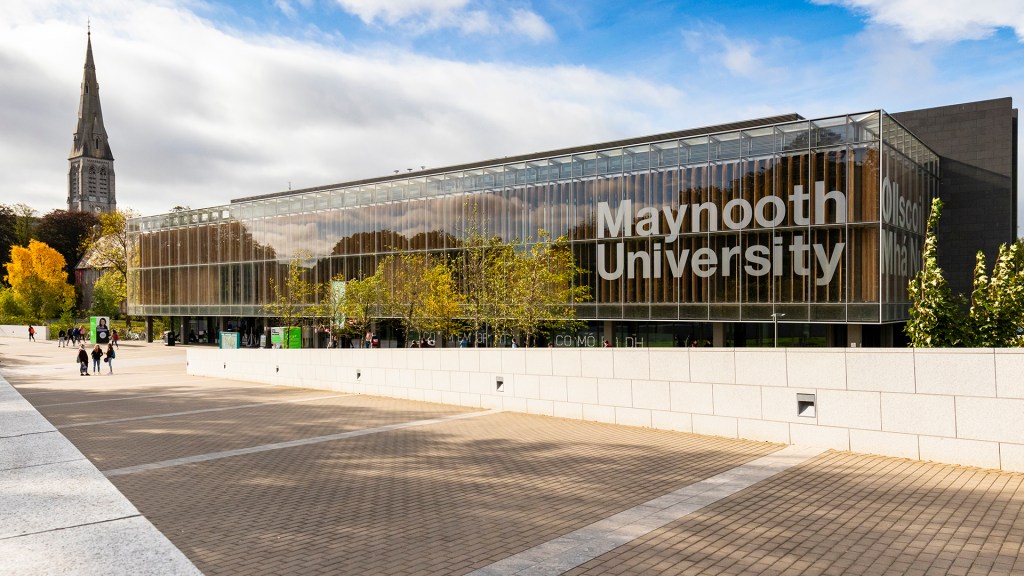
This is the Library not the Hamilton Institute but you get the idea..

Just a quick post to pass on the news that my colleagues in the Hamilton Institute at Maynooth University have a vacancy for a permanent position at Professorial level.

You can find the full advert here. Please feel free to pass it on to anyone you think might be interested.

P. S. I’m looking forward to mentioning further announcements about a number of other permanent job opportunities at Maynooth in the not-too-distant future!

New Publication at the Open Journal of Astrophysics

Posted in OJAp Papers, Open Access, The Universe and Stuff with tags , , , on February 21, 2022 by telescoper

It’s time yet again to announce a new publication in the Open Journal of Astrophysics! This one is the 3rd paper in Volume 5 (2022) and the 51st in all. We actually published this on Friday, byt I’ve only just got around to announcing it here now.

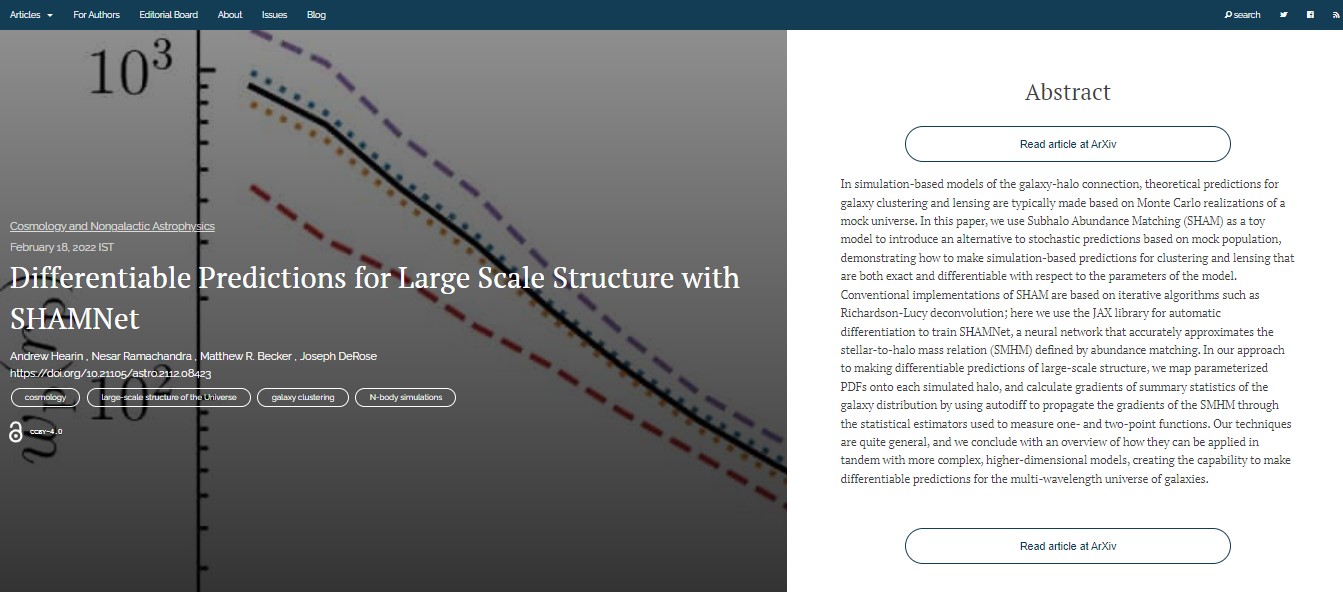
The latest publication is entitled Differentiable Predictions for Large Scale Structure with SHAMNet and is written by Andrew Hearin, Nesar Ramachandra and Matthew R. Becker of the Argonne National Laboratory and Joseph DeRose of the Lawrence Berkeley Laboratory (both institutions being in the USA).

Here is a screen grab of the overlay which includes the abstract:

You can click on the image to make it larger should you wish to do so. You can find the arXiv version of the paper here. This paper is in our popular Cosmology and Non-galactic Astrophysics section.

P. S. Here’s a bit of feedback from the author of this paper about the referees:

They reviewed the paper in conscientious detail, and every comment was thoughtful. We feel that our paper has materially improved in clarity as a result of their critique.”

Sins of Omission

Posted in The Universe and Stuff with tags , , , , , on February 20, 2022 by telescoper

There’s a paper recently published in Nature Astronomy by Moreno et al, which you can find on the arXiv here. The title is Galaxies lacking dark matter produced by close encounters in a cosmological simulation and the abstract is here:

The standard cold dark matter plus cosmological constant model predicts that galaxies form within dark-matter haloes, and that low-mass galaxies are more dark-matter dominated than massive ones. The unexpected discovery of two low-mass galaxies lacking dark matter immediately provoked concerns about the standard cosmology and ignited explorations of alternatives, including self-interacting dark matter and modified gravity. Apprehension grew after several cosmological simulations using the conventional model failed to form adequate numerical analogues with comparable internal characteristics (stellar masses, sizes, velocity dispersions and morphologies). Here we show that the standard paradigm naturally produces galaxies lacking dark matter with internal characteristics in agreement with observations. Using a state-of-the-art cosmological simulation and a meticulous galaxy-identification technique, we find that extreme close encounters with massive neighbours can be responsible for this. We predict that approximately 30 percent of massive central galaxies (with at least 1011 solar masses in stars) harbour at least one dark-matter-deficient satellite (with 108 – 109 solar masses in stars). This distinctive class of galaxies provides an additional layer in our understanding of the role of interactions in shaping galactic properties. Future observations surveying galaxies in the aforementioned regime will provide a crucial test of this scenario.

It’s quite an interesting result.

I’m reminded of this very well known paper from way back in 1998, available on arXiv here, by Priya Natarajan, Steinn Sigurdsson and Joe Silk, with the abstract:

We propose a scenario for the formation of a population of baryon-rich, dark matter-deficient dwarf galaxies at high redshift that form from the mass swept out in the Intergalactic Medium (IGM) by energetic outflows from luminous quasars. We predict the intrinsic properties of these galaxies, and examine the prospects for their observational detection in the optical, X-ray and radio wavebands. Detectable thermal Sunyaev-Zeldovich decrements (cold spots) on arc-minute scales in the cosmic microwave background radiation maps are expected during the shock-heated expanding phase from these hot bubbles. We conclude that the optimal detection strategy for these dwarfs is via narrow-band Lyman-α imaging of regions around high redshift quasars. An energetically scaled-down version of the same model is speculated upon as a possible mechanism for forming pre-galactic globular clusters.

It’s true that the detailed mechanism for forming dwarf galaxies with low dark matter densities is different in the two papers, but it does show that the issue being addressed by Moreno et al. had been addressed before. It seems to me therefore that the Natarajan et al. paper is clearly relevant background to the Moreno et al. one. I always tell junior colleagues to cite all relevant literature. I wonder why Moreno et al. decided not to do that with this paper?

Had Moreno et al. preprinted their paper before acceptance by Nature Astronomy I’m sure someone would have told them of this omission. This is yet another reason for submitting your papers to arXiv at the same time as you submit them to a journal rather than waiting for them to be published.

Personal and Postdoctoral Choices

Posted in Biographical, Brighton on February 19, 2022 by telescoper

Over the past week or so I’ve noticed quite a lot of discussion on social media about postdoctoral fellowship positions. These positions are scarce compared to the number of eligible applicants so competition is quite intense. Applications are usually required around November for a start the following year: those lucky enough to have been offered such a position to start in September or October usually have to accept or decline around this time of year; those lucky enough to receive more than one offer have to pick which one they want to accept so that those on a waiting list can be contacted. It’s a nervous time for early career researchers, particularly in the USA where there are few opportunities outside this cycle.

Seeing all these exchanges on Twitter reminded of this time of year in 1988. I was in the last the last year of my PhD DPhil at Sussex – there was only three years’ funding in those days – and had applied before Christmas 1987 for postdoc positions to start in September or October1988. I was fortunate to receive several offers, including one to stay at Sussex.

There was a big complication in my case. I have never written about this on the blog but during the last year of my PhD I was helping to care for a friend who was terminally ill. The medical people couldn’t say how long he would live but said it would be months rather than years. When it came to February 1988 and I had to make a choice, I felt I had no alternative but to make a decision that would allow me to continue to help as long as was necessary if my friend lived past September, rather than abandon him. Accordingly I accepted the position at Sussex and decline the others.

As it happened my friend passed away (peacefully) about six weeks later, but by then I’d made the decision and there was no going back.

I do generally advise younger researchers that moving away from the institute in which they did their graduate studies is generally a good idea in order to broaden your experience. Given that, people have sometimes asked me in person why I decided to stay at Sussex and I usually tell them what I’ve written above.

I have absolutely no regrets about the decision. Sussex was a very good place to be a postdoctoral researcher anyway and things worked out very well for me in the end, career-wise. I also felt I’d done the right thing based on how the situation stood at the time I made the decision.

The point of this post is that you shouldn’t be afraid of including personal considerations in your career choices. We’re all people, not robots. And if you’re that others might think your decision is strange then remind yourself that it’s your life, not theirs. In the end the only person you need to justify yourself to is yourself.

Wind, by Ted Hughes

Posted in Poetry on February 18, 2022 by telescoper

This house has been far out at sea all night,
The woods crashing through darkness, the booming hills,
Winds stampeding the fields under the window
Floundering black astride and blinding wet

Till day rose; then under an orange sky
The hills had new places, and wind wielded
Blade-light, luminous black and emerald,
Flexing like the lens of a mad eye.

At noon I scaled along the house-side as far as
The coal-house door. Once I looked up –
Through the brunt wind that dented the balls of my eyes
The tent of the hills drummed and strained its guyrope,

The fields quivering, the skyline a grimace,
At any second to bang and vanish with a flap;
The wind flung a magpie away and a black-
Back gull bent like an iron bar slowly. The house

Rang like some fine green goblet in the note
That any second would shatter it. Now deep
In chairs, in front of the great fire, we grip
Our hearts and cannot entertain book, thought,

Or each other. We watch the fire blazing,
And feel the roots of the house move, but sit on,
Seeing the window tremble to come in,
Hearing the stones cry out under the horizons.

by Ted Hughes (1930-98)