Il Mio Tesoro – John McCormack

Posted in History, Opera with tags , , , on December 19, 2021 by telescoper

The aria Il Mio Tesoro Intanto from Act II of Mozart’s great Opera Don Giovanni is widely regarded as a test piece for Operatic tenors because of its demanding mix of long flowing lines, big leaps and florid coloratura ornamentation. The other day I heard a performance by the great Irish tenor John McCormack which, despite being recorded over a hundred years ago (in 1916) completely blew me away. I thought I’d share it here.

John McCormack made over 800 records in his lifetime, the vast majority of them Irish songs and ballads that found a huge audience not only in Ireland but also in the Irish diaspora in the United States of America; this part of his career was extremely lucrative making him a millionaire. His first love was the Opera: a lyric tenor of the highest quality, his career overlapped with that of the great Enrico Caruso and the two became great friends after McCormack moved to the United States and became a regular at the Metropolitan Opera. It was Caruso who made the first ever million-selling record (Vesti La Giubba from I Pagliacci in 1902) and perhaps that’s what persuaded McCormack to embark on a recording career.

Before the 1920s gramophone recordings were entirely acoustic, made by a process exactly the reverse of a gramophone player. Musicians and singers would play into a horn at the sharp end of which was a needle that could leave an impression on the recording medium. In the early days the recording would be made on a wax cylinder, but this was soon replaced by plastic or acetate discs. It wasn’t possible to make recordings longer than a few minutes using this method.

Here’s an example of an early recording session showing what it was like. The chap with the moustache is Sir Edward Elgar:

Given this sort of arrangement it is no surprise that the sound of the Orchestra of the Met is muffled and distorted on the following recording. Almost certainly McCormack would have been standing right in front of the horn so his sizeable form would have acted as a kind of baffle. When I think of these old records it always seems a wonder that you can hear anything at all.

Despite the limitations of the recording technology the crystal clarity of McCormack’s voice and his superb control shine through. I listen to quite a lot of old jazz records made in a similar way so my ears are perhaps unusually forgiving but I think this is one of the greatest versions of this aria that I’ve ever heard – and I’ve heard quite a few. I hope you enjoy it too.

P.S. John McCormack was born in Athlone, which is about 100km due west of Maynooth.

End of Term Blog

Posted in Biographical, Covid-19, Education, Maynooth with tags , , , , , on December 18, 2021 by telescoper

Yesterday was the last day of teaching at Maynooth University for 2021 and, although I didn’t have any teaching to do, I walked to the Department partly to get a bit of fresh air having been stuck at home on Thursday after my booster jab, and partly to collect a few things before the break. I also discovered that a lovely parcel of goodies had been sent to me and I was anxious to collect the items before Christmas.

I’ll be keeping myself to myself over the break, apart from the odd trip to the shops, and am glad to be doing so. We are yet to see the steep increase in Covid-19 cases associated with the omicron variant happening in the UK and elsewhere in Europe. If anything case numbers are currently declining slowly. But the new wave will undoubtedly hit Ireland soon.

UPDATE: not half an hour after I posted this, the HSE announced 7333 new cases of Covid-19 in Ireland, more than double yesterday’s figure and the highest number seen since early January. And this is before the Christmas surge.

The jury is still out on whether omicron is more or less dangerous than previous variants but it is clearly more transmissible, and I don’t see the point of taking chances, so I agree with the Irish Government on the need to take precautions. I don’t think the latest restrictions go anywhere near far enough though.

Yesterday we received at work an email from University management that said, among other things, that

At present the aim is to resume teaching on 31 January, as in Semester 1.

The phrase “as in Semester 1” means that large lectures will be online-only but everything else will be face-to-face. That is a reasonable starting point because the extent of the omicron wave is as yet unknown, but I think it’s more likely than not that in the end we’ll find ourselves doing everything online. I just hope a decision on that is made in reasonable time for us to put Plan B into action. We don’t start lectures again until January 31st and there should be enough data by then to make an informed decision.

I don’t want to sound unduly pessimistic but I don’t see any sign that we are anywhere near the end of this pandemic. With a bit of luck we might find that we’re roughly halfway through, but as long as governments allow large pools of virus to circulate, mutations will continue to occur and new variants will continue to emerge. To end this cycle will require a majority of the world’s population to be vaccinated, and I don’t see that happening soon.

New Publication at the Open Journal of Astrophysics

Posted in OJAp Papers, Open Access, The Universe and Stuff with tags , , , , , , on December 17, 2021 by telescoper

It’s nice to be able to announce another publication in the Open Journal of Astrophysics before the Christmas break. This one was published yesterday, actually, but I didn’t get time to post about it until just now. It is the 17th paper in Volume 4 (2021) and the 48th in all.

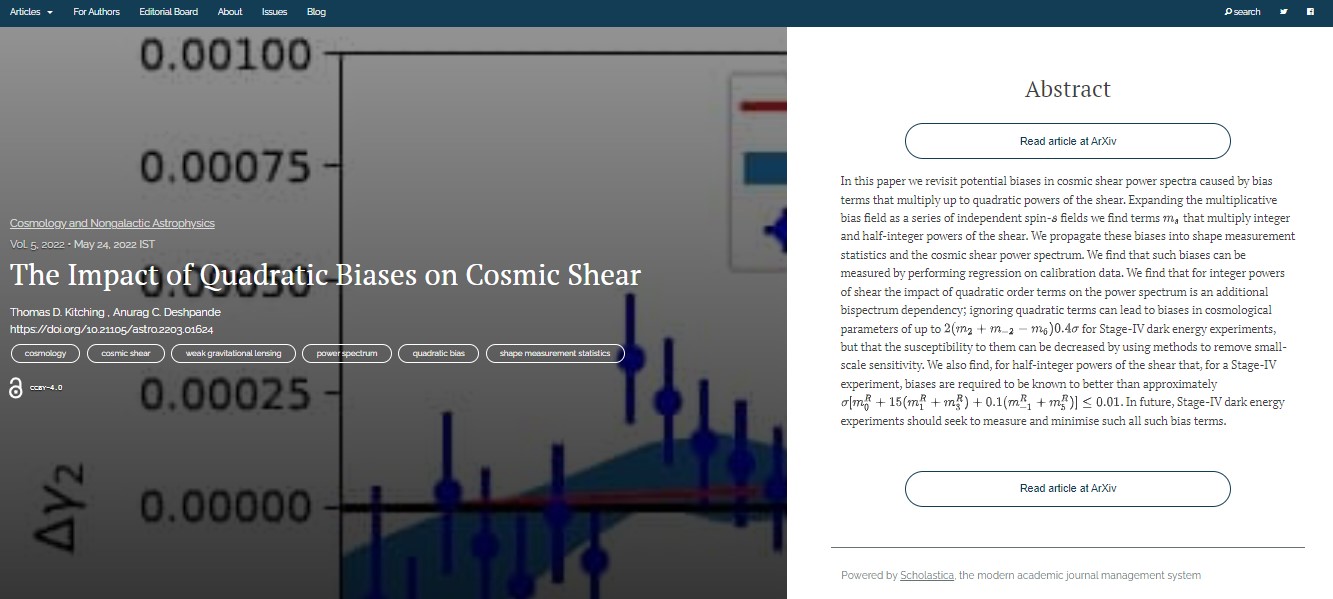
The latest publication is entitled Mapping Spatially Varying Additive Biases in Cosmic Shear Data and is written by Tom Kitching and Anurag Deshpande of the Mullard Space Science Laboratory (UCL) and Peter Taylor of the Jet Propulsion Laboratory (Caltech).

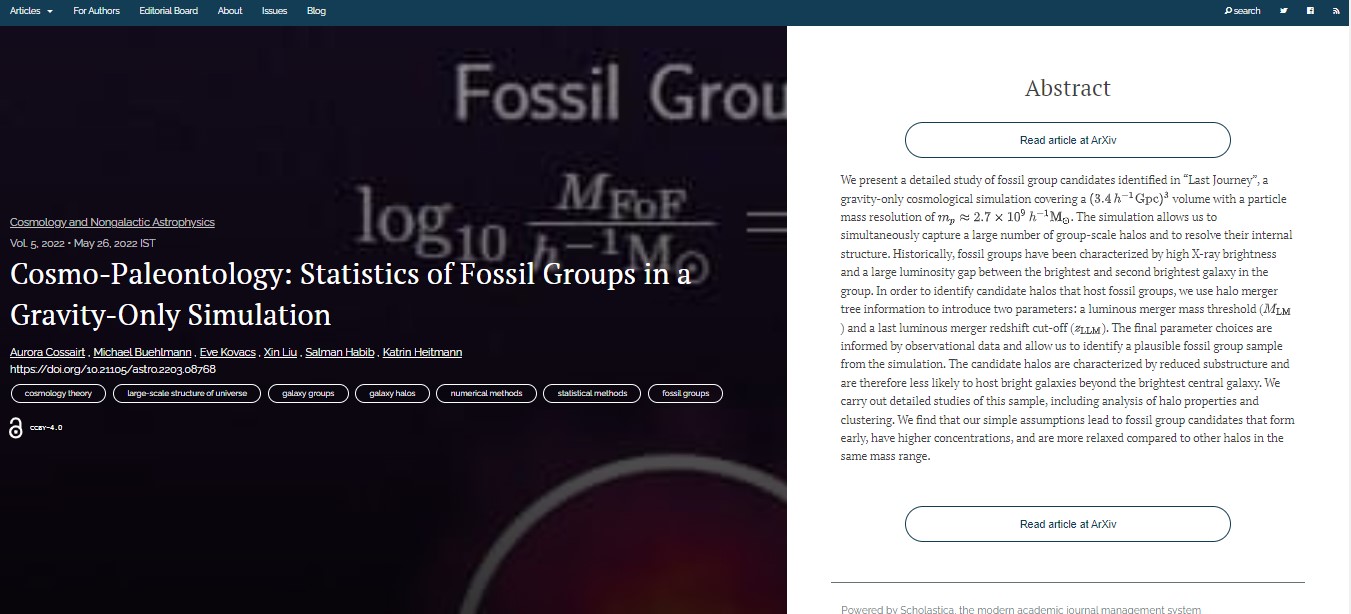
Here is a screen grab of the overlay which includes the abstract:

You can click on the image to make it larger should you wish to do so. You can find the arXiv version of the paper here. This is another one for the Cosmology and Nongalactic Astrophysics folder, which is the most popular category so far on the Open Journal of Astrophysics site.

P. S. Let me apologise for any inconvenience caused by a recent temporary outage on our Scholastica platform overnight between 16th & 17th December (US time). Normal service has now been restored.

Professor of Climate Change at Maynooth University

Posted in Maynooth with tags , on December 16, 2021 by telescoper

I’ve been indisposed for most of today thanks to the after-effects of my booster jab, so I’ve just got time to pass on a bit of news about a job opportunity at Maynooth. You may recall that I announced recently that we are to receive a new Chair in Observational Astrophysics & Cosmology under the Strategic Academic Leadership Initiative. That post was made available in the second round of these positions and we hope to advertise it early in the New Year.

However, not all the first round positions have been filled yet so I thought I’d draw your attention to such a position in the area of Climate Change. My understanding is that this is going to be interpreted broadly including such areas as climate science, hydroclimatology, biogeography, paleoecology, paleoclimatology, oceanography, adaptation and mitigation, and remote sensing.

Given the overlap with geophysics and atmospheric physics, it may be that someone reading this blog might be tempted to apply. If so then you can find further details here. The deadline is Sunday January 30th 2022.

Boosted!

Posted in Biographical, Covid-19 with tags , , on December 15, 2021 by telescoper

This morning I duly made my way for the third time this year to City West vaccination Centre to get a booster shot of the Moderna vaccine. Given reports of lengthy queues I was prepared for a long wait but that wasn’t the case. I was in and out in 40 minutes including the mandatory 15 minutes after the jab. It was busy, but good organisation kept us all moving steadily. Once again huge thanks are due to the HSE staff and volunteers (including the piano player) for all their efforts!

It could have been even quicker but the computer system had mistakenly registered that I have a history of anaphylaxis (which I don’t) so I had to answer a longer set of questions and wait for my record to be corrected. I guess someone ticked the wrong box the last time I was there!

I didn’t have any serious side effects with my other doses but I am working from home anyway, and don’t have anything scheduled this afternoon, so I can crash out if needs be. In the meantime I’ll get on with some work…

P. S. There seemed to me to be much less nervousness among the people in the queue this time. Everyone was quite chatty. I guess we’re all getting used to this rigmarole now!

Update: 10.20pm. No particularly serious side effects but I’m feeling very tired and achey so am having an early night!

Update: 9.30am the following day. The third dose (booster) has given me a far stronger reaction than the previous two. In particular my left arm (where I had the jab) is so numb as to be virtually useless and all my joints are aching. I’m glad I can stay at home today!

Some Tips on Answering Physics Exam Questions

Posted in Education, YouTube on December 14, 2021 by telescoper

Since I’m currently doing revision classes because the examination period here at Maynooth University begins shortly after Christmas, and some of our students haven’t done examinations for a while because of Covid-19 restrictions, I thought I would use my YouTube channel (which has several subscribers) to present a video version I made last spring of a post I did a few years ago about how to solve Physics problems. These are intended for the type of problems students might encounter at high school or undergraduate level in examinations or indeed in homework. I’ve tried to keep the advice as general as possible though so hopefully students in other fields might find this useful too.

Art Attack

Posted in Art, Biographical on December 14, 2021 by telescoper

Untitled, by Peter Coles (2021), 2m by 1.2m, chalk dust and oil on panel, Castlebridge Art Museum.

Yet another Hubble Constant Update

Posted in The Universe and Stuff with tags , , , , on December 13, 2021 by telescoper

The latest contribution to the ongoing debate about the Hubble constant is a new paper by Adam Riess and collaborators which you can find on the arXiv here. The abstract reads:

As you can see, this group is doubling down up on a high value for the Hubble constant. This longstanding discrepancy gives me an excuse to post my longstanding opinion polls on the topic.

First, would you go for a “high” (73-ish) or “low” (68-ish) value:

Second, do you think the discrepancy or tension is anything to get excited or even tense about?

The Coronavirus Vaccine Effect

Posted in Covid-19, mathematics with tags , , , , , , on December 12, 2021 by telescoper

When I was updating my Covid-19 page today I thought I would try something a bit different. Here are the cases and deaths (in the form of 7-day rolling averages) as I usually plot them:

You can see a slight recent downturn – the latest 7-day average of new cases is 4214.3; it has been falling for a few days. A log plot like this shows up the changing ratio between deaths and cases quite well, as in l if you multiply a quantity by a factor that manifests itself as a constant shift upwards or downwards. There is clearly a bigger shift between the orange and blue curves after 500 days than there is, say, between, 300 and 400.

(I don’t think you can read much into the gap between the curves at the beginning (up to around 100 days in) as testing coverage was very poor then so cases were significantly underestimated.

Anyway, to look at this a bit more clearly I plotted the ratio of daily reported deaths to daily confirmed cases over the course of the pandemic. This is the result:

The sharp downward glitches occur whenever the number of reported deaths is zero, as log of zero is minus infinity. The broader downward feature after about 300 days represents the period in January 2021 when cases were climbing but deaths had not caught up. To deal with that I tried plotting the deaths recorded at a particular time divided by the cases two weeks earlier. This is that result:

The spike is still there, but is much decreased in size, suggesting that a two week lag between cases and deaths is a more useful ratio to look at. Note the ratio of deaths to cases is significantly lower from 500 days onwards than it was between 200 and 400 (say), by a factor a bit less than ten.

This obviously doesn’t translate into a direct measure of the efficacy of vaccines (not least because many of the recent cases and deaths are among the minority of unvaccinated people in Ireland) but it does demonstrate that there is a vaccine effect. Without them we would be having death rates up to ten times the current level for the same number of daily cases or, more likely, we would be in a strict lockdown.

On the other hand if cases do surge over the Christmas period there will still be a huge problem – 10 % of a large number is not zero.

Last Week Ahead

Posted in Biographical, Covid-19, Education, Maynooth on December 12, 2021 by telescoper

We’re approaching the end of term here at Maynooth University; the forthcoming week is the last week of teaching, after which we have the luxury of a full week without lectures or tutorials before Christmas itself. Apart from eating and drinking I think I’ll spend most of the holiday sleeping. The first official duty I will have in the new year is on Saturday 8th January when one of my online examinations is due to take place. After that it will be all marking papers and after that it will be preparing teaching for Semester 2…

At this start of this academic year I was quite confident that Semester 2 would find us more-or-less back to normal but that now seems very unlikely. I think that we’re going to be starting Semester 2 at the end of January 2022 exactly the same way that we started Semester 2 in January 2021, i.e. with everything fully online.

As of today, the recent rapid growth in Covid-19 infections seems to have slowed (and cases have been decreasing for a few days) but a Christmas surge seems inevitable and with many people having low protection against the omicron variant and very high case numbers even before the festive period, the period from January to March may be very difficult indeed. I stand to be proved wrong, though, and the trajectory of the pandemic is highly uncertain. We’ll just have to wait and see how things turn out. Fingers crossed.

I have explained before on this blog that I am going to be working from home next week, delivering my last lectures from my study and via recordings. I have better facilities for doing online lectures at home, because the University has failed to invest in decent recording equipment in its lecture theatres.

In any case I only have one full lecture to give in my first-year module (due tomorrow); the other two will be revision classes. I have finished the lectures for my second-year module so was just planning to do a revision class in the Tuesday slot. I did have some other (virtual) meetings in my calendar for next week but most of these have all been cancelled for one reason or another.

The one remaining task is to get all the online exams ready to go in January. We haven’t got the special Moodle spaces set up yet, but I imagine that will happen sometime next week.

By the way, when I responded to the close contact alert I received on Friday I was told I’d be sent an antigen test kit from the HSE. I haven’t got it yet but I suppose it may arrive next week. I still don’t have any symptoms though, and am effectively self-isolating anyway, so I’m not concerned. I just hope I get my booster on Wednesday without having to queue for too long…