New Publication at the Open Journal of Astrophysics

Posted in OJAp Papers, Open Access, The Universe and Stuff with tags , , , , , , , on December 10, 2021 by telescoper

Time to announce yet another publication in the Open Journal of Astrophysics. This one was published yesterday, actually, but I didn’t get time to post about it until just now. It is the 16th paper in Volume 4 (2021) and the 47th in all.

The latest publication is entitled MCMC generation of cosmological fields far beyond Gaussianity and is written by Joey Braspenning and Elena Sellentin, both of Leiden University.

Here is a screen grab of the overlay which includes the abstract:


You can click on the image to make it larger should you wish to do so. You can find the arXiv version of the paper here. This is another one for the Cosmology and Nongalactic Astrophysics folder.

R.I.P. Steve Bronski (1960-2021)

Posted in Biographical, LGBTQ+, Music with tags , on December 9, 2021 by telescoper

I was saddened to hear this evening of the death at the age of 61 of Steve Bronski, co-founder of the band Bronski Beat which provided much of the soundtrack of my early twenties. I spent many an hour in the mid-80s dancing away in gay clubs to their up-tempo numbers like Hit That Perfect Beat but, as I’ve mentioned on this blog before, the song Smalltown Boy had a particular resonance for me because it was about thoughts and feelings I knew very well but had never heard expressed in popular music. I really felt like the Smalltown Boy in the song.

Rest in Peace, Steven William Forrest, aka Steve Bronski (1960-2021).

A Date for a Boost!

Posted in Biographical, Covid-19, Education with tags , , , , on December 9, 2021 by telescoper

After expressing concern about the prospects of getting a timely booster jab last night I received an SMS message offering me an appointment next Wednesday for a shot. The text was sent on 8th December, six months to the day since my second jab (8th June). I will once again have to travel to City West in order to receive it, so will have take some time off work but that’s a small price to pay.

I had inferred (incorrectly) that it would take much longer to get a date for booster because most of the people I know in their sixties haven’t had theirs yet and they are higher priority than me. I now realise that may be because they had the AstraZeneca vaccine, which had a longer interval between first and second doses than the 4 weeks for the Pfizer vaccine I had, so had a later second dose than mine.

My third vaccine dose will be of the Moderna vaccine; the previous two were Pfizer/BioNTech. It seems everyone who is getting a shot this month will be getting the Moderna version as Ireland has a large stock of this vaccine due to expire next month. Although its efficacy against the omicron variant is unknown, I will of course attend the appointment.

Yesterday, before I received the text message announcing my booster shot, I emailed the students in my classes to say the remaining lectures of the term will be online-only because of the high levels of Covid-19 in circulation and my waning immunity. Next week’s booster doesn’t change that as next week is the last week of teaching. My plan is to do the lectures live as webcasts and make the recordings available afterwards, which is how I’ve done them the entire term, except I’ll be doing them from home with no in-person audience. Apart, that is, from next Wednesday, when I’ll only be able to offer a pre-recorded lecture as I’ll be at City West when the lecture is scheduled. That will be my last lecture of the Semester, as most of my teaching is concentrated in the early part of the week.

Owing to a combination of Covid-19, Storm Barra and no doubt sheer exhaustion, student attendance at lectures and tutorials on campus has fallen sharply, though attendance at my second-year class has remained quite high. On Tuesday the campus was virtually deserted but about 70% of my class for Vector Calculus & Fourier Series were there. Somehiw, though, I don’t think they’ll mind too much watching the remaining couple of lectures from the comfort of their homes!

Solar Corona?

Posted in Bad Statistics, Covid-19, mathematics, The Universe and Stuff on December 8, 2021 by telescoper

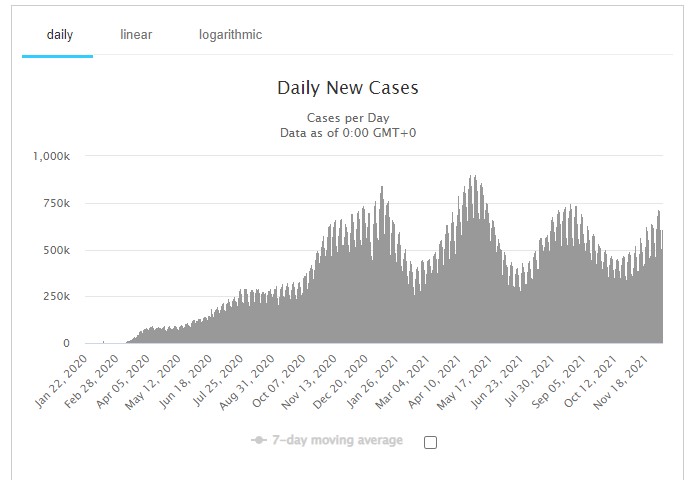
A colleague pointed out to me yesterday that  evidence is emerging of a four-month periodicity in the number of Covid-19 cases worldwide:

The above graph shows a smoothed version of the data. The raw data also show a clear 7-day periodicity owing to the fact that reporting is reduced at weekends:

I’ll leave it as an exercise for the student to perform a Fourier-transform of the data to demonstrate these effects more convincingly.

Said colleague also pointed out this paper which has the title New indications of the 4-month oscillation in solar activity, atmospheric circulation and Earth’s rotation and the abstract:

The 4-month oscillation, detected earlier by the same authors in geophysical and solar data series, is now confirmed by the analysis of other observations. In the present results the 4-month oscillation is better emphasized than in previous results, and the analysis of the new series confirms that the solar activity contribution to the global atmospheric circulation and consequently to the Earth’s rotation is not negligeable. It is shown that in the effective atmospheric angular momentum and Earth’s rotation, its amplitude is slightly above the amplitude of the oscillation known as the Madden-Julian cycle.

I wonder if these could, by any chance, be related?

P.S. Before I get thrown into social media prison let me make it clear that I am not proposing this as a serious theory!

For Those in Peril on the Sea

Posted in Biographical, Politics on December 7, 2021 by telescoper

News that winds up to 156 km/h associated with Storm Barra were recorded earlier this morning at Fastnet Lighthouse made me think of the brave lifeboat crews who put to sea in such conditions to save lives around the UK and Irish coasts. That in turn put me in mind of the hymn Eternal Father Strong to Save which I used to sing in the church choir when I was a boy and of which I can still remember most of the words:

This hymn gains extra poignancy given the tragic incident in the English Channel a few weeks ago when 27 people drowned when their boat was swamped by water in rough weather.

Thinking of Storm Barra, the desperate refugees attempting to cross the Channel, and the reports of people attempting to stop a lifeboat from launching, I decided to make a donation to the Royal National Lifeboat Institution (RNLI) and encourage you, if you are able, to do likewise. You can do so here.

Storm Barra Approaches

Posted in Biographical, Maynooth with tags , on December 6, 2021 by telescoper

I’m going to have an early night tonight as tomorrow promises to be a very “interesting” day. A large Atlantic weather system – Storm Barra – is heading towards Ireland and is expected to reach the South West coast around 3am tomorrow morning. It is expected to last about two hours.

As if the winds in excess of 130 km/h were not bad enough, the storm will reach the coast just before a very high tide so flooding is expected, especially near Cork.

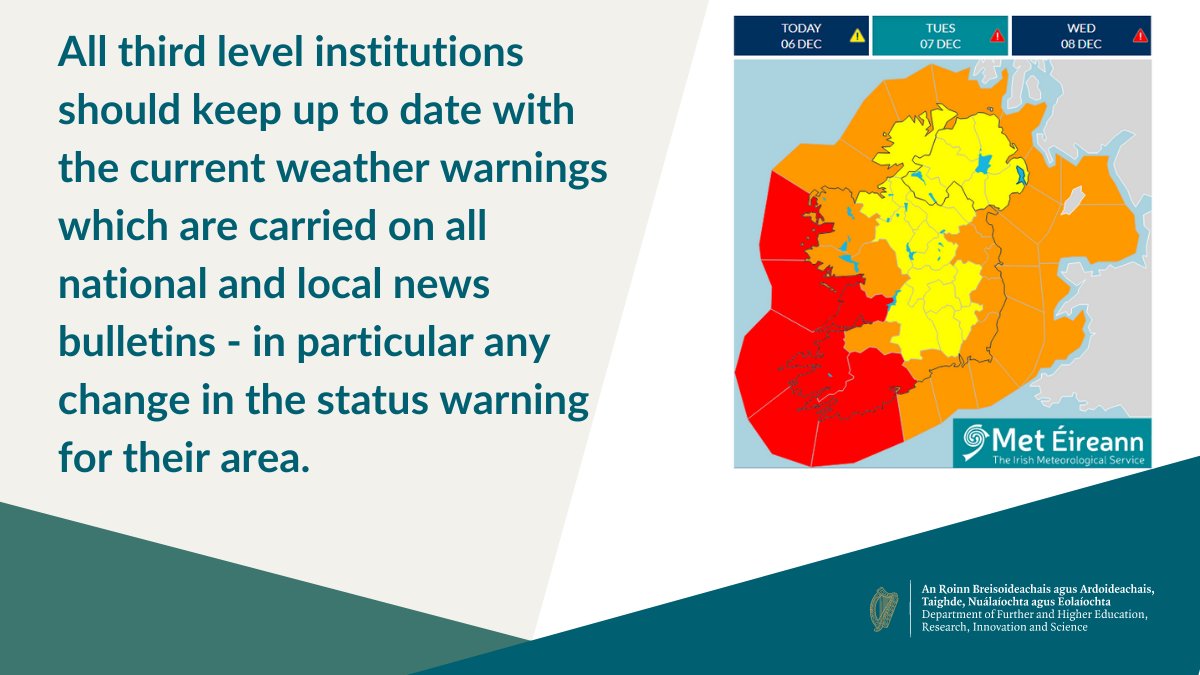
Colleges and schools in the Red and Orange alert areas will be closed tomorrow. Maynooth is in a Yellow alert area so the current plan is for the University to remain open, but it may change to Orange overnight and I suspect a significant number of staff and students will not be able to make it in anyway.

I’ll leave it there for tonight and update tomorrow.

UPDATE: 9.20am. It was very windy from about 6am and is now raining very heavily. Some branches have come down but no serious damage done near where I am.

Update: 14:20pm. Winds steadily backing as the depression moves out across the Irish Sea, now North-Easterly bringing colder air.

New Publication at the Open Journal of Astrophysics

Posted in OJAp Papers, Open Access, The Universe and Stuff with tags , , , , , , , on December 6, 2021 by telescoper

Time to announce yet another publication in the Open Journal of Astrophysics. This one is the 15th paper in Volume 4 (2021) and the 46th in all.

The latest publication is entitled  Interplanetary Dust as a Foreground for the LiteBIRD CMB Satellite Mission by Ken Ganga (Paris), Michele Maris (Trieste) and Mathieu Remazeilles (Santander) on behalf of the LiteBIRD collaboration. For information about the LiteBIRD mission see here.

Here is a screen grab of the overlay which includes the abstract:

You can find the paper on the Open Journal of Astrophysics site here and can also read it directly on the arXiv here.

Creating art from your thesis title

Posted in Art, The Universe and Stuff with tags , , on December 5, 2021 by telescoper

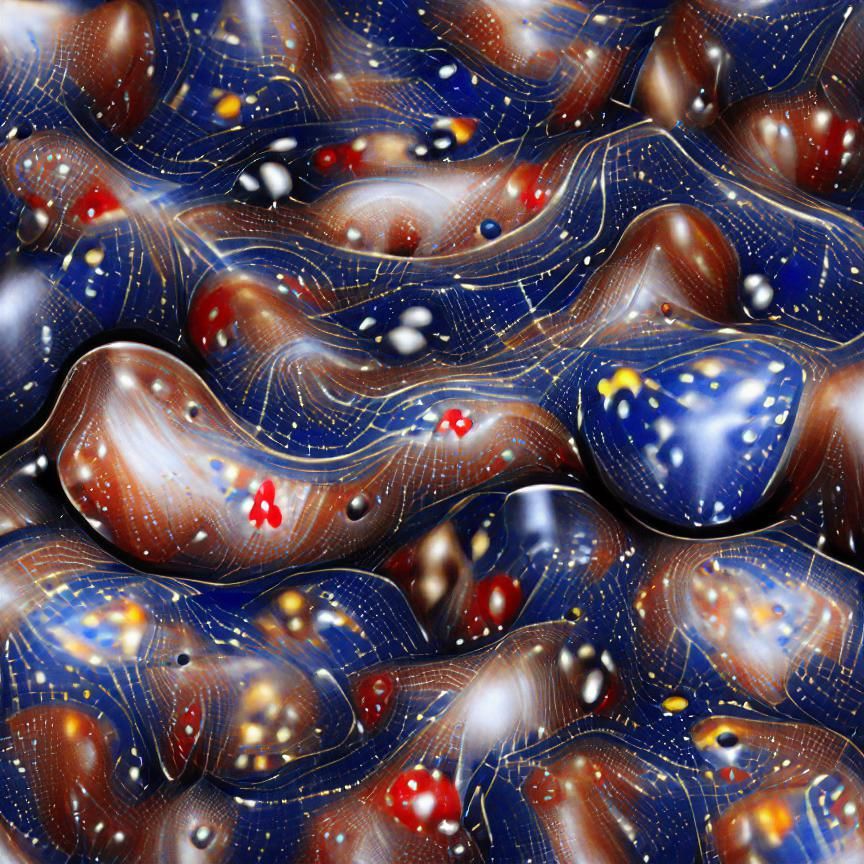
Looking for displacement activities to enable me to avoid working I noticed that people are having fun on social media by using AI apps to generate art from thesis titles. I thought I’d give it a go, and this is what I got for my thesis title Stochastic Fluctuations in the Early Universe:

Stochastic fluctuations in the early Universe

Actually, I rather like it! It’s much better than I’d expected. I’ve been told it looks like Christmas wrapping paper which gives it a seasonal twist too!

There are several apps that will create images inspired by text you type in. The one I used for the example above was this one. Why not try it yourself?

Exams in the Time of Covid

Posted in Biographical, Education, Maynooth on December 5, 2021 by telescoper

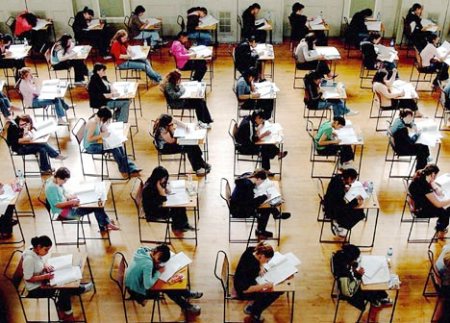
Not an online examination

With two weeks of teaching to go before the Christmas break in Maynooth we now have a settled plan for our January examinations in the Department of Theoretical Physics. We have decided that all our examinations will be done online, as we have done for all cycles of examinations since May 2020.

It seems that most other third-level education institutions – certainly the “traditional” universities have their examinations in December. At NUI Galway, for example, the examination session starts tomorrow (Monday 6th December) and their examinations will be on campus, despite the objections of the Students’ Union. This is also the case at Trinity College and University College Dublin, though University College Cork is doing most of its December exams online.

Our original plan at Maynooth was to have examinations on campus in January and some students were unhappy at the decision to revert to online examinations. The representations I heard from students in the Department of Theoretical Physics all gave the same reason: that online examinations are more difficult than on-campus examinations. I think this is the opposite of what students in other disciplines might think, but our online assessments focus to a greater extent on problem-solving tasks than the on-campus examinations, which means they are more difficult to do by rote learning and regurgitation.

An open-book exam is obviously easier if it simply requires students to look things up in their notes, textbooks or the web. Such an assessment would not only be easier, but also in my view absolutely pointless. Indeed, any exam, whether online or not, that requires students to use their brains only as memory devices is basically worthless. So our approach is to concentrate on the application of principles learned rather than bookwork.

Anyway, back to the on-campus versus on-line issue. I think campus exam venues, if arranged sufficiently carefully, need not be in themselves be places of high risk for Covid-19 risk, but large numbers of students will have to travel to and from them at the same time, largely on public transport, and there will also be a significant amount of milling around before and after. Large lectures (in the case of Maynooth this means over 250) are being delivered online at all Irish universities and exam halls will frequently have to hold greater numbers than that. It therefore seems to me rather inconsistent to insist on having large exams in person.

Finally, I’ll just note that all my colleagues (lecturers and tutors) are reporting a drop-off in student attendance at lectures and tutorials.  Last Friday the campus was extremely quiet, and I had only about half the expected class in my Vector Calculus lecture. This happens a bit in a “normal” year towards the end of term but is more marked this time round. I’m not surprised at it. With around 5000 new Covid cases per day I think many students are anxious not about lectures but about travelling on public transport and having to wait about on campus outside in the cold. I have been recording all my lectures this term and I don’t mind if students choose to view them remotely. Although we’re still officially teaching on campus, in practice many students are doing their learning online.


Top Ten JWST Facts!

Posted in The Universe and Stuff with tags , , on December 4, 2021 by telescoper

The James Webb Space Telescope looks nothing like the Hubble Space Telescope shown here.

As excitement mounts ahead of the launch of the James Webb Space Telescope (JWST) later this month I thought I would, as a service to the community, for the edification of the public at large, and despite popular demand, present my list of Top Ten JWST Facts.

  1. The JWST spacecraft will orbit the Sun near the Second Lagrange Point, L2, because it took so long to get built that tickets were no longer available for L1.
  2. JWST cost $10bn but its telescope is so sensitive that it can see back to redshifts greater than ten, meaning that it sees light that was emitted when its budget was less than $1 bn.
  3. To provide secure backup storage of the complete JWST data set, NASA has commandeered the world’s entire stock of 3½ inch floppy disks.
  4. As well as observing the Universe’s first galaxies and revealing the birth of stars and planets, JWST will look for signs that there might be intelligent life somewhere in the Universe.
  5. JWST’s unique 6.5m deployable mirror was  especially designed by experts from the IKEA company in Sweden who are famous for making items for ‘easy self-assembly’.
  6. The angular resolution of JWST is  0.1 arc seconds, which means  it could resolve a football at a distance of 550 km (or even further if it had Sky Sports).
  7. The Near-Infrared Spectrograph on JWST will be able to make simultaneous measurements of up to 100 sources while at the same time making a cup of coffee and washing the dishes.
  8. The BBC will be shortly be broadcasting a new 26-part TV series about JWST. Entitled WOW! JWST! That’s Soo Amaazing… it will be presented by Britain’s leading expert on infra-red astronomy, Professor Brian Cox.
  9. Er…
  10. That’s it.