The Killing of Samuel Luiz: why do you straight men do this?

Posted in Biographical, Brighton, LGBTQ+ with tags , , on July 10, 2021 by telescoper

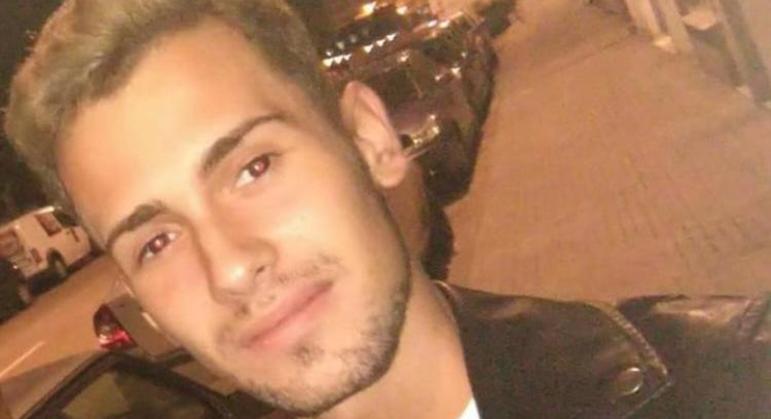
This is a picture of Samuel Luiz, a young gay man who was kicked and punched to death outside a nightclub in A Coruña, Galicia, Spain, on Saturday 3rd July 2021. At least 12 men were involved in the vicious assault and they were shouting the word maricón as they beat him. The word is a derogatory term in Spanish for a gay man, roughly equivalent to “faggot” in English. At least four men (all between the ages of 20 and 25) have been arrested for this murder. Let’s hope some justice is served. Demonstrations were held across Spain to protest Samuel’s killing.

This attack came just a few days after the end of Pride Month and if nothing else shows how far we still have to go. People sometimes ask why we still need Pride, after all we now have gay marriage? Well, Spain has gay marriage, but mobs still murder gay men. Anti-gay hate crime is reportedly on the increase in Spain and probably elsewhere. The Government of Hungary has enacted specifically homophobic legislation

There’s nothing new about this kind of homophobic violence. Queer-bashing was endemic in Brighton when I lived there in the 1980s. I know. I was on the receiving end of a beating myself. There were only four assailants in my case, and of course I didn’t die. My physical injuries were relatively superficial, but it was a life-changing experience and not in a good way. The word that was ringing in my eyes as I lapsed into unconsciousness then was “faggot”, so reading about Samuel Luiz brought it back. Sometimes things like this make me want to go and live off-grid somewhere far away from people to avoid such thoughts intruding again.

Anyway, that experience on Brighton sea front left me convinced that however much attitudes and laws change there will always be men – presumably straight – who for some reason despise gay men so much that they want to inflict violence on us. I can’t rid myself of the belief a very large number of straight men would behave in that way if they thought they would get away with it. It takes me a very long time to trust a heterosexual man enough to call him a friend.

I wish I could understand what causes so much hate. Believe me, if thought about it a lot and for a very long time and it remains incomprehensible to me. Perhaps it expresses some kind of need to assert dominance, much as misogynistic transphobic, and racist violence does? Or perhaps just a form of tribalism like football violence? The one firm conclusion I have reached is that the people who do this sort of thing are utter cowards. Why else would they need a gang to beat up one person? And the people who just look on and don’t intervene are cowards too.

In a piece a while ago I wrote about my experience in Brighton:

I have to say that for quite a long time in this period my general presumption was that a majority of heterosexual people were actively hostile to LGBT+ people, and that would always remain the case. There were quite a few gay people in Brighton who felt the same and their reaction was to become separatists. The logic was that straight people were always going to be horrible, so to hell with them. You could drink in gay bars, eat in gay restaurants, live in a gay part of the town, etc, and thereby minimize interaction with the hostile majority. This seemed an attractive lifestyle to me for some time, but I gradually began to feel that if there was ever going to be a chance of things changing for the better, LGBT+ people had to engage and form alliances. That strategy seems to have worked for the wider community, and I applaud the many straight people who have become allies.

It’s easy to say you’re an ally but are you willing to stand up and be counted?

A comment below objects to the “you” in the title of this post. I thought very carefully before including it. The response “not all straight men are like that” is unhelpful for lots of reasons.

First, I know that. All gay people do. We already know not every straight man is a murderer, or otherwise violent. We don’t need you to tell us. Second, it’s defensive. When people are defensive, they aren’t listening to the other person; they’re busy thinking of ways to defend themselves. It’s a classic social media response. Third, people saying it aren’t furthering the conversation, they’re sidetracking it. The discussion isn’t about the men who aren’t a problem. Fourth – and this the most important point – nobody can really know which straight men are “like that” and which aren’t until it’s too late.

I would genuinely love to live in a society without prejudice on the grounds of identity but we’re not there yet. I don’t think it does any harm to hold a mirror up to the kind of stereotyping that many groups have to deal with on an everyday basis. You may not like being included in a generalisation but at least you’re not put in mortal danger because of your identity. It’s not you who is a target.

IRC Starting and Consolidator Awards

Posted in Maynooth, Science Politics, The Universe and Stuff with tags , , , , on July 9, 2021 by telescoper

Just a quick post to pass on the news that there are a couple of new funding programmes run by the Irish Research Council. The full description of these programmes can be found here, but here is an excerpt:

The Council is inviting applications at the early and mid-career level (Starting and Consolidator). Funding will be awarded on the basis solely of excellence, assessed through a rigorous and independent international peer-review process. Laureates will enhance their track record and international competitiveness. As well as the benefits for the laureate and their team, it is anticipated that the award will enhance the potential for subsequent ERC success as a further career milestone; indeed it will be a requirement of all laureates that they make a follow-on application to the ERC.

Fortunately the remit of the IRC is broader than Science Foundation Ireland, which has a narrow focus on research likely to lead to short-term returns, so it is more likely to appeal to those working in more speculative fundamental or frontier science, including Astrophysics. Unfortunately IRC has a lot less money than SFI.

An overview of the programme can be found in the following recording of a webinar that took place last week:

The way the call works is that you must first lodge an Expression of Interest with the institution to which you wish to apply, i.e. Maynooth University. That must be done by 27th August 2021. Full applications will then be due in November.

Extensive view of Carton House, County Kildare, with Maynooth in the distance – Willem van der Hagen

Posted in Architecture, Art, History, Maynooth with tags , , , on July 8, 2021 by telescoper

I came across the above painting on the Maynooth local history Facebook page the other day and thought I’d share it here. It’s by a fairly obscure artist called Willem van der Hagen who was Dutch but who settled in Ireland around 1720. The painting (oil on canvas, 107.6 cm by 133.6 cm) dates from around 1730 and was sold at Christie’s in 2017 for £428,750. The painting was probably commissioned by Henry Ingoldsby who inherited Carton Demesne on the death of his father Sir Richard Ingoldsby in 1712.

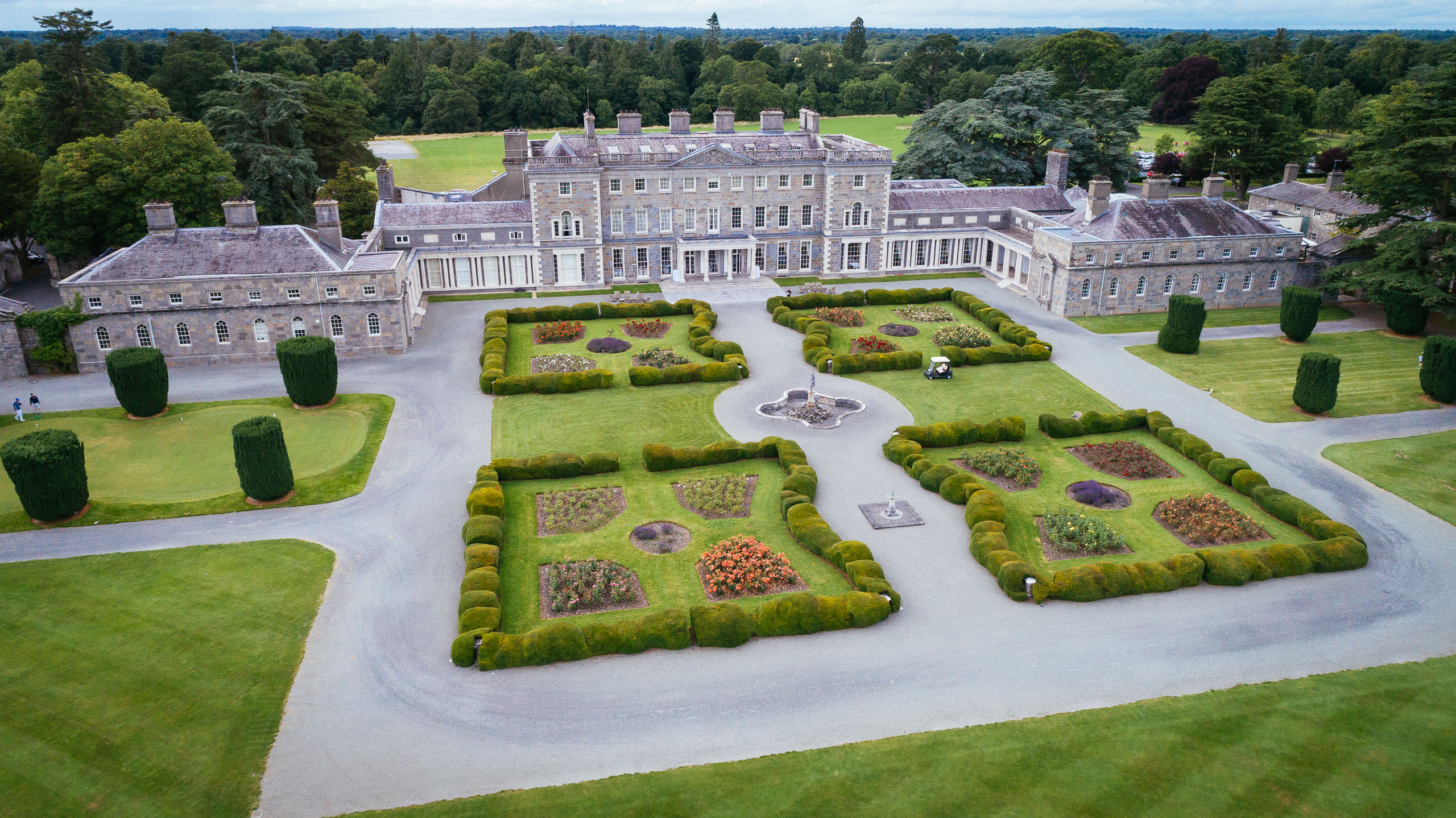
The view is of Carton House, a location very close to where I live and which I blogged about here. The grounds of Carton House are very pleasant for taking recreational walks.

The bird’s-eye view in the painting shows Carton and its demesne before the house was extensively remodelled in the mid-18th Century, although the layout is still recognizable in the modern house:

Th refurbishment of the house was undertaken by architect Richard Castle for the 19th Earl of Kildare between 1739 and 1745. The view in the painting dates from before this change and shows Carton at the centre of an elaborate formal garden. In the foreground, on the southern side of the house, avenues of lime trees radiate outward into the countryside from the enclosed entrance courtyard; on the northern side of the house can be seen a stepped series of walled gardens and terraced walks.

The gardens and demesne were also transformed when the house was rebuilt to reflect mid eighteenth-century taste. More recently the grounds have been turned into golf courses, one to the front and one to the rear as the house itself is now a golfing resort hotel so nothing remains of these extensive gardens.

In the distance to the far left you can see the ruins of the keep of the ancient FitzGerald castle in Maynooth, but St Patrick’s College was not built until the end of the 18th Century and much of the present-day town centre dates from the 19th Century so in those days Maynooth was a small place. The area between the castle and the walls surrounding Carton House demesne is now largely built-up although there is a pleasant tree-lined avenue leading from Maynooth towards the House as far as the Dunboyne Road.

In the right foreground you can see the Prospect Tower built by the Earl of Tyrconnell, which still stands. I always assumed this was some sort of folly but it was apparently intended as a mausoleum for one of the previous owners of the house.

New Publication at the Open Journal of Astrophysics

Posted in OJAp Papers, Open Access, The Universe and Stuff with tags , , , , , on July 7, 2021 by telescoper

Time to announce another publication in the Open Journal of Astrophysics. This one was actually published last Friday, but I didn’t get time to post about it until just now. It is the fifth paper in Volume 4 (2021) and the 36th paper in all.

The latest publication is entitled Gravitational Wave Direct Detection does not Constrain the Tensor Spectral Index at CMB Scales and the author is Will Kinney of the State University of New York at Buffalo (which is SUNY Buffalo, for short).

Here is a screen grab of the overlay which includes the abstract:

You can click on the image to make it larger should you wish to do so. You can find the arXiv version of the paper here. This one is, fairly obviously, in the Cosmology and Nongalactic Astrophysics folder..

Over the last few months I have noticed that it has taken a bit longer to get referee reports on papers and also for authors to complete their revisions. I think that’s probably a consequence of the pandemic and people being generally overworked. We do have a number of papers at various stages of the pipeline, so although we’re a bit behind where we were last year in terms of papers published I think may well catch up in the next month or two.

I’ll end with a reminder to prospective authors that the OJA  now has the facility to include supplementary files (e.g. code or data sets) along with the papers we publish. If any existing authors (i.e. of papers we have already published) would like us to add supplementary files retrospectively then please contact us with a request!

Interaction in Lectures

Posted in Biographical, Education on July 6, 2021 by telescoper

There’s been dismay among many students at the University of Manchester at the news that said institution is planning to keep lectures online next year. If the reason for that decision were that campuses are likely to be closed again by September then I would consider it wise, but it seems this is to be a permanent thing; see the following excerpt.

The clear assumption here is that large lectures never involve interaction. I can think of many colleagues besides myself who would object to that most strongly. Even in a big lecture hall interaction is key to the learning experience. The thing the above statement misses entirely is the extent to which the presence of an audience actually helps the lecturer to improve the learning experience for the students. It’s astonishing to me that the person quoted above seems to think interaction only happens in one direction! On the contrary, a lecture is – or should be – a shared experience between lecturer and students.

If you think about it is a very strange situation when someone stands up in front of a bunch of students and lectures at them for an hour or more. I frequently have the best part of a 100 people watching, and occasionally listening to, me drone on about something or other. What’s strange is that all those people see basically the same thing, whereas the lecturer gets to see all their different facial expressions, at least the lecturer can when the lecture is in person not online with everyone’s video muted.

I’m one of those people who finds it very difficult to give a lecture without looking at the audience, which is why I’ve found the transition to online teaching so difficult. It’s partly to try to establish some kind of rapport with them, notably in order to encourage them to answer when I ask a question or to offer questions of their own, but also to try to figure out whether anyone at all is following what I’m saying. Not all students are helpful in this regard, but some have very responsive mannerisms, nodding when they understand and frowning when they don’t. When I’m teaching a class for the first time I usually look around a lot in an attempt to identify those students who are likely to help me gauge how well things are going. Usually,  there are only a few barometers like this but I would be lost without them. Fortunately most students seem to sit in the same place in the theatre for each lecture so you can usually locate the useful ones fairly easily, with a discreet look around before you  start.

Most other students seem to have a default lecture face.  The expressions range from a perpetual scowl to a vacant smile (each of which is in its own way a bit scary). There’s the “wish I wasn’t here” face of pure boredom,  not to mention those who are fast asleep; I don’t mind them as long as they don’t snore. There’s the Bookface of someone who’s not listening but messing around on Facebook, and the inscrutable ones whose faces are masks, even when not literally wearing a mask, yielding no clues as to what, if anything, is going on behind. The brightest students often seem to belong to the last group, although I haven’t done a statistical study of this so that must be taken as purely anecdotal.

Anyway, by way of a bit of audience participation if you can be bothered, here’s a poll. If you don’t know what your own lecture face is, then you could always ask, that is if you’re one of the lucky folks who’s actually been in a lecture at all as opposed to sitting in your room watching a recording.

Reasons for Optimism

Posted in Biographical, Covid-19, Education with tags , , , , , , on July 6, 2021 by telescoper

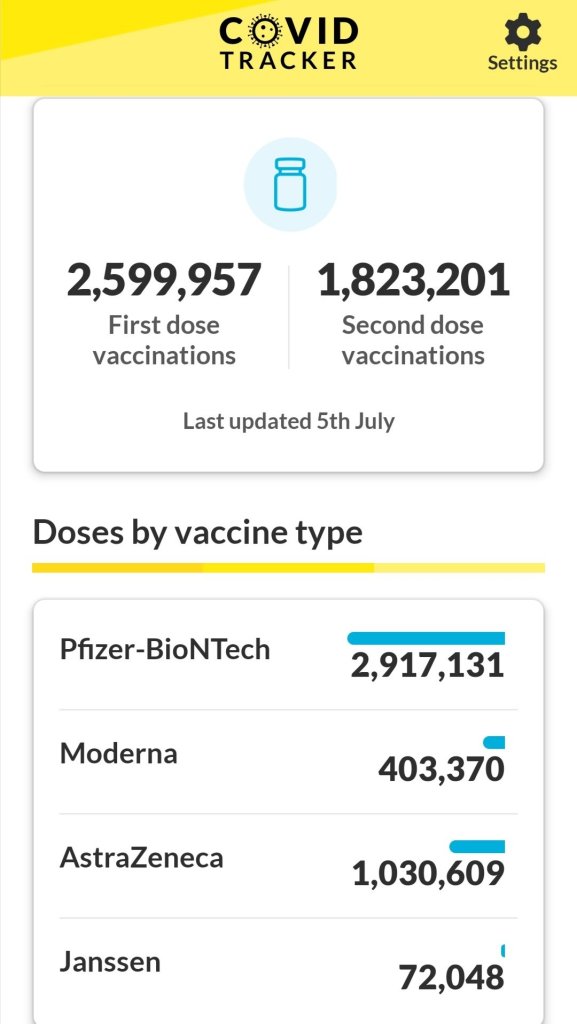
After an interruption of almost two months because of a Cyberattack on the Health Service Executive’s computer system, daily updates of Ireland’s vaccination statistics have at last resumed, including via the Covid-19 app (which has been moribund since 11th May).

You might think it strange but I find the restoration of daily updates reassuring. I suppose it’s because I work in a quantitative discipline but I like having things expressed in figures, though I am of course aware of their uncertainties and other problems involved in interpreting them.

The latest figures above show that about 70% of the adult population has received at least one dose while about 50% have had two doses; the latter are regarded as “fully” vaccinated as are the smaller number who have received the one-shot Janssen vaccine produced by Johnson & Johnson. Although the Government missed by some margin its target of giving one dose to 82% of the adult population by the end of June, I find myself much more optimistic than in past few weeks about how things are going.

Two developments in particular have helped.

First the Government is set to purchase about a million doses of Pfizer/BioNTech from Romania. That would be enough to fully vaccinated about 10% of the population. These doses have become available because take-up in Romania is very poor and the shots would go to waste if not disposed of elsewhere. What’s bad news for Romania is, however, good news for Ireland.

The second change is that the Government has decided to allow the AstraZeneca and Janssen vaccines to be used on adults in the age range 18-34 and that vaccinations of this group are now being carried out by pharmacists. Previously these vaccines were only to be given to persons aged 50 and over. Indications are that there is some reluctance among the younger cohort, which is hardly surprising since it was only a few weeks ago that they were being told these vaccines were too risky, but I suspect this change will go a long way towards fully vaccinating the adult population, which may be possible by the end of August.

I regard the immunization of students next year’s intake to third level education institutions as a necessary condition for opening up campuses to something like “normal” teaching. Just a couple of months ago I didn’t think this would be possible, but now it might be. It’s still possible that there will be disruptions in supply but it’s looking reasonably good at the moment based on the arithmetic of how many doses are available.

The fly in the ointment is of course the so-called Delta Variant, which has already gained a foothold in Ireland and is set to cause case numbers to rise substantially. We will soon see whether this causes an increase in hospitalizations and deaths. The most vulnerable should be protected so the probability of a case turning into serious illness or death should be much lower, but we don’t know by how much. Unfortunately the statistics of Covid-19 are still not being reported publicly. Some people seem to think this means they’re not happening. It doesn’t. It just means the system for reporting them is not working. I expect the forthcoming announcement of the backlog will cause some alarm.

The Irish Government recently decided to pause the gradual reopening of the economy to allow vaccinations to proceed further. There is still a race between the Delta variant and the vaccination programme. The number of people vaccinated increases approximately linearly with time, while the number of Covid-19 cases grows exponentially in the growth phase of the pandemic. I think the pause was sensible.

Across the Irish Sea there is a different situation. The English Government has decided to abandon all attempts to control the spread of Covid-19 at precisely the point when the pandemic is in another exponential phase. The number of cases is now likely to increase dramatically. The number of resulting deaths may be fewer than in previous waves but won’t be zero. Perhaps more importantly, allowing a huge pool of virus to develop increases the chance of yet another variant evolving, perhaps one that can evade the defences afforded by vaccination even more effectively than the Delta variant. I shudder to think of the consequences if that does happen. Perhaps it already has.

The Fourth of July – Charles Ives

Posted in Music with tags , , , , on July 5, 2021 by telescoper

I’m a day late posting this, but I only thought of it this morning. It’s a fine performance by the New York Philharmonic conducted by Leonard Bernstein of “The Fourth of July”, the third movement of his “Holidays Symphony” by the great Charles Ives. The video even shows the score so you can play along at home! As Ives himself famously said:

Stand up and take your dissonance like a man!

On LinkedIn

Posted in Science Politics, The Universe and Stuff with tags , , , , on July 4, 2021 by telescoper

A former colleague recently contacted me with a request to join my “network” on LinkedIn.  That was quite hard to do as (at least until this morning) I was not on LinkedIn. That reminded me of a talk at INAM2019 a couple of years ago about the Astronomical Society of Ireland  which was about to be re-launched with a new website. One of the main reasons for doing this is that Ireland recently joined the European Southern Observatory and in order to capitalize on its involvement it is important to persuade the Irish government to invest in the resources needed (especially postdocs, etc) to do as much science as possible using ESO facilities. The idea was to improve the lobbying power for astronomy in Ireland. One of the suggestions made yesterday was that astronomers in Ireland should join LinkedIn in order to raise their profile individually and collectively.

I was not on LinkedIn at the time and didn’t get around to joining it mainly because I’ve always thought it was more for businessy types than academics. Anyway, in the light of recent events I decided it couldn’t do any harm to bite the bullet and set up a LinkedIn profile, which you can find here. It’s really a rather basic profile but I think I’ve set it up so that posts from here will be posted to LinkedIn too, so if you’re on it yourself you might want to add me. Or not. It’s up to you!

P.S. The only thing I have put under “Awards and Honours” is Winner of Beard of Ireland 2020.

Stepping Down

Posted in Biographical, Education, Maynooth on July 3, 2021 by telescoper

I was planning to be on leave now; I intended to make up for the fact that I didn’t get a summer holiday last year by taking most of July off. Unfortunately that was not to be and I have to stay at work for at least another week to participate in an interview panel. I may still get a couple of weeks after that but if I do it will be taken up with organizing the move of the rest of my belongings from Cardiff to Maynooth, rather than being an actual holiday.

Over the last few days, in an exhausted and demoralized state, I have been looking back over the best part of two years I have been Head of the Department of Theoretical Physics at Maynooth University – most of which has coincided with the Covid-19 pandemic. Frankly, I have found the burden of administration on top of the heavy teaching load required of me to be unmanageable. Because we are a very small Department teaching a full degree course, all of us have to teach many more modules than is reasonable for for staff who are expected to do research as well. I had to teach five modules* last academic year; that would have been bad enough even without having to do everything online and without the additional and frequently onerous duties associated with the Head of Department. There is no prospect of that burden decreasing for the foreseeable future.

I was appointed as Head of Department for three years, but last week I asked the University to let me step down from my role as Head of Department of Theoretical Physics from the end of September 2021, a year early. I’ll carry on as a Professor, hopefully with some time to do research, although my teaching duties will undoubtedly remain heavy.

At least now, if I do get some holiday this summer I’ll be spared some of the dread of what I’ll have to return to afterwards…

*For those who are wondering, two of those modules are 36 lectures (3 per week for a 12-week semester), two are 24 lectures (two per week for a semester) and one is computer-based (1 lecture + a 2hr lab session per week for a semester). That load is about average for full-time staff in the Department; if I did less someone else would have to do more.

UPDATE: 6th July. The University has agreed to my request. “Freedom Day” for me is October 1st 2021.

Hubble Tension – The Plot Thickens

Posted in The Universe and Stuff with tags , , , on July 2, 2021 by telescoper

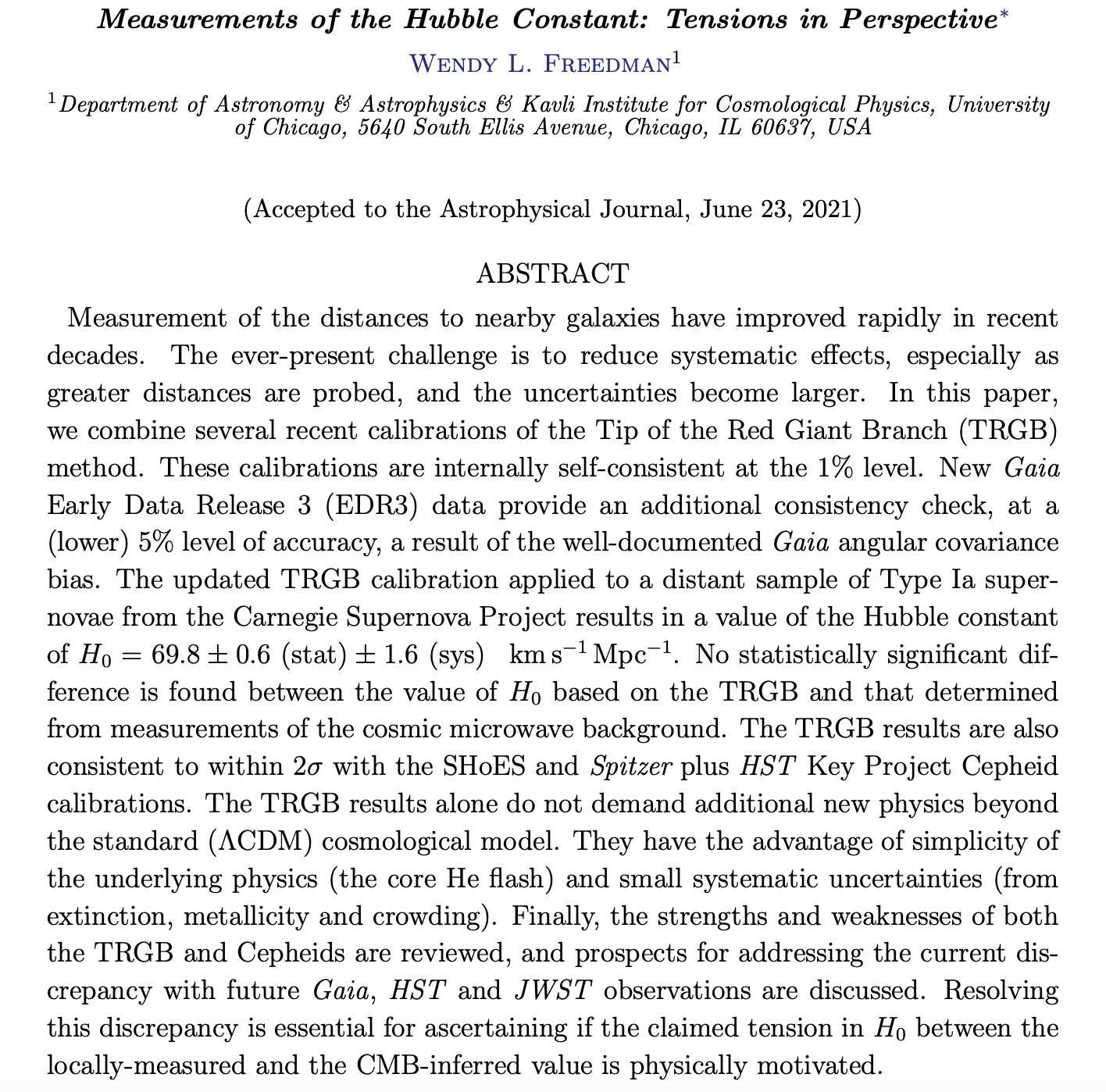
One topic on this blog seems to be as perennial as the weeds in my garden: the so-called Hubble Tension. I just saw a review paper by Wendy Freedman, one of the acknowedged experts in this area, on arXiv here. I have abstracted the abstract here:

You can find the PDF here.

What’s particularly interesting about this discussion is that stellar distance indicators have typically produced higher values than the 69.8 ± 0.6 (stat) ± 1.6 (sys) km s-1 Mpc-1 quoted here, which is consistent with the lower value favoured by Planck. See the above graphic discussed here. So perhaps there’s no tension at all. Maybe.

Anyway, here’s that poll again! I wonder if this paper might change the voting.