Cosmology Talks: Volker Springel on GADGET-4

Posted in The Universe and Stuff with tags , , , , , , , on May 18, 2021 by telescoper

It’s time I shared another one of those interesting cosmology talks on the Youtube channel curated by Shaun Hotchkiss. This channel features technical talks rather than popular expositions so it won’t be everyone’s cup of tea but for those seriously interested in cosmology at a research level they should prove interesting.

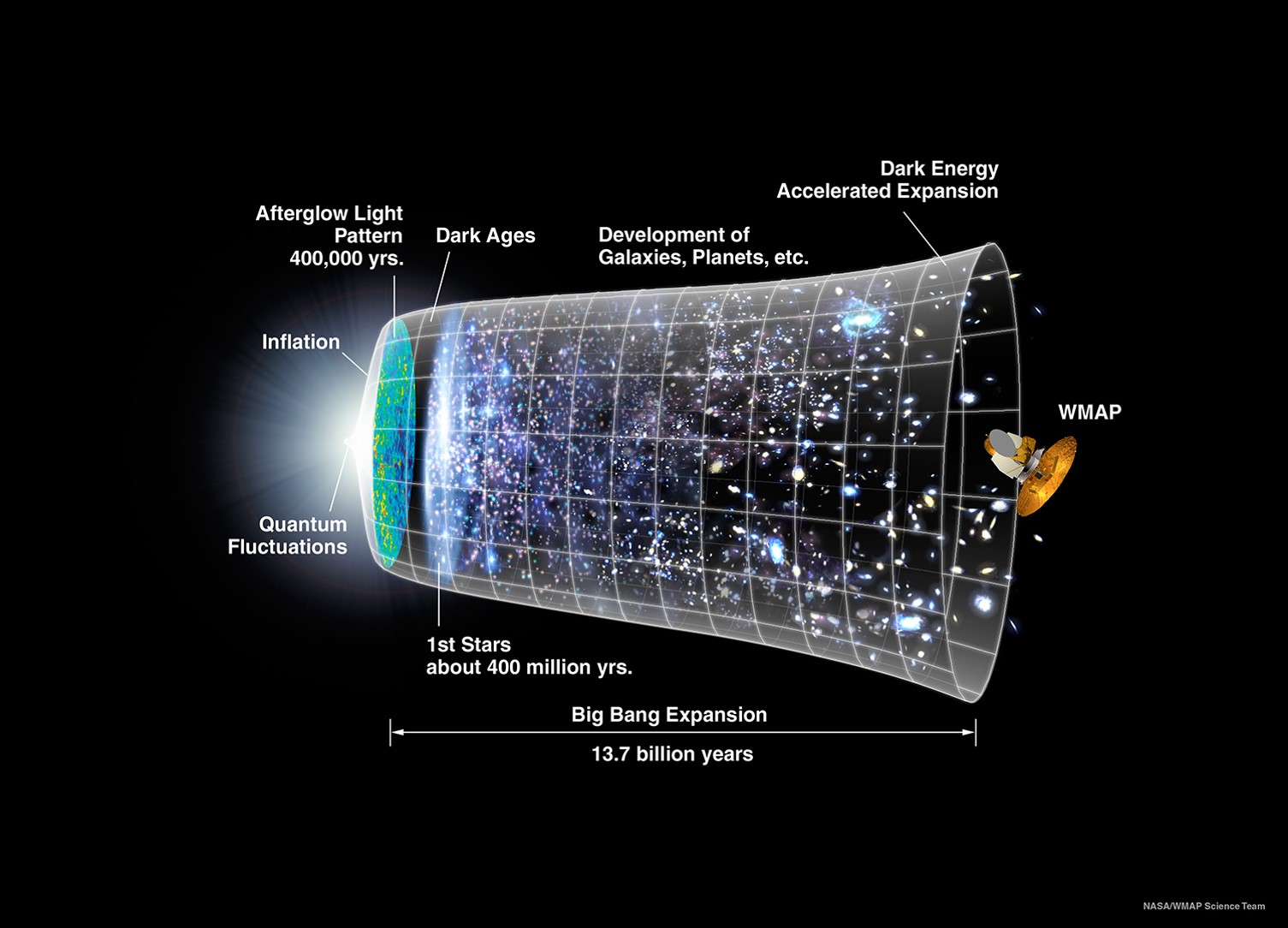
In this talk from a couple of months ago  Volker Springel discusses Gadget-4 which is a parallel computational code that combines cosmological N-body and SPH code and is intended for simulations of cosmic structure formation and calculations relevant for galaxy evolution and galactic dynamics.

The predecessor of GADGET-2 is probably the most used computational code in cosmology; this talk discusses what new ideas are implemented in GADGET-4 to improve on the earlier version and what new features it has.  Volker also explains what happened to GADGET-3!

The paper describing Gadget-4 can be found here.


International Day against Homophobia, Biphobia and Transphobia

Posted in LGBTQ+ on May 17, 2021 by telescoper

Today is May 17th which means that it is International Day Against Homophobia Transphobia and Biphobia.

If you need reasons why such a day is still necessary then you can look here.

Normal services will be resumed as soon as possible…

Posted in Biographical, Covid-19 with tags , , , on May 16, 2021 by telescoper

After posting updates about Ireland’s Covid-19 situation every single day since the end of March 2020 – a total of 441 entries so far – I’ve been forced to pause. The reason is that a “significant ransomware attack” has crippled many of the computer systems of the Health Service Executive and while it is being dealt with, no data on Covid-19 (including vaccinations) are being published. As far as I understand it, testing and vaccination are going on as before, but we will have to wait until systems are restored before announcements will resume and backdated data is published.

When the dust settles on this I’m pretty sure the inevitable investigation will reveal that the HSE has been using outdated IT hardware and software that made it much easier for the cybercriminals than it should have been.  The disruption is of course extremely annoying but there is a real possibility that the cancellation of urgent medical procedures may lead to loss of life. I sincerely hope the perpetrators are caught and subjected to the full force of the law.

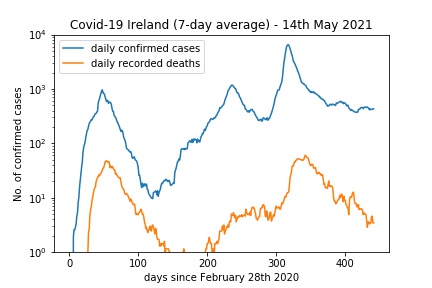
Meanwhile, out of interest, here is my latest summary plot (dated 14th May) which shows new cases steady at the (uncomfortably) high level of around 430 per day (7-day average) but deaths falling:

It is reasonable to infer that the combination of falling mortality figures and constant infection rates is attributable to the vaccination most people in the groups most at risk.

Last Monday (10th May) saw various relaxations of the current restrictions around Covid-19 and tomorrow there will be further loosening. In particular all remaining “non-essential” shops will open. This won’t make much difference to me personally as I shall be locked down marking examinations for at least the next fortnight.

I don’t think the cyber attack will affect the timing of my second vaccine dose, which is due in early June, but that remains to be seen.

I’m Old Fashioned – Curtis Fuller

Posted in Jazz with tags , , , , on May 15, 2021 by telescoper

Saddened to hear of the death last week of the great Jazz trombonist Curtis Fuller I’ve been thinking of an appropriate track to play. Fuller had a long and distinguished career alongside many great artists which makes it difficult to pick just one track as a tribute, but as so often is the case I found myself gravitating back to the late 1950s which I think is probably my favourite period in Jazz history.

Thus I settled on a track from the studio album Blue Train recorded in 1957 by a sextet led by John Coltrane and featuring Curtis Fuller (trombone) and Lee Morgan (trumpet) with Kenny Drew on piano, Paul Chambers (bass) and Philly Joe Jones on drums. It’s a superb album which is a must-have for any serious collector of this music. I thought I had already posted a track from this album on here, actually, but apparently I haven’t.

John Coltrane is now an established as one of the leading figures in the development of modern Jazz but this record is a reminder that he achieved recognition somewhat later in his life than many other soloists. At 31, he wasn’t exactly old when this album was recorded in 1957 but he was certainly no newcomer either. Obviously it took him a while to find his voice. By contrast the trumpeter Lee Morgan was, astonishingly, only 19 when this record was made; Curtis Fuller was in his mid-twenties.

Everyone plays beautifully on all the tracks on this album, and the blend of trumpet tenor sax and trombone in the ensemble gives this band a very distinctive sound, but I’ve picked a track on which Curtis Fuller really excels as a soloist. The rest of the tunes being based on the blues, this is actually the only ballad on the album, written by Jerome Kern and Johnny Mercer, and called I’m Old Fashioned

R.I.P. Curtis Fuller (1932-2021)

Analysis of Diverse Perversities

Posted in Art with tags , , on May 14, 2021 by telescoper

by Paul Klee (1879-1940), painted in 1922, 24cm x 31cm, pen and watercolour on paper.

Remote Exam Time Again

Posted in Education, Maynooth with tags , , , on May 14, 2021 by telescoper

It’s Friday 14th May 2021 which means that it’s the first day of the Summer examination period here in Maynooth, so let me begin by sending my best wishes to everyone taking examinations today and over the next few weeks, wherever you are. It’s a lovely morning in Maynooth. It seems to be a law of Nature that examinations always take place when the weather outside is nice.

For readers elsewhere in the world, full-time undergraduate students at Maynooth what is called 60 “credits” in a year, usually split into two semesters of thirty credits each. This is usually split into 5-credit modules with an examination in each module at the end of each semester. Projects, and other continuously-assessed work do not involve a written examination, but the system means that a typical student will have at least 5 written examination papers in January and at least another 5 in May.  This is very similar to the system in most UK universities that I am aware of except that a full year’s work over there is 120 credits so there’s a conversion factor of 2:1. A 5-credit module in Ireland would be a 10-credit module in the United Kingdom, for example, but otherwise the system is similar.

Each examination is usually of two hours’ duration. We’ve kept that length after moving examinations online, although students are given extra time to scan and upload their answers. The question papers themselves have been slightly adapted online use by having much less “bookwork”. Generally these assessments are unsupervised and students are allowed to consult notes and textbooks so there is little point in asking them to copy out standard derivations and formulae. That means we can concentrate on the problem-solving aspects of theoretical physics, which are the most interesting bits (and perhaps the most challenging).

One big difference between our examinations in Theoretical Physics in Maynooth and those at other institutions I’ve taught at in the UK is that most of the papers here offer no choice of questions to be answered. Elsewhere  it is quite common to find a choice of two or three questions from four or five on the paper.

One  advantage of our system is that it makes it much harder for students to question-spot in the hope that they can get a good grade by only revising a fraction of the syllabus. If they’re well designed, two long questions can cover quite a lot of the syllabus for a module, which they have to in order to test all the learning outcomes. To accomplish this, questions can be split into parts that may be linked to each other to a greater or lesser extent to explore the connections between different ideas, but also sufficiently separate that a student who can’t do one part can still have a go at others. With such a paper, however, it is a  dangerous strategy for a student to focus only on selected parts of the material in order to pass.

As an examiner, the Maynooth style of examination also has the advantage that you don’t have to worry too much if one question turns out to be harder than the others. That can matter if different students attempt different questions, but not if everyone has to do everything.

But it’s not just the number of questions that’s important, it’s the duration. I’ve never felt that it was even remotely sensible for undergraduate physics examinations to be a speed test, which was often the case when I was a student. Why the need for time pressure? It’s better to be correct than to be fast, I think. I always try to set examination questions that could be done inside two hours by a student who knew the material, including plenty of time for checking so that even a student who made a mistake would have time to correct it and get the right answer. If a student does poorly in this style of examination it will be because they haven’t prepared well enough rather than because they weren’t fast enough.

My first examination is this afternoon. The subject is (3rd Year) Computational Physics. This is an unusual module as a majority of the marks (60%) come from continuous assessment in the form of four class tests (20% altogether) and a mini-project (40%). The exam is a theory paper concerned with such topics as accuracy and stability. There are two questions on the paper, both of them compulsory. Next week there is my (4th year) Advanced Electromagnetism paper with four questions, again all compulsory. Obviously I’ll have to wait to see how the students do.

In the meantime here are some tips for students

  1. Try to get a good night’s sleep before the examination!
  2. Be ready well before the start and try to ensure you won’t be disturbed for the duration.
  3. If you’re doing an unsupervised examination, download the paper and any supplementary material needed  at the start to avoid problems if you get disconnected.
  4. Read the entire paper before starting to answer any questions. In particular, make sure you are aware of any supplementary information, formulae, etc, given in the rubric or at the end.
  5. Start off by tackling the question you are most confident about answering, even if it’s not Question 1. This will help settle any nerves.
  6. Don’t rush! Students often lose marks by making careless errors. Check all your numerical results on your calculator at least twice and remember to put the units!
  7. Show your working! Especially in an unsupervised examination you need to convince the examiner that you actually did the problem rather than looking up the answer on the net somewhere.
  8. Don’t panic! You’re not expected to answer everything perfectly. A first-class mark is anything over 70%, so don’t worry if there are bits you can’t do. If you get stuck on a part of a question, don’t waste too much time on it (especially if it’s just a few marks). Just leave it and move on. You can always come back to it later.
  9. Try to finish the paper at the assigned time, i.e. use the upload time for uploading rather than doing more work. There is always the chance that you might run out of time for upload if you’re rushing right at the end.
  10. If you’re scanning and uploading answers, check that you have submitted everything you intended to. I have had several examples of missing pages over the last year…

Anyway, once again, good luck and best wishes!

The Affair of the Missing Trophy

Posted in Covid-19, Crosswords with tags , , on May 13, 2021 by telescoper

A few weeks ago I posted about my first ever First Prize in the Azed Crossword Competition. At the end of that post I mentioned that I was eagerly anticipating being sent a silver trophy called the Azed Instant Victor Verborum Cup to hold for a month before passing it on to the winner of the next competition.

Unfortunately it seems that, owing to a combination of the Royal Mail and Covid-19, the Azed trophy has gone missing somewhere on its travels. In fact it hasn’t even reached the winner before me (a Dr S.J. Shaw) yet. The chances of it being located, retrieved and then sent to me before it would be time to send it on to the next winner are now remote so I don’t suppose I’ll ever get my hands on it. Ho hum.

Still, I did get a nice card from Dr Shaw explaining the situation and sending his congratulations:

I hope the trophy is found because it would be a shame if the tradition of passing it on came to an end, but it’s not such a big deal that I’ll miss out on having it on my mantelpiece for a few weeks. At least it absolves me of the responsibility of ensuring it reaches the next winner…

What is the Standard Cosmological Model?

Posted in The Universe and Stuff with tags , , , , on May 12, 2021 by telescoper

There’s a nice little paper – a summary of a talk – by Eric Linder on the arXiv here. The abstract is:

Reports of “cosmology in crisis” are in vogue, but as Mark Twain said, “the report of my death was an exaggeration”. We explore what we might actually mean by the standard cosmological model, how tensions – or their apparent resolutions – might arise from too narrow a view, and why looking at the big picture is so essential. This is based on the seminar “All Cosmology, All the Time”.

You can find a PDF here.

The paper discusses not only the question “what is the standard cosmological model?” in a fairly general way but also the more basic question “what is cosmology?” I’d think you’d be surprised how different would be the answers to that question from different cosmologists!

Anyway, I usually say when I give talks that the following are the six main ingredients of the standard model:

  1. General Relativity
  2. The Cosmological Principle
  3. Cold Dark Matter
  4. Cosmological Constant
  5. Primordial (nearly) Gaussian adiabatic fluctuations
  6. Inflation in the very early Universe

There are other ingredients of course, such as baryons and neutrinos but I don’t include them in a model because I feel one should distinguish at some level between the ingredients of a model and the  ingredients of the actual Universe. What I mean by that is that we know baryons exist (though we may not know their cosmic abundance precisely) but we don’t know for sure whether Cold Dark Matter exists.

Note that (1) isn’t really a model because it has no free parameters: it’s only when you add (2) that it comes a FLRW model with e.g. the curvature as a free parameter, and some assumed form of the energy-momentum tensor. The other ingredients have one or more free parameters, e.g. the density of CDM (3) and the value of Λ (4); these can be made more flexible by including, e.g., a dark energy term with equation of state w. Ingredient (5) needs the user to specify an initial power spectrum, which is at least two parameters (amplitude and slope), which may or may not be motivated by (6).

Anyway, the following items in the above list are – to a greater or lesser extent – open to question:

  1. General Relativity
  2. The Cosmological Principle
  3. Cold Dark Matter
  4. Cosmological Constant
  5. Primordial (nearly) Gaussian adiabatic fluctuations
  6. Inflation in the very early Universe

We’d be unwise to question only, e.g., 3 or 4 while ignoring the possibility that we may be wrong about the others!


Ceci n’est pas un restaurant

Posted in Biographical with tags , on May 11, 2021 by telescoper

If you are among the several people who follow this blog on my Facebook Page then I apologize for any confusion caused by the fact that Facebook appears to have decided that I am a restaurant:

I wish to point out for the record that I am not a restaurant and therefore am not available at any time for delivery, and only in certain circumstances for pick-up.

I hope this clarifies the situation.

Mark Zuckerberg is 36.

First Shot of Comirnaty!

Posted in Biographical, Covid-19 on May 11, 2021 by telescoper

So here I am, then, back home from the CityWest Convention Centre where I had my first shot of the Pfizer-BioNTech vaccine, which is actually called Comirnaty. The vaccination centre was very busy (with parking quite a long way from it) so it took a little longer than anticipated to get in and out, but only by 45 minutes instead of the expected 30 so nothing at all to complain about.

They don’t allow photography inside the place, which is a huge theatre/auditorium, though only the floor space is used for this purpose. There was quite a lot of queueing: first for an ID check, then to register, then to get the jab. The lady in front of me in the queue said it was like Ryanair, but it rather reminded me of one of those laboratory experiments with rats. Most people were very relaxed and happy to chat while waiting, but one or two seemed very anxious. That had probably been anticipated and there were friendly faces on hand to help calm people down if there were signs of distress. Not everyone likes crowds and not everyone likes needles, and no doubt for some the combination of the two is especially difficult.

Quite a lot of the people running the show were members of the Irish Defence Forces, including the guy who gave me my jab. After that I adjourned to the crossword-solving area for the mandatory 15 minutes of observation, before heading out and back to the car for my lift back home.

So there I am, phase one complete. No side effects so far but it’s too early for that just now anyway. Thanks to all the on-site staff – many of whom are volunteers – for being so friendly and well-organized. See you again in due course for the second shot!

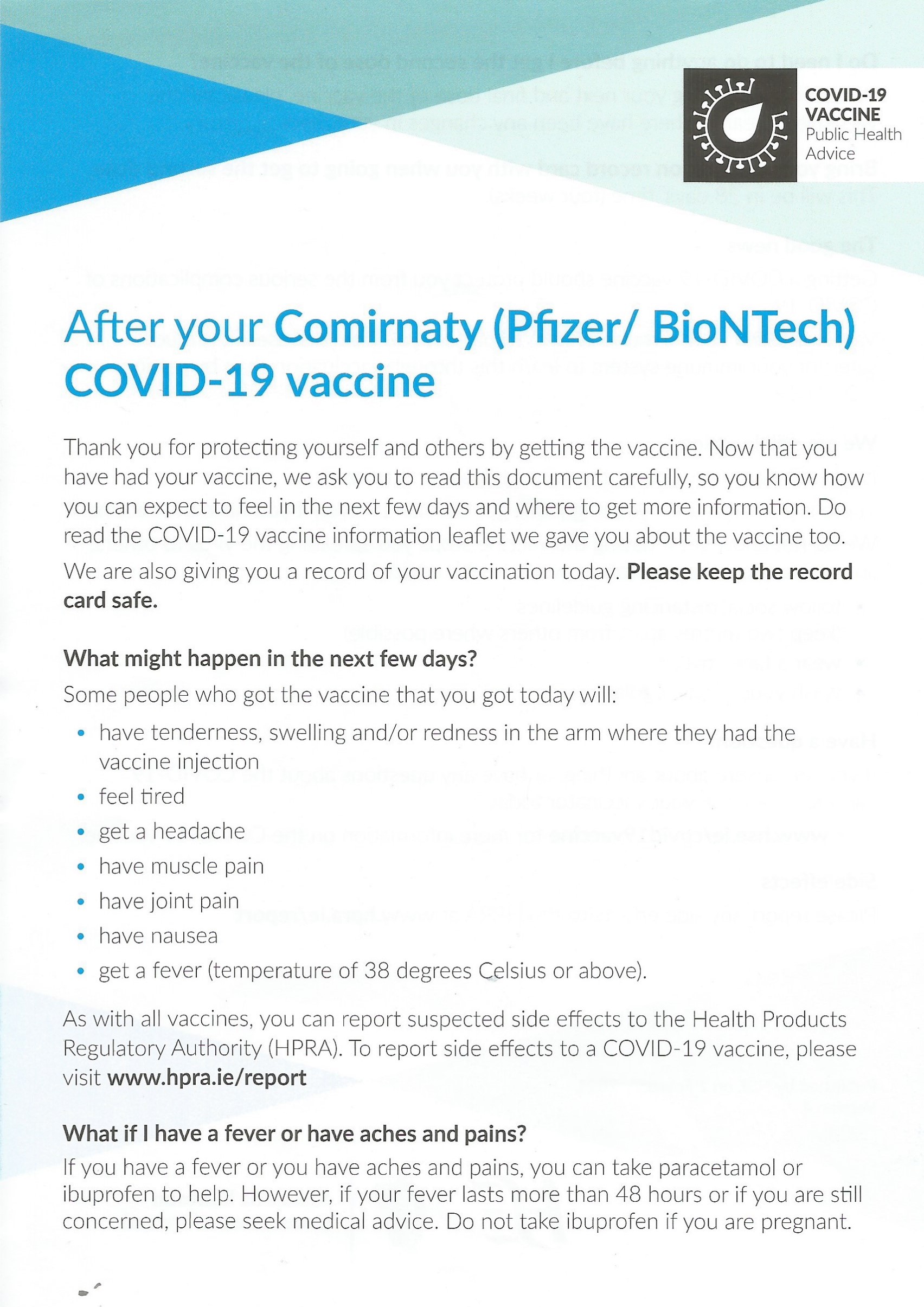
UPDATE: 12th May 2021. It’s now 24 hours since my first dose and thankfully I can report no ill effects whatsoever. The leaflet I’ve got does say that a reaction is more likely after the second dose than the first, but so far so good!