Name Change Policy at the Open Journal of Astrophysics

Posted in LGBTQ+, Open Access with tags , on April 27, 2021 by telescoper

This lunchtime I took a bit of time out to complete a task that has been on my to-do list for some time. It has been announced in a blog post at the Open Journal of Astrophysics.

The recent announcement by arXiv of a name change policy has enabled the Open Journal of Astrophysics to introduce a policy of its own concerning author name changes. The aim of such a policy is to reduce barriers to changing public records and online identity, thereby fostering diversity and promoting inclusivity. The changes announced follow recommendations by the Committee On Publication Ethics (COPE).

Since the Open Journal of Astrophysics is an arXiv overlay journal which is totally dependent on the arXiv platform we had to wait until arXiv announced its policy before following it with one of our own, which were recently able to do.

The arXiv now allows the following options:

  1. In full text works: the author name can be changed in the PDF and/or LaTeX source where it appears in the author list, acknowledgments, and email address.
  2. In metadata: the name and email address can be changed in the author list metadata and in the submission history metadata for all existing versions.
  3. In user accounts: the name, username, and email address can all be changed.

The arXiv policy notes, however, that

We are not currently able to support name changes in references and citations of works. Also, arXiv cannot make changes to other services, including third party search and discovery tools that may display author lists for papers on arXiv.

Since the Open Journal of Astrophysics deposits author metadata for all our papers with the Crossref system we can plug this gap by undertaking to redeposit all necessary information to reflect author name changes. Since author metadata is attached to the DOI we issue, this will ensure that citations and references tracked through this system are updated when an author changes their name.

If any author of a paper published in the Open Journal of Astrophysics wishes to make use of this policy the best procedure is to first contact the arXiv under their policy. Once any changes have been made to the arXiv submission the author should contact us with a request. We will then make any necessary changes to the overlay on the Open Journal of Astrophysics site and redeposit amended metadata to Crossref free of charge. We also undertake to ensure entries are updated at the NASA/ADS system.

Following the guidance from COPE the Open Journal of Astrophysics will neither seek permission from nor inform co-authors of any such change.

A list of other journals/publishers and their name change policies can be found here.

The State of the Universe Talk

Posted in Biographical, Books, Talks and Reviews, Talks and Reviews, The Universe and Stuff on April 26, 2021 by telescoper

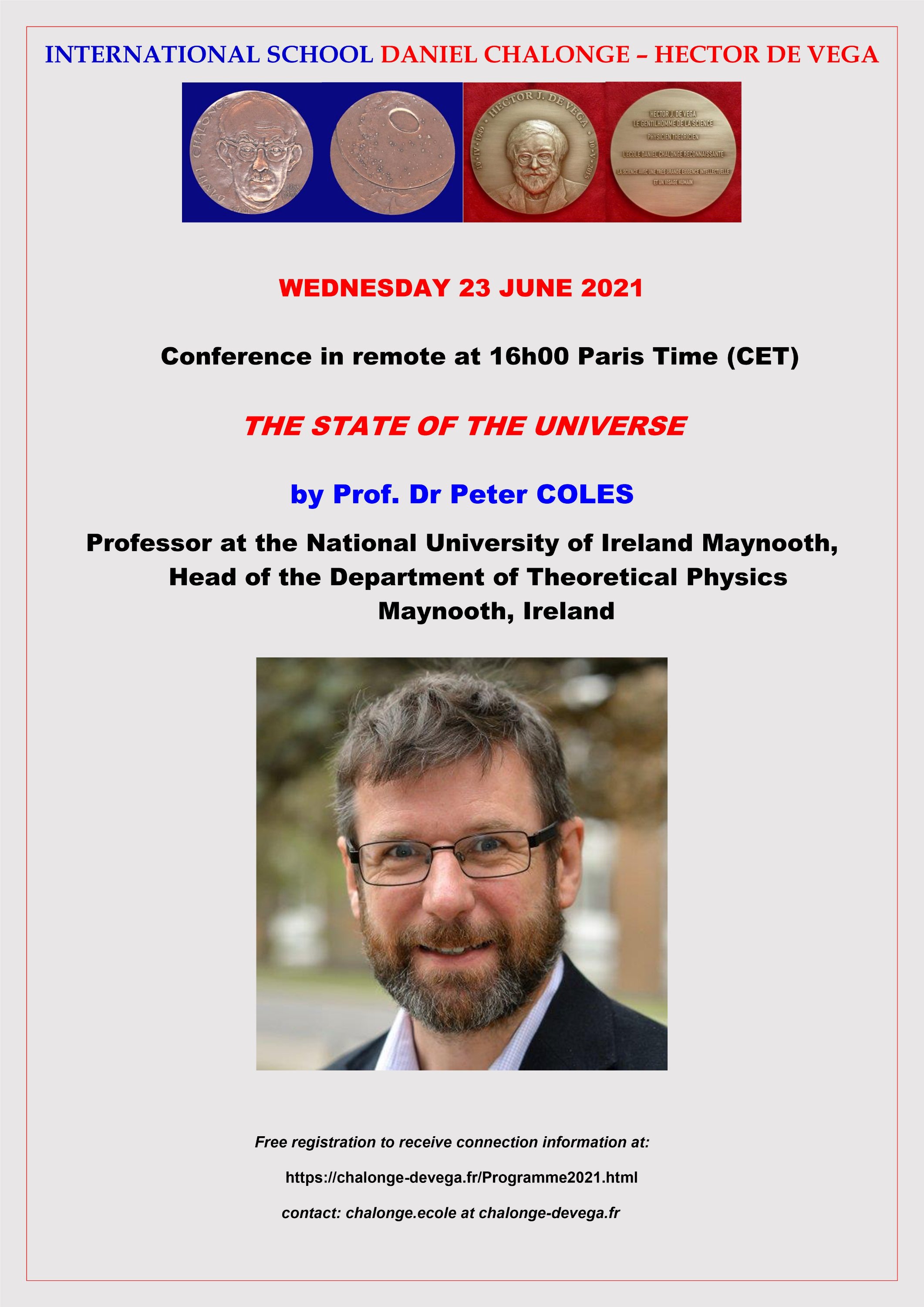
When I saw the calibre of the other speakers in the Chalonge – De Vega Series organized by Norma Sanchez- including a number of Nobel Laureates – it was with some trepidation that I accepted the invitation to give a Colloquium, but there we are. I’m on the list. If you want to attend the Colloquium (via Zoom) you can register for it here. This series was originally named after Daniel Chalonge but was renamed to honour Hector de Vega, who sadly passed away in 2015.

I used to get invited quite often to the famous Norma Sanchez Schools and Conferences in Paris and Sicily (both Erice and Palermo) but then, about a year ago. I was suddenly stopped receiving invitations. I gather that a number of other colleagues have also been abruptly “cancelled” over the years. Anyway it seems I’m back on the list, at least virtually, possibly owing to some form of administrative error.

I remember one year in Erice at the end of a talk I gave (in the OHP/Transparency era) Norma Sanchez, who was meant to be chairing the questions and discussion started writing on my transparencies, crossing out the word “theory” and replacing it with “model”. That event made quite an impression on the audience who thought it was hilarious and people who were there often remind me of it. Coincidentally, I thought of that event when I wrote Saturday’s post. Since the forthcoming colloquium is via Zoom I think I’ll be safe from any such intervention this time.

A First in Azed

Posted in Biographical, Crosswords with tags , , , , on April 25, 2021 by telescoper

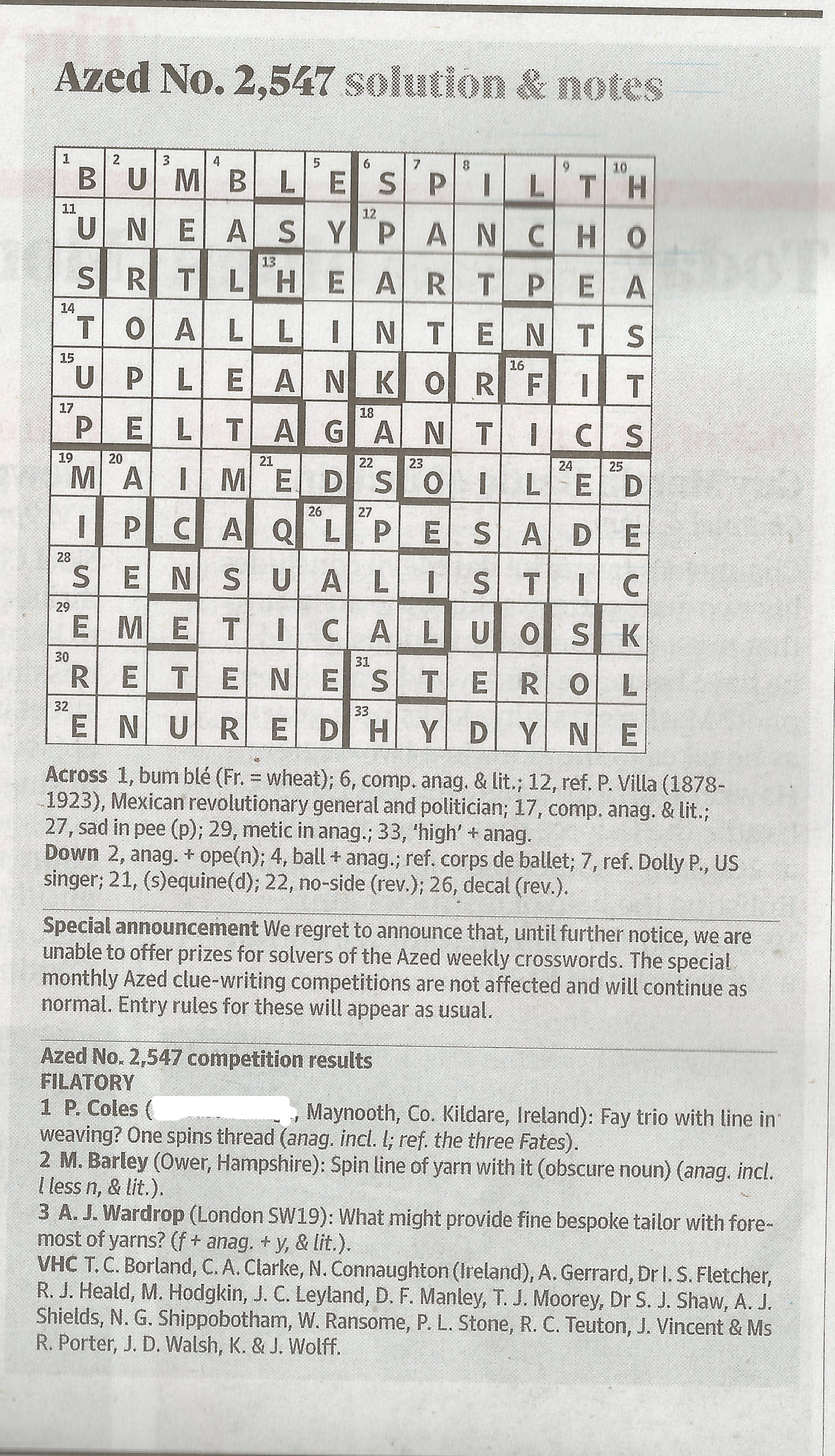
I was roused from my Sunday-morning lie-in by the news that I had actually won First Prize in the latest Azed Competition. The best I’ve done previously was third place, and that was almost a decade ago!

As I’ve mentioned before, the monthly Azed Competition puzzle involves not only solving the Azed crossword but also supplying a cryptic clue for a word or phrase given only as a definition in the crossword. This competition is tough, partly because Azed is a stickler for syntactical soundness in submitted clues, and partly because many of the competitors are professional crossword setters.

I’ve struggled this year to find the time and the energy to make a decent attempt at the Azed competition, but the latest competition puzzle was published on Easter Sunday so I had Easter Monday to think about it. Solving the actual puzzle wasn’t too hard this time, which gave me plenty of time to work on the harder bit of composing a clue.

The target word was FILATORY (a machine for spinning thread). For some reason the first thing that popped into my mind was Greek Mythology, specifically the Moirai (Fates) who between them weave the tapestry of life, but one of whom, Clotho, spins the thread. I noticed that one can find the letters of TRIO in FILATORY leaving FAY+L. I looked up FAY in the One True Chambers Dictionary where I found that in its meaning as “fairy” is is derived from the Latin Fata. Even better. I just need to find a way of putting an L into the mix but as a standard abbreviation for “line” that wasn’t too hard.

My clue was

Fay trio with line in weaving? One spins thread.

The second part is the definition (a filatory spins thread) whereas the first part is the word play, FAY TRIO with L forms the basis of an anagram, with “weaving” as the anagram indicator (“anagrind”) instructing the solver to form an anagram.

I think the mythological connection between the two parts of the clue lays a false trail that disguises the definition a bit so I was quite pleased with this effort, thinking it might just get a VHC. I was very surprised to find it winning outright and am absolutely delighted!

I’ve expunged the first line of my address from the scan for obvious reasons, though it is there in the newspaper. I presume it is there because the winner of the Azed Competition not only gets a prize in the form of book tokens but is also sent the Azed Instant Victor Verborum Cup to hold for a month before passing it on to the winner of the next competition, when the result of that is announced, in this case about a month from now. The next Competition puzzle is in next week’s Observer, published on May 2nd. The following day is a Bank Holiday in Ireland so I’ll be able to have a good go at that too.

Presumably the trophy will arrive in the post at some point. With the current state of the mail service between Ireland and the UK I only hope it arrives before I have to send it on to the next winner!

Backwards and Forwards in Science

Posted in Biographical, Maynooth, The Universe and Stuff on April 24, 2021 by telescoper

I spent a few hours today involved with our Open Day at Maynooth University, including – as I mentioned here – giving a presentation about Theoretical Physics to complement one about Experimental Physics followed by a couple of hours of Q&A. It was a bit of a shame to be cooped up inside on such a lovely Spring day but we had a lot of interesting questions and it was all quite enjoyable.

One of the things that I tried to stress in my talk is that while there theorists and experimentalists (or observers), real science is about the interplay between the two, which I’ve illustrated in the above diagram which I use sometimes when talking about cosmology though it applies to other disciplines.

We have theoretical models – normally including a set of free parameters which we don’t know how to fix a priori. What we can do though is calculate the consequences if we did know the values of these parameters. That forward calculation is represented by the upward arrow, using theory to predict the result of a measurement. The backward calculation (inverse reasoning) involves using the measurements to infer values for the free parameters; that’s represented by the downward arrow. There’s usually a considerable amount of back-and-forth between theory space and measurement space as scientific knowledge develops. If one version of a model doesn’t fit we can adjust its parameters until it does, then we might need new data to test this iteration. It is only when the theoretical slack is sufficiently tight and freedom to adjust parameters is eliminated or severely restricted can we really test a theoretical idea definitively.

In cosmology we have only a handful of free parameters and this process has worked pretty well in providing a model in which these parameters are tightly constrained by a host of observational results. This is the standard model and although there a “tensions”, most prominently concerning the Hubble Constant, the model has survived very well. The same situation holds for the standard model of particle physics, though there is tension concerning the muon magnetic moment that I blogged about here.

I’ve written quite a lot on this blog about the inverse reasoning step – partly because I think there are many people (even professional scientists) who don’t understand this part very well and partly because cosmology provides a good example of a model with elements that can’t be calculated from first principles.

It struck me this morning, however, in answering a question about the muon magnetic moment that we often tend to assume that the forward calculation is somehow trivial. In fact the theoretical calculation of (g-2) is nothing of the sort: it requires lengthy supercomputer computations before the theory can make a prediction and there is some doubt over whether the current values of the theoretically expected value of the muon dipole moment are correct within the model.

The same issue arises in cosmology. It is not at all easy to calculate, for example, detailed properties of galaxy clustering in a given cosmological model. The forward calculation here uses huge N-body experiments. This is why a very considerable part of the effort being expended in preparation for the European Space Agency’s Euclid mission is on the simulation side.

Both particle physics and cosmology – and no doubt other fields – are thus limited by how well we can do the forward calculation and that is not going to change very soon. Nevertheless it is the interplay between theory and measurement that has driven the progress so far, and it will continue to do so even if it is the case that the more progress we make the harder it gets to go further.

Climate Change Research at Maynooth University

Posted in Maynooth, The Universe and Stuff on April 23, 2021 by telescoper

Did you know that Maynooth University is Ireland’s leading institution for climate change research and teaching? Researchers are internationally recognized and they are working in areas such as climate modelling, investigating severe weather events and their mitigation, right through to examining the social and economic impacts of climate change.

Here’s a little video about it.

Theorists and Experimentalists in Physics

Posted in Education, Maynooth, The Universe and Stuff with tags , , , on April 22, 2021 by telescoper

Regular readers of his blog (Sid and Doris Bonkers) will know that here at Maynooth University there are two Physics departments, one the Department of Theoretical Physics (of which I am a Faculty member) and the other the Department of Experimental Physics. These two units are in the same building but have so far have been largely separate in terms of teaching and research; Experimental Physics (EP) is somewhat larger in terms of staff and student numbers than Theoretical Physics (TP).

For instance, when students enter on our General Science degree programme they have to choose four subjects in the first year, including Mathematics (much as I did when I did my Natural Sciences degree at Cambridge back in the day). Picking `double physics’ (i.e. Experimental Physics and Theoretical Physics) uses up two of those choices, whereas Physics was a single choice in the first year of my degree. In the second year of this programme students do three subjects so can continue with both Theoretical and Experimental Physics (and another) , as they can in Year 3 where they do two subjects, and in Year 4 where they can do a single Major in either TP or EP or a double Major doing a bit of both.

To confuse matters still further, the Department of Theoretical Physics only changed its name from the Department of Mathematical Physics relatively recently and some of our documentation still carries that title. Quite often I get asked what’s the difference between Theoretical Physics and Mathematical Physics? As far as Maynooth is concerned we basically use those terms interchangeably and, although it might appear a little confusing at first, having both terms scattered around our webpages means that Google searches for both `Mathematical Physics’ and `Theoretical Physics’ will find us.

The Wikipedia page for Theoretical Physics begins

Theoretical physics is a branch of physics that employs mathematical models and abstractions of physical objects and systems to rationalize, explain and predict natural phenomena. This is in contrast to experimental physics, which uses experimental tools to probe these phenomena.

This is what Wikipedia says about Experimental Physics:

Experimental physics is the category of disciplines and sub-disciplines in the field of physics that are concerned with the observation of physical phenomena and experiments. Methods vary from discipline to discipline, from simple experiments and observations, such as the Cavendish experiment, to more complicated ones, such as the Large Hadron Collider.

I count myself as a theoretical physicist (that’s what I did in Part II at Cambridge, anyway) though I do work a lot with data and many of the researchers in my discipline (cosmology) actually work at the interface between theory and experiment, so the distinction between theorists and experimentalists is perhaps not a very useful one.

As a matter of fact I think there’s a good case for theoretical physicists to have at least some experience of practical experimental work. There are two reasons for this:

  1. to understand about errors in measurement and how to treat them properly using statistical methods;
  2. to learn how easy it is to break expensive laboratory equipment.

In the past during Open Days I have asked the audience of prospective physics students if they could name a famous physicist. Most popular among the responses were the names you would have guessed: Einstein, Hawking, Feynman, Dirac, Newton, Schrodinger, and some perhaps less familiar names such as Leonard Susskind and Brian Greene. Every single one of these is (or was) a theorist of some kind. This is confirmed by the fact that many potential students mention similar names in the personal statements they write in support of their university applications. For better or worse, it seems that to some potential students at least Physics largely means Theoretical (or Mathematical) Physics.

Although it is probably good for our recruitment that there are so many high-profile theoretical physicists, it probably says more about how little the general public knows about what physics actually is and how it really works. No doubt there are many prospective students who are primarily drawn to laboratory work just as there are many drawn to theoretical calculations. But there are probably others whose interests encompass both. For me the important thing is the interplay between theory and experiment (or observation), as it is in that aspect where the whole exceeds the sum of the parts.

Anyway, this year we’ve been thinking very hard about bringing about closer cooperation between the two Physics Departments at Maynooth. It remains to be seen precisely what form that closer cooperation will take but I think it’s a good idea in principle. In fact in the Open Day at Maynooth coming up on Saturday 24th April there will, for the first time ever, be a joint talk by the Departments of Theoretical Physics and Experimental Physics. I’m looking forward to seeing how that goes!

Questions of Wellbeing

Posted in Biographical, Education, Maynooth with tags , on April 21, 2021 by telescoper

I wonder if the wellbeing webinar will answer the most important questions:

  1. Should I laugh or cry at receiving this email?
  2. Are staff not allowed to have any wellbeing for the other 11 months of the year?
  3. You do know that we’ll all be supervising and marking exams in May, right?
  4. Is there any chance of the reduction in workload that would be be necessary for me to have the time to attend a webinar?
  5. When can I afford to take early retirement?*

*Sadly the answer to this appears to be is “not before you’re 60…”

The Remorseful Day

Posted in Biographical, Television with tags , , , on April 20, 2021 by telescoper

The final episode of Inspector Morse is on TV tonight, so I thought I’d reblog this post about it from over a decade ago.

According to the wordpress dashboard thingy that post has been viewed 44,412 times!

telescoper's avatarIn the Dark

Not for the first time, I’m going to make an admission that will no doubt expose me to public ridicule. I can’t watch the last episode of the TV series Inspector Morse (The Remorseful Day) without bursting into tears at the end when it is revealed that the eponymous detective has died. Not that it comes as a surprise – the story has plenty of scenes that make it clear that Morse knows his days are numbered. Take this one, for example, wonderfully acted by John Thaw who was himself very ill while this episode was being filmed; he died in 2002.

The poignant quotation is from a poem by A. E. Housman. Here’s the poem in its entirety.

 Yonder see the morning blink:
The sun is up, and up must I,
To wash and dress and eat and drink
And look at things and talk and think

View original post 313 more words

Old Blue Eyes

Posted in History, Television with tags , , , , , , on April 19, 2021 by telescoper

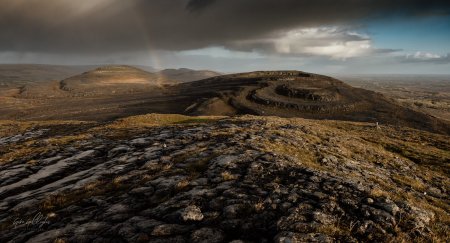
Yesterday I watched the concluding episode of a fascinating two-part documentary series called The Burren: Heart of Stone, an extraordinary region of glaciated limestone klarst in County Clare. The landscape has a distinctly other-worldly look to it, yet humans have lived and farmed on it for at least 8,000 years.

Episode 1 was largely about the geology and ecology of the Burren which explained how the motion of glaciers across the area scraped away upper layers and revealed the limestone deposits formed by the bones and shells of ancient marine creatures who lived there tens of millions of years ago. The present-day Burren is windswept and rainy but is home to a rich ecosystem of plants, insects, birds and animals. Despite the heavy rainfall there are no rivers to be seen, but water flows underground through a complex network of tunnels and caves.

The first programme was interesting enough but Episode 2 was about the history of human habitation in the Burren, incorporating recent genetic discoveries, and that was absolutely fascinating.

The oldest population for which DNA sequencing has been possible were the mesolithic hunter- gatherers who lived in Ireland at least 8,000 years ago. Studies of the available remains show that these people had dark skin and blue eyes.

I only found out recently that the genetic mutation required for blue eyes arose in a single individual about 10,000 years ago; before that happened no humans had blue eyes. Having blue eyes myself, and in light of a recent discovery that I have a different mutation that arose more recently, I find that very intriguing.

Being hunter-gatherers these folk lived on the margins of the forests that covered most of Ireland, fishing and hunting animals as well as gathering nuts and berries. Their settlements were primarily impermanent affairs made of wood, so these people did not leave lasting impression on the landscape. Ireland probably couldn’t sustain a large population of these folk either, but the next people to arrive were the neolithic people who were the first farmers in Ireland. Their genetic profiles suggest they originated somewhere around modern-day Turkey and were also somewhat dark-skinned. They cleared the forests and set up permanent habitations involving stone structures, including the famous megalithic sites such as the tomb at Poulnabrone, which is at least 6,000 years old:

The Burren could have been popular with these people because, with its thin topsoil, it was much easier for them to get rid of the trees and start farming. They built stone walls to divide fields, and it is said that the walls which criss-cross the present-day Burren follow the line of these prehistoric structures.

Genetics reveal that these neolithic people and the mesolithic people intermingled and interbred, though the circumstances that led to this are of course unknown. It is hard to believe that a huge influx of people chopping down trees and clearing the land for farming would have caused no friction with the previous inhabitants. There may well have been violent struggles.

The neolithic culture survived and flourished in relative isolation until the arrival of Bronze Age settlers somewhere around 4000 years ago. These came originally from the Steppes of Russia, who took over many of the neolithic sites and adapted them for their own use before they were eventually abandoned. Evidence from the Burren suggests that the massive deforestation, combined with a climate downturn, led to catastrophic soil erosion; farming became impossible and the culture collapsed.

Incidentally, DNA studies of the Bronze Age people of Ireland are heavily mixed with neolithic genes but show no relic of the mesolithic population. Presumably these were diluted too much, as the neolithic culture sustained a much bigger population, probably around 200,000 in number.

All this was centuries before any Celtic people arrived in these shores, which was around 500 BC.

A fascinating programme, well worth watching if you can get to see it. There was a twist in the tail too: recent discoveries of apparent human activity on animal bones dated back to around 30,000 years ago, show evidence of a population of people in Ireland before the most recent Ice Age began.

Fascinating stuff!

R.I.P. Cousin Itt

Posted in Covid-19, Television with tags , , on April 19, 2021 by telescoper

I was sorry to hear of the recent death at the age of 84 of actor Felix Silla, best known for his role as Cousin Itt in the 1964 TV series The Addams Family in which he pioneered the lockdown hairstyle that is proving so popular these days.