Catherine Connolly (left) and Heather Humphreys (right)
Now that all the excitement about the Nobel Prize for Physics has died down I thought I would do a quick post to follow up my previous one about the election for the next President of Ireland (Uachtarán na hÉireann). Only three people gathered enough support by the deadline to be named on the ballot paper, namely: Catherine Connolly (an independent TD standing as a unified leftist who has the support of Sinn Féin, Labour, the Social Democrats and People Before Profit); Jim Gavin a former GAA player and football manager for Dublin, Civil Aviation Authority bigwig, and flying instructor in the Air Corps who was picked up by Fianna Fáil as their candidate; and Fine Gael candidate Heather Humphreys.
Sunday 5th October saw the withdrawal of Jim Gavin. It has to be said that he looked and sounded completely out of his depth in the TV debates, performing so badly that the bookies had put him at 16-1 by Sunday morning, but the final straw was a scandal over rent overpaid by a tenant to Gavin 16 years ago and never returned. I thought Gavin always looked like a potential banana skin for Fianna Fáil leader and Taoiseach Micheál Martin but in the event he turned into a hot potato that left Martin with egg on his face. In retrospect it seems a very serious error of judgement to back such a weak candidate.
Apparently Martin had pushed FF members very hard to select Gavin as their candidate, even though he wasn’t a member until recently, but now they are wondering why they had been asked to endorse a dodgy landlord from outside the party when there were so many of those already in it.
So now there are only two candidates, except that the relevant electoral law does not allow a candidate to withdraw after the deadline for nominations (which was 24th September) so Jim Gavin’s name will still be on the ballot paper. It will be interesting to see how many people vote for him despite his withdrawal, as a kind of protest. They might make a difference, as might those who transfer their first choice to Heather Humphreys. I suspect many ardent FF-ers will just not vote, though. In that case it will simply be down to who wins the most first preferences.
It wasn’t – and still isn’t – obvious to me which of the two remaining candidates is favoured by these shenanigans, but it is clear what the Bookies think: odds are currently Connnolly 1/3 favourite and Humphreys 11/4. At the start of the campaign Catherine Connolly was the outsider, but she’s now odds-on favourite. She’s the only candidate whose team has canvassed me (so far)
Election Day is Friday October 24th.
And as if all that excitement weren’t enough, today was Budget Day. The reaction to that might well influence the vote for President: if it is unpopular, the anti-establishment vote might increase.
Update: it is clear from here that Gavin’s votes will be treated as valid and if he finishes third on first preferences, his transfers will be counted in the usual way.
Just to mention that tomorrow (Tuesday, October 7th 2025) will see the announcement of this year’s Nobel Prize for Physics. I must remember to make sure my mobile phone is fully charged so I can be easily reached, although I am likely to be lecturing when the announcement is made.
The announcement of the Nobel Prize for Physics on Tuesday is preceded today (Monday 6th) by the announcement of the Prize for Applications of Physics to Physiology or Medicine, and followed on Wednesday by the Prize for Applications of Physics to Chemistry. You can find links to all the announcements here.
I was, however, a guest of the Nobel Foundation rather than a prizewinner, so my medal is made of chocolate rather than gold. I think after 19 years the chocolate is now inedible, but it serves as a souvenir of a very nice weekend in Stockholm! Sadly one of the Laureates whose award we were celebrating passed away recently.
I drew a blank in 2023 when attosecond light pulses were the topic and was completely wrongfooted last when the 2024 Nobel Prize for Physics was awarded to John J. Hopfield and Geoffrey E. Hinton “for foundational discoveries and inventions that enable machine learning with artificial neural networks”. I didn’t see that one coming at all.
I really have no idea who will win it this year, but I’ll suggest that there’s still an outside chance for Michael Berry and Yakir Aharonov for their work on the geometric phase, although if they were going to win they probably would have done so by now.
To find out who the lucky winners you’ll have to wait for the announcement, around about 10.45 (UK/Irish time) on Tuesday morning. I’ll update this post when the wavefunction has collapsed.
Feel free to make your predictions through the comments box below!
Update: I’m not often right but I was wrong again: the 2025 Nobel Prize for Physics goes to John Clarke, Michel H. Devoret and John M. Martinis “for the discovery of macroscopic quantum mechanical tunnelling and energy quantisation in an electric circuit”…
I received an email about this over a week ago from Alberto Accomazzi (Director and Principal Investigator of the NASA Astrophysics Data System) and was going to post about it then but I was quite busy and it slipped my mind. I met Alberto at ENAM earlier this summer and he told me then this was in the pipeline so I should have remembered. Anyway, better late than never…
The email was to announce the formal launch of Science Explorer (SciX for short) on Monday 29th September 2025. SciX is meant to build on the excellence of ADS and expanding its coverage to accelerate astro-related research even further.
Here’s a screenshot of the home page set up in such a way as to take you, if you click on it, by a miracle of the internet, and at no extra charge, to the actual home page:
Feel free to go and check it out!
Here is some text from the email I mentioned:
So, what is the Science Explorer platform, or SciX? Think of it as your one-stop platform for exploring research across Earth, environmental and space sciences, including planetary science, heliophysics, geology, geophysics, atmospheric sciences and oceanography. From tracking solar storms, to uncovering the secrets of distant planets, to understanding the changing dynamics of our own Earth, SciX is designed to be your research co-pilot. You can find out more at scixplorer.org.
The people behind SciX would also love to know how NASA/ADS has supported your work so far and how SciX’s additional features will benefit the community. Your testimonial can be brief, in written or video form, and can be submitted via this form, or by email if easier. It is important to show your support in view of the challenges facing NASA these days. I think we tend to take services such as NASA/ADS for granted, but we’d all find our work much harder without them, so do please send a message of support.
P.S. You can find SciX on social media with the handle @SciXCommunity. Please give them a follow!
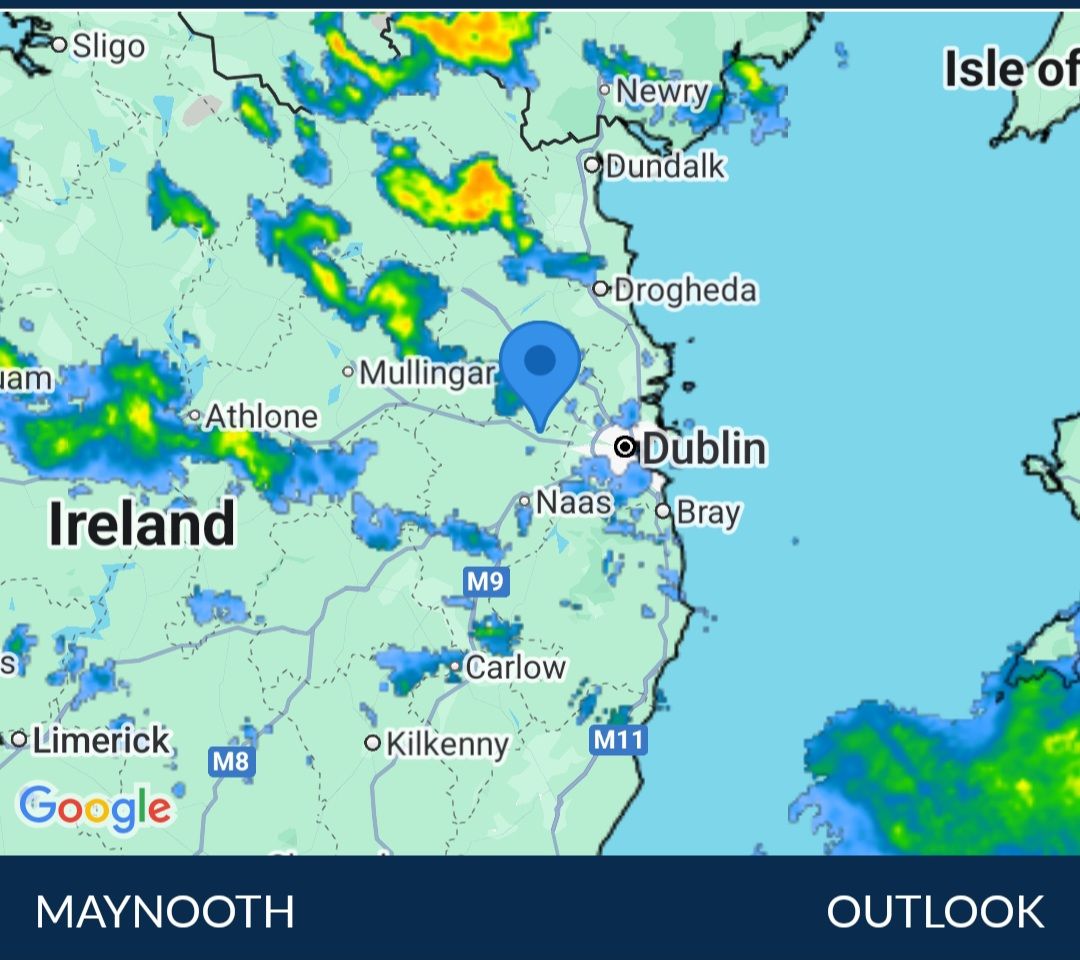
It’s been an interesting couple of days while Storm Amy worked its way over the island of Ireland and on to Scotland. The worst hit County in the Republic was Donegal but even here in the shelter of County Kidlare there were gusts over 100 hm/h on Friday, and quite a lot of rain as you can see from the first two radar* plots above. Quite a few people, quite reasonably if they were heading towards the weather, went home a bit early on Friday.
Initially the wind was southerly, and it felt surprisingly warm, despite the rain, but by this morning it had veered westerly, the rain had turned to showers, and the wind has now moderated substantially.
I spent some time this afternoon clearing up leaves and small branches that had fallen during the storm, as well as looking for signs of damage. But all’s well. No power cuts either. My big worry however is this tree just outside my house:
It is far too tall for its location, and has been leaning alarmingly for some time. If it topples in the direction it is leaning it will hit my house. I’ve been on to Kildare County Council a few times about it, actually. I don’t want them to chop it down, but I do think they should cut back the upper branches so that if it falls it won’t hit either mine or my neighbour’s house. Unfortunately, they’ve refused to do anything at all. Time for another go at them, I think. It will cost them a lot less to deal with it now than the sum they will have to pay me if serious damage is caused by their negligence.
*In case you’re interested, Met Éireann’s weather radars are located at Dublin and Shannon, and operate at 5.64 GHz (C-band).
It’s Saturday again, so it’s time for a summary of the week’s new papers at the Open Journal of Astrophysics. Since the last update we have published five more papers, which brings the number in Volume 8 (2025) up to 146, and the total so far published by OJAp up to 381. At this rate Volume 8 will contain around 190 by the end of 2025.
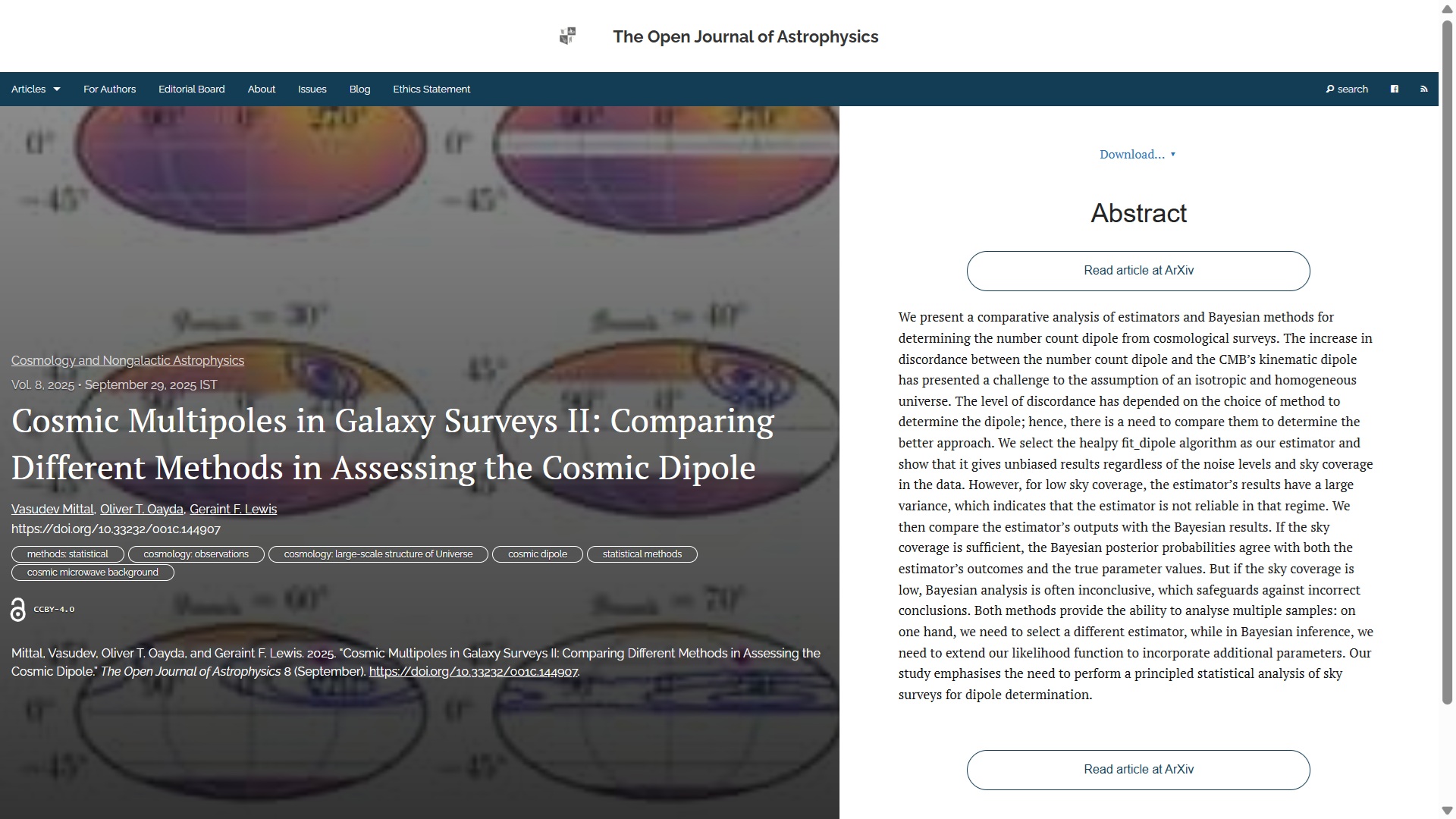
Anyway, here are this week’s papers, starting with three published on Monday 29th September 2025.
You can make this larger by clicking on it. The officially accepted version of this paper can be found on the arXiv here.
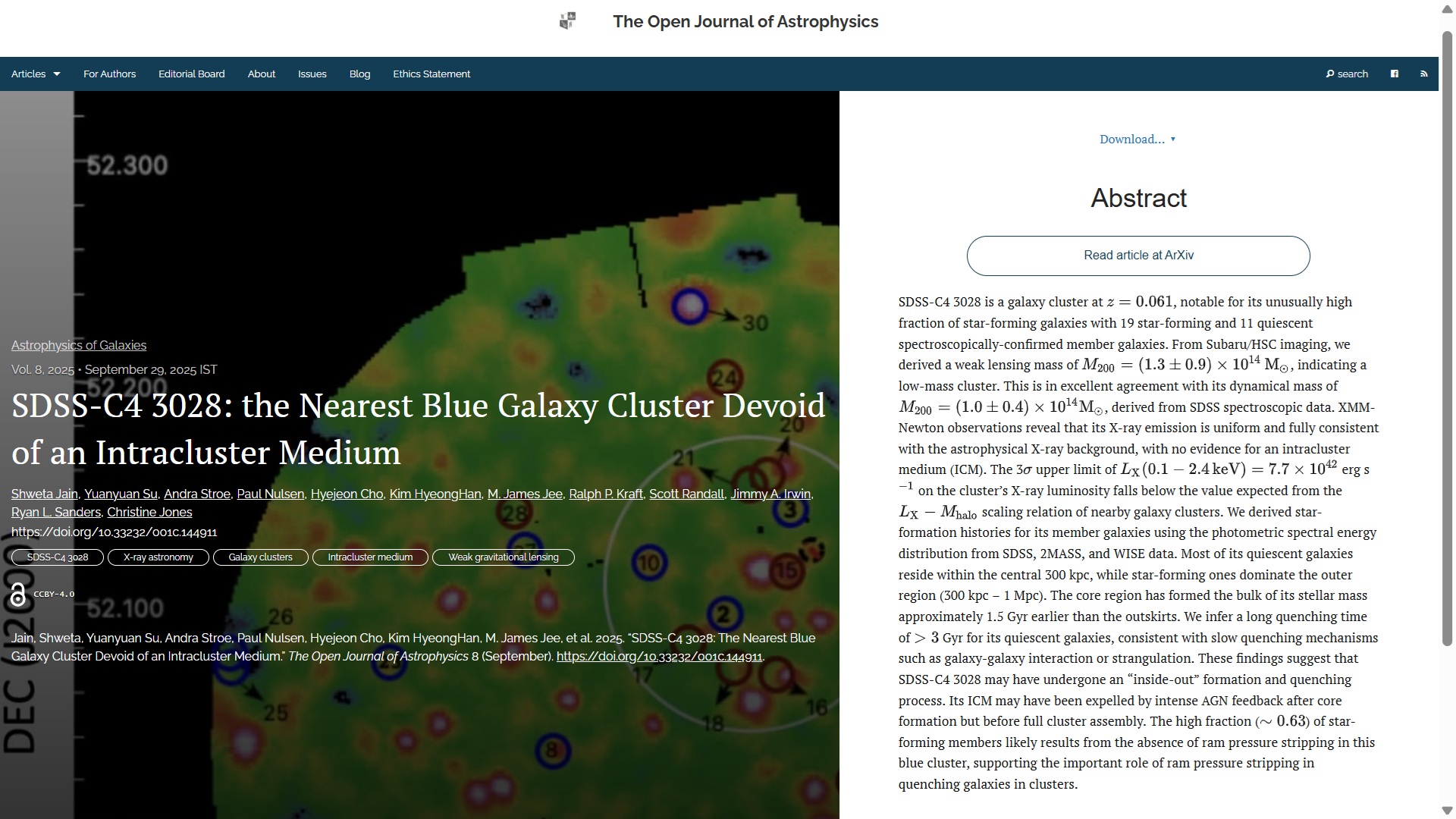
The second paper this week, also published on Monday 29th September, is “SDSS-C4 3028: the Nearest Blue Galaxy Cluster Devoid of an Intracluster Medium” by Shweta Jain (University of Kentucky, USA) and 11 others based in the USA, Australia and Korea. This describes a galaxy cluster with an unusually high fraction (about 63%) of star-forming galaxies which may be a result of ram pressure stripping; the article is in the folder Astrophysics of Galaxies.
The corresponding overlay is here:
You can find the officially accepted version on arXiv here.
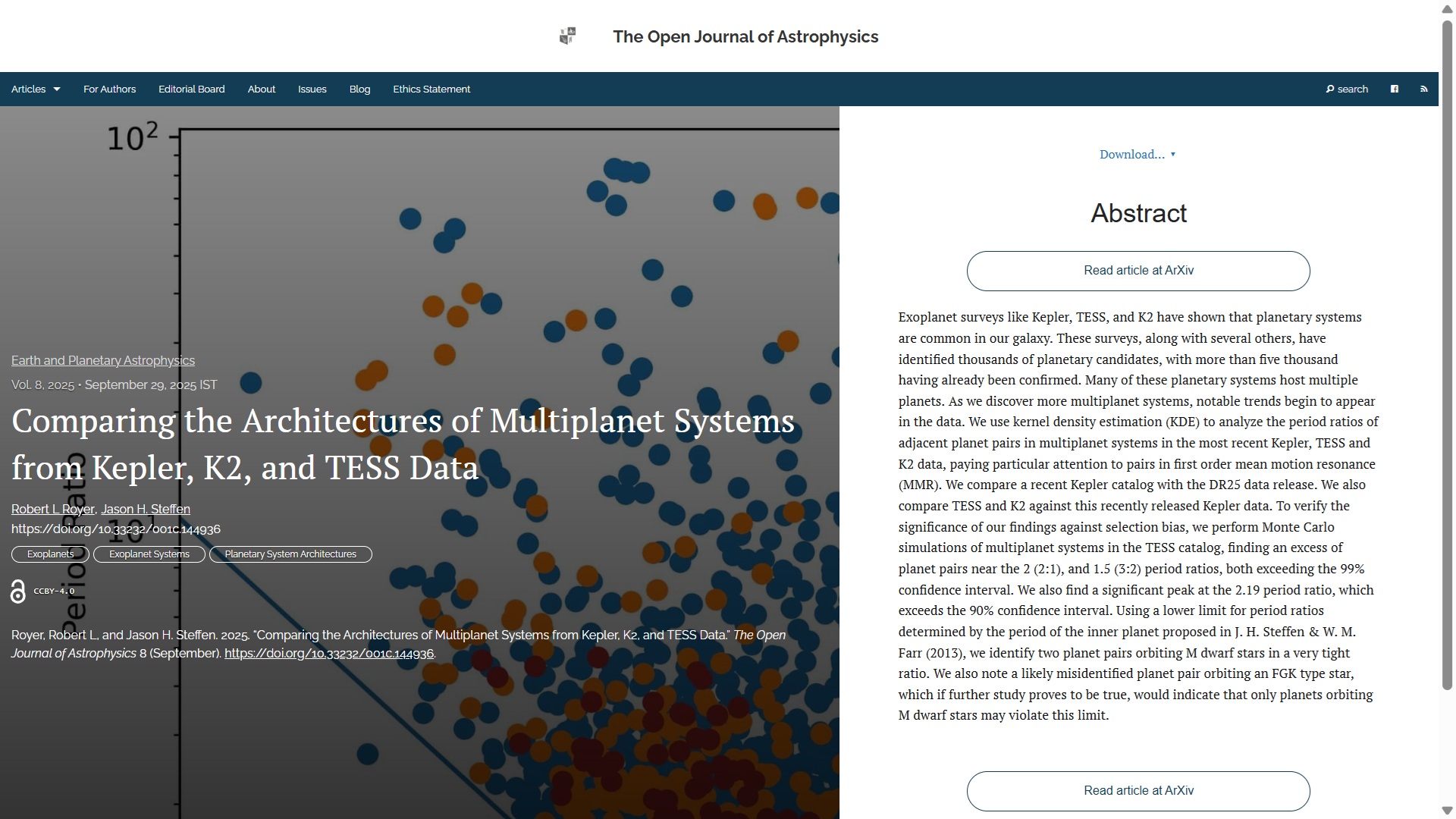
You can find the officially-accepted version on arXiv here.
The next one up is “Seeding Cores: A Pathway for Nuclear Star Clusters from Bound Star Clusters in the First Billion Years” by Fred Angelo Batan Garcia (Columbia University, USA), Massimo Ricotti (University of Maryland, USA) and Kazuyuki Sugimura (Hokkaido University, Japan). This paper was published on Thursday 2nd October in the folder Astrophysics of Galaxies. This is about modelling the formation of Nuclear Star Clusters using cosmological radiation-hydrodynamic simulations, with discussion of the implications for seeding supermassive black holes and the little red dots seen by JWST.
The corresponding overlay is here:
You can find the officially accepted version of this one on arXiv here.
The fifth and last one for this week, published on Friday 3rd October 2025, is “Efficient semi-analytic modelling of Pop III star formation from Cosmic Dawn to Reionization” by Sahil Hegde and Steven R. Furlanetto (University of Californi Los Angeles, USA). This is also in the folder marked Astrophysics of Galaxies. It uses a self-consistent analytic model to trace the formation of the first stars from their birth through the first billion years of the universe’s history. complementing semi-analytic and computational methods.
You can find the officially-accepted version of this paper on arxiv here.
That concludes the report for this week. I’ll post another update next Saturday.
Very sad news arrived today of the death at the age of 96 of the wonderful Patricia Routledge. I guess she is best known for her portrayal of Hyacinth Bucket of Keeping Up Appearances, but to me she will always be Kitty in Victoria Wood: As Seen on TV back in the 1980s. She did many other things besides, but here by way of a tribute is an example of Kitty holding forth as was her wont (although usually not in inebriated fashion). Cheadle just won’t be the same without her.
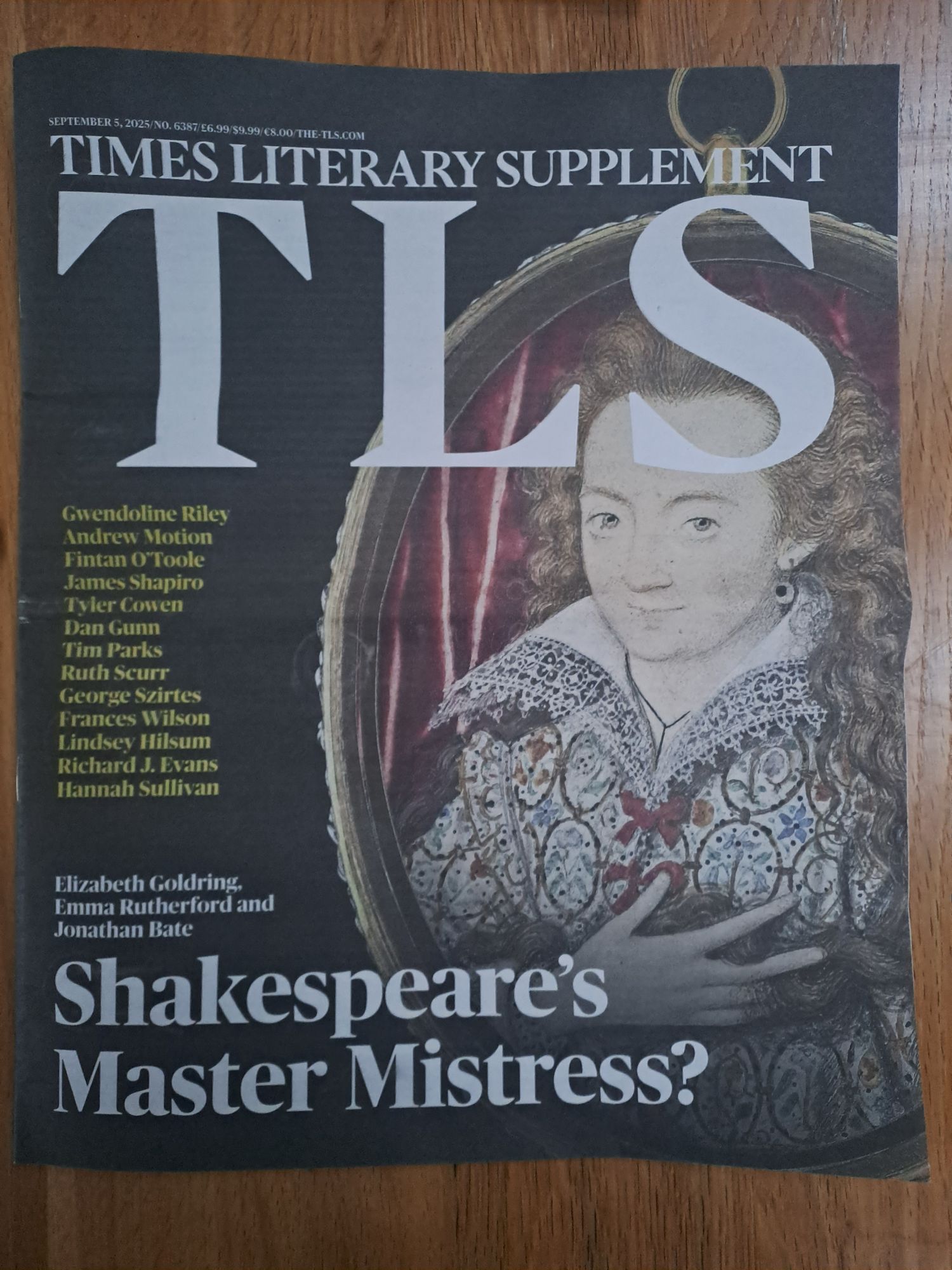
Today is National Poetry Day in the UK and Ireland but, instead of posting a poem like I usually do on this occasion, I thought I’d do a bit of reflecting on Shakespeare’s Sonnets. What prompted this is an article in the Times Literary Supplement I mentioned in a post on Monday. The cover picture shows a newly-discovered miniature by Nicholas Hilliard that is claimed to be of Henry Wriothesley, 3rd Earl of Southampton, and patron of William Shakespeare:
On the 20th May 1609, a collection of 154 Sonnets by William Shakespeare was published, which arguably represents at least as high a level of literary achievement as his plays. The “Master Mistress” in the title of the TLS article is a reference to Sonnet No. 20 in the collection, published on 20th May 1609, of 154 Sonnets by William Shakespeare, which arguably represents at least as high a level of literary achievement as his plays. Here is Sonnet No. 20 in the form usually printed nowadays:
A woman’s face with nature’s own hand painted,
Hast thou the master mistress of my passion,
A woman’s gentle heart but not acquainted
With shifting change as is false women’s fashion,
An eye more bright than theirs, less false in rolling:
Gilding the object whereupon it gazeth,
A man in hue all hues in his controlling,
Which steals men’s eyes and women’s souls amazeth.
And for a woman wert thou first created,
Till nature as she wrought thee fell a-doting,
And by addition me of thee defeated,
By adding one thing to my purpose nothing.
     But since she pricked thee out for women’s pleasure,
     Mine be thy love and thy love’s use their treasure.
The somewhat androgynous facial appearance of Henry Wriothesley – seen in other portraits – has led some to suggest that the above Sonnet was addressed to him. Others think that the poem was addressed to a young male actor (a “boy player“) who played female roles on the stage, as was usual in Shakespeare’s time. It was illegal for women to perform on stage until 1660.
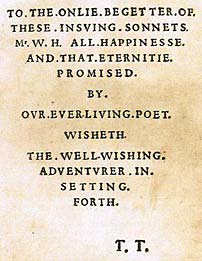
The dedication in the First Folio edition of the Sonnets, published in 1609, is shown on the left. The initials “T.T.” are accepted to stand for the name of the publisher Thomas Thorpe but the identity of “Mr. W.H.” is unknown. Of course “W.H.” is a reversal of the “H.W. ” that could be Henry Wriothesley, but would the publisher really use “Mr” to refer to a member of the nobility? Another curiosity is the prevalence of full stops, which is more characteristic of inscriptions carved in stone than on printed pages.
The First Folio edition was the only edition of the Sonnets published in Shakespeare’s lifetime and the circumstances of its publication remain uncertain to this day and not only because of identity of “Mr W.H.” For example, if it was authorised by Shakespeare, why did Shakespeare himself not write the dedication? Some have argued that it must have been published posthumously, so Shakespeare must have been dead in 1609, whereas most sources say he died in 1616.
Most of the poems (126 out of 154) contain poetic statements of love for a young man, often called the “Fair Youth”. However, there is also a group of sonnets addressed to the poet’s mistress, an anonymous “dark lady”, which are far much more sexual in content than those addressed to the “Fair Youth”. The usual interpretation of this is that the poet’s love for the boy was purely Platonic rather than sexual in nature. If Mr W.H. was a boy player then he would have been very young indeed, i.e. 13-17 years old…
Anyway, it was certainly a physical attraction: verse after verse speaks of the young man’s beauty. The first group of sonnets even encourage him to get married and have children so his beauty can continue and not die with his death. Sonnet 20 laments that the youth is not a woman, suggesting that this ruled out any sexual contact. These early poems seem to suggest a slightly distant relationship between the two as if they didn’t really know each other well. However, as the collection goes on the poems become more and more intimate and it’s hard for me to accept that there wasn’t some sort of involvement between the two. Although homosexual relationships were not officially tolerated in 17th Century England, they were not all that rare especially in the theatrical circles in which Shakespeare worked.
Oscar Wilde wrote a story called “A Portrait of Mr. W.H.” which suggests he is a young actor by the name of “Will Hughes”. The main evidence for this is Sonnet 20.
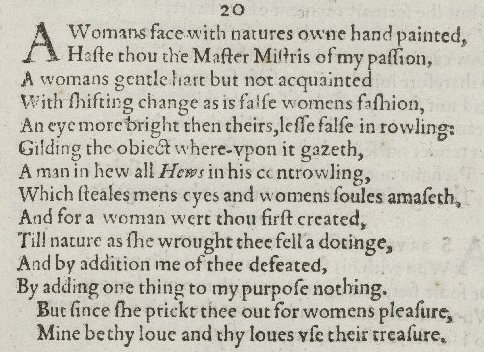
Look at the First Folio version:
The initial capital and emphasis of “Hews” seen in line 7 is very unusual and suggests that it is a joke (one of many in this poem), in the form of a pun on the preceding “hew”. It is suggested that “Hews” is actually “Hughes”. Ingenious, but I’m not convinced. There were many other meanings of “hew” in use in Shakespeare’s time; it was a variant spelling of “ewe” for example.
We’ll probably never know who Mr W.H. was – presumably not Smith – or indeed what was the real nature of his relationship to Shakespeare but we do not need to know that to read and enjoy the poems.
I do have a fundamental misgiving, though, about the assumption that the “Onlie begetter” of these sonnets means the person to whom they are addressed, or who inspired them. That assumption entirely disregards the “Dark Lady” sequence. There are at least two addressees so neither can be the only begetter, if that is what begetter is supposed to mean.
I think it more likely Mr W.H., whoever he was, is the person who caused the collection to be created and/or published, perhaps by sponsoring the First Folio. It’s also possible that these poems may have been commissioned over the years by Mr. W.H. and/or others – experts think they were written over a period of at least 16 years – and only published together at much later date. It is indeed said that some of verses were circulated in private well before they were published, though they may perhaps have been edited or otherwise tidied up for the 1609 edition. Perhaps Shakespeare supplemented his income by writing sonnets to order?
This line of thought also took me to another question: why does everyone assume that all 126 of the “Fair Youth” sonnets are about the same person? That person is never named and only occasionally described. Some of the 126 are thematically linked, but overall it is a collection rather than a sequence. Some are humorous and some are very serious indeed. Some are downright cryptic. I think it quite possible, especially if the poems really were written over a period of 16 years, that they not all addressed to the same individual. Once you accept the evident truth that there is more than one recipient, then why not more than two?
Some have taken this even further and asked: do we really know that all 154 sonnets were written by the same person? The same question is asked about Shakespeare’s work generally. Was there really one person behind his plays, or were they collaborative efforts.
Finally, I wonder for what purpose these sonnets were written. Were they actually sent to the addressee(s) as expressions of love, like letters, or were they private meditations, like one might write in a journal?
I don’t suppose we’ll ever really know the answers to these questions, but I find it fascinating that the origin of such a famous collection is enshrouded in so many mysteries! I promise to post more of them here in due course.
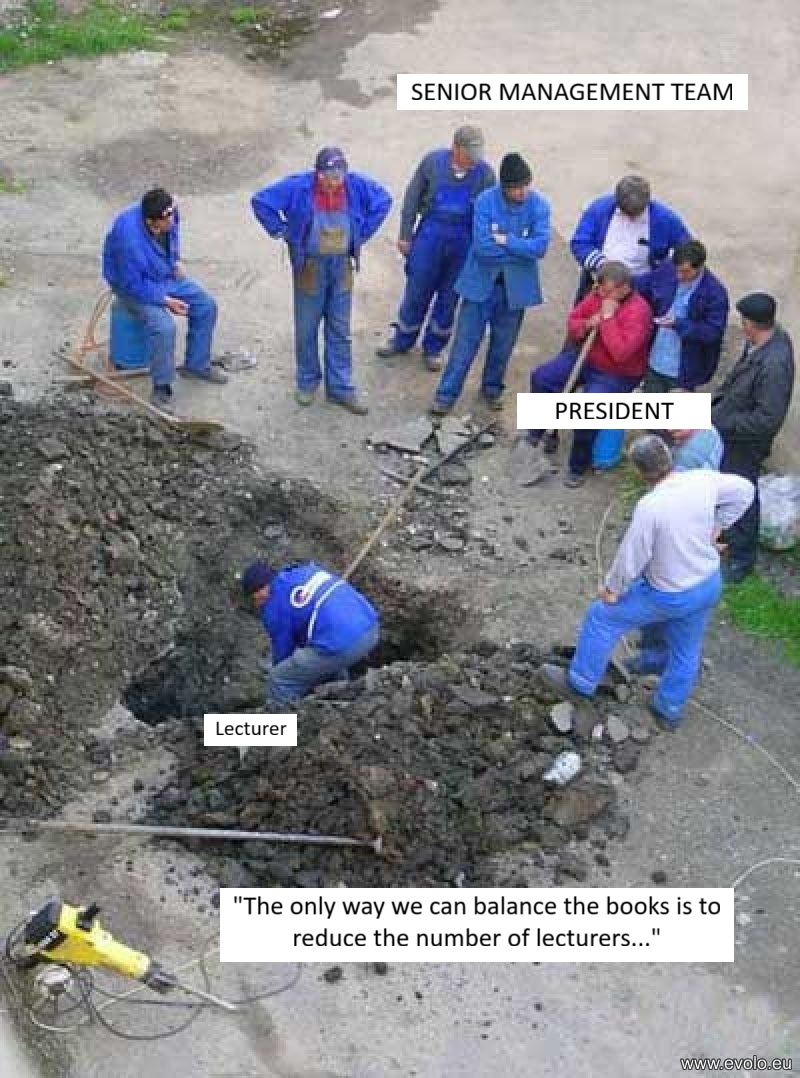
To pre-empt accusations that this is a misleading representation of the true state of affairs, I admit this is so. In a more accurate version there would be many more members of the Senior Management Team. Moreover, the President and Senior Management Team appear in the photo to be aware of, and some are even showing some interesting in, the activity of the lecturer.
A while ago I went to a concert that featured a Mozart Piano concerto with soloist David Fray. I mentioned then that his encore was a piece by Johannn Sebastian Bach, arranged for piano. I thought I’d post a performance of the same piece today.
Originally the second movement “Air” from Johann Sebastian Bach’s Orchestral Suite No. 3, this piece became known as the Air on the G string when it was arranged for solo violin and orchestra, by August Wilhelmj, which involved transposing it down from D Major to C Major so that the violin part could be played entirely on the lowest of the four strings. It’s also sometimes called the (and sometimes “Celebrated Air”, which is more appropriate when it is played on anything other than a violin. The piano version performed by David Fray was arranged by Alexander Siloti and I think it’s very beautiful, based on a beautifully simple bass. Bach’s keyboard pieces often have a left-hand part which is interesting on its own. You can also see hear why jazz musician’s like Bach so much; the left hand provides such a steady but rich foundation for improvisation with the right hand.
Anyway, here is a nice performance of the same piece, at a gently swinging tempo, not unlike a slow blues, by Ukrainian pianist Valentina Lisitsa.
One of the Youtube commenters calls this version “melancholy”, which I don’t agree with at all! Whatever it is, it’s a nice way to spend 5 or 6 minutes relaxing in between lectures.
The views presented here are personal and not necessarily those of my employer (or anyone else for that matter).
Feel free to comment on any of the posts on this blog but comments may be moderated; anonymous comments and any considered by me to be vexatious and/or abusive and/or defamatory will not be accepted. I do not necessarily endorse, support, sanction, encourage, verify or agree with the opinions or statements of any information or other content in the comments on this site and do not in any way guarantee their accuracy or reliability.










 In the Dark