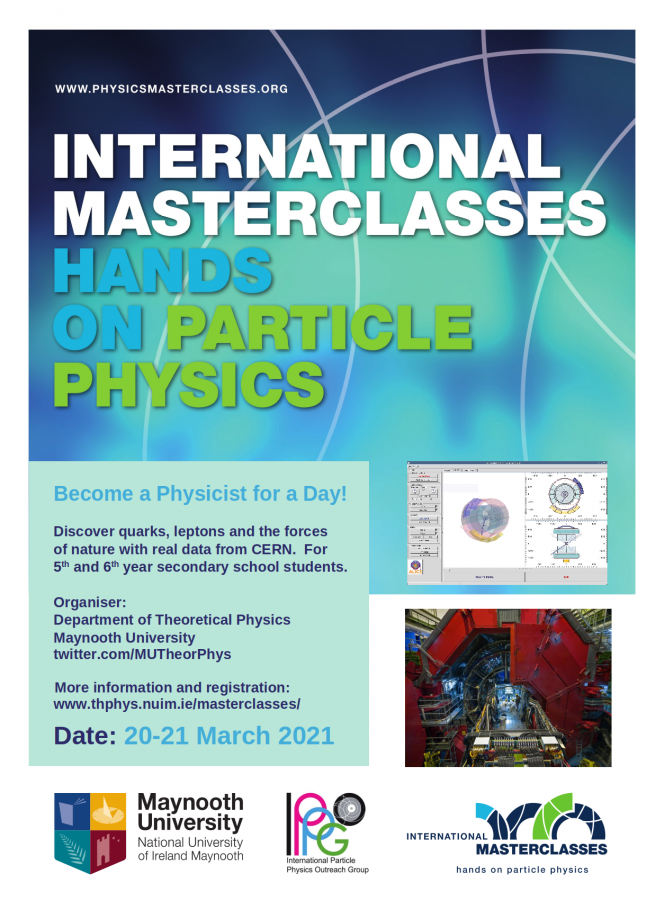
Particle Physics Masterclass at Maynooth

Posted in Education, Maynooth, The Universe and Stuff with tags , , on February 26, 2021 by telescoper

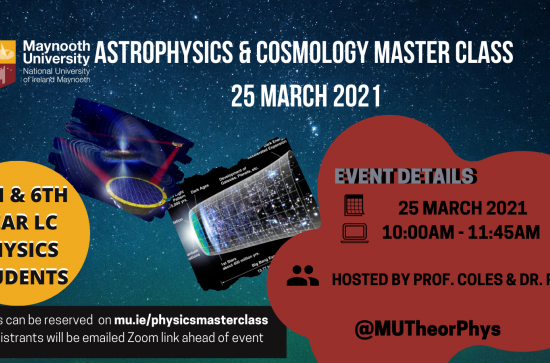
I have already informed you of a Masterclass in Astrophysics & Cosmology at Maynooth that will take place on March 25th 2021. For more information on that event including instructions on how to book see here.

Now it’s time to announce the International Masterclass on Particle Physics. The  Department of Theoretical Physics has hosted such event for secondary school students each Spring, apart from last year when it was cancelled because of Covid-19.  The next event will take place online on 21 and 22 March 2021. You can find more information, including instructions on how to book a place, here.

These Masterclasses give secondary school students the opportunity to discover the world of quarks and leptons for themselves, by performing measurements on real data from CERN, meeting active particle physics researchers and linking up with like-minded students from other countries.  We will join thousands of other secondary school students at more than 100 universities and laboratories around Europe and worldwide in a programme stretching over four weeks.

Physics at the most fundamental level – the smallest and most basic building blocks of matter – is an exotic world.  But a few introductory talks and working with data from CERN will give the students insight into the fundamental particles of matter and the forces between them, as well as what went on during the Big Bang.

On Sunday afternoon, the students are introduced to particle physics, experiments and detectors in lectures given by active particle physics researchers.  On Monday, after a virtual visit to the ALICE detector at CERN, they work on their own with data from ALICE Afterwards they participate in a video conference with students from other countries and moderators at CERN, where they discuss and compare their results.

For more information on the Particle Physics Masterclasses, see the International Masterclasses web site.

I don’t know. You wait ages for a Masterclass in Physics at Maynooth University, and then along come two in quick succession!

Údarás na Gaeltachta

Posted in Biographical, Maynooth with tags , , on February 25, 2021 by telescoper

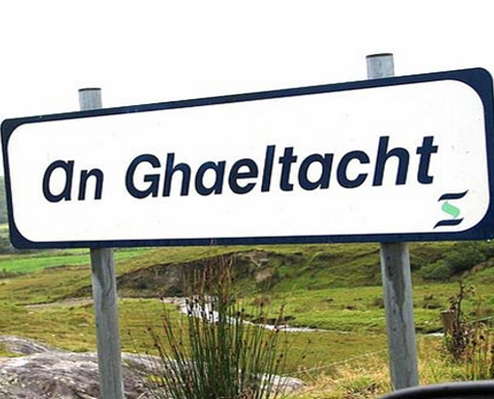
In today’s lunchtime Irish Language lesson we learned a bit about the Gaeltacht, i.e. Irish speaking areas in Ireland. Here is a little video:

You will see that most of the Gaeltacht is in the Western extremes of the country because these are the regions that largely escaped the English encroachment and suppression of the Irish language. One thing I wasn’t aware of before today however is that there is a part quite near Maynooth in the form of the town of Ráth Chairn (English: Rathcairn) about 40km away in County Meath. The people who live there were originally from Connemara so they speak the Gaeilge Chonnacht. This is where our teacher comes from, actually, so if I ever develop any ability to speak the language I’ll probably have do so with a Connacht accent!

To Solitude – John Keats

Posted in Poetry with tags , , on February 24, 2021 by telescoper

O Solitude! if I must with thee dwell,
Let it not be among the jumbled heap
Of murky buildings; climb with me the steep, —
Nature’s observatory — whence the dell,
Its flowery slopes, its river’s crystal swell,
May seem a span; let me thy vigils keep
‘Mongst boughs pavilion’d, where the deer’s swift leap
Startles the wild bee from the foxglove bell.
But though I’ll gladly trace these scenes with thee,
Yet the sweet converse of an innocent mind,
Whose words are images of thoughts refin’d,
Is my soul’s pleasure; and it sure must be
Almost the highest bliss of human-kind,
When to thy haunts two kindred spirits flee.

by John Keats (1795-1821)

Yesterday (23rd February) marked the bicentenary of the death of John Keats who passed away in Rome of tuberculosis at the age of just 25. The theme of the poem also fits the times we’re living in!


Astrophysics & Cosmology Masterclass at Maynooth

Posted in Education, Maynooth, The Universe and Stuff with tags , , on February 23, 2021 by telescoper

Regular readers of the blog – both of them – may remember that we planned to present a Masterclass in Astrophysics & Cosmology on January 14th 2021 but this had to be postponed due to Covid-19 restrictions. After today’s announcements by the Government of  a phased return to school starting on March 1st we have now decided to proceed with a new date of March 25th 2021.

This will be a half-day virtual event via Zoom. It’s meant for school students in their 5th or 6th year of the Irish system, who should be returning to classrooms on March 15th, but there might be a few of them or their teachers who see this blog so I thought I’d share the news here. You can find more information, including instructions on how to book a place, here.

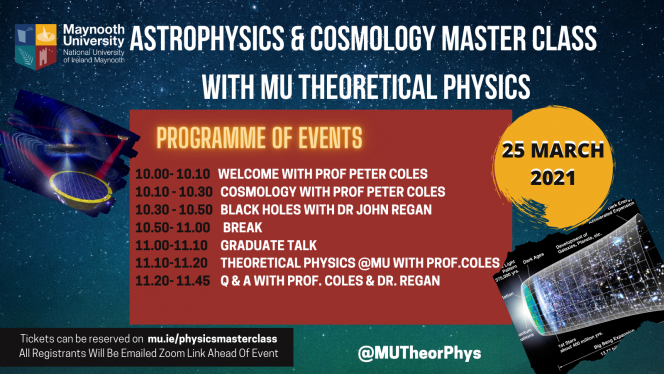
Here is the updated official poster and the programme:

I’ll be talking about cosmology early on, while John Regan will talk about black holes. After the coffee break one of our PhD students will talk about why they wanted to study astrophysics. Then I’ll say something about our degree programmes for those students who might be interested in studying astrophysics and/or cosmology as part of a science course. We’ll finish with questions either about the science or the study!

What is Quantum Technology? – A Public Lecture by Prof. Sir Peter Knight

Posted in Maynooth, The Universe and Stuff with tags , , , , on February 23, 2021 by telescoper

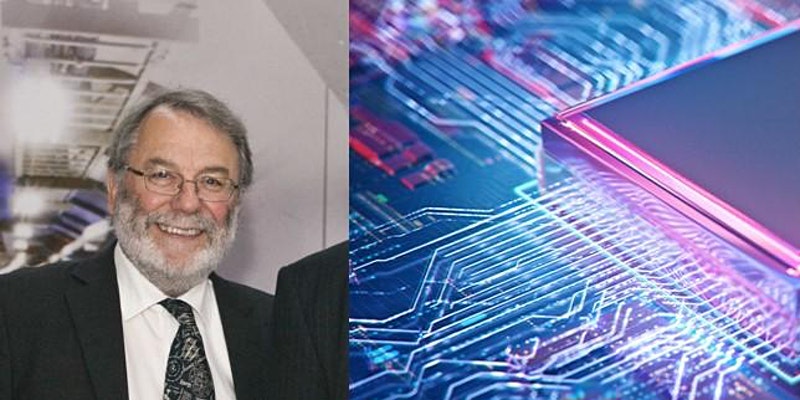
On Thursday March 11th (at 7pm) the Maynooth University Faculty of Science and Engineering will present its first ever Dean’s Lecture. This is a public event, consisting of a talk followed by a Q&A session.

The topic of the talk is quantum technology and it is presented by Prof. Sir Peter Knight who is Senior Research Investigator at Imperial College London. He retired in 2010 as Deputy Rector (Research) at Imperial. He was knighted in 2005 for his work in optical physics. Knight was the 2004 President of the Optical Society of America and 2011-2013 President of the Institute of Physics. He is Editor of Contemporary Physics, Chair of the UK National Quantum Technology Programme Strategy Advisory Board, chairs the Quantum Metrology Institute at the National Physical Laboratory, was until 2010 chair of the UK Defence Scientific Advisory Council and remains a UK Government science advisor. His research centres on quantum optics and quantum technology. He has won the Thomas Young Medal and the Glazebrook Medal of the Institute of Physics, the Ives Medal and the Walther Medal and Prize of the OSA, the Royal Medal of the Royal Society and the Faraday Prize of the IET.

Here is a description of the talk:

We already live in a quantum-enabled world with devices powered by quantum mechanics affecting our everyday world (lasers, telecoms semiconductor chips, and much more). But we are now poised to exploit a hitherto largely unexplored technology capability enabled by some of the stranger aspects of quantum physics: quantum coherence and entanglement. These new capabilities include novel sensing, timing, imaging, and of course computing. I will describe these new quantum coherence capabilities and plans to develop the next generation of quantum technologies. Quantum Information Science is advancing our understanding of the physical world in remarkable ways. But it is also driving novel and disruptive technologies. I will describe plans for ensuring the advanced quantum science and demonstrator platforms in imaging, sensing, communications, and computing developed over the past five years or so will drive the formation of the quantum technology sector and embed quantum technology in a broad range of industries.

The event is free but you will need to register here.

A Year of Covid-19 in Maynooth

Posted in Biographical, Covid-19, Maynooth with tags , on February 22, 2021 by telescoper

One useful thing about having a blog is that I can look through my back catalogue of posts quite easily to remind me exactly when things happened. Doing that over the weeked I discovered that it was exactly a year ago today that I travelled from Maynooth into Dublin to see a production of Fidelio. That was a few weeks before Covid-19 related travel restrictions were introduced. I was planning to fly to Cardiff in March but couldn’t do so because of the collapse of FlyBe.

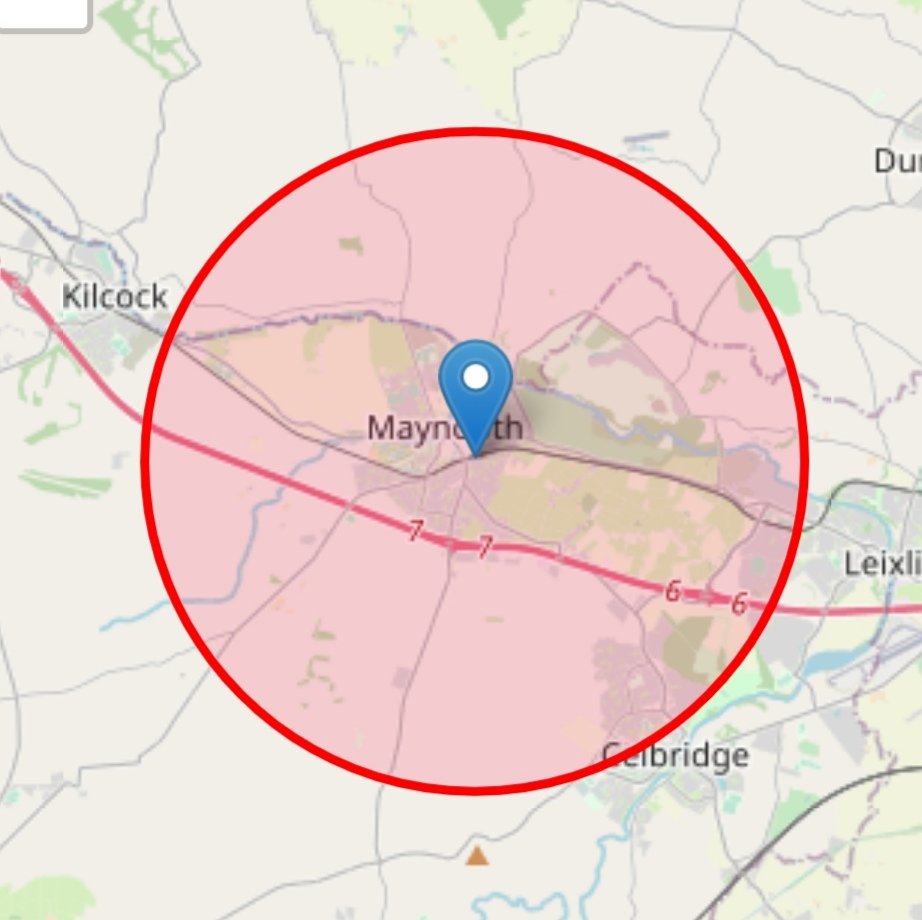
And so it came to pass that I now haven’t left Maynooth for an entire year. I have of course moved house, but only by a few hundred yards. I have spent 12 months entirely within a 5km radius.

The only time I’ve (accidentally) broken the rules was when, during a walk up the Moyglare Road, I accidentally strayed into County Meath. Travel across county boundaries is verboten, you see. The County boundary is shown on the map, to the North of the town, and is closer than I had thought.

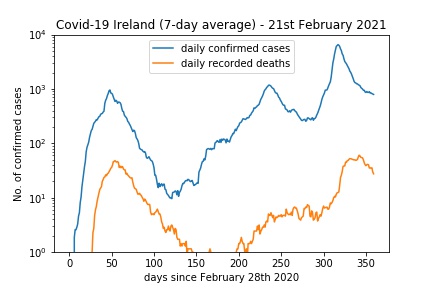
Anyway, it looks as I’m going to have a 5km horizon for some time to come. The state of play with Covid-19 as of yesterday isn’t particularly promising. Case numbers and hospitalizations are falling, but very slowly.

The reduction in new cases is only around 15 per day on average and at the current level of around 800 that’s far too high to be even thinking about opening up again.

Why is this reduction so slow? The answer to that question is fairly obvious: far too many people are flouting the existing rules. I have hardly been outside the house since Christmas, mainly to follow the health advice, but also partly because it annoys me to see so many people out and about ignoring social distancing, face coverings, and the rest. The sad thing is that by not taking responsibility now, these people are ensuring that this wretched pandemic lasts even longer.

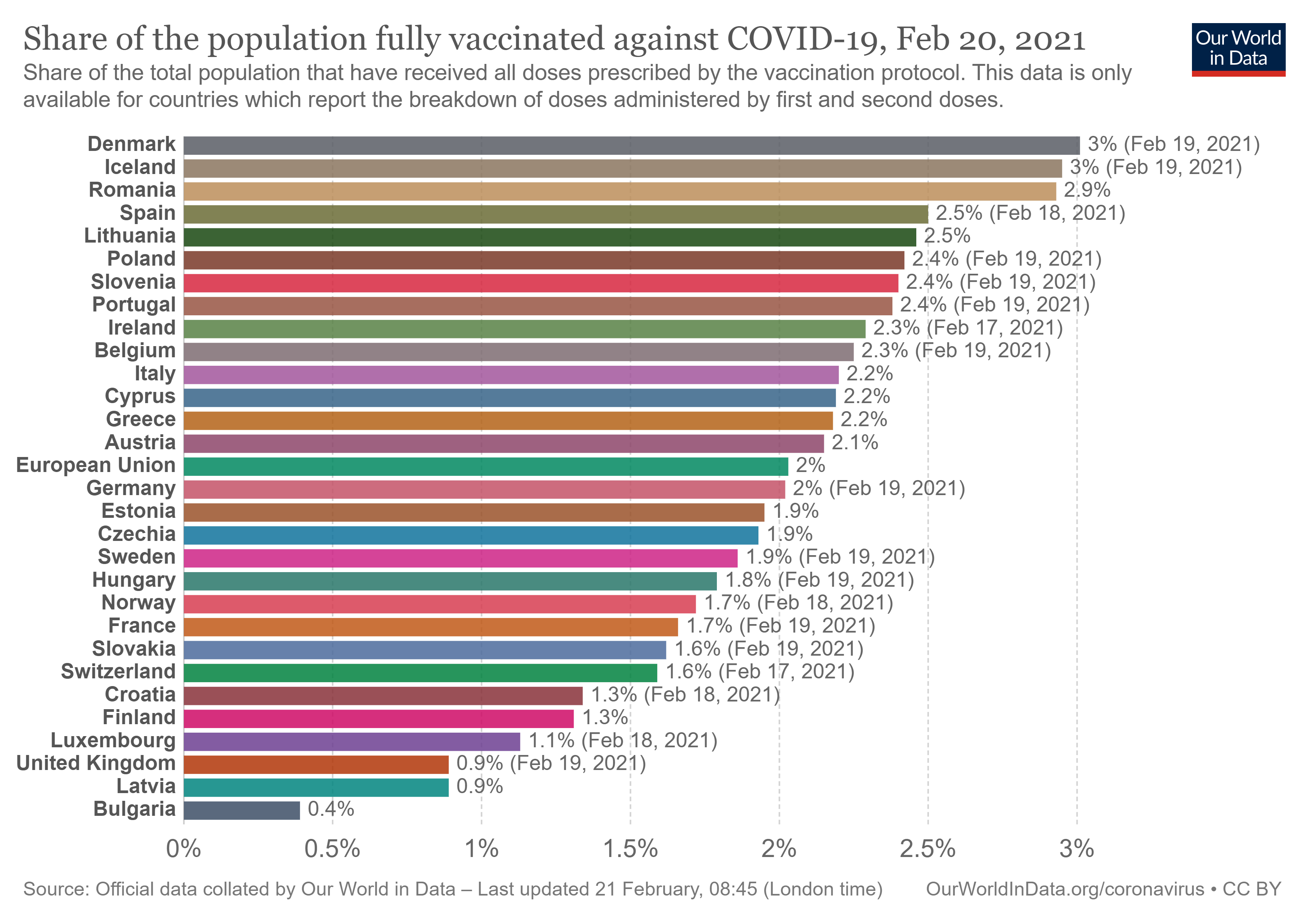
Ireland’s vaccination programme is going steadily with over 100,000 fully vaccinated and twice that number having received one dose.

Note the considerable variation in vaccination progress across the different countries*. Denmark is top of the heap, probably because it has a fully computerised nationwide health system. Things would obviously be going faster had one of the major suppliers not decided to renege on its contract with the EU but, despite the sharp practice from AstraZeneca, there is expected to be a big increase in vaccines available from April onwards, with about three million doses available between April and June.

*The UK has adopted a different strategy from most others, by giving one dose to as many as possible as quickly as possible by delaying the second dose. This may turn out to be an effective approach. I’m not sufficiently expert to comment.

Today is the start of week 4 of Semester Two of the academic year at Maynooth University. That means we have three weeks to go until the mid-term study break (which was when the first lockdown began last year). Halfway to halfway through the Semester, in other words.

The way things are going I think I’ll be remaining within the 5km horizon until June at the earliest, and probably until September, assuming I’m not carted off to an institution before then.

Thirty Years of Preprints

Posted in Open Access with tags , , , , on February 21, 2021 by telescoper

I thought I’d share an interesting paper (by Xie, Shen & Wang) that I found on the arXiv with the title Is preprint the future of science? A thirty year journey of online preprint services. The abstract reads:

Preprint is a version of a scientific paper that is publicly distributed preceding formal peer review. Since the launch of arXiv in 1991, preprints have been increasingly distributed over the Internet as opposed to paper copies. It allows open online access to disseminate the original research within a few days, often at a very low operating cost. This work overviews how preprint has been evolving and impacting the research community over the past thirty years alongside the growth of the Web. In this work, we first report that the number of preprints has exponentially increased 63 times in 30 years, although it only accounts for 4% of research articles. Second, we quantify the benefits that preprints bring to authors: preprints reach an audience 14 months earlier on average and associate with five times more citations compared with a non-preprint counterpart. Last, to address the quality concern of preprints, we discover that 41% of preprints are ultimately published at a peer-reviewed destination, and the published venues are as influential as papers without a preprint version. Additionally, we discuss the unprecedented role of preprints in communicating the latest research data during recent public health emergencies. In conclusion, we provide quantitative evidence to unveil the positive impact of preprints on individual researchers and the community. Preprints make scholarly communication more efficient by disseminating scientific discoveries more rapidly and widely with the aid of Web technologies. The measurements we present in this study can help researchers and policymakers make informed decisions about how to effectively use and responsibly embrace a preprint culture.

The paper makes a number of good arguments, backed up with evidence, as to why preprints are a good idea. I recommend reading it.

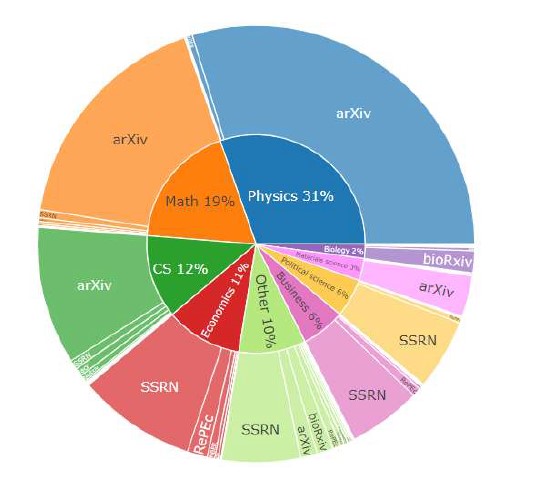
Here is Figure 1 from the paper:
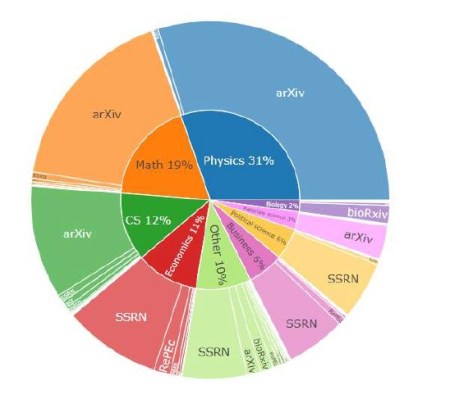
(Parts of the chart are difficult to read, so see the paper for details).

This shows that about 50% of all preprints are in the areas of physics and mathematics and their distribution mode is predominantly through the arXiv. Other scientific disciplines have much lower prevalence of preprints, e.g. biology. I’ve been putting my papers on arXiv since the early Nineties, i.e. for most of the duration of the period covered by the paper. I don’t know why other fields are so backward.

It’s standard practice in my own field of astrophysics to put preprints of articles on the arXiv but younger readers will probably not realize that preprints were not always produced in the electronic form they are today. We all used to make large numbers of these and post them at great expense to (potentially) interested colleagues before publication in order to get comments. That was extremely useful because a paper could take over a year to be published after being refereed for a journal: that’s too long a timescale when a PhD or PDRA position is only a few years in duration. The first papers I was given to read as a new graduate student in 1985 were all preprints that were not published until well into the following year. In some cases I had more or less figured out what they were about by the time they appeared in a journal!

The practice of circulating preprints persisted well into the 1990s. Usually these were produced by institutions with a distinctive design, logo, etc which gave them a professional look, which made it easier to distinguish `serious’ papers from crank material (which was also in circulation). This also suggested that some internal refereeing inside an institution had taken place before an “official” preprint was produced and this lending it an air of trustworthiness. Smaller institutions couldn’t afford all this, so were somewhat excluded from the preprint business.

With the arrival of the arXiv the practice of circulating hard copies of preprints in astrophysics gradually died out, to be replaced by ever-increasing numbers of electronic articles. The arXiv does have some gatekeeping – in the sense there are some controls on who can deposit a preprint there – but it is definitely far easier to circulate a preprint now than it was.

It is still the case that big institutions and collaborations insist on quite strict internal refereeing before publishing a preprint – and some even insist on waiting for a paper to be accepted by a journal before adding it to the arXiv – but there’s no denying that among the wheat there is quite a lot of chaff, some of which attracts media coverage that it does not deserve. It must be admitted, however, that the same can be said of some papers that have passed peer review and appeared in high-profile journals! No system that is operated by human beings will ever be flawless, and peer review is no different.

Nowadays, in astrophysics, the single most important point of access to scientific literature is through the arXiv, which is why the Open Journal of Astrophysics was set up as an overlay journal to provide a level of rigorous peer review for preprints, not only to provide a sort of quality mark but also to improve the paper through the editorial process.

So is the preprint the future of science? I think that depends on how far ahead you are willing to look. In my opinion we are currently in an era of transition trying to shoehorn old publishing practices into a digital world. At some point in the future people will realize that the scientific paper itself – whether a preprint or not – is an outmoded 18th Century concept and there are far more effective ways of disseminating scientific ideas and information at our fingertips if only we stopped living in the past.
Irish Bingo Lingo

Posted in Education, Irish Language with tags , on February 20, 2021 by telescoper

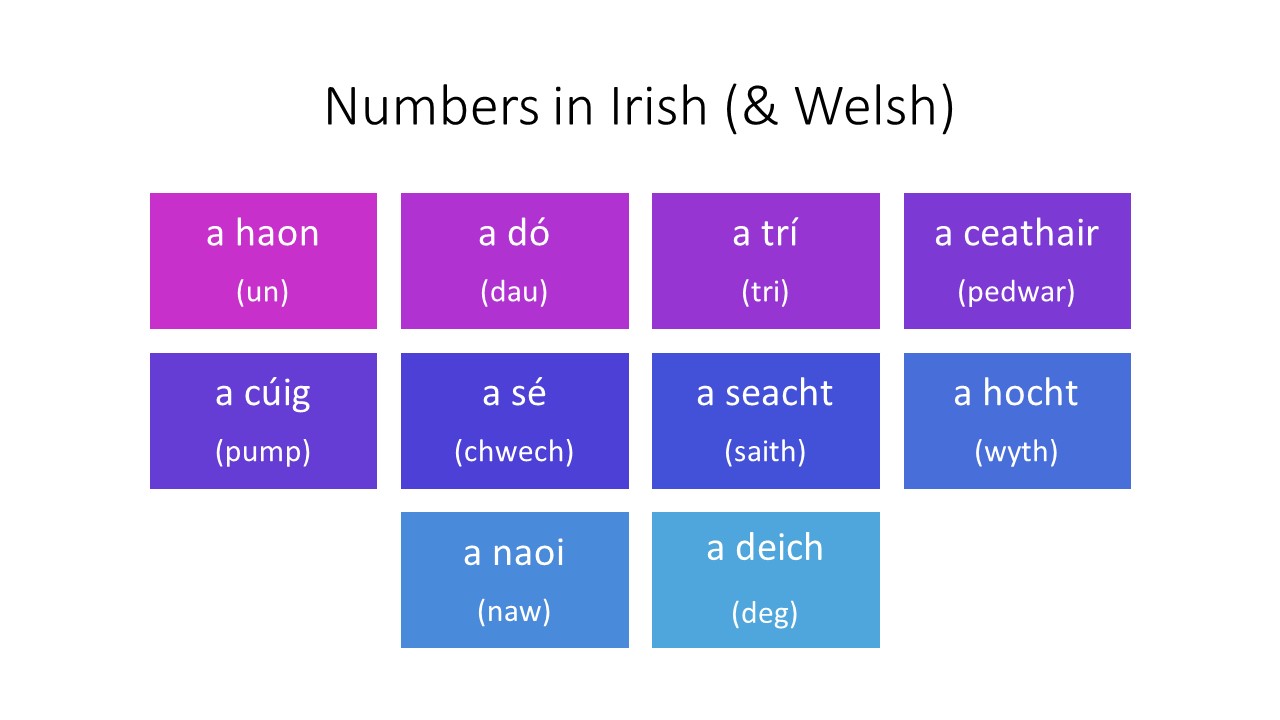
This week I had my third lunchtime Irish language class during which, among a few other things, we learned about numbers (just 1-10 so far). After some practice in pronunciation, we then had some practice in comprehension by playing Bingo in Irish. Out of interest I’ve put up the Irish numbers along with their counterparts in Welsh for reasons which will become clear:

The first thing to note is the presence of the particle “a” in front of the number in Irish. This is a consequence of something I didn’t know about before taking this course. In Irish there are different ways of using numbers depending on whether you’re using them just as numbers (in which case you put the “a” in front) or if you’re using them to denote a quantity of things or people (in which cases you don’t put the “a” in front but have to use a particular grammatical construction involving the thing being counted). Numbers in Irish are not used simply as adjectives, as in for example English. That’s not how it works in any other language I know. So far we haven’t been taught about these other counting systems so I can’t say any more.

The second thing concerns the similarity of these numbers to those in many other European languages, which is not surprising since they share an Indo-European origin. Integers are such basic things that they are embedded at a very deep level in languages. The Irish numbers resemble those in French particularly strongly. This may be a consequence of modern Irish being influenced by Norman French or may just be evidence of the common root.

Notice the comparison with Welsh, however, which gives very clear evidence of the ancient mutation that led to the distinct language branches of p-Celtic and q-Celtic. Look at the number 4. In Irish, this is a ceathair (which is pronounced “a ka-hir”; the t is weakened by the following h) which resembles the French quatre. There is no q in the standard Irish alphabet but the sound is similar. In Welsh we have pedwar which, apart from the initial letter being a “p”, is structurally similar to the Irish version. A similar change in initial consonant happens with the number five.

Anyway I’m enjoying learning Irish. It’s a very interesting challenge. In the rest of the class we learned how to answer questions like What is your name (Cad is ainm duit?) followed by an exercise in giving names to celebrities shown in photographs. I firmly established my status as the Old Fogey of the class in this part, by being unable to identify a person called Shakira who, I’m told, is a popular vocal artiste of some sort.

The Return to Schools in Ireland – The Facts

Posted in Covid-19, Education, Politics on February 20, 2021 by telescoper

There is some confusion going around about precisely when schools will reopen in the Republic of Ireland. In order to provide a service to the community I therefore thought I would summarize the main points here as clearly, concisely and coherently as possible.

At Primary schools, Junior infants or perhaps Junior and Senior infants and perhaps also including First and Second Class will return either separately or together on either 1st March or possibly 8th March. All other pupils will definitely return on 15th March or possibly a week or two weeks later but definitely by three weeks later than that unless there’s a change of plan.

At Secondary schools, the Junior Cycle will continue as normal apart from not actually happening: the Junior Certificate will be replaced by a voucher to spend on computer games. The Senior Cycle will return at the same time as Primary Schools, or at some different time depending on the circumstances, or perhaps just for the day before the Leaving Certificate examinations. Pupils will be able to choose either to take the examination or to receive a grade based on all the coursework they haven’t done because the schools have been closed or to receive a grade based on how much their parents can afford to pay. Leaving Certificate examinations will take place according to the published timetable unless they’re cancelled at the last minute.

Transition Year students have been completely forgotten but no doubt somebody will think of something when they remember.

I hope this clarifies the situation.

Norma Foley is 51.

]

R.I.P. Roger Griffin (1935-2021)

Posted in Film, History, The Universe and Stuff with tags , , , on February 19, 2021 by telescoper

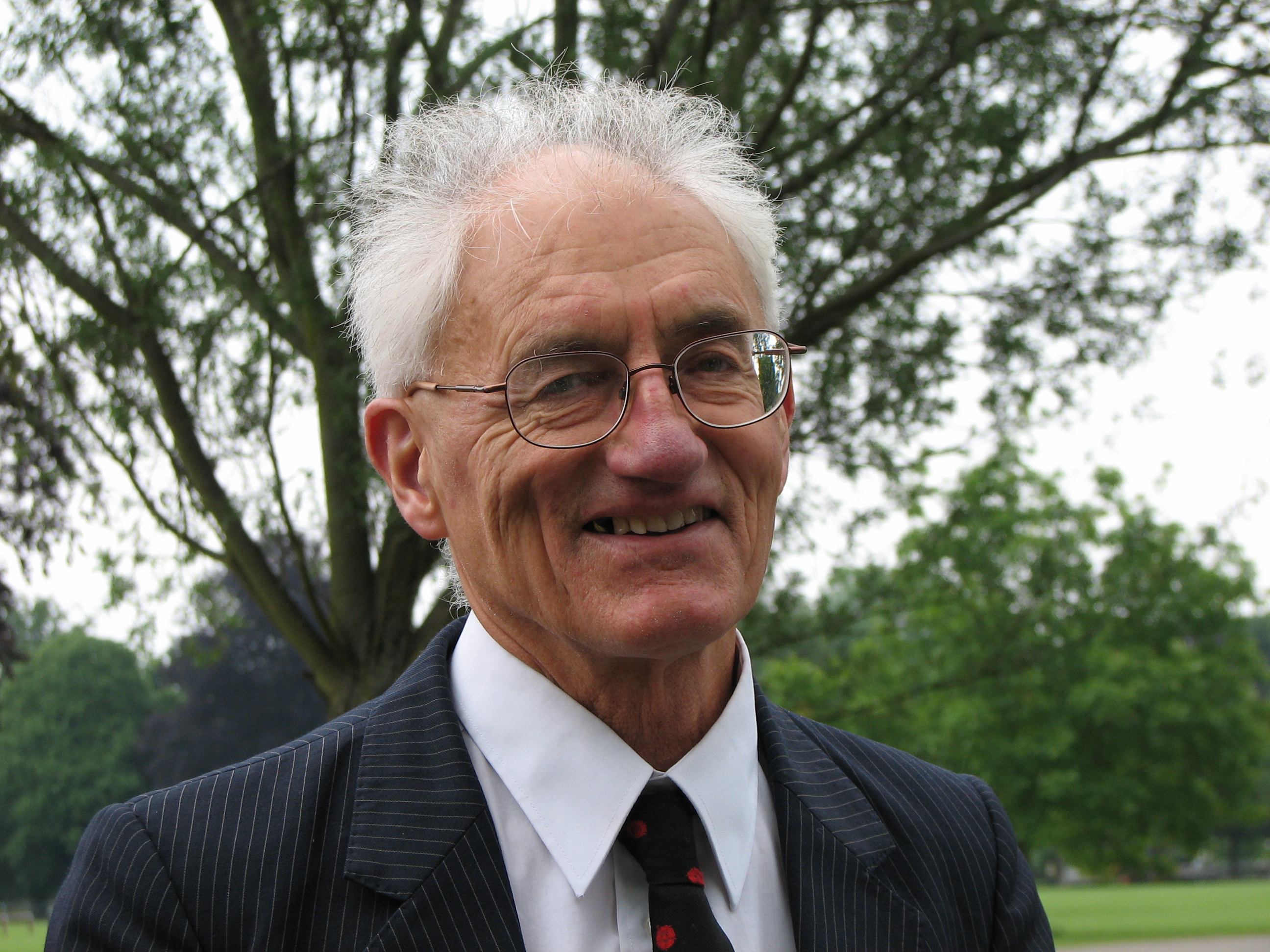
Roger Griffin (picture credit: St John’s College, Cambridge)

Earlier today I heard the sad news of the death at the age of 85 of astronomer Roger Griffin. He passed away on 12th February 2021.

Roger Griffin worked at Cambridge for over six decades, except for one year when he had a post-doctorate position at the Mount Wilson and Palomar Observatories, of the Carnegie Institution of Washington. He was the Assistant Director of Research in Astronomy at the University of Cambridge for nine years before he was promoted to a Readership of Observational Astronomy and later a Professorship. He appeared in the film Starmen alongside Donald Lyndon-Bell, Wal Sargent and Neville “Nick” Woolf.

Roger Griffin worked on astronomical spectroscopy and his main scientific claim to fame was that he invented a method of measuring radial velocities of stars in binary systems described in this classic paper published in 1967:

Over the subsequent years he published many radial velocity curves thus obtained in a long series of papers in the Observatory Magazine and the same method was subsequently used for measuring orbits of black holes and detecting extrasolar planets.

Despite the Cambridge connection I never met Roger Griffin personally but people who did talk about him with great affection and he will be greatly missed.

Rest in peace, Roger Griffin (1935-2021)