Remote Exam Time

Posted in Education, Maynooth with tags , , , on January 7, 2021 by telescoper

It’s the day before the start of the January examination period at  Maynooth University so I thought I’d do a quick post on the topic of examinations or, as they are right now, online timed assessments.

First, for readers elsewhere, full-time undergraduate students at Maynooth what is called 60 “credits” in a year, usually split into two semesters of thirty credits each. This is usually split into 5-credit modules with an examination in each module at the end of each semester. Projects, and other continuously-assessed work do not involve a written examination, but the system means that a typical student will have at least 5 written examination papers in January and at least another 5 in May.  This is very similar to the system in most UK universities that I am aware of except that a full year’s work over there is 120 credits so there’s a conversion factor of 2:1. A 5-credit module in Ireland would be a 10-credit module in the United Kingdom, for example, but otherwise the system is similar.

Each examination is usually of two hours’ duration. We’ve kept that length after moving examinations online, although students are given extra time to scan and upload their answers. The question papers themselves have been slightly adapted online use by having much less “bookwork”. Generally these asssessments are unsupervised and students are allowed to consult notes and textbooks so there is little point in asking them to copy out standard derivations and formulae. That means we can concentrate on the problem-solving aspects of theoretical physics, which are the most interesting bits (and perhaps the most challenging).

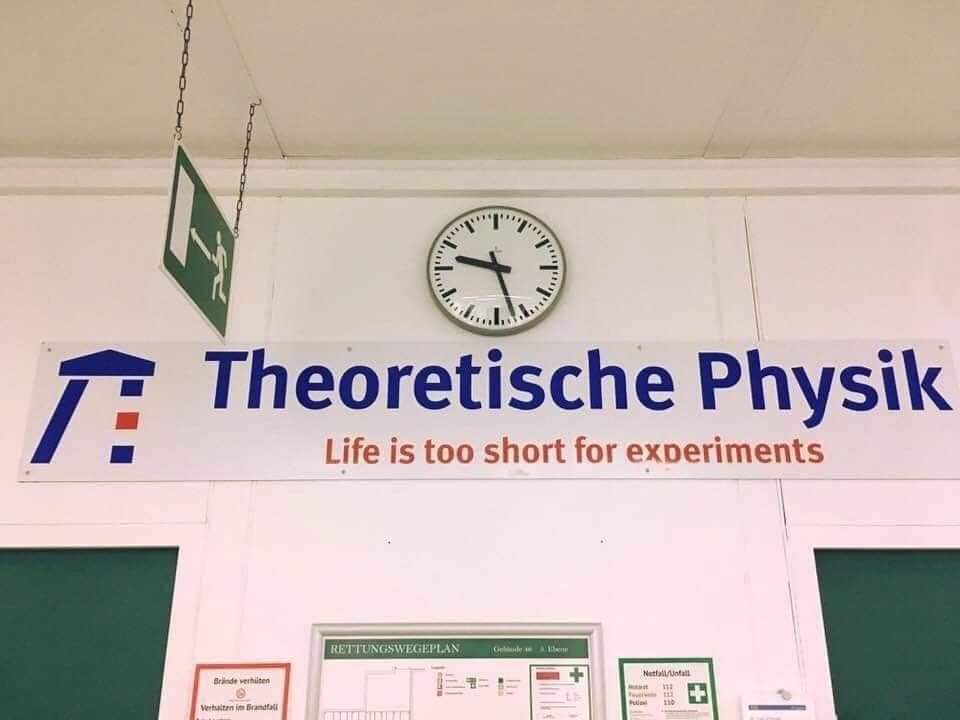
One big difference between our examinations in Theoretical Physics in Maynooth and those at other institutions I’ve taught at in the UK is that most of the papers here offer no choice of questions to be answered.  A typical format for a two-hour paper is that there are two long questions, each of which counts for 50 marks. Elsewhere  one normally finds students have a choice of two or three questions from four or five on the paper.

One  advantage of our system is that it makes it much harder for students to question-spot in the hope that they can get a good grade by only revising a fraction of the syllabus. If they’re well designed, two long questions can cover quite a lot of the syllabus for a module, which they have to in order to test all the learning outcomes. To accomplish this, questions can be split into parts that may be linked to each other to a greater or lesser extent to explore the connections between different ideas, but also sufficiently separate that a student who can’t do one part can still have a go at others. With such a paper, however, it is a  dangerous strategy for a student to focus only on selected parts of the material in order to pass.

As an examiner, the Maynooth style of examination also has the advantage that you don’t have to worry too much if one question turns out to be harder than the others. That can matter if different students attempt different questions, but not if everyone has to do everything.

But it’s not just the number of questions that’s important, it’s the duration. I’ve never felt that it was even remotely sensible for undergraduate physics examinations to be a speed test, which was often the case when I was a student. Why the need for time pressure? It’s better to be correct than to be fast, I think. I always try to set examination questions that could be done inside two hours by a student who knew the material, including plenty of time for checking so that even a student who made a mistake would have time to correct it and get the right answer. If a student does poorly in this style of examination it will be because they haven’t prepared well enough rather than because they weren’t fast enough.

The structure of the Maynooth examinations at more introductory level is rather different, with some choice. In my first year module on Mechanics & Special Relativity, for example, there is a compulsory first question worth 50 marks (split into several pieces) and then the students can pick two out of three shorter questions worth 25 marks each. This is a somewhat gentler approach than with the more advanced papers, partly adopted because we have quite a few students doing the General Science degree who taking Mathematical Physics as one of their 4 first-year subjects but will not be taking it further.

As both my examinations are not until next week, I’ll have to wait to find out how my students have done. This will be the examination taken at University level for most of my class, so let me take this opportunity to pass on a few quick tips.

  1. Try to get a good night’s sleep before the examination!
  2. Be ready well before the start and try to ensure you won’t be disturbed for the duration.
  3. If you’re doing an unsupervised examination
  4. Read the entire paper before starting to answer any questions. In particular, make sure you are aware of any supplementary information, formulae, etc, given in the rubric or at the end.
  5. Start off by tackling the question you are most confident about answering, even if it’s not Question 1. This will help settle any nerves.
  6. Don’t rush! Students often lose marks by making careless errors. Check all your numerical results on your calculator at least twice and – PLEASE – remember to put the units!
  7. Don’t panic! You’re not expected to answer everything perfectly. A first-class mark is anything over 70%, so don’t worry if there are bits you can’t do. If you get stuck on a part of a question, don’t waste too much time on it (especially if it’s just a few marks). Just leave it and move on. You can always come back to it later.

Oh, and good luck to anyone at Maynooth or elsewhere taking examinations in the next few weeks!

P.S. It snowed overnight in Maynooth, although only a centimetre or so…

And the most viewed paper at the Open Journal of Astrophysics in 2020 is…

Posted in Open Access, The Universe and Stuff with tags , , , , , , on January 6, 2021 by telescoper

Yesterday I was looking at the Publishing Analytics tool on the Open Journal of Astrophysics to see which paper(s) had attracted the most interest in 2020. The winner in terms of  page views is  this paper, A Beginner’s Guide to working with Astronomical Data. Here is a grab of the overlay:

You can find the arXiv version of the paper here.

The author is Markus Pössel of the Haus der Astronomie at the Max Planck Institute for Astronomy in Heidelberg (Germany). This is a long paper – 71 pages with over a hundred figures – that gives a comprehensive introduction to the various kinds of astronomical data and techniques for working with such data. This paper has obviously attracted a lot of interest from many different kinds of people, especially  students doing undergraduate projects involving astronomical data (and their supervisors). It has had more than three times as many views as the runner-up.

It’s interesting to note that this paper has not yet obtained any citations from academic papers through the Crossref system and it may never that because of the kind of paper it is. Nevertheless, I think this is a valuable resource for the astronomical community and I am very glad we published it. I do hope, however, that anyone who does use this paper does remember to cite it!

It is perhaps also worth mentioning that we do not track download statistics for the papers we publish. This is because the PDF files are held on the arXiv, which does not publish download statistics for individual papers.

Níl tuile dá mhéad nach dtránn

Posted in Biographical, Covid-19 on January 5, 2021 by telescoper

The title of this post is an old Irish saying that in English means “There’s no flood so high that it won’t recede”. The relentless increase in Covid-19 cases over the last few days is starting to make me wonder whether it is true.

Even with 7-day averaging and a logarithmic y-axis the rise looks very steep. On a linear y-axis the new cases look like this:

It’s even more dramatic without the 7-day smoothing:

The numbers for deaths on a linear scale look like this:

After doing extraordinarily well through the summer, things have gone very badly wrong. The standard measure using for comparing countries is the 14-day incidence rate per 100,000 population. On that measure Ireland is now on 674.4, with some counties over 1000 (Limerick, Louth and Monaghan). That’s not quite as bad as the latest figures for London, but getting there.

By staying in and reducing the number of contacts now we can influence what happens in a few weeks, but we know the results of Christmas and New Year infections haven’t fully filtered through into cases numbers yet, let alone deaths. It’s like standing on a beach watching an enormous wave coming at you and knowing you can’t do anything to get out of the way.

R.I.P. Sir Arnold Wolfendale (1927-2020)

Posted in Biographical, The Universe and Stuff with tags , , , on January 4, 2021 by telescoper

I’ve just heard the sad news that former Astronomer Royal Sir Arnold Wolfendale passed away on December 21st 2020 at the age of 93. There’s a full tribute to him here from Durham University, where he spent most of his very distinguished career as a cosmic ray physicist and played such an important role in developing a worldwide centre of excellence in Astronomy.

I remember Arnold Wolfendale very well from many trips to Durham over the years, starting with the SERC School for new postgraduate students in Astronomy I attended in 1985. He was an avuncular and extremely friendly presence there who went to a lot of trouble to talk to studdents; you can see him in the front row of the now (in)famous group photograph taken there:


Rest in peace, Sir Arnold Wolfendale (1927-2020)

Funding ‘Blue Skies’ Research in Ireland

Posted in Maynooth, Politics, Science Politics with tags , , , on January 4, 2021 by telescoper

Before Christmas, Ireland’s new Department for Further and Higher Education, Research, Innovation and Science embarked on a consultation about its strategy for 2021-23. Like most other departments, the Department of Theoretical Physics at Maynooth made a collective submission to this consultation and we await further developments. This blog post is not that submission. What follows here is my own rant personal view and not that of my colleagues. And before you accuse me of some kind of sour grapes I’ll point out that the Department of Theoretical Physics is actually doing very well in securing grant funding despite the difficult environment.

It has been very clear to me since arriving in Ireland that funding for basic or fundamental research – especially in the sciences – is extremely poor. This is not a new thing, but the current situation is largely the result of a high-level report published in 2012. This identified 14 priority areas of research that are most likely to give demonstrable economic and societal return, and where Ireland should focus the majority of competitive funding. Four criteria were used in selecting the 14 priority areas for future, competitively-awarded investment for economic objectives:

  1. the area is associated with a large global market or markets in which Irish-based enterprises already compete or can realistically compete;
  2. publicly performed R&D in Ireland is required to exploit the area and will complement private sector research and innovation in Ireland;
  3. Ireland has built or is building (objectively measured) strengths in research disciplines relevant to the area; and,
  4. the area represents an appropriate approach to a recognized national challenge and/or a global challenge to which Ireland should respond.

The `vast majority’ of SFI’s funding is directed towards the 14 areas so defined, leaving virtually nothing for anything else, an outcome which has dire implications for `blue skies’ research.

I think this is a deeply misguided short-term policy, which will have a strongly negative effect on science in Ireland in the medium to long term, especially because Ireland spends so little of its GDP on research in the first place. On top of that it will mean that Ireland will miss out on a golden opportunity to capitalise on Brexit, by encouraging European scientists disaffected by the hostile environment that has been created in Britain by its government’s xenophobic policies to relocate to Ireland. There’s simply no point in trying to persuade world-leading researchers to come to Ireland if insufficient funds are available to enable them to establish here; the politicians’ welcoming platitudes will never be enough.

I hope the Irish government can be persuaded to reverse this situation by investing more in basic research.
In the meantime I thought I’d re-iterate the argument I made a while ago, in response to a funding crisis in the UK, about using taxpayer’s money to fund research in universities:

For what it’s worth I’ll repeat my own view that “commercially useful” research should not be funded by the taxpayer through research grants. If it’s going to pay off in the short term it should be funded by private investors, venture capitalists of some sort or perhaps through some form of National Investment Bank. When the public purse is so heavily constrained, it should only be asked to fund those things that can’t in practice be funded any other way. That means long-term, speculative, curiosity driven research.

This is pretty much the opposite of what Irish government thinks. It wants to concentrate public funds in projects that can demonstrate immediate commercial potential. Taxpayer’s money used in this way ends up in the pockets of entrepreneurs if the research succeeds and, if it doesn’t, the grant has not fulfilled its stated objectives and the funding has therefore, by its own standards, been wasted.

My proposal, therefore, is to phase out research grants for groups that want to concentrate on commercially motivated research and replace them with research loans. If the claims they make to secure the advance are justified, they should have no problem repaying the funds from the profits they make from patent income or other forms of exploitation. If not, then they will have to pay back the loan from their own funds (as well as being exposed as bullshit merchants). In the current economic situation the loans could be made at very low interest rates and still save a huge amount of the current research budget for higher education. I suggest these loans should be repayable in 3-5 years, so in the long term this scheme would be self-financing. I think a large fraction of research in the applied sciences and engineering should be funded in this way.

The money saved by replacing grants to commercially driven research groups with loans could be re-invested in those areas where public investment is really needed, such as purely curiosity-driven science. Here grants are needed because the motivation for the research is different. Much of it does, in fact, lead to commercial spin-offs, and when that happens it is a very good thing, but these are likely to appear only in the very long term. But just because this research does not have an immediate commercial benefit does not mean that it has no benefit. For one thing, it is subjects like Astronomy and Particle Physics that inspire young people to get interested in science in the first place. That such fields are apparently held in so low regard by the Government can only encourage Ireland’s brightest young minds to pursue careers abroad.

Last Day Off

Posted in Biographical, Covid-19, Education, Maynooth on January 3, 2021 by telescoper

Tomorrow is officially my first day back at work after the Christmas break. Not that I’ll be going back to my office on campus in the morning. Thanks to the state of the Covid-19 pandemic I will be working from home for the foreseeable future. It’s looking pretty grim at the moment, and I think it’s going to get a lot worse before it gets better:


I know I’m not alone in thinking that it was a big mistake to relax the Covid-19 restrictions so soon before Christmas with cases at such a high level. What has happened since then in terms of new cases and hospitalizations is even worse than the experts predicted; today almost 5000 cases were reported, taking the total past 100,000. I hope the current Government is properly held to account for the way it bowed to pressure from vested interests (especially the so-called “hospitality industry”) the way it did.

I haven’t read my work emails since the end of last term (December 18th 2020). I do hope I don’t have to work through a mountain of them when I finally open my inbox tomorrow morning. No doubt as  we get back to work there will be detailed instructions on what we can and can’t do. Semester Two of teaching in Maynooth doesn’t start until February 1st so we have a bit of time to see how things progress, but I honestly can’t see any prospect of a return to on-campus classes for the rest of the academic year. I do hope we’re not going to be required to make yet another set of elaborate plans that will never be put into practice…

At least this term I will be “working from home” in better conditions than previously, in my own house with a good internet connection and a proper study that I can close the door on when I need a break. I’ll be teaching three modules next Semester, including one (Advanced Electromagnetism) that I’ve never taught before. Teaching isn’t the only thing, but the other important matters to be dealt with this month are not things I can really write anything about at this stage.

The January examination period starts on Friday (8th) and ends two weeks later (Friday 22nd) so getting through that and getting the examinations marked is going to be the first priority. As in May all these examinations will be in the form of online assessments. We have done this sort of examination before, which makes it a bit easier than last year, but they still cause a lot of stress for staff and students alike. I will have about 100 scripts to mark and will have to do all of them on screen. I’m not looking forward to that at all, but it has to be done. In between those we will be running our first Astrophysics & Cosmology Master Class, which I am looking forward to enormously. It seems to have generated a lot of interest, but we won’t know precisely how many will tune in until the day arrives. It might be a lot if the Schools are closed, which they may be.

I was tempted at this point to make a list of all the things I have to do tomorrow, but that would be breaking my resolution to take a complete break so I will leave that until the morning and instead go and have a nap.

The Day of Perihelion

Posted in The Universe and Stuff with tags , , , , , , , , on January 2, 2021 by telescoper

Earth’s elliptical orbit viewed at an angle (which makes it look more eccentric than it is – in reality is very nearly circular).

Today (Saturday 2nd January 2021) at approximately 13:50 GMT the Earth reaches at the point on its orbit, which which it is at its closest to the Sun, i.e. at its perihelion. At this time the distance from the Sun’s centre to Earth’s centre will be 147,093,163 km. This year, aphelion (the furthest distance from the Sun) is at 23.57 GMT on July 5th 2021 at which point the centre of the Earth will be 152,100,527 km from the centre of the Sun. You can find a list of times and dates of perihelion and aphelion for future years here.

At perihelion the speed of the Earth in its orbit around the Sun is greater than at aphelion (about 30.287 km/s versus 29.291 km/s). This difference, caused by the Earth’s orbital eccentricity, contributes to the difference between mean time and solar time I blogged about when discussing the Winter Solstice a couple of weeks ago.

It surprises me how many people think that the existence of the seasons has something to do with the variation of the Earth’s distance from the Sun as it moves in its orbit. The fact that perihelion occurs in the depth of winter should convince anyone living in the Northern hemisphere that this just can’t be the case, as should the fact that it’s summer in the Southern hemisphere while it is winter in the North.

The real reason for the existence of seasons is the tilt of the Earth’s axis of rotation. I used to do a little demonstration with a torch (flashlight to American readers) to illustrate this when I taught first-year astrophysics. If you shine a torch horizontally at a piece of card it will illuminate a patch of the card. Keep the torch at the same distance but tilt the card and you will see the illuminated patch increase in size. The torch is radiating the same amount of energy but in the second case that energy is spread over a larger area than in the first. This means that the energy per unit area incident on the card is decreases when the card is tilted. It is that which is responsible for winter being colder than summer. In the summer the sun is higher in the sky (on average) than in winter. From this argument you can infer that the winter solstice not the perihelion, is the relevant astronomical indicator of winter.

That is not to say that the shape of the Earth’s orbit has no effect on temperatures. It may, for example, contribute to the summer in the Southern hemisphere being hotter than in the North, although it is not the only effect. The Earth’s surface possesses a significant North-South asymmetry: there is a much larger fraction of ocean in the Southern hemisphere, for example, which could be responsible for moderating any differences in temperature due to insolation. The climate is a non-linear system that involves circulating air and ocean currents that respond in complicated ways and on different timescales not just to insolation but to many other parameters, including atmospheric composition (especially the amount of water vapour).

The dates when Earth reaches the extreme points on its orbit (apsides) are not fixed because of the variations in its orbital eccentricity so, in the short-term, the dates can vary up to 2 days from one year to another. The perihelion distance varies slightly from year to year too.

There is however a long-term trend for perihelion to occur later in the year. For example, in 1246, the December Solstice (Winter Solstice for the Northern Hemisphere) was on the same day as the Earth’s perihelion. Since then, the perihelion and aphelion dates have drifted by an average of one day every 58 years and this trend will continue. This means that by the year 6430 the timing of the perihelion and the March Equinox will coincide, although I will probably have retired by then…

The New Year’s Old Year Blog Statistics

Posted in Biographical on January 1, 2021 by telescoper

Here we are then, in 2021. Good riddance to 2020. I thought I’d see in the New Year by following the tradition of doing a quick blog about this blog.

Once upon a time, in the good old days, in the dim and distant past, WordPress used to publish an annual statistical summary page for its bloggers, but it has discontinued that practice so now I’ll just write my own brief summary based on the data available via the usual dashboard.

For those interested this blog got 350,765 hits last year, an average of just under a 960 a day. That’s up by 10,732 (or about 3.2%) on last year. Interest in this blog is way down from the dizzy heights of 2012 when I got 464,221 page views. Interestingly, 2020 was the first year ever in which there were more hits on this blog from the USA (113,596) than the UK (101,981). Germany and Ireland take third and fourth place in the blog hits table.

Incidentally, there are 1659 current followers of In The Dark on WordPress itself. These are fellow bloggers who use the built-in reader to access posts. I don’t know whether or not these are counted in the above web traffic statistics.

In 2020 there were 2487 comments, also up on last year and in the same era posts received 1898 ‘likes’; that’s a big increase on last year’s figure. The most liked category, incidentally, was Poetry. In case you’re interested the most popular post published in 2020 was this one, on Clifford’s Space-Theory of Matter.

Altogether, since this blog started in 2008 to the end of 2020, it has been viewed about 4,486,045 times by about 1.65 million unique visitors (though, obviously, all my visitors are unique).

P. S. As of today, January 1st 2021, readers in the United Kingdom wishing to view this blog are required to use Netscape.

End of Year Thoughts

Posted in Biographical, Covid-19, Maynooth, Poetry on December 31, 2020 by telescoper

The Royal Canal, Maynooth, looking towards the Railway Station; the harbour is on the right.

The last morning of 2020 found Maynooth covered in a light dusting of snow. Since then the snow has turned to sleet and rain and the town looks a bit less picturesque as a consequence, not least because we haven’t really seen any proper daylight. My trip out this morning was a rare excursion from my house, but I’m glad I was able to get a bit of fresh (though freezing) air without there being lots of people around. I’ll be sitting cosily at home for the rest of the day (and, probability, tomorrow).

It’s extraordinary to think that this time last year there wasn’t an inkling of what was to come in terms of the Coronavirus pandemic. The first cases had been detected in China in December 2019 but I don’t think anyone seriously thought it would go global in the way it did. A year on and we’re still not out of it. Not by a long way. I think this are going to get a lot worse before they get better, but at least there are vaccines on the way.

Looking back over some of my posts from early in the year I’m reminded of two  events in particular- the 200th Anniversary Dinner of the RAS Club in January and the Irish General Election in February, both of which seem now to have happened at least a decade ago. I went to London again in mid-February, but had to cancel my planned trip back to the UK in March because FlyBe went bust. After that I made a couple of trips to Dublin (including a performance of Fidelio)  but since then I haven’t left Maynooth. It’s extremely likely that by March 2021 I will have spent an entire year without leaving the boundaries of Maynooth.

It’s almost a whole year since I posted a list of things I wanted to do in 2020. The first three were:

    1. Go to more live concerts.
    2. See more of Ireland.
    3. No more working weekends

That went well then! I don’t think I’ll bother making a list for next year, or perhaps I’ll just carry over this year’s. Obviously the Covid-19 restrictions and vastly increased workload involved in switching teaching to online put paid to most of my plans for 2020. Although I did manage to buy a house in Maynooth, I will have to wait until the Third Wave is over before I can retrieve the rest of my belongings from Wales and relocate fully.

Although I didn’t make an impact in this year’s Beard of the Year (finishing in last place in the final poll), at least I have the honour of being St Patrick’s Day Beard of Ireland for 2020.

You have to take what positives you can but I’m sure I’m not the only person to think, on balance, this has been a spectacularly awful year. I haven’t myself had Covid-19 but I know people who have and some of them are still struggling with the after-effects. I know many have also lost loved ones to the Coronavirus; condolences to everyone so affected. Although nothing to do with Covid-19, I still feel a very deep sadness that my former thesis supervisor John Barrow is no more. I hope after the pandemic there can be some form of proper tribute to him.

Anyway, to end with, here are a few verses from In Memoriam, by Alfred Lord Tennyson:

Ring out the old, ring in the new,
Ring, happy bells, across the snow:
The year is going, let him go;
Ring out the false, ring in the true.

Ring out the grief that saps the mind,
For those that here we see no more;
Ring out the feud of rich and poor,
Ring in redress to all mankind.

Ring out false pride in place and blood,
The civic slander and the spite;
Ring in the love of truth and right,
Ring in the common love of good.

Ring out old shapes of foul disease;
Ring out the narrowing lust of gold;
Ring out the thousand wars of old,
Ring in the thousand years of peace.

Level 5 New Year

Posted in Biographical, Covid-19, Maynooth with tags , on December 30, 2020 by telescoper

To nobody’s surprise the Taioseach this evening announced that the whole of Ireland would go immediately into full Level 5 Covid-19 restrictions. Officially these will apply until January 31st, but nobody thinks they will end then. Nor should they. The past few days have seen the number of cases and hospitalizations skyrocket and the current positivity rate of tests is 10.5% (7-day average) with a figure of 18% recorded yesterday.

Here are the latest plots of 7-day averages. First, logarithmic:

Second, linear:

I’m not alone in thinking that it was a very big mistake to relax the restrictions in early December, but that’s done now and we have to deal with the situation as it is now. Unfortunately the Christmas wave hasn’t really hit these figures yet so I think thinks are going to get a lot worse before they get better. The current exponential phase with a R number of around 1.6-1.8 means the cases will probably double by this time next week.

Anyway, looks like a quiet night in for New Year’s Eve (not that I mind that) and my horizon for January is back down to a 5km radius, although its centre has shifted a little as I have moved house since last time!