Cosmology Talks: Eiichiro Komatsu & Yuto Minami on Parity Violation in the Cosmic Microwave Background

Posted in Cardiff, Maynooth, The Universe and Stuff with tags , , , , , , , , on December 2, 2020 by telescoper

It’s time I shared another one of those interesting cosmology talks on the Youtube channel curated by Shaun Hotchkiss. This channel features technical talks rather than popular expositions so it won’t be everyone’s cup of tea but for those seriously interested in cosmology at a research level they should prove interesting.

In this video, Eiichiro Komatsu and Yuto Minami talk about their recent work, first devising a way to extract a parity violating signature in the cosmic microwave background, as manifested by a form of birefringence. If the universe is birefringent then E-mode polarization would change into B-mode as electromagnetic radiation travels through space, so there would be a non-zero correlation between the two measured modes. They  try to measure this correlation using the Planck 2018 data, getting  a 2.4 sigma `hint’ of a result.

A problem with the measurement is that systematic errors, such as imperfectly calibrated detector angles,  could mimic the signal. Yuto and Eiichiro’s  idea was to measure the detector angle by looking at the E-B correlation in the foregrounds, where light hasn’t travelled far enough to be affected by any potential birefringence in the universe. They argue that this allows them to distinguish between the two types of measured E-B correlation. However, this is only the case if there is no intrinsic correlation between the E-mode and B-mode polarization in the foregrounds, which may not be the case, but which they are testing. The method can be applied to any of the plethora of CMB experiments currently underway so there will probably be more results soon that may shed further light on this issue.

Incidentally this reminds me of Cardiff days when work was going on about the same affect using the Quad instrument. I wasn’t involved with Quad but I do remember having interesting chats about the theory behind the measurement or upper limit as it was (which is reported here). Looking at the paper I realize that paper involved researchers from the Department of Experimental Physics at Maynooth University.

P. S. The paper that accompanies this talk can be found here.

Arecibo Collapse

Posted in Uncategorized with tags on December 1, 2020 by telescoper

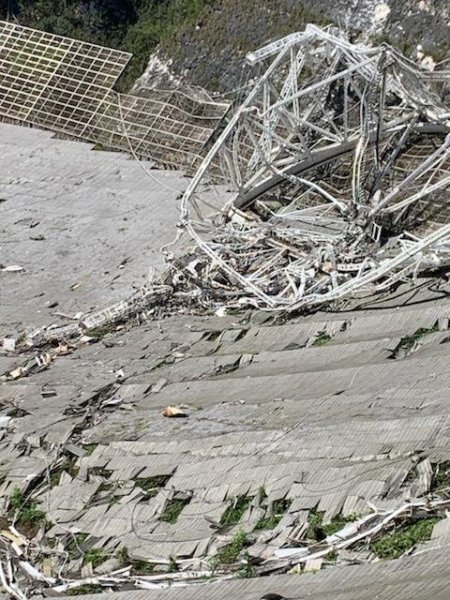
I posted recently about the decision to close the iconic radio telescope at Arecibo. Well it seems the end has come more quickly than anticipated.

The instrument platform (which weighed 820 tonnes), normally suspended at a height of 150m, has crashed down into the dish causing catastrophic destruction.

Fortunately nobody was hurt. The telescope is however a goner.

P. S. For bonus marks, calculate the energy released by the collapse.

Three Years in Maynooth

Posted in Biographical with tags , , on December 1, 2020 by telescoper

It’s 1st December 2020 which means that it’s now been three whole years since I started my job as Professor of Theoretical Physics in the Department of Theoretical Physics at Maynooth University, in County Kildare in the Irish Republic.

Until the Summer of 2018 I was working part-time at Cardiff and part-time in Maynooth, which required a lot of flying to and from between Wales and Ireland.  That situation would have been impossible to sustain during the pandemic for reasons of quarantine and also because FlyBe went bust. The timing of my move to Maynooth was providential in many ways apart from that.

I didn’t think it would take me the best part of three years to buy a house in Ireland, but owing to a combination of circumstances it took until the end of this summer to do that. Still, all’s well that ends well and I’m very happy with my home.

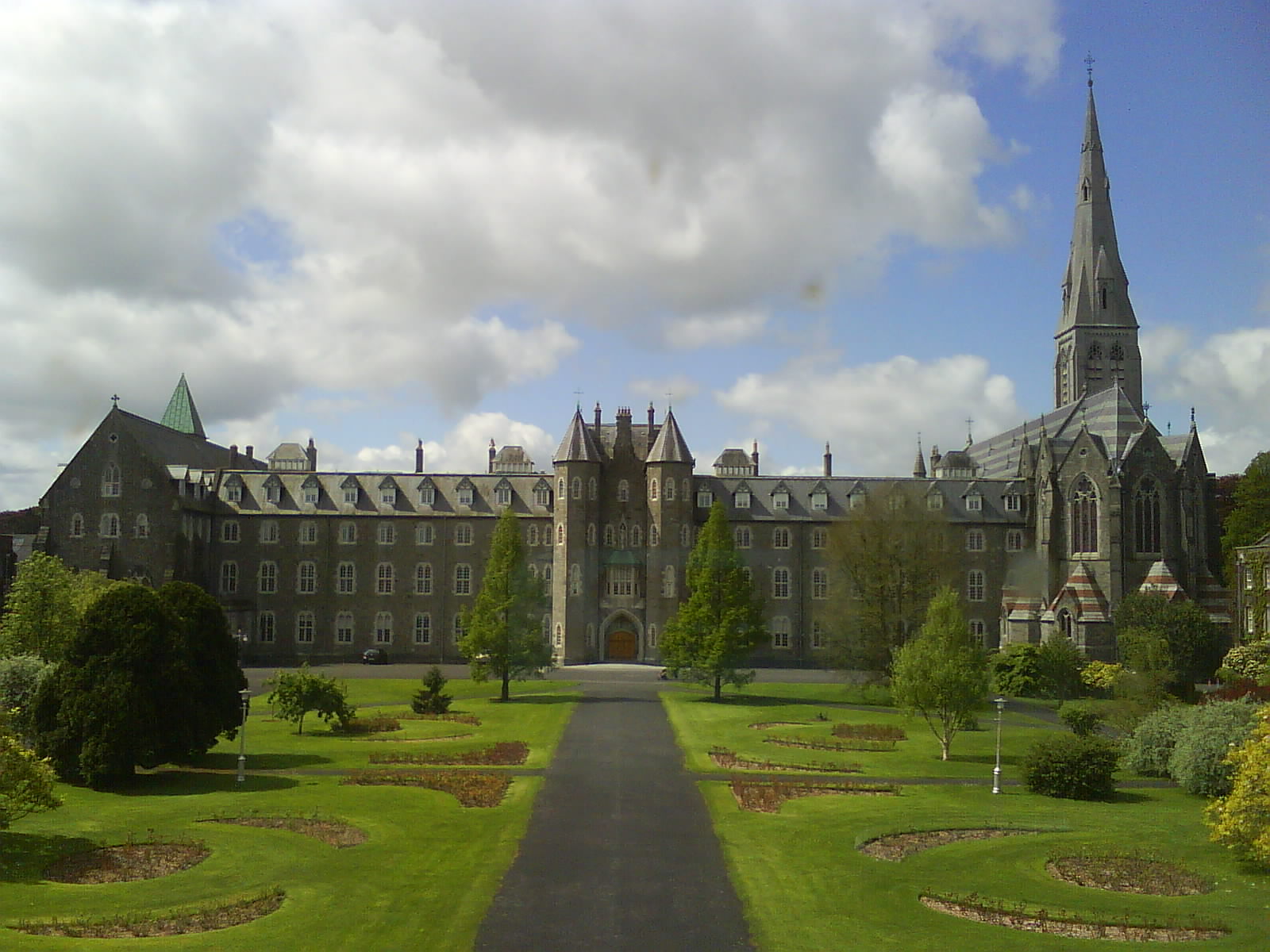
When I first arrived in Maynooth I stayed in St Patrick’s House (above), part of the Roman Catholic seminary on Maynooth University’s South Campus. I took this picture of the corridor I was on the night I arrived because it reminded me of  The Shining:

The arrival of the Covid-19 Pandemic earlier this year has been another completely unexpected development. I wonder what fate has next in store?

“And” Time Draws Nigh

Posted in History, Poetry, The Universe and Stuff with tags , , , , , , , on November 30, 2020 by telescoper

It’s November 30th 2020, which means we have just three teaching weeks to go until the end of term. I am currently teaching two modules: Mechanics 1 and Special Relativity for first-year students and Vector Calculus and Fourier Series for second years. We’re now getting to the “and” bit in both modules.

I didn’t want to present the two topics mentioned in the title of the second year module as completely disconnected, so I decided to link them with a lecture in which I use the divergence theorem of vector calculus to derive the heat equation, the solution of which led Joseph Fourier to devise his series in Mémoire sur la propagation de la chaleur dans les corps solides (1807), a truly remarkable work for its time that inspired so many subsequent developments.

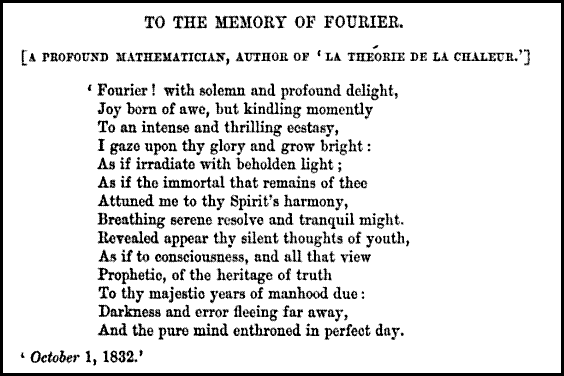
That gives me an excuse to repost the following “remarkable” poem about Fourier by William Rowan Hamilton:

In the first-year module I will be spending most of this week talking about potentials and forces before starting special relativity next week, at the proper time.

This day and age we’re living in
Gives cause for apprehension
With speed and new invention
And things like fourth dimension
Yet we get a trifle weary
With Mr. Einstein’s theory
So we must get down to earth at times
Relax relieve the tension
And no matter what the progress
Or what may yet be proved
The simple facts of life are such
They cannot be removed

As time goes by, the other thing drawing nigh is the loosening of Ireland’s current Level 5 Covid-19 restrictions which were imposed about six weeks ago though, judging by the crowds drinking in Courthouse Square on Saturday night, a lot of folks have thrown the rules out the window already.

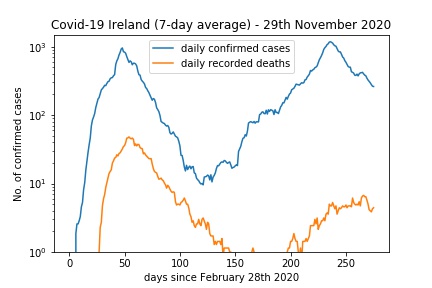
I think it’s a dangerous time. The daily cases are still hovering around the 250-300 mark and will undoubtedly start climbing even before Christmas itself:

The chances of us getting back to anything resembling normality during the early part of next year are exceedingly slim.

Bill Bailey, David Olusoga & Michael Rosen head Beard of the Year 2020 shortlist

Posted in Beards on November 29, 2020 by telescoper

It’s almost time for the voting to start for Beard of the Year 2020. By virtue of being voted Beard of Ireland way back in March I qualified for the shortlist of eight. This year’s field is very strong, but I reckon I’ll be a good contender for eight place.

Voting this time will be via Twitter, as the following post explains.

kmflett's avatarKmflett's Blog

Beard Liberation Front

29th November

Contact BLF Organiser Keith Flett 07803 167266

Bill Bailey, David Olusoga & Michael Rosen head Beard of the Year 2020 shortlist

The Beard Liberation Front, the informal network of beard wearers has announced the final shortlist for the Beard of the Year 2020.

The list consists of eight names after two ‘trim-off’ votes shaved the longlist of twelve names

There will now be two ‘Beard-Off’ votes for Beard of the Year 2020 which will open on 14th December and close on 22nd December. The winners of each vote will face each other for a final Beard of the Year vote on 23rd and 24th December.

Beard of the Year will be announced on 28th December.

BLF Organiser Keith Flett said, we’ve made some changes to the way the Beard of the Year vote runs for 2020. We’ve moved the vote to…

View original post 74 more words

A Problem of Resistance

Posted in Cute Problems with tags , on November 29, 2020 by telescoper

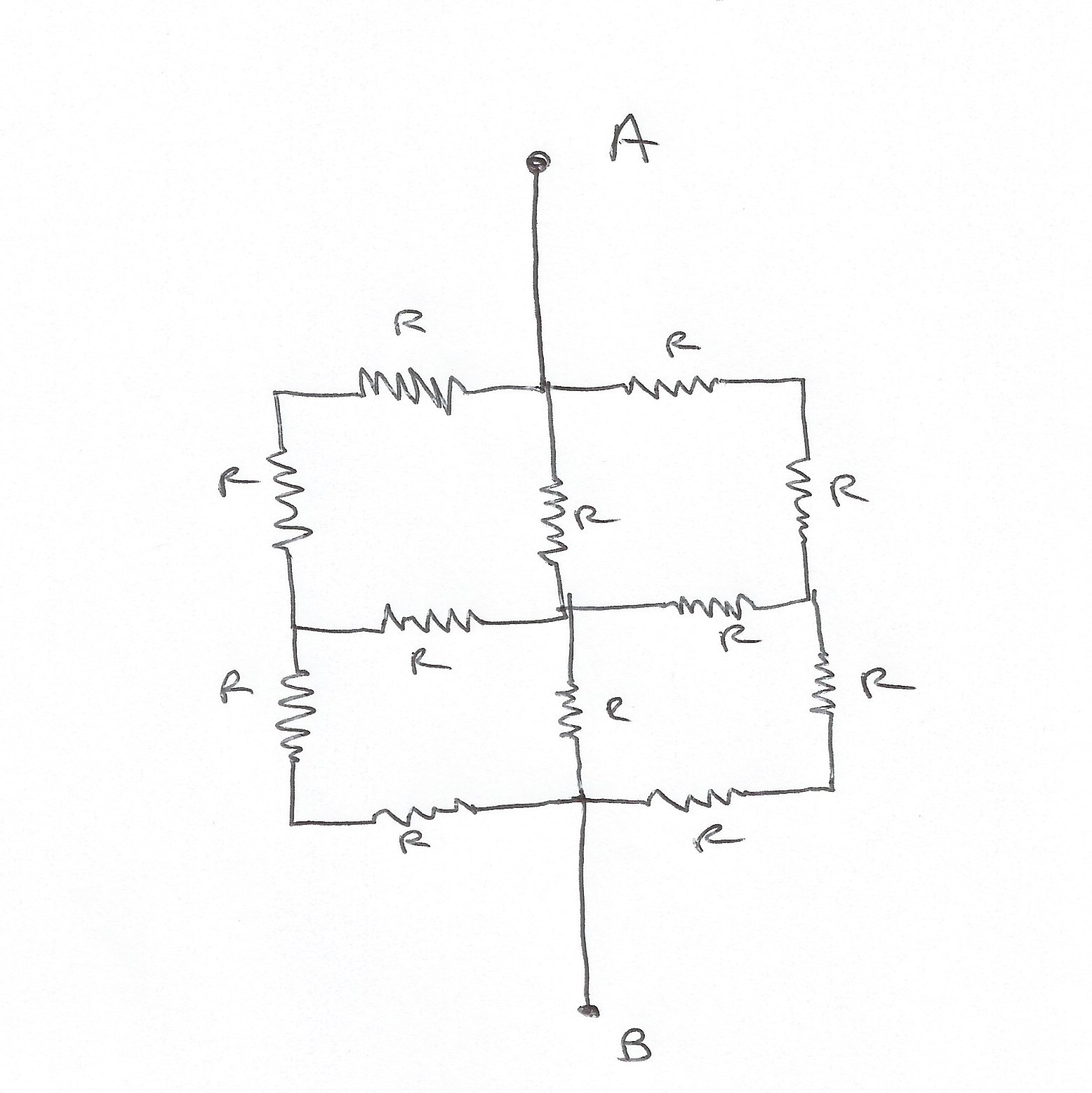
Bizarrely, last night I dreamt of this physics problem. This mean that I’ve seen it before somewhere, but if that’s the case then I’ve forgotten where. In the dream the problem of electrical resistance was muddled up with the problem of how to calculate the Euler Characteristic of a structure defined on a grid*, which is something I have used in the past. Anyway, with apologies for the poor quality of the drawing, here is the set up.

Twelve identical resistors R are arranged in four squares with common edges thus:

Yes, they’re meant to be identical squares!

What would be the effective resistance of this circuit measured between A and B?

Please post your answers through the comments box, with appropriate explanations. Bonus marks for elegant (i.e. short) solutions.

(In my dream this problem came up in contrast with the case where the four internal resistors and their connecting wires were absent, so the circuit was just a ring.  The Euler Characteristic of the original connected set of squares is 1 while that of the ring is 0, not that it’s relevant to the problem in hand!)


Et in Arcadia…

Posted in Art with tags , on November 28, 2020 by telescoper

“It says ‘Top Shop’…”

I doubt if anyone will get the joke without a hint.

Virtually Open Saturday at Maynooth

Posted in Education, Maynooth on November 28, 2020 by telescoper

Today is the second of two consecutive Virtual Open Days here at Maynooth University so here I am sitting in front of my computer at home on a Saturday morning answering questions from prospective students about Theoretical Physics courses. The first day was more about clubs and societies and other aspects of student life at Maynooth so I wasn’t involved so much in that. Today is about courses of study so I’m here fielding questions for my Department.

With about an hour gone since we opened at 10am it’s been quite busy, but at least I’ve either known, or had access to, the information needed to be able to answer the questions asked! So far. If questions keep coming at the same rate for the next three hours I’m going to need quite a lot of coffee to keep me going!

At least I can do this from the comfort of my own home. It’s a rather cold and miserable day outside. The weather turned much colder a couple of days ago, and the temperature was below freezing last night. There was a hard frost covering my garden when I got up this morning. Winter draws on.

Anyway, I’ll be online until 2pm, which fortunately will give me plenty of time to do some things I need to do before watching the Semi-final of the All Ireland Senior Hurling Championship between Waterford and Kilkenny, which starts at 6pm…

UPDATE: It was a remarkable game of hurling, Waterford looking dead and buried at half time but turning it around in amazing fashion  in the second half to win 2-27 to 2-23. Greatest comeback since Lazarus.

Swinging on the Säckpipa

Posted in Jazz with tags , , on November 27, 2020 by telescoper

And now for something completely different.

This is Swedish musician Gunhild Carling out front of a swinging big band on the open-air stage at Central Park, New York, tearing it up on the bagpipes*.

You’re welcome.


(*to  be precise these are a kind of traditional Swedish bagpipes known as the säckpipa).


Cosmological Non-Linearities as an Effective Fluid

Posted in The Universe and Stuff with tags , , , , , , , on November 27, 2020 by telescoper

We know our Universe is inhomogeneous, comprising regions of high density (galaxies and clusters of galaxies) as well as regions of much lower density (e.g. cosmic voids). Our standard cosmological models are based on exact solutions of Einstein’s equations of general relativity that assume homogeneity and isotropy. The general assumption is that if we confine ourselves to large enough scales the effect of the clumpiness of matter can either be disregarded or treated using perturbation theory. As far as we can tell, that approach works reasonably well but we know it must fail on smaller scales where the structure is in the non-linear regiome where it can’t be described accurately using perturbation theory because the fluctuations are so large.

From time to time I’ve idly wondered whether it might be possible to understand the effect of these non-linearities in general relativity by treating them as a kind of fluid with an energy-momentum tensor that acts as a correction to that of the perfect fluid form of the background cosmological model. This would have to be done via some sort of averaging so it would be an effective, coarse-grained description rather than an exact treatment. It is clear though that non-linearities would generate departures from the perfect fluid form, particularly resulting in off-diagonal terms in the energy-momentum tensor corresponding to anisotropic stresses (e.g. viscosity terms).

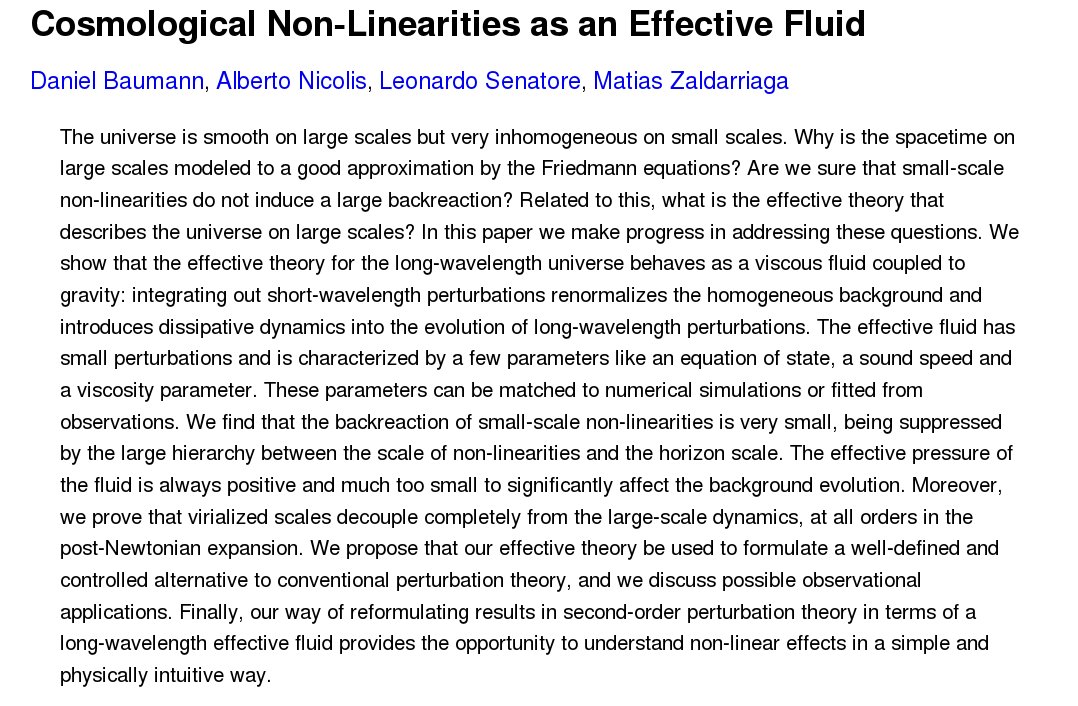
Anyway, a recent exchange on Twitter relating to a new paper that has just appeared revealed that far cleverer people than me had looked at this in quite a lot of detail a decade ago:

You can find the full paper here.

There are quite a lot of subtleties in this – how to do the spatial averaging, how to do the time-slicing, etc – which I don’t fully understand but at least I’m reassured that it isn’t a daft idea to try thinking of things this way!

P.S. The relativistic simulations reported in this paper could in principle be used to estimate the parameters mentioned in the abstract above, if that hasn’t been done before!