To Level Five?

Posted in Covid-19, Maynooth, Politics with tags , , on October 4, 2020 by telescoper

When I saw that 613 new cases of Covid-19 were recorded in Ireland on Saturday (3rd October) it seemed obvious that the situation in Ireland was getting out of control:

Note that on this graph the new cases have been growing in a roughly linear fashion for at least a month. Since the y-axis is logarithmic this means the growth of the pandemic is roughly exponential. The  7-day moving average up to and including Saturday was 448, with no sign of an end to the upward trend.

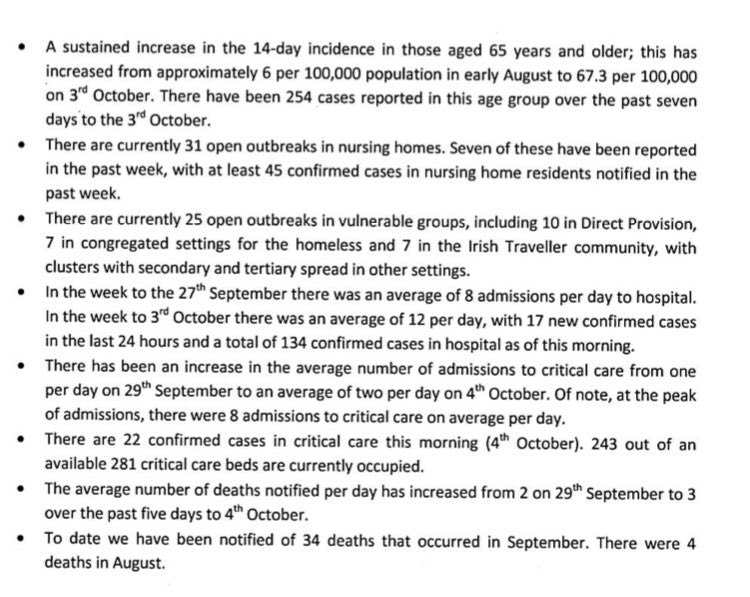
After a meeting yesterday, the National Public Health Emergency Team (NPHET) reviewed the following statistical developments:

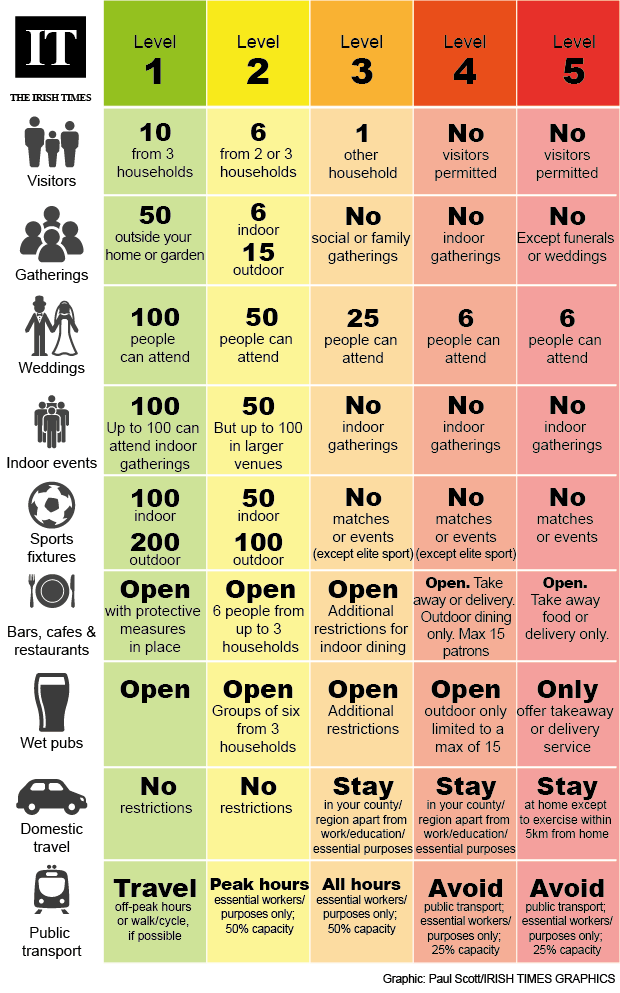
In the light of these it decided to recommend an immediate jump to the highest level of restrictions, Level 5, for the entire country:

Level Five isn’t quite the same as what happened in March, largely because Schools and Colleges are intended to remain open, but it means the same widespread shutdown of the private sector. This escalation is supposed to last at least 4 weeks.

This is of course a recommendation. The imposition of these measures is up to the Government, which has to balance public health measures against economic damage. Presumably will make a decision sometime this week. Will they have the guts to stand up against the hospitality industry?

The problem is that the Government announcing restrictions and people actually abiding by them are not the same thing at all. It only takes a few people to flout the rules for the pandemic to take hold once more, and while many people are behaving sensibly, there is ample evidence of people not doing so.

What this means for us at Maynooth University remains to be seen.


UPDATE: The Government this afternoon rejected the advice of NPHET and instead moved the country to Level 3. I hope they know what they’re doing.

Week Ending

Posted in Biographical, Covid-19, Maynooth on October 3, 2020 by telescoper

It’s the Saturday after a very tough week. At least I’ve got an excuse for lounging about at home because I’m waiting for a new bed to be delivered. Since I moved into my new house I’ve been sleeping in a single bed, in what will be the spare room, but when the bigger bed arrives I’ll be able to move into the main bedroom.

Last week was a tough one at work. Switching teaching online at short notice was only part of it. The building work that started late still isn’t finished so I’ve got more disruption from that to look forward to when I return to the Department on Monday.

I did at least get through the first week of online teaching. The newly installed Panopto system (which we used when I was in Cardiff) works very well, although the cameras are a bit limited. This system can webcast a lecture as well as recording it to be viewed later. I always assumed most students would watch the lectures after the event but as it turned out a majority actually viewed them live.

The sudden switch to online teaching was designed to restrict the number of students travelling to and from the University but nobody seems to have thought very much about those actually living on campus. In the case of Maynooth University that includes a sizeable fraction of first-year students whose first experience of university life is much poorer than in a normal year. I feel very sorry for this cohort but I suppose circumstances made this inevitable.

The official University line, as explained in an email (inevitably) sent out to Department Heads on Friday evening), is that teaching will be online at least until Study Week ( the week beginning 26th October). I think it’s overwhelmingly probable that we teach like this for the entire semester and there is a good chance that it will be the entire academic year. I think it would benefit us all, staff and students, if this decision were made now. There is no end in sight to Covid-19 and there is no point in pretending otherwise.

Update: the bed arrived this afternoon. It required “some self assembly”: though not on the scale of IKEA furniture that was quite hard work because the frame parts are very heavy. It’s done now though and I’m looking forward to sleeping in it tonight.

R.I.P. Derek Mahon (1941-2020)

Posted in Covid-19, Poetry with tags , , , , on October 2, 2020 by telescoper

The poet Derek Mahon has died, so it seems apt to pay tribute by posting some examples of his poetry.

This poem, Everything is going to be all right, was read on the main news on RTÉ television when the national lockdown was announced back in March, sounding a note of optimism to a worried nation. I’m not sure everything is going to be all right, but it’s an excellent poem:

How should I not be glad to contemplate
the clouds clearing beyond the dormer window
and a high tide reflected on the ceiling?
There will be dying, there will be dying,
but there is no need to go into that.
The poems flow from the hand unbidden
and the hidden source is the watchful heart.
The sun rises in spite of everything
and the far cities are beautiful and bright.
I lie here in a riot of sunlight
watching the day break and the clouds flying.
Everything is going to be all right.

Sadly he didn’t live to see the end of the pandemic. Over the years I have posted a few poems by Derek Mahon. Here are two more. This one is called The Thunder Shower

A blink of lightning, then
a rumor, a grumble of white rain
growing in volume, rustling over the ground,
drenching the gravel in a wash of sound.
Drops tap like timpani or shine
like quavers on a line.

It rings on exposed tin,
a suite for water, wind and bin,
plinky Poulenc or strongly groaning Brahms’
rain-strings, a whole string section that describes
the very shapes of thought in warm
self-referential vibes

and spreading ripples. Soon
the whispering roar is a recital.
Jostling rain-crowds, clamorous and vital,
struggle in runnels through the afternoon.
The rhythm becomes a regular beat;
steam rises, body heat—

and now there’s city noise,
bits of recorded pop and rock,
the drums, the strident electronic shock,
a vast polyphony, the dense refrain
of wailing siren, truck and train
and incoherent cries.

All human life is there
in the unconfined, continuous crash
whose slow, diffused implosions gather up
car radios and alarms, the honk and beep,
and tiny voices in a crèche
piercing the muggy air.

Squalor and decadence,
the rackety global-franchise rush,
oil wars and water wars, the diatonic
crescendo of a cascading world economy
are audible in the hectic thrash
of this luxurious cadence.

The voice of Baal explodes,
raging and rumbling round the clouds,
frantic to crush the self-sufficient spaces
and re-impose his failed hegemony
in Canaan before moving on
to other simpler places.

At length the twining chords
run thin, a watery sun shines out,
the deluge slowly ceases, the guttural chant
subsides; a thrush sings, and discordant thirds
diminish like an exhausted concert
on the subdominant.

The angry downpour swarms
growling to far-flung fields and farms.
The drains are still alive with trickling water,
a few last drops drip from a broken gutter;
but the storm that created so much fuss
has lost interest in us.

And this one, about the noble self-sacrifice of Captain Lawrence Oates,  is called Antarctica

‘I am just going outside and may be some time.’
The others nod, pretending not to know.
At the heart of the ridiculous, the sublime.
He leaves them reading and begins to climb,
Goading his ghost into the howling snow;
He is just going outside and may be some time.
The tent recedes beneath its crust of rime
And frostbite is replaced by vertigo:
At the heart of the ridiculous, the sublime.
Need we consider it some sort of crime,
This numb self-sacrifice of the weakest? No,
He is just going outside and may be some time
In fact, for ever. Solitary enzyme,
Though the night yield no glimmer there will glow,
At the heart of the ridiculous, the sublime.

Rest in Peace Derek Mahon (1941-2020)

New Publication at the Open Journal of Astrophysics!

Posted in OJAp Papers, Open Access, The Universe and Stuff with tags , , , , , , on October 2, 2020 by telescoper

Time to announce another new paper in the Open Journal of Astrophysics. The latest publication is by Amy Louca and Elena Sellentin, both of the Sterrewacht Leiden in the The Netherlands, and is entitled The impact of signal-to-noise, redshift, and angular range on the bias of weak lensing 2-point functions. This is another one for the Cosmology and Nongalactic Astrophysics folder.

Here is a screen grab of the overlay:

You can click on the image to make it larger should you wish to do so. You can find the arXiv version of the paper here.

We actually published this one a few days ago but there was a slight delay registering the metadata and also I was very busy, so this post is a little late. With this paper, we have published as many papers so far in 2020 as we did in 2019 so with several more in the pipeline this looks like being our busiest year

17 Postdoctoral Positions in Astronomy all at the same Institution!

Posted in The Universe and Stuff with tags , , on October 1, 2020 by telescoper

I know how difficult it is for budding astronomers to find postdoctoral positions, so when I saw that there are no fewer than 17 such positions have become available at the same time at the same institution – Instituto de Astrofísica de Canarias (IAC) on Tenerife (Spain) – I couldn’t resist sharing. Postdoc positions are a bit like buses: you can wait ages for one,  and then seventeen come along all at the same time!

Below you will find links these positions, most of which have deadlines at the end of October (except one with has 15th October, and one at the end of November). Applicants must have their PhD by the time of the application deadline.

The Galaxias 2020 post is in Johan Knapen’s group, and can be to work on deep imaging from LSST.

You will see that 12 of the 17 positions are for 4-year ‘Advanced Fellow’ positions, several of which are in the area of formation and evolution of galaxies. Other areas are Solar physics, exoplanets, stellar and interstellar physics, Milky Way and Local Group, and cosmology & astroparticles.

Other galaxies-related positions are the HARMONI and the ‘Estallidos’ ones; EUROCC is for supercomputing support.

– 12 contratos PS-2020-040 Advanced -Fellows SO 2020 (deadline: 31/10/20)
https://www.iac.es/en/employment/doce-contratos-postdoctorales-advanced-fellows-so-2020twelve-postdoctoral-contracts-advanced-fellows-so-2020-ps

– 1 contrato PS-2020-041 Galaxias 2020 (deadline: 31/10/20)
https://www.iac.es/en/employment/un-contrato-postdoctoral-galaxias-2020one-postdoctoral-contract-galaxias-2020-ps-2020-041

– 1 contrato PS-2020-043 HARMONI 2020 (deadline: 31/10/20)
https://www.iac.es/en/employment/un-contrato-postdoctoral-harmoni-2020one-postdoctoral-contract-harmoni-2020-ps-2020-043

– 1 contrato PS-2020-044 Astroparticulas-MAGIC 2020 (deadline 30/11/20)
https://www.iac.es/en/employment/un-contrato-postdoctoral-astroparticulas-magicone-postdoctoral-contract-astroparticulas-magic-2020-ps-2020-044

– 1 contrato PS-2020-045) EUROCC 2020 (deadline: 31/10/20)
https://www.iac.es/en/employment/un-contrato-postdoctoral-eurocc-2020one-postdoctoral-contract-eurocc-2020-ps-2020-045

– 1 contrato PS-2020-049 Estallidos 2020 (deadline: 15/10/20)
https://www.iac.es/en/employment/un-contrato-postdoctoral-estallidos-2020one-postdoctoral-contract-estallidos-2020-ps-2020-049


The Eyes to the Left

Posted in Biographical, Brighton, Mental Health with tags , , , , , , on October 1, 2020 by telescoper

One of the things I managed to squeeze in during these last hectic days was a visit to the optician. I hadn’t had my eyes tested since I lived in Brighton, probably more than five years ago, which is a bit long to leave it for one of my advanced years. Inevitably the test revealed that I needed new spectacles, though curiously one eye – the left – has changed much more than the other since my last test. My prescription has corrections for both astigmatism and myopia (short-sightedness) but these are both well corrected by varifocals, the type of glasses I have worn for some time. My new specs took just a week to arrive and I find reading much more comfortable wearing them than I did with my old ones.

I remember the first time I had to wear varifocals I found it quite difficult, especially looking down through the bottom half of the lens (which is where you are assumed to be looking when reading) as they make it difficult to judge the distance to the ground (or, more dangerously, exactly where the next stair is….). I found after a day or two I was used to the varying focus and now I think nothing of it.

Because it means that your eyes focus differently on horizontal and vertical lines, and that’s exactly how text is constructed, uncorrected astigmatism makes it difficult to read words and numbers at a distance. With varifocals you have to look through the top half of the lens, which is the bit that corrects the astigmatism, and move your point of view until you find the place where the optical performance is best. I’ve often found myself in the audience of a lecture moving my head in odd ways to try to find the best angle to read what’s on the screen. I hope it’s not too disconcerting for the speaker when I do that!

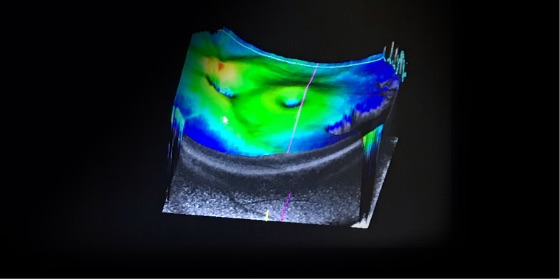
The most interesting bit of my visit to the optician however was that I had an optical coherence tomography scan which generate a three-dimensional picture of the back of the eyeball. I’ve never seen one of those before. Here’s an example (not me):

This type of scan can be used to diagnose things like glaucoma and diabetic retinopathy, neither of which I have. In my case though it did reveal a significant level of unevenness in the surface at the back of both eyes and some signs of swelling of or near the optic nerves. The optician showed me the scan and pointed out these abnormalities, but said that it wasn’t anything too worry too much about as he thought it was historical rather than progressive. He said the only time he’d seen anything like that was in the cases of people who had in the past had some form of trauma to the head (which can cause increased pressure inside and so damage the back of the eyes).

I’ve blogged before about the long term effects on my mental health of the beating I experienced in Brighton over thirty years ago, but this was the first time I’ve seen such clear evidence of the physical damage that I presume was caused by that event. In extreme cases I experience periods of exaggeratedly heightened awareness of things moving in my peripheral vision that I can’t keep track of, accompanied by auditory and visual hallucinations. I’m not an expert but it seems likely to me that what the scan revealed may play a role in these episodes. It doesn’t explain why they seem to be triggered by stress, though, so there must be other factors.

Over the years a number of people have remarked that I often have the blinds closed in my office during the day, and that as well as that as well as being varifocals the lenses I wear in my glasses are reaction lenses (i.e. they go dark in bright light). Avoiding bright light in such ways was suggested by an optician some years ago, who suspected I might have some form of retinal damage but couldn’t see anything definitive with the technology available then. It seems he was right!


Threshold, by R.S. Thomas

Posted in Poetry with tags , , , , on September 30, 2020 by telescoper

I emerge from the mind’s
cave into the worse darkness
outside, where things pass and
the Lord is in none of them.

I have heard the still, small voice
and it was that of the bacteria
demolishing my cosmos. I
have lingered too long on

this threshold, but where can I go?
To look back is to lose the soul
I was leading upwards towards
the light. To look forward? Ah,

what balance is needed at
the edges of such an abyss.
I am alone on the surface
of a turning planet. What

to do but, like Michelangelo’s
Adam, put my hand
out into unknown space,
hoping for the reciprocating touch?

by Ronald Stuart Thomas (1913-2000)


Teaching Improvisation

Posted in Biographical, Education, Maynooth with tags , , , on September 29, 2020 by telescoper

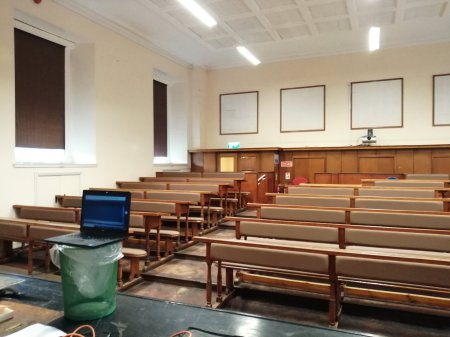
The sudden switch of all our teaching online on Friday has necessitated a certain amount of improvisation. I had intended to do my introductory session on Mechanics and Special Relativity to first-year students as a kind of interactive workshop using the blackboard in Physics Hall. When we were told to move everything online I thought I’d just do yesterday’s session from my office which has quite a good blackboard and a setup I had already tested. Unfortunately however an office refurbishment project I was assured would be finished before the start of teaching but which has barely started meant that yesterday there was constant hammering and drilling in the Department. That made it impossible to do an online lecture (or do anything else) in my office. I knew there would be nobody in Physics Hall, though, so I did the lecture there to an empty room.

The camera provided in that room is fixed to a monitor at once side of the theatre and is therefore useless for capturing the blackboard, so I used my laptop camera plus a handy litter bin to raise it up. It wasn’t great but was better than nothing.

You might ask why I don’t do this from home. The answer to that is that I haven’t yet got an internet connection in the new house, so I can do online activities from there.

You might also ask why a refurbishment job, which could have been completed at any point during the summer when the building was empty, has only just started now we’ve started teaching again. If I had an answer I would tell you. I think the six people whose offices are currently unusable would like to know too, though at least they can work from home. It’s tough enough trying to keep everything together these days without this.

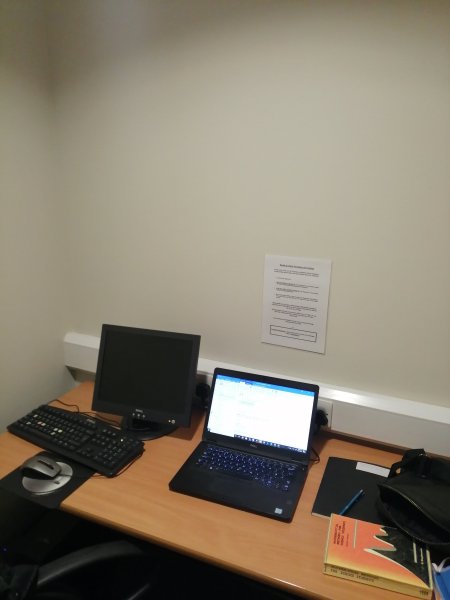
Fortunately today a colleague in the Department of Psychology found me a quiet place to work. It’s a small windowless cubicle normally used for experiments. At least it’s quiet. I think the next step will be a padded cell somewhere.

Memories of My First Paper

Posted in Biographical, The Universe and Stuff with tags , on September 28, 2020 by telescoper

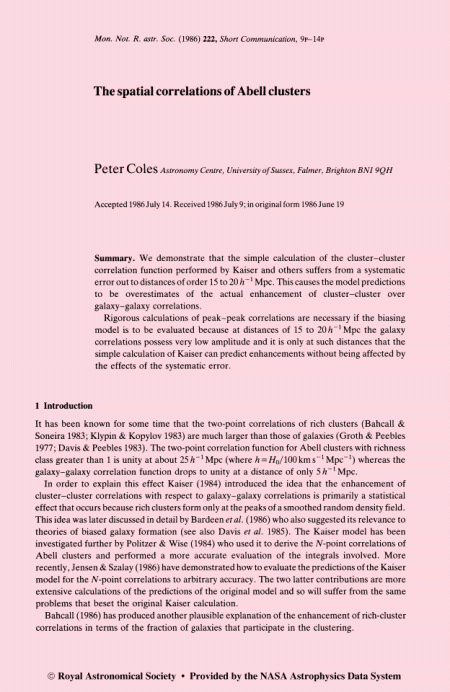
The death of John Barrow reminded me of a post I did some years ago about my first ever publication, which was published on 15th September 1986 while I was doing my DPhil at Sussex under John’s supervision. I’m mentioning
it hereby way of a postscript to yesterday’s piece.

Here is the front page:

mnras_paper

This was before the days of arXiv so there isn’t a copy on the preprint server, but you can access the whole article here on NASA/ADS.

All right. I know it’s a shitty little paper. But you have to start somewhere!

I’m particularly sad that, looking back, it reads as if I meant to be very critical of the Kaiser (1984) paper that inspired it. I still think that was a brilliant paper because it was based on a very original idea that proved to be enormously influential. The only point I was really making was that a full calculation of the size of the effect Nick Kaiser had correctly identified was actually quite hard, and his simple approximation was of limited quantitative usefulness. The idea was most definitely right, however.

I was just a year into my PhD  DPhil when this paper came out, and it wasn’t actually on what was meant to be the subject of my thesis work (which was the cosmic microwave background), although the material was related.

This paper provides two excellent illustrations of what a good supervisor John was. I was a bit stuck with the project that John had assigned me and eventually admitted to him that I was having problems getting anywhere. I thought he’d assume I was useless and suggest that someone else should supervise me. But no. He said he realised it was a hard problem and sometimes it’s good to think about something else when you’re stuck. So he asked me to look at cluster clustering for a bit. I told him what I found and he said I should write this up as a paper, which I did. Most importantly however the trick I used in simplifying the calculations in this paper turned out to be applicable to the first problem, hotspots in the cosmic microwave background, which led a success in the project and to my second paper. We were both delighted that everything turned out well with that original project.

My original draft of this first paper had John Barrow’s name on it, but he removed his name from the draft (as well as making a huge number of improvements to the text). At the time I assumed that he took his name off because he didn’t want to be associated with such an insignificant paper, but I later realized he was just being generous. It was very good for me to have a sole-author paper very early on. I’ve taken that lesson to heart and have never insisted – unlike some supervisors – in putting my name on my students’ work.

R.I.P. John D Barrow (1952-2020)

Posted in Biographical, The Universe and Stuff with tags on September 27, 2020 by telescoper

My heart is filled with sorrow as I find myself having to pass on some very sad news. I have just heard of the death, yesterday, at the age of 67, of esteemed physicist, mathematician, author and polymath John Barrow. With his passing, one of cosmology’s brightest lights has gone out.

John Barrow was my thesis supervisor. Words can’t express how much I owe him for his advice and encouragement not only during my graduate studies but also throughout the 35 years that have elapsed since I started my career, as a research student at Sussex University.

John had an extraordinary mind that combined immense mathematical gifts with an encyclopedic knowledge of all kinds of literature and a wonderful flair for writing. He wrote dozens of books and a theatre play as well as hundreds of scientific articles. He was a whirlwind of ideas who had an uncanny knack of finding clever ways to crack previously unsolved problems. That he was happy to share these ideas with his students is a credit to his intellectual generosity. He inspired dozens of researchers early in their careers and continued to inspire them when they became not so young.

On a personal level, John was rather reserved and, despite his being a talented and confident public speaker, I always felt he was a rather shy person. He was a committed Christian and a regular churchgoer though he didn’t talk much about his private religious beliefs in the Department.

It is also interesting that, despite writing a number of superb popular books, giving public lectures and being a regular guest on radio programmes he steadfastly refused to appear on television. He just didn’t want to become a TV celebrity, though I suspect that if he did he would have been rather good at it.

Although I didn’t see as much of him in recent years as I would have liked, John was a member of the RAS Club which gave me the opportunity to see and talk to him fairly frequently. I always found him a very agreeable dining companion. We usually discussed sport on such occasions rather than science, actually. John was a talented middle-distance runner in his younger days and he gave me a lot of advice about training, etc, when I started running marathons. We also shared an interest in football – at which he was rather good, having had a trial for Chelsea Juniors – and we played together quite a few times in Sussex days. I remember him as a quality midfielder with a terrific engine, though he was not a natural goalscorer.

John also had a very dry and sometimes lugubrious sense of humour. I remember sending him a congratulatory email in 2003 when I found out he had been made a Fellow of the Royal Society. He replied thanking me but pointing out his joy at having been elected was tempered by the fact that the first official communication he got from Carlton House was a rather substantial bill for the subscription and a form on which to enter details to be used in an obituary.

It was through the RAS Club that I first heard, about a year ago that John was suffering from cancer. For a time he responded well to treatment but a few weeks ago I heard that his condition had deteriorated to the extent that only palliative care was possible. That news came as a shock as he always seemed so healthy and ageless that one imagined him to be indestructible. Today’s news was not unexpected but still distressing. The end came more quickly than we imagined but at least he was at home among his loved ones when he passed away.

I send heartfelt condolences to Elisabeth and the rest of John’s family, and friends and colleagues at Cambridge and elsewhere.

UPDATE: An obituary of John, written by Michael Rown-Robinson, is now available online on the Guardian website.

Rest in peace, Professor John D Barrow FRS (1952-2020).