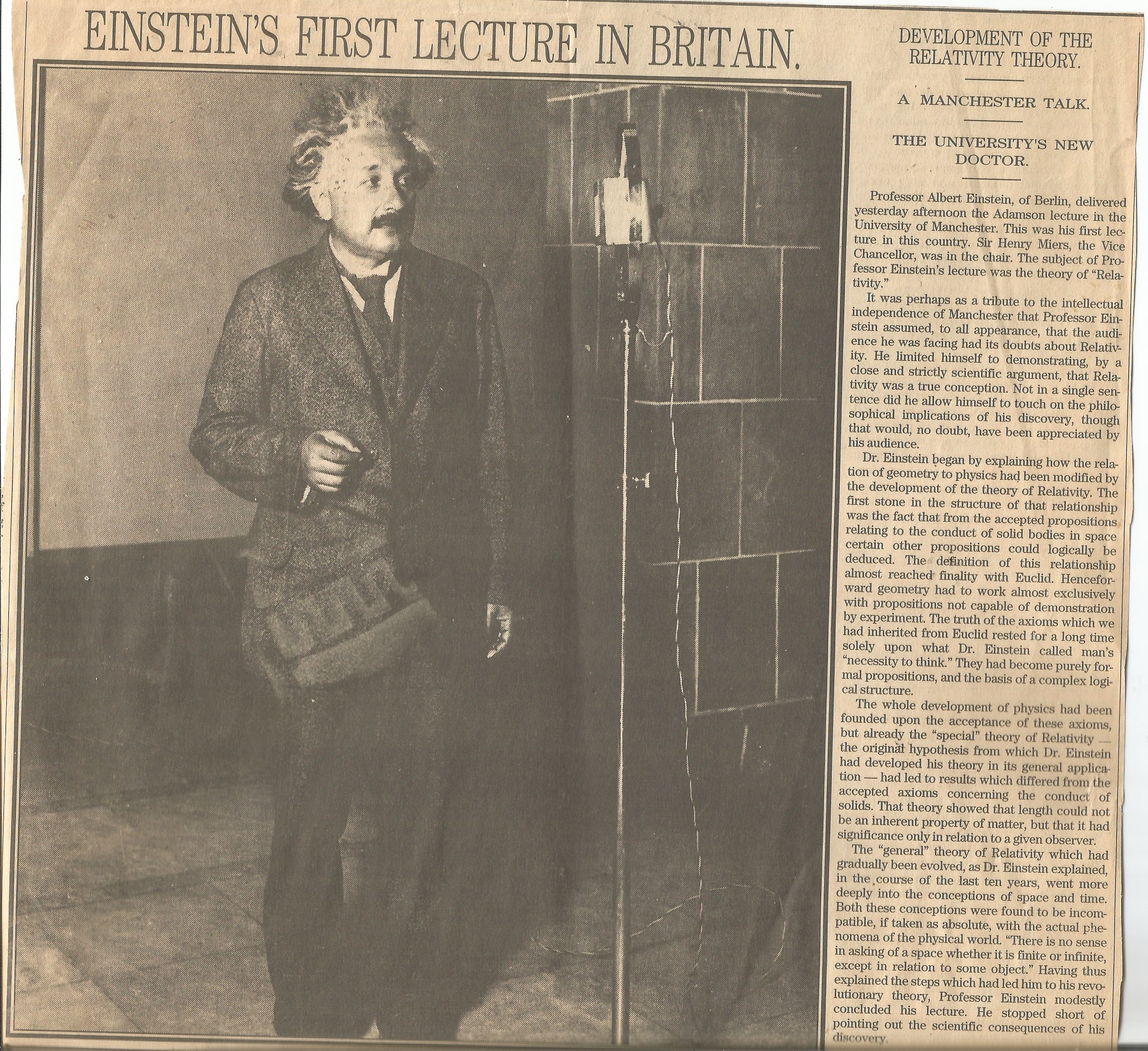
Tidying a few things up ahead of the start of term I discovered this old clipping, yellowed with age, and decided to scan it before it disintegrates entirely:
It is from the (then) Manchester Guardian which is now known as the Grauniad. The article is dated 1st October 1921, which implies that the talk must have been on the afternoon of Friday 30th September 1921. However, the University of Manchester website states that the talk was on June 9th 1921. During his visit, Einstein was awarded an Honorary Doctorate of Science by the University of Manchester, which is recorded here as having been presented on June 8th, so it appears the Guardian piece was published some time after the event. As usual, Einstein gave his lecture – to a packed house – entirely in German, as he did when he lectured in Nottingham almost a decade later.
Einstein was already famous by 1921 – largely thanks to the 1919 Eclipse results (see, e.g., here) – but it was still before he won his Nobel Prize (in 1922).
Anyway, the text down the right-hand side of the Guardian piece can be found here; it’s well worth reading!
On September 4th, when I posted a piece about the forthcoming Presidential Election in Ireland, I forgot to mention that just two days earlier was the 50th anniversary of the funeral of Éamon de Valera, founder of Fianna Fáil (one of the two largest political parties in Ireland) and architect of the Irish constitution, who died on 29th August 1975 at the age of 92. Here’s some coverage at the time by (British) Movietone News, the commentary is rather generous to him:
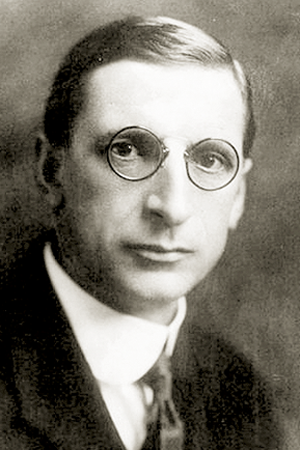
De Valera (nickname `Dev’) is an enigmatic figure, who was a Commandant in the Irish Republican Army during the 1916 Easter Rising, but despite being captured he somehow evaded execution by the British. There’s no evidence, incidentally, that he escaped the firing squad because he was born in America. Dev subsequently became Taoiseach (Prime Minister) and then President (Head of State) of the Irish Republic.
Eamon de Valera, photographed sometime during the 1920s.
There’s no question in my mind that de Valera is the most significant Irish politician of the 20th Century, which is not to say I fid him an agreeable figure at all and his legacy isn’t particularly positive. Nevertheless, his funeral was perhaps as significant event for the Irish as that of Winston Churchill had been for the British just a decade earlier.
Over the past couple of weeks RTÉ television broadcast a two-part documentary called Dev: Rise and Rule; the second part was on last night. It is quite nicely made, but disappointingly superficial and lacking in any real historical insight. The suggestion that it would “decode” Dev was unfulfilled. This is a pity because RTÉ often does good documentaries.
Anyway, this gives me an excuse to mention again, Dev’s connection with Maynooth. De Valera was a mathematics graduate, and for a short time (1912-13) he was Head of the Department of Mathematics and Mathematical Physics at St Patrick’s College, Maynooth, which was then a recognised college of the National University of Ireland. The Department became incorporated in Maynooth University when it was created in 1997. Mathematical Physics is no longer a part of the Mathematics Department at Maynooth, having first become a Department in its own right, then changing its name to the Department of Theoretical Physics and then, just last year, being subsumed within a new Department of Physics.
De Valera missed out on a Professorship in Mathematical Physics at University College Cork in 1913. He joined the the Irish Volunteers, when it was established the same year. And the rest is history. I wonder how differently things would have turned out had he got the job in Cork?
Quinto expeditionum anno nave prima transgressus1 ignotas ad id tempus gentis crebris simul ac prosperis proeliis domuit; eamque partem2 Britanniae quae Hiberniam aspicit copiis instruxit...
The first question relates to transgessus meaning “crossed”. Where did he cross? I remembered all the way back to school days reading some of this, and found the following in Vol. 1 of the Latin textbook we used back then (Wilding’s Latin Course for Schools). On page 68 of that tome we find the following as part of an exercise to translate from Latin to English:
Agricola copias Clanoventae, ubi ora Britanniae ad Hiberniam spectat...
Clanoventae is a Roman name for the town of Ravenglass, near the Cumbrian coast. At the time I took this to be a direct quote from Tacitus, but it isn’t. Obviously Wilding made that bit up! There is evidence of substantial Roman activity at Ravenglass, but none that this was the place he placed the troops intended for a possible invasion of Ireland. Moreover, the actual quote from Tacitus makes it clear that he “crossed” with ships, but that doesn’t seem right when you look at the location (marked with the red thingy):
It’s quite a long way to “cross” from there to modern-day Scotland, and in any case what you would see from there is first and foremost the Isle of Man. From there he could definitely see both Britain and Ireland, but as far as I know there’s little or non direct evidence of Roman activity there, though the Romans did know it through trading interactions. They called it Insula Manavia. Tacitus does not use place names very often – there are only half-a-dozen – in the entire book about Agricola but it seems to me he would not have confused it with Hibernia.
Putting my school textbook away and turning to other commentaries, I didn’t find any real consensus but the best bet is that what Agricola crossed was the Solway Firth, and where he crossed from could well have been Maryport, also a well-known Roman military site (called Alauna). There is no direct evidence for that either, though, and the earliest directly dated evidence of significant activity there is much later, around 122AD. Agricola’s incursion to Scotland was around 81 AD.
If Agricola did cross the Solway Firth he and his army would have landed in what is now Dumfries and Galloway. Most commentaries now believe that the place from which he could see Ireland would be the Rhinns of Galloway, the hammer-shaped peninsula to the West of Stranraer. Now that isn’t the part of Scotland closest to Ireland – that would be the Mull of Kintyre, much further North – but it is pretty close, and it certainly does face across the Irish Sea with nothing in the way.
There is also plenty of evidence of Roman activity near Stranraer, including a settlement and fort in a place known to them as Rerigonium. There are also traces of a Roman road. That is important because, to the Romans, roads were primarily military structures, meant to facilitate the movement of troops and supplies quickly. Had the Romans ever invaded Ireland they would have built an extensive network of roads, as they did in England.
It seems to me that Rerigonium would have been a good choice of place to launch the putative invasion. Loch Ryan would have provided a natural harbour for the ships that would take troops the short distance to Ireland and it’s not difficult to imagine a Roman legion embarking there.
P.S. When I was a lad there were regular ferries from Stranraer to Belfast and back, but now they operate to and from Cairnryan, about 6 miles further up Loch Ryan.
Posted in Art, Maynooth on September 9, 2025 by telescoper
One of the consequences of living in a (relatively) small Irish town surrounded by farmland is that every now and again you notice authentic countryside smells. This time of year is often accompanied by the whiff created by the slurry being spread on nearby fields. The farmers typically do this in mid to late September, depending on the weather; it is actually not allowed after 30th September). When I first noticed this sort of pong I thought there was something wrong with the drains, but you get used to it.
Anyway, this made me think of this painting
by Jean-François Millet (1851, oil on canvas, 37.3 cm x 55.2 cm, Van Gogh Museum, Amsterdam)
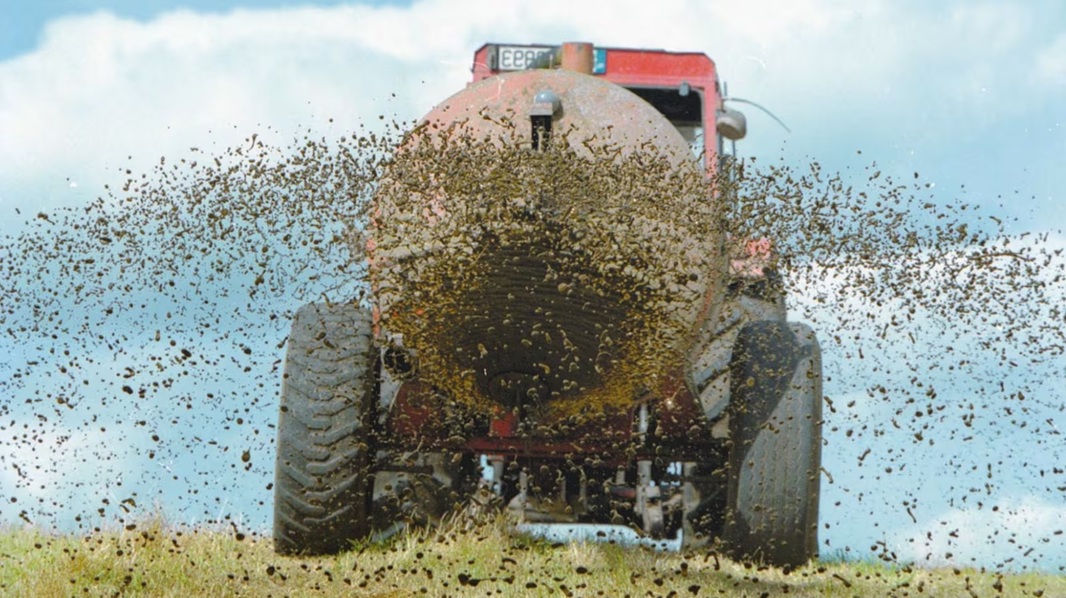
Of course the manure isn’t spread by hand nowadays. It’s done like this:
About a month ago I posted an item about the National Famine Way, at the end of which I signalled my future intention to walk the 165 km 6-day route from Strokestown to Dublin. I was subsequently contacted by a number of people warning me that I might not be up to it. They didn’t put me off, but I have come up with a plan. This week – on Wednesday in fact – I will have the injections I get every six months or so to control the arthritis in my knees. Thus fortified, I intend next week to do a trial run walk consisting of the last stage of the Famine Way, from Maynooth to Dublin, along the Royal Canal. That’s about 27km and will take most of a day. I’ll stop on the way for lunch and when I get to the end I can get the train back to Maynooth. And if I run walk into difficulties I can stop at one of the intermediate stations and return from there; the canal runs right alongside the railway line for most of the way. If all goes to plan I’ll take time off next year to do the whole trip from Strokestown.
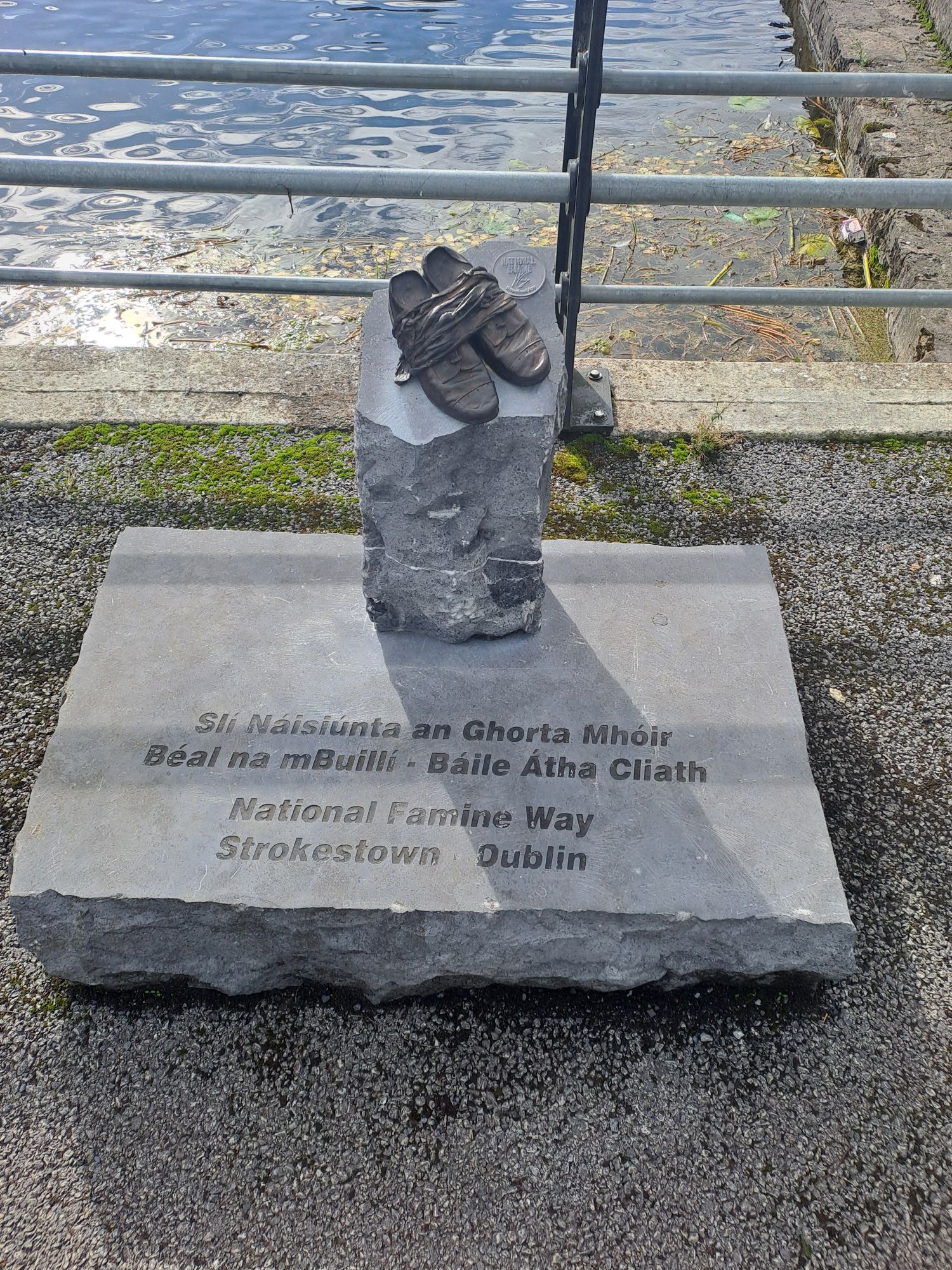
Meanwhile here’s a picture of one the poignant bronze sculptures of children’s shoes placed along the way. This one is at Maynooth harbour; there are 8 others on the way to Dublin.
To learn more about these shoes, see here, and here’s a video telling the story
With just two weeks to go before we resume teaching at Maynooth University, I find that next week I have no fewer than three medical appointments next week, on different days and in different locations. All of them are (or should be) routine, and none are particularly serious. Much as I dislike hospitals, etc, it will be good to get these bits of scheduled maintenance out of the way before the start of term.
On the other hand, they mean that I have to miss what looks like a very nice meeting in Italy in honour of Sabino Matarrese. I was invited, and initially accepted, but had to cancel. I hope that it goes well!
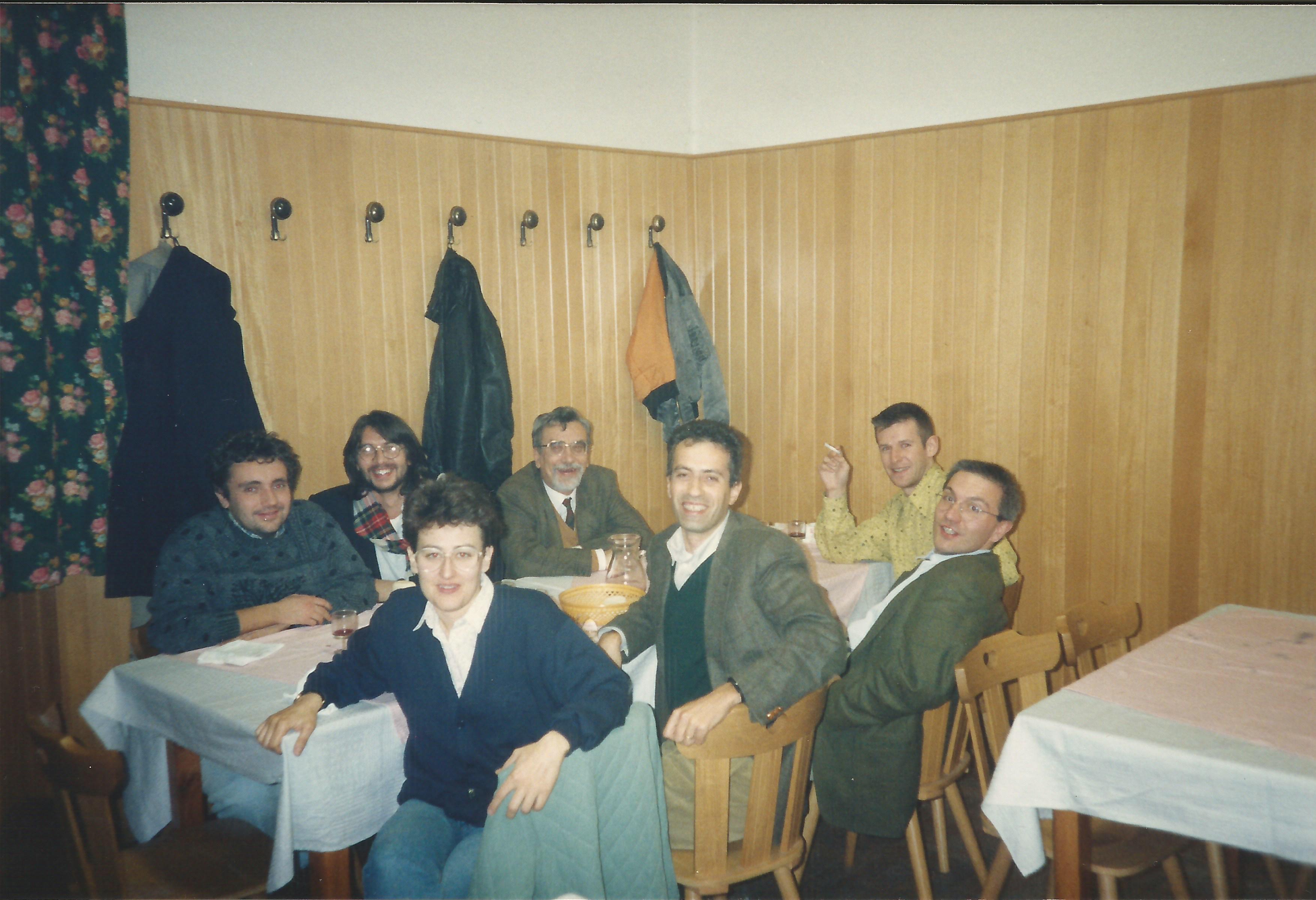
For old time’s sake I thought I’d post this picture of a youthful Sabino from years ago; he’s in the middle of the row nearest the camera; I’m at the end in the yellow shirt.
Anyway, last Friday our first cohort of MSc students in Theoretical Physics and Mathematics received their final results. This course lasts a calendar year so the results come out later than for the undergraduate courses. Congratulations to them all, but especially to Enda who completed a project under my supervision that we hope to turn into a paper before long.
Some familiar faces will no longer be around, but soon we will be joined by some new ones. Tomorrow, registration opens up for incoming first-year students at Maynooth and later in the week for returning second-, third-, and fourth-year students. By this time next week we’ll have a much better idea how many students there will be in our classes for the new academic year.
On Friday (12th September) I’ll be off to the National Concert Hall for the 2025/6 Season Opener with the National Symphony Orchestra conducted by Leonard Slatkin, another indication that Autumn Semester is nigh.
World Beard Day. Holiday design with handsome bearded men for social media post, banner, poster, card. Vector illustration isolated on white background
Today is World Beard Day 2025. I refer you to this post by Keith Flett, Spokesbeard of the Beard Liberation Front for further information about this important annual celebration:
It’s Saturday again, so it’s time for a summary of the week’s new papers at the Open Journal of Astrophysics. Since the last update we have published two new papers, which brings the number in Volume 8 (2025) up to 127, and the total so far published by OJAp up to 362. It’s been another relatively slow week, not least because of the Labor (sic) Day holiday in the USA on Monday which, among other things, meant there was no arXiv update on Tuesday.
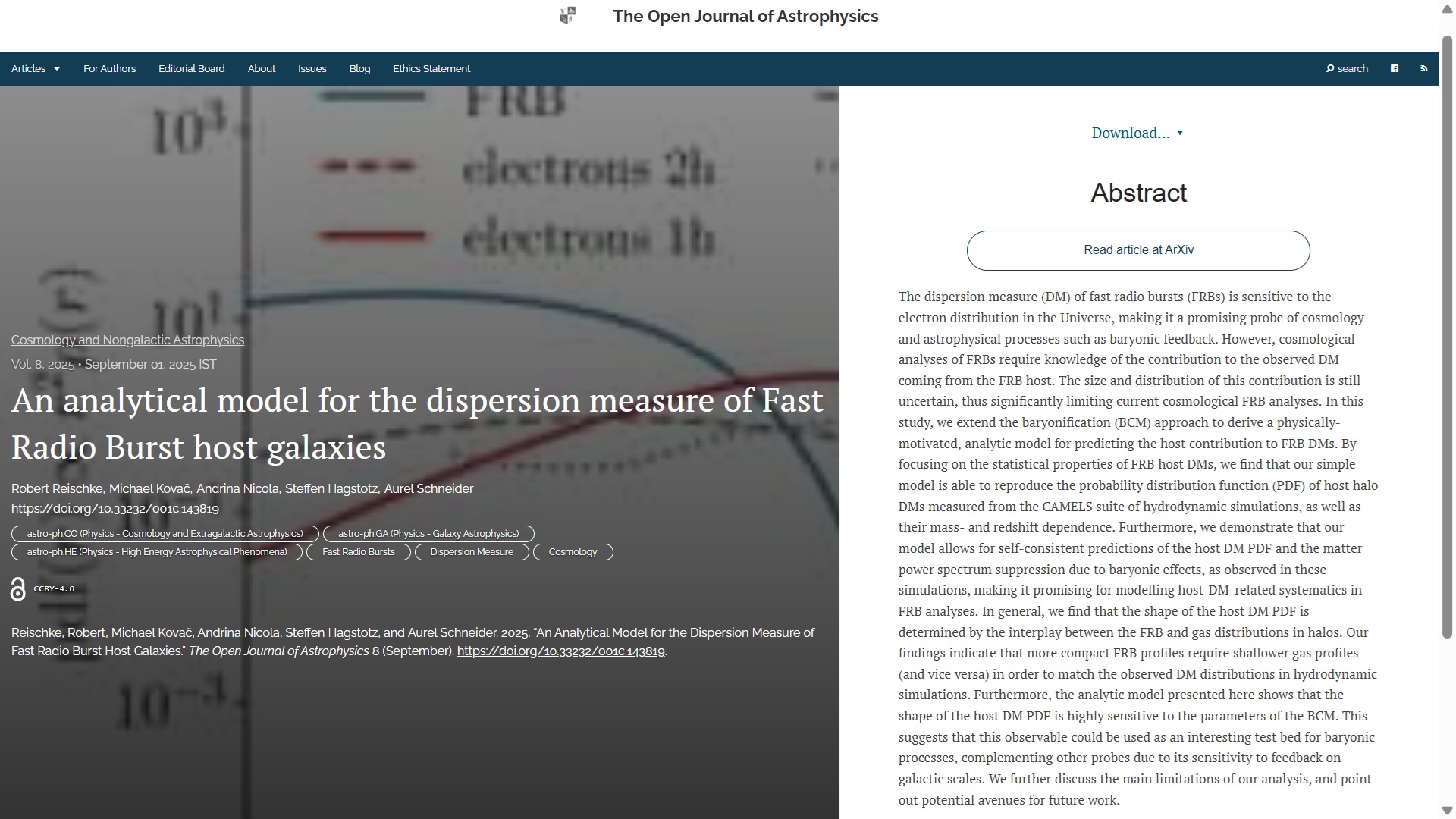
Anyway, the first paper to report this week is “An analytical model for the dispersion measure of Fast Radio Burst host galaxies” by Robert Reischke, Michael Kovač & Andrina Nicola (U. Bonn, Germany), Steffen Hagstotz (Ludwig-Maximilians Universität München) and Aurel Schneider (U. Zurich, Switzlerland). This is a theoretical study of the dispersion measures (DMs) intrinsic to host galaxies of Fast Radio Burst (FRB) sources to enable separation of that from the line-of-sight DM. This one was published on Monday 1st September 2025 in the folder Cosmology and NonGalactic Astrophysics.
The overlay is here:
You can make this larger by clicking on it. The officially accepted version of this paper can be found on the arXiv here.
You can find the officially accepted version on arXiv here.
And that’s all the papers for this week. It’s still a bit slow as we emerge from the summer vacations, we have a lot of papers in the pipeline that I expect to emerge pretty soon.
A very comprehensive review article has appeared on arXiv with the title Hitchhiker’s Guide to the Swampland: The Cosmologist’s Handbook to the string-theoretical Swampland Programme by Kay Lehnert (who just happens to be my PhD student). The paper is 170 pages long and contains over 1,800 references, which gives some idea of what a large field this is and how much work Kay has put into writing it!
This is Figure 3 from Kays paper. If you would like to know more of what it is about, turn to page 50…
The abstract reads
String theory has strong implications for cosmology: it tells us that we cannot have a cosmological constant, that single-field slow-roll inflation is ruled out, and that black holes decay. We elucidate the origin of these statements within the string-theoretical swampland programme. The swampland programme is generating a growing body of insights that have yet to be incorporated into cosmological models. Taking a cosmologist’s perspective, we highlight the relevance of swampland conjectures to black holes, dark matter, dark energy, and inflation, including their implications for scalar fields such as quintessence and axions. Our goal is to inspire cosmological model builders to examine the compatibility of effective field theories with quantum gravitational UV completions and to address outstanding cosmological tensions such as the Hubble tension. This comprehensive literature review presents clear definitions, cosmological implications, and the current status – including evidence and counterexamples – of the following swampland conjectures: the anti-de Sitter distance conjecture (AdSDC), the completeness conjecture (CC), the cobordism conjecture, the de Sitter conjecture (dSC), the swampland distance conjecture (SDC), the emergence proposal (EP), the Festina Lente Bound (FLB), the finite number of massless fields conjecture (or finite flux vacua conjecture (FFV)), the no global symmetries conjecture, the no non-supersymmetric theories conjecture, the non-negative null energy condition conjecture, the positive Gauss-Bonnet term conjecture, the species scale conjecture, the gravitino swampland conjecture (GSC), the tadpole conjecture, the tameness conjecture, the trans-Planckian censorship conjecture (tPCC/TCC), the unique geodesic conjecture, and the weak gravity conjecture (WGC), including the repulsive force conjecture (RFC).
This is essentially the literature review part of Kay’s thesis; the aim of his research is to study the implications of the string-theoretical swampland programme for cosmology. He’s particularly interested in the predictions string theory makes regarding inflation, dark energy, and dark matter, and the impact this has on the Hubble tension. The point of writing this review was to suggest projects that might be undertaken to bring string theory into the realm of testability, thus suppling material for the rest of Kay’s thesis, but I think it is also a very good guide for cosmologists of all types to what the swampland conjectures are and what they do and do not say about the Universe we actually live in.
Yesterday the official Presidential Election Order was tabled which means that an election for the office of President of Ireland (Uachtarán na hÉireann) will be held in the Republic on Friday 24th October 2025. The incumbent Michael D. Higgins will have served his second 7-year term by November and since by the Constitution nobody can hold the office more than twice, we will have a new President of the Republic.
The Irish media have been trying to make news about the presidential election all summer, which has been pointless and tedious to put up as no candidates had even been nominated then. Actually nobody has yet either, as nominations don’t officially open until tomorrow; they close on September 25th. Still, at least the process has started.
In order to progress to the election, a candidate has to receive the support of at least 20 members of the Oireachtas or at least 4 local authorities (i.e. councils). Former or retiring Presidents can nominate themselves but this is not relevant here.
The way the election works is that voters rank all candidates. In the first round of counting, first preference votes are totted up and if one candidate has more than 50% he/she is elected. If not an Instant Runoff method is used, with votes of lower-ranked being reallocated until there’s a winner (ie until one candidate gains a majority).
I just checked the online electoral register to confirm my status:
I will wait to see who has acually been nominated before deciding who to vote for. In the last Presidential Election (2018), five candidates opposed the re-election of Michael D. Higgins, three of them businessmen best known for having appeared on the Irish version of the TV show Dragon’s Den. There’s ample evidence from elsewhere that the products of reality TV shows do not make good presidents. Neither do rapists, so let’s hope Conor McGregor does not get nominated. It is likely that there will be more than six candidates this time and the election will be more closely contested that last time. In 2018 the turnout was very low, no noubt because many people assumed – correctly – that Higgins would win. In the event he got over 56% of the first-preference vote so the transfers were irrelevant. That might not be the case this time.
The Presidency of Ireland is a ceremonial rather than an executive office, and it has little actual power associated with it. It is nevertheless important in that the President is the guardian of the Constitution as well as representing the Irish Nation as a kind of ambassador and as patron of many good causes. Surprisingly, some of the people who want to put themselves forward don’t seem to know anything about what the job entails. Hopefully, the more obvious fruitcakes who put themselves forward will fail to get nominated. I think Michael D. Higgns has carried out his duties in a very dignified and diligent way over the years, and will be a very hard act to follow. I’ve been proud to have him as my President.
It’s hard to believe that seven whole years have passed since the last election. There’s another reminder of that coming up on Friday September 12th when I will be going to the National Concert Hall for a performance by the National Symphony Orchestra that marks the opening of the 2025/6 season. On September 15th 2018 I went to the season opener for that year. That was also my first ever visit to the National Concert Hall. To mark the occasion we were in the presence of the man himself , Michael D Higgins, and his wife Sabena. The President attended as Patron of the National Symphony Orchestra. I don’t know whether he will attend on Friday 12th September, but if he does I’m sure he will get a good ovation. As well as many other things Michael D. Higgins has been a very strong advocate for the Arts in Ireland. I’m not sure his successor will live up to the standard he set.
The views presented here are personal and not necessarily those of my employer (or anyone else for that matter).
Feel free to comment on any of the posts on this blog but comments may be moderated; anonymous comments and any considered by me to be vexatious and/or abusive and/or defamatory will not be accepted. I do not necessarily endorse, support, sanction, encourage, verify or agree with the opinions or statements of any information or other content in the comments on this site and do not in any way guarantee their accuracy or reliability.








 In the Dark