Cosmology Talks – Clare Burrage on Chameleon Dark Energy

Posted in The Universe and Stuff with tags , , , , , , on June 11, 2020 by telescoper

Here is another one of those Cosmology Talks curated on YouTube by Shaun Hotchkiss.

In this talk, Clare Burrage of Nottingham University explains how chameleon dark energy models can be very tightly constrained by laboratory scale experiments (as opposed to particle accelerators and space missions). Chameleon models were popular for dark energy because their non-linear potentials generically create screening mechanisms, which stop them generating a fifth force despite their coupling to matter, the net effect of which is to make them hard to detect on Earth. On the other hand , in a suitably precise atomic experiment the screening can be minimised and the effect of the Chameleon field measured. Such an experiment has been constructed, and it rules out almost all of the viable parameter space where a chameleon model can explain dark energy.

The paper that accompanies this talk can be found here and the talk is here:

#ShutDownSTEM & #ShutDownAcademia

Posted in Politics on June 10, 2020 by telescoper

For more information see here (or here or here).

About that Statue of Colston

Posted in History with tags , , , , on June 9, 2020 by telescoper

I don’t know Bristol very well. I’ve been there a few times, but mainly for work-related reasons, and I’ve never really explored the City.

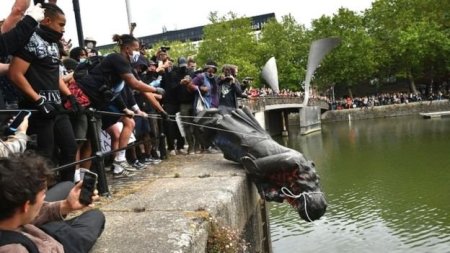
I had heard of notorious slave trader (and Tory MP) Edward Colston because I had heard of the Colston Hall (though never been there). I didn’t know until this weekend however that there was a statue of him in the city. Now it is in the drink.

The statue concerned was apparently erected in 1895, one hundred and seventy four years after Colston died, and sixty two years after slavery was abolished. I’m not at all sorry to see it gone, as it should never have been put up in the first place. I was much more shocked to learn of its existence than of its destruction.

Please don’t try to argue that taught people about slavery. People have learnt much more about the horrors of the slave trade as a result of the destruction of this statue than they ever did by looking at it. The better way to teach people about history is in school, but British schools mostly avoid the uncomfortable truth of the imperial past. Mine certainly did. I wasn’t taught much about slavery at all, except that it conveniently provided one very profitable leg of the Triangular Trade, but that slavery was illegal in Britain at that time so that was somehow supposed to make it alright.

I don’t learn much about the Great Famine in Ireland at school either, but you can be absolutely sure that the Irish know all about it, and not by looking at statues of its architect, the genocidal Charles Trevelyan. Imagine what would happen if someone tried to put up a statue to him in Ireland, or to Oliver Cromwell.

So less of the phoney outrage about a lousy statue. It would be a better outlet for your energy to read some proper history and be outraged by that instead.

P. S. I’ve been busy marking examinations over the last few days which is why I’m late commenting on this.

Math versus Maths

Posted in mathematics, Pedantry with tags , on June 8, 2020 by telescoper

I was amused by this discussion on Dictionary.Com of the different abbreviations of mathematics..

I’d like to think that ending is deliberate!

God’s Little Cow

Posted in Irish Language, Uncategorized with tags , on June 8, 2020 by telescoper

The other day I discovered that Ladybird in Irish is Bóín Dé which means, literally, “Little Cow of God”. I thought it a strange name for this critter, then a friend told me (via Facebook) that the Welsh is buwch goch gota which means “short red cow”. A little googling then told me that the Russian is Bozhya korovka which is in literal translation the same as the Irish, God’s Little Cow.

The more general connection with God seen in Irish and Russian is presumably to do with the Ladybird being either cute or beneficial (or both): if you’re a gardener you will certainly appreciate the help that Ladybirds offer in eliminating aphids and other garden pests. They may look cute but they are voracious predators.

I am told that the `cow’ part of the name probably comes from the spots on a Ladybird, which resemble the black patches on the hides of certain breeds of cow.

I have known for a while that the Lady in the English Ladybird refers not just to any lady but to the Virgin Mary, allegedly because the most common type of Ladybird has seven spots and the number 7 is associated with Mary, as is the colour red. The original English term was “Our Lady’s Bird” which turned into Ladybird (or Ladybug in the United States).

The connection with the Virgin Mary is more explicit in the Danish Mariehøne (Mary’s Hen). I assume the Hen is because the Ladybird would have to be a bird that can fly but not all that well. In German the word for Ladybird is Marienkäfer (Mary’s Beetle). In Spanish it is Mariquita, which I assume also has a connection with the Virgin Mary though there is another term: Vaca de San Antón , which brings us back to cows again (Vaca is Spanish for cow).

The Italian word for Ladybird is Coccinella (from the Latin Coccineus, scarlet) which is also the scientific name; the family is Coccinellidae. The standard French for a Ladybird is Coccinelle, but older terms found in dictionaries include vache à Dieu (Cow of God again) and bête à bon Dieu.

I know Ladybirds are very widespread and, to a lesser extent, so are my readers, so I’d be very interested to hear what a Ladybird is in other languages (alongside a literal translation).

Time for Phase 2 in Ireland

Posted in Covid-19, Maynooth with tags , , on June 7, 2020 by telescoper

Tomorrow (June 8th) sees the start of Phase 2 of Ireland’s Roadmap for Reopening. You can see that, as of yesterday, the number of confirmed cases per day is small and stable after three weeks of Phase 1, which has justified proceeding to Phase 2.
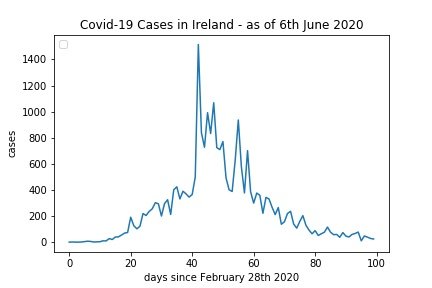
Incidentally, since the Covid-19 outbreak took hold in Ireland there have been daily press briefings by the Department of Health. Yesterday’s was the last of these: from now on the updates will be twice a week, on Mondays and Thursdays. Data will still be released every day but there won’t be a press conference every time. I’ve been following these every day for three months so this will be quite a change to the routine!

Moving to Phase 2 means that most shops will be able to reopen (subject to social distancing measures being in place), people will be able to travel much further (anywhere within your own county and 20 km into another) and there will be a limited return to work (subject to the completion of various protocols, risk assessments, etc).

For us at Maynooth University there won’t be a sudden change. Staff who can will continue to work from home (which is basically everyone in the Department of Theoretical Physics) but labs will gradually reopen for research when the necessary arrangements are in place. Other than that Phase 2 will be very similar to Phase 1.

On Friday, however, the Taioseach announced that the Roadmap would be accelerated so that Phase 4, starting 20th July will, if all goes well, be the last, though measures will be in place for some time after that.

That’s good news of course but it’s all dependent on there being no second wave. As a cautionary tale, take a look at the numbers for Covid-19 Iran:

Iran has been experiencing a second wave of new cases for some time now, and this looks set to produce more cases than the first, but this has only recently resulted in an increase in daily mortality figures:
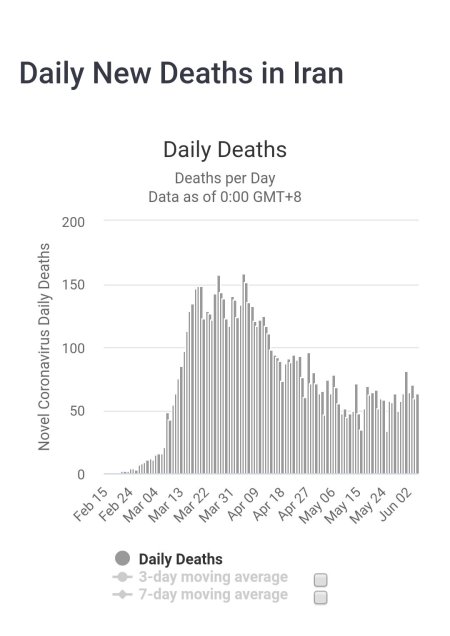
Note the lowest number of new cases per day in Iran was just under 1000. That’s far fewer than the United Kingdom, which has chosen to undo its restrictions far more rapidly in Ireland. The number of confirmed new cases in Ireland reported yesterday was just 24; in the United Kingdom the figure was 1557. In my opinion there is a strong possibility that the UK will follow a similar trajectory to Iran…


D-Day 76 Years On.

Posted in History, Politics with tags , , on June 6, 2020 by telescoper

Just a reminder that it was 76 years ago today, on June 6th 1944, that antifascists began landing on the beaches of Normandy.

Public Lectures?

Posted in Education, Maynooth on June 5, 2020 by telescoper

Taking a break from marking examinations and other assignments I was thinking about the next academic year. Although we’re planning to give as much teaching as possible in face-to-face form from September,  it is likely that we will have some material online. In fact I found the short video summaries I did last term were quite popular with students so I may well carry on doing them even if we were to return completely to normal as a supplement to the live experience.

Thinking about this a bit further I reckon I should put all such material on Youtube so that anyone who wants to access it can do so. I don’t think there will be a huge demand for them in the general public, but for me it’s more a point of principle. As my teaching is funded by the public purse, it seems reasonable to me that what I produce should all be in the public domain wherever possible. That obviously excludes some teaching activities (e.g. labs and tutorials) but I don’t see why I shouldn’t do it with lectures or other video content.

If you object on the grounds that students pay a €3000 `student contribution‘ to attend university in Ireland and would be annoyed if I gave away what they’re having to pay for, then I’d reply that that money is not supposed to cover tuition – just student services and examinations.

I know many of my colleagues disagree with this, so I thought I’d do another totally unscientific poll to see what others think. Not that it will change my mind….


Exciting new changes at LGBTQ+ STEM

Posted in LGBTQ+ on June 5, 2020 by telescoper

There are some changes at the LGBTQ+ Stem site. In particular they are looking for contributors for their new blog. See this post for details.

Alex Bond's avatarLGBTQ+ STEM

Alex Bond & Izzy Jayasinghe

It seems impossible to write about diversity, equity and inclusion, in STEM or in broader society, without thinking about the horrendous racism and police brutality going on in the US, or the impact of Covid-19 on BAME health care workers in the UK. STEM is political, and STEM is people. You simply cannot be for diversity in STEM and not angry, upset, or scarred right now. And that’s ok.

We’re announcing some changes for us as an organization, in what we do, and how we do it. Last November, we celebrated our 5th anniversary and we sought feedback about what folks would like to see from us in the years to come. The feedback has been incredibly helpful, and we’ll be rolling out some new things and addressing some of the issues raised to make us a better, more inclusive organization. We need to be…

View original post 660 more words

The Mains in Maynooth

Posted in Maynooth with tags , , on June 4, 2020 by telescoper

I don’t often post about local news but I thought for a change while I’m taking a break from examination marking I’d just mention a little local difficulty here in Maynooth.

When I woke up on Tuesday morning (2nd June) I was surprised by the amount of (stationary) traffic on the Straffan Road beside my flat. I later had to pop into the bank on Main Street and discovered that the reason was major roadworks reducing the traffic to one lane and necessitating the introduction of stop/go manual signals to replace the traffic lights. Unlike today, Tuesday was a hot day and the ensuing traffic jam caused a few frayed tempers among impatient drivers.

The roadworks are to do with the laying of a new water main, which is being done in phases. The job started down Parson Street a few weeks ago when construction work resumed (after a break for Covid-19 reasons) and gradually moved up towards the Castle. This was less disruptive than the current phase which is on Mill Street. This is the main thoroughfare from Maynooth both North to Moyglare and West to Kilcock. The works here have caused tailbacks all the way through the town. There are barriers along Main Street to enforce single line traffic which have turned the centre of town an obstacle course. This type of signal is very heavy on manpower: there must be at least 20 people standing at junctions operating the signs and signalling to each other. It’s working reasonably well, though, all things considered.

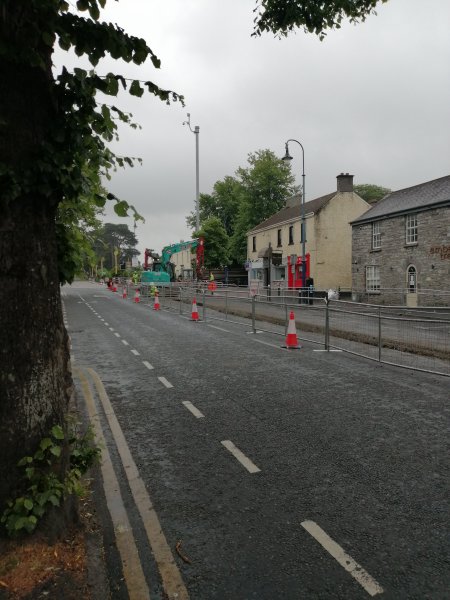
Here are a couple of snaps I took on Mill Street, first looking south towards Main Street and Leinster Street:

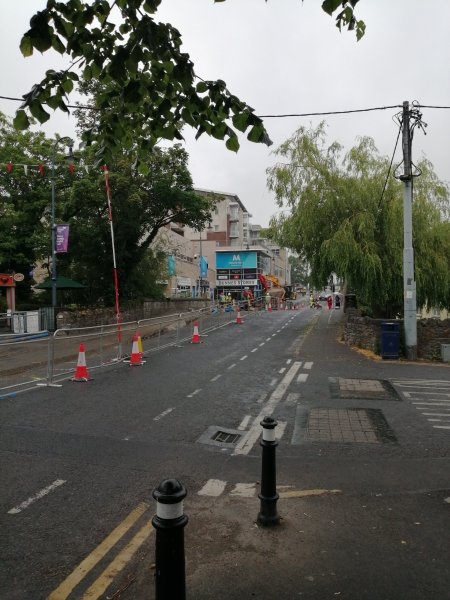
Here’s one looking North over the bridge towards Manor Mills shopping centre on the left:

The roadworks take up entire lane. There is no vehicle traffic visible because I took the picture just before traffic was allowed in from the bottom end of Mill Street.

I am a bit surprised that the new water main is being laid in a trench running right along the middle of one lane, rather than to the side, but I’m told that isn’t unusual in Ireland. When I asked someone the other day what the works were for he said “they’re replacing the old lead pipes”. I didn’t actually believe that there could still be lead water mains, but I’m told it is true. There has been so little public investment here that much of Ireland’s infrastructure is Victorian.

Anyway, although the constant traffic jams are a bit annoying (and noisy) it’s good that they’re doing this work. At the moment Ireland is experiencing something approaching a drought and is estimated that over 25% of the water in the system is being lost through leaky pipes.

I think that if there are no delays they should be finished by tomorrow evening (5th June) but as of this evening it seems that they still have a lot to do!