The War of Independence

Posted in History with tags , , on June 3, 2020 by telescoper

There is an excellent magazine supplement with today’s Irish Times looking back at the Irish War of Independence, which was raging a century ago. There’s a lot to digest in the magazine and it will take me a while to read all the articles in it.

The War of Independence began in earnest at the start of 1920 but the cycle of violence ramped up rapidly with the arrival of the infamous Blank and Tans in March and, later on, the equally infamous Auxiliaries. It was the latter who burned the city of Cork to the ground in October 1920, the aftermath of which event which provides the cover picture to the supplement.

The War of Independence ended in summer 1921 with a ceasefire and subsequently the Treaty that led to Partition and a Civil War.

The centenary commemorations of the Easter Rising of 1916 and the War of Independence in Ireland have generally taken the form of the heroic narrative of a liberation struggle, but the Civil War is a matter that many still find painful to confront. It will be interesting to see what the mood of the country will be like when that centenary arrives.

Finding the Lost Baryons

Posted in Astrohype, The Universe and Stuff with tags , , , , , on June 3, 2020 by telescoper

Taking a break from examination marking I thought I’d post a comment on a recent paper in Nature which you can find on the arXiv here; see also a report here.

The paper, entitled A census of baryons in the Universe from localized fast radio bursts, is an important one which does seem to resolve a longstanding question often called the missing baryon problem. In a nutshell, the problem is that the density of baryons suggested by cosmological considerations – specifically the element abundances produced by Big Bang nucleosynthesis and the cosmic microwave background (CMB) – was, until recently, rather higher than that which has been observed by astrophysical measurements; by `baryonic material’ I mean basically protons and neutrons (whether or not they are in atomic nuclei).

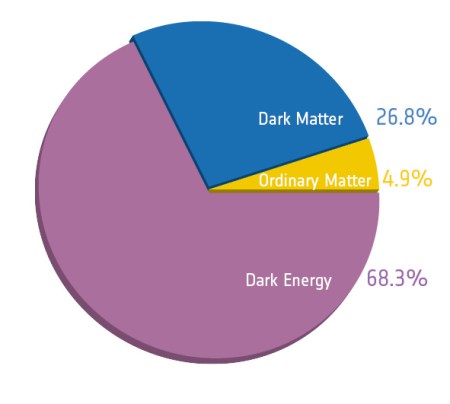
In the framework of the standard cosmological model, The density of baryonic matter (denoted `Ordinary Matter’ in the following figure) contributes only around 5% of the overall mass-energy budget of the Universe:

The first thing to stress is that this paper says nothing about the `Dark Matter’ which, according to the standard model, makes up about 27% of the pie and which cannot be in the form of baryons if the CMB and nucleosynthesis measurements are correct. If it were baryonic it would participate in nuclear reactions and mess up the light element abundances and also interact with photons in such a way as to change the fluctuation spectrum of the cosmic microwave background. Having said that, `dark’ is better adjective to use for hidden baryons than it is for non-baryonic matter, as baryons can absorb light. Non-baryonic matter isn’t really dark, it’s transparent because it doesn’t interact at all with electromagnetic radiation. We are however in the dark about it.

Note that the total density of dark + ordinary matter is about 32%, just what George Ellis and I concluded way back in 1994.

We can be much more certain about baryons actually existing than we can about dark matter because. For one thing, we are made of them. It has, however, been known for ages that the total density of directly visible baryons (ie those associated with stars and galaxies) is much lower than this figure, leading to the conclusion that some of the baryons predicted by cosmologists must be in some invisible form(s). Some, for example, is found by X-ray emissions in dense galaxy clusters, but this component is still inadequate to account for all the missing matter.

It has been suspected for some time that the hidden baryons probably inhabit a diffuse Warm-Hot Component of the Intergalactic Medium which, according to simulations of structure formation, traces its own form of the cosmic web we see in the distribution of galaxies:

The diffuse state and inhomogeneous nature of this intergalactic medium makes it difficult to detect, as explained in the abstract of the paper, but adding a relatively new technique involving fast radio bursts to probe the distribution of matter along the line of sight to the observer, it seems that it has now brought out into the open:

Now the inventory of observed baryons matches the 5% figure we cosmologists always knew it would be, and all is well with the world!

P. S. I was informed on Twitter after posting this that there was a paper on this topic in Nature a couple of years ago the last sentence of the abstract of which reads:

We conclude that the missing baryons have been found.

Cristo Redentor – Donald Byrd

Posted in Jazz with tags , on June 2, 2020 by telescoper

Duke Pearson was inspired by the famous statue that looks down over Rio de Janeiro to write this tune, of which this is the very first version, put on record in 1963 and released a year later in 1964 to become an instant classic. It’s a wonderful fusion of jazz, blues and gospel music but above all it’s a gentle hymn to peace and respect.I don’t think I have to explain why I think it’s apt to put it up today.

Front and centre is Donald Byrd on trumpet, but the rest of the band includes Hank Mobley (tenor), Herbie Hancock (piano), Donald Best (vibes), Kenny Burrell (guitar), Butch Warren (bass) and Lex Humphries (drums). The choir consists of 8 voices (4 male, four female) but sadly they are not named on the liner notes.


Cosmology Talks – Colin Hill on Early Dark Energy

Posted in The Universe and Stuff with tags , , , , , on June 2, 2020 by telescoper

Here is another one of those Cosmology Talks curated on YouTube by Shaun Hotchkiss.

In the talk, Colin Hill explains how even though early dark energy can alleviate the Hubble tension, it does so at the expense of increasing other tension. Early dark energy can raise the predicted expansion rate inferred from the cosmic microwave background (CMB), by changing the sound horizon at the last scattering surface. However, the early dark energy also suppresses the growth of perturbations that are within the horizon while it is active. This mean that, in order to fit the CMB power spectrum the matter density must increase (and the spectral index becomes more blue tilted) and the amplitude of the matter power spectrum should get bigger. In their paper, Colin and his coauthors show that this affects the weak lensing measurements by DES, KiDS and HSC, so that including those experiments in a full data analysis makes things discordant again. The Hubble parameter is pulled back down, restoring most of the tension between local and CMB measurements of H0, and the tension in S_8 gets magnified by the increased mismatch in the predicted and measured matter power spectrum.

The overall moral of this story is the current cosmological models are so heavily constrained by the data that a relatively simple fix in one one part of the model space tends to cause problems elsewhere. It’s a bit like one of those puzzles in which you have to arrange all the pieces in a magic square but every time you move one bit you mess up the others.

The paper that accompanies this talk can be found here.

And here’s my long-running poll about the Hubble tension:


Welcome to Pride Month 2020!

Posted in Covid-19, LGBTQ+, Politics on June 1, 2020 by telescoper

Once again it’s time for a month of LGBTQ Pride.

Although the main Dublin Pride event has been cancelled this year because of the Covid-19 outbreak, there are still a number of virtual events going on.

Thus year more than any other Pride gives us an important opportunity to express solidarity to all grieving and fighting for a better world in the face of monstrous injustices such as the murder of George Floyd.

That includes those of us who are white and gay acknowledging that systematic racism exists and that by keeping quiet and doing nothing we are, however unintentionally, complicit in it.

Lá Saoire i mí Mheitheamh

Posted in Maynooth with tags , , , on June 1, 2020 by telescoper

So here I am in Maynooth where it is a lovely sunny day and a Bank Holiday. Looking back through this blog I realise that this is my third June Bank Holiday in Ireland. Tempus fugit!

To celebrate the occasion here is a picture of Maynooth University Library Cat which I took when he was on post waiting for food a couple of days ago.

The June Bank Holiday (Lá Saoire i mí Mheitheamh) in Ireland is actually the equivalent of last week’s late May Bank Holiday in the UK, in that both have their origin in the old festival of Whitsuntide (or Pentecost) which falls on the 7th Sunday after Easter. I understand Pentecost is when the Holy Spirit went down on the Disciples.

Anyway, because the date of Easter moves around in the calendar so does Whit Sunday, but it is usually in late May or early June. When the authorities decided to fix a statutory holiday at this time of year, presumably to reduce administrative difficulties, the UK went for late May and Ireland for early June. Whit Sunday was actually yesterday (31st May) so this year Lá Saoire i mí Mheitheamh coincides with Whit Monday.

Incidentally, when I was a lad, ‘Whit Week’ was always referred to as ‘Race Week’. Geordie Ridley’s famous music hall song The Blaydon Races begins “I went to Blaydon Races, ’twas on the 9th of June, Eighteen Hundred and Sixty Two on a summer’s afternoon…”. Easter Sunday fell on 20th April in 1862, so Whit Sunday was on 8th June. After raucous scenes at the Blaydon Races, they were scrapped and replaced with a Temperance Festival on the Town Moor in Newcastle which evolved into one of the largest open-air funfairs in Europe, The Hoppings, although I suppose there was any of that this year.

This year the Bank Holiday is a bit strange, what with the Covid-19 restrictions, and I still have exam marking to do, but I have decided to put the autoreply on for my work email and take the day off.

This Violation

Posted in Film, Politics with tags , , , on May 31, 2020 by telescoper

A typically perceptive and powerful piece in the Guardian by Fintan O’Toole about dignity, violation and the Dominic Cummings has been turned into a short film by Mark Cousins. It features a hundred people, from all walks of life, each reading a line of it to camera. It’s very well worth watching.

The Trees, by Philip Larkin

Posted in Poetry with tags , , on May 31, 2020 by telescoper

The trees are coming into leaf
Like something almost being said;
The recent buds relax and spread,
Their greenness is a kind of grief.

Is it that they are born again
And we grow old? No, they die too,
Their yearly trick of looking new
Is written down in rings of grain.

Yet still the unresting castles thresh
In fullgrown thickness every May.
Last year is dead, they seem to say,
Begin afresh, afresh, afresh.

by Philip Larkin (1922-1985)

What are scientific papers for?

Posted in Astrohype, Open Access with tags , , on May 30, 2020 by telescoper

Writing scientific papers and publishing them in academic journals is an essential part of the activity of a researcher. ‘Publish or perish’ is truer now than ever, and an extensive publication list is essential for anyone wanting to have a career in science.

But what are these papers actually for? What purpose do they serve?

I can think of two main purposes (which aren’t entirely mutually exclusive): one is to disseminate knowledge and ideas; the other is to confer status on the author(s) .

The academic journal began hundreds of years ago with the aim of achieving the former through distribution of articles in print form. Nowadays the distribution of research results is achieved much less expensively largely through online means. Nevertheless, journals still exist (largely, as I see it, to provide editorial input and organise peer review) .

Alongside this there is the practice of using articles as a measure of the ‘quality’ of an author. Papers in certain ‘prestigious’ ‘high impact’ journals are deemed important because they are indicators of status, like epaulettes on a uniform, and bibliometric data, especially citation counts, often seem to be more important than the articles themselves.

I thought it was just me getting cynical in my old age but a number of younger scientists I know have told me that the only reason they can see for writing papers is because you need to do it to get a job. There is no notion of disseminating knowledge just the need to establish priority and elevate oneself in the pecking order. In other words the original purpose of scientific publications has largely been lost.

I thought I’d test this by doing a (totally unscientific) poll here to see how my several readers think about this.

Covid-19 in Ireland: the Pandemic’s Progress

Posted in Covid-19, Maynooth on May 29, 2020 by telescoper

I noticed last night when I was updated the numbers and graphs on my Covid-19 page that it is now 90 days since I started counting on 28th February. By way of an update here are the latest graphs (as of last night):
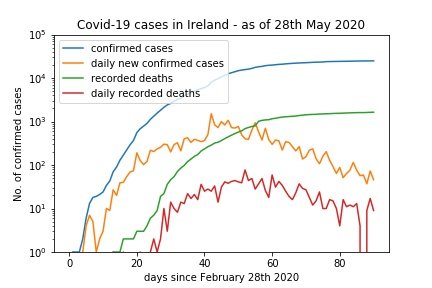
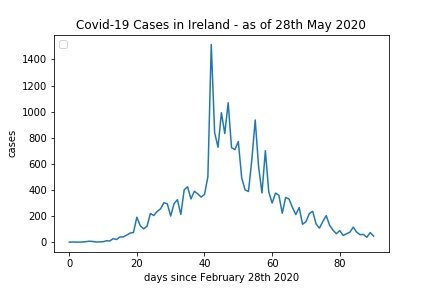
Mindful of a study that suggests that the general public do not understand log plots – I have had some angry messages on Twitter accusing me of deliberately misleading people by using a log axis – here are the daily updates on linear plots, first the record of new cases:
And second the recorded new deaths:
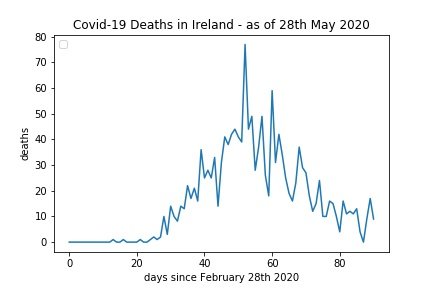
The latter appears rather noisy because of low numbers.

You may notice that these plots look a little different from those presented elsewhere (e.g. here). That is because I have treated the various retrospective corrections that have been made in a different way from others, generally by adjusting the cumulative totals but not the daily figure. For a full explanation of what I’ve done see the notes here. I also haven’t smoothed the data at all. Other representations tend to use a 7-day moving average to get rid of weekly artifacts of reporting, especially the “weekend effect” by which there appear to be fewer deaths on Saturday and Sunday.

If you don’t like log plots then you really won’t like this one, which is a plot of daily cases against the cumulative number on log-log axes:
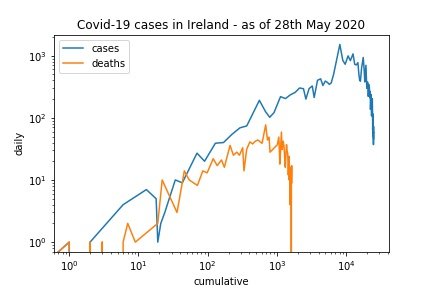
I like this plot because I think the message is clear: it would give a straight line if the cases were growing exponentially, which was the case initially. You can see that both cases and deaths are well past this stage. In Ireland it seems the Covid-19 pandemic is under reasonably good control. According to the experts the value of the reproductive number R in Ireland is in the range 0.4 to 0.5, and it seems community transmission of the disease has almost stopped.

I haven’t left Maynooth since February so I’ve been here all through the lockdown. The overwhelming majority of people I’ve seen have been observing the restrictions. I can just think of just one occasion that was an exception, on the way into the local supermarket, when someone failed to observe the 2m social distancing when he pushed past me while I was washing my hands with the gel provided. When told by an assistant that he had to wait in line and wash his hands before coming in he refused and was then told to leave, which he eventually did after unleashing some foul language. He was obviously drunk, but probably a twat even when sober. Maynooth is a small and rather quiet place (especially when there are no students around, like now) and there may be worse issues elsewhere, but it does seem that Irish folk are behaving very sensibly.

For the record, as of last night there were 24,481 confirmed cases of Covid-19 in Ireland and 1,639 people have died. That means that the number of deaths per million of population is approximately 332. That’s a lot fewer per capita than the UK (officially 553, but probably more like 900) a lot larger than, say, Denmark (which is of a similar size) which is on 98 Covid-19 deaths per million population or Norway which is on 44. The reason for the large number despite the stricter lockdown than the United Kingdom, seems to have been the number of deaths in care homes.

On this basis I’d summarise the situation by saying that Ireland hasn’t done all that well when you look at it in the cold light of day, but it could have been a lot worse. Credit is due to the medical experts for their leadership.

Another thing worth mentioning is that according to the experts the fraction of the population that has been infected with Covid-19 is probably around one per cent and is very unlikely to exceed five percent. That means that if the infection begins to spread again then it will do so with very little resistance and the exponential phase we saw in March will recur.

So what next?

Ireland is currently in Phase 1 of a the Roadmap, a programme of gradual and justifiably reduction of the restrictions imposed to halt the spead of Covid-19. Phase 2 is supposed to begin on June 8th. However, next Monday (1st June) is a bank holiday and we have very good weather at the moment – it’s about 27 °C outside as I write this. That, together with the good news from the Covid-19 data may well convince some people to forget about the restrictions and start having barbecues, go to the beach, etc. There must be some concern that this may trigger a second wave, which will at best cause delays on the Roadmap and may require a second total shutdown.

There is a thoroughly reprehensible opinion piece in the Irish Times today by Stephen Collins that on the one hand deliberately encourages mass disobedience if the government “doesn’t move to ease the lockdown measures”. Bu the government has moved to ease the lockdown measures. Quite rightly, though, the movement is slow and cautious. People need to be patient and continue listening to the experts, not people like Stephen Collins.