The Bandana Face Mask

Posted in Covid-19, Education with tags , , , on April 22, 2020 by telescoper

There is quite a controversy these days about whether or not to wear a face mask in public to help prevent the spread of Covid-19. The way you should think of this is not to protect yourself but to protect others from being infected by you. On the other hand there is a shortage of proper medical face masks which no sensible person would want to exacerbate.

Yesterday I saw this little video on YouTube that shows how to make a mask from a bandana and two elastic bands:

The instructions are so simple that I even managed to make one myself, though it’s not as neat as the one in the video.

The thing about all the folding is that it puts several layers in between your nose/mouth and the outside world. It’s important to use quite large elastic bands too, otherwise it will pull on your ears.

It’s quite comfortable so from now on I think I will wear one whenever it seems appropriate. The only disadvantage I’ve found so far is that it results in the audio quality on my video lectures being somewhat degraded…

Death in the UK

Posted in Covid-19, Politics with tags , , on April 22, 2020 by telescoper

I couldn’t resist the temptation to do a short post drawing attention to an article in the Financial Times that points out that, based on an analysis of data from the Office of National Statistics, the number of Covid-19 related deaths in the UK is probably around 41,000 which is more than twice the official figure. Unusually for the FT the article is not behind a paywall so I recommend you read it.

Here you can see a couple of figures from the FT piece:
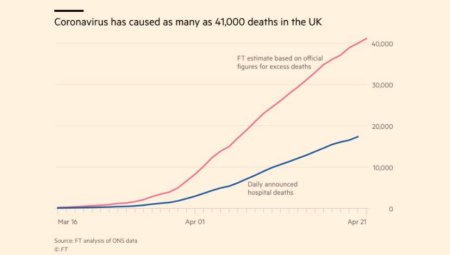
There are three main reasons why the official figures are misleading, namely that Covid-19 deaths reported each day by the UK authorities exclude:

Your reminder that the Covid-19 deaths reported each day by the UK authorities exclude:

  1. those who died of Covid-19 without ever being tested;
  2. those who died of Covid-19 who were tested but whose result was a false negative;
  3. those who died of Covid-19 outside hospitals whether they were tested or not.

Whenever I have pointed this out on Twitter (which I have done several times) I have attracted comments to the effect of “So what? Every country does the same” which is untrue. Several other countries (both large and small), including Ireland, include deaths outside hospital. Not all countries have such a shambolic policy on testing either, so not all countries leave people to die alone in their own homes without being tested. And, above all, not all countries have a Government consisting entirely of people whose incompetence is surpassed only by their dishonesty.

I’m not saying that it’s easy to communicate reliable data during a rapidly evolving pandemic. The Irish authorities are struggling to keep their figures accurate and up to date. The result is that the information available to the public is sometimes a bit confusing.

For example, a couple of days ago there was a significant upward spike in the reported deaths (red curve, about a factor two increase):

Whether this is an artefact of counting having been delayed over the weekend or a real increase, I don’t know. In any case the deaths reported each day did not necessarily occur in the previous 24 hours and may have been several days earlier. This makes the plot difficult to interpret

What I am saying is that the UK government could easily be more honest about the Covid-19 situation in the UK if it wanted to. Given that the shambles is of its own creation, and that lying is a way of life for its Ministers, it has no incentive to do anything other than obfuscate.

How Reliable Are University Rankings?

Posted in Bad Statistics, Education with tags , on April 21, 2020 by telescoper

I think most of you probably know the answer to this question already, but now there’s a detailed study on this topic. Here is the abstract of a paper on the arXiv on the subject

University or college rankings have almost become an industry of their own, published by US News \& World Report (USNWR) and similar organizations. Most of the rankings use a similar scheme: Rank universities in decreasing score order, where each score is computed using a set of attributes and their weights; the attributes can be objective or subjective while the weights are always subjective. This scheme is general enough to be applied to ranking objects other than universities. As shown in the related work, these rankings have important implications and also many issues. In this paper, we take a fresh look at this ranking scheme using the public College dataset; we both formally and experimentally show in multiple ways that this ranking scheme is not reliable and cannot be trusted as authoritative because it is too sensitive to weight changes and can easily be gamed. For example, we show how to derive reasonable weights programmatically to move multiple universities in our dataset to the top rank; moreover, this task takes a few seconds for over 600 universities on a personal laptop. Our mathematical formulation, methods, and results are applicable to ranking objects other than universities too. We conclude by making the case that all the data and methods used for rankings should be made open for validation and repeatability.

The italics are mine.

I have written many times about the worthlessness of University league tables (e.g. here).

Among the serious objections I have raised is that the way they are presented is fundamentally unscientific because they do not separate changes in data (assuming these are measurements of something interesting) from changes in methodology (e.g. weightings). There is an obvious and easy way to test for the size of the weighting effect, which is to construct a parallel set of league tables each year, with the current year’s input data but the previous year’s methodology, which would make it easy to isolate changes in methodology from changes in the performance indicators. No scientifically literate person would accept the result of this kind of study unless the systematic effects can be shown to be under control.

Yet purveyors of league table twaddle all refuse to perform this simple exercise. I myself asked the Times Higher to do this a few years ago and they categorically refused, thus proving that they are not at all interested in the reliability of the product they’re peddling.

Snake oil, anyone?

Exceptional Moods?

Posted in Biographical, Mental Health with tags , , on April 20, 2020 by telescoper

The other day I came across the following excerpt from The War Of The Worlds by H. G. Wells:

Perhaps I am a man of exceptional moods. I do not know how far my experience is common. At times I suffer from the strangest sense of detachment from myself and the world about me; I seem to watch it all from the outside, from somewhere inconceivably remote, out of time, out of space, out of the stress and tragedy of it all.

This passage struck me very forcefully because it captures what it feels like to experience depersonalisation disorder. I wrote about my own experiences of this about three years ago.

In my own case the depersonalisation was, I think, a side-effect of medication I took to deal with an anxiety condition that has plagued me off and on for many years.

In recent weeks I have often felt strangely detached in the same way as before, but I haven’t been on medication for nearly three years now so that’s not the cause this time.

Perhaps it is just the social distancing and the general stress caused by the Covid-19 outbreak that is causing it?

If so there is probably quite a number of people out there feeling the same way.do maybe these moods aren’t really exceptional?

Things to do during the Covid-19 lockdown, No. 563

Posted in Uncategorized on April 19, 2020 by telescoper

Another thing you might try if you’re attempting to avoid the onset of boredom during this lockdown is to switch on closed captions in English on YouTube when a person is speaking French..

R.I.P. Henry Grimes (1935-2020)

Posted in Jazz with tags , , , , , on April 19, 2020 by telescoper

The Coronavirus continues to cut a swathe through a generation of great Jazz musicians. The latest sad news is of the passing of bass player Henry Grimes at the age of 84.

Henry Grimes was very active in the 50s and 60s, playing with such luminaries as Sonny Rollins and Thelonious Monk, and appearing on some classic recordings, but he dropped out of the music scene as a performer for roughly thirty years from about 1970 during which time he was virtually destitute. He returned to music around 2002 after a Jazz fan tracked him down and bought him a double bass to play – he had sold his instrument decades earlier – and remained active until his death.

When I heard last night of the death of Henry Grimes the first thing that popped into my mind was this sequence from the movie Jazz On A Summer’s Day. You can see shot of the young Henry Grimes right at the beginning in this clip of the Thelonious Monk trio playing Blue Monk at the Newport JJazz Festival in 1958; Roy Haynes was the drummer.

Rest in peace, Henry Grimes (1935-2020)

Things to do during the Covid-19 lockdown, No. 234

Posted in Covid-19 on April 18, 2020 by telescoper

If you’re trying to avoid the onset of boredom during this lockdown, why not take the opportunity to amuse yourself and entertain your neighbours by choosing an interesting new name for your WiFi connection?

Cosmology Talks: Omar Darwish on Lensing Maps

Posted in The Universe and Stuff with tags , , , , , on April 17, 2020 by telescoper

If you are missing your regular seminar experience because of the Coronavirus lockdown, Shaun Hotchkiss has set up a YouTube channel just for you!

The channel features technical talks rather than popular expositions so it won’t be everyone’s cup of tea but for those seriously interested in cosmology at a research level they should prove interesting.

Here’s another example from that series in which Omar Darwish talks about CMB Lensing Maps and specifically about an extremely impressive example thereof which he made using data from the Atacama Cosmology Telescope.

R. I. P. Lee Konitz (1927-2020)

Posted in Jazz with tags , , , , , on April 16, 2020 by telescoper

My word this Covid-19 pandemic is having a terrible effect on the Jazz world. I heard this evening that it has now taken from us the great alto saxophonist Lee Konitz at the age of 92 after a career lasting 75 years.

I can’t possibly do justice here to the memory of such a legend but at least I can post one of my favourite tracks of his, a live performance from the 1950s of a tune called Ablution. If Lee Konitz hadn’t announced it at the start the comping of pianist Ronnie Ball would have told you straight away that this is a contrafact built on the chords of the famous Jerome Kern tune All The Things You Are, the unusual chords of which have made it a popular vehicle for jazz musicians to improvise on ever since it was written back in 1939.

In the bebop era it was typical practice to base original compositions on top of the chord sequences of standard tunes in such a way as to hide their foundations from the casual listener. A famous example of this was the Charlie Parker – Dizzy Gillespie session in which they decided to play a variation on the standard Cherokee. It went well until they absent-mindedly played the actual theme of Cherokee at which point there was a cry of anguish from the control room from a producer who had obviously hoped that if they stayed off the original melody he wouldn’t have to pay composer’s royalties. So off they went again called the next take Ko Ko and created one of the Charlie Parker classics.

Although Lee Konitz had a tone much more reminiscent of Paul Desmond than Charlie Parker he had a wonderfully agile and inventive way of playing that had echoes of Bird at the same time as being definitely his own style, as I hope you will agree after listening to this!

Here are just two classic albums that Lee Konitz played on relatively early in his career, if you want to check them out

R.I.P. Lee Konitz (1927-2020)

Covid-19: the next steps

Posted in Biographical, Covid-19, Education, Maynooth with tags , on April 16, 2020 by telescoper

The Irish Government’s information booklet about Covid-19

Although we are currently in what is meant to be the Easter holiday the new normal continues in the form of a plethora video conferences and email exchanges punctuated by the occasional bit of rest and relaxation. We’ve even got a virtual seminar tomorrow and a virtual Open Day on Saturday 25th April to add to the fun.

One of the things making life stressful for academics these days is uncertainty about the future. Will the current lockdown actually end on May 5th? Will our plans for remote examinations work out OK? Will the Leaving Certificate actually go ahead this summer? When will the next academic year begin?

None of these issues is on the same scale as those confronting health workers and others on the front line fighting this pandemic, but that doesn’t mean they aren’t causing anxiety.

My own view is that we need to concentrate as far as possible on the next step and not get carried away by the ifs and buts about what comes after. There are too many imponderables on the horizon, so just focus on what you can control. We have three more weeks teaching here at Maynooth before the end of the Semester so let’s do that as well as we can. After that there is the exam period so let’s try to get through that with as few glitches as possible. We’ll just have to cross other bridges when we come to them.

For myself, I am sceptical that there will be any reduction of the current restrictions on May 5th and if there is, it will be slight at first. As the Taoiseach Leo Varadkar said today relaxation of the lockdown will take places gradually over a number of months. As a physicist I see the change being rather like an adiabatic process, carried out in quasi-static fashion in a series of reversible steps…