R.I.P. Mirella Freni (1935-2020)

Posted in Opera with tags , , on February 10, 2020 by telescoper

I was deeply saddened last night to hear of the death at the age of 84 of legendary operatic soprano Mirella Freni who belonged to the generation of stars that included Joan Sutherland, Renata Tebaldi, Renata Scotto and Maria Callas. Freni’s light and elegant voice was perfectly suited to lyric roles, especially Mozart and Puccini, although in the later years of her long career she did broaden her repertoire considerably. For me (and I guess many others) her signature role was as Mimi in La Bohème to which she brought not only lovely singing, but a wonderful tenderness and warmth to the character. As a small tribute here she is in that role with the great Luciano Pavarotti (who was born in the same town as Freni, Modena).

R.I.P. Mirella Freni (1935-2020)

In for the Count

Posted in Biographical, Politics with tags , , , , , , , on February 9, 2020 by telescoper

I voted in the 2020 General Election yesterday morning before Storm Cíara arrived in Maynooth, which it did in the early afternoon.I don’t know if the weather or the switch to a Saturday polling day affected the turnout, but it looks to have been about 60% nationally*. One factor in the Dublin area was that a couple of big sporting fixtures took place in the city on Saturday, the Six Nations Rugby between Ireland and Wales at the Aviva Stadium and a Gaelic Football match between Dublin and Monaghan at Croke Park.

Whatever the effect of these things on the overall turnout I’d imagine that a larger fraction of voters turned out earlier in the day than in other elections as few people would want to interrupt their Saturday night pleasures by visiting a polling station!

The worst of Storm Cíara seems to have passed, but it’s still rather windy with the odd heavy rain shower, which is enough to keep me indoors for the count. As the meteorological storm subsides, an electoral storm seems to be brewing – last night’s exit polls the three largest parties tied on about 22% of the vote (with a margin of error around 1.5%).

Taking a look at the preceding opinion polls you will see that outcome is well within the ±3% uncertainty of the last few:

  • Sunday Times/Behaviour & Attitude: FF 32%; FG 20%; SF 19%
  • Irish Times/IPSOS-MRBI: FF 25%; FG 21%; SF 21%
  • BusinessPost/Red C: FF 26%; FG 23%; SF 19%
  • Daily Mail/Ireland Elects: FF 27%; FG 22%; SF 22%
  • Sunday Times/Panelbase: FF 23%; SF 21%; FG 19%
  • Business Post/Red C: FF 24%; SF 24%: FG 21%.
  • Irish Times/IPSOS-MRBI: FF 23%; FG 20%; SF 25%

If this pattern is borne out it will be a bitter disappointment for Fianna Fáil who have had four years in opposition to make inroads but have apparently failed to do so.

The main story however is the remarkable rise of Sinn Féin, which looks likely to shatter the two-party dominance that has held sway in Ireland more or less since its inception as an independent state. Early indications are that they will do very well and return TDs in constituencies where they have never previously won a seat.

My constituency is Kildare North which elected 1 Social democrat, 1 Fine Gael and 2 Fianna Fáil TDs last time. based on early tallies it seems that Catherine Murphy (the Social Democrat), who is a very good candidate with a strong local following, will get re-elected on the first round but the Sinn Féin candidate Réada Cronin looks likely to win a seat too. That is remarkable because she only polled 6.55% of the votes in the last General Election and also lost her County Council seat in the Local Elections last year. It’s been a remarkable turnaround for her and for Sinn Féin generally. If SF do win a seat that means at least one of the incumbents will lose theirs. But who? We’ll have to wait and see!

Counting has really only just started so I won’t comment much until the real results are available, except to say that it is very difficult to see what kind of Government will emerge from all this, which looks essentially like a three-way tie in terms of popular vote, because that will not translate directly into seats owing to the way the Single Transferable Vote works.

For example, take Dublin Central, the constituency of Sinn Féin President Mary Lou McDonald. The STV system involves a quota for automatic election which is N/(m+1) votes, where N is the number of valid ballots cast and m is the number of seats in the constituency. Dublin Central is a four-seater and it seems that Mary Lou got about 36% of the first-preference votes, which is way past the quota of 20%. This surplus (16% of the valid ballots) will be re-distributed among the 2nd preference votes of those who put her first which could make a huge difference to the fortunes of those lower-ranked candidates. But where will they go?

One might imagine that Sinn Féin voters would rank other leftish parties, but there is a fraction who don’t use the whole ballot paper, but just put a 1 next to the SF candidate. Some of the SF surplus may be wasted in this way. Moreover, during the European Elections last summer I noticed some very strange transfers that went from SF to right-wing rather than left-wing alternatives. It’s all very hard to predict, but we’ll know soon enough.

It took several days to get the full results of the European Parliament Elections last year, but in that case the constituencies were much larger (both geographically and in terms of number of voters). There were also many more candidates on each ballot paper. Hopefully there will be a clear picture of the outcome of this General Election later this evening…

*the official turnout figure is 62.9%

Bruckner: Symphony No. 8

Posted in Music with tags , , , , , on February 8, 2020 by telescoper

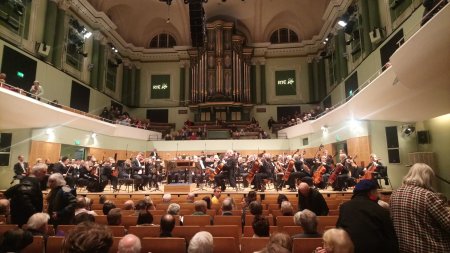
Last night I once again found myself settling into a seat at the National Concert Hall in Dublin for a performance by the RTÉ National Symphony Orchestra, this time under the direction of Mihhail Gerts. There was only one item on the menu – the Symphony No. 8 by Anton Bruckner – but what a feast it turned out to be!

Bruckner had a habit of making multiple revisions to his scores, and the Eighth Symphony is no exception to this. There are two major versions (usually referred to as the 1887 and 1890 versions) but also numerous edited variations of these two. For the record last night we heard the edition made by Robert Haas, based mainly on the 1890 version, but replacing some pieces which had been edited out of the 1887, perhaps most notably a quiet passage in the Third (Adagio) Movement.

This is a colossal work, lasting about 90 minutes in performance and requiring a huge orchestra so the stage was very crowded when the concert got under way.

As well as larger than usual string sections, the brass section comprises no less than eight horns, three trumpets, three trombones and a tuba as well as a quartet of Wagnertuben which you don’t often see in a symphony orchestra. These instruments have a sound somewhere between that of the horns and the trombones and they add an immense solidity to the section that produces a wall of sound that has an extraordinary effect when heard live, especially during the fortissimo passages (of which there are several in this work).

Woodwinds include a bass clarinet and a contrabassoon alongside the more usual clarinets and flutes, and there are three harps and percussion. A special mention must be made of the timpanist (Grahame King) who was given a huge amount to do, and did it all exceptionally well.

The work is structured in four movements, each of which involves a shift from minor to major (the piece opens in C minor) but each covers a very varied musical landscape. The overall atmosphere of the work varies too. At times it is tranquil (or perhaps merely resigned) but it often evokes a sense of conflict and sometimes even terror. It does, however, end in a glorious crescendo that gives a sense of triumph. Along the way there is some truly memorable passages: a gorgeous dialogue between flutes and clarinets in the 2nd Movement (Scherzo) comes to mind, and the Adagio as a whole is just magnificent.

I have never heard this work performed live, and have to admit I got completely lost in the performance. Despite the length of the concert, I never looked at my watch once during the whole thing. Congratulations to Mihhail Gerts and the entire orchestra for taking us on such an epic journey. I enjoyed every second of it, and so I think did the rest of the audience, because the end was greeted with a standing ovation.

But you don’t need to rely on my opinion. You can’t beat live music, but the entire concert is here for you to enjoy as live on the Lyric FM stream. Enjoy!

Polling Day Eve

Posted in Biographical, Maynooth, Politics, Rugby with tags , , , , on February 7, 2020 by telescoper

It’s Friday 7th February 2020, the day before Ireland goes to the polls in a General Election. I’m actually quite excited.

My polling card arrived a couple of days ago:

You don’t need to take this card with you when you vote, although it does speed things up a bit. The card is useful, however, because it tells you where the polling station is. In this case it’s the same place as in the European and Local Elections last summer.

A few days ago I came home from work and found this. It’s the only such card I’ve had from any individual or party during the three weeks of the campaign.

It’s a pity I wasn’t in when Bernard Durkan called around. I’m not going to vote for him, but I should like to have seen the look on his face when I told him who I’m actually going to vote for!

It remains to be seen whether the switch to a Saturday polling day will change the volume or composition of the turnout. It seems likely to me that the more important factor might be the weather: Storm Ciara is due to arrive on Saturday, bringing high winds and heavy rain. The local forecast in Maynooth for Saturday seems OK in the morning, however, so I’ll get my voting done then, but the storm seems set to hit Dublin just as the Six Nations rugby between Ireland and Wales gets under way, which might make things interesting.

Have you ever had a flu jab?

Posted in Biographical with tags , , on February 6, 2020 by telescoper

What with all the news about the coronavirus outbreak that originated recently in China, a few of us were talking yesterday about being vaccinated against influenza. As it happens, to my knowledge, I have never had a flu jab. Some people I’ve told about this were astonished and assumed I was some sort of anti-vax nutter, which I am not. I’m not scared of injections, either. In fact I’ve recently  had monster injections in my knees to help with my arthritis. It’s  just that I regard `flu as a relatively minor ailment and that it’s better to let nature’s own defences fight it off. It seems that this is in accord with practice both here in Ireland and in the UK.

The NHS recommends having a  flu vaccine if you:

  • are 65 years old or over
  • are pregnant
  • have certain medical conditions
  • are living in a long-stay residential care home or another long-stay care facility
  • receive a carer’s allowance, or you’re the main carer for an elderly or disabled person whose welfare may be at risk if you fall ill .

Similar advice is given here in Ireland. It appears that, e.g in the United States, anyone over the age of 6 months is recommended (“with rare exceptions”)

I wonder why there’s such a big difference in practice on this? Are Americans just soft?

Anyway, as part of a totally unscientific study into this question I thought I’d see what fraction of my totally unrepresentative readership have actually had flu jabs via the poll below:

Of course other comments are, as always, welcome through the box below.


The Reverend Professor Callan

Posted in Biographical, History, Maynooth, The Universe and Stuff with tags , , , , , on February 5, 2020 by telescoper

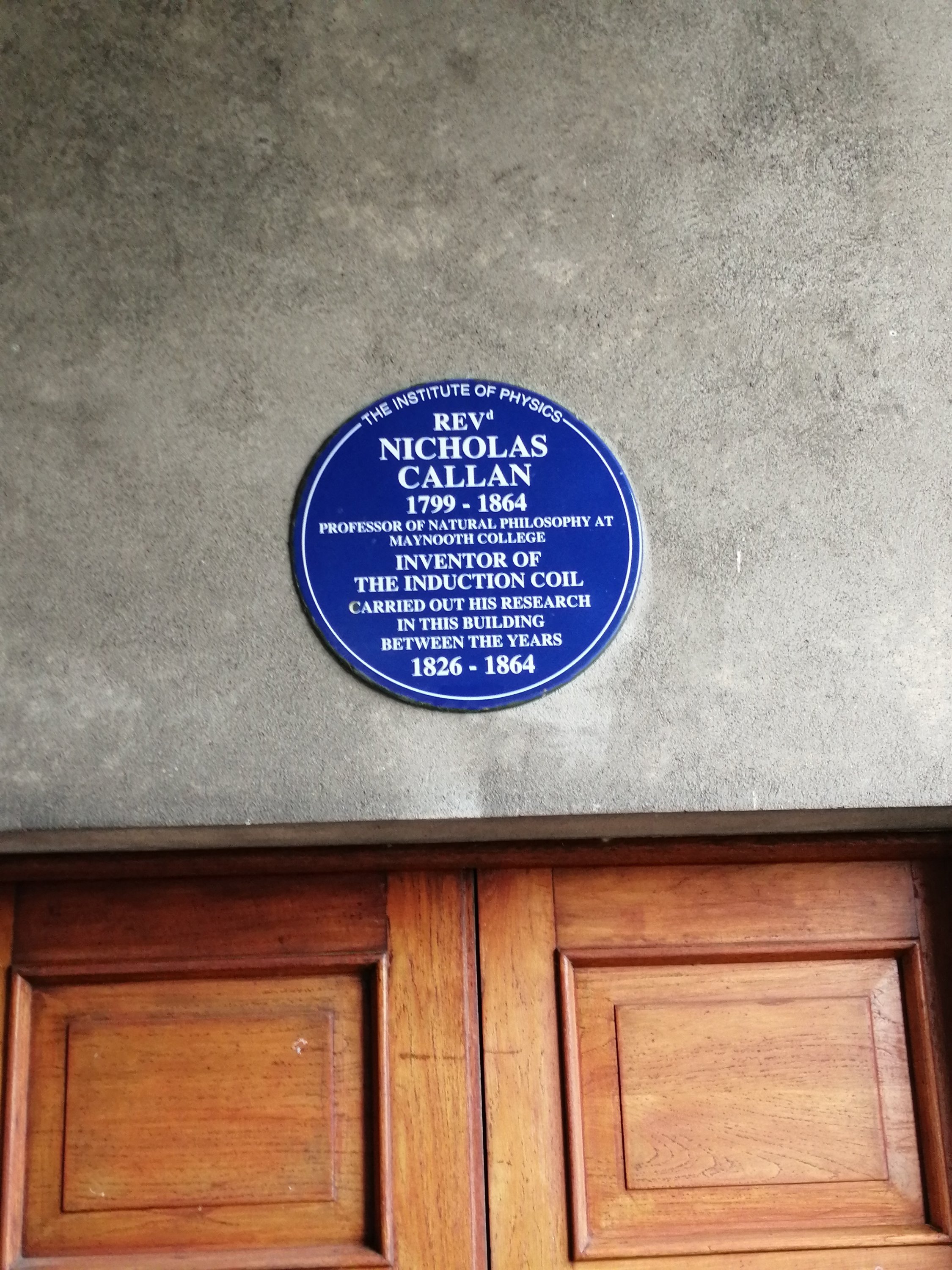
I’ve had a busy day doing various things that took me to various places on the Maynooth University campus, culminating in my first visit to the Department of Mathematics and Statistics (which is based in Logic House) to give a colloquium. On my travels I passed this sign, which I hadn’t noticed before:

Since I’ve been too busy to write a post today I thought I’d rehash an old one about the person named in the plaque, which is above Callan Hall (on the South Campus)

Father Nicholas Callan (or, more formally, The Reverend Professor Nicholas Joseph Callan) was born in County Louth in 1799 went to the seminary of St Patrick’s College, Maynooth, in 1816 to train as a priest. During his time as a seminarian Callan studied ‘Natural Philosophy’ and became interested in experiments involving electricity. In 1823 Callan was ordained as a priest, and went to Rome in 1826 to obtain his doctorate in Divinity. At the time Italy was a centre for research into electricity and here Callan became familiar with the work of the Italian physicist Alessandro Volta who had developed the world’s first battery. Callan returned to Maynooth where he was made chair of Natural Philosophy, a post he would hold until his death in 1864.

Callan is most famous for inventing the induction coil (in 1836). By connecting two copper wire coils to a battery and electromagnet and then interrupting the current he was able to generate much larger voltages than could be obtained from batteries alone. His 1837 version that used a clock mechanism to interrupt the current 20 times a second is estimated to have produced 60,000 volts – the largest artificially generated charge at that time. It is said that his induction coil could produce sparks 15″ long, which must have been fun to watch.

Callan’s biggest induction coil, unfinished at the time of his death, can be found in the National Science Museum of Ireland (which is in Maynooth). This was one of the largest in the world at the time. The iron core is 109 cm long. The secondary windings are 53 cm in diameter and consist of about 50 km of iron wire insulated with beeswax. They were made in three separate rings separated by air gaps, so wires carrying large voltage differences would not lie adjacent to each other, reducing the risk of the insulation breaking down. At the left end is a vibrating mercury ‘contact breaker’ in the primary circuit, actuated by the magnetic field in the primary, which interrupted the primary current to generate potentials of over 200,000 volts.

Sadly Callan’s work was forgotten for quite a period after his death – experimental electromagnetism was not a priority for St Patrick’s College at this time – for which reason the invention of the induction coil has often been attributed to Heinrich Ruhmkorff who made his first device (independently) about 15 years after Callan. More recently, however, Callan’s achievements have been more widely recognized and in 2000 the Irish government issued a stamp in his honour.

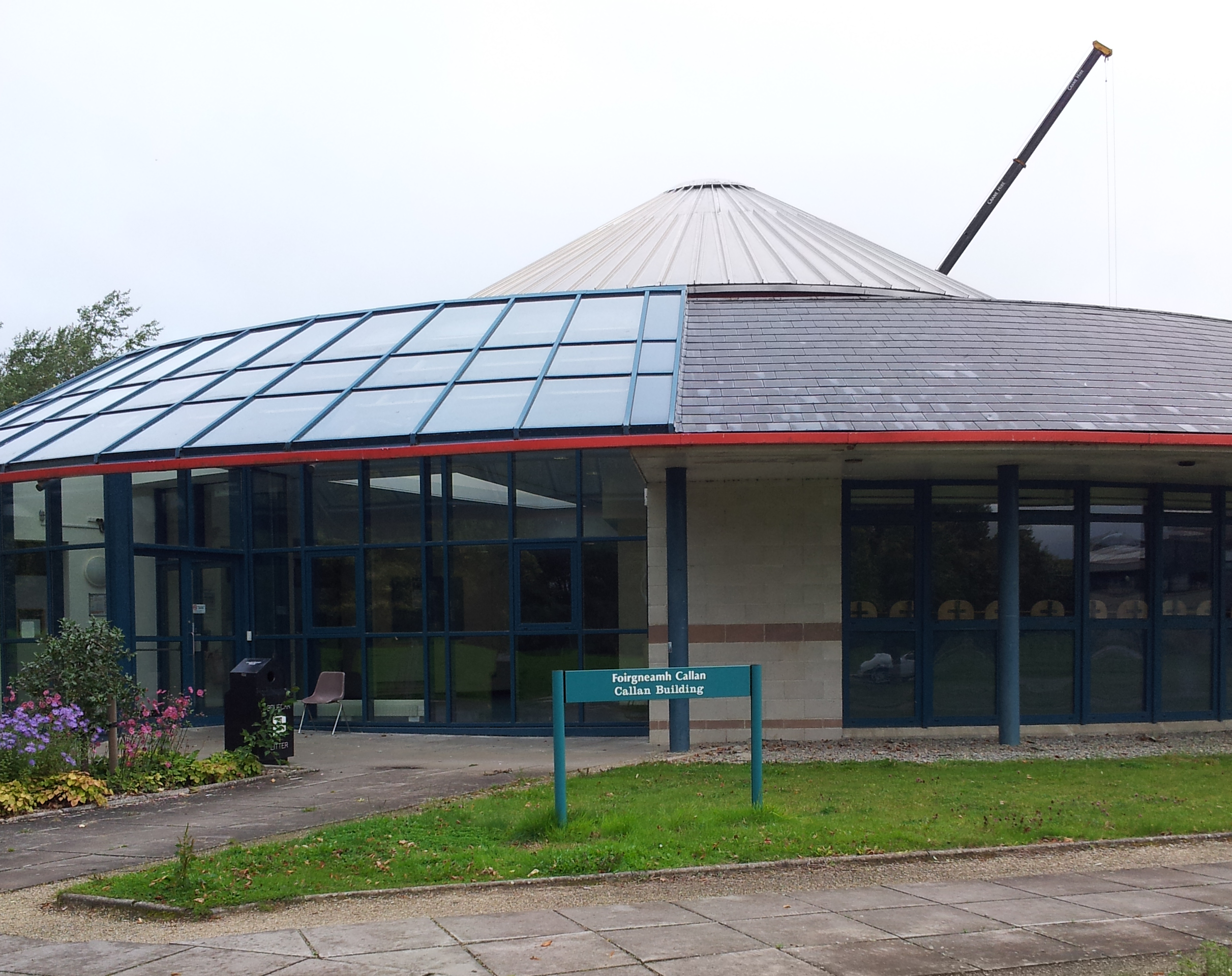
The Callan Building

Nicholas Callan was laid to rest in the College Cemetery at Maynooth in 1864. The Callan Building (above) on the North Campus of the present-day Maynooth University is named in his honour, as of course is Callan Hall which I mentioned at the start.

Beethoven from Brexit Day

Posted in Music with tags , , on February 4, 2020 by telescoper

I may not have been able to attend the concert at the National Concert Hall in Dublin on Friday 31st January, but I did listen to it live on the Radio. Now you can experience the whole thing yourself via the Youtube recording of the live stream. The programme consisted of three pieces by Ludwig van Beethoven played by the RTÉ National Symphony Orchestra under the direction of Leonard Slatkin:

  • The Consecration of the House Overture
  • Violin Concerto (soloist Stefan Jackiw)
  • Symphony No. 7

I very much enjoyed listening to the concert, especially the up-tempo finale of the Seventh Symphony. I gather there was a problem with the live stream that meant the sound wasn’t broadcast along with the pictures, but they’ve fixed it on the recording so now you can experience both sight and sound from the NCH:


Voids, Galaxies and Cosmic Acceleration

Posted in The Universe and Stuff with tags , , , , , , on February 4, 2020 by telescoper

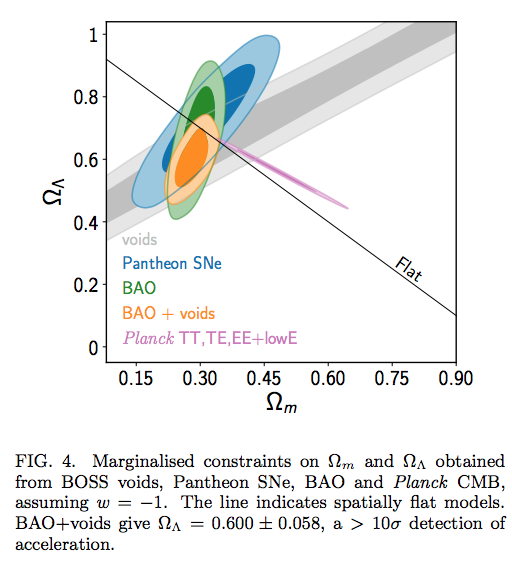
Time for a quick plug for a paper by Nadathur et al. that appeared on the arXiv recently with the title Testing low-redshift cosmic acceleration with large-scale structure. Here is the abstract:

You can make it bigger by clicking on the image. You can download a PDF of the entire paper here.

The particularly interesting thing about this result is that it gives strong evidence for models with a cosmological constant (or perhaps some other form of dark energy), in a manner that is independent of the other main cosmological constraints (i.e. the Cosmic Microwave Background or Type 1a Supernovae). This constraint is based on combining properties of void regions (underdensities) with Baryon Acoustic Oscillations (BAOs) to produce constraints that are stronger than those obtained using BAOs on their own. The data used derives largely from the BOSS survey.

As well as this there’s another intriguing result, or rather two results. First is that the the BAO+voids data from redshifts z<2 gives H0 = 72.3 ± 1.9, while, on the other hand adding, BAO information from the Lyman-alpha forest for from z>2 gives a value H0 = 69 \pm 1.2, favouring Planck over Riess. Once again, the `tension’ over the value of the Hubble constant appears to be related to using nearby rather than distant sources.

Irish Election Update

Posted in Politics with tags , , , , on February 3, 2020 by telescoper

I couldn’t resist one more update before Saturday’s General Election because there has been another opinion poll (Irish Times/IPSOS-MRBI), which I’ve added to the previous ones here:

  • Sunday Times/Behaviour & Attitude: FF 32%; FG 20%; SF 19%
  • Irish Times/IPSOS-MRBI: FF 25%; FG 21%; SF 21%
  • BusinessPost/Red C: FF 26%; FG 23%; SF 19%
  • Daily Mail/Ireland Elects: FF 27%; FG 22%; SF 22%
  • Sunday Times/Panelbase: FF 23%; SF 21%; FG 19%
  • Business Post/Red C: FF 24%; SF 24%: FG 21%.
  • Irish Times/IPSOS-MRBI: FF 23%; FG 20%; SF 25%

This last one is the first to put Sinn Féin in the lead, although to be honest the margin of error is 3% again so there’s really no evidence for a significant change on the last poll by the same outfit.

I still find it very hard to predict what kind of Government Ireland will end up with, but it seems even less likely than before that Leo Varadkar will be leading it.

British friends keep asking me whether all this change is a result of Brexit. I have to say that the answer to that is ‘no’ and neither is it driven entirely by thoughts of a United Ireland. The focus of campaigning is largely on domestic political issues, chiefly housing and health. Most people tend to think Varadkar has handled Brexit pretty well, but his party had failed badly in these other areas.

Spring Semester Starts

Posted in Biographical, Education, Maynooth with tags , , , , , , on February 3, 2020 by telescoper

It’s February 3rd 2020, which means that today is two days after Imbolc, a Gaelic festival marking the point halfway between the winter solstice and vernal equinox. The 1st Day of February is also the Feast day of St Brigid of Kildare (c. 451-525), one of Ireland’s patron saints along with Saints Patrick and Colm Cille. One of her miraculous powers was the ability to change water into ale, which perhaps explains her enduring popularity among the Irish.

In Ireland this day is sometimes regarded as the first day of spring, as it is roughly the time when the first spring lambs are born. It corresponds to the Welsh Gŵyl Fair y Canhwyllau and is also known as the `Cross Quarter Day’ or (my favourite) `The Quickening of the Year’.

Today is, appropriately enough in the light of all this, the start of the Spring Semester of teaching at Maynooth University, the third Spring Semester I will have experienced here. The weather has even played along; it has definitely been spring-like. The Campus, whicgh has beenhas been very quiet for the last week or so since the examinations finished, is full of students again.

This Semester, as was the case last year, I am teaching Engineering Mathematics II and Computational Physics I. The former, what you would probably call a `service course’, covers a mixture of things, mainly Linear Algebra but with some other bits thrown in for fun, such as Laplace transforms. Interestingly I find the Mathematical Physics students do not encounter Laplace Transforms in the first year, but perhaps engineers use them more often than physicists do? I think I’ve written only one paper that made use of a Laplace transform. Anyway, I have to start with this topic as the students need some knowledge of it for some other module they’re taking this semester. I reckon six lectures will be enough to give them what they need. That’s two weeks of lectures, there being three lectures a week for this module.

Once again my teaching timetable for this module is quite nice. I have lectures on Monday, Tuesday and Wednesday and then the students have a choice of tutorial (on either Thursday or Friday). That means I can get through a decent amount of material each week before each tutorial. I don’t do the tutorials, by the way: that’s left to one of our PhD students, who gets paid for doing that and correcting the weekly coursework. There are about 50 students on this module, divided into two courses: Electronic Engineering and Robotics and Intelligent Devices. We don’t have Civil or Mechanical or Chemical Engineering, etc at Maynooth, in case you were wondering.

Anyway, my first lecture was this afternoon at 2pm and had a good turnout. It was so sunny outside that we had to close all the blinds. That’s quite an unusual event for a February lecture!

My first Computational Physics lecture is on Thursday, after which it will be back to the Department for some frantic behind-the-scenes activity ahead of the afternoon lab session, which is in a computer room near my office. Students attend one two-hour lab session in addition to the lecture, on either Thursday or Tuesday. The first lecture being on Thursday the first lab session will be Thursday afternoon, with the same material being covered the following Tuesday.

While my teaching duties are the same this year as they were in the corresponding semester last year, there is a significant difference this year in that I am now also Head of Department. Either side of my first lecture I had to attend a meeting of the Faculty Executive for Science & Engineering, a meeting on `Project LEGO’ (which, sadly, did not involve any actual Lego but was instead about the proposed redesign of the University’s website) and a meeting of Academic Council. I have also been trying to sort out tutors and tutorials for the forthcoming Semester: these don’t start until next week so there’s time, but it’s quite a challenge to get everyone sorted out. A few timetable clashes have also come to light. So, in summary, I’m a bit worn out after today and will shortly go home to vegetate.

At least I didn’t have to find time for the regular Monday afternoon Euclid telecon in which I usually participate. There wasn’t one today because the working group of which I am part is actually meeting in person for a few days… in Paris! I couldn’t go because of all the above!