UK and Ireland Trade

Posted in Politics with tags , on February 2, 2020 by telescoper

For reasons that are probably obvious I recently took a look at the latest figures relating to trade between Ireland and the United Kingdom. These were produced by the UK Government but I’ll nevertheless assume they are trustworthy. The latest complete figures are from 2018; the report was published in January this year (2020).

Here are the key points:

  • In 2018, UK exports to Ireland were worth £35.1 billion; imports from Ireland were £21.6 billion, resulting in a trade surplus of £13.5 billion with Ireland.
  • The UK had a surplus with Ireland in both goods and services.
  • Ireland accounted for 5.5% of UK exports and 3.2% of all UK imports.
  • Ireland was the UK’s 5th largest export market and the 10th largest source of imports.
  • The UK has recorded a trade surplus with Ireland every year between 1999 and 2018.

Brexiter logic states that the fact that the EU exports more to the UK than vice versa means that the EU needs the UK more than the UK needs the EU. Applying the same argument to Ireland would imply that the UK needs Ireland more than Ireland needs the UK (if it were correct). The reality is that membership of the single market has been of benefit to the economy of both countries (and the rest of the EU). Trade is not a zero-sum game. While the Single Market has allowed the UK to generate a trading surplus with Ireland, Ireland has found other opportunities elsewhere to more than make up. Contrary to popular myth, the UK now only accounts for a small fraction of goods exports from Ireland.

As the United Kingdom has left the European Union it must now try to negotiate new trading arrangements that will cover trade with remaining member states, including Ireland. No doubt the EU negotiators will be pressed by Ireland to take steps to reduce the imbalance described above. As the UK no longer wants to avail itself of the benefits of Single Market, it seems likely that other EU member states will want to seize the opportunity to boost their trade by filling the gaps.

Since the UK’s trading agreement with the EU (if there ever is one, which is doubtful) will probably not include services, I thought it would be interesting to look at goods: here is a summary of the breakdown of this category of UK exports to Ireland:

`Miscellaneous manufactured articles’, incidentally, means things made out of plastic, etc.

As a relatively recent arrival in Ireland I find these figures quite interesting in light of my own experience of shopping here. I know that consumer goods aren’t representative of all trade so this is just a comment on my own impressions and is not to be taken too seriously.

If you go into a Supermarket in Ireland you will find that fresh vegetables, meat and dairy products are generally all from local sources. There is a wide choice of these items and value for money is generally very good. The same is true for bread and bread-related products. Some fruit is imported from the EU (especially France and The Netherlands, but including some, e.g. apples, from the UK) and some from further afield (e.g. bananas from the Caribbean and Latin America). You will be shocked to learn that bendy bananas are freely available.

Moving to processed foods (including confectionery, canned items, etc) the picture changes quite a bit. There are local Irish brands but they tend to be alongside familiar British ones. There are also items from elsewhere, e.g. from Italy, that I have never seen on sale in the UK. The (smaller) Irish brands of, say, marmalade seem to be a bit dearer than their imported equivalent but are often of better quality.

As an aside I’ll also mention that supermarkets here have a noticeably smaller range of convenience foods (e.g. microwave meals and ready-made sandwiches) than in corresponding outlets in the UK.

I’ve been impressed at the quality and availability of another important staple, wine. There is a better range of French, Spanish and Italian wines in Supervalu in Ireland, especially at the quality end of the spectrum, than in stores of a similar size in the United Kingdom. There is also a good range of wines from Australia, New Zealand, South Africa and Latin America. I haven’t tried Irish wine yet…

In summary, then, it’s perfectly easy to eat and drink well in Ireland without buying any British products. For myself, I have always tried to buy local food products whenever possible to support the Irish economy as best I can.

Elsewhere in the store however you can see a much greater dominance of UK products. This is particularly true of toiletries (including toothpaste, shampoo), pharmaceutical goods, domestic cleaning products and so on. These tend to be dominated by familiar British brands, although they seem to be more expensive here in Ireland than in the UK.

None of the goods mentioned in the previous paragraph are at all perishable so they could in principle be quite easily be imported from further afield. I wonder if we’ll soon start seeing products of this sort starting to appear from elsewhere?


Irish Election Update

Posted in Biographical, Maynooth, Politics with tags , , , , on February 1, 2020 by telescoper

Well. Life goes on, and so does the Irish General Election campaign. A week today I’ll be casting my vote. Sinn Féin seem the most energized by the events of the last week, even to the extent that their posters have been going up around Maynooth. The one above, showing leader Mary Lou McDonald, is on my way into work (the North Campus of Maynooth University is on the other side of the road, beyond the trees).

Since last week’s update there have been other opinion polls (by the Sunday Times/Panel base and Red C), which I’ve added to the previous ones here:

  • Sunday Times/Behaviour & Attitude: FF 32%; FG 20%; SF 19%
  • Irish Times/IPSOS-MRBI: FF 25%; FG 21%; SF 21%
  • BusinessPost/Red C: FF 26%; FG 23%; SF 19%
  • Daily Mail/Ireland Elects: FF 27%; FG 22%; SF 22%
  • Sunday Times/Panelbase: FF 23%; SF 21%; FG 19%
  • Business Post/Red C: FF 24%; SF 24%: FG 21%.

The latest polls (like the others) are based on a small sample (1000) so has a large marging of error (around 3%) and is based on online responses and an uncertain methodology which may create a systematic bias. Those caveats aside, however, they seems to be telling the same story as the others: decline for Fine Gael and a relatively strong showing for Sinn Féin who are up 7% and 5% on the previous Panelbase and Red C numbers, respectively.

I wouldn’t be at all surprised if Sinn Féin end up with a share of the first preference votes around 25%. If that is the case they’ll probably wish they had stood more candidates, which they will probably do next time if they perform strongly in the actual election. They did poorly in the European Elections last year, which probably explains their rather defensive strategy. On the other hand if Fianna Fáil really are polling in the low twenties they may regret standing so many candidates, as their vote may end up splitting so that none reach the quota.

It will be very interesting to see how this all pans out. I find it very hard to predict what kind of Government Ireland will end up with, but I’m willing to bet that Leo Varadkar won’t be leading it.

The Anthem of Europe

Posted in Music, Politics with tags , , , , on January 31, 2020 by telescoper

(I was tempted to put up the version that is currently No. 1 in the UK charts, but I’m afraid I draw the line at André Rieu…)


Brexit Day Blues

Posted in Biographical, Politics with tags , , , on January 31, 2020 by telescoper

Well, here we are then. It’s January 31st 2020. This morning, Facebook reminded me that exactly seven years ago today I left Cardiff University to take up a new job at Sussex University. What a strange 7 years followed! I moved to Sussex, then back to Cardiff, and then here to Maynooth in Ireland. It seems impossible, looking back, that all that happened in just seven years.

Today’s date has a much wider significance, of course. After 11pm (Irish Time) today, the United Kingdom will no longer be a member state of the European Union. Some people seem, for some reason, to think this is a good idea. I don’t, but that’s irrelevant now. It’s happening. And I don’t live in the United Kingdom any more anyway.

It has taken three and a half years since the Brexit referendum for the UK to leave. I’ve heard it said that’s been too long, but historically it usually takes a lot longer to get the British to leave. Just ask Ireland or India, for example.

Anyway, yesterday I planned how to mark the event, and came up with the following.

Dinner will comprise Irish, Spanish, Greek, Dutch, Danish and French ingredients, with Italian wine and afterwards a glass of (Portuguese) port. That’s not all the EU countries, of course, but it’s the best I could do with the available shopping time!

Musical accompaniment will be provided by Beethoven (courtesy of the RTÉ National Symphony Orchestra live from the National Concert Hall in Dublin on RTÉ Lyric FM). I was hoping to go to the concert, but I left it too late to buy a ticket and it’s sold out!

And at the appointed hour I’ll raise a glass to the EU, to everyone in the UK who is being dragged out of it against their will, to my colleagues in the UK who hate what’s happening as much as I do but haven’t had the opportunity to escape, and to all the EU citizens in the UK who have been treated so shabbily by the British Government.

Living in a country that has chosen to define itself by its contempt for foreigners is not going to be easy, and is certain to get worse when Brexit fails to deliver the `sunlit uplands’ that were promised. There are very good reasons to fear for the future.

I wrote back in 2017, when it seemed that the madness of Brexit might still be halted, but I’d decided to leave Britain anyway:

The damage has already been done. The referendum campaign, followed by the callous and contemptuous attitude of the current UK Government towards EU nationals living in Britain, unleashed a sickening level of xenophobia that has made me feel like a stranger in my own country. Not everyone who voted `Leave’ is a bigot, of course, but every bigot voted for Brexit and the bigots are now calling all the shots. There are many on the far right of UK politics who won’t be satisfied until we have ethnic cleansing. Even if Brexit is stopped the genie of intolerance is out of the bottle and I don’t think it well ever be put back. Brexit will also doom the National Health Service and the UK university system, and clear the way for the destruction of workers’ rights and environmental protection. The poor and the sick will suffer, while only the rich swindlers who bought the referendum result will prosper. The country in which I was born, and in which I have lived for the best part of 54 years, is no longer something of which I want to be a part.

The Me of 2020 thinks the Me of 2017 was absolutely right.

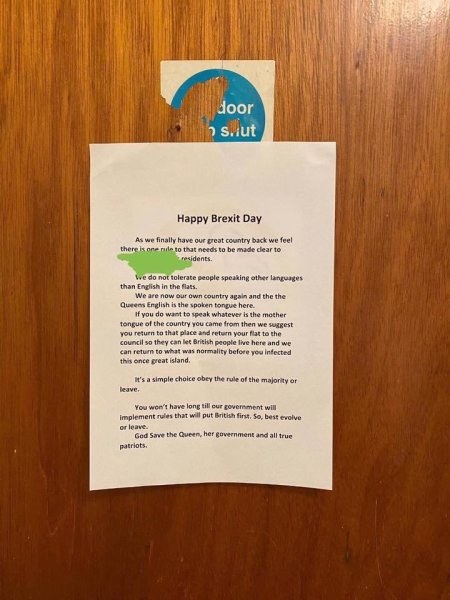
I got this today from a friend. Posted on the front door of an EU resident.

An die Freude

Posted in Poetry with tags , , , , , on January 30, 2020 by telescoper

Freude, Schöner Götterfunken,
Tochter aus Elysium,
Wir betreten feuer-trunken,
Himmlische, dein Heiligtum!
Deine Zauber binden wieder,
Was die Mode streng geteilt;
Alle Menschen werden Brüder,
Wo dein sanfter Flügel weilt.

Wem der grosse Wurf gelungen,
Eines Freundes Freund zu sein,
Wer ein holdes Weib errungen,
Mische seinen Jubel ein!
Ja, wer auch nur eine Seele
Sein nennt auf dem Erdenrund!
Und wer’s nie gekonnt, der stehle
Weinend sich aus diesem Bund!

Freude trinken alle Wesen
An den Brüsten der Natur;
Alle Guten, alle Bösen
Folgen ihrer Rosenspur.
Küsse gab sie uns und Reben,
Einen Freund, geprüft im Tod;
Wollust ward dem Wurm gegeben,
Und der Cherub steht vor Gott.

Froh, wie seine Sonnen fliegen
Durch des Himmels Prächt’gen Plan,
Laufet, Brüder, eure Bahn,
Freudig, wie ein Held zum Siegen.

Seid umschlungen, Millionen!
Diesen Kuss der ganzen Welt!
Brüder über’m Sternenzelt
Muss ein lieber Vater wohnen.
Ihr stürzt nieder, Millionen?
Ahnest du den Schöpfer, Welt?
Such’ ihn über’m Sternenzelt!
Über Sternen muss er wohnen.

by Friedrich Schiller (as revised by Ludwig van Beethoven)


On the Surface of the Sun

Posted in The Universe and Stuff with tags , , , on January 30, 2020 by telescoper

There are some wonderful images and movies going around from the Daniel K Inouye Solar Telescope which has produced the highest resolution images of the solar surface ever seen.

Here’s a snapshot:

And here’s a movie:

In the above image you can see the granular structure of the Sun’s photosphere. The cells you can see are a manifestation of the large-scale convective motions that transport energy from the Sun’s inner regions to the surface. This energy is created by nuclear reactions in the solar core and it sets up convective motions in the outer layers rather like those in a pan of boiling water set up by heating from below (or perhaps the gentler motions that appearin a lava lamp).

The surface structure looks surprisingly regular but the highly turbulent magnetized plasma is responsible to an extraordinary range of activity, from sunspots, flares and prominences, to the heating of the solar corona and the generation of the solar wind.


Taxing Figures

Posted in Bad Statistics, Politics with tags , , , on January 29, 2020 by telescoper

Following the campaign for the forthcoming General Election in Ireland has confirmed (not entirely unexpectedly) that politicians over here are not averse to peddling demonstrable untruths.

One particular example came up in recent televised debate during which Fine Gael leader Leo Varadkar talked about his party’s plans for tax cuts achieved by raising the salary at which workers start paying the higher rate of income tax. Here’s a summary of the proposal from the Irish Times:

Fine Gael wants to increase the threshold at which people hit the higher rate of income tax from €35,300 to €50,000, which it says will be worth €3,000 to the average earner if the policy is fully implemented.

Three thousand (per year) to the average earner! Sounds great!

But let’s look at the figures. There are two tax rates in Ireland. The first part of your income up to a certain amount is taxed at 20% – this is known as the Standard Rate. The remainder of your income is taxed at 40% which is known as the Higher Rate. The cut-off point for the standard rate depends on circumstances, but for a single person it is currently €35,300.

According to official statistics the average salary is €38,893 per year, as has been widely reported. Let’s call that €38,900 for round figures. Note that figure includes overtime and other earnings, not just basic wages.

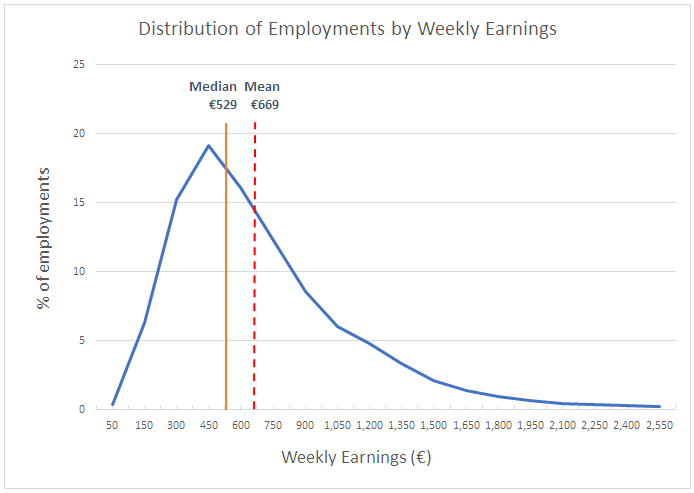
It’s worth pointing out that in Ireland (as practically everywhere else) the distribution of earnings is very skewed. here is an example showing weekly earnings in Ireland a few years ago to demonstrate the point.


This means that there are more people earning less than the average salary (also known as the mean)  than above it. In Ireland over 60% of people earn less than the average.  Using the mean in examples like this* is rather misleading – the median would be less influenced by a few very high salaries –  but let’s continue with it for the sake of argument.

So how much will a person earning €38,900 actually benefit from raising the higher rate tax threshold to €50,000? For clarity I’ll consider this question in isolation from other proposed changes.

Currently such a person pays tax at 40% on the portion of their salary exceeding the threshold which is €38,900 – €35,300 = €3600. Forty per cent of that figure is €1440. If the higher rate threshold is raised above their earnings level this €3600 would instead be taxed at the Standard rate of 20%, which means that €720 would be paid instead of €1440. The net saving is therefore €720 per annum. This is a saving, but it’s nowhere near €3000. Fine Gael’s claim is therefore demonstrably false.

If you look at the way the tax bands work it is clear that a person earning over €50,000 would save an amount which is equivalent to 20% of the difference between €35,300 and €50,000 which is a sum close to €3000, but that only applies to people earning well over the average salary. For anyone earning less than €50,000 the saving is much less.

The untruth lies therefore in the misleading use of the term `average salary’.

Notice furthermore that anyone earning less than the higher rate tax threshold will not benefit in any way from the proposed change, so it favours the better off. That’s not unexpected for Fine Gael. A fairer change (in my view) would involve increasing the higher rate threshold and also the higher rate itself.

All this presupposes of course that you think cutting tax is a good idea at this time. Personally I don’t. Ireland is crying out for greater investment in public services and infrastructure so I think it’s inadvisable to make less money available for these purposes, which is what cutting tax would do.


*Another example is provided by the citation numbers for papers in the Open Journal of Astrophysics. The average number of citations for the 12 papers published in 2019 was around 34 but eleven of the twelve had fewer citations than this: the average is dragged up by one paper with >300 citations.


The Brexit Visa

Posted in Politics, Science Politics with tags , , , , , , on January 28, 2020 by telescoper

I noticed yesterday a news item about a new fast-track ‘global talent visa’ to be launched days after Brexit. The Tory press have been jumping up and down touting this as a way to attract the best scientific talent from around the world to the United Kingdom. Global Britain and all that.

Given the very short timescale involved, it seems very likely to me that this new visa is likely to be just a slight re-branding of the existing `Exceptional Talent’ Tier 1 visa. There is at present a cap of 2000 on the number of such visas that the Home Office will issue per year but this has never been reached. The proposal to remove the cap would be of no practical consequence were it not for the fact that when the United Kingdom leaves the European Union, freedom of movement of EU and EEA citizens will be brought to an end so such citizens will also have to apply.

Currently, for most applicants the total cost of a visa application under the Exceptional Talent scheme is £608 per person (and dependent thereof). It seems likely to me that extra staff will be needed to process the larger number of applications expected under the new scheme, so I infer that additional charges will be imposed to pay for them. Remember that, currently, a scientist (or anyone else) from the EU does not need a visa to work in the UK.

In addition, EU citizens will almost certainly have to pay the so-called Healthcare Surcharge of £400 per person per year from which they are currently exempt. I’ve always felt this charge was grossly unfair to all immigrants. The National Health Service is paid for out of income tax and national insurance. If an immigrant pays tax and national insurance anyway, what possible justification can there be for a health surcharge? If you ask me it’s just another manifestation of the Tory Government’s intrinsic hostility to anyone foreign. This visceral xenophobia is now perceived across the world to be the defining characteristic of Brexit Britain. You don’t need to be a budding Einstein to see what is going on. Everyone knows the language routinely used by the Government and Tory press to demean and humiliate immigrants.

Given this hostile environment, and the fact that scientists who are EU citizens still have freedom of movement within the EU (along with everyone else), why would such a person come to the UK instead of a country with a more civilized attitude?

It is true that the science base of the United Kingdom is generally pretty strong, but that is at least in part due to the influx of EU scientists thanks to freedom of movement. I’m not saying that all the wonderful Italian, Danish, French, German and other scientists currently in the UK are going to leave immediately because many have deep roots in the United Kingdom. In the long run, however, Britain’s self-imposed loss will be Europe’s gain, and no amount of cosmetic tinkering with the visa system will change that.

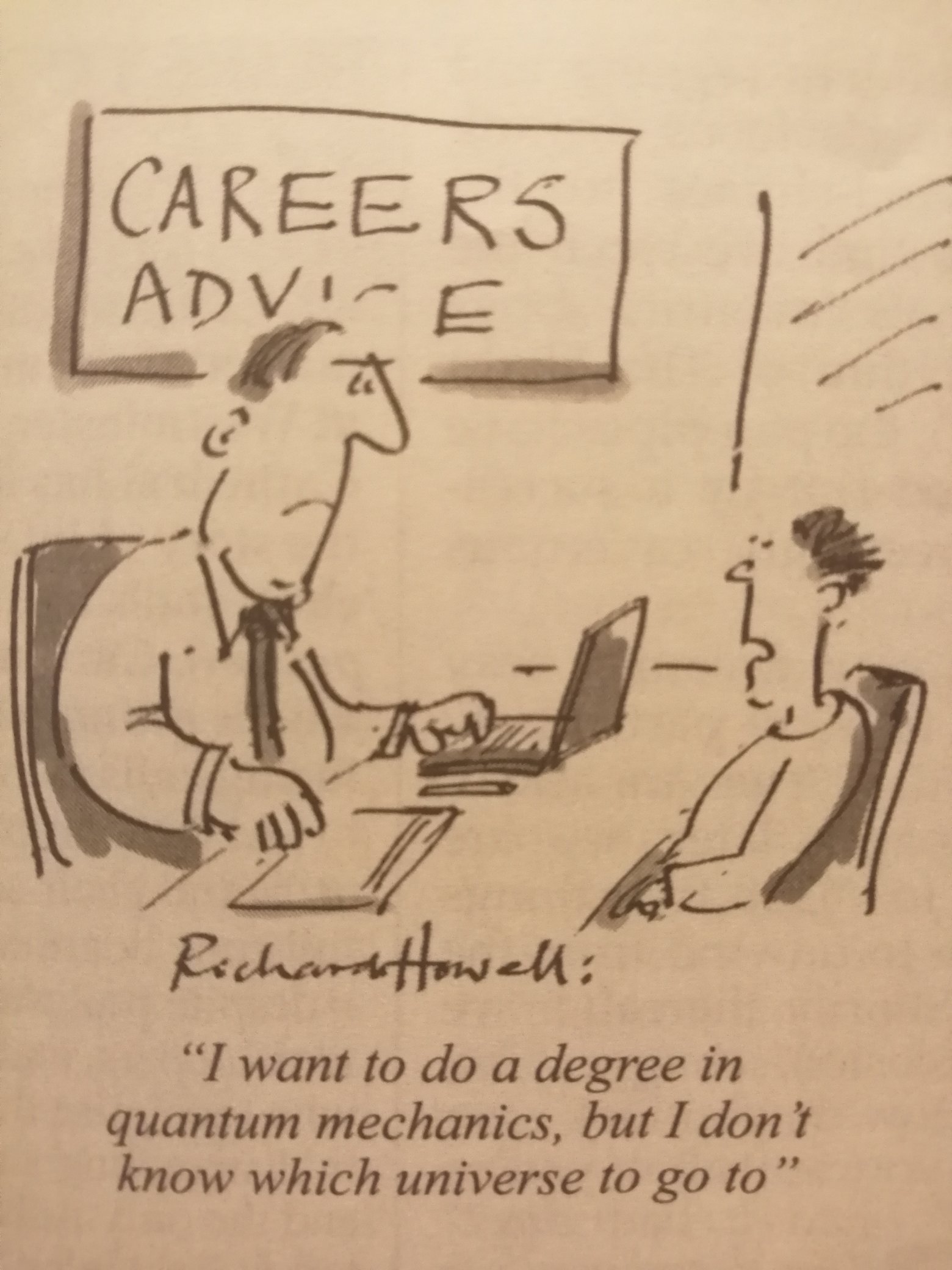
A Question for Prospective Physics Students

Posted in The Universe and Stuff with tags , , on January 28, 2020 by telescoper

I saw this in the latest Private Eye…

Appeal by Astronomers

Posted in Uncategorized with tags , , on January 27, 2020 by telescoper

I apologize for being a bit late onto this but this is a very important initiative that tries to safeguard the sky from the plethora of satellite fleets that threaten to cause untold damage to major astronomical projects, especially surveys. I’ve signed the document and I hope you will also consider doing so.

Many of the readers of this blog will be aware of the fast-moving issue of satellite constellations, which is the launching of the first of potentially tens of thousands of communications satellites. The SpaceX Starlink cluster is one of these, but there will be others such as Amazon’s project Kuiper and Facebook Athena.
These satellite constellations will be detrimental to both optical and radio ground-based astronomy, from their reflected light and broadcasted emissions. Mitigating the effects of these satellites needs to be done quickly before services such as 5G internet from them are established in the coming months. Beyond that point, it will be harder to regulate them.
Organisations which represent our discipline such as the AAS, IAU, EAS and RAS are attempting to engage directly with SpaceX and others on this issue.
Please consider promptly adding your name to the appeal linked to in the post below.

Stefano Gallozzi's avatarAstronomers' Appeal

Safeguarding the Astronomical Sky (IT)

Download EN_PDFDownload IT_PDF

THIS APPEAL HAS BEEN SIGNED BY

901+ ASTRONOMERS

VIEW SIGNATURES

(the refresh rate of the counter may slow down).

To sign/subscribefollow this link.

This is an international appeal by professional astronomers open for subscription to ask for an intervention from institutions and governments.

Astronomical observations from the ground can be greatly harmed by the ongoing deployment of large satellite fleets in preparation for the next generation of telecommunications.

For centuries the astronomical observations from the ground have led to exceptional progress in our scientific understanding of the Laws of Nature. Currently, the capability of astronomical instrumentation from the ground is endangered by the deployment of satellites fleets.

Through this international appeal and following the same concerns expressed by the International Astronomical Union, IAU [1] and other institutions, we raise a formal request for greater…

View original post 1,586 more words