I get quite a few of these spam invitations to fake academic conferences, but I have never had one before with such an obviously back-handed compliment about the quality of my research!
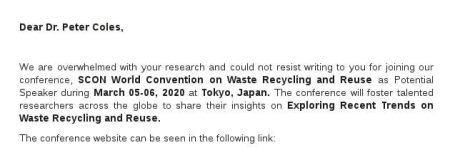
I get quite a few of these spam invitations to fake academic conferences, but I have never had one before with such an obviously back-handed compliment about the quality of my research!
The rain is pouring down here in Maynooth, but this isn’t the only place to have had inclement weather today:
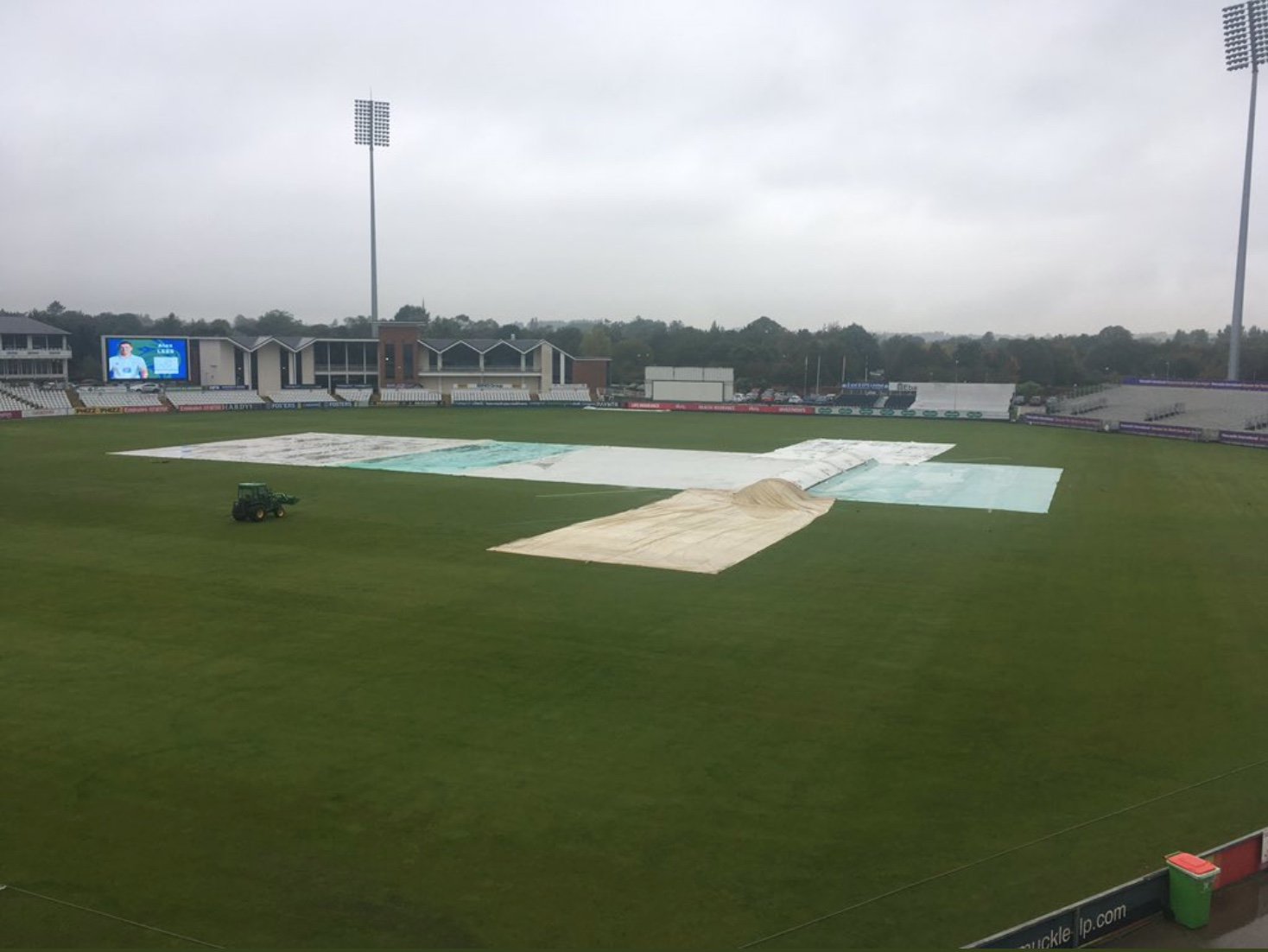
The picture above shows the scene this morning at Chester-le-Street in County Durham where the County Championship Division 2 match between Durham and Glamorgan was taking place. Or rather, wasn’t taking place. The game was abandoned this morning owing to a the cumulative effect of heavy rain over the last few days that allowed only 86 overs to be bowled in total over the four days.
This match being declared a draw, Glamorgan finish the season in 4th place on 167 points, missing out on promotion to Division 1 but having performed much better than last season. They were top of the table early on, but the loss of the excellent Marnus Labuschagne to Ashes duty for Australia proved a big blow and they fell back in the second half of the season. Anyway, at least they’ll probably win a few games next season, while they would undoubtedly struggle in Division 1. Lancashire finish top of the Division 2 table by a country mile, while Northants and Gloucester also go up.
I always thing of the last day of the County Championship as the end of summer. This year most of the final round of games has been hit by the weather so it’s a rather damp ending. This is also the first year in a while in which I haven’t seen any live cricket. Still, there’s always next year.
That’s basically all I have time to write about today as I’ve been running around all day – including popping into the library to give the webinar I mentioned yesterday. Moreover, at 6pm local time all the power in the building is going off and we’re to be turfed out while some repair work is done. I’ll shortly have to go round checking all the computers are switched off.
Follow @telescoperJust a quick reminder that tomorrow I’ll be participating in webinar (whatever that is) organized by Scholastica to do a about the Open Journal of Astrophysics, which will involved a short presentation delivered over the interwebs jointly by myself and Fiona Morley (Head of Digital Programmes and Information Systems at Maynooth University Library), followed by a question and answer session. The session will be conducted via Zoom (which is the pretty neat platform we use, e.g., for Euclid teleconference meetings).
Here is the advert:

You can sign up here.
Now I have to figure out what I should say.
Follow @telescoperThis morning the Supreme Court delivered a ruling that the UK Government acted unlawfully in its recent prorogation of Parliament and so Parliament is consequently no long prorogued. After its decision in this case that the Prime Minister prorogued Parliament with the intent of stopping it carrying out its duties, I look forward to a similarly shocking ruling in the vexed matter of whether or not ursine mammals defecate in forested areas.
I have noticed over the years that everyone on Twitter is – or at least thinks they are – a legal expert, so not to be outdone I last night posted my own prediction of the Supreme Court ruling:
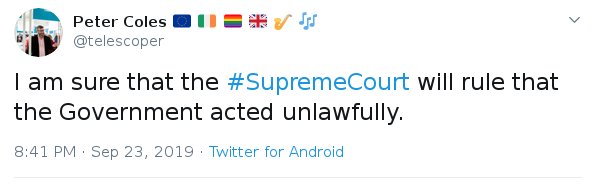
My legal acumen having been established beyond any reasonable doubt, I mention for the record that I posted this tweet at the same time:
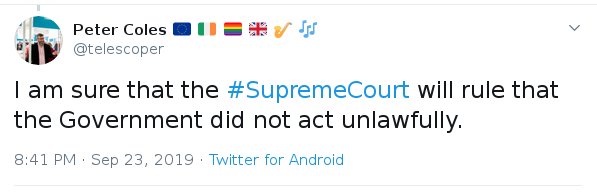
This is the correct way to make predictions in the age of social media.
Diana Ross is 75.
Follow @telescoper
Yesterday we published another new paper at The Open Journal of Astrophysics, but I didn’t get time to write a post about because of teaching and other start-of-term business so I’m correcting that omission now.
The authors are Selim Can Hotinli of Imperial College London (UK), Marc Kamionkowski of Johns Hopkins University, Baltimore (USA) and Andrew Jaffe, also of Imperial College.
You can find the accepted version on the arXiv here. This version was accepted after modifications requested by the referee and editor. Because this is an overlay journal the authors have to submit the accepted version to the arXiv (which we then check against the copy submitted to us) before publishing; version 2 on the arXiv is the accepted version.
You will see that this is one for the `Cosmology and Nongalactic Astrophysics’ folder. We would be happy to get more submissions from other areas, especially Stellar and Planetary astrophysics. Hint! Hint!
P.S. Just a reminder that we now have an Open Journal of Astrophysics Facebook page where you can follow updates from the Journal should you wish..
Follow @telescoperThe Autumnal Equinox (in the Northern hemisphere) took place today (Monday 23rd September 2019) at 8.50am in Ireland.
People sometimes ask me how one can define the `equinox’ so precisely when surely it just refers to a day on which day and night are of equal length, implying that it’s a day not a specific time? The answer is that the equinox is defined by a specific event, the event in question being when the plane defined by Earth’s equator passes through the centre of the Sun’s disk (or, if you prefer, when the centre of the Sun passes through the plane defined by Earth’s equator). Day and night are not necessarily exactly equal on the equinox, but they’re the closest they get. From now on days in the Northern hemisphere will be shorter than nights and they’ll get shorter until the Winter Solstice.
For many people the autumnal equinox is taken to be the end of summer, though there is a saying around these parts that `Summer is Summer to Michaelmas Day’ (which does not happen until September 29th). Nevertheless it is the first day of teaching term and the start of the last round of this years matches in English cricket’s County Championship. The end of the cricket season is the end of summer as far as I’m concerned, though I haven’t seen any matches in person this year.
Over the past week or two the new students have been going through various induction and orientation processes, but their first encounter with actual teaching will be tomorrow. I will be greeting our 94 new first-year Mathematical Physics students at 11am on their first day. I hope I don’t put too many off. Then I start the fourth-years off on Astrology and Cosmetics Astrophysics and Cosmology. That is assuming that I take the right notes to the right lectures.
Anyway, I think that’s enough rambling for now. I’ve got to finish getting my notes together for the next few days. Let me end by wishing the new and returning students at Maynooth all the best for the new academic year. That goes for all students everywhere too! Work hard, and enjoy your studies, but don’t forget to enjoy life on the way!
Follow @telescoper
Yesterday, 21st September 2019, would have been Leonard Cohen‘s 85th birthday, which made last night’s performance of Between your love and mine at the National Concert Hall in Dublin an especially moving occasion.
The piece – a Requiem by Leonard Cohen, rather than a Requiem for Leonard Cohen – was created by John MacKenna who, in the summer of 2016 approached Leonard Cohen with the idea of creating a requiem in memory of young people who had died tragically, and for those grieving for them. It roughly follows the liturgical form of the Requiem mass but with text and music provided entirely by Cohen. Leonard Cohen – a Jew who had embraced Buddhism – often referred to Catholic themes and imagery in his songs and poems so the work is in no way a contrivance but has a compelling unity and honesty about it.
The first `hymn’ Come Healing sets the tone:
And let the heavens hear it,
the penitential hymn,
come healing of the spirit,
come healing of the limb.
Behold the gates of mercy
in arbitrary space
and none of us deserving
the cruelty or the grace.
Some of the songs were unfamiliar to me, but there are some of Leonard Cohen’s famous songs in Between love and mine, including Anthem and If it be your will. There are three principal vocalists: Katie Jacques, Shane Sullivan and Eric Butler. The latter in particular gave a superb performance demonstrating wonderful versatility in his voice, including a passable reference Cohen’s own deep tone (that someone once described as `like a boulder rolling down a granite tunnel’) but also deploying his own natural register to powerful effect, especially in Anthem where he summoned up his thundercloud in fiery tenor tones. Three backing singers, two readers (including John MacKenna) and a small band of strings, keyboard and drums make up the cast of this intriguing and emotionally powerful work.
Naturally, given the theme, it was a sombre performance but at the same time very uplifting. Leonard Cohen may not have been there in the flesh, but he was certainly present in spirit. In more ways than one it felt like he was the host.
And those who dance, begin to dance,
those who weep begin
and “Welcome, welcome” cries a voice
“Let all my guests come in.”
I thought I’d do a quick round-up of my little trip around cultural and historic Dublin yesterday after being stood down from duty at the Higher Options fair at the Royal Dublin Society (RDS). I have to say it was wonderful to see so many people out and about in the City’s beautiful parks and public spaces enjoying the September sunshine as I walked around.
The RDS is in the Ballsbridge area in of Dublin, to the East of the City. My route into town from there took me along Northumberland Road, where I took this picture outside Number 25:

A little further along I went across Mount Street Bridge, passing this memorial.

If you want to know more about the significance of these memorials to the events of the Easter Rising in 1916, see my post here.
My main intention during my afternoon off was to visit the National Gallery of Ireland which is situated on one side of Merrion Square. I have to say that this was even better than I’d expected, and I’m sure to visit again many times in the future. The ground floor is dominated by the work of Irish artists from about 1660 to 1965, together with European Art from 1835 to 1965. You will find works by Monet and Picasso in this section, which has much to savour. Among the Irish artists represented in this show is Jack B. Yeats (brother of poet W.B. Yeats), an extremely interesting artist in his own right.
The highlights for me, however, were found on the 3rd floor which displays examples of European Art from the early Renaissance (c. 1300) to the Enlightenment. One of the interesting things about this collection is that it is arranged thematically rather than by artist (or nationality thereof). There is, for example, an entire room of paintings inspired and influenced by Caravaggio, all of them with an intensely dramatic use of light and shadow. The gallery is worth it just for that room, but there are also fascinating juxtapositions of religious paintings from the renaissance with icons and altarpieces from the Byzantine and Russian orthodox traditions from the same period.
Elsewhere in the collection there are notable works by Vermeer, Rembrandt and Perugino as well as a number of British works by, for example, Gainsborough and Reynolds.
The work that really stopped me in my tracks, however, was this:
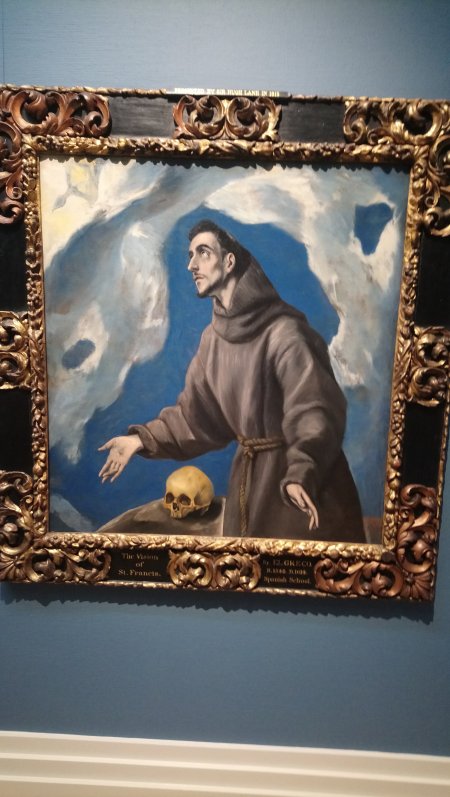
This is St Francis Receiving The Stigmata by El Greco. I knew about this painting but had no idea it was in Dublin. Seeing it close up is a revelation: the swirling brushstrokes give it an extraordinary texture that makes it hard to bring the image completely into focus. The hypnotic feel that results is a brilliant depiction of a man undergoing a kind of ecstatic vision. This work has an unbelievably powerful effect on the viewer (or at least on this one).
After a break for a sit down and a cup of coffee I visited the Natural History Museum (which is practically next door to the National Gallery). This is a surprisingly old-fashioned affair, with hundreds of stuffed animals and birds crammed into two large rooms:
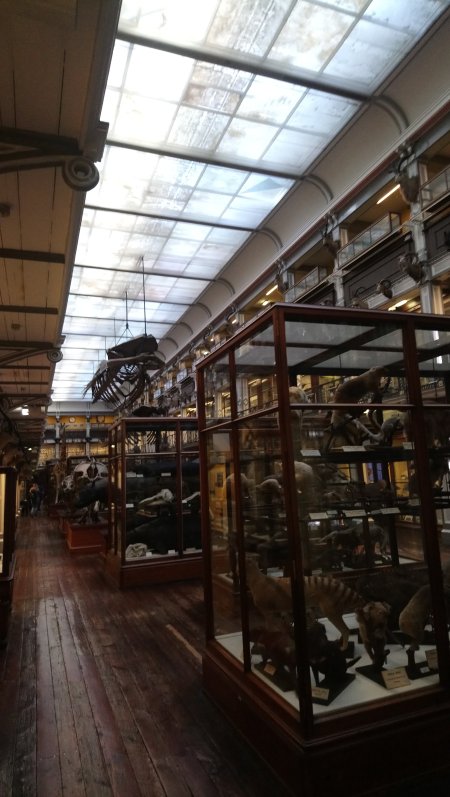
It reminded me a lot of visits to the Hancock Museum in Newcastle when I was a kid. It’s interesting, but more than a little creepy and would make an excellent setting for a horror story!
After adjourning to a pub for a pint of Guinness the final stop of the day was the National Concert Hall for yesterday’s Culture Night concert. On the way there I saw a big queue of people trying to get into one of the many free events around Dublin. It turns out this Culture Night was the grand opening of the Museum of Literature Ireland, which is situated in Newman House on the South Side of St Stephen’s Green. There’s another one to put on my list of places to visit.

The Culture Night concert was by the RTÉ National Symphony Orchestra conducted by Leonard Slatkin. The opening piece, Kinah, was a composition by the conductor himself and is a sort of memorial to his parents, both of whom were classical musicians, one a violinist and the other a cellist, and together they formed half of the famous Hollywood String Quartet. It was a new piece for me, and I found it very moving indeed. After that there was a bit of reorganization on stage to make way for the Steinway on which the brilliant Xiayin Wang played the Piano Concerto by Samuel Barber, which consists of two fast and furious movements either side of a beautifully lyrical slower movement. This must be a ferociously difficult piece to play – especially the last movement which is at a breakneck pace in 5/8 time – requiring not only dexterity but physical strength. It was a wonderful performance by Xiayin Wang, who rounded off the first half with an encore in the form of a transcription of George Gershwin’s song The Man I Love.
After the wine break interval came the main course in the form of the Symphony No. 4 in E Minor by Johannes Brahms. This is of course a much more familiar work than the previous two, but I really like concerts that mix unfamiliar material with the standard concert repertoire. It also gave me the chance to persevere with Brahms as my friends keep telling me to. It’s not that I don’t like Brahms, it’s just that I don’t find that he moves me as much as many other composers and so many people rave about him that I think I must be missing something. The 4th Symphony is a very fine work, and was performed beautifully last night under the direction of Leonard Slatkin (conducting, incidentally, without a score), but I couldn’t stop myself thinking how much like Beethoven it sounds. That’s not meant to be derogatory, by the way.
But you don’t need to take my word for it. You can listen to (and watch) the whole concert here:
Anyway, after the applause had died down I headed out towards Pearse Station for the train back to Maynooth. I was a bit tired after a very full day and wanted to get the 10.08 train so I didn’t stop to watch any of the numerous musical and artistic events I passed on the way, including an intriguing installation involving images projected onto one of the buildings to the side of St Stephen’s Green. I made it to the station with 5 minutes to spare and discovered that, because it was Culture Night, the train home was free!
Follow @telescoperSo here I am at the RDS in Dublin for the final day of Higher Options which is a sort of trade fair for Irish Universities, other tertiary education institutions and related organisations.
It’s my first trip to one of these events and I was a bit taken aback by the crowds when I arrived. I’m not very good in unfamiliar situations where there a lots of people moving around me.
Fortunately I soon found the Maynooth stand, which was fairly conspicuous:
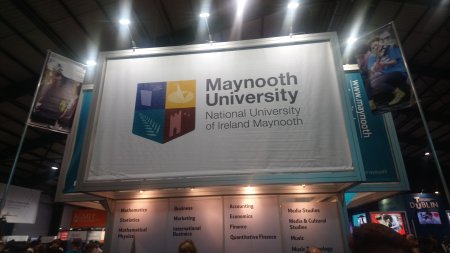
Once I found the sanctuary where I was supposed to be it was all fine. There was a constant stream of people coming to talk to us until about 1pm, when it started to quieten.
Just as well really as we had run out of the relevant literature!
Now I’m a free agent and it’s a lovely afternoon so I’m going to wander around Dublin this afternoon until this evening’s concert at the National Concert Hall. My excuses for not going back to Maynooth are (a) that I didn’t fancy going back just to come into Dublin later this evening and (b) that this is the last day before teaching starts next week, and therefore my last chance of a bit of rest and recreation before term!
Update: there was, apparently, an incident outside the RDS while I was inside, but I wasn’t aware of it at all and only found out about it after I left.
Follow @telescoper

 In the Dark