I find this absolutely fascinating. I’ve programmed in Fortran, Pascal, Basic, Assembler, C, C++, Javascript and Python lived long enough to see quite the fashion for most of these languages come and go on a relatively short timescale. Perhaps it provides a salutary lesson for those who think their current Python codes will always be useful?
Follow @telescoperMost Popular Programming Languages 1965-2019
Posted in The Universe and Stuff with tags Computing, History, Programming Languages, Python on October 21, 2019 by telescoperOn Zero-Hours Contracts
Posted in Maynooth, Politics with tags Caroline Flint, European Union, ireland, Oireachtas, Zero-Hours Contracts on October 20, 2019 by telescoper
In a week dominated by stupid things being said by stupid British politicians, one of the stupidest of all was the claim by Labour MP Caroline Flint that the European Union is to blame for the rise of zero-hours contracts. Caroline Flint is a Brexit supporter, of course, so she will not be interested in facts, but it is a fact that the European Union recently adopted a directive that protects workers’ rights and, in most cases, rules out zero-hours contracts. It’s up to the national governments to implement EU directives, something that the United Kingdom has yet to do and obviously will not do if and when Brexit happens and all employment protections go on the bonfire. As a Labour MP you would think Caroline Flint would care about this, but apparently not. She’s content to recite lies she hopes will curry favour with her leave-voting constituents and perpetuate her own political career at their expense.
Meanwhile, here in Ireland, the Oireachtas recently passed legislation making zero-hours contracts unlawful in Ireland `in most circumstances’. There’s a nice summary of the effects of the new law here.
I probably don’t need to spell it out but I rather think that the existence of this law and Ireland’s membership of the European Union comprehensively refutes Caroline Flint’s claim. Zero-hours are on the rise in the UK because of it’s own Government, not because of the European Union. I can think of dozens of other things that the EU gets the blame for that are actually the fault of the idiots in Westminster. Perhaps after Brexit British politicians will no longer be able to use the EU as a scapegoat for things they themselves mess up, though something makes me think they will continue to try and that the gullible public may actually believe them.
Anyway, the legal changes around zero-hours contracts in Ireland have had a significant impact in higher education, where many people – often (but not always) graduate students – are employed on casual part-time arrangements to run small group teaching sessions (i.e tutorials), demonstrate in laboratories, mark coursework and so on. The contracts on which such people have been employed have hitherto often been of the zero-hours type that is now unlawful.
As a response to this change in the law, here in Maynooth we have changed the contracts we issue to casual teaching staff, introducing clearer terms and conditions of employment as well as giving clearer indications of hours to be worked. In particular there is now a new category of employment designed for graduate students who are doing teaching, with terms and conditions that reflect their special status. All this required quite an effort at the start of teaching term this year to adapt to the new arrangements in time for the first teaching sessions. I only started as Head of Department on 1st September, and teaching started on 23rd, so this all caused quite a few headaches for me personally as I tried to get to grips with the new system. Fortunately, in the end, the transition actually went relatively smoothly and we have now settled into a steady state.
Of course it wasn’t the existence of graduate student teachers that precipitated the change in the law in Ireland. There are far worse offenders than universities in the use of exploitative employment contracts. Nevertheless but I am glad that the change has happened. Meanwhile, in the United Kingdom, according to UCU figures, around 46% of universities use staff on zero-hours contracts to deliver teaching.
Follow @telescoperA Letter to Donald Tusk
Posted in Politics with tags Donald Tusk, Mrs Trellis on October 20, 2019 by telescoperWe all now know that, last night, the UK Government sent not one or two but three letters to President of the Council of the European Union, Donald Tusk. These were not the only items of correspondence delivered to Mr Tusk last night. In fact, as an In The Dark exclusive, I can now reveal the contents of yet another letter, this one written by a Mrs Trellis of North Wales:
Follow @telescoperDear Mr
TrumpTusk,I have heard that Boris Johnson does not want an extension.
If you have one spare please could I have it?
I promise to make good use of it as my kitchen is really very small.
Yours sincerely,
Mrs Trellis.
A Strange Day
Posted in Politics, Rugby with tags Boris Johnson, BrExit, ireland, People's Vote March, Sir Oliver Letwin on October 19, 2019 by telescoper
Being in Maynooth getting some work done this afternoon, I wasn’t in London for today’s People’s Vote March, which seems to have been a big one. So big, in fact, that even the BBC felt compelled to mention it. Well done to everyone who took part!
Inside the House of Commons, Members of Parliament voted for an Amendment, the upshot of which is that the Government is now required to seek an extension of the October 31st deadline for leaving the European Union to allow Boris Johnson’s so-called `deal’ with the European Union and the associated legislation to be properly scrutinized.
The `deal’ finalized with the EU last week is a remarkable achievement, in that it is even stupider than the already extremely stupid deal negotiated by Theresa May. The one good thing about it is that it is a big step on the road to a United Ireland, which I personally hope I live long enough to enjoy. Loyalists – especially the Democratic Unionist Party – don’t see things the same way of course. The latter party’s public humiliation by Johnson in was a huge gamble that backfired spectacularly on him ,as their ten votes in favour of the Letwin Amendment led to the Government’s defeat, which lost by 322 to 308.
And then there’s Scotland which, like Northern Ireland, voted to remain in the European Union in the referendum that seemed to take place decades ago. While special customs arrangements to facilitate frictionless trade have been proposed for NI, there’s nothing at all in the Withdrawal Agreement for Scotland. In fact Scotland isn’t mentioned once in the text. Faced with such contemptuous treatment from Westminster, the likelihood of Scottish independence must now be greater than at any point in recent memory.
Anyway, Johnson is presumably now back at home in Downing Street with his crayons,writing a letter to the European Union asking for an extension as the law requires him. Or will he? Will he instead do what he usually does and try to bluster his way out of trouble? Will he end up going to prison for contempt of court? Or perhaps he’ll just go and die quietly in a ditch somewhere?
UPDATE: In an astonishing act of petulance, the UK Prime Minister sent not just one but three letters. The first – an unsigned photocopy of the letter contained in the Benn Act. It’s a wonder he didn’t wipe his bottom on it for further effect. The second letter was a covering note from the UK Ambassador to the EU explaining what the first letter was for, and the third was a rambling and incoherent missive from Bozo himself trying to explain in poor grammar why he didn’t think it was a good idea to grant an extension. If Johnson had been planning to make himself like a complete imbecile he could hardly have done a better job. Meanwhile Donald Tusk did exactly the right thing and took the first letter as a request for an extension. Johnson’s pathetic bluster had no effect on the EU, but in any case that was all for Tory party consumption anyway. Stupidity goes down very well with the Conservative Party these days.
P.S. For diary purposes I’ll note that today in the Rugby World Cup quarter-finals, England beat Australia 40-16 while New Zealand beat Ireland 46-14. That means my accumulator bet is still on…
P.P.S. Wales beat France by the narrowest of margins (an elbow) and South Africa beat hosts Japan in the other two quarter-finals, bringing my quad bet home in style. Who will win the competition overall? I’ll go for New Zealand, but I’m not going to bet on it. Always quit while you’re ahead.
Follow @telescoper
Uri Caine’s Mahler
Posted in Music with tags Gustav Mahler, Mahler Symphony No. 5, Uri Caine, Urlicht on October 18, 2019 by telescoperAnd now for something completely different. I have recently been listening a lot to a fascinating album Urlicht by jazz pianist and bandleader Uri Caine in which he re-imagines the music of Gustav Mahler with a small band to wonderful effect. The music he produces is not only influenced by jazz but full of references to klezmer music and (to my ears at least) redolent of the music of the Weimar era. I confidently predict that many Mahler fans will absolutely hate this, with its pared-down arrangements and roughness around the edges, but I find it very refreshing. Anyway, you can decide for yourself whether you like it or not. This is Uri Caine’s take on the Funeral March from Mahler’s Symphony No. 5:
Follow @telescoperTen Years on Twitter
Posted in Biographical with tags social media, Twitter on October 17, 2019 by telescoper
This morning, a certain social media site pointed out to me that it is ten years to the day since I started using it.
My experiences of Twitter haven’t been anything like as bad as some people I know have reported. I think that’s probably because I’m quite liberal with the ‘block’ facility when it comes to bots and trolls and sundry other tediously offensive types. I have found that the positives have definitely outweighed the negatives over the last decade, and I count myself lucky to have encountered some very lovely people on Twitter, some of whom I have eventually met in the real world.
I don’t have a huge following on Twitter, but I’d like to take this opportunity to say that I do appreciate those who do read my tweets and hope that they find at least some of them interesting or amusing!
Follow @telescoperGravitational Lensing, Cosmological Distances and the Hubble Constant
Posted in The Universe and Stuff with tags arXiv:1910.06306, cosmological distance ladder, Gravitational Lensing, Hubble constant on October 17, 2019 by telescoper
To continue the ongoing Hubble constant theme, there is an interesting paper on the arXiv by Shajib et al. about determining a distance to a gravitational lens system; I grabbed the above pretty picture from the paper.
The abstract is:

You can click on this to make it bigger. You will see that this approach gives a `high’ value of H0 ≈ 74.2, consistent with local stellar distances measures, rather than with the `cosmological’ value which comes in around H0 ≈ 67 or so. It’s also consistent with the value derived from other gravitational lens studies discussed here.
Here’s my ongoing poll on the Hubble constant, with
Follow @telescoper
Happy Birthday, Quaternions!
Posted in History, mathematics with tags Broom Bridge, Broombridge, Dublin, Quaternions, William Rowan Hamilton on October 16, 2019 by telescoper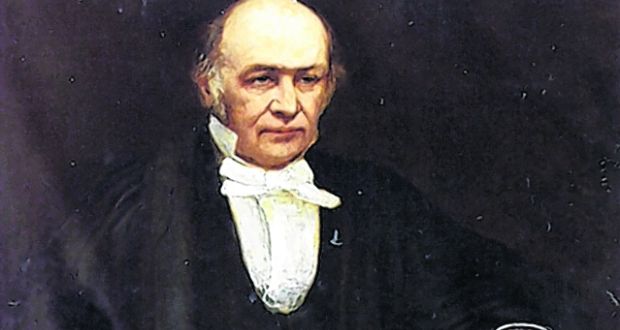
Sir William Rowan Hamilton (1805-1865)
Today, October 16th, is Hamilton day! It was on this day 176 years ago, in 1843, that William Rowan Hamilton first wrote down the fundamental result of quaternions. Apparently he was walking from his residence at Dunsink Observatory into Dublin when he had a sudden flash of inspiration and wrote the result down on the spot, now marked by a plaque:
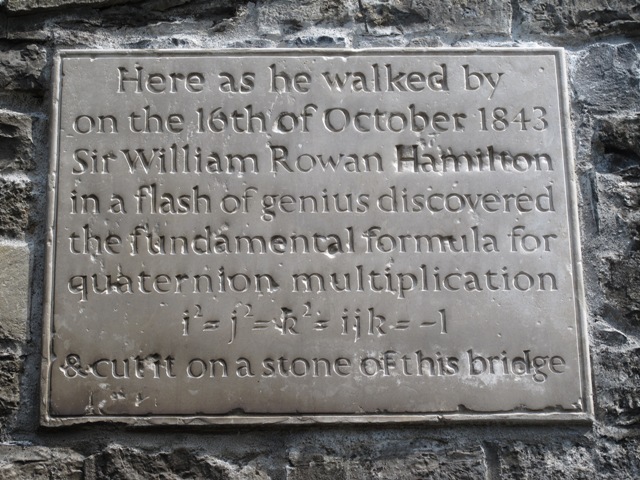
Picture Credit: Brian Dolan
This episode is commemorated by an annual Hamilton Walk. Sadly, Broombridge (Droichead Broome) is near the bridge (Broom Bridge) where Hamilton had his Eureka moment and it is on the main commuter line from Maynooth into Dublin. This is ironic because Quaternion algebra does not commute. (Geddit?)
Although it is quite easy to reach Broombridge from Maynooth, I sadly can’t attend the walk this year because I’m teaching this afternoon.
P.S. Maynooth is also home to the Hamilton Institute which promotes and facilitates research links between mathematics and other fields.
Follow @telescoperPrestige Bias and Luck
Posted in Uncategorized with tags arXiv:1910.05813, Brian Skinner, prestige bias, privilege on October 15, 2019 by telescoperQuite a few times on this blog I have acknowledged the tremendous amount of luck I have had all the way through my career, not least that the opportunity which led to my current position in Maynooth came up when exactly when it did, but another thing that has played a role has been privilege, defined not only in terms of race and social class but also educational and institutional background. Those of us who have benefitted from this are often blind to its influence, preferring to think we achieve things purely on merit. I was reminded of this by an interesting paper on the arXiv by Brian Skinner, which has the abstract:
One of the major benefits of belonging to a prestigious group is that it affects the way you are viewed by others. Here I use a simple mathematical model to explore the implications of this “prestige bias” when candidates undergo repeated rounds of evaluation. In the model, candidates who are evaluated most highly are admitted to a “prestige class”, and their membership biases future rounds of evaluation in their favor. I use the language of Bayesian inference to describe this bias, and show that it can lead to a runaway effect in which the weight given to the prior expectation associated with a candidate’s class becomes stronger with each round. Most dramatically, the strength of the prestige bias after many rounds undergoes a first-order transition as a function of the precision of the examination on which the evaluation is based.
You can read the full paper here. The author acknowledges the role that blind luck played in his own career but also develops a simple mathematical model of prestige bias. It’s an interesting paper, well worth a read.
Follow @telescoperThe Bush, by R.S. Thomas
Posted in Poetry with tags Poetry, R.S. Thomas, The Bush on October 15, 2019 by telescoperI know that bush,
Moses; there are many of them
in Wales in the autumn, braziers
where the imagination
warms itself. I have put off
pride and, knowing the ground
holy, lingered to wonder
how it is that I do not burn
and yet am consumed.
And in this country
of failure, the rain
falling out of a black
cloud in gold pieces
there are none to gather,
I have thought often
of the fountain of my people
that played beautifully here
once in the sun’s light
like a tree undressing.
by R.S. Thomas (1913-2000)
Follow @telescoper

 In the Dark