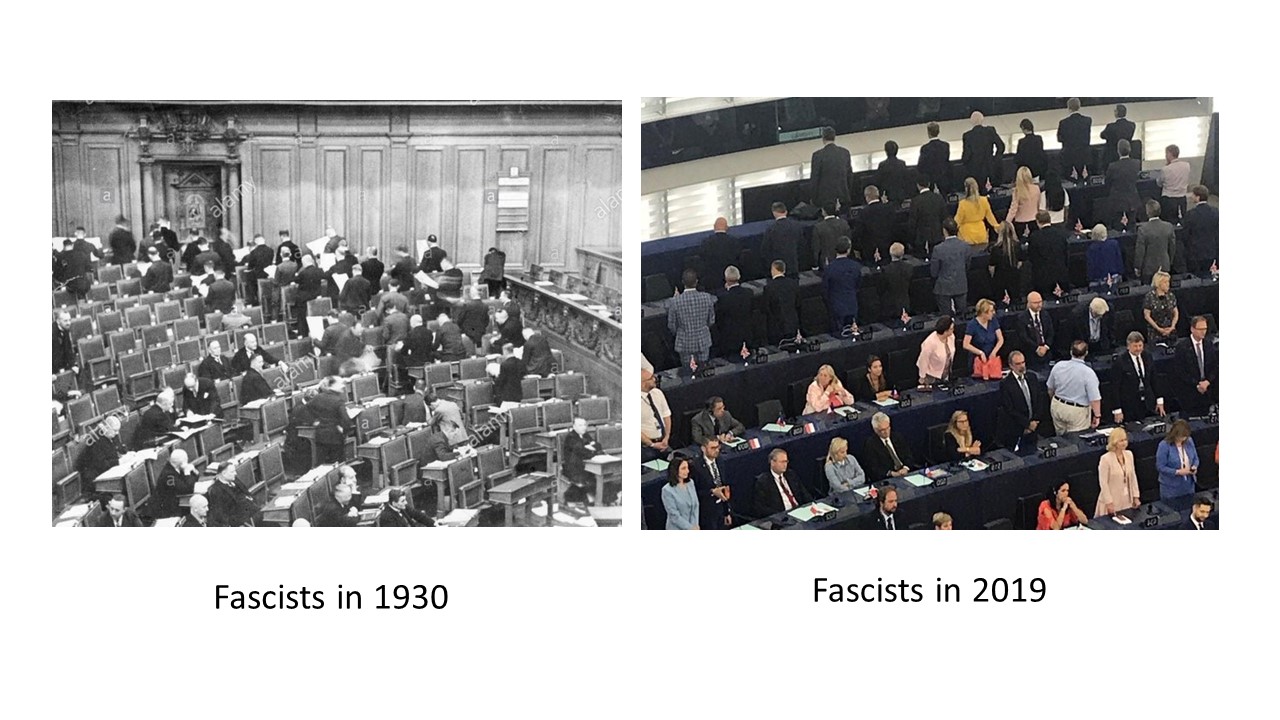
Fascist Lookalikes No. 357

Posted in History, Politics with tags , , , , , on July 2, 2019 by telescoper


Have you noticed to remarkable similarity in behaviour between representatives of the Nazi Party elected to the Reichstag in 1930* and representatives of the Brexit Party Money-Laundering Company in the European Parliament in Strasbourg?

I wonder if, by any chance, they might be related?

*In an earlier version of this post I used 1926 (the date given by the stock photo supplier Alamy) but this is incorrecr; the right date is 1930.

Admissions, Consultations and Congratulations!

Posted in Education, Maynooth with tags , , , , , , on July 2, 2019 by telescoper

Some good news for Maynooth University arrived this morning. Yesterday (1st July) was the deadline for applicants to Irish universities to change their mind about first preference courses through the Central Applications Office (CAO) which, for UK readers, is roughly equivalent to UCAS). That deadline having passed, CAO has now released details of the number of first-choice applicants to each course at each university.

The news for Maynooth University is very positive, in that it has received its highest-ever (>4,200) first preference applications. This figure represents a 7% increase on Maynooth applications from last year. In particular the number of students applying for the Bachelor of Science degree is up a whopping 33% on last year!

I like our `Omnibus’ Science degree programme, for reasons which I’ve discussed here and am glad to see it’s proving so attractive to students.

Of course it now remains to be seen how many of those students get the required points on their Leaving Certificate examinations (which have just finished) but the prospects are looking good! I’m particularly looking forward to meeting new students in Theoretical Physics next year!

Yesterday was also an important day for existing Maynooth students. The main University Examination Board was held last Thursday and yesterday students received all their results. Of course I saw all the marks last week but couldn’t say anything before the final results were released so it was nice yesterday to join in the congratulations of the final-year students in Theoretical Physics who have done extremely well this year. You couldn’t wish to meet a nicer, friendlier and harder-working group of students and I’m delighted for their success. Some will be leaving to pursue studies abroad,  but some are staying on to do Masters programmes here so there will be some familiar faces still around in Theoretical Physics next year.

An innovation this year is that the Examinations Office has set up an Exam Results Information Centre to advise students on what to do if there are issues arising from their results (such as taking repeat examinations):

For subject-specific inquiries to do with academic matters we have a Consultation Day tomorrow (Wednesday 3rd July) during which students can, if they wish, ask to see their marked examination scripts as well as asking other questions about their academic studies. This is something I feel very positively about too (as I wrote here). I’ll be on duty in Theoretical Physics tomorrow, actually. If Theoretical Physics students can’t make it in tomorrow then just email us and we’ll try to arrange another time.


Additional Mathematics O-level 1979

Posted in Biographical, Education, mathematics with tags , , , on July 1, 2019 by telescoper

Yesterday a comment appeared on an old post of mine about the O-level Examination I took in Mathematics when I was at School. With a shock that reminded me that it was FORTY years ago this summer that I was taking my O-levels at the Royal Grammar School in Newcastle. That’s a memory lane down which I wasn’t anxious to take a trip.

For any youngsters reading this, the GCE (General Certificate of Education) Ordinary Level Examinations O-levels were taken at age sixteen in the United Kingdom back in the day; they were replaced during the 1980s by the modern GCSE Examination. For readers in Ireland the O-levels were roughly equivalent to the Junior Certificate, just as A-levels are roughly equivalent to the Leaving Certificate.

Anyway, that also reminded me that I never got round to posting the other O-level I took in Mathematics that summer, in Additional Mathematics. I thought I’d remedy that failing now, so here are the two papers I took (on Tuesday 26 June 1979 and Thursday 5 July respectively.

I had forgotten that there was so much mechanics in this actually (Section C of each paper). Is that different from equivalent papers nowadays? In fact I’d be interested in comments about the content and level of difficulty of this compared to modern examinations in mathematics via the box below.

P.S. I did ten O-levels that summer of ’79: Mathematics; Additional Mathematics; Combined Science (2); English Language; English Literature; French; Latin; History; and Geography. I still have all the papers and have only posted a subset. If anyone has requests for any others please let me know and I’ll scan them.

What’s the Point of the Prospectus?

Posted in Education, Maynooth with tags , , on June 30, 2019 by telescoper

Visitors to last weekend’s Summer Open Day at Maynooth University were all given a `goodie bag’ containing this:

The Undergraduate Handbook (as it’s called) is an example of a Prospectus, which Wikipedia helpfully defines as:

A university or school prospectus is a document sent to potential (prospective) students to attract them to apply for admissions. It usually contains information about the institution and the available courses, including advice on how to apply and the benefits of accepting a place. Many universities have an individual prospectus for each course or group of courses that they offer. Most universities have both online and paper versions of their prospectus, and they are divided into an Undergraduate Prospectus and a Postgraduate Prospectus.

I’ve worked at quite a few Universities in my career: (Sussex, Queen Mary, Nottingham, Cardiff and, now, Maynooth) and they have all produced something similar. The Maynooth one shown above is a fairly hefty document, in A4 format, and over 200 pages in length. It is nicely laid out and well produced so what follows is not to be interpreted as a criticism of it as a piece of literature!

Last week I was thinking about why universities continue to produce prospectuses in paper form when nowadays all the information is available online in a form that is much easier to search than the cumbersome hard copy.
Of the 200+ pages in the Maynooth version, only a few will be of any interest to any one student and we found on our stall last weekend that a much smaller pamphlet outlining just the science courses was far more popular and, one infers, useful for prospective students. The big handbook must be quite expensive to produce and distribute – and a new one is required every year – so is it really worth the effort?

I know from time at Sussex that the annual printing of the prospectus imposed a number of constraints on the process of developing new courses. The deadline for getting things ready was over a year ahead of the time a new course would start, which dramatically slowed down the process. That’s not a particular criticism of Sussex, by the way, I think that’s a fairly ubiquitous issue. Why not just have the material available online, where it can be updated with new courses and modules at any time?

There may be good reasons for continuing with the old-style university prospectus, but the only reason I’ve heard articulated is that `everyone else has one so we have to too’. Maybe the prospectus is an effective marketing tool, I don’t know. If so it’s probably more for the benefit of parents than students.

I’d be interested in hearing views from prospective students, parents thereof, academics and or university
admissions specialists on this issue, especially from those who want to change my mind as I have to say that I think we should scrap the paper and just deliver the material via the internet (either via webpages or an app).

[twitter-follow

Sonnet No. 76

Posted in Poetry with tags , , on June 29, 2019 by telescoper
Why is my verse so barren of new pride,
So far from variation or quick change?
Why with the time do I not glance aside
To new-found methods, and to compounds strange?
Why write I still all one, ever the same,
And keep invention in a noted weed,
That every word doth almost tell my name,
Showing their birth, and where they did proceed?
O know, sweet love, I always write of you,
And you and love are still my argument,
So all my best is dressing old words new,
Spending again what is already spent:
   For as the sun is daily new and old,
   So is my love still telling what is told


by William Shakespeare (1564-1616)

Stonewall, Fifty Years On

Posted in Biographical, LGBTQ+ with tags , , , , , on June 28, 2019 by telescoper

Well, it’s 28th June 2019 which means that it is exactly 50 years to the day since the Stonewall Riots, the event commemorated each year by the annual Pride celebrations. The Dublin Pride Parade is tomorrow, actually. My Facebook and twitter feeds have been filled with rainbows all week, and it is nice to to see so many people, straight and gay, celebrating diversity and equality. I’m a bit more cynical about the number of businesses that have tried to cash in on  Pride but even that is acceptance of a sort. It remains to be seen how many of them are fair weather friends. I’m sure I’m not the only person who sees the dark clouds of bigotry threatening the fragile and precious rainbow.


It’s all very different from the first Pride March I went on, way back in 1986. That was a much smaller scale event than yesterday’s, and politicians were – with very few exceptions – notable by their absence.

It was in the early hours of the morning of Saturday June 28th 1969 that the Stonewall Riots took place in the Greenwich Village area of New York City. There are few photographs and no film footage of what happened which, together with some conflicting eyewitness accounts, has contrbuted to the almost mythical status of these demonstations, which were centred on the Stonewall Inn (which, incidentally, still exists).  What is, I think, clear is that they were the spontaneous manifestation of the anger of a community that had simply had enough of the way it was being treated by the police. Although it wasn’t the first such protest in the USA, I still think it is also the case that Stonewall was a defining moment in the history of the movement for LGBT equality.

One of the myths that has grown up around Stonewall is that the Stonewall Inn was a place primarily frequented by drag queens and it was the drag queens who began the fight back against intolerable  police harassment. That was the standard version, but the truth is much more complicated and uncertain that that. Nevertheless, it is clear that it was the attempted arrest of four people – three male (cross-dressers) and one female – that ignited the protest. Whether they led it or not, there’s no doubt that drag queens played a major role in the birth of the gay liberation movement. Indeed, to this day, it remains the case that the “T” part of the LGBT spectrum (which I interpret to include Transgender and Transvestite) is often neglected by the rest of the rainbow.

I have my own reasons for being grateful for drag queens. When I was a youngster (still at School) I occasionally visited a gay bar in Newcastle called the Courtyard. I was under age for drinking alcohol let alone anything else – the age of consent was 21 in those days – but I got a kick out of the attention I received and flirted outrageously without ever taking things any further. I never had to buy my own drinks, let’s put it that way.

Anyway, one evening I left the pub to get the bus home – the bus station was adjacent to the pub – but was immediately confronted by a young bloke who grabbed hold of me and asked if I was a “poof”. Before I could answer, a figure loomed up behind him and shouted “Leave him alone!”. My assailant let go of me and turned round to face my guardian angel, or rather guardian drag queen. No ordinary drag queen either. This one, at least in my memory, was enormous: about six foot six and built like a docker, but looking even taller because of the big hair and high heels. The yob laughed sneeringly whereupon he received the immediate response of a powerful right jab to the point of the chin, like something out of boxing manual. His head snapped back and hit the glass wall of a bus shelter. Blood spurted from his mouth as he slumped to the ground.

I honestly thought he was dead, and so apparently did my rescuer who told me in no uncertain terms to get the hell away. Apart from everything else, the pub would have got into trouble if they’d known I had even been in there. I ran to the next stop where I got a bus straightaway. I was frightened there would be something on the news about a violent death in the town centre, but that never happened. It turns out the “gentleman” concerned had bitten his tongue when the back of his head hit the bus shelter. Must have been painful, but not life-threatening. My sympathy remains limited.

I think there’s a moral to this story, but I’ll leave it up to you to decide what it is.

Anyway, back to Pride. In a post a few days ago I referred to the view that since we now, for example, ave equal marriage then it’s basically all done, isn’t it? There’s now no discrimination. You can stop talking about LGBT+ matters and `just be a scientist’.

That, I’m afraid, is bollocks. We may have equal marriage but, though welcome, by no means represents some sort of utopia. Society is still basically a patriarchy, configured in a way that is profoundly unfair to many groups of people, so there are still many challenges to be fought. Hate crimes against LGBT+ – especially transgender – people have rocketed. The rise of fascism around the world is encouraging bigots to target minorities and other vulnerable groups with their agenda of hate. Unless we keep pushing for a truly inclusive society there is a real danger that the rights we have won could easily be rolled back. In fact, you could really say that it’s really just the start. We still need to stand up for ourselves just like the heroes of 1969.
Summertime – Henry “Red” Allen & Coleman Hawkins

Posted in Jazz with tags , , , on June 27, 2019 by telescoper

Summer seems to have made it to Ireland at last so here’s an appropriate piece of music. It’s George Gershwin’s Summertime, played in 1958 by a band led by trumpeter Henry “Red”Allen that included the great Coleman Hawkins on tenor sax. This record came from a session that Henry Allen said near the end of his life that he regarded as his best work, and indeed his playing on this is absolutely beautiful (as is that of Coleman Hawkins). Other musicians on this track are Earl Warren (clarinet), Marty Napoleon (piano), Chubby Jackson (bass) and George Wettling (drums). Enjoy!

The Senior Academic Leadership Initiative

Posted in Education, Maynooth, Politics with tags , , , , , on June 27, 2019 by telescoper

I’ve been so busy over the last week or so that I forgot to mention that on Friday (21st June) the Minister of State for Higher Education Mary Mitchell O’Connor announced a new scheme to improve the gender balance in senior academic roles in Irish universities.

While women make up more than half of university lecturers here in Ireland, just 24% are professors, and the new scheme plans to tackle that under-representation at senior levels by creating up to 45 academic leadership positions specifically for women over the next three years.

The Senior Academic Leadership Initiative (SALI) is funded by the Department of Education and Skills and managed by the Higher Education Authority. More details of the scheme can be found here and the call for applications can be found here.

In summary: new and additional senior academic leadership posts will be funded in areas where

  • there is clear evidence of significant gender under-representation
  • where this appointment will have significant impact within the HEI and the relevant faculty/department/functional unit
  • where they would be a proportionate and effective means to achieve accelerated and sustainable change within an institution

Predictably there has been a bit of a backlash to this announcement from some quarters, but I think it’s an excellent idea and it has my full support. Note further that Legal advice from the Attorney General has confirmed that this policy approach is consistent with EU and national employment and equality law.

I hope a significant number of these positions go to outstanding female academics in STEM disciplines, where the under-representation is indeed significant – and hope we can also attract some here to Maynooth! We don’t have any female academics in the Department of Theoretical Physics….

It’s important, however, to bear in mind that this scheme addresses only one of the issues relating to gender discrimination in Irish higher education and there are many others, especially in STEM disciplines (such as recruitment of early-career level) which will require separate actions.


Exploring the workplace for LGBT+ Physical Scientists

Posted in LGBTQ+ with tags , , , , , on June 26, 2019 by telescoper

Had things gone to plan, today I would have been at the premises of the Royal Society of Chemistry in Burlington House in London for the launch of Exploring the workplace for LGBT+ physical scientists a report by the Institute of Physics, Royal Astronomical Society and the Royal Society of Chemistry resulting from a survey that I blogged about last year. Unfortunately I’ve been too busy here in Maynooth to fly to London and back for the launch so I’ll have to restrict myself to thanking these organizations for undertaking this project and pointing out that you can download, and perhaps even read, the resulting report here.

This report demonstrates that, while we have come a long way, we still have to do a lot more to make sure that LBGT+ people feel welcome and valued in the physical sciences.

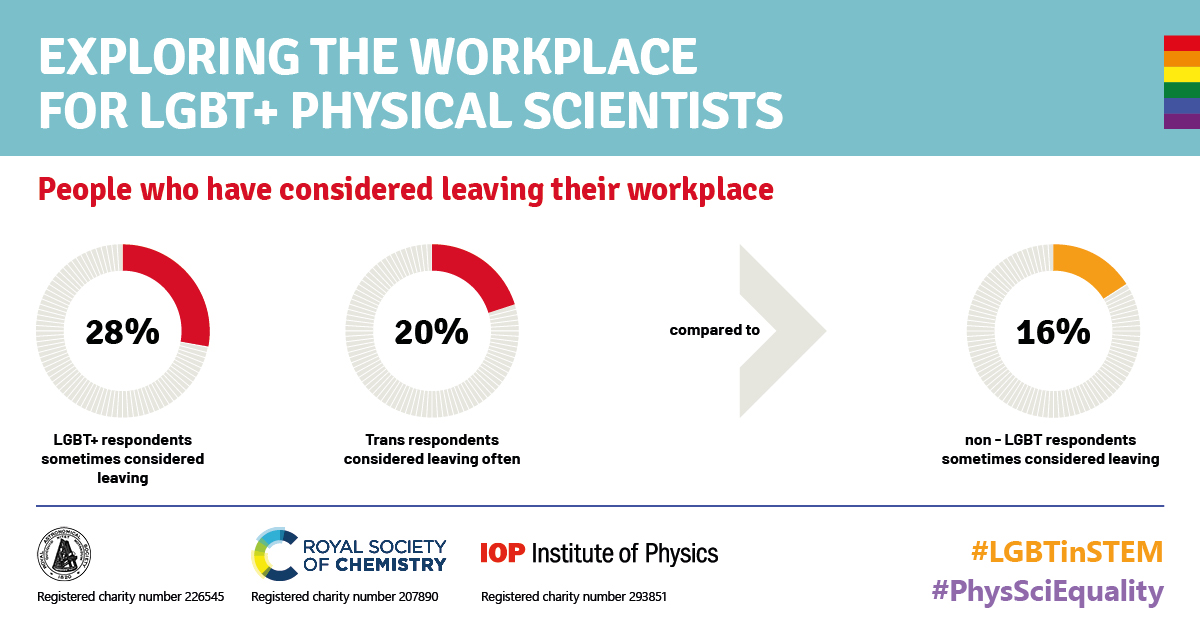
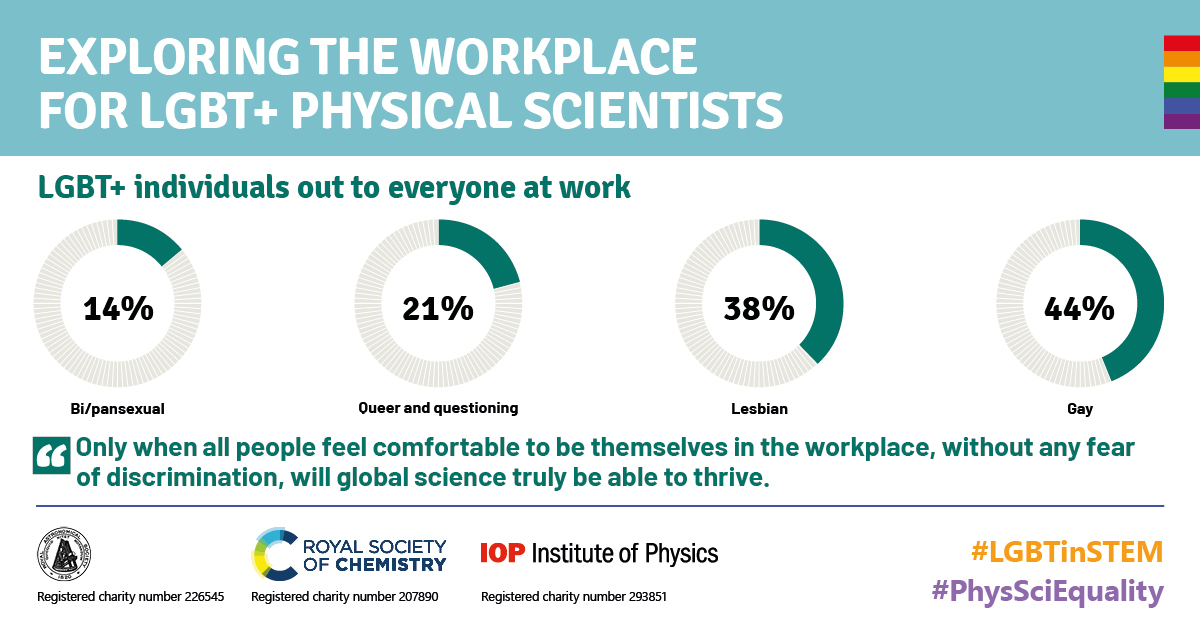
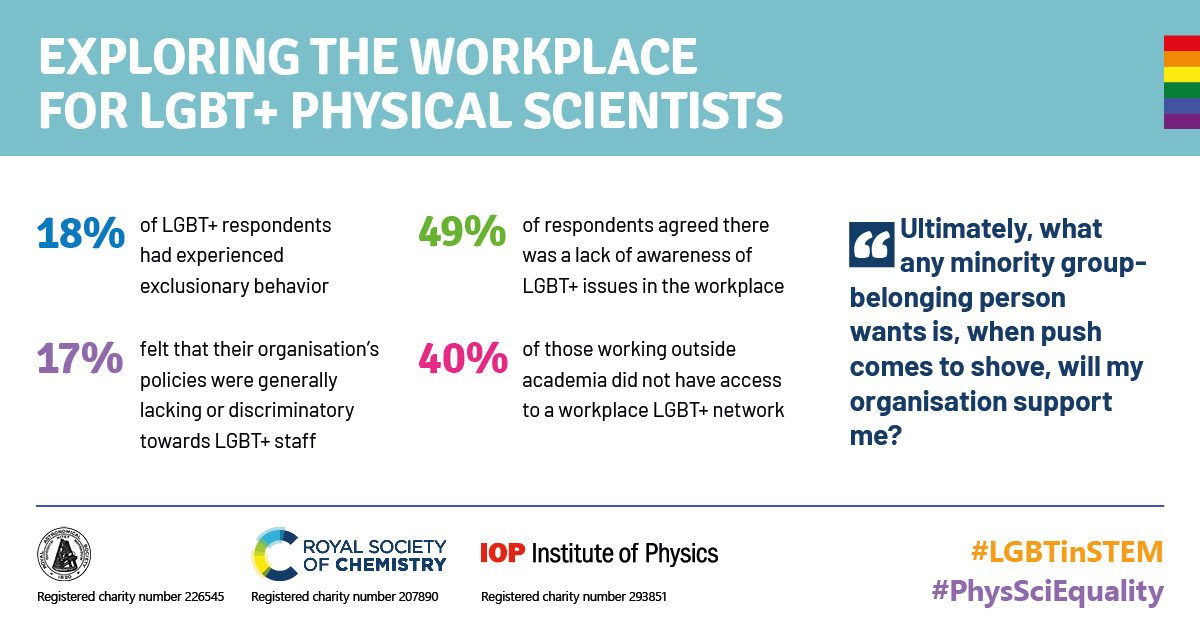
A majority (70%) of the survey respondents believed that the working environment was improving for LBGT+ members of the physical science community but as many as 25% had at some point considered leaving the physical sciences due to discrimination.

I have also taken the liberty of including below a few infographics summarizing some of the main findings of the report.

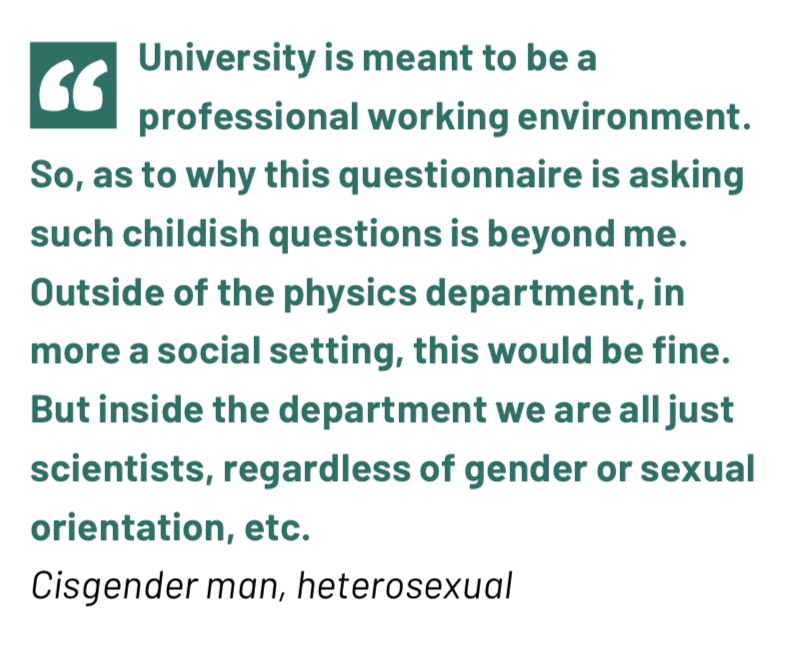
One of the responses to the survey reads

I doubt this view is uncommon among heterosexual scientists but I disagree with it. The idea that no scientist has any identity at all in the workplace other than `scientist’ is quite ridiculous. Scientists are human beings, and humans are extremely diverse. I doubt if anyone likes to be defined by a single characteristic – we are all complex individuals subject to a whole host of different influences – but, to create an inclusive environment where the best scientists can flourish and the best science can be done, we need to make sure everyone feels comfortable. If we can do that it won’t just benefit our LGBT+ colleagues, but everyone in our workplaces.

Do read the report!

New Publication at the Open Journal of Astrophysics!

Posted in OJAp Papers, Open Access, The Universe and Stuff with tags , , , , , , on June 26, 2019 by telescoper

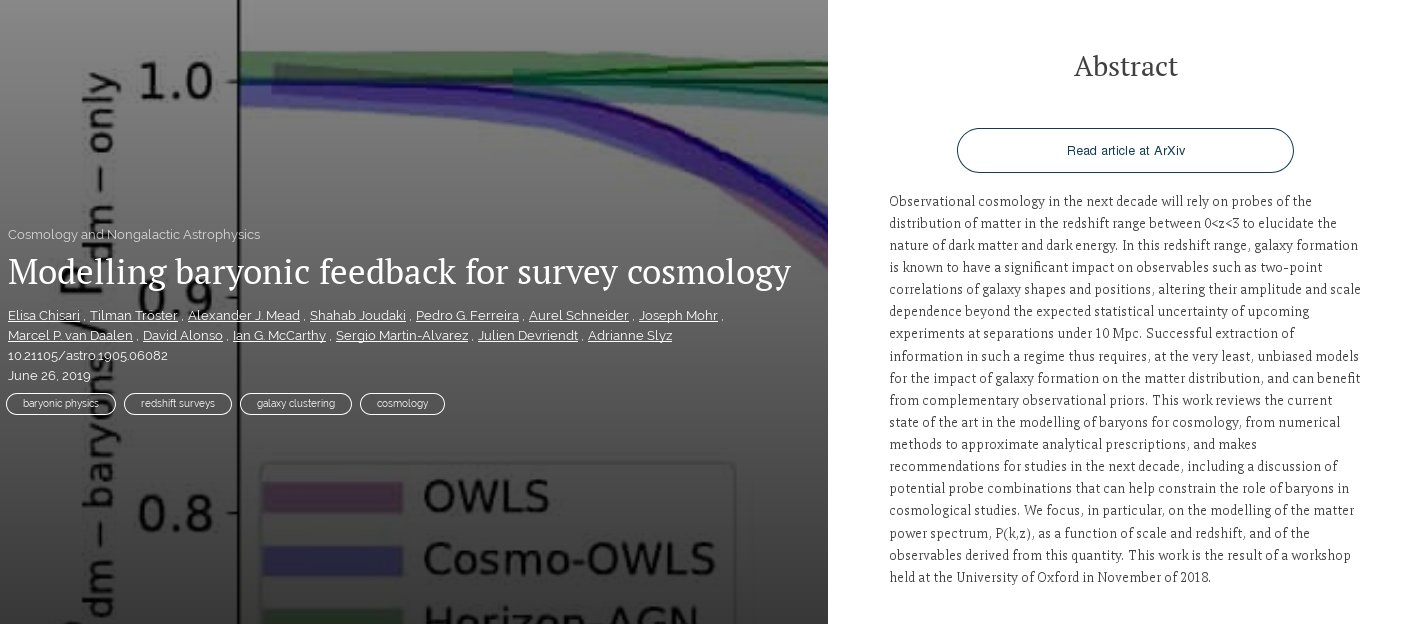
In a blog I posted just a couple of day ago I mentioned that there were a number of papers about to be published by the Open Journal of Astrophysics and, to show that I wasn’t making that up, the first of the latest batch has just appeared. Here is how it looks on the site!

There are thirteen authors altogether (from Oxford, Liverpool, Edinburgh, Leiden, British Columbia, Zurich and Munich); the lead other is Elisa

You can find the accepted version on the arXiv here. This version was accepted after modifications requested by the referee and editor.

This is another one for the `Cosmology and Nongalactic Astrophysics’ folder. We would be happy to get more submissions from other areas of astrophysics. Hint! Hint!

A few people have asked why the Open Journal of Astrophysics is not yet listed in the Directory of Open Access Journals. The answer to that is simple: to qualify for listing a journal must publish a minimum of five papers in a calendar year. Since OJA underwent a failure long hiatus after publishing its first batch of papers we haven’t yet qualified. However, this new one means that we have now published five papers so have reached the qualifying level.  I’ll put in the application as soon as I can, but will probably wait a little because we have a bunch of other papers coming out very soon to add to that number.

P.S. Please note that we now have an Open Journal of Astrophysics Facebook page where you can follow updates from the Journal should you wish..