The English Higher Education Funding Mess

Posted in Biographical, Education, Politics with tags , , , , on June 2, 2019 by telescoper

One of the items that sneaked out in the news last week was the Augar report on the future of post-18 education and funding in England. A review led by a former equities broker was never likely to be friendly to the higher education sector, and so it seems to have turned out.

The headline recommendation that the level of tuition fee should be reduced from £9250 to £7500 seems to me rather silly: it’s enough of a reduction to cause serious financial problems to universities if the shortfall is not replaced by increased teaching grants  but not enough to make a qualitative difference to students. In fact, since the report also recommends reducing the threshold for repaying student loans, and increasing the term over which they will be repaid, many graduates will end up paying significantly more in the long run.

To be fair the Augar report does recommend:

Government should replace in full the lost fee income by increasing the teaching grant, leaving the average unit of funding unchanged at sector level in cash terms.

Unfortunately, I can easily see a Conservative government implementing the cut in tuition fees but not making up the difference with grants.

As I have blogged about before (many times e.g here) the current level of resource is insufficient to fund teaching STEM disciplines properly. This graphic is from a few years ago, but the situation has not changed significantly:

The annual cost per student in Arts and Humanities disciplines is typically around £6K whereas for STEM disciplines the figure is typically over £10K. The former are effectively subsidizing the latter in the current system. If the maximum fee chargeable is £7.5K then this subsidy will be impossible. Bear in mind also that a slice of the fee is used to fund bursaries and other schemes for widening participation, so only a fraction of that funding is available to be redistributed. It’s a system that is stacked against STEM disciplines already, and that will only get worse if the Augar proposals are implemented.

Another problem with the stance taken by the `independent panel’ is that it seems to regard the only useful courses to be those that lead to high earnings upon graduation. There is even a call to cut funding for course that do not produce `outputs’ that are paid high wages.  I find it profoundly depressing that the purpose of a university is reduced to such an empty utilitarian level. Is this what the education system is to become?

Increasing their future earning potential may indeed be why some people go to university, and good luck to them if it is, but others are driven by quite different goals. Anyone who wants to be a research scientist, for example, faces years of low salaries and insecure contracts until, if they’re lucky, they get a secure job with a decent wage. In this case and no doubt in countless others, students go to university because learning is and end in itself.

While I am critical about the Augar review’s narrow-minded view of higher education, I will give credit where it is due and point out that it does recommend the re-introduction of maintenance grants which, if implemented, would be a positive.

When I went to University (in 1982) I was the first in my family ever to go to university. I’m also, at least as far as my immediate family goes, the last. However, in those days there was no need for a First Generation Scholars scheme: there were no tuition fees and, because I don’t come from a wealthy background, I qualified for a full maintenance grant. Life (in Cambridge) as an undergraduate student on a grant was fairly comfortable. Times have changed a lot. Many more people go to university nowadays, but the price is that support for those who don’t have access to family funds is now spread very thinly. There are no full maintenance grants, and the fees are very high. Looking back, though, I don’t think it would have been the tuition fees that might have deterred me from going to university. After all, they don’t have to be paid back until after graduation, and when one’s income exceeds a certain level. What would have made a difference would have been the withdrawal of maintenance. Without the grant, I simply wouldn’t have been able to study without getting a job. Apart from the amount of work involved in doing my degree, the recession of the early 1980s meant that jobs were very hard to come by.

In summary, then, I think UK universities are right to be worried about, especially as it comes on top of the damage already being done by Brexit. But Brexit has also induced a paralysis in Westminster that means the legislation needed to enact the Augar recommendations is unlikely to be forthcoming any time soon. Although that means that cuts – and let’s face it, that’s what this review is about – are likely to be delayed, the uncertainty will make it difficult for universities to plan their finances.

To summarize the summary: it’s a mess and I’m glad I’m out of it. As I wrote a in 2018, after I’d decided to move to my current position in Ireland:

Oh, and there’s neither a Research Excellence Framework nor a Teaching Excellence Framework nor a Knowledge Exchange Framework nor punitive levels of student tuition fees nor any of the many other idiocies that have been inflicted on UK* universities in recent years. It will be a relief to be able to teach and do research in environment which, at least for the time being, regards these as things of value in themselves rather than as means of serving the empty cycle of production and consumption that defines the modern neoliberal state. Above all, it’s a good old-fashioned professorship. You know, teaching and research?

*To clarify, these idiocies are mainly of English origin, but the devolved systems of Scotland, Wales and Northern Ireland have had to deal with the consequences so they have been inflicted on the entire United Kingdom.

I just hope Ireland resists the temptation to destroy its own education system. Recent history does reveal a remarkable willingness to implement stupid ideas from across the Irish Sea but perhaps Brexit will put a stop to that.


Suddenly the End of Term

Posted in Biographical, Education, Maynooth with tags , , , on June 1, 2019 by telescoper

Yesterday I finished the last of my marking duties, and put away the exam scripts and other assessments. I had to rush to get them all done in time for this weekend because I will not be here for most of next week. That’s been quite difficult because of all the other things going on and has led to quite a few late nights!

The marks will of course need to be validated and uploaded to a database in advance of the meetings of the Examination Boards which take place the week after next in the presence of the External Examiner. It will be some time, therefore, before everything is finalised and the students get their marks. (In case you didn’t realise, that was a hint to any students reading this not to pester us for their marks…)

The last examinations took place this week and all of a sudden the campus is deserted. Most of the students at Maynooth University don’t actually live here so many of them depart as soon as their last examination is over. The effect is dramatic. There’s been a particularly noticeable change in the vicinity of the Library, which was crammed full of students during the examination period but yesterday morning was deserted. Our friendly feline celebrity will have a lot less company for the next few months but I’m sure he’ll still be well looked after..

Not everyone has disappeared for the summer, of course. The postgraduate will still be around, and we have quite a few students in Theoretical Physics staying for (paid) internships: I have two working with me and I’m looking forward to starting them off on their projects.

This is actually a Bank Holiday Weekend, so everyone will be off on Monday and the campus is closed, which makes  for a nice end-of-term break for some of us. Not all staff had exams early enough to finish in time like I did, however, and no doubt some will have to spend the weekend marking scripts. The June Bank Holiday (Lá Saoire i mí Mheitheamh) in Ireland is actually the equivalent of last week’s late May Bank Holiday in the UK, in that both have their origin in the old festival of Whitsuntide (or Pentecost) which falls on the 7th Sunday after Easter. Because the date of Easter moves around in the calendar so does Whit Sunday, but it is usually in late May or early June. Here in Ireland the Bank Holiday is always on the first Monday in June whereas on the other side of the Irish Sea it is on the last Monday in May.

Finally I noticed last night that the season of concerts from the National Concert Hall in Dublin is now over. The new season will start in September. I’ve been too busy this term to get to many of these but I’ll try to plan things a bit better for the new season.

Open Access Publishing: Plan S Update

Posted in Open Access with tags , on May 31, 2019 by telescoper

I haven’t had time to go through the details yet, but yesterday saw the release of revised Principles and Implemenation for Plan S, which I have blogged about before, e.g. here. There’s also a rationale for the changes here.

For those of you who have never heard of Plan S, it For those that haven’t it is a proposal by funding agencies from 11 European Nations to give the public free access to publicly funded science. The 11 countries involved in this initiative are: France, Italy, Austria, Ireland, Luxembourg, the Netherlands, Norway, Poland, Slovenia, Sweden, and the UK. Together, these nations compise `cOAlition S’ – the `OA’ is for `Open Access’ – to carry out the plan.

The principal change is that the deadline for implementation has been moved back a year, which is sensible as the original deadline of January 2020 was never going to be feasible. The principal principle is however unchanged:

With effect from 2021, all scholarly publications on the results from research funded by public or private grants provided by national, regional and international research councils and funding bodies, must be published in Open Access Journals, on Open Access Platforms, or made immediately available through Open Access Repositories without embargo.

I’ll go through the revised guidelines when I get time but in the meantime if you can are so minded you can read them yourself and comment thereon through the comments box below.

Hondootedly John Cole…

Posted in Biographical, Politics with tags , , , on May 30, 2019 by telescoper

I mentioned that Pat Kenny mistakenly called me `John Cole’ at the start of my interview on NewsTalk Radio a couple of days ago. He admitted that he was thinking of the late and much lamented BBC Political Editor of that name. John Cole was born in Belfast and his voice was frequently heard in pieces to camera as he talked about the great issues of the day. This sparked Private Eye to run a piece in almost every issue, mocking his strong Ulster accent, entitled John Cole writes. Here’s an example, from Issue No. 641:

This one is fairly topical as it is on the subject of the 1986 Divorce Referendum in Ireland which was on whether to remove the constitutional ban on divorce. That vote failed, but the vote held on Friday went completely in the other direction with 82% in favour of removing the ban.


Winners and Losers

Posted in Biographical, Crosswords, Politics with tags , , on May 30, 2019 by telescoper

Hopefully the hecticity of the last week or so will now begin to die down and I can get on with the rest of my examination marking, which I hope to complete today.

Now to a couple of updates.

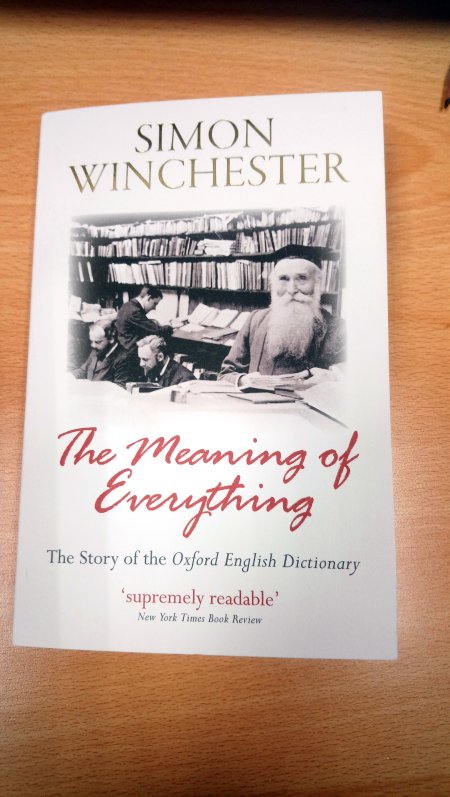
Yesterday I took delivery of the above book. Regular readers of this blog will probably not recall that I won the Financial Times Crosssword competition way back in February. The prize never arrived so I contacted them to ask what had happened. It must have got lost in the post, but they kindly sent a replacement which arrived promptly. The book is not a dictionary, but is about the story of the creation of one – the Oxford English Dictionary to be precise. I look forward to reading it!

The other matter to be updated concerns the Irish Elections to the European Parliament. The counting of these proved to be a slow process but watching the regular updates on the web as votes were transferred is actually rather fascinating. It’s surprisingly difficult to predict where second choice votes of eliminated candidates will end up. The Green Party seems rather `transfer-friendly’, for example, whereas Sinn Féin is not.

In my own constituency of Midlands-North-West it took thirteen rounds of counting to pick the four MEPs: one for Sinn Féin, two for Fine Gael and one strange but probably harmless Independent. The turnout was about 50%. I think Fianna Fáil made a tactical error by fielding two candidates: neither had enough first-preference votes to make the cut.

I was worried that the dreadful Peter Casey might sneak in in fourth place but he fell well short of the required transfers, though he still got a worryingly large number of votes. The Irish Media are making the same mistake pandering to him as they have done in the UK with Nigel Farage: he gets far more airtime than the other candidates despite being obviously unfit for office.

Elswhere, Dublin elected MEPs from the Green Party (1), Fine Gael (1) and Fianna Fáil (1) and one Independent standing under the banner of `Independents for Change’ (I4C). The incumbent Sinn Féin candidate Lynn Boylan lost her seat. The 4th candidate here will only take a seat in the European Parliament if and when the United Kingdom leaves the EU.

As I write there’s a recount going on in Ireland South, but it looks like the winners will be Fine Gael (2), Fianna Fáil (1), I4C (1) and the fifth (who will only take up a seat after Brexit) will probably be from the Green Party. It looks like incumbent Sinn Féin MEP Liadh Ní Riada (and unsuccessful candidate for the Presidency) will lose her seat, but the count is very close: only a few hundred votes are in it, hence the recount. UPDATE: in fact there will be a full recount of the whole ballot, which could take weeks.

Overall it’s clear that the losers are Sinn Féin, who lost two MEPs (and also about half their councillors in the local elections). After appearing to improve their vote share in recent years this is a definite reverse for them. The party that gained the most is the Green Party, with (probably) two MEPs and a strong showing in Midlands-North-West. I wonder if they can keep this momentum going for a General Election?

Interestingly, unlike the rest of the `United’ Kingdom Northern Ireland uses the Single Transferable Vote system for European Elections too. There Sinn Féin came top of first preferences and won one seat, with another for the Alliance and one for the DUP. That’s two-to-one in favour of `Remain’.

The 1919 Eclipse: That Was The Talk That Was…

Posted in History, The Universe and Stuff with tags , , , , , on May 29, 2019 by telescoper

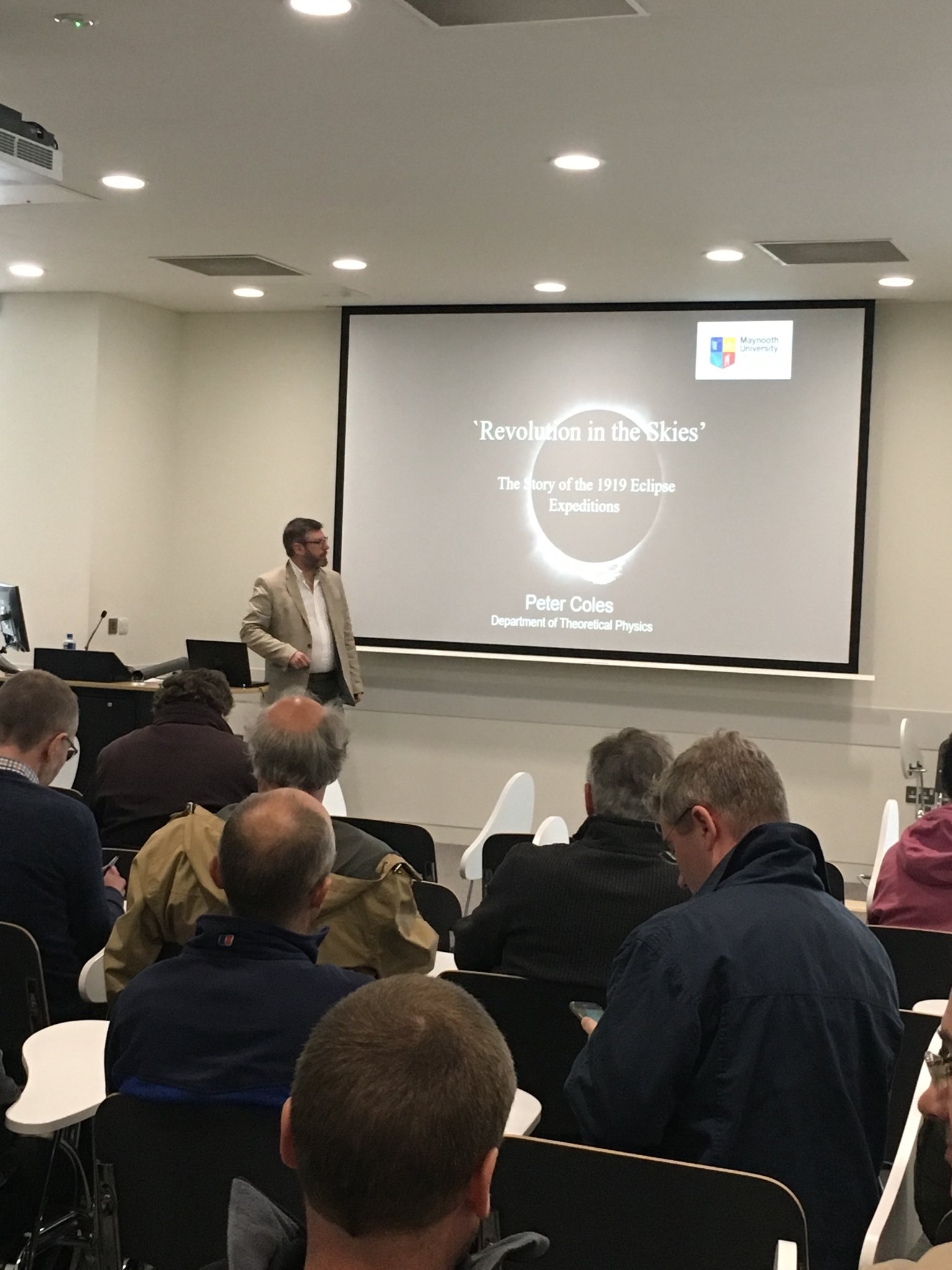
Well, I did my talk this afternoon to mark the centenary of the 1919 Eclipse Experiment that was performed on May 29th 1919. It’s a good job we changed the venue to a bigger lecture theatre than originally booked because even the new one was full! Thanks to everyone who came, and I hope you enjoyed the talk!

Anyway, here are the slides if you’d like to see them:

Here is a picture of me about to start:

Now that the centenary has passed I promise to post a bit less about this topic, although there are still a few things coming up that I might mention…

The Centenary of the 1919 Eclipse Expeditions

Posted in History, The Universe and Stuff with tags , , , , on May 29, 2019 by telescoper

Well, the big day has arrived. Today, 29th May 2019, is the centenary of the 1919 Solar Eclipse during which an experiment was carried out to test Einstein’s theory of general relativity. I’m giving a public talk this afternoon and will post the slides afterwards.

In the meantime, however, I’ll just re-post his little piece which is based on an article I wrote some years ago for Firstscience.

–0–

The Eclipse that Changed the Universe

A total eclipse of the Sun is a moment of magic: a scant few minutes when our perceptions of the whole Universe are turned on their heads. The Sun’s blinding disc is replaced by ghostly pale tentacles surrounding a black heart – an eerie experience witnessed by hundreds of millions of people throughout Europe and the Near East last August.

But one particular eclipse of the Sun, eighty years ago, challenged not only people’s emotional world. It was set to turn the science of the Universe on its head. For over two centuries, scientists had believed Sir Isaac Newton’s view of the Universe. Now his ideas had been challenged by a young German-Swiss scientist, called Albert Einstein. The showdown – Newton vs Einstein – would be the total eclipse of 29 May 1919.

Newton’s position was set out in his monumental Philosophiae Naturalis Principia Mathematica, published in 1687. The Principia – as it’s familiarly known – laid down a set of mathematical laws that described all forms of motion in the Universe. These rules applied as much to the motion of planets around the Sun as to more mundane objects like apples falling from trees.

At the heart of Newton’s concept of the Universe were his ideas about space and time. Space was inflexible, laid out in a way that had been described by the ancient Greek mathematician Euclid in his laws of geometry. To Newton, space was the immovable and unyielding stage on which bodies acted out their motions. Time was also absolute, ticking away inexorably at the same rate for everyone in the Universe.

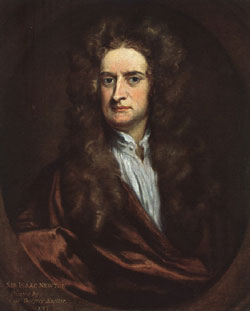
Sir Isaac Newton, painted by Sir Godfrey Kneller. Picture Credit: National Portrait Gallery,

For over 200 years, scientists saw the Cosmos through Newton’s eyes. It was a vast clockwork machine, evolving by predetermined rules through regular space, against the beat of an absolute clock. This edifice totally dominated scientific thought, until it was challenged by Albert Einstein.

In 1905, Einstein dispensed with Newton’s absolute nature of space and time. Although born in Germany, during this period of his life he was working as a patent clerk in Berne, Switzerland. He encapsulated his new ideas on motion, space and time in his special theory of relativity. But it took another ten years for Einstein to work out the full consequences of his ideas, including gravity. The general theory of relativity, first aired in 1915, was as complete a description of motion as Newton had prescribed in his Principia. But Einstein’s description of gravity required space to be curved. Whereas for Newton space was an inflexible backdrop, for Einstein it had to bend and flex near massive bodies. This warping of space, in turn, would be responsible for guiding objects such as planets along their orbits.

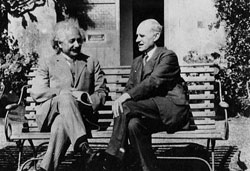
Albert Einstein (left), pictured with Arthur Stanley Eddington (right). Picture Credit: Royal Greenwich Observatory.

By the time he developed his general theory, Einstein was back in Germany, working in Berlin. But a copy of his general theory of relativity was soon smuggled through war-torn Europe to Cambridge. There it was read by Arthur Stanley Eddington, Britain’s leading astrophysicist. Eddington realised that Einstein’s theory could be tested. If space really was distorted by gravity, then light passing through it would not travel in a straight line, but would follow a curved path. The stronger the force of gravity, the more the light would be bent. The bending would be largest for light passing very close to a very massive body, such as the Sun.

Unfortunately, the most massive objects known to astronomers at the time were also very bright. This was before black holes were seriously considered, and stars provided the strongest gravitational fields known. The Sun was particularly useful, being a star right on our doorstep. But it is impossible to see how the light from faint background stars might be bent by the Sun’s gravity, because the Sun’s light is so bright it completely swamps the light from objects beyond it.

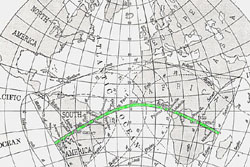
A scientific sketch of the path of totality for the 1919 eclipse. Picture Credit: Royal Greenwich Observatory.

Eddington realised the solution. Observe during a total eclipse, when the Sun’s light is blotted out for a few minutes, and you can see distant stars that appear close to the Sun in the sky. If Einstein was right, the Sun’s gravity would shift these stars to slightly different positions, compared to where they are seen in the night sky at other times of the year when the Sun far away from them. The closer the star appears to the Sun during totality, the bigger the shift would be.

Eddington began to put pressure on the British scientific establishment to organise an experiment. The Astronomer Royal of the time, Sir Frank Watson Dyson, realised that the 1919 eclipse was ideal. Not only was totality unusually long (around six minutes, compared with the two minutes we experienced in 1999) but during totality the Sun would be right in front of the Hyades, a cluster of bright stars.

But at this point the story took a twist. Eddington was a Quaker and, as such, a pacifist. In 1917, after disastrous losses during the Somme offensive, the British government introduced conscription to the armed forces. Eddington refused the draft and was threatened with imprisonment. In the end, Dyson’s intervention was crucial persuading the government to spare Eddington. His conscription was postponed under the condition that, if the war had finished by 1919, Eddington himself would lead an expedition to measure the bending of light by the Sun. The rest, as they say, is history.

The path of totality of the 1919 eclipse passed from northern Brazil, across the Atlantic Ocean to West Africa. In case of bad weather (amongst other reasons) two expeditions were organised: one to Sobral, in Brazil, and the other to the island of Principe, in the Gulf of Guinea close to the West African coast. Eddington himself went to Principe; the expedition to Sobral was led by Andrew Crommelin from the Royal Observatory at Greenwich.

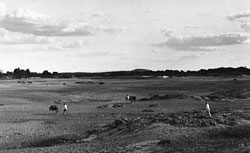
British scientists in the field at their observing site in Sobral in 1919. Picture Credit: Royal Greenwich Observatory

The expeditions did not go entirely according to plan. When the day of the eclipse (29 May) dawned on Principe, Eddington was greeted with a thunderstorm and torrential rain. By mid-afternoon the skies had partly cleared and he took some pictures through cloud.

Meanwhile, at Sobral, Crommelin had much better weather – but he had made serious errors in setting up his equipment. He focused his main telescope the night before the eclipse, but did not allow for the distortions that would take place as the temperature climbed during the day. Luckily, he had taken a backup telescope along, and this in the end provided the best results of all.

After the eclipse, Eddington himself carefully measured the positions of the stars that appeared near the Sun’s eclipsed image, on the photographic plates exposed at both Sobral and Principe. He then compared them with reference positions taken previously when the Hyades were visible in the night sky. The measurements had to be incredibly accurate, not only because the expected deflections were small. The images of the stars were also quite blurred, because of problems with the telescopes and because they were seen through the light of the Sun’s glowing atmosphere, the solar corona.

Before long the results were ready. Britain’s premier scientific body, the Royal Society, called a special meeting in London on 6 November. Dyson, as Astronomer Royal took the floor, and announced that the measurements did not support Newton’s long-accepted theory of gravity. Instead, they agreed with the predictions of Einstein’s new theory.

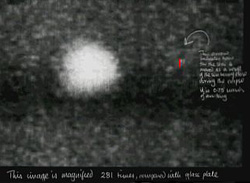
The final proof: the small red line shows how far the position of the star has been shifted by the Sun’s gravity. Each star experiences a tiny deflection, but averaged over many exposures the results definitely support Einstein’s theory. Picture Credit: Royal Greenwich Observatory.

The press reaction was extraordinary. Einstein was immediately propelled onto the front pages of the world’s media and, almost overnight, became a household name. There was more to this than purely the scientific content of his theory. After years of war, the public embraced a moment that moved mankind from the horrors of destruction to the sublimity of the human mind laying bare the secrets of the Cosmos. The two pacifists in the limelight – the British Eddington and the German-born Einstein – were particularly pleased at the reconciliation between their nations brought about by the results.

But the popular perception of the eclipse results differed quite significantly from the way they were viewed in the scientific establishment. Physicists of the day were justifiably cautious. Eddington had needed to make significant corrections to some of the measurements, for various technical reasons, and in the end decided to leave some of the Sobral data out of the calculation entirely. Many scientists were suspicious that he had cooked the books. Although the suspicion lingered for years in some quarters, in the end the results were confirmed at eclipse after eclipse with higher and higher precision.

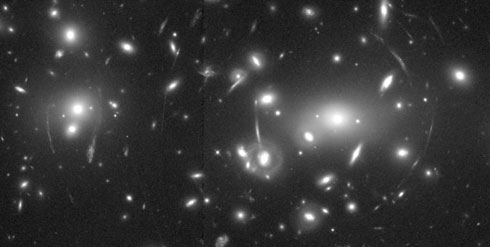
In this cosmic ‘gravitational lens,’ a huge cluster of galaxies distorts the light from more distant galaxies into a pattern of giant arcs. Picture Credit: NASA

Nowadays astronomers are so confident of Einstein’s theory that they rely on the bending of light by gravity to make telescopes almost as big as the Universe. When the conditions are right, gravity can shift an object’s position by far more than a microscopic amount. The ideal situation is when we look far out into space, and centre our view not on an individual star like the Sun, but on a cluster of hundreds of galaxies – with a total mass of perhaps 100 million million suns. The space-curvature of this immense ‘gravitational lens’ can gather the light from more remote objects, and focus them into brilliant curved arcs in the sky. From the size of the arcs, astronomers can ‘weigh’ the cluster of galaxies.

Einstein didn’t live long enough to see through a gravitational lens, but if he had he would definitely have approved….

Talking and Marking

Posted in Biographical, Politics, The Universe and Stuff with tags , on May 28, 2019 by telescoper

I’m taking a short break from my examination marking to have a cup of tea before I resume and make an attempt to finish it this evening. I’m late today because I had to go into Dublin to do an interview on NewsTalk Radio with a chap called Pat Kenny.

I was supposed to go on about 11.15 and was told to get to their HQ by 11am. I got there a bit earlier in fact and had to sit around a bit in the offices before going into the studio and then my bit was delayed because they wanted to play an audio recording of some bloke called Tony Blair pointing out, with devastating insight, that the United Kingdom is a very divided country.

After a bit of a delay  for that and a commercial break we finally got going nearer to 11.30. The subject of the interview was, of course, the Einstein-Eddington-Eclipse-Extravaganza taking place tomorrow. Pat Kenny introduced me as `John Coles from Maynooth University’, obviously thinking of John Cole, the former BBC political correspondent. Remember him? Anyway, I corrected him it and it went reasonably well from then on.

Unfortunately I’ve got a bit of a cold so I’ve been coughing and spluttering a bit and was a bit worried I would sneeze into the microphone but got through it reasonably well. I’ve done one or two bits of radio before, including an encounter with John Humphreys on BBC Radio 4, which that was about the anniversary of the publication of Stephen Hawking’s book A Brief History of Time.

Anyway after this morning’s interview was finished I was asked if I minded recording a little video about the topic I’d been talking about so I went with a nice young man into a very small  but very brightly lit room. I think it will probably look like a hostage video, but I’ll post it here if and when I find it. I gather they will put it up somewhere tomorrow, along with a podcast of the Pat Kenny show.

Now back to the marking.


Statistical Analysis of the 1919 Eclipse Measurements

Posted in Bad Statistics, The Universe and Stuff with tags , , , , on May 27, 2019 by telescoper

So the centenary of the famous 1919 Eclipse measurements is only a couple of days away and to mark it I have a piece on RTÉ Brainstorm published today in advance of my public lecture on Wednesday.

I thought I’d complement the more popular piece by posting a very short summary of how the measurements were analyzed for those who want a bit more technical detail.

The idea is simple. Take a photograph during a solar eclipse during which some stars are visible in the sky close enough to the Sun to be deflected by its gravity. Take a similar photograph of the same stars at night at some other time when the Sun is elsewhere. Compare the positions of the stars on the two photographs and the star positions should have shifted slightly on the eclipse plates compared to the comparison plate. This gravitational shift should be radially outwards from the centre of the Sun.

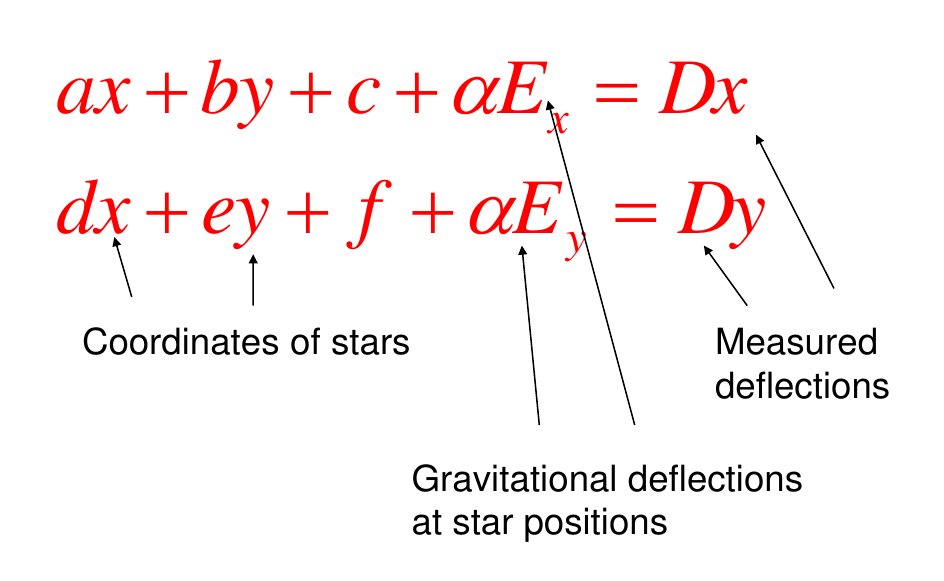
One can measure the coordinates of the stars in two directions: Right Ascension (x) and Declination (y) and the corresponding (small) difference between the positions in each direction are Dx and Dy on the right hand side of the equations above.

In the absence of any other effects these deflections should be equal to the deflection in each component calculated using Einstein’s theory or Newtonian value. This is represented by the two terms Ex(x,y) and Ey(x,y) which give the calculated components of the deflection in both x and y directions scaled by a parameter α which is the object of interest – α should be precisely a factor two larger in Einstein’s theory than in the `Newtonian’ calculation.

The problem is that there are several other things that can cause differences between positions of stars on the photographic plate, especially if you remember that the eclipse photographs have to be taken out in the field rather than at an observatory.  First of all there might be an offset in the coordinates measured on the two plates: this is represented by the terms c and f in the equations above. Second there might be a slightly different magnification on the two photographs caused by different optical performance when the two plates were exposed. These would result in a uniform scaling in x and y which is distinguishable from the gravitational deflection because it is not radially outwards from the centre of the Sun. This scale factor is represented by the terms a and e. Third, and finally, the plates might be oriented slightly differently, mixing up x and y as represented by the cross-terms b and d.

Before one can determine a value for α from a set of measured deflections one must estimate and remove the other terms represented by the parameters a-f. There are seven unknowns (including α) so one needs at least seven measurements to get the necessary astrometric solution.

The approach Eddington wanted to use to solve this problem involved setting up simultaneous equations for these parameters and eliminating variables to yield values for α for each plate. Repeating this over many allows one to beat down the measurement errors by averaging and return a final overall value for α. The 1919 eclipse was particularly suitable for this experiment because (a) there were many bright stars positioned close to the Sun on the sky during totality and (b) the duration of totality was rather long – around 7 minutes – allowing many exposures to be taken.

This was indeed the approach he did use to analyze the data from the Sobral plates, but tor the plates taken at Principe during poor weather he didn’t have enough star positions to do this: he therefore used estimates of the scale parameters (a and e) taken entirely from the comparison plates. This is by no means ideal, though he didn’t really have any choice.

If you ask me a conceptually better approach would be the Bayesian one: set up priors on the seven parameters then marginalize over a-f  to leave a posterior distribution on α. This task is left as an exercise to the reader.


A Story of St Stephen’s Green

Posted in History with tags , , , , , on May 26, 2019 by telescoper

I had a bit of spare time before the Opera on Friday and the weather was fine so I decided to go for a walk around the park in St Stephen’s Green.

I have walked past St Stephen’s Green many times but have never previously been inside, or if I have it was so long ago that I’ve now forgotten.

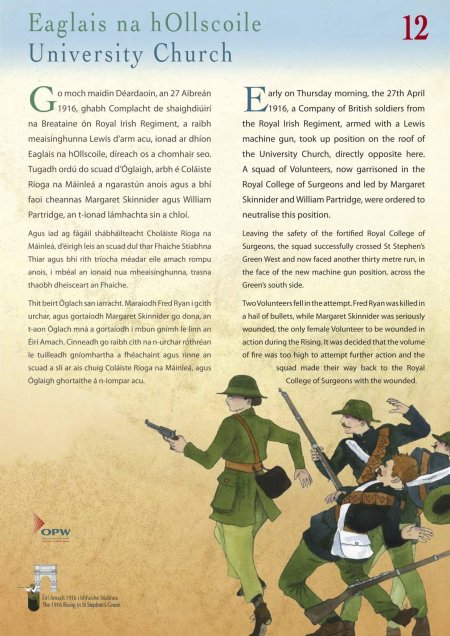
On my way around I noticed that there are posters here and there marking the events of the 1916 Easter Rising. Here’s an example:

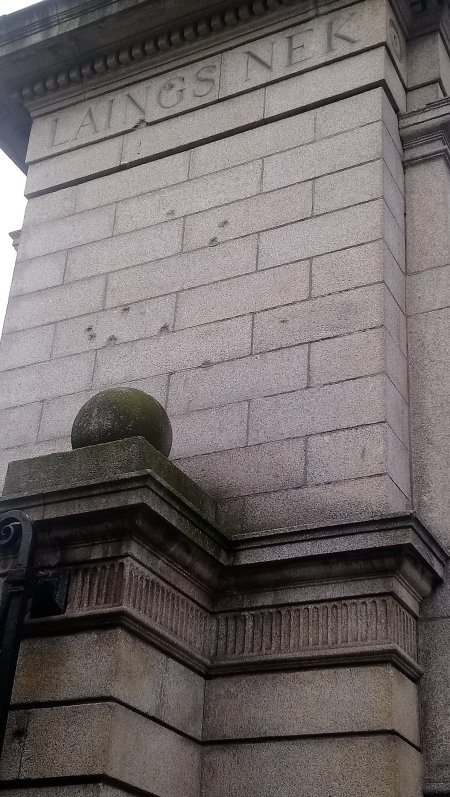
The artwork is a bit ‘Boy’s Comic’ style but the descriptions are fascinating especially because the Park and the area around it are pretty much unchanged in more than a hundred years since the momentous events of 1916 so it’s not difficult to imagine the scene as it was then. There are still bullet holes in the Fusiliers Arch at the North West Corner of the Green, as there are in a number of other locations around Dublin.

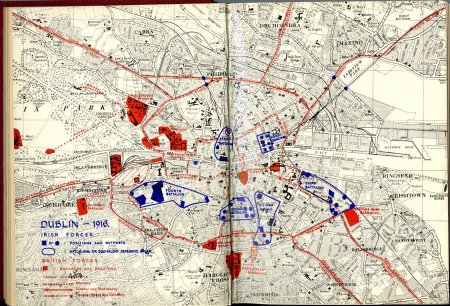
St Stephen’s Green is inside the area marked ‘Citizens Army‘. One look at the map will tell you why this was considered an important location to control as it is at the junction of several main roads. On the other hand if you actually visit the location you will see a big problem, namely that the Green itself is surrounded on all sides by very tall buildings, including the swanky Shelbourne Hotel to the North.

When a contingent of about 120 members of the Citizens Army arrived in St Stephen’s Green on Easter Monday, 24th April 1916, they immediately began erecting barricades outside, and digging trenches inside, the Park. They did not, however, have the numbers needed to seize and hold the buildings around it except for the Royal College of Surgeons building to the West.

The following morning, Tuesday 25th April, the British moved two machine guns into position, one in the Shelbourne Hotel and the other in the United Services club, along with numerous snipers. From these vantage points British soldiers could shoot down into the Park making it impossible for the rebels to move around.

The position inside the Green being untenable the Rebels effected an orderly (but perilous) withdrawal to the Royal College of Surgeons which they had fortified for the purpose. And that’s where they stayed until the end of the Rising.

The British realised that there was no need to assault the RCS building, as the force inside was contained and offered no real threat. From the roof of the building the Rebels watched helplessly as the British systematically reduced the resistance around the Rebel Headquarters in the GPO Building to the North, using artillery fired from College Green. Smoke rose into the sky as one entire side of O’Connell Street went up in flames and the perimeter slowly tightened around the GPO.

In the early hours of the morning of Thursday 27th April the occupants of the RCS were alarmed to see that British soldiers had installed another machine gun on the roof of the University Church on the South side of St Stephen’s Green along with snipers in adjacent buildings.

This was a very dangerous development that required a rapid response. A plan was devised that involved sending a squad of about 30 to break into buildings on the South side of the Green and start fires therein that would force the British to withdraw. This action is the subject of the poster shown above.

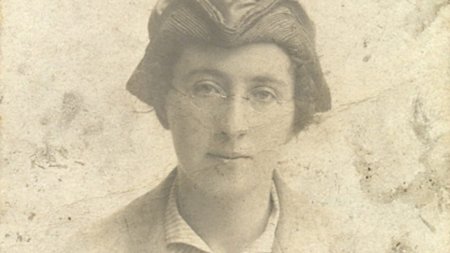
This is a photograph of the remarkable Margaret Skinnider, who is shown in the graphic leading the attempted assault. Before the Rising she was a school teacher. During the hostilities she initially acted as a scout and a runner, carrying messages to and from the GPO, but when given the chance she proved herself a crack shot with a rifle and showed conspicuous courage during the heavy fighting in and around St Stephen’s Green.

Skinnider insisted on leading the assault on Thursday 27th April despite the obviously high risk as it would involve running about 30 yards in full view of the machine gun position.

Under the cover of darkness, the detachment made its way out of the RCS to the South West corner of the Green safely enough but when men began breaking windows in Harcourt Street in order to gain entry to buildings there, the sound alerted the British soldiers who realised what was happening and opened fire as the Rebels made their move. Margaret Skinnider was leading from the front and she was inevitably among the casualties: she was hit three times by rifle bullets and very badly wounded.

Such was the volume of fire that the assault was abandoned and the surviving members of the squad retreated to the RCS where they remained until the general surrender on Saturday (29th April).

Skinnider was taken to hospital after the Rising ended but escaped and made her way to Scotland. She later returned to Ireland to take part in the War of Independence and subsequent Civil War. When the latter ended, in 1923, she went back to her job as a teacher in a primary school. She passed away in 1971 at the age of 79.