Talking and Marking

Posted in Biographical, Politics, The Universe and Stuff with tags , on May 28, 2019 by telescoper

I’m taking a short break from my examination marking to have a cup of tea before I resume and make an attempt to finish it this evening. I’m late today because I had to go into Dublin to do an interview on NewsTalk Radio with a chap called Pat Kenny.

I was supposed to go on about 11.15 and was told to get to their HQ by 11am. I got there a bit earlier in fact and had to sit around a bit in the offices before going into the studio and then my bit was delayed because they wanted to play an audio recording of some bloke called Tony Blair pointing out, with devastating insight, that the United Kingdom is a very divided country.

After a bit of a delay  for that and a commercial break we finally got going nearer to 11.30. The subject of the interview was, of course, the Einstein-Eddington-Eclipse-Extravaganza taking place tomorrow. Pat Kenny introduced me as `John Coles from Maynooth University’, obviously thinking of John Cole, the former BBC political correspondent. Remember him? Anyway, I corrected him it and it went reasonably well from then on.

Unfortunately I’ve got a bit of a cold so I’ve been coughing and spluttering a bit and was a bit worried I would sneeze into the microphone but got through it reasonably well. I’ve done one or two bits of radio before, including an encounter with John Humphreys on BBC Radio 4, which that was about the anniversary of the publication of Stephen Hawking’s book A Brief History of Time.

Anyway after this morning’s interview was finished I was asked if I minded recording a little video about the topic I’d been talking about so I went with a nice young man into a very small  but very brightly lit room. I think it will probably look like a hostage video, but I’ll post it here if and when I find it. I gather they will put it up somewhere tomorrow, along with a podcast of the Pat Kenny show.

Now back to the marking.


Statistical Analysis of the 1919 Eclipse Measurements

Posted in Bad Statistics, The Universe and Stuff with tags , , , , on May 27, 2019 by telescoper

So the centenary of the famous 1919 Eclipse measurements is only a couple of days away and to mark it I have a piece on RTÉ Brainstorm published today in advance of my public lecture on Wednesday.

I thought I’d complement the more popular piece by posting a very short summary of how the measurements were analyzed for those who want a bit more technical detail.

The idea is simple. Take a photograph during a solar eclipse during which some stars are visible in the sky close enough to the Sun to be deflected by its gravity. Take a similar photograph of the same stars at night at some other time when the Sun is elsewhere. Compare the positions of the stars on the two photographs and the star positions should have shifted slightly on the eclipse plates compared to the comparison plate. This gravitational shift should be radially outwards from the centre of the Sun.

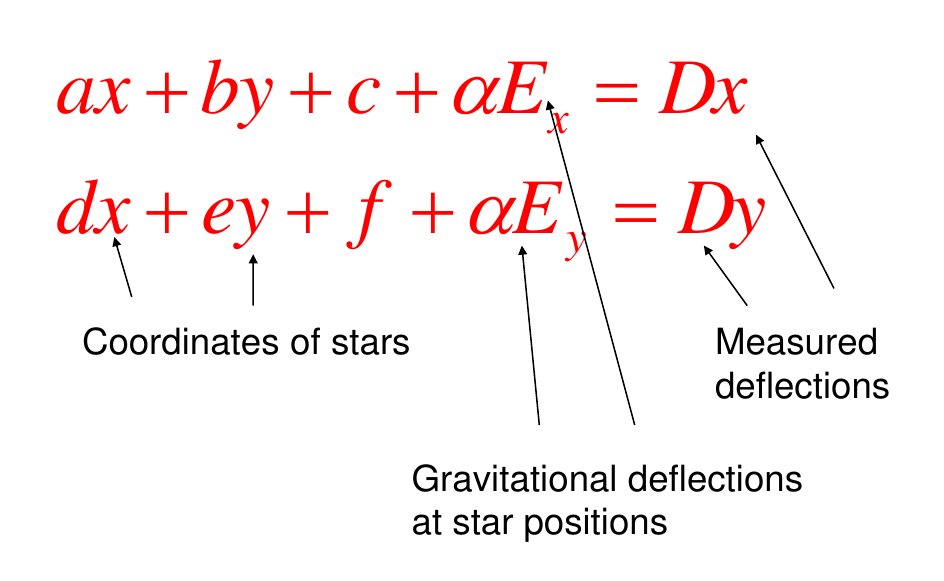
One can measure the coordinates of the stars in two directions: Right Ascension (x) and Declination (y) and the corresponding (small) difference between the positions in each direction are Dx and Dy on the right hand side of the equations above.

In the absence of any other effects these deflections should be equal to the deflection in each component calculated using Einstein’s theory or Newtonian value. This is represented by the two terms Ex(x,y) and Ey(x,y) which give the calculated components of the deflection in both x and y directions scaled by a parameter α which is the object of interest – α should be precisely a factor two larger in Einstein’s theory than in the `Newtonian’ calculation.

The problem is that there are several other things that can cause differences between positions of stars on the photographic plate, especially if you remember that the eclipse photographs have to be taken out in the field rather than at an observatory.  First of all there might be an offset in the coordinates measured on the two plates: this is represented by the terms c and f in the equations above. Second there might be a slightly different magnification on the two photographs caused by different optical performance when the two plates were exposed. These would result in a uniform scaling in x and y which is distinguishable from the gravitational deflection because it is not radially outwards from the centre of the Sun. This scale factor is represented by the terms a and e. Third, and finally, the plates might be oriented slightly differently, mixing up x and y as represented by the cross-terms b and d.

Before one can determine a value for α from a set of measured deflections one must estimate and remove the other terms represented by the parameters a-f. There are seven unknowns (including α) so one needs at least seven measurements to get the necessary astrometric solution.

The approach Eddington wanted to use to solve this problem involved setting up simultaneous equations for these parameters and eliminating variables to yield values for α for each plate. Repeating this over many allows one to beat down the measurement errors by averaging and return a final overall value for α. The 1919 eclipse was particularly suitable for this experiment because (a) there were many bright stars positioned close to the Sun on the sky during totality and (b) the duration of totality was rather long – around 7 minutes – allowing many exposures to be taken.

This was indeed the approach he did use to analyze the data from the Sobral plates, but tor the plates taken at Principe during poor weather he didn’t have enough star positions to do this: he therefore used estimates of the scale parameters (a and e) taken entirely from the comparison plates. This is by no means ideal, though he didn’t really have any choice.

If you ask me a conceptually better approach would be the Bayesian one: set up priors on the seven parameters then marginalize over a-f  to leave a posterior distribution on α. This task is left as an exercise to the reader.


A Story of St Stephen’s Green

Posted in History with tags , , , , , on May 26, 2019 by telescoper

I had a bit of spare time before the Opera on Friday and the weather was fine so I decided to go for a walk around the park in St Stephen’s Green.

I have walked past St Stephen’s Green many times but have never previously been inside, or if I have it was so long ago that I’ve now forgotten.

On my way around I noticed that there are posters here and there marking the events of the 1916 Easter Rising. Here’s an example:
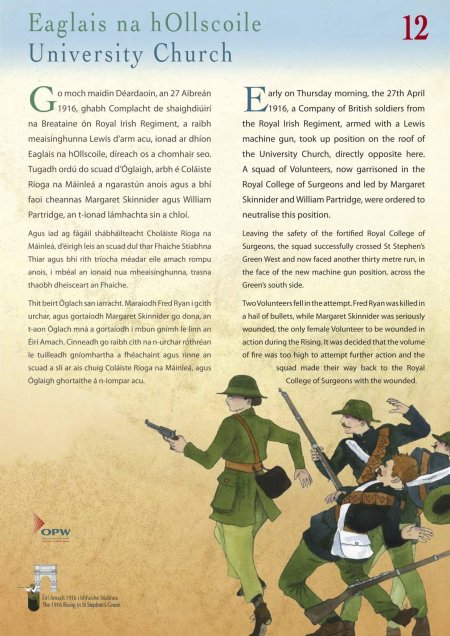
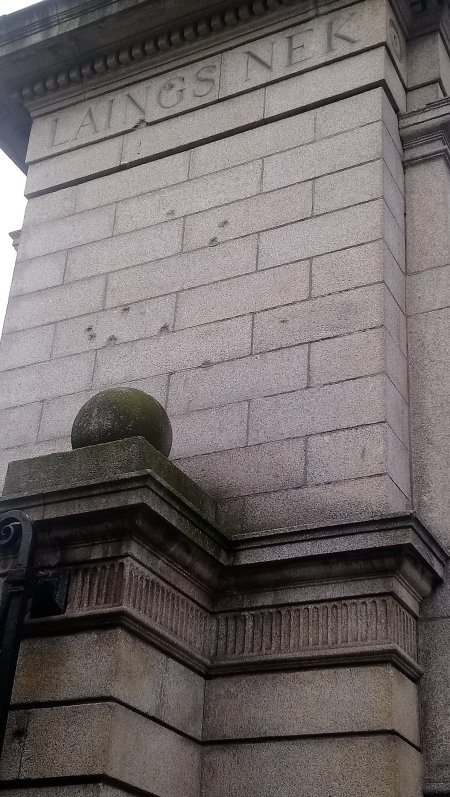
The artwork is a bit ‘Boy’s Comic’ style but the descriptions are fascinating especially because the Park and the area around it are pretty much unchanged in more than a hundred years since the momentous events of 1916 so it’s not difficult to imagine the scene as it was then. There are still bullet holes in the Fusiliers Arch at the North West Corner of the Green, as there are in a number of other locations around Dublin.
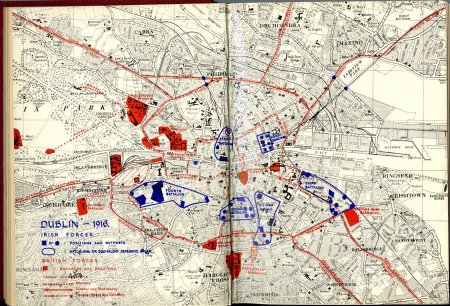
St Stephen’s Green is inside the area marked ‘Citizens Army‘. One look at the map will tell you why this was considered an important location to control as it is at the junction of several main roads. On the other hand if you actually visit the location you will see a big problem, namely that the Green itself is surrounded on all sides by very tall buildings, including the swanky Shelbourne Hotel to the North.

When a contingent of about 120 members of the Citizens Army arrived in St Stephen’s Green on Easter Monday, 24th April 1916, they immediately began erecting barricades outside, and digging trenches inside, the Park. They did not, however, have the numbers needed to seize and hold the buildings around it except for the Royal College of Surgeons building to the West.

The following morning, Tuesday 25th April, the British moved two machine guns into position, one in the Shelbourne Hotel and the other in the United Services club, along with numerous snipers. From these vantage points British soldiers could shoot down into the Park making it impossible for the rebels to move around.

The position inside the Green being untenable the Rebels effected an orderly (but perilous) withdrawal to the Royal College of Surgeons which they had fortified for the purpose. And that’s where they stayed until the end of the Rising.

The British realised that there was no need to assault the RCS building, as the force inside was contained and offered no real threat. From the roof of the building the Rebels watched helplessly as the British systematically reduced the resistance around the Rebel Headquarters in the GPO Building to the North, using artillery fired from College Green. Smoke rose into the sky as one entire side of O’Connell Street went up in flames and the perimeter slowly tightened around the GPO.

In the early hours of the morning of Thursday 27th April the occupants of the RCS were alarmed to see that British soldiers had installed another machine gun on the roof of the University Church on the South side of St Stephen’s Green along with snipers in adjacent buildings.

This was a very dangerous development that required a rapid response. A plan was devised that involved sending a squad of about 30 to break into buildings on the South side of the Green and start fires therein that would force the British to withdraw. This action is the subject of the poster shown above.
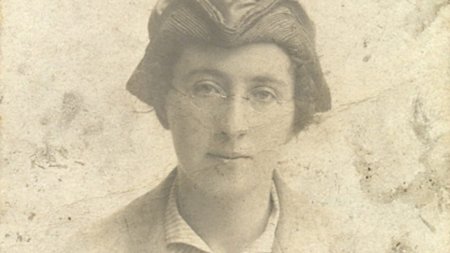
This is a photograph of the remarkable Margaret Skinnider, who is shown in the graphic leading the attempted assault. Before the Rising she was a school teacher. During the hostilities she initially acted as a scout and a runner, carrying messages to and from the GPO, but when given the chance she proved herself a crack shot with a rifle and showed conspicuous courage during the heavy fighting in and around St Stephen’s Green.

Skinnider insisted on leading the assault on Thursday 27th April despite the obviously high risk as it would involve running about 30 yards in full view of the machine gun position.

Under the cover of darkness, the detachment made its way out of the RCS to the South West corner of the Green safely enough but when men began breaking windows in Harcourt Street in order to gain entry to buildings there, the sound alerted the British soldiers who realised what was happening and opened fire as the Rebels made their move. Margaret Skinnider was leading from the front and she was inevitably among the casualties: she was hit three times by rifle bullets and very badly wounded.

Such was the volume of fire that the assault was abandoned and the surviving members of the squad retreated to the RCS where they remained until the general surrender on Saturday (29th April).

Skinnider was taken to hospital after the Rising ended but escaped and made her way to Scotland. She later returned to Ireland to take part in the War of Independence and subsequent Civil War. When the latter ended, in 1923, she went back to her job as a teacher in a primary school. She passed away in 1971 at the age of 79.

R.I.P. Murray Gell-Mann (1929-2019)

Posted in The Universe and Stuff with tags , , , on May 25, 2019 by telescoper

I heard this morning of the death of Murray Gell-Mann who passed away yesterday at the age of 89. Professor Gell-Mann was awarded the Nobel Prize for Physics in 1969 for his work on elementary particle physics, specifically for the development of the quark model. It was Gell-Mann who appropriated the phrase from James Joyce’s Finnegans Wake (‘Three quarks for Muster Mark’) from which the word `quark’ passed into the scientific lexicon.

There will be proper tributes from people who knew the man and his science far better than I do, so I’ll just say here that he was a man who made enormous contributions to physics and who will be greatly missed.

Rest in peace Murray Gell-Mann (1919-2019).

The Magic Flute at the Gaiety Theatre

Posted in Opera with tags , , , , on May 25, 2019 by telescoper

Last night went for the first time to the Gaiety Theatre in Dublin for a performance of Mozart’s The Magic Flute by Irish National Opera in conjunction with the Irish Chamber Orchestra. It was my first INO performance and my first visit to the Gaiety Theatre (although I’m sure it won’t be the last of either of those). I’ve actually lost count of the number of times I’ve seen the Magic Flute but I hope this won’t be the last either!

The Gaiety Theatre is quite compact, which engenders a more intimate atmosphere than is often experienced at the Opera. The music being provided by a small-ish chamber orchestra also suited the venue, but more importantly gave a fresh and sprightly feeling to Mozart’s wonderful score. You would think it would be hard to make Mozart sound stodgy, but some orchestras seem to manage it. Not last night though.

The scenery is rather simple, as is needed for touring Opera playing in relatively small venues. The stage directions of the Magic Flute are in any case so outlandish that it’s virtually impossible to enact them precisely according to instructions.

For example, what is the set designer supposed to do with this?

The scene is transformed into two large mountains; one with a thundering waterfall, the other belching out fire; each mountain has an open grid, through which fire and water may be seen; where the fire burns the horizon is coloured brightly red, and where the water is there lies a black fog.

This production takes the sensible approach of leaving a lot to the imagination of the audience though that does mean, for example, that there is no dragon…

The costumes are a different matter. The hero Tamino begins in the drab clothes of a working man of the 19th century, as do the three ladies that he encounters early on in Act I. The enigmatic Sarastro and his followers are however dressed as the gentry of a similar period, and are accompanied by a chorus of domestic servants. As Tamino works his way into the Brotherhood he becomes progressively gentrified in manner and in clothing. A central idea of the Opera is that of enlightenment values prevailing over superstition, but under the surface oppression remains, both in the form imposed by property-owners on the working poor, but also in the misogynistic behaviour of Sarastro and others, and the racist stereotyping of the villainous and lustful `Moor’, Monastatos. This production is sung in the original German, and there were gasps from the audience when they saw some of the surtitles in English. Although Magic Flute is on one level a hugely enjoyable comic fantasy, it also holds up a mirror to attitudes of Mozart’s time – and what you see in it is not pleasant, especially when you realize that many of these are still with us.

Importantly, however, this undercurrent does not detract from the basic silliness which I believe is the real key to this Opera. It’s fundamentally daft, but it succeeds because it’s daft in exactly the same way that real life is.

In last night’s performance the two fine leads were Anna Devin was Pamina (soprano) and Nick Pritchard Tamino (tenor). The excellent Gavan Ring provided suitable comic relief and a fine baritone voice to boot. Kim Sheehan (soprano) as the Queen of the Night doesn’t have the biggest voice I’ve ever heard, but she sang her extraordinarily difficult coloratura arias (one of them including a top `F’) with great accuracy and agility and brought a considerable pathos to her role instead of making it the pantomime villain you sometimes find. Sarastro was Lukas Jakobski (bass), memorable not only for his superb singing way down in the register, but for his commanding physical presence. Well over 2 metres tall, he towered over the rest of the cast. I think he’s the scariest Sarastro I’ve ever seen!

And finally I should congratulate the three boys: Nicholas O’Neill, Seán Hughes and Oran Murphy. These roles are extremely demanding for young voices and the three who performed last night deserved their ovation at the end.

The last performances in this run are today (Saturday 25th May, matinée and evening) so this review is too late to make anyone decide to go and see it but last night’s was recorded for RTÉ Lyric Fm and will be broadcast at a future date.

Exercising the Franchise

Posted in Biographical, Politics with tags , , on May 24, 2019 by telescoper

First thing this morning I cast my vote in Maynooth, the polling station for which is in the Presentation Girls School, a Catholic Primary School. It wasn’t amazingly busy inside but there was a steady flow of people coming through. There were 8 desks dishing out ballot papers, more desks than you usually get at a polling station in the UK. There were three ballot papers, one for the European Parliament, one for the Local Council, and one for the Constitutional Referendum.

Anyway, Polling Card in hand I eventually found the right desk. Having done my homework last night I ranked all 17 candidates for the European Parliament Elections and all 9 for the Local Council Elections, copying my preferences from a piece of paper I had taken with me. The Single Transferable Vote system must making counting quite a lengthy process so it will take some time before the results are known.

At least I got to vote, which many EU citizens in the UK were unable to do. There’s a major scandal brewing about what looks like deliberate disenfranchisement. These things shouldn’t happen in a democracy, but apparently in the United Kingdom they do.

I had a very busy morning after arriving at the Department so I’ve just discovered that Theresa May has resigned. Part of me is delighted as I thought she was callous and mean-spirited as well as being useless. Apparently she cried when she read out her resignation statement. You’d have to have a heart of stone not to burst out laughing.

The feeling of happiness that the current PM is leaving is however tempered by the very high probability that whoever replaces her will be even worse…

So I’m now heading off to Dublin again for the second session of IQF 2019 after which I’ll be going to the Gaiety Theatre for a performance of the Magic Flute, an Opera about Particle Physics.

LiteBIRD Newsflash

Posted in The Universe and Stuff with tags , , , , on May 23, 2019 by telescoper

Just a quick post to pass on the news that the space mission LiteBIRD has been selected as the next major mission by the Japanese Space Agency JAXA and  Institute for Space and Astronautical Science (ISAS).

LiteBIRD (which stands for `Lite (Light) satellite for the studies of B-mode polarization and Inflation from cosmic background Radiation Detection’) is a planned space observatory that aims to detect the footprint of the primordial gravitational waves on the cosmic microwave background (CMB) in a form of a B-mode polarization pattern. This is the signal that BICEP2 claimed to have detected five years ago to much excitement, but was later shown to be a caused by galactic dust.

It’s great news for a lot of CMB people all round the world that this mission has been selected – include some old friends from Cardiff University. Congratulations to all of them!

I’m not sure when the launch date will be, but the mission will last three years and will be at Earth-Sun Lagrange point known as L2.It will be a very difficult task to extract the B-mode signal from foregrounds and instrumental artifacts so although there’s joy that it has been selected, the real work starts now!

Irish Quantum Foundations and Other Matters

Posted in Biographical, The Universe and Stuff with tags , , on May 23, 2019 by telescoper

So here I am then, at Irish Quantum Foundations (IQF) 2019 which is being held in the Hamilton Building (shown above), and hosted by the School of Mathematics of the College of the Holy and Undivided Trinity of Queen Elizabeth near Dublin, which is sometimes known as Trinity College, Dublin for short.

I got here a bit later than I originally planned as some last-minute things came up this morning to do with next week’s events. I’ll have to skip tomorrow morning too, for similar reasons. When I did get going this morning I had to stand all the way from Maynooth to Connolly because the train was packed. At least it was reasonably on time though.

Anyway, the schedule of IQF 2019 is rather varied and I’m looking forward to the parts of it that I can attend.

Among the things I have been dealing with to do with next week are  submitting the final version of pedagogical piece about the Eclipse Expeditions of 2019 which should be published very soon in Contemporary Physics (at least in the online version) and writing a short piece for RTÉ Brainstorm (which will appear on Monday 27th May), and sorting out an appearance on Newstalk Radio next week. How I’ll get time to finish my exam marking in the middle of all this I don’t know!


Should students be (financially) compensated for strike action by lecturers?

Posted in Cardiff, Education, Politics with tags , , , , on May 22, 2019 by telescoper

Regular readers of this blog will know that last year I was still employed part of the time at Cardiff University and during that period I was participating in strike action called by the Universities and Colleges Union (UCU) over pensions. As a result of that action students on my module on Physics of the Early Universe missed quite a lot of lectures (and I was docked a large fraction of my pay).

I refused to do extra lectures after the strike was over to make up for those lost, as it seemed to me that defeated the point of the strike action, but I did make notes available for the students (which I do anyway). Students were also given access to recordings of the previous year’s lectures on the same module. I know some lecturers also adjusted their examinations and/or other assessments to exclude material that had not been covered.

It seems practice for dealing with this (admittedly difficult) situation has varied from institution to institution, and some students who feel that they missed out as a result of the strike have apparently asked to be compensated by their University. Institutions could of course pay compensation to students out of the money saved by not paying lecturers, but that wouldn’t go very far because only a small part of the £9000+ students pay in fees goes to the salaries of teaching staff. Another issue is that I recall one or two students didn’t come to lectures even before the strike started. Should they be compensated too?

Anyway I thought this might be an interesting topic for a poll, so here goes:

As always views are welcome through the comments box too!

An Informational Approach to Cosmological Parameter Estimation

Posted in The Universe and Stuff with tags , , , , , , , on May 22, 2019 by telescoper

In order to avoid having to make a start on examination marking I was having a trawl through the arXiv this morning when I found an interesting paper by Stephens & Gleiser called An Informational Approach to Cosmological Parameter Estimation. The abstract is:

You can download a PDF of the full paper here.

I haven’t had time to go through the manuscript in detail but while it doesn’t seem to say very much of a specific nature about the Hubble constant tension issue, it does introduce an approach which is new to me. The Jensen-Shannon Divergence is a variation on the familiar Kullback-Leibler Divergence.

Anyway, I’d be interested in comments on this from experts!