I couldn’t resist sharing this hilarious introduction to the art of the Wagnerian dramatic soprano from the sublime Anna Russell.
Follow @telescoper
I couldn’t resist sharing this hilarious introduction to the art of the Wagnerian dramatic soprano from the sublime Anna Russell.
Follow @telescoper
I’m up to my eyeballs in matters Eddingtonian these days preparing for the big centenary, so I thought I’d share this which I was reminded about this morning. The official results of the 1919 Eclipse Expeditions were announced at a joint meeting of the Royal Society and Royal Astronomical Society on November 6 1919. Members of a certain physics graduate student society at Cambridge, however, were treated to a sneak preview in October of that year, to which the minutes of the 83rd Meeting of the `Del-Squared V Club’ attest:
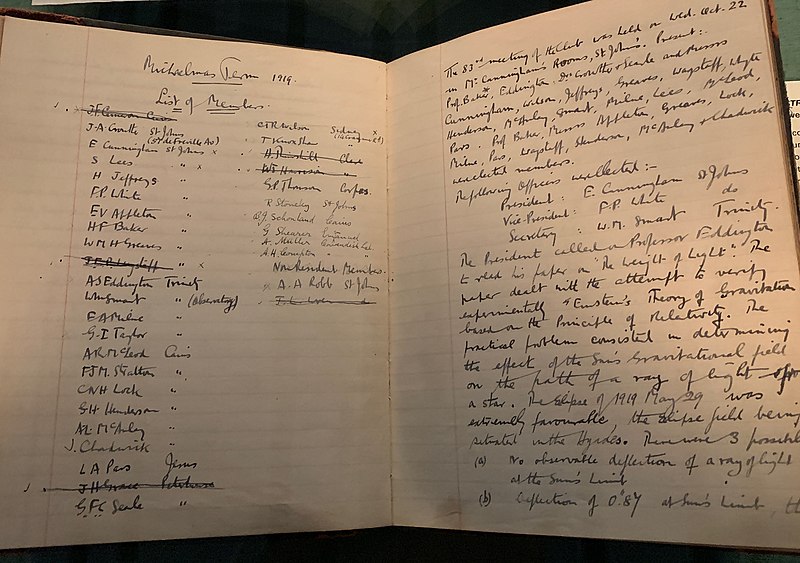 Arthur Stanley Eddington gave a talk at that meeting, a brief note of which appears on the right-hand page of the minute book shown above. You can see the Newtonian value for the expected deflection of 0.87 seconds at the bottom of the page. There’s also a nice reference to `The Weight of Light’. I had no idea Eddington was a lightweight speaker, but there you are.
I don’t think the Del-Squared V Club exists* any more, so I won’t make the joke that if you want to phone them up you have to go through the operator…
*I’m reliably informed that it has been defunct since 1970.
Follow @telescoper
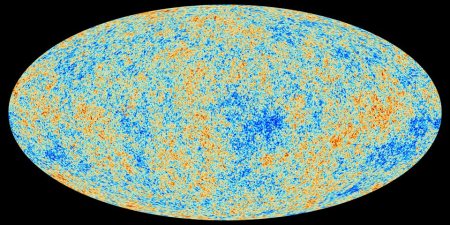
After yesterday’s decennial celebration of the launch of ESA’s Herschel and Planck missions, I noticed that this morning a new paper from the Planck Consortium has arrived on the arXiv. Coincidence?
The other 2018 `last’ papers from Planck were released last year.
Anyway, this is the long-awaited paper IX about primordial non-Gaussianity and the abstract is:
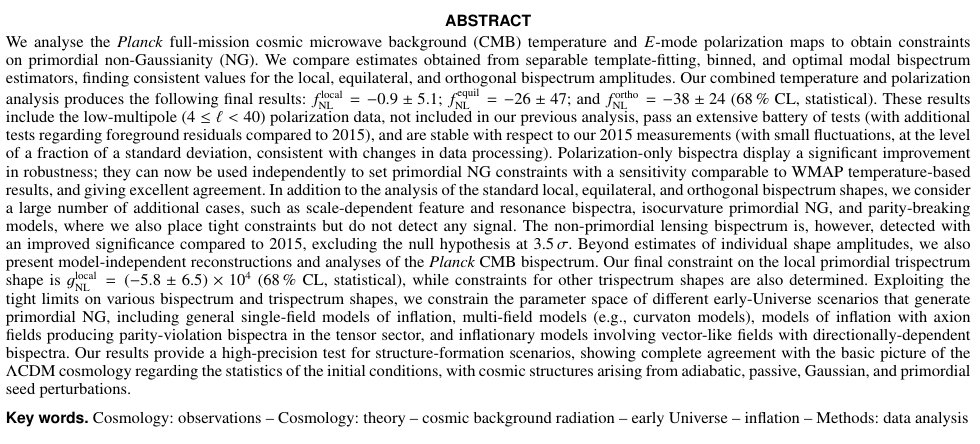
In a nutshell, there’s no evidence for primordial non-Gaussianity from the Planck observations. The paper is rather long, but well worth reading because it shows how much work has to go in to extract higher-order statistical information from CMB data. It’s far harder than the (second-order) power-spectrum, which is no doubt why this paper to so long to emerge.
Follow @telescoperA little birdie told me (via a tweet) that today is the 10th anniversary of the launch of the ESA Planck and Herschel satellite missions. Can it really be so long ago?
Anyway, both were superbly successful and both involved many friends and former colleagues from Cardiff and elsewhere, so I thought I’d reblog this post which I wrote on the day of the launch (on May 14 2009)….
The Big Day has finally arrived!
I’ve managed to submit my paper to the journal and the ArXiv before the little shindig we’ve been planning for the Planck and Herschel launch gets under way at 1pm. Business as usual so far, though.
Strangely, I haven’t managed to get nervous yet, although I have to say there are many anxious faces around the department. I just keep telling people how much simpler their life is going to be if it all goes wrong, without all that messy and unnecessarily complicated data to deal with. It bothers me sometimes that I don’t often get nervous expect when watching sport. Mind you, being a Newcastle United supporter probably makes me more nervous more often than most people.
Anyway, at times like this a stiff upper lip is obviously called for. Anyone who cracks now is clearly not officer material. There’ll be plenty of…
View original post 361 more words

At the risk of being a complete bore about the 1919 Eclipse Expeditions, here is a plug for a public talk I am giving in Maynooth on 29 May 2019, the centenary of the event itself.
Here is the blurb:
Albert Einstein is the undisputed genius whose insights have revolutionised the way we think about the Universe. He is also a cultural icon whose fame extends far beyond the realm of theoretical physics.
Einstein’s transition to global stardom can be dated precisely to 29th May 1919, the date of a total solar eclipse at which the first measurements were made of the bending of light by the Sun’s gravity that tested Einstein’s then new general theory of relativity. The announcement of the results created an unprecedented media sensation: news of Einstein and his revolutionary theory made front-page news around the world.
To mark the centenary of this historic event, Peter Coles will describe the historical and scientific background to an experiment that changed the world, and explain why it was such an important event both for Einstein the physicist and Einstein the celebrity.
The event will be on the North Campus of Maynooth University. It is free, but please register at the Eventbrite site here if you want to attend so we can get an idea of numbers. If, for some reason, you can’t get to Maynooth, we are planning to do a live feed of the talk too, so please watch this blog for more details.
Follow @telescoperAfter the cold spell we’ve had for the last week or two it’s a warm sunny and generally rather lovely day today. It’s also very quiet on campus here in Maynooth because lectures are over. There are students around, especially in the library and other study spaces, but there’s none of the usual rushing about in between lectures. After rushing about myself a bit this morning I thought I’d take a coffee break and reflect on the weekend’s football.

A picture of a football
Yesterday saw the last round of matches in the Premiership, where the focus was on which of the two leading Midlands clubs (Liverpool or Manchester City) would win. After a brief glimmer of excitement when Brighton took the lead against Manchester City and thus gave Liverpool a chance of the title, normal service was resumed when Manchester City regained the lead and eventually won 4-1. Although Liverpool won their game too (against Wolves) they ended up in second place by one point. It’s quite a remarkable feat to finish on 97 points and not win the Premiership, which is what Liverpool have done. I suppose they will be seeking some meagre consolation by winning the UEFA Champions League..
Earlier last week there were two remarkable matches in said UEFA Champions League. Liverpool, 3-0 down to Barcelona after the first (away) leg of their semi-final, managed to win the home leg 4-0 and thus qualified for the final. I wasn’t going to watch this as I thought it was a foregone conclusion that Barcelona would win, but I eventually wandered into the pub (McMahon’s) for the second half when it was 1-0 and saw two more goals. The closing stages of the game were very exciting, as even at 4-0 Barcelona only needed one goal to win. There was huge support for Liverpool among the locals too, which made it very enjoyable to watch.
Obviously Liverpool benefited from a much tougher game last weekend against Newcastle United, who made them work hard for a 3-2 victory. A difficult work-out like that made their job against less distinguished opponents Barcelona relatively straightforward.
The next day Tottenham had a 1-0 deficit from their home leg against Ajax, who I thought were going to clean up (Geddit?) especially when they scored two early goals. In another remarkable turnaround, Spurs then scored three goals away goals which took them through when the aggregate score finished at 3-3. Amazing stuff.
In the interest of full disclosure I should admit that I put £50 on a double that the final would be between Ajax and Barcelona. You can’t win ’em all.
Oh and both Arsenal and Chelsea have qualified for the Europa League final (whatever that is). They will play each other in Baku (wherever that is) for a place in next year’s Eurovision song contest.
More importantly than all this, Newcastle United won 4-0 yesterday away at Fulham to finish 13th on 45 points. It hasn’t been a marvellous season but at least there was no last-minute nail baiting. They secured Premiership status some weeks ago. They are indeed fortunate to have Rafa Benitez as manager. He is an excellent coach, but his contract is up this summer and it’s not obvious he will stay. Next season will be difficult without him.
Already relegated Cardiff City managed a win against Manchester United: Ole Gunnar Solskjær’s bright start in charge seems to have come a cropper in a disappointing last few games. At least Cardiff City went down with guns blazing.
And finally back to Brighton who, I have just learned, have sacked their manager Chris Hughton. That’s not a very nice way to thank someone who got them promoted, and kept them in the Premiership. It’s a great shame for Hughton for whom I have a lot of respect. Football is a brutal game sometimes, especially off the field.
Follow @telescoper
Not surprisingly, given that the centenary is fast approaching, pieces are appearing in the mainstream media about the 1919 Eclipse Expeditions that first measured the deflection of light by the Sun’s gravitational field. One such article, by Robin McKie, appears in today’s Observer. It’s a nice piece, though it concentrates almost entirely on Eddington’s measurements taken at Principe. In fact it was Crommelin’s measurements from Sobral that proved decisive.
Anyway, the article gives me a (very brief) mention courtesy of the piece I wrote in Nature a few weeks ago:

For many years at Cardiff I ran an undergraduate project in which the students had to reanalyze the measurements from the eclipse expeditions. That is possible because all the necessary star positions are tabulated in the paper by Dyson et al. (1920). It is undoubtedly the case that Eddington had to improvise a bit because of the unexpected problems that arose in the field, but this is actually quite normal. As a famous general put it `No plan of battle survives first contact with the enemy’. I remain convinced that Eddington didn’t do anything dodgy, but you don’t have to take my word for it: if you don’t believe me then go ahead and look at the data yourself! At the very least you will then understand what a difficult experiment this was!
Follow @telescoperSo here we are, then. The term is finally over. Lectures officially finished yesterday, and there’s now another week or so before examinations start (next Friday, 17th May). The examinations for my two modules take place on Tuesday 21st and Wednesday 22nd May, and after that I’ll be busy with marking for a while. In fact, I’ll probably be getting much busier in general pretty soon, but more of that in due course…

Marking doesn’t just mean written examinations. I have been teaching a module on Computational Physics to 3rd Year students here in Maynooth, and 40% of the assessment for that is a mini-project (usually done in groups of two or three). Early on the term, I put up a list of a dozen or so projects and ask them to pick first second and third choices so I can form groups in such a way that most students get to work on a project they like the look of. This year I made up a new set of projects, but I feel a bit sorry for one of them (`Scattering in a Spherical Potential’), which didn’t appear anywhere \at all on any student’s list of preferences. That’s a shame as I thought it was a well-rounded project, with lots of potential. Hopefully it will prove more popular next year…
Anyway, the deadline for projects to be handed in came yesterday so I’ve got a stack of those to mark which, you will realise, why I am indulging in a displacement activity by writing this blog post. My plan is to mark these next week so that they’re done before the written examinations come in.
Before I get on with what I should be doing I’ll just mention another thing that happened yesterday: the President of Ireland (Uachtarán na hÉireann), Michael D. Higgins visited Maynooth University yesterday:

That’s him at the front, on the right, of course. The reason for his visit was to attend a memorial service.
Follow @telescoperA few weeks ago I had a very bad dream and, unlike most dreams I have, I didn’t forget it immediately afterwards. In fact I keep thinking about it, although it hasn’t recurred. I’m not sure why I decided to share it here, but here goes..
In the dream I am giving a lecture using a blackboard in a lecture theatre to a group of students. The lecture theatre isn’t a specific room that I remember and the students in the audience are not people that I recognise at all.
Anyway, I’m busy talking when the door at one side of the front of the theatre opens to reveal not the standard corridor that you would expect alongside a lecture theatre a university building but a very long corridor leading off into the distance.
I pay little attention and carry on lecturing. A few moments later I look out along the corridor where, off in the distance, there is a very dark object. It’s very far aware and I can make out no details. I turn my attention back to the lecture.
This happens several times, and each time the shape is closer to the doorway to the lecture theatre. It remains indistinct in shape. No arms or legs or head, just a sort of black blob. It is not sharply delineated around the ages nor does it suggest any sense of depth. It’s like someone has painted something a very dense black into the air. It’s not obvious even how it moves as it does not appear to be on the ground and seems still every time I look at it, but each time I look away and look back it has moved closer. I am getting more and more frightened.
Eventually the shape is in the doorway, about to enter the room, and I’m now completely terrified. I look at the audience in the lecture theatre and they have all gone away. There’s just me and the thing.
As I watch, the thing enters the room. At this point I decide to run away, but I can’t move. I try again but I’m rooted to the spot. I scream, but I can make no sound. The thing moves closer. And closer.
Eventually, with the thing just a few feet away, my attempts to scream succeed. I screech at the top of voice.
At this point I woke up with a start. I’m pretty sure that I really did scream in my sleep and it was that noise that woke me up. I hope I didn’t wake up my neighbours! My heart was pounding and I was sweating. There being no possibility of going back to sleep, I got up and had a glass of water. It was about 4am. I didn’t sleep any more that night.
I’m by no means an expert in the interpretation of dreams but on the occasions when I can remember what I’ve dreamed about it always seems to be a weird juxtaposition of things I’ve experienced in the previous day or two.
My interpretation of this sort of thing is that during a dream the sleeping brain is sifting through recent experiences and relating them to others, including recent events and things lodged in long-term memory. If I’m right, then this kind of dream is basically a by-product of the workings of a sort of subconscious filing system.
There are other kinds of dream, of course, and they don’t always fit into this pattern. In my experience the majority don’t make any sense at all, so I won’t say any more about that class. I don’t know how many people have regular recurrent dreams, but I do; these are of two types. The first is a standard `anxiety’ dream. I could be sitting in an orchestra on the stage of a concert hall, or some similar situation. I have a musical instrument in my hands and am dressed for the part, like all the other musicians. It is shortly before the performance is due to start. The problem is that I don’t actually know how to play the instrument. Time is ticking away and I’m soon to be found out. How do I escape?
The second type of recurrent dream is harder to fathom. I’ve moved around quite a lot during my career. In this kind of dream I’m supposed to be back in one of the places I used to live, but it’s curiously different from what it was like in reality. One example involved me being back in my old flat in Bethnal Green. Exploring the place I took a nice walk through the French windows and into the garden. Trouble is, the flat didn’t actually have French windows or a garden. How could it? It wasn’t even on the ground floor…
Anyway it seems obvious that the black thing in the corridor represents some sort of anxiety, a kind of variation of the type I mentioned above, but I’m intrigued by the fact that it had no discernible form. It was just a pool of blackness. It wouldn’t have made a very impressive monster in a horror film, but it was certainly terrifying.
Now, would any psychoanalysts out there like to interpret this for me?
Follow @telescoper
I’ve just heard that the Gruber Foundation has announced the winners of this year’s Gruber Prize for cosmology, namely Nick Kaiser and Joe Silk. Worthy winners the both of them! Congratulations!
Here’s some text taken from the press release:
The recipients of the 2019 prize are Nicholas Kaiser and Joseph Silk, both of whom have made seminal contributions to the theory of cosmological structure formation and to the creation of new probes of dark matter. Though they have worked mostly independently of each other, the two theorists’ results are complementary in these major areas, and have transformed modern cosmology — not once but twice.
The two recipients will share the $500,000 award, and each will be presented with a gold medal at a ceremony that will take place on 28 June at the CosmoGold conference at the Institut d’Astrophysique de Paris in France.
The physicists’ independent contributions to the theory of cosmological structure formation have been instrumental in building a more complete picture of how the early Universe evolved into the Universe as astronomers observe it today. In 1967 and 1968, Silk predicted that density fluctuations below a critical size in the Cosmic Microwave Background, the remnant radiation “echoing” the Big Bang, would have dissipated. This phenomenon, later verified by increasingly high precision measurements of the CMB, is now called “Silk Damping”.
In the meantime, ongoing observations of the large-scale structure of the Universe, which evolved from the larger CMB fluctuations, were subject to conflicting interpretations. In a series of papers beginning in 1984, Kaiser helped to resolve these debates by providing statistical tools that would allow astronomers to separate “noise” from data, reducing ambiguity in the observations.
Kaiser’s statistical methodology was also influential in dark matter research; the DEFW collaboration (Marc Davis, George Efstathiou, Carlos Frenk, and Simon D. M. White) utilised it to determine the distribution and velocity of dark matter in the Universe, and discovered its non-relativistic nature (moving at a velocity not approaching the speed of light). Furthermore, Kaiser devised an additional statistical methodology to detect dark matter distribution through weak lensing — an effect by which foreground matter distorts the light of background galaxies, providing a measure of the mass of both. Today weak lensing is among cosmology’s most prevalent tools.
Silk has also been impactful in dark matter research, having proposed in 1984 a method of investigating dark matter particles by exploring the possibilities of their self-annihilations into particles that we can identify (photons, positrons and antiprotons). This strategy continues to drive research worldwide.
Both Kaiser and Silk are currently affiliated with institutions in Paris, Kaiser as a professor at the École Normale Supérieure, and Silk as an emeritus professor and a research scientist at the Institut d’Astrophysique de Paris (in addition to a one-quarter appointment at The John Hopkins University). Among their numerous significant contributions to their field, their work on the CMB and dark matter has truly revolutionised our understanding of the Universe.
I haven’t worked directly with either Nick Kaiser or Joe Silk but both had an enormous influence on me, especially early on in my career. When I was doing my PhD, Nick was in Cambridge and Joe was in Berkeley. In fact I think Nick was the first person ever to ask me a question during a conference talk – which terrified the hell out of me because I didn’t know him except by scientific reputation and didn’t realize what a nice guy he is! Anyway his 1984 paper on cluster correlations was the direct motivation for my very first publication (in 1986).
I don’t suppose either will be reading this but heartiest congratulations to both, and if they follow my advice they won’t spend all the money in the same shop!
P.S. Both Nick and Joe are so distinguished that each has appeared in my Astronomy Lookalikes gallery (here and here).
Follow @telescoper

 In the Dark
