So here I am in my hotel room in Copenhagen after breakfast doing a quick post before checking out. I’ve put the DO NOT DISTURB sign on the door.
Ibsens Hotel seems to know its guests!
My flight back to Dublin is not until this evening and I have to leave the hotel by 11am (local time) so I have a few hours wandering about the city which should be very nice, since the weather is lovely.
I took the above picture with my phone yesterday morning while taking the short walk to the Niels Bohr Institute. The strange effect was cause by the mist hanging over the city. This morning is bright and sunny. Ideal for a walk about.
Anyway, the main point of this post is to congratulate Dr Sebastian von Hausegger who successfully defended his PhD thesis yesterday. In the Danish system the thesis defence is a public affair, involving a talk by the candidate followed by questions from a panel involving two external examiners, of which I was one. The talk lasted about 45 minutes and was followed by about 40 minutes of questions. I’m told that was a longer than usual question-and-answer session, but that’s only because we found the thesis so interesting. The thesis concerned various projects related to the cosmic microwave background, including foreground subtraction methods and analysis of polarization.
It was actually a very enjoyable occasion, rather than an ordeal, and the candidate passed with flying colours. Afterwards there was a small drinks reception, during which I got to talk to Sebastian’s parents and his girlfriend (who apparently reads this blog). I hope they all had a good celebration yesterday evening!
P.S. I couldn’t think of a good title for this post so I borrowed the latin motto of the City of Newcastle (my home town). Roughly translated it means `triumphing by brave defence’!
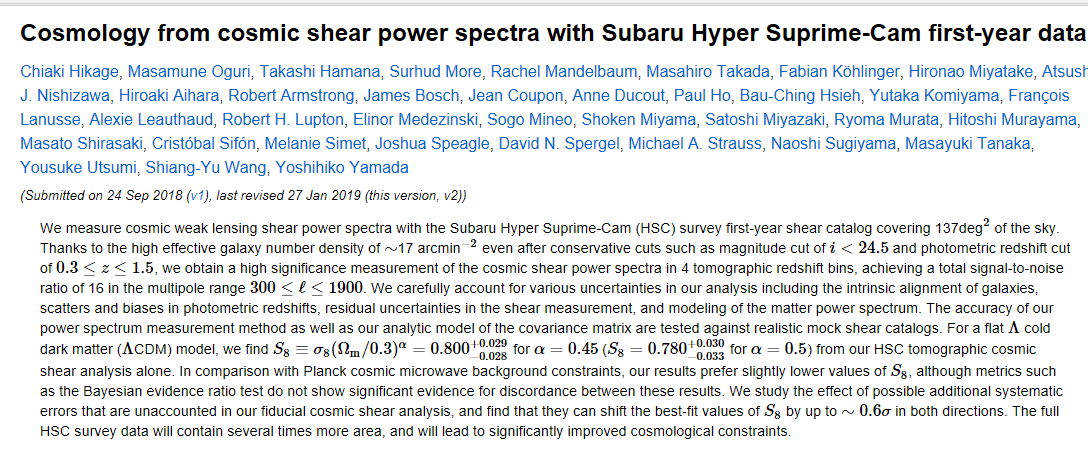
Up with the lark this morning I suddenly remembered I was going to do a post about a paper which actually appeared on the arXiv some time ago. Apart from the fact that it’s a very nice piece of work, the first author is Chiaki Hikage who worked with me as a postdoc about a decade ago. This paper is extremely careful and thorough, which is typical of Chiaki’s work. Its abstract is here:
The work described uses the Hyper-Suprime-CamSubaru Telescope to probe how the large-scale structure of the Universe has evolved by looking at the statistical effect of gravitational lensing – specifically cosmic shear – as a function of redshift (which relates to look-back time). The use of redshift binning as demonstrated in this paper is often called tomography. Gravitational lensing is sensitive to all the gravitating material along the line of sight to the observer so probes dark, as well as luminous, matter.
Here’s a related graphic:
The article that reminded me of this paper is entitled New Map of Dark Matter Spanning 10 Million Galaxies Hints at a Flaw in Our Physics. Well, no it doesn’t really. Read the abstract, where you will find a clear statement that these results `do not show significant evidence for discordance’. Just a glance at the figures in the paper will convince you that is the case. Of course, that’s not to say that the full survey (which will be very much bigger; the current paper is based on just 11% of the full data set) may not reveal such discrepancies, just that analysis does not. Sadly this is yet another example of misleadingly exaggerated science reporting. There’s a lot of it about.
Incidentally, the parameter S8 is a (slightly) rescaled version of the more familiar parameter σ8 – which quantifies the matter-density fluctuations on a scale of 8 h-1 Mpc – as defined in the abstract; cosmic shear is particularly sensitive to this parameter.
Anyway, if this is what can be done with just 11%, the full survey should be a doozy!
Once again I find myself in the wonderful city of Copenhagen. As far as I’m concerned, at least, my wavefunction has collapsed (along with the rest of me into a definite location: Ibsen’s Hotel, in fact. Henrik Ibsen isn’t here: he checked out many years ago.
The hotel management, being Danes, are refreshingly honest in their description of my room:
Usually hotel rooms this size are described as `standard’…
After a very enjoyable but rather tiring day yesterday I was up early this morning to get from Loughborough to Luton Airport. What I thought would be the reasonable way of making the trip – train from Loughborough to Luton Airport Parkway and shuttle bus from there – turned out to be inconvenient in terms of timing and cost, so the kind people of Loughborough University just booked me a cab all the way there. I had to leave at 7am, though, so missed the hotel breakfast but I got to the airport in good time to have something there.
My second flight with Ryanair this week was also on time and Copenhagen’s excellent public transport system got me to this hotel very quickly. It’s a good few degrees colder here than in England.
When I checked in the receptionist asked me if I had stayed here before. I said yes, but couldn’t remember when. She said it was 2012, as I was still on their system. I did actually post about it then. The hotel hasn’t changed at all from what I remember last time. I must remember to get to breakfast in good time.
The flight from Luton Airport carried a large contingent of Chelsea supporters. Their team is playing Malmö this evening in the UEFA Europa League. Malmö is easily reachable from Copenhagen by train over the Øresund Bridge. Fortunately I was heading into Copenhagen on the Metro so parted company with the supporters as soon as I left the airport.
Anyway, I’m in Copenhagen again as one of the External Examiners for a thesis defence at the Niels Bohr Institute tomorrow morning and then I’ll be returning directly to Dublin on Saturday afternoon. I’m missing today’s Computational Physics lecture and laboratory in Maynooth, but the students are being well looked after in my absence by John and Aaron who have all the notes and lab scripts.
It’s been a hectic couple of days during which I somehow missed the very sad news of the passing of legendary goalkeeper Gordon Banks, who died yesterday (12th February 2019) at the age of 81.
Gordon Banks made 628 appearances during a 15-year career in the Football League, and won 73 caps for England, highlighted by starting every game of the 1966 World Cup campaign. He will however be best remembered for one amazing save in the 1970 World Cup, so by way of a short tribute here is a rehash of a post I wrote some years ago about that.
–0–
I’ve posted a few times about science and sport, but this bit of action seems to defy the laws of physics. I remember watching this match, a group game at Guadalajara (Mexico) between England and Brazil from the 1970 World Cup, live on TV when I was seven years old. The Brazil team of 1970 was arguably the finest collection of players ever to grace a football field and the names of Jairzinho, Carlos Alberto, Rivelino and, of course, Pelé, were famous even in our school playground. The England team of 1970 was also very good, but they were made to look very ordinary that day – with one notable exception.
The only thing I remember well about the game itself was this save – the best of many excellent stops – by the great goalkeeper Gordon Banks. I’ve seen it hundreds of times since, and still can’t understand how he managed to block this header from Pelé. You can tell from Bobby Moore’s reaction (No. 6, on the line) that he also thought Brazil had scored…
Here’s the description of this action from wikipedia:
Playing at pace, Brazil were putting England under enormous pressure and an attack was begun by captain Carlos Alberto who sent a fizzing low ball down the right flank for the speedy Jairzinho to latch on to. The Brazilian winger sped past left back Terry Cooper and reached the byline. Stretching slightly, he managed to get his toes underneath the fast ball and deliver a high but dipping cross towards the far post. Banks, like all goalkeepers reliant on positional sensibility, had been at the near post and suddenly had to turn on his heels and follow the ball to its back post destination.
Waiting for the ball was Pelé, who had arrived at speed and with perfect timing. He leapt hard at the ball above England right back Tommy Wright and thundered a harsh, pacy downward header towards Banks’ near post corner. The striker shouted “Goal!” as he connected with the ball. Banks was still making his way across the line from Jairzinho’s cross and in the split-second of assessment the incident allowed, it seemed impossible for him to get to the ball. He also had to dive slightly backwards and down at the same time which is almost physically impossible. Yet he hurled himself downwards and backwards and got the base of his thumb to the ball, with the momentum sending him cascading to the ground. It was only when he heard the applause and praise of captain Bobby Moore and then looked up and saw the ball trundling towards the advertising hoardings at the far corner, that he realised he’d managed to divert the ball over the bar – he’d known he got a touch but still assumed the ball had gone in. England were not being well received by the locals after cutting comments made about Mexico prior to the tournament by Ramsey, but spontaneous applause rang around the Guadalajara, Jalisco stadium as Banks got back into position to defend the resulting corner. Pelé, who’d begun to celebrate a goal when he headed the ball, would later describe the save as the greatest he’d ever seen.
Here is Gordon Banks describing it in his own words.
Brazil deservedly went on to win the game, but only by a single goal. Without Gordon Banks, England would have been well and truly hammered.
So here I am then, in Burleigh Court (a hotel on the campus of Loughborough University), having just had a fine breakfast, preparing for the start of today’s Pride in STEM Research Showcase, which I am very much looking forward to. I’m giving the keynote talk at the end of the day’s events and will be here for the whole day. I’m very grateful to the organizers for inviting me and especially to Claudia Eberlein, Dean of Science at Loughborough University for greeting me when I arrived at Burleigh Court.
Some readers may recall that I worked with Claudia Eberlein at the University of Sussex a few years ago – she was Head of the Department of Physics & Astronomy for a time, but last year she moved to her new role at Loughborough. It was nice to have a beer and share some gossip about goings-on at the old place. It seems quite a few of the people I worked with at Sussex until 2016 have moved on to pastures new. Perhaps I’d better not comment further.
Anyway, I travelled yesterday evening from Dublin via the dreaded Ryanair who operate the only direct flights from Dublin to East Midlands Airport. In fairness, though, it was a very pleasant experience: we departed and arrived on time, where I was met on arrival by a driver who took me to Burleigh Court by taxi.
Well, I had better get my act together for the start of the meeting. Toodle-pip!
I noticed that there has been an outbreak of mumps among students in the Dublin area (including a case in Maynooth). I had mumps when I was a kid and I can tell you it was no fun at all. I had thought mumps had been virtually eradicated by vaccination; the MMR vaccine was brought into use in the UK in 1988, and I had mumps long before that. I suppose one can lay the blame for the current outbreak at the door of the anti-vaxxers.
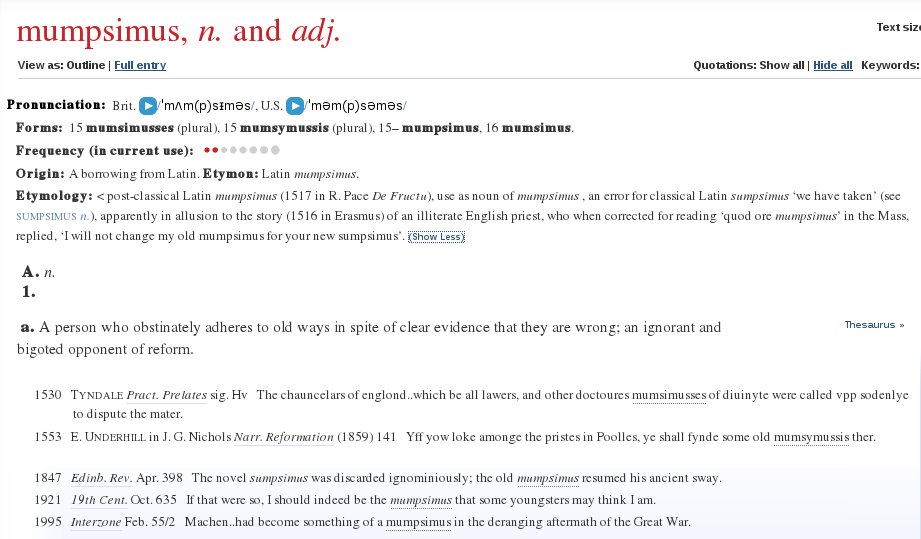
That brings me to one of my favourite words – yet another that I found out while doing a crossword – mumpsimus. Here is (part of) the OED entry:
Wikipedia gives “traditional custom obstinately adhered to however unreasonable it may be”, which is in the OED further down the page.
It seems to me that belief in idea that one’s children should not be protected against mumps is a mumpsimus, and people who cling to that belief are mumpsimusses.
Yesterday there came to my attention to a tweet from an organization called `Turning Point’. Disappointingly this is not as its name suggests, something to do with differential calculus, but a far-right propaganda organization which, among other things, is bemoaning the `socialist dominance in academia’.
Left-wing infiltration of university education would be a very serious matter if it existed, so to allay the fears of my readership that this is not really a problem, in the following I am going to list a few physics topics I will be teaching this week to make it clear that they can not possibly be accused of being influenced by political bias.
Mathematical Physics. I will be explaining how Laplace Transformations can be used to solve ordinary differential equations by seizing the means of production.
Quantum Mechanics. I will be demonstrating how the path integral formalism allows the result of a quantum mechanical calculation to be obtained by considering the sum over all historical class struggles.
Electrostatics. I will be discussing why some substances are insulators rather than conductors using the theory of dielectrical materialism.
Optics. The topic here is Snell’s Law, which relates the Engels of incidence and refraction for light of a given colour and for given pair of media.
It goes without saying that students will not pass the examination on these topics unless they get enough Marx.
I had to come into the office today to do a few things ahead of what will be another busy week, but when I stepped out I found the weather to be much more pleasant than it has been of late, so went for a short stroll around the town of Maynooth. I’m also house-hunting, so I took the opportunity to have a look at the locations of a few properties I’d seen on the market before deciding whether to check them out in more detail.
Anyway, at the opposite end of the Main Street from the Maynooth University campus, I found the above monument, the Tree of Liberty Stone, which commemorates the (failed) Irish Rebellion of 1798 which had sought to emulate the French Revolution (which began in 1789) in overthrowing British rule in Ireland. This rebellion was launched by the Society of United Irishmen.
Incidentally, one of the founders and leading lights of the Society of United Irishmen was a character from Belfast by the name of Henry Joy McCracken. That name will be familiar to many astronomers, and especially to people involved in the European Space Agency’s Euclid mission, as there is an astronomer with exactly the same name who did his PhD in Durham and who now works in Paris. Whether the present Henry Joy McCracken is directly related I don’t know.
The historical Henry Joy McCracken was executed by public hanging on 17th July 1798 after the failure of the 1798 rebellion. He was just 30 years old. Another thing worth mentioning is that he was a Protestant republican. There were more of those than people tend to think.
I was quite excited the other day when I got an email notifying me that Science Foundation Ireland (SFI) has announced a new funding programme called Frontiers for the Future. What particularly caught my attention are the so-called Frontiers for the Future Projects, which..
will provide funding for high-risk, high-reward research that facilitates highly innovative and novel approaches to research.
The wording here contrasts with the Frontiers for the Future Awards, which…
will provide larger scale funding for innovative, collaborative and excellent research programmes that have the potential to deliver economic and societal impact.
The Projects can fund up to €480K over 4 years (compared to the Awards, which are up to €1M over 5 years). This second category seems to follow the policy of the past decade of SFI which is only to fund research which is able more-or-less immediately to generate a financial return. I’ve argued previously that I think this is a short-sighted policy, but I won’t repeat that argument here. It is a fact however that SFI’s policy has made it very difficult in Ireland for researchers who want to do basic `blue skies’ research, including us astronomers and astrophysicists.
The new `Projects’ however may just be a step away from this damaging shor-termism.
Further down the page SFI states (my emphasis):
To be eligible for funding through the SFI Frontiers for the Future Programme, all proposals must be aligned to one of the 14 Refreshed Priority Areas for 2018-2023, or to any other research area within SFI’s legal remit (i.e. oriented basic or applied research) where there is convincing evidence that there will be significant potential for economic and/or societal impact in Ireland.
Astronomers in the UK have succeeded in arguing that their big science projects have all kinds of societal impact (in inspiring more students into STEM disciplines, as well as wider public engagement) as well as direct economic impact in terms of developing research methods, and building up a talent pool, especially in areas like data science. Whether SFI will accept such arguments in Ireland, I just don’t know.
If you’re wondering what `oriented basic or applied research’ means, SFI defines it as follows:
Oriented basic research is research that is carried out with the expectation that it will produce a broad base of knowledge that is likely to form the background to the solution of recognised, or expected, current or future problems or possibilities.
To me that means virtually any science!
Anyway, I’ll probably throw the dice to see if I can get some SFI support for my research in cosmology. It might turn out to be a waste of effort, but if you don’t buy a ticket you don’t win the lottery…
It’s been a very busy week so I’m about to go home and dive into a glass or two of wine, but before doing that I thought I’d leave a little something for the weekend.
Among the other things I have to do next week is make a short trip to Copenhagen to examine a PhD candidate. This track was recorded live at Copenhagen on September 8 1961 and it features Eric Dolphy (alto sax), Bent Axen (piano), Erik Moseholm (bass) and Jørn Elniff (drums). The tune The Way You Look Tonight is an old standard, written in 1936 by Dorothy Fields and Jerome Kern, but what a version this is! Dolphy tears through the changes on this performance, reinventing the piece in a way that turns what might be a routine tune into something absolutely new and refreshing. The combination of virtuosity and exuberance of the saxophone playing in this phenomenal performance is absolutely exhilarating. Enjoy!
The views presented here are personal and not necessarily those of my employer (or anyone else for that matter).
Feel free to comment on any of the posts on this blog but comments may be moderated; anonymous comments and any considered by me to be vexatious and/or abusive and/or defamatory will not be accepted. I do not necessarily endorse, support, sanction, encourage, verify or agree with the opinions or statements of any information or other content in the comments on this site and do not in any way guarantee their accuracy or reliability.







 In the Dark