The future of journal publishing here today – Guest Post by Syksy Räsänen

Posted in Open Access with tags , , , , on February 8, 2019 by telescoper

You may recall that the Open Journal of Astrophysics recently published a paper by Syksy Räsänen of the University of Helsinki. I invited Syksy to write a blog post on the Open Journal for Astrophysics about why he chose to publish with us, and I’m delighted to say that his post is now available there and, with the author’s permission, I am reproducing it below on this blog. It’s also available at Syksy’s own blog . It’s quite a long post, but there is some very interesting information in it, which will probably surprise you!

—0—

The bad news:: the scientific community can no longer afford commercial science journals.

The good news: the scientific community no longer needs commercial science journals.

The bottom line: open internet archives and overlay journals are the solution.

Scientific journal publishing is in crisis. Already 25 years ago librarians referred to the rising costs of journals as a “doomsday machine”. In 2012, Harvard University Library announced that it can no longer afford scientific journals, warning that publishers had created a “fiscally unsustainable” situation. The library took the unprecedented step of asking faculty to resign from publications that keep articles behind paywalls.

In its 2015 Open Access Policy White Paper, the Max Planck Digital Library assessed the annual revenue of scientific journal publishing as 7.6 billion euros. Divided by an estimated 1.5-2.0 million published articles, they arrived at a cost of €3800 to €5000 per article. The International Association of Scientific, Technical and Medical Publishers has estimated $10 billion in revenue and 2.5 million articles annually, which gives €3500 per article. According to them, 68-75% of the costs are borne by academic libraries.

These are enormous sums, funnelled from science to the pockets of large corporations. (Some journals are published by scientific societies, but this doesn’t change the overall picture.)

To put the numbers in perspective, the total construction cost of the Large Hadron Collider at CERN –the largest scientific experiment in the history of humanity–was around 5 billion euros, or 500 million euros per year. The cost of science publishing would cover the construction of 10 to 20 top-of-the-line successor experiments to the LHC. It is equivalent to the salaries and overheads of 150,000 to 200,000 postdoctoral researchers per year. This is likely more than the combined number of postdocs in the United States and the European Union.

Scientific publishing is a strange business. Scientists carry out research for free, write it up for free, give the article to the publisher for free, manage the peer review process as editors (some editors get paid), do peer-review for the publisher for free – and then the scientists’ institutions pay the publisher so that they can read the articles. In some cases scientists even pay the publisher to have their articles published. (Here “free” simply means the scientists are not paid by the publisher, but rather by their university or research institute – in the end, mostly by taxpayers.)

Is there any other industry where corporations pay nothing for the raw materials, have negligible processing costs and enjoy a captive market that automatically buys everything they produce? This setup leads to record profits. For example, the profit margin of Elsevier’s Scientific, Technical & Medical publishing division in the years 1991-2013 was consistently over 30%, and in 2013 it was 39%. For comparison, in the same year Apple, Google and Microsoft had profit margins of 22%, 20% and 28%, respectively. No wonder Robert Maxwell, a pioneer of scientific journal publishing, described the business as a “perpetual financing machine”.

In the past, publishers at least had the expenses of printing and shipping journals. With the internet, this cost has disappeared for many journals. However, prices have not come down – quite the opposite. Thankfully, the same technological advances that have made commercial journals so profitable have also rendered them unnecessary.

Journals used to be needed for registering and communicating research, for archiving it (via paper journals in libraries), and for performing quality control via peer review. In cosmology and particle physics, the first three services have been provided by the internet archive arXiv since 1991. Depositing articles to arXiv is free, and they can be read for free in perpetuity. In 2018, 140,616 articles appeared on arXiv, and its estimated total expenditures were $1,915,997, or 12€ per article. Other disciplines, such as economics and biology, have followed suit, either starting new categories on arXiv or setting up their own archives such as bioRxiv. There is no reason why this model cannot be extended to all fields of science.

A lot of discussion around the cost of journals centred on open access, so it is important to emphasise one thing: the issue is not open access. That problem has been solved by arXiv 27 years ago. The question is how to organise peer review in a cost-effective manner. This is where overlay journals come in.

The idea of overlay journals is simple: they are journals that concentrate on the only thing journals are needed for anymore, namely peer review. As articles appear on arXiv (or other online archives) anyway, there is no need to duplicate their work. An overlay journal has a website where papers (typically already available on arXiv) can be submitted. Peer review is conducted as usual, and in case of acceptance, the final version of the paper is updated on arXiv, with a journal reference and DOI link to the journal website.

Custom toolkits for overlay journals have been designed for more than 10 years, for example in the astrophysics RIOJA project. These days the necessary software is also available off the shelf from Scholastica. The service costs $99 per month plus $10 per submitted article, and getting a DOI from Crossref costs $1 per published article. As in the case of arXiv, the costs scale well with the number of papers. If a journal publishes 100 articles annually and has a 2/3 rejection rate, the cost works out to €38 per article – about 100 times less than the sum currently paid for article publishing.

Given that open archives and overlay journals could save 7 to 9 billion euros every year, why haven’t they already replaced commercial journals?

Unfortunately, the existence of a more optimal configuration does not automatically lead the community to shift there. Instead, people respond to individual incentives, and scientists are no exception. The publishing peer Robert Maxwell noted that “scientists are not as price-conscious as other professionals, mainly because they are not spending their own money”. As journal fees are paid centrally, there is little motivation for an individual researcher to change their publication pattern. Established journals are seen to provide a quality stamp that is necessary in the competition over positions and grants. Also, founding an overlay journal requires an investment of time that does not necessarily yieldproportionate professional rewards.

So researchers as individuals have rational reasons for not changing the system. What about libraries and scientific consortia that are struggling to bring the costs down? Unfortunately, institutional efforts have often concentrated on the narrow problem of getting journals to accept payment from the author rather than the reader (i.e. open access). However, the main issue is not whether the money is paid by the author or the reader (or rather their institutions), but what they are paying for.

Thus, for example, the SCOAP3 consortium has become part of the problem by providing life support to commercial journals. It has arranged to pay publishers vast amounts of money, entirely incommensurate with the actual costs, to make articles open access, guaranteeing them a steady stream of revenue.

The open access initiative Plan S launched last September is more ambitious. Particularly noteworthy is the commitment to provide incentives to establish new open access journals and platforms. However, open archives are only “acknowledged because of their long-term archiving function and their potential for editorial innovation”, not as publishing channels of their own right when paired with overlay journals. A lot depends on how the initiative will be implemented, but for now the scheme seems to focus on the old-fashioned aim of getting commercial publishers to convert journals to open access.

According to the Max Planck Digital Library White Paper, switching all commercial journals to an open access model would drop the cost of publication to between €1,100 and €2,000 per article. This would cut expenditures by a factor of 2 to 5, saving billions of euros every year – and continuing to waste billions of euros every year.

It is striking that the principles of Plan S contain no commitment to maximising the returns on public money and optimising financial sustainability, even though this is the heart of the matter. Instead, it supports the continuation of the commercial publishing model in co-operation with corporations, whose interests are at odds with those of the scientific community. We do not need to reform the business model of scientific journal publishing, we have to abandon it.

Open access consortia should start supporting a publishing model that begins from the needs of the scientific community and aims to fulfil them in an economical manner, while helping to make the transition as smooth as possible. This involves communicating with scientists about the costs of corporate publishing, following and expanding on Harvard’s example of calling on scientists to use the power of their labour (often given to the publishers for free) to change the situation, and providing incentives and support to establish and publish in overlay journals. Scientists, in turn, need to re-evaluate their brand loyalty to established journals, and give appropriate career merits for time spent on changing the publishing system.

Open archives and overlay journals are not a utopian solution for the future. Discrete Analysis, Open Journal of Astrophysics and others are publishing already. They are a proven model for open access publishing and quality peer review in a modern, cost-effective manner tailored to the needs of the scientific community. The sooner they become the new standard, the more money we will save for science.

The Future Circular Collider: what’s the MacGuffin?

Posted in Science Politics, The Universe and Stuff with tags , , , , , , , on February 7, 2019 by telescoper

I’ve been reading a few items here and there about proposals for a Future Circular Collider, even larger than the Large Hadron Collider (and consequently even more expensive). No doubt particle physicists interested in accelerator experiments will be convinced this is the right move, but of course there are other projects competing for funds and it’s by no means certain that the FCC will actually happen.

One of the important things about `Big Science’ when it gets this big is that it has to capture the imagination of people with political influence if it is to be granted funding. Based on past experience that means that there has to be a Big Discovery to be made or a Big Idea to be tested. This Big Thing has to be simple enough for politicians to understand and exciting enough to capture their imagination (and that of the public). In the case of the Large Hadron Collider (LHC), for example, this was the Higgs Boson. In the case of the Euclid space mission, the motivation is Dark Energy.

The Big Thing that sells a project to politicians is not necessarily the thing that most scientists are interested in. The LHC has done a lot of things other than discover the Higgs, and Euclid will do many things other than probe Dark Energy, but there has to be one thing to set it all in motion. It seems to me that the Big Question about the FCC is whether there is something specific that can motivate this project in the way the Higgs did for the LHC? If so, what is it?

Answers on a postcard or, better, through the comments box below.


Humphrey Bogart with the eponymous Maltese Falcon

Anyway, these thoughts reminded me of the concept of a  MacGuffin. Unpick the plot of any thriller or suspense movie and the chances are that somewhere within it you will find lurking at least one MacGuffin. This might be a tangible thing, such the eponymous sculpture of a Falcon in the archetypal noir classic The Maltese Falcon or it may be rather nebulous, like the “top secret plans” in Hitchcock’s The Thirty Nine Steps. Its true character may be never fully revealed, such as in the case of the glowing contents of the briefcase in Pulp Fiction , which is a classic example of the “undisclosed object” type of MacGuffin, or it may be scarily obvious, like a doomsday machine or some other “Big Dumb Object” you might find in a science fiction thriller.

Or the MacGuffin may not be a real thing at all. It could be an event or an idea or even something that doesn’t actually exist in any sense, such the fictitious decoy character George Kaplan in North by Northwest. In fact North by North West is an example of a movie with more than one MacGuffin. Its convoluted plot involves espionage and the smuggling of what is only cursorily described as “government secrets”. These are the main MacGuffin; George Kaplan is a sort of sub-MacGuffin. But although this is behind the whole story, it is the emerging romance, accidental betrayal and frantic rescue involving the lead characters played by Cary Grant and Eve Marie Saint that really engages the characters and the audience as the film gathers pace. The MacGuffin is a trigger, but it soon fades into the background as other factors take over.

Whatever it is or is not, the MacGuffin is responsible for kick-starting the plot. It makes the characters embark upon the course of action they take as the tale begins to unfold. This plot device was particularly beloved by Alfred Hitchcock (who was responsible for introducing the word to the film industry). Hitchcock was however always at pains to ensure that the MacGuffin never played as an important a role in the mind of the audience as it did for the protagonists. As the plot twists and turns – as it usually does in such films – and its own momentum carries the story forward, the importance of the MacGuffin tends to fade, and by the end we have usually often forgotten all about it. Hitchcock’s movies rarely bother to explain their MacGuffin(s) in much detail and they often confuse the issue even further by mixing genuine MacGuffins with mere red herrings.

Here is the man himself explaining the concept at the beginning of this clip. (The rest of the interview is also enjoyable, convering such diverse topics as laxatives, ravens and nudity..)

There’s nothing particular new about the idea of a MacGuffin. I suppose the ultimate example is the Holy Grail in the tales of King Arthur and the Knights of the Round Table in which the Grail itself is basically a peg on which to hang a series of otherwise disconnected stories. It is barely mentioned once each individual story has started and, of course, is never found. That’s often how it goes with MacGuffins -even the Maltese Falcon turned out in the end to be a fake – they’re only really needed to start things off.

So let me rephrase the question I posed earlier on. In the case of the Future Circular Collider, what’s the MacGuffin?

Banging the drum for ESO

Posted in Maynooth, The Universe and Stuff with tags , , , on February 6, 2019 by telescoper

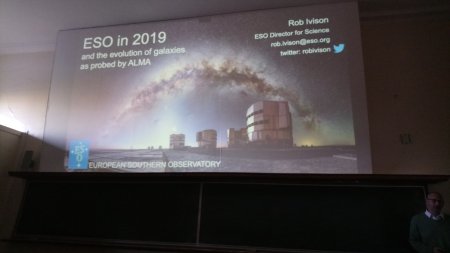
It was a pleasure to welcome Rob Ivison, Director of Science at the European Southern Observatory (ESO) , to Maynooth this afternoon for a colloquium.

I was on my best behaviour introducing his talk and even refrained from pointing out that his native Lancashire is actually in the Midlands.

Ireland became a full member of ESO earlier this year and Rob has been touring Ireland giving talks to encourage Irish astronomers to make the most of the many opportunities membership presents. Having already visited Cork and Galway he passed through Maynooth today before ending up in Dublin tomorrow.

It was an enjoyable and impressive talk and very nice to chat with Rob afterwards over dinner.

Bon voyage to Rob and thanks for the visit!

Hyperbolic sine, shine or sinsh (or sinch)?

Posted in Education, mathematics with tags , , , on February 6, 2019 by telescoper

An important coffee-time discussion just revealed a significant cultural difference between members of staff here in the Department of Theoretical Physics at Maynooth University, which I wish to explore further via a completely scientific poll.

The hyperbolic sine, usually written sinh, is well known to be defined in thuswise fashion:

But the question is how do you pronounce it? Since my schooldays I have always pronounced it like `shine’ whereas I’m told others have pronounced it more like `sinch’. Yet others simply call it hyperbolic sine. What is your pronunciation?

This also gives me the excuse to tell a little story of when I was at school. One morning, which happened to be April 1st, our maths teacher started on the subject of hyperbolic functions, talking about `shine’ and `cosh’ and `tanch’. We all assumed it was an April Fool’s joke and although it was very clever it wasn’t all that funny, particularly as it went on for the whole class. We only realised it wasn’t a joke when he carried on in the same vein the following day…

And another thing, for bonus marks. In all European languages with which I am familiar (which is by no means all), the trigonometric function sin is pronounced `sinus’ not `sine’. Is English the only language to depart from sinus?

Answers through the comments box!

John & Pat Hume Doctoral Scholarships

Posted in Maynooth, The Universe and Stuff with tags , , , , on February 5, 2019 by telescoper

You may or may not know that former Northern Irish politician John Hume, is an alumnus of St Patrick’s College Maynooth and thus has close connections with Maynooth University. There’s a building named after him, for one thing.

In the words of the Maynooth University website,

Born in Derry/Londonderry, John Hume was the second leader of the Social Democratic and Labour Party (SDLP) from 1979 to 2001. He has served as a member of the European Parliament and a member of the UK parliament, as well as a member of the Northern Ireland Assembly.

He is regarded as one of the most important figures in the recent political history of Ireland and one of the architects of the Northern Ireland peace process. The co-recipient of the Nobel Peace Prize with David Trimble in 1998, Hume was also recognised with the Gandhi Peace Prize and the Martin Luther King Award – he is the only recipient of all three major peace awards.

In 2010, he was named ‘Ireland’s Greatest’ in a public poll by RTÉ. It is fitting that Maynooth University recognises the contribution of John and Pat Hume to peace on the island of Ireland.

One of the most important manifestations of the connection between John Hume, his wife Pat Hume, and Maynooth University is a programme of Doctoral Scholarships, which are now being advertised for entry in September 2019.

These are available to fund a PhD in any academic discipline so I encourage anyone interested in doing graduate research to have a look at the details which can be found here. Maynooth University is particularly keen to encourage more women to pursue careers in STEM disciplines, so we particularly encourage female applicants.

If there’s anyone out there who might be interested in doing a PhD in Theoretical Physics or Astrophysics please feel free to contact me directly! And I’d be very grateful if others who see this could draw it to the attention of potential candidates.

Plan S – Get your feedback in!

Posted in Open Access with tags , , on February 4, 2019 by telescoper

It’s been a rather busy first day back at teaching, and I’m a bit tired after my first Engineering Mathematics lecture, so I’ll just post a couple of quick items on the topic of Open Access Publishing.

The most important thing is a reminder that the deadline for submission of feedback on the Plan S proposals is February 8th 2019, which is this Friday so please get your finger out and submit feedback.

I haven’t written my feedback yet, but when I do I will post it here.

The nice people at the arXiv have already sent in their feedback, and have released it publicly here. There’s a lot of good sense in their comments, which I encourage you to read.

In particular I agree with their comment that the reference XML should be removed. I agree very much with the principle underlying the decision by CoalitionS to include this, I don’t think mandating XML is a sensible way forward. For one thing, it is not a useful format when a paper contains lots of figures and mathematical equations. It’s not that it is particularly difficult to do, just that it’s a waste of time for mathematical disciplines. We could implement a fix to make XML versions of papers available on the Open Journal of Astrophysics, but I’m not going to do it unless and until it’s made obligatory (which I hope it isn’t).

Finally, let me just point out that Scholastica have chosen the latest publication in the Open Journal of Astrophysics as an article highlight!

Ahead of Teaching

Posted in Biographical, Education, mathematics, Maynooth, Music with tags , , , , on February 3, 2019 by telescoper

It’s 3rd February 2019, which means that today is two days after Imbolc, a Gaelic festival marking the point halfway between the winter solstice and vernal equinox. This either happens 1st or 2nd February, and this year it was former, i.e. last Friday In Ireland this day is sometimes regarded as the first day of spring, as it is roughly the time when the first spring lambs are born. It corresponds to the Welsh Gŵyl Fair y Canhwyllau and is also known as the `Cross Quarter Day’ or (my favourite) `The Quickening of the Year’.

I wrote a post about this time last year, on the day I gave my first ever lecture in Maynooth University, on Computational Physics, in a theatre called Physics Hall. That was on Thursday February 1st 2018. It’s hard to believe that was a full year ago. Time certainly has gone quickly this year.

Owing to the vagaries of the academic calendar we’re a week later getting back to teaching this year than last year so my first Computational Physics lecture won’t be until this Thursday (7th February) at 9am, but sadly it won’t be in Physics Hall, which I rather liked, but in Hall C – a much less atmospheric venue, but one rather closer to my office, which will be handy if I forget anything (which I am prone to do). There are about 25 students taking this module, a few down on last year, which means they should fit comfortably into our computer lab. I’m not surprised they moved the lecture, really. The capacity of Physics Hall is 90, and even last year I only had about 30 students. Still, it did have a piano (which Hall C does not):

Computational Physics doesn’t start until Thursday. Before that I have to start my other module: Engineering Mathematics II. This (what you would probably call a `service course’) covers a mixture of things, mainly Linear Algebra but with some other bits thrown in for fun, such as Laplace transforms. Interestingly I find the Mathematical Physics students do not encounter Laplace Transforms in the first year, but perhaps engineers use them more often than physicists do? I think I’ve written only one paper that made use of a Laplace transform. Anyway, I have to start with this topic as the students need some knowledge of it for some other module they’re taking this semester. I reckon six lectures will be enough to give them what they need. That’s two weeks of lectures, there being three lectures a week for this module.

By coincidence rather than good planning, the timetable for this module is quite nice. I have lectures on Monday, Tuesday and Wednesday and then the students have a choice of tutorial (on either Thursday or Friday). That means I can get through a decent amount of material each week before each tutorial. I don’t do the tutorials, by the way: that’s left to one of our PhD students, who gets paid for doing that and correcting the weekly coursework. There are about 50 students on this module, divided into two courses: Electronic Engineering and Robotics and Intelligent Devices. We don’t have Civil or Mechanical or Chemical Engineering, etc at Maynooth.

Campus has been very quiet for the last week or so. The exam period finished in late January but lectures don’t start until tomorrow morning (Monday 4th February) so there have been few students around. No doubt it will be a different story tomorrow. I’ve done my first week’s notes and compiled my first problem set so I’m more-or-less ready to go. First lecture at 2pm tomorrow in Hall H, which is one of the rooms I taught in last term so at least I know where it is!


Sosban Fach

Posted in Music, Rugby with tags , , , , on February 2, 2019 by telescoper

Well, this year’s Six Nations competition certainly got off to a great start for Wales last night with a memorable victory against France in Paris. That reminded me to post this, a song often heard at rugby matches in Wales. It’s particularly associated with Llanelli RFC and, more recently, the  Scarlets regional side.

The title Sosban Fach means (`Little Saucepan’) and I decided to post this version by Cerys Matthews in particular because of the beautiful clarity of her Welsh diction that makes it very easy to follow the lyrics (even for a foreigner like me).

Here are the words in Welsh:

Mae bys Meri-Ann wedi brifo,
A Dafydd y gwas ddim yn iach.
Mae’r baban yn y crud yn crio,
A’r gath wedi sgramo Joni bach.

Sosban fach yn berwi ar y tân
Sosban fawr yn berwi ar y llawr,
A’r gath wedi sgramo Joni bach.

Dai bach y sowldiwr,
A chwt ei grys e mas.

Mae bys Meri-Ann wedi gwella,
A Dafydd y gwas yn ei fedd;
Mae’r baban yn y crud wedi tyfu,
A’r gath wedi huno yn ei hedd.

Sosban fach yn berwi ar y tân
Sosban fawr yn berwi ar y llawr
A’r gath wedi sgramo Joni bach.

Shwd grys oedd ganddo?
Un wen â streipen las.

A’r gath wedi sgramo Joni bach.

O hwp e mewn, Dai,
O hwp e mewn, Dai,
O hwp e mewn, Dai,
Mae’n gas ei weld o mas.

Now feel free to sing along!


The Cost of the Open Journal of Astrophysics

Posted in Open Access with tags , , , on February 1, 2019 by telescoper

Our recent publication of a paper in the Open Journal of Astrophysics caused a flurry of interest in social media and a number of people have independently asked me for information about the cost of this kind of publication.

I see no reason not to be fully `open’ about the running costs of the Open Journal, but it’s not quite as simple as a cost per paper.

The Scholastica platform we use (which is very nice, simple and easy to use) costs $99 per month. That includes professional website hosting with a custom domain, a built-in website editor (so the site itself can be easily customized), integrated PDF viewer, indexing through e.g. Google scholar, fully searchable metadata, and readership analytics. That amounts to $1188 per annum, regardless of how many submissions we receive or how many articles get published.

On top of that we pay for the Peer Review service, which amounts to $10 for each submission (subject to an annual minimum of $250). We pay that whether or not a submission is published. So far we have rejected significantly more than we have accepted. This system provides automated emails, deadline reminders, an interface for searching sorting and assigning submissions to editors, file versioning & blindness control, a reviewer database, metrics to track performance, etc.

The final charge is only for papers that are accepted: we pay a fee to Crossref to register the Digital Object Identifier (DOI). That costs a princely $1.

There are no* other charges, as editors and referees give their services for free. Since all papers are typset by authors we do not use the Scholastica typesetting service (which is $5 per 500 words). If you’re thinking of setting up a non-overlay journal you might want to pay for that.

The actual cost per paper therefore depends on how many papers we publish. If we had 25 papers submitted in a year and published 10 the net cost per published paper would be ($250+$1188+$10)/10= $144.80, but that reduces as the number of published papers increases. For 50 submissions with 20 published it would be ($500+$1188+$20)/20=$85.40, and so on.

Some publishers argue that Open Access publication justifies an Article Processing Charge of several thousands of dollars. I think I’ve demonstrated that it doesn’t. Any charge over a hundred dollars or so is pure profiteering, bearing in mind the huge economies of scale inherent in large organizations.

In reality we have a combination of sources of funding that will be able to pay the annual fee for the foreseeable future. Ignoring this element, the marginal cost per published paper is just $11…

I hope this clarifies the situation.

*As has been pointed out in the comments, there is of course the cost of running the arXiv. The current funding model for that involves a membership program according to which institutes pay a fee depending on how heavily they use the arXiv. The top fee is $4400 per annum, for an entire institution. Some OA journals charge that much as an APC for a single paper!

25 Years of Python!

Posted in History with tags , , on February 1, 2019 by telescoper

Not a lot of people know* that it is 25 years to the day since Guido van Rossum announced the release of Python 1.0.0:

The latest version of Python is 3.7.2.

It’s not quite correct to say that Python is 25 years old today, though. There were versions available before the official Version 1. For a full history see here.

*H/T to Tom Crick, whose tweet alerted me to this.