We and They

Posted in Biographical, Literature, Politics with tags , , , , , , on November 25, 2018 by telescoper

All good people agree,
And all good people say,
All nice people, like Us, are We
And every one else is They.

(from `We and They‘, by Rudyard Kipling.)

A few days ago one of my colleagues here in Maynooth mentioned that he found it amusing that, although I’ve been living and working here in Ireland for less than a year, I have already taken to referring to the British as `They’ rather than `We’. He went on to point out that he noticed this transformation from First Person to Third Person some months ago.

I hadn’t realised that I was doing this, but I suppose it is a reflection of the fact that I have accepted that I will almost certainly be spending the rest of my working life in Ireland, and will probably end my days here too. It has taken relatively little time of observing Britain from the other side of the Irish Sea to recognize that it is changing into something grotesque and horrible. I want no part of what it is becoming, a squalid xenophobic rathole run by crooks, liars, and narrow-minded bigots. My new home is far from perfect, but it’s a damn sight better than Brexit Britain.

About a year ago I wrote (from Cardiff) about my reasons for moving to Maynooth. Here is a quote:

Because I’ve lived here all my life I thought I would find it difficult to leave Britain. I was quite traumatised by the Brexit referendum, as one would be by the death of a close relative, but it made me re-examine my life. There is a time when you have to move on, and that’s what I’m doing. I’m done here.

I haven’t changed my mind.

Not that I now consider myself fully Irish. Passport and citizenship notwithstanding, I still feel like a foreigner here and probably always will. I lived for over fifty years in Britain and do not have sufficient experience of Ireland to feel really part of it. Yet. That may come. But to appropriate the phrase Theresa May used in her Lancaster House speech last year I am proud to be for the time being, and perhaps forever, a `Citizen of Nowhere’. I don’t mind that, and a little bit of autobiography that might explain why I see things the way I do.

I was born in Wallsend (on Tyneside) in the North East of England. My parents were both born just before World War II started, also in the area where I was born. Of my four grandparents, one was born in England, one in Northern Ireland, one in Scotland, and one in Wales. I always smile when I had to put my nationality on a form, because I always put `United Kingdom’. Of course being born in England makes me English too, but I find that less defining than `UK’ or `British’ or even `Geordie’, and now of course there’s the Irish dimension. To be honest, my ancestry means that I generally find the whole concept of nationality fundamentally silly. I find nationalism silly too, except for those occasions – regrettably frequent nowadays – when nationalism takes on the guise of xenophobia. Then it is truly sinister. Nationalism is a tool by which unscrupulous individuals whip up hatred for political gain, regardless of the economic or social consequences. This is what lies behind Brexit.

Anyway, talking about Theresa May, it appears that the Prime Minister has written a letter to the British public asking for them to support her `deal’. I find it very curious that she has done this when, without another referendum or a General Election, the British public is denied any way of either expressing or withholding such support. Is this an admission that there will have to be another vote?

It appears from her letter that the PM is particularly happy about one aspect of the deal:

We will take back control of our borders, by putting an end to the free movement of people once and for all.

Apart from the fact that the UK always had control of its borders anyway, I find it absolutely astonishing that any politician could brag about removing from its own citizens the right to free movement across 27 countries. Freedom of movement was and is one of the great benefits of the European Union. Outside the EU, Theresa May’s `hostile environment’ in which all foreigners are viewed with suspicion and contempt will become even more hostile. It is just a matter of time before the unlawful deportations that the Home Office have inflicted on members of the Windrush generation will begin happening to Europeans currently living in the United Kingdom.

Towards the end of her awful letter, there is this:

We will then begin a new chapter in our national life. I want that to be a moment of renewal and reconciliation for our whole country. It must mark the point when we put aside the labels of ‘Leave’ and ‘Remain’ for good and we come together again as one people.

Excuse me, but the time for reconciliation was in the immediate aftermath of the 2016 Referendum result. Instead, Mrs May went out of her way to insult, denigrate and marginalize everyone who voted Remain; she never apologized for the `Citizens of Nowhere’ jibe and her pals in the right-wing added other pejoratives like ‘saboteur’ and ‘enemy of the people’. Like so many other things she says and does, Mrs May’s letter is so phony it is painful.

Worse, the Prime Minister has continued to insult European citizens working in the UK by accusing them of `jumping the queue’. It seems that the Prime Minister just can’t stop her deep-seated xenophobia showing itself from time to time. It’s her defining characteristic, and it is sure to be the defining characteristic of post-Brexit Britain.

On the Second (Open) Day..

Posted in Education, Maynooth with tags , on November 24, 2018 by telescoper

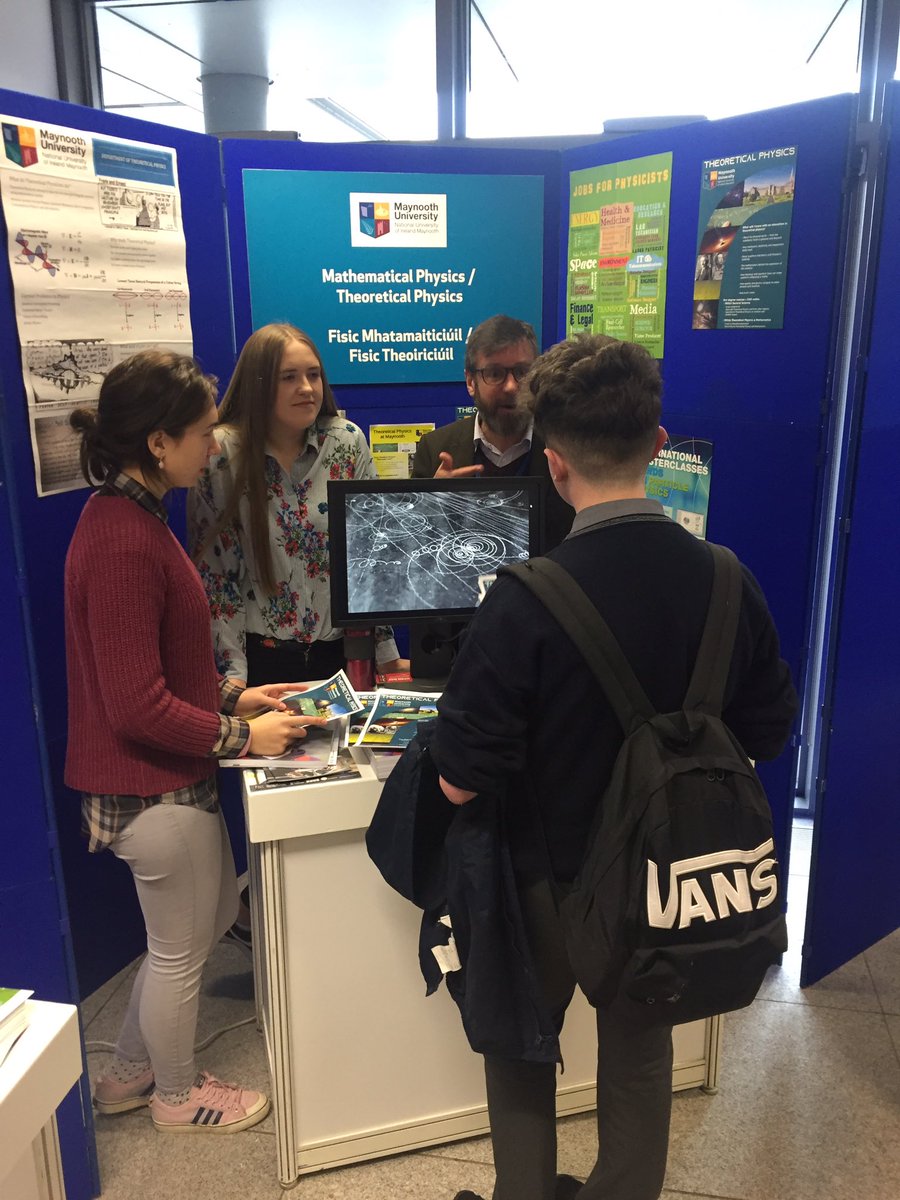
I’ve been back on campus all morning today (Saturday 24th November) at Maynooth University for the second Open Day. I’m just taking a short break to have a sandwich and a cup of tea before rejoining the fray and giving the Subject Talk at 2.10pm on behalf of the Department of Theoretical Physics.

Yesterday’s Open Day was a very busy day. I’m given to understand that there was a record crowd  of over 3000 visitors. We were certainly not short of people to talk to at our stand in Iontas.

I think being a number of school trips contributed to the high attendance. Today has been more individual prospective students and parents. Also it’s been a bit rainy this morning so numbers might be down a bit compared to yesterday, but we’ve been busy again on the stall.

Anyway the main reason for writing this post is to thank all our student helpers including Rebekah, Eibhlin, Philip, Cai, Tigernach and Ryan for contributing over the two days and staff members Paul and Jiri for doing their stint. Their only material reward for helping has been a lunch voucher for one of the campus refectories.

UPDATE: The talk was very well attended and ended with lots and lots of questions, so I think I’ll call it a success. Now home to put my feet up and have a nice cup of tea!

Circular Polarization in the Cosmic Microwave Background?

Posted in The Universe and Stuff with tags , , , , on November 23, 2018 by telescoper

Some years ago I went to a seminar on the design of an experiment to measure the polarization of the cosmic microwave background. At the end of the talk I asked what seemed to me to be an innocent question. The point of my question was the speaker had focussed entirely on measuring the intensity of the radiation (I) and the two Stokes Parameters that measure linear polarization of the radiation (usually called Q and U). How difficult, I asked, would it be to measure the remaining Stokes parameter V (which quantifies circular polarization)?

There was a sharp intake of breath among the audience as if I had uttered an obscenity, and the speaker responded with a glare and a curt `the cosmic microwave background is not circularly polarized’. It is true that in the standard cosmological theory the microwave background is produced by Thomson scattering in the early Universe which produces partial linear polarization, so that Q and U are non-zero, but not circular polarization, so V=0. However, I had really asked my question because I had an idea that it might be worth measuring V (or at least putting an upper limit on it) in order to assess the level of instrumental systematics (which are a serious issue with polarization measurements).

I was reminded of this episode when I saw a paper on the arXiv by Keisuke Inomata and Marc Kamionkowski which points out that the CMB may well have some level of circular polarization. Here is the abstract of the paper:

(You can click on the image to make it more readable.) It’s an interesting calculation, but it’s hard to see how we will ever be able to measure a value of Stokes V as low as 10-14.

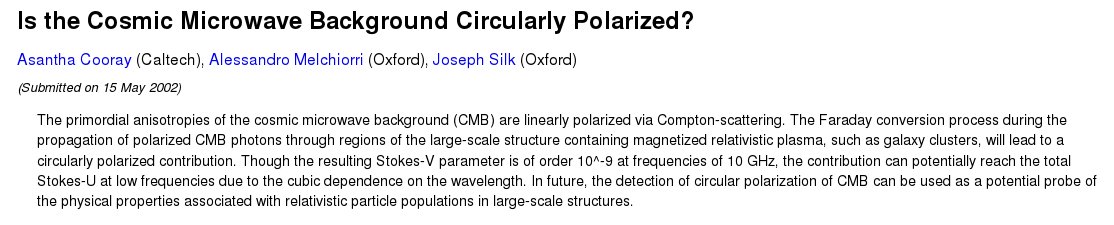
A few years ago there was a paper on the arXiv by Asantha Cooray, Alessandro Melchiorri and Joe Silk which pointed out that the CMB may well have some level of circular polarization. When light travels through a region containing plasma and a magnetic field, circular polarization can be generated from linear polarization via a process called Faraday conversion. For this to happen, the polarization vector of the incident radiation (defined by the direction of its E-field) must have non-zero component along the local magnetic field, i.e. the B-field. Charged particles are free to move only along B, so the component of E parallel to B is absorbed and re-emitted by these charges, thus leading to phase difference between it and the component of E orthogonal to B and hence to the circular polarization. This is related to the perhaps more familiar process of which causes the plane of linear polarization to rotate when polarized radiation travels through a region containing a magnetic field.

Here is the abstract of that paper:

(Also clickable.) This is a somewhat larger effect but differs from the first paper in that it is produced by foreground processes rather than primordial physics. In any case a Stokes V of 10-9 is also unlikely to be measurable at any time in the foreseeable future.

Theoretical Physics at Maynooth University Open Days!

Posted in Education, Maynooth with tags , on November 22, 2018 by telescoper

Well, tomorrow (Friday 23rd November) and Saturday 24th November are both open days at Maynooth University. If you want to find out more about them you can look here where you will find this video which has some nice views of the campus:

I used to give Open Day talks quite frequently in a previous existence as Head of School of Mathematical and Physical Sciences at the University of Sussex and now I’m at it again, giving talks on behalf of the Department of Theoretical Physics on each Open Day. If you come along, please say hello either at the lectures (1.10pm on Friday and 2.10 on Saturday)! We also have a stall in the Iontas Building from 9.30 each day where you can meet staff and students and talk to them about the course, or anything else vaguely related to Theoretical Physics. There are other stalls, of course, but the Theoretical Physics one is obviously em>way more interesting than the others!

Looking for fun pictures to put in my talk I stumbled across this:

I think that’s the only one I need, really!

Britten – Hymn to St Cecilia

Posted in Music with tags , , , on November 22, 2018 by telescoper

Apparently today is Thanksgiving (whatever that is) but, more importantly, it is also the Feast of Saint Cecilia. That reminded of this wonderful piece of music, which I thought I’d post to mark the occasion. It is the Hymn to St Cecilia, with words by W.H. Auden set to music by Benjamin Britten and performed on this recording by the Choir of King’s College, Cambridge conducted by Sir David Willcocks.

Incidentally, 22nd November is also Britten’s birthday; he would have been 105 today.

After I posted about Britten’s War Requiem a couple of weeks ago, some comments appeared at Another Place (i.e. Facebook) about Britten and whether he really was a great composer whose legacy would endure. My view, which I’ve stated on this blog a number of times, is that one should judge artists (and scientists, for that matter) by their best work rather than their worst. In my opinion, Mozart wrote a lot of music that wasn’t very good but if all he’d ever done in his life was write, e.g., Don Giovanni he’d still be regarded as a timeless genus.
Even if you don’t like all of Britten’s music, there are enough masterpieces among his output to guarantee a lasting reputation. I would put Peter Grimes and the Serenade for Tenor, Horn and Strings firmly in the category of masterpieces alongside the Hymn to St Cecilia.

Anyway, if you’d like to nominate any works by Britten as examples of his best or worst then please feel free to do so via the Comments Box below.

50 Years of the Cosmic Web

Posted in The Universe and Stuff with tags , , , , , , on November 21, 2018 by telescoper

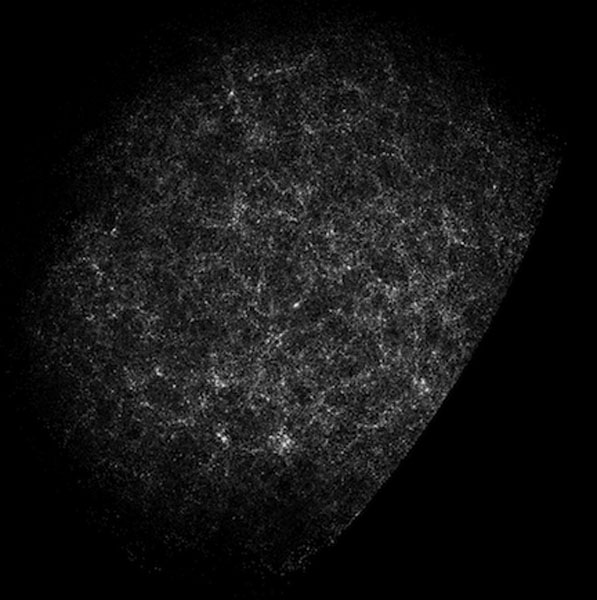
I’ve just given a lecture on cosmology during which I showed a version of this amazing image:

The picture was created in 1977 by Seldner et al. based on the galaxy counts prepared by Charles Donald Shane and Carl Alvar Wirtanen and published in 1967 (Publ. Lick. Observatory 22, Part 1). There are no stars in the picture: it shows the  distribution of galaxies in the Northern Galactic sky. The very dense knot of galaxies seen in the centre of the image is the Coma Cluster, which lies very close to the Galactic North pole.The overall impression  is of a frothy pattern, which we now know as the Cosmic Web. I don’t think it is an unreasonable claim that the Lick galaxy catalogue provided the first convincing evidence of the form of the morphology of the large-scale structure of the Universe.

The original Shane-Wirtanen Lick galaxy catalogue lists counts of galaxies in 1 by 1 deg of arc blocks, but the actual counts were made in 10 by 10 arcmin cells. The later visualization is based on a reduction of the raw counts to obtain a catalogue with the original 10 by 10 arcmin resolution. The map above based on the corrected counts  shows the angular distribution of over 800,000 galaxies brighter than a B magnitude of approximately 19.

The distribution of galaxies is shown only in projection on the sky, and we are now able to probe the distribution in the radial direction with large-scale galaxy redshift surveys in order to obtain three-dimensional maps, but counting so many galaxy images by eye on photographic plates was a Herculean task that took many years to complete. Without such heroic endeavours in the past, our field would not have progressed anything like as quickly as it has.

I’m sorry I missed the 50th anniversary of the publication of the Lick catalogue, and Messrs Shane and Wirtanen both passed away some years ago, but at last I can doff my cap in their direction and acknowledge their immense contribution to cosmological research!

UPDATE: In response to the comments below, I have updated this scan of the original rendition of the Lick counts:

534515-112918 (2)


Sonnet No. 87

Posted in Poetry with tags , on November 21, 2018 by telescoper

Farewell! thou art too dear for my possessing,
And like enough thou knowst thy estimate.
The Charter of thy worth gives thee releasing;
My bonds in thee are all determinate.
For how do I hold thee but by thy granting,
And for that riches where is my deserving?
The cause of this fair gift in me is wanting,
And so my patent back again is swerving.
Thy self thou gav’st, thy own worth then not knowing,
Or me, to whom thou gav’st it, else mistaking,
So thy great gift, upon misprision growing,
Comes home again, on better judgement making.
Thus have I had thee as a dream doth flatter:
In sleep a king, but waking no such matter.


Open Journal Promotion?

Posted in Maynooth, Open Access with tags , , on November 20, 2018 by telescoper

Back in Maynooth after my weekend in Cardiff, I was up early this morning to prepare today’s teaching and related matters and I’m now pretty exhausted so I thought I’d just do a quick update about my pet project The Open Journal of Astrophysics.

I’ve been regularly boring all my readers with a stream of stuff about the Open Journal of Astrophysics, but if it’s all new to you, try reading the short post about the background to the Open Journal project that you can find here.

Since the re-launch of the journal last month we’ve had a reasonable number of papers submitted. I’m glad there wasn’t a huge influx, actually, because the Editorial Board is as yet unfamiliar with the system and require a manageable training set. The papers we have received are working their way through the peer-review system and we’ll see what transpires.

Obviously we’re hoping to increase the number of submissions with time (in a manageable way). As it happens, I have some (modest) funds available to promote the OJA as I think quite a large number of members of the astrophysics community haven’t heard of it. This also makes it a little difficult to enlist referees.

So here I have a small request. Do any of you have any ideas for promoting The Open Journal of Astrophysics? We could advertise directly in journals of course, but I’m wondering if anyone out there in the interwebs has any more imaginative ideas? If you do please let me know through the comments box below..

Autumn Nights

Posted in Art with tags on November 19, 2018 by telescoper

I stumbled across this abstract painting (acrylic on canvas) by the artist Victoria Kloch and thought I’d share it this autumn night. Do check out her website. There’s lots more interesting stuff on it!

Hip Replacement

Posted in Uncategorized on November 19, 2018 by telescoper

From this month’s Oldie..