As I’m working on the Open Journal of Astrophysics project quite a lot these days I’m probably going to be boring a lot of people with updates, but there you go.
First astro.theog.org is now transferred to the new platform here. It doesn’t look like much now but there is a lot sitting behind the front page and we will get the new site up and running when we’ve got various administrative things approved.
Another thing I forgot to mention in yesterday’s post concerns the SAO/NASA Astrophysics Data System which (for the uninitiated) is a Digital Library portal for researchers in astronomy and physics, operated by the Smithsonian Astrophysical Observatory (SAO) under a NASA grant. The ADS maintains three bibliographic databases containing more than 14.0 million records covering publications in Astronomy and Astrophysics, Physics, and (of course) the arXiv e-prints. In addition to maintaining its bibliographic corpus, the ADS tracks citations and other information, which means that it is an important tool for evaluating publication impact.
One of the issues that we’ve had with the handful of papers published so far by the Open Journal of Astrophysics is that, because it is an overlay journal, the primary location of the papers published is on the arXiv, alongside other content that has not been refereed. Up until recently searching ADS for `All bibliographic sources’ would return OJA papers, but `All refereed articles’ would not. I’m glad to say that with the help of the ADS team, this issue has now been resolved and OJA papers now show up as refereed articles, as demonstrated by this example:
I know that this was a particular worry for early career researchers who might have been deterred from submitting to the Open Journal of Astrophysics by the fear that their publications would not look like refereed publications. They need worry no longer!
Incidentally, that image also shows that citations are tracked through the CROSSREF system, in which OJA papers are registered when published and issued with a DOI. All this happens behind the scenes from the point of view of an author, but it involves a lot of interesting machinery! A discussion on facebook the other day led to an academic publisher stating that one of the greatest costs of running a journal was registering publications for citation tracking. In fact it costs a maximum of $1 per article (see here). The industry is relying on academics not understanding how cheap things actually are.
It’s nice to see that my recent post on the Open Journal of Astrophysics has been attracting some interest. The project is developing rather swiftly right now and it seems the main problems we have to deal with are administrative rather than technical. Fingers crossed anyway.
I thought I’d do a follow-up re-iterating a request in that recent post. As you will be aware, the Open Journal of Astrophysics is an arXiv overlay journal. We apply a simple criterion to decide whether a paper is on a suitable topic for publication, namely that if it it is suitable for the astro-ph section of the arXiv then it is suitable for the Open Journal of Astrophysics. This section of the arXiv, which is rather broad,is divided thuswise:
astro-ph.GA – Astrophysics of Galaxies.
Phenomena pertaining to galaxies or the Milky Way. Star clusters, HII regions and planetary nebulae, the interstellar medium, atomic and molecular clouds, dust. Stellar populations. Galactic structure, formation, dynamics. Galactic nuclei, bulges, disks, halo. Active Galactic Nuclei, supermassive black holes, quasars. Gravitational lens systems. The Milky Way and its contents
astro-ph.CO – Cosmology and Nongalactic Astrophysics.
Phenomenology of early universe, cosmic microwave background, cosmological parameters, primordial element abundances, extragalactic distance scale, large-scale structure of the universe. Groups, superclusters, voids, intergalactic medium. Particle astrophysics: dark energy, dark matter, baryogenesis, leptogenesis, inflationary models, reheating, monopoles, WIMPs, cosmic strings, primordial black holes, cosmological gravitational radiation
astro-ph.EP – Earth and Planetary Astrophysics.
Interplanetary medium, planetary physics, planetary astrobiology, extrasolar planets, comets, asteroids, meteorites. Structure and formation of the solar system
astro-ph.HE – High Energy Astrophysical Phenomena.
Cosmic ray production, acceleration, propagation, detection. Gamma ray astronomy and bursts, X-rays, charged particles, supernovae and other explosive phenomena, stellar remnants and accretion systems, jets, microquasars, neutron stars, pulsars, black holes
astro-ph.IM – Instrumentation and Methods for Astrophysics.
Detector and telescope design, experiment proposals. Laboratory Astrophysics. Methods for data analysis, statistical methods. Software, database design
astro-ph.SR – Solar and Stellar Astrophysics.
White dwarfs, brown dwarfs, cataclysmic variables. Star formation and protostellar systems, stellar astrobiology, binary and multiple systems of stars, stellar evolution and structure, coronas. Central stars of planetary nebulae. Helioseismology, solar neutrinos, production and detection of gravitational radiation from stellar systems.
The expertise of the current Editorial Board is concentrated in the area of (2), and a bit of (5), but we would really like to add some editors from different areas (i.e. 1, 3, 4 and 6). We would therefore really appreciate volunteers from other areas of astrophysics (especially stars/exoplanets, etc). If you’re interested please let me know. Please also circulate this call as widely as possible among your colleagues so we can recruit the necessary expertise. The journal is entirely free (both to publish in and to read) and we can’t afford to pay a fee, but there is of course the prestige of being in at the start of a publishing revolution of cosmic proportions!
If you join the Editorial Board we will invite you to an online training session to show you how the platform works.
Thank you in advance for your interest in this project, and I look forward to hearing from you.
When I logged onto WordPress yesterday I received a message that it was the 10th anniversary of my registration with them as a blogger, which is when I took my first step into the blogosphere; that was way back on 15th September 2008.
I actually wrote my first post on the day I registered but unfortunately I didn’t really know what I was doing on my first day at blogging – no change there, then – and I didn’t actually manage to figure out how to publish this earth-shattering piece. It was only after I’d written my second post that I realized that the first one wasn’t actually visible to the general public because I hadn’t pressed the right buttons, so the two appear in the wrong order in my archive. Anyway, that confusion is the reason why I usually take 16th September as this blog’s real anniversary.
I’d like to take this opportunity to send my best wishes, and to thank, everyone who reads this blog, however occasionally. According to the WordPress stats, I’ve got readers from all round the world, including the Vatican!
If you’re interested in statistics then, as of 14.00 Irish Summer Time Today today, I have published 4,225 blog posts, not counting about 20 that I wrote but have not yet published; I’ll probably save these for my memoirs.. These posts have received 3,688,023 hits altogether; I get an average of about 1200 per day. This varies in a very erratic fashion from day to day, but the annual average has been fairly constant over the last several years. The greatest number of hits I have received in a single day is 8,864 (at the peak of the BICEP2 controversy). Some of the most popular posts have not been about science at all, including my rant about Virgin Media and a post about the last episode of Inspector Morse.
There have been 30,372 comments published on here and 2,213,145 rejected by my filters. The vast majority of the rejected comments were from automated spam bots, but a small number have been removed for various violations, usually for abuse of some kind. And, yes, I do get to decide what is published. It is my blog!
While I am on the subject of comments, I’ll just repeat here the policy stated on the home page of this blog:
Feel free to comment on any of the posts on this blog but comments may be moderated; anonymous comments and any considered by me to be abusive will not be accepted. I do not necessarily endorse, support, sanction, encourage, verify or agree with the opinions or statements of any information or other content in the comments on this site and do not in any way guarantee their accuracy or reliability.
It does mean a lot to me to know that there are people who find my ramblings on this `shitty wordpress blog’ interesting enough to look at, or even read, and sometimes even to come back for more, so I’d like to take this opportunity to send my best wishes to all those who follow this blog and especially those who take the trouble to comment on it in such interesting and unpredictable ways!
The last decade has been eventful, to say the least, both personally and professionally. I started blogging not long after I’d moved into my house in Pontcanna, Cardiff. Since then I moved to Sussex, and then back to Cardiff, and now to Ireland. More importantly we’ve seen the discovery of the Higgs Boson and gravitational waves, both of which resulted in Nobel Prizes, as did the studies of high-redshift supernovae. The Planck mission mission was launched, did its stuff, and came to a conclusion in this decade too. Science has moved forward, even if there are many things in this world that seem to be going backwards.
I don’t know how long I’ll keep blogging – vitae summa brevis spem nos vetat incohare longam – but I’ve got no immediate plans to stop.
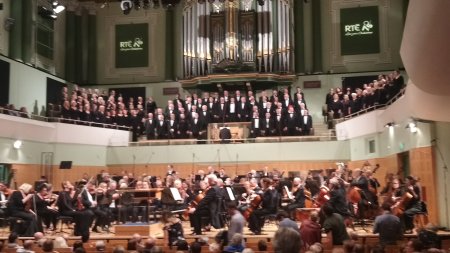
Last night I had the pleasure of attending the opening performance of the new season of the RTÉ National Symphony Orchestra at the National Concert Hall in Dublin. As well as being the first concert of the season, it was also my first ever visit to the National Concert Hall. To mark the occasion we were in the presence of the Uachtarán na hÉireann, Michael D Higgins, and his wife Sabena. By `occasion’ I of course mean the first concert of the season, rather than my first visit to the NCH. After the concert the audience were all treated to a glass of Prosecco on the house too!
I’ve done quite a few reviews from St David’s Hall in Cardiff over the years, so before writing about the music I thought I’d compare the venues a little. The National Concert Hall was built in 1865 and soon after its construction it was converted into the main building of University College Dublin. It was converted to a concert venue when UCD moved out of the city centre, and fully re-opened in 1981. It is a bit smaller than St David’s – capacity 1200, compared with 2000 – and does not have such a fine acoustic, but it is a very nice venue with a distinctive and decidedly more intimate vibe all of its own. I had a seat in the centre stalls, which cost me €40, which is about the same as one would expect to pay in Cardiff.
The NCH is situated close to St Stephen’s Green, which is a 15 minute walk from Pearse Station or a 30 minute walk from Connolly (both of which are served by trains from Maynooth). The weather was pleasant yesterday evening so I walked rather than taking the bus or Luas from Connolly. I passed a number of inviting hostelries on the way but resisted the temptation to stop for a pint in favour of a glass of wine in the NCH bar before the performance.
Anyway, last night’s curtain-raiser involved just one piece – but what a piece! – Symphony No.2 (“Resurrection”) by Gustav Mahler. This is a colossal work, in five movements, that lasts about 90 minutes. The performance involved not only a huge orchestra, numbering about a hundred musicians, but also two solo vocalists and a sizeable choir (although the choir does not make its entrance until the start of the long final movement, about an hour into the piece). The choir in this case was the RTÉ Philharmonic Choir. At various points trumpets and/or French horns moved offstage into the wings and, for the finale, into the gallery beside the choir.
About two years ago I blogged about the first performance I had ever heard of the same work. Hearing it again in a different environment in no way diminished its impact.
Stunning though the finale undoubtedly was, I was gripped all the way through, from the relatively sombre but subtly expressive opening movement, through the joyously dancing second that recalls happier times, the third which is based on a Jewish folk tune and which ends in a shattering climax Mahler described as “a shriek of despair”, and the fourth which is built around a setting of one of the songs from Des Knaben Wunderhorn, sung beautifully by Jennifer Johnson (standing in wonderfully for Patricia Bardon, who was unfortunately indisposed). Jennifer Johnson has a lovely velvety voice very well suited to this piece, which seems more like a contralto part than a mezzo. The changing moods of the work are underlined by a tonality that shifts from minor to major and back again. All that was very well performed, but as I suspect is always the case in performances of this work, it was the climactic final movement – which lasts almost half an hour and is based on setting of a poem mostly written by Mahler himself, sung by Orla Boylan – that packs the strongest emotional punch.
The massed ranks of the RTÉ Philharmonic Choir (all 160 of them) weren’t called upon until this final movement, but as soon as they started to sing they made an immediate impact. As the symphony moved inexorably towards its climax the hairs on the back of my neck stood up in anticipation of a thrilling sound to come. I wasn’t disappointed. The final stages of this piece are sublime, jubilant, shattering, transcendent but, above all, magnificently, exquisitely loud! The Choir, responding in appropriate fashion to Mahler’s instruction to sing mit höchster Kraft, combined with the full force of the Orchestra and the fine concert organ of the NCH to create an overwhelming wall of radiant sound.
Mahler himself wrote of the final movement:
The increasing tension, working up to the final climax, is so tremendous that I don’t know myself, now that it is over, how I ever came to write it.
Well, who knows where genius comes from, but Mahler was undoubtedly a genius. People often stay that his compositions are miserable, angst-ridden and depressing. I don’t find that at all. It’s true that this, as well as Mahler’s other great works, takes you on an emotional journey that is at times a difficult one. There are passages that are filled with apprehension or even dread. But without darkness there is no light. The ending of the Resurrection Symphony is all the more triumphant because of what has come before.
The end of the performance was greeted with rapturous applause (and a well-deserved standing ovation). Congratulations to conductor Robert Trevino, the soloists, choir and all the musicians for a memorable concert. On my way out after the Prosecco I picked up the brochure for the forthcoming season by the RTÉ National Symphony Orchestra, which runs until next May. I won’t be attend all the Friday-night concerts, but I will try to make as many as I can of the ones that don’t involve harpsichords.
Update: I hadn’t realised that the concert was actually broadcast on TV and then put on YouTube; here is a video of the whole thing:
The observant among you will have noticed that the website for the Open Journal of Astrophysics is currently offline. This emphatically does not mean that this project is dead so
In fact we’re in the process of moving the journal to a new platform (at the same web address) and the new site will be up and running as soon as we have completed the transfer, have tested the new configuration and done a few administrative things. All papers already published on the old site will be transferred to the new one and their DOI will remain unchanged. In fact the old site is still available, but at a secret location.
I’ll be blogging in a bit more detail about the new-look Open Journal of Astrophysics in due course, but in the mean time I’ll just make a few points.
First and foremost, if you don’t know what this project is about it is an idea I first floated over five years ago, shortly before I moved to Sussex. Although we got a website together and published a few papers, for one reason or another I didn’t have time to iron out some remaining bugs and the project stalled. However, after my move to Maynooth University I’ve been delighted to receive the support of the Maynooth University Library team and we’re now moving ahead. I know there have been a few false dawns on this project – for which I apologize – so I won’t announce the full re-opening until I’m absolutely sure everything works.
Second, and actually most importantly, the Editorial Board for the Open Journal of Astrophysics is looking for new members. We already have several distinguished editors, but the expertise we currently have is concentrated (not surprisingly) in cosmology, and we would really appreciate volunteers from other areas of astrophysics (especially stars/exoplanets, etc). If you’re interested please let me know.
Third, although the platform will look a little different (i.e. better) the overall philosophy of the Open Journal will remain as it always was, a fully `Green’ Open Access Journal, as defined by the following points:
There will be no charge for accessing or downloading OJA papers (i.e. no subscription fee).
There will be no charge for submitting, reviewing or publishing OJA papers (i.e. no `article processing charge’).
The OJA is a peer-reviewed journal; all papers accepted for publication will be assigned a DOI and registered with Crossref for citation tracking purposes.
The OJA is an arXiv overlay journal, so paper submitted to it must first be submitted to the arXiv.
Finally, I will mention that I was motivated to post this update by a piece by George Monbiot in todays’s Guardian. I don’t agree with everything Monbiot says, but he is dead right about this:
In the great majority of cases, the research reported has been funded by taxpayers. Most of the work involved in writing the papers, reviewing and editing them is carried out at public expense by people at universities. Yet this public asset has been captured, packaged and sold back to us for phenomenal fees. Those who pay most are publicly funded libraries. Taxpayers must shell out twice: first for the research, then to see the work they have sponsored. There might be legal justifications for this practice. There are no ethical justifications.
I’ve said as much myself on this blog. My point is that the academic publishing industry is not going to change of its own volition. If the Academic Journal Racket is to be rumbled, it is we (by which I mean academics and our institutions) who have to take control. Sitting on our hands while we get systematically fleeced is not an option. One way to do this is for institutions and organizations to themselves become Open Access publishers, which is precisely what my current institution is doing: Maynooth University will be the official publisher of the Open Journal of Astrophysics (and hopefully many more similar journals in the future).
There is an interesting, pithy and polemical paper on the arXiv by David Mermin, with the abstract:
We still lack any consensus about what one is actually talking about as one uses quantum mechanics. There is a gap between the abstract terms in which the theory is couched and the phenomena the theory enables each of us to account for so well. Because it has no practical consequences for how we each use quantum mechanics to deal with physical problems, this cognitive dissonance has managed to coexist with the quantum theory from the very beginning. The absence of conceptual clarity for almost a century suggests that the problem might lie in some implicit misconceptions about the nature of scientific explanation that are deeply held by virtually all physicists, but are rarely explicitly acknowledged. I describe here such unvoiced but widely shared assumptions. Rejecting them clarifies and unifies a range of obscure remarks about quantum mechanics made almost from the beginning by some of the giants of physics, many of whom are held to be in deep disagreement. This new view of physics requires physicists to think about science in an unfamiliar way. My primary purpose is to explain the new perspective and urge that it be taken seriously. My secondary aims are to explain why this perspective differs significantly from what Bohr, Heisenberg, and Pauli had been saying from the very beginning, and why it is not solipsism, as some have maintained. To emphasize that this is a general view of science, and not just of quantum mechanics, I apply it to a long-standing puzzle in classical physics: the apparent inability of physics to give any meaning to “Now” — the present moment.
I was very sad last night to hear news of the death, at the age of 90, of the sublime Fenella Fielding. There was much more to Fenella Fielding than the Carry On films – she only appeared in two, but everyone will remember her as Valeria in the hilarious spoof horror movie Carry on Screaming with the classic gag “Do you mind if I smoke?”
Well, with the Last Night of the Proms over and done with on Saturday, and the last day of the Fifth Test between England and India just finished at the Oval, that’s the end of the summer as far as I’m concerned.
I thought for a while earlier today that India might just pull off a remarkable victory. Needing 464 to win they were going well as Rahul and Pant put on a 200 partnership. I saw that BetFair were offering 16/1 on an India victory so put a tenner on. That had the desired effect and India were all out for 345. Good effort though by India. Especially well, played by Pant, on his maiden century!
Oh, and Jimmy Anderson took the last wicket, his 564th in Test cricket, and thereby beat Glenn McGrath’s record as leading pace bowling wicket-taker of all time in Test matches.
The 4-1 margin of victory in this series rather flatters England and is correspondingly harsh on India. The big worry for England is that with Cook now in retirement they now have to find two reliable opening batsmen when so far they’ve failed to find one.
Anyway, tomorrow morning I’m back to Maynooth. I have a paper and a book manuscript to submit before getting my lectures ready for the new term.
After receiving some very good news today, there is also a big event to prepare for on October 9th of which more anon..
Posted in Cricket on September 10, 2018 by telescoper
Back in Cardiff for a short visit, I thought I’d make the most of what remains of my season ticket to watch the morning’s play at Sophia Gardens between Glamorgan and Gloucestershire.
It being September, play commenced at 10.30 after an uncontested toss. Gloucestershire invited Glamorgan to bat first. In humid conditions, under overcast skies, and against a team lacking confidence, it was a predictable decision.
Connor Brown was the first Glamorgan batsman to go, lbw playing back to one that might have kept low. A few overs later Tom Cullen inexplicably shouldered arms to a straight delivery that hit the top of middle stump. Kieran Carlson went first ball to a very good delivery from Payne, and then Stephen Cook was caught behind down the leg side off one that bounced sharply and took the glove. That made it 17 for 4, which became 21 for 5 when David Lloyd was lbw to Payne.
To be fair to the batsmen the ball was darting around a bit, and batting didn’t look at all easy. All the same it looked like another sorry capitulation.
Wicketkeeper Chris Cooke had other ideas, however, and he and Graham Wagg out together a good counterattack. Cooke reached 50 having hit 11 fours, and their partnership was worth 83 valuable runs. Cooke was out before lunch for 60, caught behind off the bowling of Payne.
Glamorgan went into lunch at 109 for 6, having recovered somewhat from 21 for 5. I left at lunchtime to take care of some personal things. When I checked just now, Glamorgan were all out for 137, heading for their 9th consecutive defeat.
Meanwhile, at the Oval, Alastair Cook has scored a century in his final Test Match. Well played sir!
UPDATE: I went back to the ground after the tea interval, and saw Gloucestershire progress to 133 for 5. It never looked easy batting, and there were quite a few edges that fell safe and quite a lot of playing and missing, but no great collapse by the visitors. The weather forecast for tomorrow is a bit grim so that is probably the last cricket I’ll see at Sophia Gardens as a Glamorgan member. Best wishes to the players and all the staff at the ground.
The views presented here are personal and not necessarily those of my employer (or anyone else for that matter).
Feel free to comment on any of the posts on this blog but comments may be moderated; anonymous comments and any considered by me to be vexatious and/or abusive and/or defamatory will not be accepted. I do not necessarily endorse, support, sanction, encourage, verify or agree with the opinions or statements of any information or other content in the comments on this site and do not in any way guarantee their accuracy or reliability.






 In the Dark