EDGES and Foregrounds

Posted in Astrohype, The Universe and Stuff with tags , , , on September 3, 2018 by telescoper

Earlier this year I wrote a brief post about paper by Bowman et al. from the EDGES experiment that had just come out in Nature reportining the detection of a flattened absorption profile in the sky-averaged radio spectrum, centred at a frequency of 78 megahertz, largely consistent with expectations for the 21-centimetre signal induced by early stars. It caused a lot of excitement at the time; see, e.g., here.
The key plot from the paper is this:
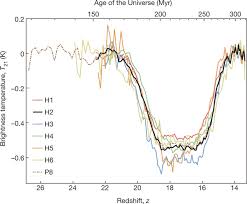
At the time I said that I wasn’t entirely convinced. Although the paper is very good at describing the EDGES experiment, it is far less convincing that all necessary foregrounds and systematics have been properly accounted for. There are many artefacts that could mimic the signal shown in the diagram.

I went on to say

If true, the signal is quite a lot larger than amplitude than standard models predict. That doesn’t mean that it must be wrong – I’ve never gone along with the saying `never trust an experimental result until it is confirmed by theory’ – but it’s way too early to claim that it proves that some new exotic physics is involved. The real explanation may be far more mundane.

There’s been a lot of media hype about this result – reminiscent of the BICEP bubble – and, while I agree that if it is true it is an extremely exciting result – I think it’s far too early to be certain of what it really represents. To my mind there’s a significant chance this could be a false cosmic dawn.

I gather the EDGES team is going to release its data publicly. That will be good, as independent checks of the data analysis would be very valuable.

Well, there’s a follow-up paper that I missed when it appeared on the arXiv in May the abstract of which reads:

We have re-analyzed the data in which Bowman et al. (2018) identified a feature that could be due to cosmological 21-cm line absorption in the intergalactic medium at redshift z~17. If we use exactly their procedures then we find almost identical results, but the fits imply either non-physical properties for the ionosphere or unexpected structure in the spectrum of foreground emission (or both). Furthermore we find that making reasonable changes to the analysis process, e.g., altering the description of the foregrounds or changing the range of frequencies included in the analysis, gives markedly different results for the properties of the absorption profile. We can in fact get what appears to be a satisfactory fit to the data without any absorption feature if there is a periodic feature with an amplitude of ~0.05 K present in the data. We believe that this calls into question the interpretation of these data as an unambiguous detection of the cosmological 21-cm absorption signature.

You can read the full paper here (PDF). I haven’t kept up with this particular story, so further comments/updates/references are welcome through the box below!

Sheila Tinney et al.

Posted in History, The Universe and Stuff with tags , on September 2, 2018 by telescoper

I came across the above picture via Twitter the other day. It was taken about 75 years ago, in 1943, the year that Erwin Schrödinger gave his famous lectures in Dublin on the topic What Is Life? Schrödinger is second from the right in the front row, next to Arthur Stanley Eddington (who is to his left as you look a the picture). Next but one to Eddington (to his left as you look at the picture)  is Éamon de Valera (who was Taioseach at the time; apparently he dragged all his cabinet along to Schrödinger’s lectures) and next to him (on the left as you look at the picture) is Paul Dirac. That’s quite a front row!

I’m afraid I don’t know the identity of most of the other people in the picture, apart from the lady on the far left who is Dr Sheila Tinney. She completed a PhD under the supervision of Max Born in just two years and was held in very high regard as a physicist, not least by Schrödinger himself. Sheila Tinney spent her academic career at University College Dublin and passed away in 2010 at the age of 92.

The gender balance in physics has improved a bit since 1943 but we still have a long way to go! Note also the numerous men in clerical garb.

There is a conference coming up in Dublin to mark the 75th anniversary of the What is Life lectures, and there has been quite a lot of interest in Schrödinger in the Irish media as a consequent, such as this piece in the Irish Times.

I guess most readers of this blog will know that Éamon de Valera set up the Dublin Institute for Advanced Studies (DIAS) in 1939 in order to create a position for Schrödinger, who was then basically a refugee from the Nazis. He had attempted to settle in Oxford but his unconventional domestic arrangements – he lived in the same house as his wife and his mistress – met with disapproval. Dublin was far more tolerant, and he took up the post of Director of Theoretical Physics at DIAS in 1940 and stayed in Ireland for 17 years.

If you ask me for a personal opinion about Schrödinger’s private life then I have to say two things. One is that all three members of his ménage à trois seemed quite happy with the arrangement as well as the affairs that Schrödinger had outside it. His wife also had numerous affairs, including one with physicist Hermann Weyl. Unconventional it may have been, but most conventions are pretty silly in my view.

On the other hand, there is a part of Schrödinger’s life that I do find entirely reprehensible, and that is the way he treated some of the women with whom he had affairs. As the Irish Times puts it

‘For Schrödinger, the mystical union of sexual love did not endure for long .. With Erwin it was never able to survive tidings of pregnancy.

The Schrödingers did (unofficially) adopt one of the children he fathered outside his marriage, but he strikes me as someone who wanted (or perhaps needed) the sexual and emotional fulfillment his lovers could give him, but wasn’t prepared to accept the responsibility that goes with human relationships. That strikes me as a very selfish attitude.

A Sign of Progress

Posted in Education, Maynooth on September 1, 2018 by telescoper

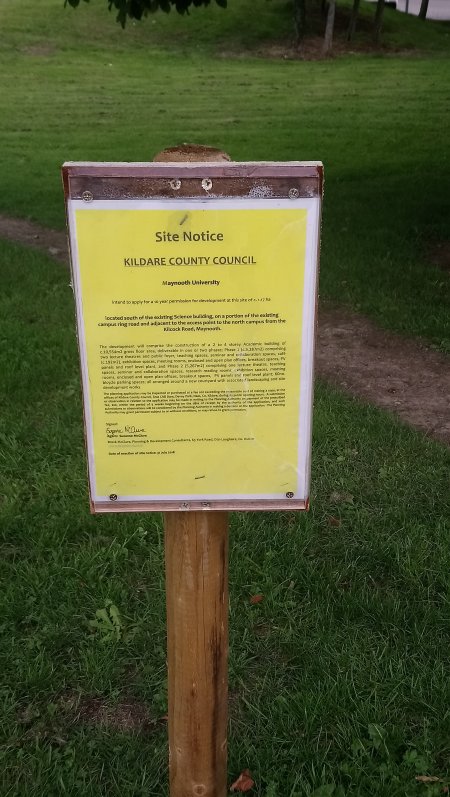
The other day I saw this sign on my way into work. It has been put up near the Science Building on Maynooth University campus, and is a planning notice that hopefully will start the process of constructing extra buildings for science in Maynooth. Among the facilities the new buildings will provide are new teaching laboratories.

Currently, most students doing Science subjects here enter on a four-year general science programme that involves doing four subjects in the first year, becoming increasingly specialised thereafter. That’s not unlike the Natural Sciences course I did at Cambridge, except that students can do both Theoretical Physics and Experimental Physics in the first year as separate choices.

I like this programme because it does not force the students to choose a specialism before they have had a taste of the subject, and that it is flexible enough to accommodate Joint Honours qualifications in, e.g., Theoretical Physics and Mathematics.

The problem we have in Maynooth is that this structure combines with the limited laboratory space in the existing Science Building to create a bottleneck in the first year. We can’t increase our intake without increasing capacity in the labs. This is especially true for Chemistry, which is taken alongside Physics by some students and Biology by others. Increasing laboratory space for chemistry will actually help other disciplines.

It will take several years to construct the new building, and there will probably be a great deal of disruption when the work starts, but in the long run I think it will be worth it.

Books Returned!

Posted in Uncategorized on August 31, 2018 by telescoper

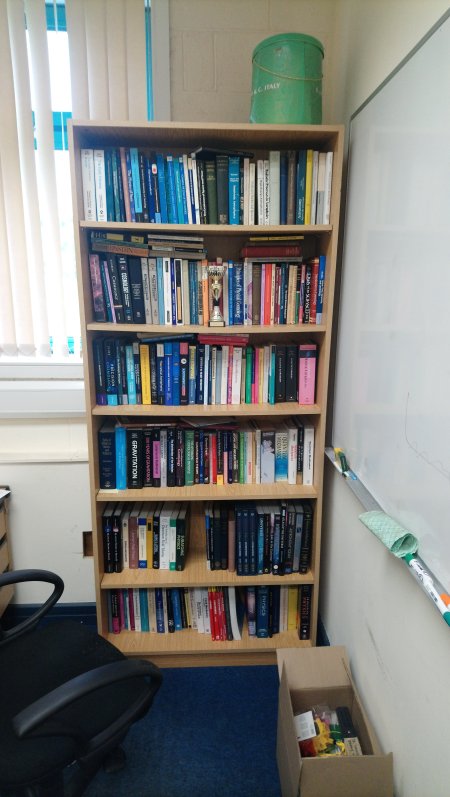
At the end of a very busy week in Maynooth I’ve at last been reunited with my books and other possessions. Eamon arrived with his van this afternoon, we unloaded all the boxes and I made a start of stacking the shelves.

It being rather warm this afternoon, however, I’m now a bit sweaty and have had enough so am going home for a drink…

The Hubble Constant Tension Video!

Posted in The Universe and Stuff on August 31, 2018 by telescoper

The interwebs informed me yesterday that there’s a video out on Youtube about the Hubble Constant Tension I’ve blogged about a few times (e.g. here). The video features a number of distinguished cosmologists and Daniel Mortlock (;-). It’s well worth a look:

This also gives me the excuse to resurrect the poll I’ve been running on this issue for a few years now. Feel free to vote if you haven’t done so already…

[twittter-follow screen_name=’telescoper’]

Jesus’ Blood Never Failed Me Yet

Posted in Music with tags , , on August 30, 2018 by telescoper

And now for something completely different.

I heard part of this on the Radio the other night, and thought I’d share it here. It’s definitely one of the strangest pieces of music I’ve ever heard, but I find it very moving and, in its own way, compelling. The full story can be found here, but is summarized the composer Gavin Bryars:

In 1971, when I lived in London, I was working with a friend, Alan Power, on a film about people living rough in the area around Elephant and Castle and Waterloo Station. In the course of being filmed, some people broke into drunken song – sometimes bits of opera, sometimes sentimental ballads – and one, who in fact did not drink, sang a religious song “Jesus’ Blood Never Failed Me Yet”. This was not ultimately used in the film and I was given all the unused sections of tape, including this one.

When I played it at home, I found that his singing was in tune with my piano, and I improvised a simple accompaniment. I noticed, too, that the first section of the song – 13 bars in length – formed an effective loop which repeated in a slightly unpredictable way.

I took the tape loop to Leicester, where I was working in the Fine Art Department, and copied the loop onto a continuous reel of tape, thinking about perhaps adding an orchestrated accompaniment to this. The door of the recording room opened on to one of the large painting studios and I left the tape copying, with the door open, while I went to have a cup of coffee. When I came back I found the normally lively room unnaturally subdued. People were moving about much more slowly than usual and a few were sitting alone, quietly weeping.

I was puzzled until I realised that the tape was still playing and that they had been overcome by the old man’s singing. This convinced me of the emotional power of the music and of the possibilities offered by adding a simple, though gradually evolving, orchestral accompaniment that respected the homeless man’s nobility and simple faith. Although he died before he could hear what I had done with his singing, the piece remains as an eloquent, but understated testimony to his spirit and optimism.

Several versions of this piece exist. This one, recorded in 1993, is 74 minutes long. It begins with the unaccompanied voice of the old man to which instrumental accompaniment of increasing depth and texture is gradually added and, for the last twenty minutes or so, there is also the voice of Tom Waits…

The Russell Library, Maynooth

Posted in Books, Education, Literature, Maynooth with tags , on August 29, 2018 by telescoper

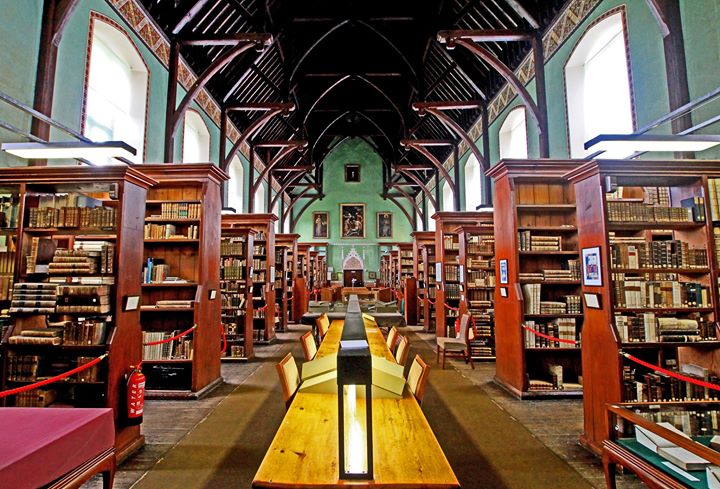
For those of you who like lovely old libraries filled with lovely old books, here’s a picture of the Russell Library, which is on the South Campus of Maynooth University:

Library Picture

According to the website:

The Russell Library houses the historical collections of St Patrick’s College, Maynooth which was founded in 1795 as a seminary for the education of Irish priests. The reading room was designed by renowned British architect and designer Augustus Welby Northmore Pugin (1812-1852) and completed in the year 1861. The Russell Library contains approximately 34,000 printed works dating from the 16th to the mid-19th century across a range of subjects including: theology, mathematics, science, geography and history. Other important collections include: medieval and Gaelic manuscripts, archival material and incunabula (pre-1501 printing).

The academic life – student emails

Posted in Biographical, Education on August 28, 2018 by telescoper

Here’s an interesting blog post about dealing with emails from students.

It seems to me that these days students aren’t as keen on using email as they used to be a few years ago (especially from their official university account) which may mean that they’re using it reluctantly and are unsure of the right tone to use.I have had a small number of emails from students over the years that I found rather rude (I mean blunt rather than abusive), but I try to give the sender the benefit of the doubt because it is easy to sound abrupt in an email without meaning to.

My advice in such cases is not to reply at first, in case you respond in a way that escalates things. Take some time to chill about it, and then reply to the factual matters without rising to what you might interpret as provocation.

I would also recommend not checking your email outside of working hours if you can help it. It took me a long time to get to the habit of not reading work emails at the weekend or late at night, except in very special circumstances, but there’s no reason why students (or colleagues, for that matter) should expect you to be available 24 hours a day.

Finally, make full use of the `Out of Office’ feature on your email application. I found that particularly important when I was working part-time to remind senders that were times when I was working, and times when I wasn’t.

I’m sure readers have other tips….if so please share them!

universitydiary's avatarUniversity Blog

When I began any lecturing career in 1980, in the days before the internet or even mobile phones, it would have been totally impossible for a student to reach me outside of normal working hours. By the time my active teaching came to an end (in 2000), I was beginning to get both emails and phone calls into the night; though this was still a relatively rare thing, and almost always the students were polite when they reached me.

It became clear to me how much had changed when a colleague from another institution contacted me recently to ask me for advice, as he was seriously stressed with the number of student emails he was receiving; in particular because many of these were, he claimed, insistent in nature. He showed me some of the offending messages, and indeed it might almost be said that a small number of them adopted…

View original post 157 more words

The Simons Observatory: Science Goals and Forecasts

Posted in The Universe and Stuff with tags , , on August 27, 2018 by telescoper

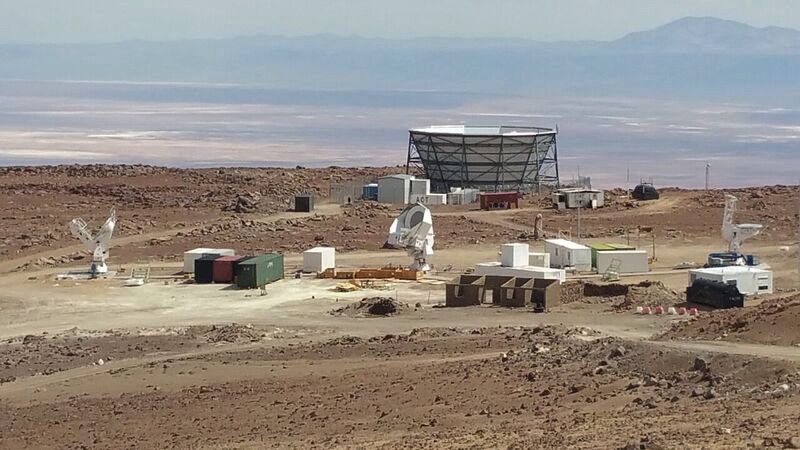
I haven’t been involved in this project, but several of my former colleagues at Cardiff have beenm and still are, so I know how much work has gone into this (especially by the amazing Erminia Calabrese), so I am happy to share this impressive work here. This long (54 pages) paper, which appeared on the arXiv last week, describes the latest step forward in ground-based cosmology using the cosmic microwave background. It shows just how rapid the onward march of instrumental technology continues to be.

The Simons Observatory Site, in Chile

It is likely that the Simons Observatory (based on a single 6m dish) will form part of the next generation CMB experiment known currently as CMB-S4.

You can download the paper in full from the arXiv here.

The Simons Observatory (SO) is a new cosmic microwave background experiment being built on Cerro Toco in Chile, due to begin observations in the early 2020s. We describe the scientific goals of the experiment, motivate the design, and forecast its performance. SO will measure the temperature and polarization anisotropy of the cosmic microwave background in six frequency bands: 27, 39, 93, 145, 225 and 280 GHz. The initial configuration of SO will have three small-aperture 0.5-m telescopes (SATs) and one large-aperture 6-m telescope (LAT), with a total of 60,000 cryogenic bolometers. Our key science goals are to characterize the primordial perturbations, measure the number of relativistic species and the mass of neutrinos, test for deviations from a cosmological constant, improve our understanding of galaxy evolution, and constrain the duration of reionization. The SATs will target the largest angular scales observable from Chile, mapping ~10% of the sky to a white noise level of 2 μK-arcmin in combined 93 and 145 GHz bands, to measure the primordial tensor-to-scalar ratio, r, at a target level of σ(r)=0.003. The LAT will map ~40% of the sky at arcminute angular resolution to an expected white noise level of 6 μK-arcmin in combined 93 and 145 GHz bands, overlapping with the majority of the LSST sky region and partially with DESI. With up to an order of magnitude lower polarization noise than maps from the Planck satellite, the high-resolution sky maps will constrain cosmological parameters derived from the damping tail, gravitational lensing of the microwave background, the primordial bispectrum, and the thermal and kinematic Sunyaev-Zel’dovich effects, and will aid in delensing the large-angle polarization signal to measure the tensor-to-scalar ratio. The survey will also provide a legacy catalog of 16,000 galaxy clusters and more than 20,000 extragalactic sources.

Golf and other Hazards

Posted in History, Maynooth, Sport with tags , , , , , on August 27, 2018 by telescoper

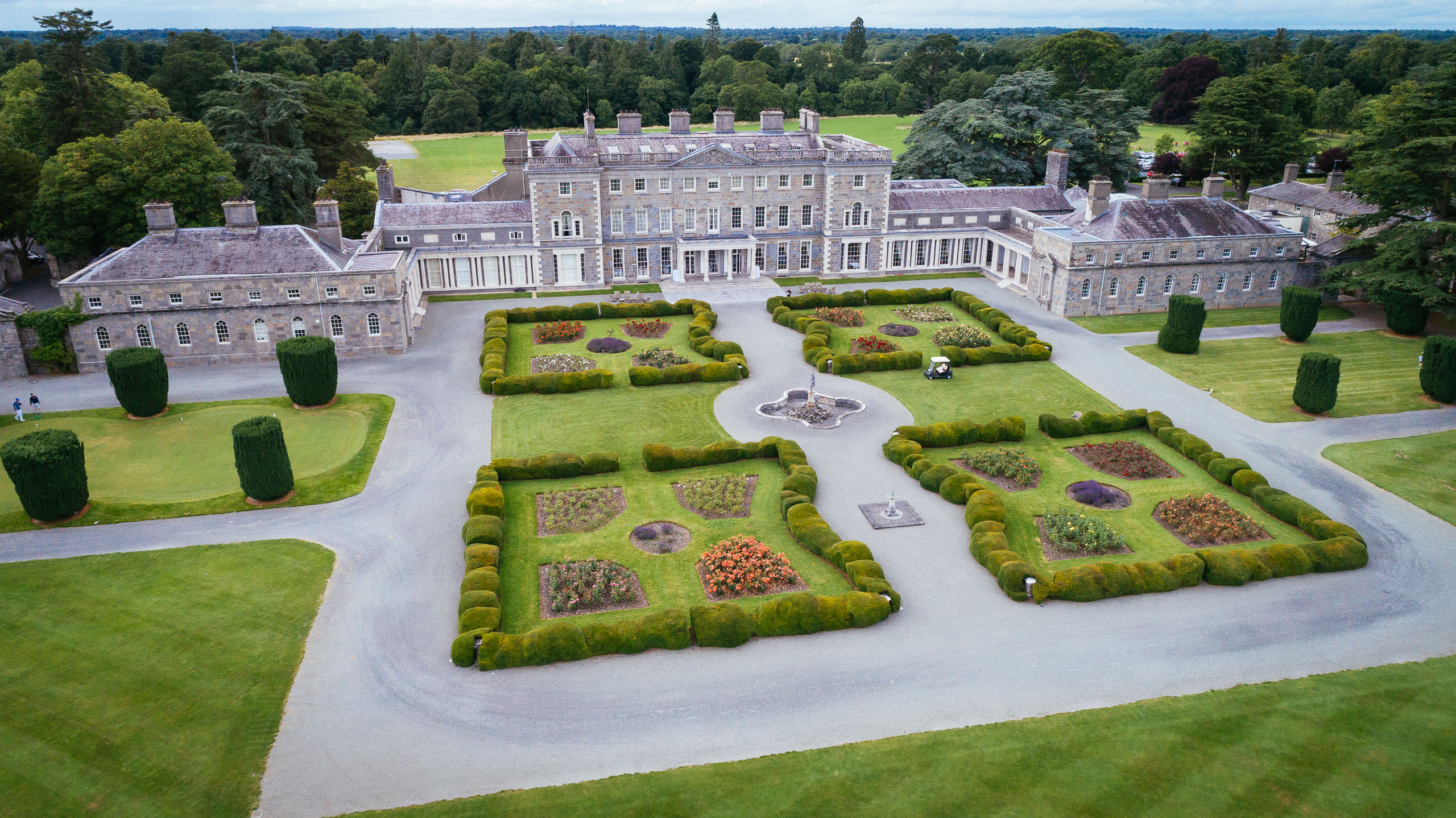
Back in the office with a few minutes to go before a meeting starts I thought I’d give a little insight into life in the throbbing metropolis that is Maynooth, County Kildare. This week sees the start of the World Amateur Team Golf Championships, which is being held at Carton House (above) which is a short walk from downtown Maynooth. Some of the competitors will be staying on Maynooth University campus for the duration, which will no doubt provide welcome revenue.

Now the game of golf is obviously of no conceivable interest to anyone, but the venue – Carton House – is quite fascinating. The current house was built on the Carton Estate in the 18th Century to accommodate the Earl of Kildare, when their fortunes had slowly recovered after Thomas Fitzgerald (`Silken Thomas’) the 10th Earl of Kildare was executed, along with several others of the Fitzgerald family, by Henry VIII for plotting a rebellion against the English. If you have been paying attention you will know that it was the Fitzgeralds who built the stone castle in Maynooth that was destroyed in the 16th Century. Carton House is at the other end of town, and is approached by a very pleasant tree-lined avenue. The extensive grounds are also surrounded by a wall. The latter-day Fitzgeralds obviously wanted to keep the hoi polloi at arm’s length.

Anyway, to cut a long story short, Carton House fell into disrepair in the second half of the 20th Century and was eventually sold off and turned into a hotel and spa resort, with two golf courses.

In the meantime, among many other things, Carton House and it its grounds were used as one of the locations for Stanley Kubrick’s (1975) film Barry Lyndon. That was of course before the beautiful landscaped gardens were destroyed and turned into golf courses. I went for a pleasant walk in the grounds earlier this summer, during the heatwave, but the path runs alongside a small lake beside one of the fairways where a group of people were openly committing acts of golf. A not-very-competent member of this group sent several balls into the water before finally managing to hit dry land with a tee shot. For a while I wished I’d brought a tin hat with me.