The Simons Observatory: Science Goals and Forecasts

Posted in The Universe and Stuff with tags , , on August 27, 2018 by telescoper

I haven’t been involved in this project, but several of my former colleagues at Cardiff have beenm and still are, so I know how much work has gone into this (especially by the amazing Erminia Calabrese), so I am happy to share this impressive work here. This long (54 pages) paper, which appeared on the arXiv last week, describes the latest step forward in ground-based cosmology using the cosmic microwave background. It shows just how rapid the onward march of instrumental technology continues to be.
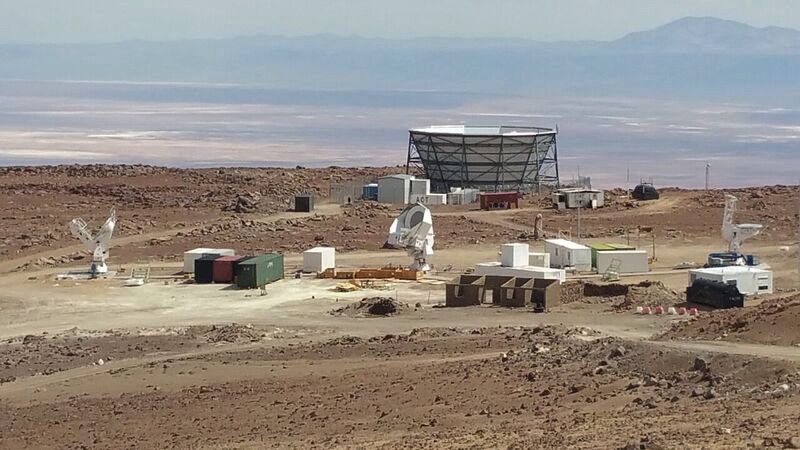
The Simons Observatory Site, in Chile

It is likely that the Simons Observatory (based on a single 6m dish) will form part of the next generation CMB experiment known currently as CMB-S4.

You can download the paper in full from the arXiv here.

The Simons Observatory (SO) is a new cosmic microwave background experiment being built on Cerro Toco in Chile, due to begin observations in the early 2020s. We describe the scientific goals of the experiment, motivate the design, and forecast its performance. SO will measure the temperature and polarization anisotropy of the cosmic microwave background in six frequency bands: 27, 39, 93, 145, 225 and 280 GHz. The initial configuration of SO will have three small-aperture 0.5-m telescopes (SATs) and one large-aperture 6-m telescope (LAT), with a total of 60,000 cryogenic bolometers. Our key science goals are to characterize the primordial perturbations, measure the number of relativistic species and the mass of neutrinos, test for deviations from a cosmological constant, improve our understanding of galaxy evolution, and constrain the duration of reionization. The SATs will target the largest angular scales observable from Chile, mapping ~10% of the sky to a white noise level of 2 μK-arcmin in combined 93 and 145 GHz bands, to measure the primordial tensor-to-scalar ratio, r, at a target level of σ(r)=0.003. The LAT will map ~40% of the sky at arcminute angular resolution to an expected white noise level of 6 μK-arcmin in combined 93 and 145 GHz bands, overlapping with the majority of the LSST sky region and partially with DESI. With up to an order of magnitude lower polarization noise than maps from the Planck satellite, the high-resolution sky maps will constrain cosmological parameters derived from the damping tail, gravitational lensing of the microwave background, the primordial bispectrum, and the thermal and kinematic Sunyaev-Zel’dovich effects, and will aid in delensing the large-angle polarization signal to measure the tensor-to-scalar ratio. The survey will also provide a legacy catalog of 16,000 galaxy clusters and more than 20,000 extragalactic sources.

Golf and other Hazards

Posted in History, Maynooth, Sport with tags , , , , , on August 27, 2018 by telescoper

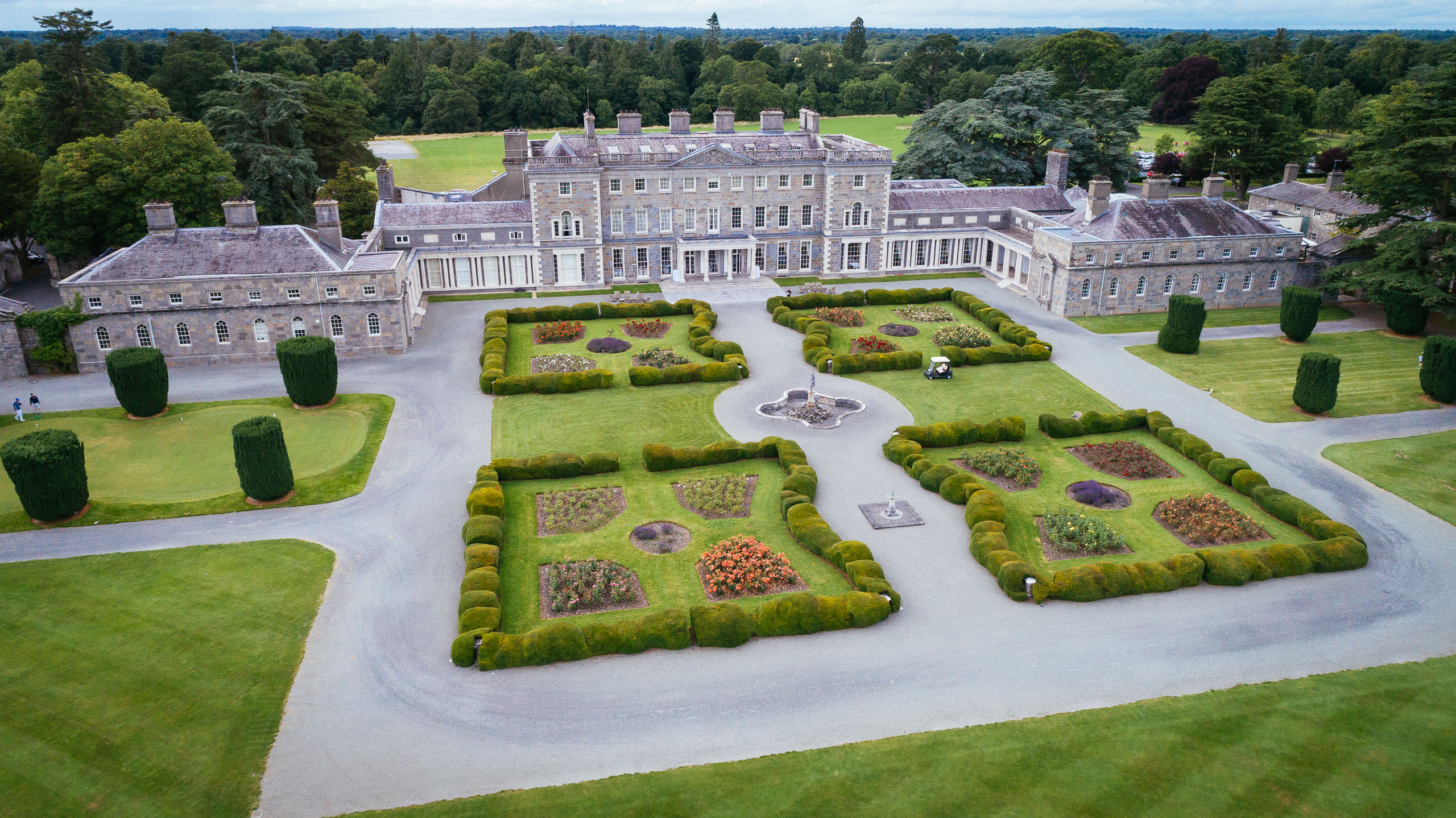
Back in the office with a few minutes to go before a meeting starts I thought I’d give a little insight into life in the throbbing metropolis that is Maynooth, County Kildare. This week sees the start of the World Amateur Team Golf Championships, which is being held at Carton House (above) which is a short walk from downtown Maynooth. Some of the competitors will be staying on Maynooth University campus for the duration, which will no doubt provide welcome revenue.

Now the game of golf is obviously of no conceivable interest to anyone, but the venue – Carton House – is quite fascinating. The current house was built on the Carton Estate in the 18th Century to accommodate the Earl of Kildare, when their fortunes had slowly recovered after Thomas Fitzgerald (`Silken Thomas’) the 10th Earl of Kildare was executed, along with several others of the Fitzgerald family, by Henry VIII for plotting a rebellion against the English. If you have been paying attention you will know that it was the Fitzgeralds who built the stone castle in Maynooth that was destroyed in the 16th Century. Carton House is at the other end of town, and is approached by a very pleasant tree-lined avenue. The extensive grounds are also surrounded by a wall. The latter-day Fitzgeralds obviously wanted to keep the hoi polloi at arm’s length.

Anyway, to cut a long story short, Carton House fell into disrepair in the second half of the 20th Century and was eventually sold off and turned into a hotel and spa resort, with two golf courses.

In the meantime, among many other things, Carton House and it its grounds were used as one of the locations for Stanley Kubrick’s (1975) film Barry Lyndon. That was of course before the beautiful landscaped gardens were destroyed and turned into golf courses. I went for a pleasant walk in the grounds earlier this summer, during the heatwave, but the path runs alongside a small lake beside one of the fairways where a group of people were openly committing acts of golf. A not-very-competent member of this group sent several balls into the water before finally managing to hit dry land with a tee shot. For a while I wished I’d brought a tin hat with me.

Not the Bank Holiday Weekend

Posted in Uncategorized on August 26, 2018 by telescoper

So here I am, then, back in Maynooth. The rain was pelting down in Cardiff when I went to get the bus so I arrived at the airport soaked to the skin. Other than that, and a slightly delayed flight, the trip home was uneventful and I arrived in Maynooth in good time.

That was quite a surprise, actually, as this afternoon the Pope was doing his thing in Phoenix Park, Dublin, and there were many road closures in the city as a consequence. I feared a long delay on the Airport Hopper bus, but in the event it ran precisely on schedule.

Perhaps the lack of travel disruption was connected to the fact that fewer than 130,000 attended today’s Papal Mass for which 500,000 tickets had been made available? The last Papal visit to Ireland in 1979 drew a crowd of 1.25 million to Phoenix Park. Ireland does seem to have changed a lot in 40 years.

Anyway the heavy rain I left behind in the United Kingdom is pretty typical for an August Bank Holiday weekend. Here in Ireland, however, this is not a Bank Holiday weekend. The August Bank Holiday here is on the first Monday of August, not the last…

I didn’t realise until yesterday that the UK August Bank Holiday was originally set to be the first Monday too, but was moved in 1965 as an experiment to try to extend the summer; change was made permanent in 1971. You can read more about that here.

Anyway, since it is not a Bank Holiday Monday, I have a busy day at work tomorrow, including an Examiners’ Meeting. Perhaps my books will arrive too!

Pride Cymru

Posted in LGBTQ+ on August 25, 2018 by telescoper

Just a quick post today, as it is the day of the Pride Cymru parade in Cardiff, part of a three-day ‘Big Weekend’ of celebrations going on over the Bank Holiday weekend.

The above picture (which I took from the ‘We Are Cardiff’ Twitter feed) shows the front of the Parade. I arrived too late to see the start, but I’m including the picture here to show that Pride Cymru is having none of the anti-Trans nonsense that blighted the London Pride parade earlier this summer.

I could only see a little bit of the Parade before returning home, as I have lot to do before returning to Ireland tomorrow, but it seemed to be going well and people seemed to be having fun!

Jurassic Cardiff

Posted in Bute Park, Cardiff on August 24, 2018 by telescoper

I saw the above creature when I was walking through Bute Park in Cardiff this afternoon.

I hadn’t realised that the annual UKIP conference was in Cardiff this year…

Books Away!

Posted in Uncategorized on August 23, 2018 by telescoper

Well, the inestimable Eamon and Barry have been with their van and collected 34 boxes of books, including those shown below, files of notes, and sundry other items from my Cardiff residence.

It all went more smoothly than I’d anticipated, actually, because a parking space right outside my front door appeared about a minute before the van arrived. That saved quite a bit of to-ing and fro-ing loading the boxes.

Another part of my relocation to Maynooth is thus under way.

I hope to be reunited with these belongings in Maynooth at some point next week as they are currently making their way to Ireland (via Birkenhead, apparently).

WINNIE ILLE PU

Posted in Uncategorized on August 23, 2018 by telescoper

Not a lot of people know that a Latin translation of Winnie the Pooh, by A.A. Milne, was published in 1960. Alexander Lenard, the translator, was also a physician, painter, musician, and poet, but he is most famous for Winnie Ille Pu.

The book is the only Latin book to become a New York Times best seller – it remained on the NY Times list for 20 weeks.

Here’s a sample page:

An Open Letter to Jacob Rees-Mogg MP

Posted in Uncategorized on August 22, 2018 by telescoper

Rt Hon Jacob Rees-Mogg MP
House of Commons,
London
SW1A 0AA

Dear Mr Farage,

I have now moved to Ireland, so if you would like to send all your clients’ money to me I promise to look after it.

Yours Sincerely,

Mrs Trellis

Glamorgan v Durham: Day 3

Posted in Biographical, Cricket with tags , , , , on August 21, 2018 by telescoper

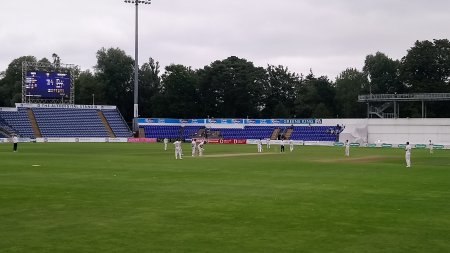
I flew back this morning from Dublin to Cardiff and, since Sophia Gardens is on the way to my Pontcanna residence from the bus stop, I popped in to watch the last rites of the County Championship match between Glamorgan and Durham.

I got there just in time to see the start of play, with Glamorgan resuming on 79 for 7. Just over half an hour later they were all out for 111 and had list the match by an innings and 30 runs. That despite the fact that Durham only scored 295 in their first innings.

You can’t really blame the tailenders this morning. Glamorgan’s higher-order batsmen folded twice in the match. Their line-up looked weak on paper and so it proved.

Glamorgan have five remaining County Championship matches to play with no overseas batsmen (Marsh & Khawaja having returned to Australian duties). The loss of fast bowler Marchant De Lange for the whole season with a hamstring injury hasn’t helped either. To make matters worse, yesterday Aneurin Donald announced he was leaving the club for Hampshire with immediate effect.

Glamorgan are clearly going to finish bottom of Division 2 of the County Championship. The club having gambled all on success in the Twenty20 format, and lost, they’re now adrift, going nowhere, and with morale at a low ebb. I wouldn’t be surprised if other players joined Donald in seeking pastures new.

The only thing that can turn Glamorgan round is a complete overhaul of its strategy and coaching staff. I’m not sure however whether the club management will do the necessary though.

Anyway, I may get to see some more cricket at Sophia Gardens on my season ticket next month, but I won’t be renewing my membership. Living in Ireland would make it impossible to see enough to justify the expense, even if there were a decent team to watch.

Age, Memory and Learning

Posted in Education, Maynooth with tags , , , , , , , on August 20, 2018 by telescoper

Today’s a big day for prospective students at Irish universities. It’s the day when the Central Applications Office (CAO, the equivalent of the UK’s UCAS) makes offers of places to students based the Leaving Certificate results that were announced last week. Thus begins the process by which universities find out how many students we will have for entry next month. Lectures here at Maynooth start on 24th September, with an induction week before that, so there promises to be quite a rush to get everything sorted out.

The first thing that struck me thinking ahead to this year’s new entry of students was that the majority of students starting this autumn either here in Ireland or in the UK were born in the year 2000. That means that I’ve been a Professor (at four different universities: Nottingham, Cardiff, Sussex and Maynooth) all the time they have been alive! Yikes I feel old!

The other thing that struck me among all the press coverage of the Leaving Certificate in Ireland is the significant amount of griping about how these examinations are basically just memory tests and the system encourages rote learning. This is something I’ve complained about before in the context of British A-levels and indeed the system of university examinations.

Over my lifetime the ratio of assessment to education has risen sharply, with the undeniable result that academic standards have fallen especially in my own discipline of physics. The modular system encourages students to think of modules as little bit-sized bits of education to be consumed and then forgotten. Instead of learning to rely on their brains to solve problems, students tend to approach learning by memorizing chunks of their notes and regurgitating them in the exam. I find it very sad when students ask me what derivations they should memorize to prepare for examinations because that seems to imply that they think their brain is no more than a memory device. It has become very clear to me over the years that school education in the UK does not do enough to encourage students to develop their all-round intellectual potential, which means that very few have confidence in their ability to do anything other than remember things. It seems the same malaise affects the Irish system too.

On the other hand, as a number of people have pointed out in opinion pieces (e.g. here) and letters (here and here), a good memory is undoubtedly an extremely important asset in its own right.

I went to a traditional Grammar school that I feel provided me with a very good education in which rote learning played a significant part. Learning vocabulary and grammar was an essential part of their approach to foreign languages, for example. How can one learn Latin without knowing the correct declensions for nouns and conjugations for verbs? But although these basic elements are necessary, however, they are not sufficient. You other aspects of your mental capacity to comprehend, translate or compose meaningful pieces of text.

The same considerations apply to STEM disciplines. It is important to have a basic knowledge of the essential elements of mathematics and physics as a grounding, but you also need to develop the skill to apply these in unusual settings. I also think it’s simplistic to think of memory and creative intelligence as entirely separate things. I seems to me that the latter feeds off the former in a very complex way. A good memory does give you rapid access to information, which means you can do many things more quickly than if you had to keep looking stuff up, but I think there’s a lot more to it than that. Our memories are an essential part of the overall functioning of our brain, which is not  compartmentalized in such a simple way.  For example, one aspect of problem-solving skill relies on the ability to see hidden connections; the brain’s own filing system plays a key role in this.

Recognizing the importance of memory is not to say that rote learning is necessarily the best way to develop the relevant skills. My own powers of recall are not great – and are certainly not improving with age – but I find I can remember things much better if I find them interesting and/or if I can see the point of remembering them. Remembering things because they’re memorably is far easier than remembering because you need to remember them to pass an examination!