Results Day Advice!

Posted in Education with tags , , , , on August 15, 2018 by telescoper

Today’s the day in Ireland that students get the results of their school Leaving Certificate examinations and, over the other side of the Irish Sea, tomorrow is when A-level results come out. For many there will be joy at their success, and I particularly look forward to meeting those who made their grades to get into Maynooth University shortly.

Others will no doubt receive some disappointing news.

For those of you who didn’t get the grades you needed or expected, I have one piece of very clear advice:

1-dont-panic

In particular, if you didn’t get the Leaving Certificate points you needed for entry to your first University in Ireland or the A-levels needed to do likewise in the United Kingdom, do not despair. There are always options.

For example, in Ireland, you could try looking at alternative choices on the Available Courses, where any places remaining unfilled in particular courses after all offers have been made and the waiting lists of applicants meeting minimum entry requirements have been exhausted, will be advertised.

In the United Kingdom the Clearing system will kick into operation this week. It’s very well organized and student-friendly, so give it a go if you didn’t make your offer.

D.G. Bradman b Hollies 0

Posted in Cricket, History with tags , , on August 14, 2018 by telescoper

It was on this day 70 years ago (i.e. on 14th August 1948) that the great Australian batsman Sir Donald Bradman played his last Test innings, against England at the Oval. He didn’t know it would be his last knock but Australia won the match by an innings so he never got to bat again in the match, which was the last in the five-match Ashes series that Australia won 4-0.

Bradman needed only to score four runs to finish with a Test batting average of 100, but he was out second ball to the legspinner Eric Hollies, for a duck, and his average was stuck on 99.94.

Here’s a short video of Bradman’s last Test innings, featuring commentary by John Arlott:

Two things struck me when I watched this just now. One is that Norman Yardley’s decision to give Bradman three cheers at the start of his innings may have seemed very sporting at the time, but I’m sure it put the batsman off and I wonder if that was Yardley’s calculated intent?

The second striking thing is the poor state of the pitch, with huge footmarks clearly visible. Although Hollies was bowling round the wicket presumably to exploit them, it’s not clear these played a role in Bradman’s dismissal. It looks to me that he played a loose shot at a full delivery, probably a googly that turned a little. Nevertheless it is worth remembering that batsmen of Bradman’s era had to play on uncovered wickets. I won’t dwell on this point for fear of starting to sound like Geoffrey Boycott, but it does reinforce just how remarkable Bradman’s average really was. Add to that the fact that England had been bowled out on that strip in their first innings for just 52!

Eric Hollies may have been a good bowler, but his record with the bat was at the opposite extreme to Bradman, scoring a total of 37 runs in 13 Test matches, at an average of 5.28. His total of 1,673 runs in first-class matches was 650 fewer than his haul of wickets, and only once (in 1954) did he reach 30 in an innings. In fact, he did not reach 20 in any innings between 1946 and 1953, and equalled an all-time first-class record, between July 1948 and August 1950, of seventy-one consecutive innings without reaching double figures.

Although Australia won the Ashes convincingly in 1948, the Australian camp was not entirely harmonious. The tension therein largely originated in the fact that Bradman was a Protestant and there was a Catholic faction in the touring party that didn’t like him for essentially tribal reasons. Indeed, I’m told that some former Australian players in the Press Box burst out laughing when `The Don’ was out for a duck that day.

The Mother of Civilisation Library Project

Posted in Uncategorized on August 13, 2018 by telescoper

When I was packing books at my Cardiff residence last week I set aside a few I no longer needed. This morning I put them in a parcel which I took to the post office and sent to the Mother of Civilisation Library Project in Sindh (Pakistan).

In case you weren’t aware, the Mother of Civilization Library is a volunteer organisation in the Indus Valley around Sindh, in the southern part of Pakistan. Their project is to help and facilitate a libraries program in Sindh by collecting books. They contacted me a while ago about making a donation, and I’ve finally done it!

If you have any spare new or used books that you would like to send to the Library program, I’m sure they’d be thrilled to receive them! Your donation could do much to stimulate and encourage the growth of learning, especially among the young generation of students.

Please send books to:

Rashid Anees Magsi, Project Manager, Mother of Civilization Library

Street: Sobho Khan Magsi,

City: Radhan Station Dadu,

Province: Sindh,

Postal Code: 76310,

Country: Pakistan

P. S. If you send a donation from the UK be sure to say that you are sending books – the cost is much lower if your parcel contains only books than if it contains other items of the same weight.

Royal Society University – Science Foundation Ireland University Research Fellowships

Posted in Uncategorized on August 13, 2018 by telescoper

It is now time for a quick public information broadcast.

Did you know that the Royal Society has teamed up with Science Foundation Ireland to enable early career researchers in Ireland access to the University Research Fellowship (URF) scheme?

This scheme provides five years of research funding (with the possibility of renewal) and has proved to be a stepping stone to their first permanent academic position for a great many scientists.

This scheme covers, but is not limited to, physics and astronomy. For full details of the scheme, see here.

The deadline if you want to apply to hold a URF in Ireland is 12th September 2018, which is just a month away so get cracking!

You could go a lot worse than applying to hold your URF in Maynooth!

Oh, and five years residency in Ireland qualifies you for citizenship. Just saying…

A Message for your Resit

Posted in Uncategorized on August 12, 2018 by telescoper

It’s the time if the year for repeat examinations at Maynooth University and resit examinations at Cardiff University (note the slightly different nomenclature).

There’s only a couple of students taking my own papers but I will be marking a few other papers in Maynooth so here’s a message for all students taking resits or repeats over the next couple of weeks:

An interview with Peter Coles

Posted in Biographical, LGBTQ+ on August 11, 2018 by telescoper

I did this interview for the LGBT STEM website, where you can find similar profiles of other LGBT folk working in STEM disciplines. Why not give it a look?

Alex Bond's avatarLGBTQ+ STEM

Name: Peter Colesme_n - Peter ColesCurrent Job: Professor of Theoretical Physics

Scientific Discipline/Field: Cosmology

Country: Ireland

Pick some letters (L,G,B,T,Q,+, etc.): G

Website:https://telescoper.wordpress.com

Twitter or other social media handle:@telescoper

What does your job involve?

I do research in theoretical cosmology and the large-scale structure of the Universe and teach various topics in theoretical physics, including computational physics, vector calculus and astrophysics and cosmology.

How did you get to this job (education etc.)?

I did my first degree in Natural Sciences, specialising in Theoretical Physics in my final year. I then did a postgraduate research degree (DPhil) at the University of Sussex under the supervision of John Barrow. I subsequently held postdoctoral research positions at Sussex and Queen Mary, University of London, before I got my first professorial position at the University of Nottingham. I moved to Cardiff to become Professor of Theoretical Astrophysics in 2007, and then back to Sussex…

View original post 300 more words

Glamorgan versus Hampshire: Vitality Blast Twenty20

Posted in Cricket with tags , , , , on August 10, 2018 by telescoper

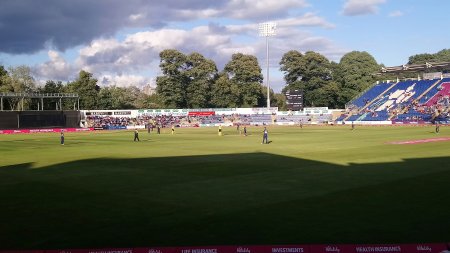
After indifferent weather all day it turned out nice for this evening’s Twenty20 match at Sophia Gardens between Glamorgan and Hampshire. It was a good night for Glamorgan too, as they won by 8 wickets, making it a run of five victories in a row.

Glamorgan won the toss asked Hampshire to bat. Openers Vince and Roussow got the visitors off to a flying start, putting on 58 in less than five overs, before Vince was well caught by David Lloyd (returning to the side after injury) off Hogan.

Glamorgan’s quicker bowlers were expensive but spinners Salter (2 for 16 off 4) and Ingram (1-10 off 2) and medium-pacer Meschede (3 for 21 off 4) established control after the power play, and wickets fell as the Hampshire batsmen struggled to accelerate from their good base and frustration set in. From 90 for 1 in the 8th over they could only manage 151 off their 20. Graham Wagg bowled the last three overs from the Cathedral Road end for just 16. When everyone had expected Hampshire to accelerate, they slowed down dramatically thanks to fine bowling and fielding. The catching, in particular, was outstanding: wickets resulted from mistimed slogs, some of which went very high indeed. No chances went down.

With a target of 152 to win, Glamorgan were favourites, the only real worry being complacency. Donald fell early, run out by a direct hit while clearly not paying attention. That brought Colin Ingram to the crease and he immediately started to play his shots. There were one or two near misses early on, lofted shots just clearing the infield, but when he got into his stride the match was never in doubt. He finished on 71 not out, including four huge sixes and six fours.

Meschede fell with the score on 101, but Kieran Carlson played confidently to finish unbeaten on 31.

Needing a miracle with the score on 146 for 2, Hampshire brought Dale Steyn back on the 16th over. After a single from Carlson, Ingram clouted one to the fine leg boundary for four. The scores were level. Two dot balls followed, then Steyn bowled a bouncer that took off, Ingram ducked and the ball went through the wicketkeepers gloves for four byes. Game over.

New Polling Agency

Posted in Bad Statistics with tags , , on August 10, 2018 by telescoper

There is a new polling agency on the block, called DeltaPoll.

I had never heard of them until last week, when they had a strange poll published in the Daily Mail (which, obviously, I’m not going to link to).

I think we need new pollsters like we need a hole in the head. These companies are forever misrepresenting the accuracy of their surveys and they confuse more than they inform. I was intrigued, however, so I looked up their Twitter profile and found this:

They don’t have a big Twitter following, but the names behind it have previously been associated with other polling agencies, so perhaps it’s not as dodgy as I assumed.

On the other hand, what on Earth does ’emotional and mathematical measurement methods’ mean?

Summer Repeats, Removals and Research

Posted in Uncategorized on August 8, 2018 by telescoper

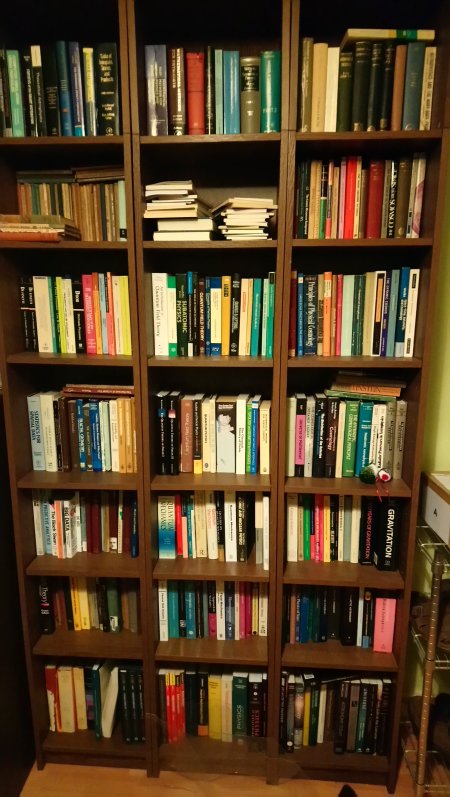
For those people who think the summer is one long holiday for academics, I’m using a narrow window in my calendar to pack, and supervise the removal from Cardiff to Ireland of, some of these:

There will be about 30 boxes of books to ship. I have more than that, but I’m only moving my technical books for now; the novels, poetry, dictionaries, and other stuff will stay until I buy a house in Ireland.

I also have three or four boxes of old lecture notes. I almost threw these out when I left Sussex two years ago ago. I. thought I wouldn’t need them again because I was planning to take early retirement. Now things have changed and they might prove very useful.

In September I start to teach two new courses at Maynooth, one of which (Vector Calculus and Fourier Series) has similar content to modules I’ve previously taught in Sussex and Cardiff so hopefully I can use some of the notes and examples instead of starting entirely from scratch. That’s for students in their second year at Maynooth. The other new module is on Astrophysics and Cosmology for final-year students and I also have material for that. I’m looking forward to that as it is closest to my own research interests.

Anyway before I can start preparing for the new academic year there is the end of the old one to take care of. Coming up next week are the repeat (resit) examinations which have to be marked pronto so the relevant students know if they can continue in September.

And then there’s the small matter of research. I have two papers to write up {and one project which I’m stuck with) that I wanted to finish this summer .

Oh, and the new edition of my book Cosmology: A Very Short Introduction needs finishing off. And a publication for next year’s centenary of the famous Eddington Eclipse expedition. And getting the Open Journal of Astrophysics fully operational.

But, yes, it’s the summer holiday.

Now I’d better get back to work.

Glamorgan versus Essex: Vitality Blast Twenty20

Posted in Cricket with tags , , , , , on August 7, 2018 by telescoper

I’m back in Cardiff for a few days sorting out some logistics, and also to make the most of what remains on my season ticket for Glamorgan cricket club, where I spent this evening.

While my late supper warms in the oven I just have time to post a quick item about this evening’s events at Sophia Gardens.

I don’t normally do selfies unless they’re of other people but I’m posting the above one because it made it via Twitter onto the big screen during the match. Fame at last!

Essex won the toss and out Glamorgan into bat. Glamorgan got off to a poor start, losing both openers cheaply. That brought Colin Ingram to the crease and the scoring accelerated, especially when he took apart the hapless Quinn for 30 off one over.

Glamorgan reached 110 for 3 off 11 overs, of which Ingram had scored 85, but they then faltered against good bowling. Ingram fell with the score on 135 for 7, at the start of the 17th over. Essex were on top.

Graham Wagg and Ruaidhri Smith then launched a stunning counter-attack and in the blink of an eye and a flurry of boundaries, Glamorgan were suddenly 198 for 7 off their 20 overs.

It was a good score in the end, but Essex started well with the bat and Glamorgan’s bowlers at first struggled to contain them. Gradually however Glamorgan began to exert some control. Wagg was outstanding in the crucial middle overs.

Pressure built, some wickets fell, but Essex didn’t collapse and kept more or less in touch with wickets in hand and the experienced Bopara at the crease and looking in good form.

The crowd waited anxiously for the climax. Essex needed 48 off the last 3 overs. Then 32 off 2. Then, after an excellent penultimate over from Wagg, 24 from the last. With Ravi Bopara on strike.

Michael Hogan ran into bowl. His first two balls conceded two fours, one a very difficult dropped catch that might have gone for six if the fielder hadn’t got a hand to it. Now it was 16 off 4 balls. The next ball was skied but fell safe for 2 runs. That meant 14 from 3; at least one six needed. Hogan bowled and Bopara obliged, slogging one into the Grandstand.

Eight now needed off two balls. Possible. Nerves jangling around the ground, Hogan bowled again, a very good one. Bopara was beaten and the ball went through to the keeper. A dot ball. A huge cheer went up from the crowd. That was effectively that. An inconsequential single off the last ball meant that Glamorgan won by six runs.

That makes it four wins out of four for Glamorgan, who go 3rd in the table. They now have a good chance of a semifinal place that looked beyond their reach four games ago. Poor old Essex are bottom of the table, with only one win from ten matches.

Walking home just know it occurred to me that as well as ones for fours and sixes they should give out cards to wave when a dot ball is bowled. It’s often those that win matches!