
Pictures from a Mediaeval Bestiary, No. 69 – The Turtle
Posted in Uncategorized on April 14, 2018 by telescoperThe Day’s Events
Posted in Uncategorized with tags Maynooth, Power Cut, UCU, UCU Strike, USS Pension on April 13, 2018 by telescoperToday has been a very strange day. The strangeness started last night when, without any notice being given to us mere residents, a crew arrived at 8pm to do roadworks (resurfacing). There then followed an excruciating racket right outside my window well into the early hours of the morning.
So, having not had much sleep at all, I wasn’t in a very good mood when I got up. Things went from bad to worse when, just after 8am, all the electricity in my flat went off. I checked the trip switches and saw no problem. I then went outside and saw the traffic lights were off. It turned out that the power supply to all of Maynooth was off (including the entire University), as well as quite a bit of the rest of County Kildare.
With no electricity I couldn’t have a shower or make any coffee or have the bacon sandwich I’d planned to have for breakfast. The prospect of sitting in a cold flat all morning with nothing to do and not even the radio to listen to didn’t appeal so I got dressed and went to the office (which is only 15 minutes walk away). No shops were open on the way. There was no electricity anywhere on campus, so no internet connection, and quite a lot of students sitting around wondering what to do. At least the office was fairly warm and I had plenty of things I could do without a computer.
News eventually started coming through that power was returning gradually to the campus buildings. Ours came back at about 10.30. At that point I finally got a cup of coffee. I still don’t know what caused the fault.
The other major event of the day was that the result came through from the Universities and Colleges Union ballot on whether to accept the Employers’ offer on pensions. A majority of the members voted `yes’, so strike action – which had been planned to resume at Cardiff on Monday 16th April – is now suspended. I wouldn’t bet against a resumption later this year, as the major issues seem to me unresolved. However, I will be leaving Cardiff in July so that’s the end of the matter for me.
Anyway, this now means that I’ll be resuming my teaching in Cardiff on Tuesday next week (17th April). I’d already decided to spend this weekend in Ireland so I’ll be going back on Monday morning, Flybe willing…
Follow @telescoperFun with the Airy Equation
Posted in Education, mathematics with tags Airy functions, Airy's equation, Computational Physics, George Airy, Numerical Solution of Ordinary Differential Equations, ODEs, Ordinary Differential Equations on April 12, 2018 by telescoperToday being a Maynooth Thursday, it has, as usual, has been dominated by computational physics teaching. We’re currently doing methods for solving ordinary differential equations. At the last minute before this afternoon’s lab session I decided to include an exercise that involved solving the following harmless-looking equation:

This is usually known as Airy’s equation and it comes up quite frequently in problems connected with optics. It was first investigated by a former Astronomer Royal George Airy, after whom the function is named; incidentally, he was born in Alnwick (Northumberland, i.e. not the Midlands).
Despite its apparent simplicity, the Airy equation describes some very interesting phenomena. Indeed it is the simplest ODE (that I know of) that has the property that there’s a point at which the behaviour of the solution turns from oscillatory to exponential. Here’s a result of a numerical integration of the equation: obtained using a simple Python script:
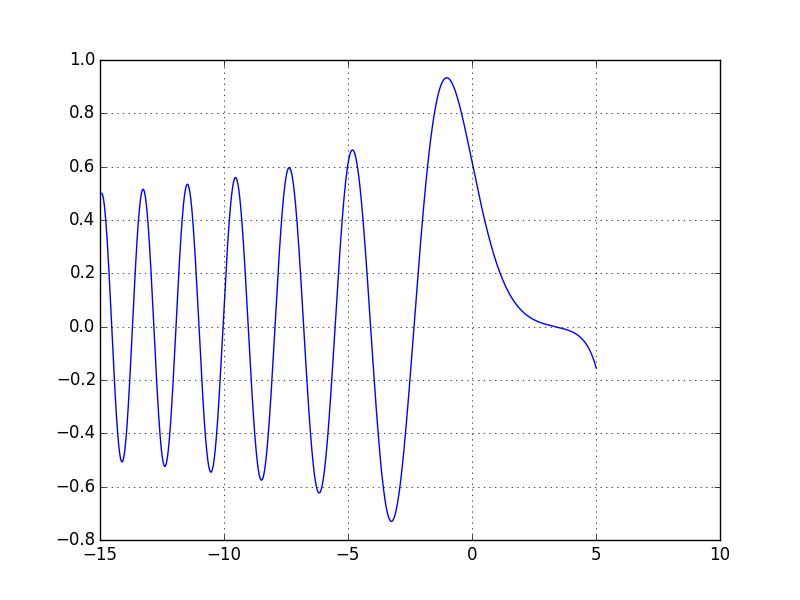
(I stopped the integration at 
One of the reasons for including this example (apart from the fact that Airy was a Geordie) is that the students were so surprised by the behaviour of the solution and most of them assumed that there was some problem with the numerical stability of their results. Some integration methods do struggle with such simple equations as the simple harmonic oscillator, but just sometimes weird numerical results are not mere numerical artifacts!
Anyway, my point is not about this particular equation or even about computational physics, but a general pedagogical one: finding interesting results for yourself is much more likely to motivate you to think about what they mean than if they’re just described to you by someone else. I think that goes for numerical experiments in a computer lab just as much as it does for any other kind of practical experiment in a science laboratory.
Follow @telescoperMathematical operations with the Normal distribution
Posted in Uncategorized on April 12, 2018 by telescoperInteresting post about the USS pension `deficit’ and why it is strongly dependent on the valuation method.

This post is a little off-topic, as the exercise I am about to illustrate is not one that most corpus linguists will have to engage in.
However, I think it is a good example of why a mathematical approach to statistics (instead of the usual rote-learning of tests) is extremely valuable.
Case study: The declared ‘deficit’ in the USS pension scheme
At the time of writing nearly two hundred thousand university staff in the UK are active members of a pension scheme called USS. This scheme draws in income from these members and pays out to pensioners. Every three years the pension is valued, which is not a simple process. The valuation consists of two aspects, both uncertain:
- to value the liabilities of the pension fund, which means the obligations to current pensioners and future pensioners (current active members), and
- to estimate the future asset value of the pension fund…
View original post 2,760 more words
Cardiff to Dublin via Belfast
Posted in Biographical, Cardiff with tags Belfast, Cardiff, Dublin, FlyBe on April 11, 2018 by telescoperI thought I write a brief post to arising from today’s travel difficulties, really just to make a record of the episode for posterity.
As last Wednesday I got up early this morning (4.30am) to get the 7am FlyBe flight from Cardiff to Dublin, due into Dublin at 8.05am. Having only hand luggage, as usual, I proceeded straight upstairs to the departure area only to find that the screen said the flight was cancelled, and directed passengers intending to travel on it back downstairs to the `Disruption Desk’ .
A long queue had already formed by the time I got there, but I got to the desk fairly quickly. The assistant explained that the cancellation was due to `staff sickness’ (i.e. they were short of a pilot) and the only option on offer was to fly to Belfast whence a bus would be provided to Dublin. The Belfast flight should have left at 6.15am but was being held for passengers to Dublin. I was also given a £5 refreshments voucher.
I thought a moment and then decided to accept this offer. I didn’t have any morning appointments today, but definitely had to get to Maynooth somehow by tomorrow morning as I have a lecture to deliver.
The plane left Cardiff about 7.15am and arrived in Belfast around 8.10am but when I emerged from the arrivals area there was no bus. In fact it took about 45 minutes to arrive, and we didn’t get going until about 8.55am. Many of the passengers were clearly nervous about missing connecting flights in Dublin, including a group of women planning onward travel to the USA, but the trip was fairly uneventful apart from the fact that the toilet was out of commission necessitating a stop so that people could use the facilities in a service station.
I can confirm that there is no visible border between Northern Ireland and the Republic on the road between Belfast and Dublin, although it does change name from A1 to M1 on the way. The distance between Belfast and Dublin by road is about 100 miles and it took just over two hours. I arrived at Terminal 1 of Dublin Airport at 11.05, almost exactly three hours late. I thought that wasn’t too bad a result given the chaos in Cardiff when I left but it was still a frustrating morning. I had to wait until 11.50 for the bus to Maynooth, where I finally arrived about 12.40.
I will of course be submitting a request for the compensation to which I am entitled for the delay, but above all I hope that those whose arrangements were even more seriously disrupted than mine managed to get to where they needed to go in the end.
Follow @telescoperWhat happens if you ask people to pick a number `at random’ between 1 and 100?
Posted in Bad Statistics with tags randomness on April 11, 2018 by telescoperI saw this circulating on Twitter and thought I would share it here; it was originally posted on reddit.

The graph shows the results obtained when 6750 people were asked to pick an integer `at random’ between 1 and 100. You might naively expect the histogram to be flat (give or take some Poisson errors), consistent with each number having the same probability of being picked, but there are clearly some numbers that are more likely to be chosen than a constant probability would imply. The most popular picks are in fact 69, 77 and 7 (in descending order).
It’s well known amongst purveyors of conjuring tricks and the like that if you ask people to pick a number between 1 and 10, far more people choose 7 than any other number. And I suppose 77 is an extension of that. More interestingly, however, the top result implies that, given the choice, more people seem to prefer a 69 to anything else…
Anyway, it proves a point that I’ve made more than a few times on this blog, namely that people generally have a very poor idea of what randomness is and are particularly bad at making random choices or generating random sequences.
P.S. Please direct any criticism of the graph (e.g. why the x-axis goes up to 104 or why the x-values are given to two decimal places) to the reddit page…
Follow @telescoperPublic House Outreach
Posted in Education, The Universe and Stuff with tags Antimatter, Feynman Diagrams, Particle Physics, sick bag, time reversal on April 10, 2018 by telescoper
I’m told that there are pubs in which people don’t sit around discussing antimatter and time reversal by sketching Feynman diagrams on seasickness bags, but who would want to drink in one those?
Follow @telescoperRemembering Clover
Posted in Biographical, Science Politics, The Universe and Stuff with tags 9th April 2009, B-mode, Bicep2, Clover, Cosmic Microwave Background, Cosmology, Polarization, Science and Technology Facilities Council on April 10, 2018 by telescoperI was tidying up some papers in my desk yesterday and came across a clipping dated April 9th 2009, i.e. exactly nine years ago to the day. Amazed by this coincidence, I resolved to post it on here but was unable to work out how to use the new-fangled scanner in the Data Innovation Institute office so had to wait until I could get expert assistance this morning:
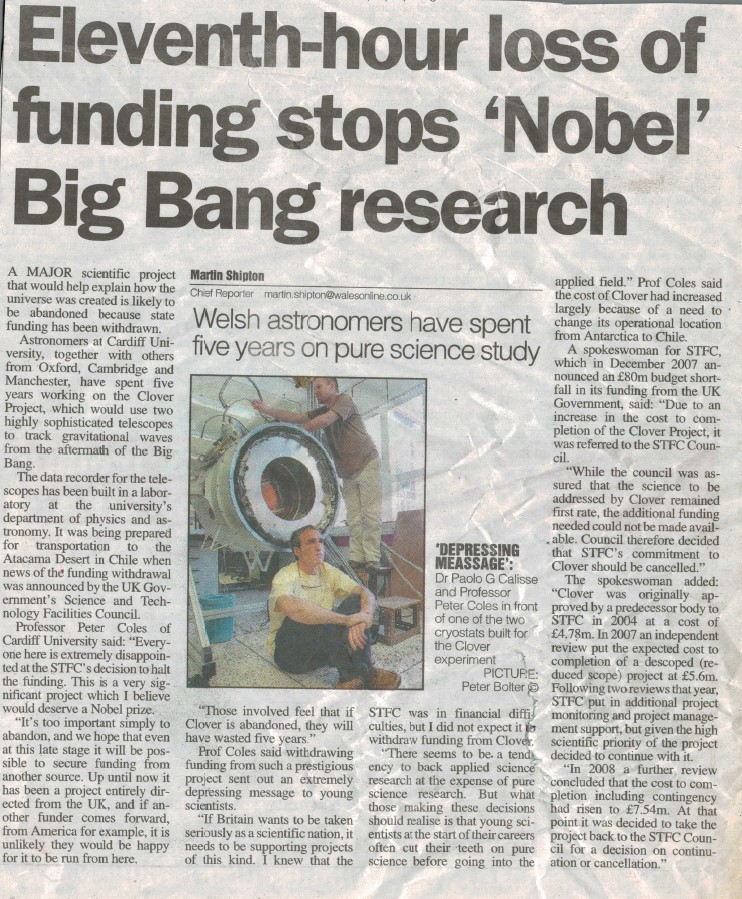
Sorry it’s a bit crumpled, but I guess that demonstrates the authenticity of its provenance.
The full story, as it appeared in the print edition of the Western Mail, can also be found online here. By the way it’s me on the stepladder, pretending to know something about astronomical instrumentation.
I wrote at some length about the background to the cancellation of the Clover experiment here. In a nutshell, however, Clover involved the Universities of Cardiff, Oxford, Cambridge and Manchester and was designed to detect the primordial B-mode signal from its vantage point in Chile. The chance to get involved in a high-profile cosmological experiment was one of the reasons I moved to Cardiff from Nottingham almost a decade ago, and I was looking forward to seeing the data arriving for analysis. Although I’m primarily a theorist, I have some experience in advanced statistical methods that might have been useful in analysing the output. It would have been fun blogging about it too.
Unfortunately, however, none of that happened. Because of its budget crisis, and despite the fact that it had already spent a large amount (£4.5M) on Clover, the Science and Technology Facilities Council (STFC) decided to withdraw the funding needed to complete it (£2.5M) and cancel the experiment. I was very disappointed, but that’s nothing compared to Paolo (shown in the picture) who lost his job as a result of the decision and took his considerable skills and knowledge abroad.
We will never know for sure, but if Clover had gone ahead it might well have detected the same signal found five years later by BICEP2, which was announced in 2014. Working at three different frequencies (95, 150 and 225GHz) Clover would have had a better capability than BICEP2 in distinguishing the primordial signal from contamination from Galactic dust emission (which, as we now know, is the dominant contribution to the BICEP2 result; see thread here), although that still wouldn’t have been easy because of sensitivity issues. As it turned out, the BICEP2 signal turned out to be a false alarm so, looking on the bright side, perhaps at least the members of the Clover team avoided making fools of themselves on TV!
P.S. Note also that I moved to Cardiff in mid-2007, so I had not spent 5 years working on the Clover project by the time it was cancelled as discussed in the newspaper article, but many of my Cardiff colleagues had.
Follow @telescoperTom Lehrer at 90!
Posted in mathematics, Music with tags Tom Lehrer, We will all go together when we go on April 9, 2018 by telescoperI was reminded this weekend that today (9th April 2018) is the 90th birthday of American musician, singer-songwriter, satirist, and mathematician Tom Lehrer. Although he has retired from theatres of both musical and lecture variety, his songs (and especially the one I’ve selected) remains topical to this day. I’m about to retreat into a bunker to finish marking a batch of coursework so please enjoy the following short tribute and wish Tom Lehrer a very happy 90th birthday!
Follow @telescoperMetrics for `Academic Reputation’
Posted in Bad Statistics, Science Politics with tags citations, PageRank, Science, Science Politics on April 9, 2018 by telescoperThis weekend I came across a provocative paper on the arXiv with the title Measuring the academic reputation through citation records via PageRank. Here is the abstract:
The objective assessment of the prestige of an academic institution is a difficult and hotly debated task. In the last few years, different types of University Rankings have been proposed to quantify the excellence of different research institutions in the world. Albeit met with criticism in some cases, the relevance of university rankings is being increasingly acknowledged: indeed, rankings are having a major impact on the design of research policies, both at the institutional and governmental level. Yet, the debate on what rankings are exactly measuring is enduring. Here, we address the issue by measuring a quantitative and reliable proxy of the academic reputation of a given institution and by evaluating its correlation with different university rankings. Specifically, we study citation patterns among universities in five different Web of Science Subject Categories and use the PageRank algorithm on the five resulting citation networks. The rationale behind our work is that scientific citations are driven by the reputation of the reference so that the PageRank algorithm is expected to yield a rank which reflects the reputation of an academic institution in a specific field. Our results allow to quantifying the prestige of a set of institutions in a certain research field based only on hard bibliometric data. Given the volume of the data analysed, our findings are statistically robust and less prone to bias, at odds with ad hoc surveys often employed by ranking bodies in order to attain similar results. Because our findings are found to correlate extremely well with the ARWU Subject rankings, the approach we propose in our paper may open the door to new, Academic Ranking methodologies that go beyond current methods by reconciling the qualitative evaluation of Academic Prestige with its quantitative measurements via publication impact.
(The link to the description of the PageRank algorithm was added by me; I also corrected a few spelling mistakes in the abstract). You can find the full paper here (PDF).
For what it’s worth, I think the paper contains some interesting ideas (e.g. treating citations as a `tree’ rather than a simple `list’) but the authors make some assumptions that I find deeply questionable (e.g. that being cited among a short reference listed is somehow of higher value than in a long list). The danger is that using such information in a metric could form an incentive to further bad behaviour (such as citation cartels).
I have blogged quite a few times about the uses and abuses of citations (see tag here) , and I won’t rehearse these arguments here. I will say, however, that I do agree with the idea of sharing citations among the authors of the paper rather than giving each and every author credit for the total. Many astronomers disagree with this point of view, but surely it is perverse to argue that the 100th author of a paper with 51 citations deserves more credit than the sole author of paper with 49?
Above all, though, the problem with constructing a metric for `Academic Reputation’ is that the concept is so difficult to define in the first place…
Follow @telescoper
 In the Dark